Category Archives: Historical Links / Pre-Independence

On the street where you live

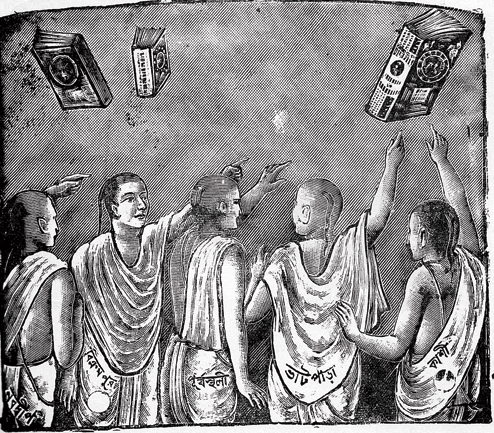
An advertisement in the PM Bagchi Directory Panjika proclaiming its superiority to other almanacs as pundits of all centres of learning depended on it

The last entry of the Calcutta Street Directory of 1915 published by P.M. Bagchi & Company Private Limited is on Halliday Street named after Sir Frederick James Halliday, KCB, the first lieutenant governor of Bengal (1854-1859).

The street was swept aside when the Calcutta Improvement Trust (set up in 1911) began the construction of Central Avenue, later renamed Chittaranjan Avenue. What only remains of this street is Motilal Seal’s Free College, whose headmaster in 1915 was Jagabandhu Ghosh, BA, according to the “directory”. This entry provides the names and sometimes the professions of the residents of each building on this thoroughfare, as it does in the case of all the other streets and lanes of the city of Calcutta listed in the “directory”. Its function, as scholar Gautam Bhadra pointed out at the launch of the tremendously value-added version of the original last Wednesday, was to “direct”.

Originally an appendage of the almanac or panjika published by P.M. Bagchi, the street directory in Bengali, unlike Thacker Spink & Company’s older one in English of mostly “white” neighbourhoods, covers the “native” areas too, and is part of the urban ethos, said Bhadra.

However, he pointed out that the first such “directory” was Bhabanicharan Bandyopadhyay’s satire published in 1823 titled Kolikata Kamalalaya where city slickers point out to country bumpkins the city landmarks. Marketing Bengali almanacs was a highly competitive business, and P.M. Bagchi had undertaken this huge survey of the city. Playwright and humorist Amritalal Basu had written in Kautuk Jautuk that sadly, Bengalis were losing their hold over Calcutta. But Basu was wrong, said Bhadra, for the city never belonged to Bengalis alone. This street directory presents a layered and complete picture of those living in the city. He congratulated Jayanta Bagchi, grandson of Kishorimohan Bagchi and current director of the firm, for bringing back to life this century-old street directory, adding valuable material to it. The book carries a wealth of old advertisements which indicate prevailing popular tastes.

“Current histories on Calcutta are sterile and irrelevant,” said scholar Sukanta Chaudhuri, on the occasion. There is hardly any material on the city’s growth and development, its present and future and public utilities. However, this street directory, unlike websites, telephone directories and Yellow Pages, presented a total picture.

Scholar Samik Bandyopadhyay, who is one of the two editors of the street directory, said when one goes through the book one gets a clear idea of community building. It initially projects a macro history, and a micro history thereafter.

The other editor, urban historian Debasis Bose, has written the preface which presents a history of P.M. Bagchi and that of other such directories. He traced the rag-to-riches story of the entrepreneur, Kishorimohan Bagchi, who had established the firm in 1888 and became a resident of Masjidbari Street in Darjipara, where he specialised in making rubber stamps, stamp pads, various kinds of inks, syrups, glue and toiletries.

The brand was so much in demand, fakes swamped the market. So he got the inimitable labels printed in Germany. Kishorimohan named the firm after his father, Peary Mohan, who had once disowned him for he feared his son would turn out to be a loser.

In mid-19th century, people could not think of beginning the day without consulting an almanac or panjika. But to give his products a cachet, Kishorimohan imported two printing presses from England. Besides churning out typical Battala fare, he also brought out Harisadhan Mulhopadhyay’s popular history of Calcutta in novel form titled Kolikata Ekaler O Sekaler. Kishorimohan died at the age of 55 in 1923.

During the days of the East India Company, the pundits of Bhatpara, Nabadwip and other centres of learning, on an invitation from Maharaja Krishnachandra, put their heads together and standardised the dates of all festivals. Almanacs began to be printed probably at the beginning of the 19th century. To make them even more popular, invaluable information on postal and legal fees and suchlike, began to be added as these tomes became weightier. Thacker Spink’s almanac dominated the scene for 80 years.

Among Bengalis, Ramanath Das was the first to publish an almanac with a treasure trove of information needed all the time. When Kishorimohan first published the street directory priced at one and half rupee (against Rs 24 for the Thacker Spink one), a review read: “A Bengali Directory with a Bengali Almanac on the model of Messrs Thacker, Spink and Co’s work on the same line. This is perhaps the first attempt of its kind that has been made by a native of Bengal.”

But Kishorimohan did not ape the English. His team of field workers fanned out all over the city to gather information and nothing was untouchable for them. Even the names of the denizens of Sonagachhi and other red-light areas are mentioned here. Sadly we have no inkling about the identity of these field workers.

In those days, when there was no compulsion for being politically-correct, there was no reason for concealing regional chauvinism, and derisive nicknames for settlers from our neighbouring states in eastern India were freely used. Many neighbourhoods were named after the caste which perhaps dominated that area. Take for instance Chasha Dhobapara (now Girish Park north) from No. 146 Baranasi Ghosh Street. It was intersected by Brahmanpara Lane. Nothing escaped the attention of those who did the field work – thus vacant plots, ponds, slums…everything was indicated along with the address.

There are interesting nuggets on the history of Calcutta. There are several entries on the Banaji family, the first Parsi family to settle down in Calcutta – Parsi Church Street, where Rustomji Cowasjee Banaji established the first fire temple of the city in 1839, Parsibagan Lane near Maniktala, Parsibagan Street. Falgun Das Lane, which intersects Sankharitolla Street, was named after a man from Odisha who made a fortune by supplying coolies to ships.

What we know as Loudon Street was actually Loudoun. The wife of Lord Hastings was in her own right the Countess of Loudoun. The “u” was dropped at some point of time. An entry recounts how electric lights were introduced in the Kalighat temple (Kalighat First Lane). At No. 15 Gobinda Sarkar Lane near Banchharam Akrur Lane was a Philharmonic Orchestra, and a Bengali circus company belonging to Nabagopal Mitra operated from Canal West Road. Asutosh Mukherjee’s slum at 1-6 Kankulia Road included paddy fields, and the man owned other properties on the road. Was this Mukherjee our ” Banglar Bagh”

source: http://www.telegraphindia.com / The Telegraph, Calcutta,India / Front Page> Calcutta> Story / by Soumitra Das / Friday – September 04th, 2015
The chequered history of Kolkata’s banks

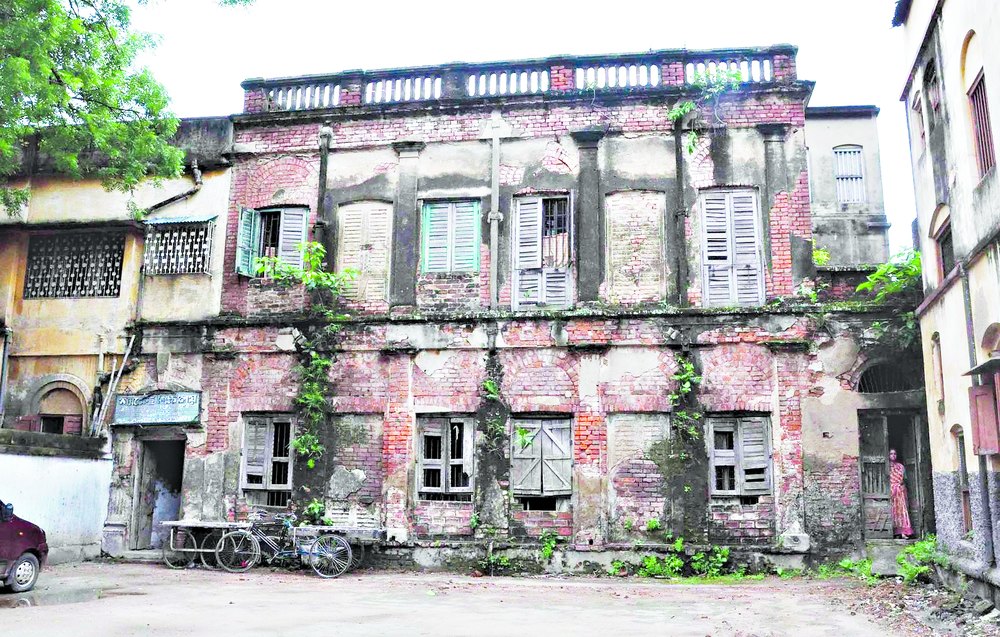
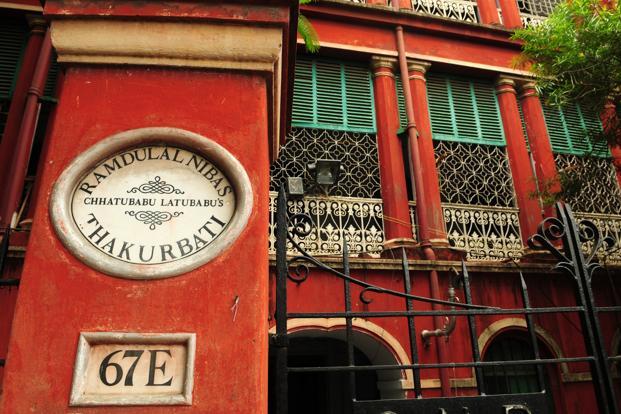
The ancestral home of Asutosh and Pramatha Nath, sons of the legendary Ramadulal De. Photo: Indranil Bhoumik/Mint

In the 20th century alone, hundreds of banks went belly up in the city, leaving many landed families in ruin

Photographs by Indranil Bhoumik.

It is historically documented that one Ramdulal De (1752-1825) rose from penury to become one of Kolkata’s wealthiest businessmen ever by wagering on the wreck of a ship.

As a manager in a shipping company, De was a man of modest means when he bid an astounding Rs14,000 to snap up a sunken ship. Within hours, he managed to sell it to a European with better knowledge of its cargo for almost Rs1 lakh.

No one knows what happened to the European who bought the ship, but De never looked back.

The more recent emergence of Chandra Shekhar Ghosh as an entrepreneur is equally fascinating.

Even in the early 2000s, he was travelling by public transport into the interiors of West Bengal and neighbouring states to stabilize the operations of a fledgling microfinance institution.

In only 15 years, Ghosh’s Bandhan Financial Services Pvt. Ltd is turning itself into a bank with bruised and battered Bengali pride riding on it for redemption.

West Bengal has a chequered history in banking. It was in Kolkata—then Calcutta—where the first deposit-taking bank was founded in the early 1770s.

Alexander and Co.—a British managing agency, or a diversified conglomerate—launched Bank of Hindostan in partnership with local moneylenders, or indigenous bankers called shroffs or banians in those days.

De was at that time one of the leading banians.

Many more banks were launched in the late 18th century, but all of them collapsed within 50-60 years. The reason? Speculation and overtrading by their founders. Bank of Hindostan survived three runs, but eventually went under in 1832 along with its founder Alexander and Co.

In 1806, Bank of Calcutta—one of the forebears of today’s State Bank of India—was established by a government charter. But because it was risk-averse and wouldn’t lend for more than three months, local businessmen—both British and Indian—continued to launch private banks.

The result was the same—more bank failures. The most storied failure was that of Union Bank Ltd (1829-48), founded by illustrious Bengalis such as prince Dwarkanath Tagore (poet Rabindranath Tagore’s grandfather) in partnership with British companies.

When it collapsed, De’s sons Asutosh and Pramatha Nath had to pick up the tab for its bankruptcy. Whereas their father remained a banian, they had become shareholders of Union Bank.

According to some historians, Bengalis turned to safe-haven investments such as real estate following the collapse of Union Bank. Property prices zoomed.

Described by many historians as reckless destroyers of wealth, Bengalis returned to banking again in the early 20th century, ostensibly with the noble purpose of backing Indian businessmen to compete against the British.

These ventures were even more short-lived. Some wound up within years.

Between the early 1940s and the mid-1960s, West Bengal had gained unparalleled notoriety in bank failures, and former SBI chairman D.N. Ghosh blames it on greed, corruption and lack of regulation.

In the 20th century alone, hundreds of banks went belly up in Kolkata, leaving many landed families in ruin.

The state’s inglorious past has weighed on the minds of regulators, according to D.N. Ghosh.

Bandhan is a break from the past. It has earned the regulator’s confidence, and its conservative and risk-averse founder, Chandra Shekhar Ghosh, is the Bengali community’s best bet for redemption.

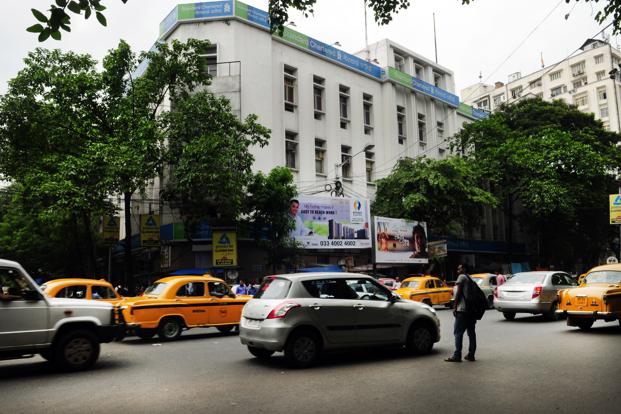
The headquarters of the erstwhile Calcutta City Banking Corp., founded in 1863. Among its founders was Durga Charan Law, a wealthy banker and banian.

source: http://www.mintonsunday.livemint.com / Mint On Sunday / Home> Photo Essay / by Aniek Paul / Sunday – August 23rd, 2015

Heritage tag on Bankim house

Bankim’s house at Panchanantala Road. Picture by Anup Bhattacharya

The house where Bankim Chandra Chattopadhyay lived during his stint as deputy magistrate and deputy collector of Howrah has been declared a heritage building.

The 17-cottah park adjoining the house at 218 Panchanantala Road – called Bankim Park – has been included in the Howrah Municipal Corporation’s “demand register” for development grants.

Bankim Chandra, who wrote the national song Vande Mataram, had worked and lived in Howrah between 1881 and 1886.

“We have granted heritage status to 218 Panchanantala Road. The park adjoining the house will also be developed and a grant of Rs 5 crore has been sanctioned for the project. An archive on Bankim Chandra along with a library and other facilities will be set up,” said mayor Rathin Chakraborti.

A bronze statue of the litterateur and administrator will adorn the park while the heritage structure will house a conference hall, a guesthouse and the proposed archive.

At the beginning of his first stint as an administrator in Howrah in 1881, Bankim Chandra would travel from his Calcutta home to his workplace every morning. He later decided to shift to the rented house at 218 Panchanantala Road.

Bankim Chandra lived in the same house during his second stint in Howrah from 1883. He wrote Muchiram Gurer Jibancharit while living in Howrah.

source: http://www.telegraphindia.com / The Telegraph, Calcutta,India / Front Page> Calcutta> Story / by Dalia Mukherjee / Saturday – August 01st, 2015

Darjeeling hotel to be pulled down – Housing complex and hotel to come up

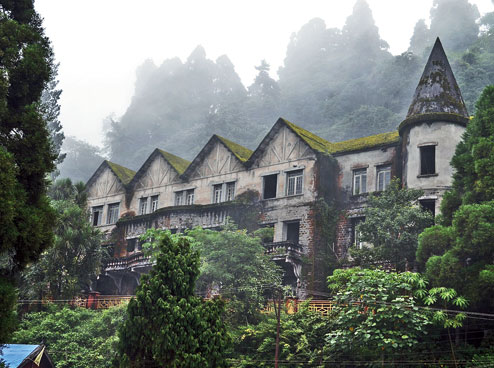
Mount Everest Hotel in Darjeeling. Picture by Suman Tamang

Hotel Mount Everest that in its hey day had hosted Mohammed Ali Jinnah and Amitabh Bachchan will soon be dismantled and a housing complex and a new hotel will come up in its place.

East India Hotels (EIH) Limited, which owns the Oberoi and Trident brand of hotels, has announced that it has sold the property to a consortium of businessmen led by B.M. Garg, a Darjeeling-based multiplex owner, for Rs 11 crore.

Today, Garg said: “The property has been bought by a consortium of businessmen. We plan to dismantle the hotel as it is a 100-year-old structure. The property was ravaged by fire and it has been closed for 30 years now.”

Garg said they had not yet finalised the details of the housing complex and the hotel that would come up.

“We have not yet given any name to our business consortium or to the project. We will soon hire an architect to work out the details of the housing complex — given its demand in Darjeeling — and a high-end modern hotel.
We plan to start work after the winter.”

The land on which the hotel stands now and two residential buildings near it — Rutland House and Newstead House — were owned by Darjeeling resident Nemy Chandra Bose.

The property, which stands on a plot measuring around 5 acres, is along Gandhi Road.The stretch was earlier known as Auckland Road.

It is hardly a kilometre away from Chowrasta and is close to the Circuit House.

Bose leased out the property to Arathon Stephen for 99 years, which was to end on December 31, 2013.

Stephen turned the property into a hotel and named it Hotel Mount Everest.

In 1925, Stephen transferred the hotel to Everest Hotels Limited.

In 1963, it was transferred to a firm called Hotel 1938 Private Limited.

In September 9, 1968, the property was transferred to East India Hotels Limited.

According to author Sanjay Biswas, who wrote the book Pahar Theke Hariye Jaowa Padachinhaguli, Jinnah had stayed at Hotel Mount Everest in 1917.

Actors like Dev Anand, Raj Kapoor, Sunil Dutt, Rajesh Khanna and Rekha had also stayed at the hotel.

Suresh Periwal, the owner of Clubside Tours and Travel, the oldest travel agency in Darjeeling that was set up in 1948, said: “It is sad that an international chain of hotels is leaving Darjeeling. Their presence in Darjeeling would have meant lot of publicity for the place.”

Periwal was one of the first residents of Darjeeling to hold his marriage reception at Hotel Mount Everest.

“The hotel was devastated by a fire on October 19, 1978, and my marriage was on November 22, 1978. The hotel authorities ensured that the reception was held there. They closed down a section of the hotel with 30 rooms and opened the remaining 40 rooms for the marriage,” Periwal said.

Hotel Mount Everest was finally shut in June 1984.

Periwal said in 1969, a double room in the hotel would cost Rs 115 a day, while a single room came for Rs 85.

Today, Garg said they were hopeful that they would be able to start the construction soon.

Asked if the land mutation was under the name of EIH Limited, he said: “As of now, no. But we are confident that all issues would be resolved soon.”

source: http://www.telegraphindia.com / The Telegraph, Calcutta,India / Front Page> North Bengal > Story / by Vivek Chhetri / Friday – August 07th, 2015

Kolkata forgets Job Charnock on 325th year of his landing

Kolkata :

Two red wild flowers were what the city had on offer for Job Charnock on Monday, the day that marked the 325th birth anniversary of his landing in Kolkata.

Nobody knows who the kind-hearted soul was who made it a point to pay homage to the founder of the city (though the high court had quashed the claim in 2003), but unknowingly he turned out to be an exception in a city that has forgotten the day for good.

Till 2003, Charnock was considered as the founder of Kolkata. Programmes were organized at the grave to mark the historic landing, which was even considered as the birthday of Kolkata. In 1990, the tercentenary of the city was celebrated on this day with global fanfare. But post the court order, the celebrations turned muted and headed for a slow death. And on Monday, Charnock’s grave inside St John’s Church near Dalhousie Square lay as non-descript as it has been lying for years now.

The grave is certainly older than the church since Charnock died in 1692, two years after he had landed on the eastern bank of Hooghly and discovered a cluster of prosperous villages that he thought would help him set up trade for the British East India Company. It’s another matter that other European traders had already set foot in different parts of what is now known as the Hooghly district, but there is no denying that this chance decision by Charnock was to change the fate of Kolkata and the entire country.

“Despite the controversy, there is no denying the importance of the day. Had he not done that, Plassey would not have happened in 1757 and the entire history of India would have been different. The day should definitely be specially remembered,” said historian Arun Bandopadhyay, president of the Society for Preservation of Calcutta that was set up by historian Nisith Ranjan Ray. Ray, along with historian Barun De, was among those who had argued the case in favour of Charnock in 2003.

St John’s Church, too, is sad with the neglect. “Apart from maintaining the grave as a heritage structure, what else can we do? The day has a great symbolic importance and the city should come forward to observe it. The structures with which we identify the city were mostly built by the British, can we deny that? Would all this have happened had Job Charnock landed somewhere else?” said priest of the church, Pradip Nanda.

Mayor Sovan Chatterjee agreed that the KMC did not do anything to commemorate the day. “Actually there is a controversy related to whether the day is actually the city’s birthday since the court has quashed that claim, but yes, Job Charnock can be certainly celebrated for his contribution and we will collaborate with St John’s Church from next year,” Chatterjee promised.

source: http://www.timesofindia.indiatimes.com / The Times of India / News Home> City> Kolkata / by Jhimli Mukherjee Pandey, TNN / August 25th, 2017

Taste of Jains from Murshidabad comes to city

Kolkata :

Sheherwali cuisine, unique to Jains who had settled in Murshidabad around 400 years ago, is on the cusp of becoming ‘endangered’.

Evolved from a confluence of multiple cuisines, it is still the mainstay in the Sheherwali households of Kolkata. But with community now experiencing reverse migration and the young ones moving to other cities, a shadow has been cast over the cuisine’s survival.

“The Sheherwalis are famous for their gastronomic preferences. The meals are always served in courses. The food that is to be consumed is cooked daily. The dishes served at lunch are distinct from those served at dinner with summer and winter variances as well. The tradition was kept alive for centuries by the close-knit community. But, this is gradually disintegrating with inter-community marriage becoming inevitable and their daughters landing up in Marwari, Gujarati or Punjabi Jain kitchens. Also unlike our generation, when men were primarily in business and women homemakers, today’s educated youths are professionals. Many of them migrate to other cities and even abroad. They have neither the time nor the inclination to pursue the fine art of cooking Sheherwali dishes,” said Sumitra Jhunjhunwala, a member of the Sheherwali community.

In the years to come, it will be a challenge to keep authentic dishes, like Kachhe Kela Ke Chop, Kumra ka Murabba, Saloni Mewa ke Khichdi and Kachha Aam ke Kheer, alive. Already, Mirchi ka Achaar and Kaathbel Pachak are no longer made in the Sheherwali homes in Kolkata. These are instead procured from a family in Murshidabad’s Azimganj.

A cook booklet containing Anita Dugar’s favourite dishes that her children Sujata and Priyankar had compiled after her death has recently become much sought afterwith many Sheherwali families keen to send it to their children living away hoping that they would at least try out some of the recipes to learn the art. Mindful of the threat, the Sheherwalis in Kolkata are trying to retain the tradition to the best of their ability.

Businessman Tushar Singhi, who takes much interest and pride in the cuisine, said the community patronized special cooks who prepared Sheherwali food and sweets at marriages and other community events. “Even in the community, there are some who are catering from home to keep others rooted to the taste and affinity for the cuisine,” he said.

Though there is no Sheherwali restaurant in Kolkata yet, Singhi and others are well aware that the fine essence of Sheherwali cuisine needs to travel beyond their kitchens so that others get to taste it as well. Hence, when ITC Hotels approached Murshidabad Heritage Development Society to showcase Sheherwali cuisine, the community was delighted.

“In its endeavor to enable Indian cuisine its rightful place in the global culinary scape, ITC Hotels accords special emphasis on showcasing regional Indian cuisines while presenting global dining concepts, perfected on Indian soil. This initiative under the aegis of Kitchens of India will showcase Indian’s wealth of unique, undiscovered, royal and forgotten cuisines. Sheherwali is the first of the series. Sheherwali cuisine is a vegetarians paradise, in which Bengali meets Rajasthani, Afghan, Mughal, Awadhi and even several European culinary practices, making it a unique mix of ingredients and flavors that tantalizes the palate,” said ITC Sonar master chef Mayank Kulshreshtha. The cuisine will be on offer at Eden Pavilion in ITC Sonar from August 25 to 30 as part of dinner buffet.

source: http://www.timesofindia.indiatimes.com / The Times of India / News Home> City> Kolkata / by Subhro Niyogi, TNN / August 24th, 2015

Devdas: A classic is back home

India succeeds in obtaining rare original print of talkie version of ‘Devdas’

In a priceless acquisition, the National Film Archive of India (NFAI), after decades of negotiation, has finally succeeding in obtaining a rare original print of the country’s first talkie version of Sarat Chandra Chattopadhyay classic novella, Devdas, from the Bangladesh government on Monday.

The 1935 version was filmed in Bengali and was directed by the legendary Pramathesh Barua, who cast himself in the title role of the doomed, narcissistic lover. Mr. Barua’s film was a blistering critique of Indian feudal mores and customs.

Such was Mr. Barua’s passion for the literary classic that he remade it twice, helming it in Hindi in 1936 with iconic singer K.L. Saigal in the role of Devdas and in 1937 again in Assamese, with the renowned theatre actor-playwright Phani Sarma in the titular role.

All Indian prints of this version were lost decades ago in a fire that destroyed the Kolkata-based New Theatres, which produced this film.

A severely mangled copy of the film, the only one, was traced by the NFAI to the Bangladeshi Film archives in the 1970s.

A Bangladeshi delegation led by Ministry of Information Secretary Martuza Ahmad met with NFAI Director Prakash Magdum and handed over the print of the film.

source: http://www.thehindu.com / The Hindu / Home> Cities> Kolkata / by Shoumojit Banerjee / Pune – August 18th, 2015

Diplomat seeks revival of French connection of Chandernagore

Kolkata :

Outgoing French Consul-General in Kolkata Fabrice Etienne, whose second innings in the city comes to an end this month, celebrates the cultural bond that links the city with Paris, but bemoans the fading French connection with Chandernagore.

Q. Your first posting was in this very city 20 monsoons ago. What was your first impression back then?

A. I was first impressed by the excessive sides of Calcutta — too many people, too many cars, too much noise, too much heat, too much rain. The old, and often decayed, colonial buildings of central Calcutta and what remained of the palaces of north Calcutta left its mark. I had the feeling I had been transported to a place rich with a thousand stories.

Q. Cut to 2015, how much has the city changed in your eyes?

When I first returned to Kolkata in 2004, I was pleasantly surprised — the streets were cleaner, some shopping malls had come up, some flyovers were built, some old buildings renovated and repainted that gave the city a more modern look. In 2012, this impression was confirmed and yet at the same time, I felt the very soul of Kolkata was still very much there, and the soul of Kolkata, is its people and the great culture they carry within them.

Q. Do you have any bitter memories during your stay here?

A. Road accidents that have struck my Bengali friends. Nothing really has been done to improve the road conditions in India—it is not only a Kolkata issue—and reduce the number of fatalities. This bothers me to no end, especially because the social and economic gains are directly related to a fluid traffic flow. It is true for environment protection. And of course, I do feel a little bitter about the lack of any concrete fruition of the projects earmarked in my tenure between France and Bengal.

Q. What has been your impression on the former French colonies of Chandernagare. Do you think the preservation work is satisfactory? If not, what are your suggestions?

A. As a Frenchman, I am of course much attached to the remnants of our past in this former trading outpost. The banks of the Hooghly are very nice and I feel something from the French “art de vivre” (art of living) each time I go there. I sadly do not see any serious preservation work done there, and it is even sadder when you think about the huge tourism potential of this area. Every 10 years or so, the government shows an intention to develop cultural tourism here by improving connectivity, renovating heritage building, promoting this unique destination. Nothing takes place afterwards. A few years ago, the French embassy commissioned an inventory of the French heritage building in Chandernagore to Indian architect Aishwarya Tipnis. Of the 100 building she listed, many have been destroyed. Tipnis, with the support of French NGO Vieilles Maisons Francaises is digitalizing the database.

Q. During a meeting with the CM, you expressed France’s interest in investing in Bengal. What’s the progress?

A. I cannot speak on behalf of the many French companies in India. It is true certain companies did not consider Bengal as the best possible place to invest in their fields. The ABG-LDA case in Haldia did not contribute towards sending the right signals back home. Fortunately, there are some success stories: The Accor group opened its first hotel, Novotel, a few months ago and plans to open other hotels in near future; Decathlon (sport equipment) will open stores here in the next few months.

Q. What in your opinion has been your greatest achievement as Consul-General?

As Consul General, that France is back in Kolkata and now active in a wide range of subjects of bilateral interests — culture thanks to Alliance Francaise du Bengale, students exchanges thanks to Campus France, tourism thanks to a very effective visa section that processes all applications for Indian tourists within 48 hours, science — and many others areas of mutual interests and cooperation building blocks laid down in the past few years.

Nothing really has been done to improve the road conditions in India… The same is true for environment protection. I do feel a little bitter about the lack of any concrete fruition of the projects earmarked during my tenure between France and Bengal

source: http://www.timesofindia.indiatimes.com / The Times of India / News Home> City> Kolkata / by Showmak Ghosal, TNN / August 20th, 2015

Bankim house heritage tagging begins

Kolkata :

Finally, the Mamata Banerjee government has initiated the process of bestowing heritage tag to the house where Vande Mataram creator Bankim Chandra Chattopadhyay lived during his stints as deputy magistrate and deputy collector. The house is in ruins and desperately needs restoration. Even as Howrah Municipal Corporation (HMC) has sanctioned Rs 5 crore for it, but work can’t be started unless the building is included in the heritage list.

Ten years ago, the house-owner, Pranab Mukherjee, sold the house to a developer. Just then, locals and an NGO, Howrah Citizen’s Forum, put up stiff resistance and stalled demolition of the property.

On Tuesday, at the behest of the chief minister, a Heritage Commission team visited the premises to start the tagging process. Basudeb Malik, OSD, heritage commission, told TOI, “Although the house doesn’t have much architectural significance, it is associated with a great man. It must be protected from falling apart, at any cost. We are looking for substantial records to prove that the creator of Anandamath had lived here.”

Chattopadhyay wrote the iconic novel became synonymous with the struggle for Independence and banned by the British. The song, Vande Mataram, originally a Sanskrit stotra personifying India as Mother Goddess, was first published in this novel. Bipin Chandra Pal named his patriotic journal after Vande Mataram in August 1906. Lala Lajpat Rai also published a journal of the same name. Chattopadhyay is also regarded as a proponent of Bengal’s literary renaissance for his versatile writing.

Efforts have been on to have Chattopadhyay’s stay in Howrah (between 1881 and 1886) officially recognized and commemorated. But confusion has been prevailing over his residences at 218 Panchnantala Road (about 2 km off Howrah Station) and 212 Panchanatala Road, in the same locality.

Pranab Mukherjee (63), who lives on the first floor of 218 Panchantala Road, that threatens to fall apart any day, said, “We had no idea that the building was associated with Bankim Chandra. If the state government wants to take it over, me and my brother and sister who co-own the house, should be compensated.” Chunks of concrete keep peeling off the house, forcing the other two Mukherjee siblings, Prodyut and Protima, to move out. In 1964, they had bought it from one Jaladhar Mitra, who, in turn, had bought it in 1936. Locals have turned the 17-cottah land in front of the house at 218 Panchanantala Road into a park and named after the litterateur. Mukherjee alleged, “The land was part of the same property, but the local club has encroached it.”

Howrah mayor Rathin Chakraborti said, “We have sanctioned Rs 5 crore for the restoration. Now we are waiting for the government to announce the heritage staus.”

Howrah Citizen’s Forum coordinator N Sarkar said, “During his first stint as an administrator in Howrah in 1881, Bankim Chandra would travel from Kolkata to his workplace. He later shifted to the rented house at 218 Panchanatala Road, and lived there during his second stint in Howrah in 1883. This tenure was his longest among the three.” For the third time, Bankim joined as first class deputy magistrate and deputy collector after being transferred from Bhadrak in Odisha on July 10, 1886. He travelled to Howrah every day but had not vacated the rented house at Panchanantala.

source: http://www.timesofindia.indiatimes.com / The Times of India / News Home> City> Kolkata / by Ajanta Chakraborty & Rupak Banerjee, TNN / August 15th, 2015

Food for friendship on freedom day

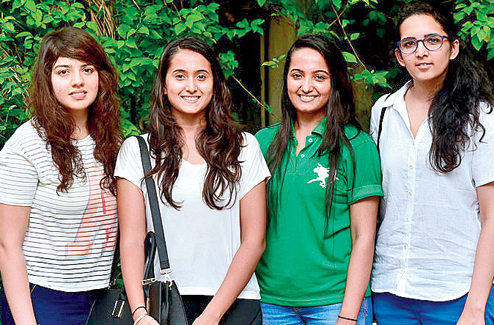
(From left) Isha Kapoor, Aishwarya Jena, Pragya Jena and Ankita Dokania. Picture by Anindya Shankar Ray

Two nations. Seven-hundred-and-fifty volunteers. One lakh food packets for the hungry and homeless.

An army of students and young professionals from across India, including 50 from Calcutta, will distribute food in slums of India and Pakistan on August 14-15 in a unique Independence Day initiative aimed at spreading a message of peace and friendship.

The city chapter of the Robin Hood Army, as they call themselves, is led by Ankita Dokania, a fashion designer, and Chitvan Jaipuria, a wedding and event planner. Also part of the group is Green Oscar winner Ashwika Kapur. “I have been part of the army since its inception. I always do my bit to spread the word when I am not in the jungles,” she said.

It all began in August 2014 with Neel Ghose, a city boy who works with Zomato in Delhi, teaming up with colleague Anand Sinha to form the Robin Hood Army in Delhi. “We procured excess food from restaurants to distribute among the poor. It’s been fulfilling,” said Neel over the phone from Delhi.

The army now operates in 12 cities, including Calcutta, Delhi, Hyderabad and Mumbai. The city chapter was born in October 2014 with five of Neel’s friends. Today, there are 50 members and several more volunteers.

In February this year, Neel got in touch with a Pakistani friend who helped form the Lahore and Karachi chapters of the army. Thus was born the idea of commemorating Independence Day. The Calcutta army plans to distribute over 4,000 food packets among slum dwellers in the Kidderpore, Gariahat, Southern Avenue, Park Circus and other areas.

Isha Kapoor, a third-year student of JD Birla College, joined the movement three months ago. “For I-Day I have mobilised my friends to distribute food in their neighbourhoods,” she said. Aishwarya Jena, a third-year student of microbiology at St. Xavier’s College, has been marshalling forces, too.

Pragya Jena, an entrepreneur, remembers a boy who refused to take a packet of khichdi because he wanted another one for his dog. “Such life’s lessons are precious,” she said.

The movement has garnered corporate support. “We hope to involve more people. But for now we want to make people smile on both sides of the border,” Ankita said.

source: http://www.telegraphindia.com / The Telegraph, Calcutta,India / Front Page> Calcutta> Story / by Chandreyee Ghose / Friday – August 14th, 2015