Category Archives: Records, All

On a mission to save old buildings

CAL wants to go beyond heritage structures
ChaudharisKOLKATA29may2016

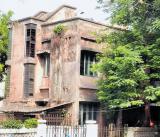
The Chaudhuris of Latu Mullick Lane in north Kolkata have unknowingly become part of a rather silent movement. Once part of Bengal’s landed gentry, they now have just this two-storeyed building left to their name. Built some time in late 19th century, the house does not offer much in terms of heritage value, given it was just the residential building of a family that had no great role in uplifting Bengal’s social or political consciousness. It is buildings like this that interests author Amit Chaudhuri.

Chaudhuri does not share any links with the said family, except a surname spelt the same way. Neither is this particular building, tucked away in a dingy lane, part of the initiative that is taking up much of his time these days. The author, however, is concerned with how the “heritage” tag is used in Kolkata. He feels somewhat disturbed that heritage only refers to buildings that had some role to play, even though the term should encompass much more than just achievements, he believes.

Once the second city of the British Empire after London, Kolkata, offers a visual feast of old houses, which stand out for remarkable architecture. These buildings represent not only an era but also stand testimony to the city’s history, giving an insight into the structural changes that influenced architecture over the years. Chaudhuri’s love for the architectural aesthetics in old buildings inspired him to launch the Calcutta Architectural Legacies (CAL), a mission to save old buildings.

It is also probably not a coincidence that the acronym spells out as CAL, the name most English-speaking Kolkatans refer to their home town by. CAL is what one would call a citizen’s initiative, with Chaudhuri bringing together a group of interested people. From conservation architect Partha Ranjan Das to G M Kapur of heritage preservation group INTACH, to activists Bonani and Pradeep Kakkar, ad guru Ram Ray and even Nobel laureate Amartya Sen, they will all pull in their ideas to help conserve buildings that have not found place on state’s heritage list.

Although CAL was formally launched in February, Chaudhuri has been working towards this for more than a year. In an article for The Guardian in June 2015, he laid down his ideas. He pointed out that in Kolkata, a heritage building is a landmark, either because it is a “significant institutional building” or “because a famous person frequented it or lived there”. “The architectural distinctiveness of the building is a secondary concern, or is a pre-ordained, generic feature of the structure: that is, we already know it qualifies as a heritage structure because it adheres to our idea of what a heritage colonial building looks like,” he wrote.

The author went on to say that heritage for Kolkata also “…means we cease to engage with the architectural individuality and difference of buildings and precincts. We don’t periodise, falling back on catch-all terms like ‘colonial’ or historicise; or describe; or define. Simply put, ‘heritage’ means we don’t see, or think about, buildings.”

While launching CAL, he pointed out that the time has come to rethink words like “architecture” and “heritage” in order to save buildings “before these are brought down and turned into generic multi-storeyed buildings”. CAL would also attempt to move beyond heritage and take the initiative to everywhere in Kolkata.

Chaudhuri pointed out how the city developed into neighbourhoods, “para” in Bengali, which were oases of resident communities, and stressed on the need to preserve their distinct characters, before these fall prey to realtors. He is of the opinion that the heritage tag should include far more than landmarks and involve buildings, which give the city its character. He also talked about the need for residents of such buildings to come forward and join the initiative, if they are keen on preserving their individual heritage, instead of a generic sense of history.

Chaudhuri’s campaign among the urban educate class for more than a year found fruition when Kumartuli Sarbojanin Durgotsav, the Durga Puja committee at the idol-makers’ district in north Kolkata, decided to turn his efforts into the theme for its Puja offering last year.

A much-visited Durga Puja marquee, the committee celebrated its 84th year with a cause that has faced criticism from some quarters as “elitist”. Disparagement aside, artist Subal Pal persuaded the Puja committee to go with the theme.

Chaudhuri observed how a number of aesthetic old buildings are being razed to ground, making way for box-like high-rises, on the Pratapaditya Road in south Kolkata. Pal, who has been noticing similar changes in north Kolkata, felt one with Chaudhuri’s woes and etched out the theme in his Puja marquee. The artist, however, admitted that without proper conservation of these buildings, there would be no point in having the theme, at a time when such houses are getting lost across the city. “…the message needs to be sent out to people before it’s too late,” he said.

A regular visitor to Europe, he pointed out in his Guardian article how the British have managed to preserve even the most mundane, old buildings, just because of their architectural and aesthetic brilliance.

The author, who first started the campaign online and sought signatures, stated in his expression note how the old-world Kolkata is fast falling prey to the real estate mafia. While the online petition received nearly 2,000 signatures in a matter of days, Chaudhuri said, “I am an admirer of Kolkata’s neighbourhoods. Its architecture is not just confined to colonial legacy or north Kolkata-based buildings owned by landed families. But there are many interesting architectures spread across the city which were built by the educated middle-class in the past,” Chaudhuri said. This petition also drew support from Sen, who has spent years amid the heritage corridors of educational institutes in Kolkata, England and the US.

The real deal for such an initiative, however, is to get the administration’s attention, admitted those pushing the initiative. While Das talked about the apathy of Kolkata Municipal Corporation, which is in charge of refreshing the city’s ‘heritage list’, Mayor Sovan Chatterjee seemed oblivious to such concerns.

Chaudhuri noted how bodies like the West Bengal Heritage Commission, entrusted with the job of refurbishing the list from time to time seem mostly toothless. “…the list of heritage buildings should be urgently revised and various neighbourhoods should be declared heritage zones,” Chaudhuri said.

While the author asked for empowering the Commission for better functioning, Das echoed his thoughts. A former member of the commission, he submitted a proposal to introduce transfer of development rights or TDR in 2013. A successful process at Mumbai and Ahmedabad, TDR provides a residential building owner to retain it, with the developer buying the land getting to build elsewhere where new construction is not an issue. There has been no move in the direction of allowing TDR, he said.

Chaudhuri hopes that like in Europe, owner of old buildings will take up the cause themselves and fight to preserve the character of their localities. The administration, however, continues to remain aloof, even after the Nobel laureate economist wrote a letter of support to Chaudhuri, stating, “We owe to future generations a preserved and un-mutilated heritage of Calcutta’s eccentric but exciting old buildings.

source: http://www.deccanherald.com / Deccan Herald / Home> Special Features / by Drimi Chaudhuri,Kolkata / May 29th, 2016
Indian-American scientist wins Springer Theses Award

Mr. De has dedicated his PhD thesis to cricketing legend Sachin Tendulkar and his alma mater, Kolkata’s Presidency University.

An Indian-American scientist has received the prestigious Springer Theses Award in recognition for his outstanding research in which he developed transgenic mice to study a critical tumour-suppressor called A20.

Arnab De’s thesis was nominated by New York’s Columbia University. Before this, Mr. De, who has also developed peptide-based prodrugs as therapeutics for diabetes, had received the Young Investigator Award at the American Peptide Symposium.

The thesis prize is awarded by Springer, a leading global publisher of renowned scientific journals and books, to recognise outstanding PhD research.

Internationally top-ranked research institutes select their best thesis annually for publication in the book series: “Springer Theses: Recognising Outstanding PhD research”.

Additionally, winners also get a cash prize of 500 euros.

The research work was highlighted by the European Molecular Biology Organization (EMBO) Reports.

Only research considered to be of ‘fundamental relevance to a general readership’ is chosen to be highlighted by EMBO.

Mr. De has dedicated his PhD thesis to cricketing legend Sachin Tendulkar and his alma mater, Kolkata’s Presidency University.

Mr. De said: “Two things that have influenced me the most is sports and education. This thesis is dedicated to Sachin Tendulkar not only for the cricketing joy he provided me, but also for being a constant source of inspiration to all Indian youth.”

Ole John Nielsen (University of Copenhagen), who shared the 2007 Nobel peace Prize as a member of the Intergovernmental Panel on Climate Change along with US vice president Al Gore, had in 2012 described the Springer award as an “insanely great honour”.

source: http://www.thehindu.com / The Hindu / Home> International / PTI / Singapore – May 28th, 2016

Kolkata’s Indian Museum Collection Going Online With Google

IMAGE CREDIT : indianmuseumkolkata.org

Kolkata :

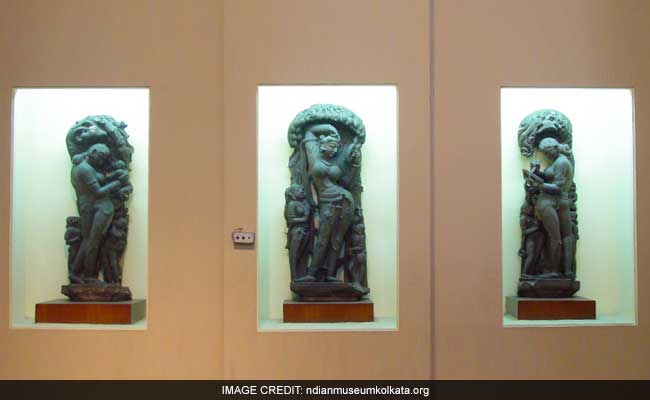
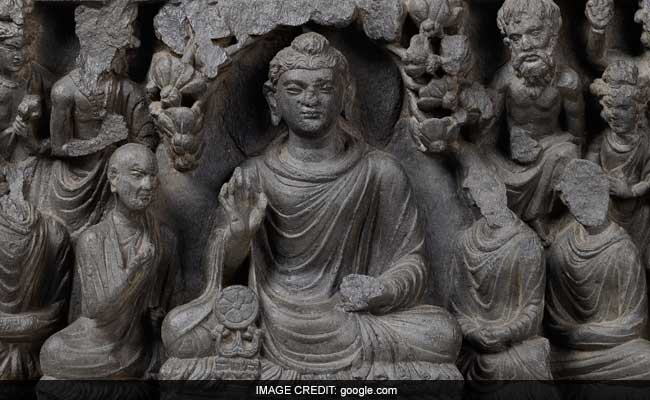
Beginning with its prized collection of Buddhist art including the famous Gandhara sculptures, the Indian Museum is now putting all of its galleries for 360- degree panoramic viewing for anyone to see online.

As part of a tie-up with the Google Cultural Institute, which allows art lovers to explore artifacts from all over the world on its website, the Indian Museum is launching an e-version of its exquisite exhibition titled Indian Buddhist Art on Wednesday.

Among the important highlights in the exhibit include a sculpture of the head of Buddha from fifth century in Sarnath which is featured even in school textbooks.

“This is the first virtual exhibition we are organising after which all our galleries will gradually be available on the Google Cultural Institute website,” museum director Jayanta Sengupta told PTI.

IMAGE CREDIT : google.com  /  Buddha' First Sermon (100-200 C.E) by unknown exhibited at Indian Musuem pubilshed on google cultural institute website.
IMAGE CREDIT : google.com / Buddha’ First Sermon (100-200 C.E) by unknown exhibited at Indian Musuem pubilshed on google cultural institute website.

Three galleries, including those on Buddhist sculptures, are ready for 360-degree panoramic viewing on the internet. “This allows anyone to have a walk through the gallery and see it as you do it with your eyes. You can scroll around to see even the ceiling and the floor,” he said.

Since last year a team of Google from the UK and the US have been working hard with their specialised and patented camera technology to click high-resolution photos of the treasures lying in the museum.

The process is taking time because the work can only be done on Mondays when the museum is closed to visitors. It is expected that all galleries will be online within a year’s time.

Over 200 years old, Indian Museum is the oldest and the largest multi-purpose museum in Asia.

The biggest repository of Indian antiquity, some of the museum’s prized possessions include an Egyptian mummy, Buddhist stupa from Bharhut, Buddha’s ashes, Ashoka pillar, fossil skeletons of pre-historic animals and a collection of meteorites.

For some of such cultural and historical treasures, the museum is also planning to have gigapixel images which will allow magnification upto a thousand times.

“If it’s a painting then you can see all intricate details like even the brush strokes. Seeing a gigapixel image is like putting the object under microscope,” Mr Sengupta said.

The musuem director rejects suggestions that once all galleries are online the number of visitors at their campus will decrease.

“Internationally this has been the case. After people see it online they are more motivated to see the real thing and so they walk into the museum,” he said.

Spread over 10,000 square feet area, it boasts of over sixty galleries of art, archeology, anthropology, geology, zoology and botany sections.

It houses rare artifacts of great archival and heritage value numbering more than a lakh.

source: http://www.ndtv.com / NDTV / Home> Sections> All India / Press Trust of India / May 24th, 2016

National Award for HA girl

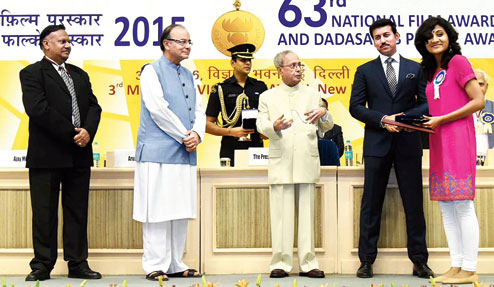
Moumita Roy on stage with President Pranab Mukherjee, Arun Jaitley and Rajyavardhan Rathore

HA Block has produced a National Award winner. Twenty-eight-year-old Moumita Roy earlier this month was awarded the National Film Award for Best Non-Feature Film Audiography for Edpa Kana, a film in the Kurukh language of Jharkhand.

“I wasn’t expecting this award. In fact, I had forgotten that the film had been sent for the National Awards,” laughs the fresh pass-out of Satyajit Ray Film and Television Institute (SRFTI). The winning film was the final year diploma project that she and three of her classmates had to make as part of their course and Moumita was handling the audiography.

“Audiography includes all the dialogues, music and sounds that we hear while watching a film. One has to get the right balance between them,” says Moumita. The director of the film was her classmate Niranjan Kujur who belongs to Jharkhand’s Oraon tribe and speaks Kurukh. The film is about a tribal boy of the Sarna faith who falls in love with a tribal girl who follows Christianity.

“Most of the film was shot in Jharkhand and the actors were Niranjan’s relatives. We were using sync sound (in which dialogues do not get dubbed over in the studio later) so mics had to be hidden in the actors’ clothing. We were shooting in the winter of 2014 and the mics kept picking up rustle of the actors’ winter garments,” recalls the HA 36 resident.

The 26-minute-long Edpa Kana has been making a mark in the festival circuit too but the National Award is the icing on the cake. “The ceremony in New Delhi was very formal. I received the award from the President and was off stage in a few seconds. There was a lot of security protocol too so I didn’t get to speak to other award recipients but I got to meet Sanjay Kurien, who won best audiography (location sound recordist) for the film Talvar.

Her parents watched the ceremony from the audience. “Our daughter. is good at everything she does,” says mother Sikha.

“I have been receiving calls and Facebook messages from relatives, neighbours and even school friends I had lost touch with,” she laughs.

She also won Rs 50,000 with which she plans to buy sound equipment. “As of now I’m working on a freelance basis in Calcutta. Let’s see what happens next,” she smiles.

source: http://www.telegraphindia.com / The Telegraph,Calcutta,India / Front Page> Salt Lake> Story / by Brinda Sarkar / Friday – May 20th, 2016

LMG two blaze Harvard trail

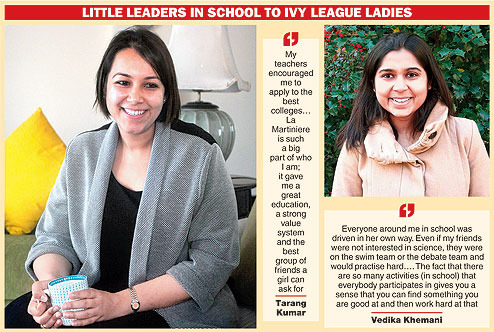
– Two bright young minds with shared roots in La Martiniere for Girls, Calcutta, are lighting up an Ivy League campus with their brilliance.

Jhinuk Mazumdar spoke to Vedika Khemani, Junior Fellow designate at Harvard University, and Tarang Kumar, Teaching Fellow at Harvard College, to chart their inspiring journeys

VedikaKOLKATA16may2016

VEDIKA KHEMANI

As a toddler, she was fascinated by science museums. As a student of Class IV, she had already made up her mind to specialise in either physics or mathematics. As a teenager, she would hunt for answers to her inquisitiveness in the pages of books by Richard Feynman and Stephen Hawking.

Vedika Khemani, “science geek” from the Class of 2006 at La Martiniere for Girls, will now get to dine and discuss physics with Nobel laureates.

The 27-year-old has been designated Junior Fellow at Harvard University with effect from August, a position she earned by clearing an interview by a panel of distinguished academicians that included Nobel laureate Amartya Sen. She is the 94th and only the ninth woman physicist to be admitted to this elite group. No other Indian woman physicist has gone where she has.

The Harvard Society of Fellows, founded in 1933, is the most prestigious postdoctoral research fellowship in the US. Only 12 fellowships are awarded each year across fields ranging from physics to literature to law. The list of Junior Fellows in physics since the inception of the society includes top scientists and Nobel laureates like David Gross, John Bardeen and Kenneth Wilson.

Vedika’s extraordinary journey started at La Martiniere, where the school topper would help her friends with their math problems the day before an exam. After completing her ISC in 2006, she went to Harvey Mudd College and is currently finishing her PhD in theoretical condensed matter physics at Princeton University.

So, how did a girl of barely 10 decide in Class IV that she would study physics or math? “Those were the subjects I really enjoyed, and everything else I kind of did because I had to,” she told Metro.

Vedika describes her favourite subjects the way a poet would give voice to feelings. To her, math is “beautiful, pristine, neatly tied with a bow” while physics is “messy, chaotic, but then you discover patterns in that mess”.

She also finds it fascinating that “this really complicated system of so many trillions of electrons actually follows this one very simple and beautiful equation”.

A teacher in school remembers Vedika as “effortlessly brilliant, with an amazing memory”. But the able – and humble – student feels there is no alternative to hard work, discipline and drive.

“Everyone around me in school was driven in her own way. Even if my friends were not interested in science, they were on the swim team or the debate team and would practise hard…. The fact that there are so many activities (in school) that everybody participates in gives you a sense that you can find something you are good at and then work hard at that,” she said.

Her history teacher Behula Chowdhury, who Vedika remembers fondly, said the most striking thing about the precocious girl in class was the ease with which she could assimilate knowledge. “She was not one of those students who would jot down every note in class. Everything was inside her head,” recalled Chowdhury.

Vedika owes her love of physics and math to her father Navneet and maternal uncle Rajesh Kanoria, who she remembers would “willingly spend hours discussing esoteric math and physics problems that were well outside my course of study at school”.

Even when he returned home late from work, Navneet would not turn away from discussing any math problem his daughter came up with. “A message for all dads everywhere to invest time in their children instead of just paying the bills!” quipped Vedika.

To her mother Rashmi, Vedika gives credit for giving her “the courage to dream without thinking about any misgivings or limitations”.

Vedika had received fellowships from Berkeley, Stanford and Caltech, and a position from Microsoft, but she chose Harvard over everything else.

Last December, when she was to be interviewed at Harvard for the position of Junior Fellow, Vedika was struck by nerves just like any other young person on the cusp of a great career opportunity. The nervousness, which she says helps her prepare for such big occasions, disappeared the moment she stepped into the room filled with brilliant minds.

For half an hour, Vedika took questions and presented her work on “Many-body localisation” with the confidence of someone who knew her subject. “I had spent a lot of time on this project and the fact that all these people were interested in it and asking questions was really exciting,” she recalled.

But for all her achievements, Vedika compares her entry into Harvard as “that of one electron among those trillions” and refuses to dwell on it. “This position is only based on my potential to do something. In the grand scheme of things, what have I really discovered about physics yet? There is the prestige of a position, but that is nothing compared to actually figuring something out,” she said.

Vedika is still the same Wood Street girl who loves to have chaat near Vardaan market, Chinese at Flavours of China and rolls on Park Street. Whenever she is in town, which is at least once a year, she visits College Street to buy textbooks on physics and misses the stores that once dotted Free School Street.

And to all those who aspire to be the next Vedika, she is never far away for some friendly advice. “I always try to write back to students who email me asking how and where to apply,” smiled the 27-year-old.

TARANG KUMAR

Tarang Kumar, 31, had cited her experience of taking two classes in her alma mater, La Martiniere for Girls, in her application for the post of Teaching Fellow at Harvard College. “You have never learnt something until you are made to teach it,” she wrote in the application.

Tarang, who passed out of La Martiniere in 2003, is doing her MBA at Harvard Business School and the opportunity to be a Teaching Fellow is something she hadn’t planned for. The last time she had taught was 12 years ago – she was then a student of economics at Delhi’s St. Stephen’s College – and Tarang was drawn to the information session primarily because it was to be addressed by Gregory Mankiw, whose books she had read in college and wanted to “put a face to the name”.

“He was on the campus and it was super convenient,” she said of the session, attended by 600-odd students.

The experience encouraged Tarang to take “a shot” at becoming a Teaching Fellow and she was soon on board as part of “an army of 25-30” selected to teach economic theory to undergraduates. But Tarang refuses to make a big deal out of it even though “there are many who apply for the job but don’t get it”.

“The undergraduate college has developed a system where they recruit teachers from Harvard Kennedy School, Harvard Law School, Harvard Business School, PhD students and also full-time teachers,” she explained.

Although Tarang didn’t have any long-term career goal when she was in school, she always knew that she would study economics. “And my teachers encouraged me to apply to the best colleges…La Martiniere is such a big part of who I am; it gave me a great education, a strong value system and the best group of friends a girl can ask for,” she recalled.

Whenever she makes a trip home, Tarang’s to-do list includes time with her school friends and trips to Kookie Jar and Tolly Club.

At La Martiniere, Tarang had been the president of the Drishti Club that organises cultural events. Being involved in these activities gave her the opportunity to learn about teamwork and leadership, skills essential to success in any workplace. “All the activities we had, whether it was sports, debate or elocution, gave us a lot of opportunities to step up and take leadership positions even at the school level,” she reminisced.

Sharmila Mazumdar, her economics teacher in school, said of Tarang: “There is not much growth in our profession and the maximum reward we get is when our students do well across the country and the world.”

According to Tarang, what makes La Martiniere different from a lot of other institutes is that “even if academics is not your strong suit, you still could find a place”.

At Harvard, Tarang teaches for three hours a week and “prepares for two hours for every class that I take”. Preparation is something she can’t do without because students “are smart and ambitious and some of the questions stump you”.

The hours that she puts in mean “giving up on other things such as great speaker events, opportunities to travel, socialise, take certain courses and sleep”. Two to three classes a week is a “huge time commitment” also because there are occasions when her students need her help to prepare for an exam in the middle of her own tests.

But Tarang won’t have it any other way. “This has given me an opportunity to relearn economics; to stand up in front of the class and teach. I have had the benefit of having some good teachers and to share the experience with someone is a great opportunity,” she signed off.

What message do you have for Vedika and Tarang? Tell ttmetro@abpmail.com

source: http://www.telegraphindia.com / The Telegraph,Calcutta,India / Front Page> Calcutta> Story / by Jhinuk Mazumdar / Monday – May 16th, 2016

Bristol will always remember Rammohan Roy, says mayor

Continuing along city tradition, the Lord Mayor of Bristol on Sunday led the annual service at the sylvan Arnos Vale Cemetery to pay tributes to Indian social reformer Rammohan Roy, who died here on 27 September 1833 of meningitis.

The service at the tomb built to an Indian temple style, was attended by many people from across Britain, including representatives of the Indian high commission, Brahmo Samaj and the Unitarian church.

Lord mayor Alastair Watson recalled Roy’s many contributions, and said Bristol would always remember and cherish his memory. The annual service at Roy’s tomb has been held for nearly a century.

A new documentary, titled ‘Relics of the Raja’ by academic Suman Ghosh, was shown at the event, which included new research on Roy’s contribution to the anti-slavery movement in early nineteenth century.

It also showed the newly-discovered replica in back of Roy’s original death mask.

Carla Contractor, local historian, who has led several initiatives to preserve, cherish and celebrate Roy’s life and work, recalled his accomplishments. Her latest research is focussed on Roy’s last days in England.

“The Raja was a remarkable man in his day.

He fought for women’s rights and for the reform of legal and fiscal services in India. All Indians can take pride in what the city of Bristol has done in memory of the Raja and be proud too of their own roots in the Indian subcontinent,” Contractor said.

source: http://www.hindustantimes.com / Hindustan Times / Home / by Prasun Sonwalkar, Hindustan Times,Bristol / September 29th, 2014

Brand Bengal to steal the show in London, Edinburgh and Glasgow

Kolkata :

Two-fifty-nine years after East India Company brought business to Bengal, the roles have reversed. Brand Bengal, aka Biswa Bangla, has travelled the British Isles, and it means business.

Starting Tuesday, shows are being organized in London, Edinburgh and Glasgow to hard-sell the exotic arts and crafts of Bengal. The exhibitions will be a prologue to the grand Biswa Bangla showroom coming up in London three months later, as announced by chief minister Mamata Banerjee during her London visit in July, last year.

Titled “Gods and Demons”, the event will include live demonstrations and workshops on the making and rich history of the masks of Bengal. There will be visual storytelling from Patachitra, which was used originally as ways of spreading ancient mythology. The integration of modern social themes and issues in the artwork makes patachitra and mask-making inspiring tools for today’s artists.

Talking to TOI about UK’s exposure to “Bengal summer” at the Nehru Centre (till Friday), the Scots in the Museum of Edinburgh on May 12 and 13, Rajiva Sinha, secretary, micro and small and medium scale enterprises (MSME) and textiles, said, “The Biswa Bangla tagline ‘where the world meets Bengal’ says it all. The most exciting part of the event are the live shows by artisans Suman Chitrakar and Sankar Das. They have blended the traditional art-forms into the modern-day usage.”

In Glasgow, the location for the grand event is the Art Village Scotland which will be held on May 14 and 15, as part of the Southside Fringe festival.

“Biswa Bangla believes there is a keen appreciation for Bengal arts and crafts in the modern global community and we want the British to be a part of it, keep these art forms alive by bringing the magic of Bengal’s temples into the UK living rooms,” said London-based designer Neishaa Gharat, who represents Biswa Bangla in the UK.

Das, who hails from Sabdalpur village in South Dinajpur, will tell the British audience how “there was no rain in Kushmundi 200 years ago and people started praying to the gods for rain and to restrict the evil powers. Many characters became part of the dance, Kali, Rakshasa, Hanuman and Dakini – these are the faces we still carve today.”

Chitrakar, a villager from Naya who has applied patachitra to modern-day products like painted bags, apparels and crockery said, “Patachitra painting started many years ago. Patuas were mostly Muslims but painted Hindu gods. They moved house-to-house, singing for grains and money. Gradually, this took the shape of the art form we see today. In 2004, there were only 18 patuas in Naya, now there are 300.”

Gharat, who has been working with traditional Indian arts, crafts and textiles promoting artisans and creating designs for a global audience, sounded exited “because this is a government initiative to revive the art and craft of Bengal, which is one the most culturally diverse states in India. The art forms are fascinating because they give away such a stark dichotomy between tradition and modernity. There’s a tremendous legacy of skilled work out there and the willingness to take it forward.”

John Bell, former chairmen of the British Guild of Travel Writers and a consultant for the United Nations World Tourism Organisation, delivered the key note speech. Bell, who started his career with the BBC in London, producing and reporting for its travel and transport programmes on radio and television, said, “The work is not just a question of design, its jobs and poverty … this beautiful art is not just beautiful art, its beautiful art for good … the more we trade, the more we work, the more work we give to our friends Shankar Das and Suman Chitraker here, the more we are doing for the people of West Bengal and doing good for ourselves.”

– Aimed at rejuvenating the state’s handloom and handicraft products, Biswa Bangla was conceptualized in 2013
– The first store to sell products under the brand opened in 2014
– With 7 stores, the venture clocked a Rs 15 crore in 2014
– In the next two years, revenue is expected to increase six-fold to about Rs 100 crore.
– Among the arts being revived at Biswa Bangla are:
– Indo-Portuguese shawls (takes six months to embroider)
– Muslin
– Darjeeling tea
– Masks
– Attar perfumes
– Kalimpong cheese
– Mustard sauce
– Sundarbans honey
– Bonolokkhi ghee
– States like Rajasthan and UP are adopting the Biswa Bangla model
– Biswa Bangla markets 5,000 products, including 24 kinds of dolls from various parts of the state

source: http://www.timesofindia.indiatimes.com / The Times of India / News Home> City> Kolkata / by Ajanta Chakraborty / May 04th, 2016

‘Pather Panchali’ vignettes now in print

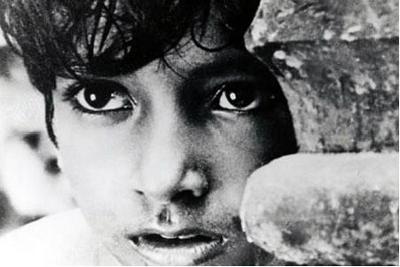
Pather Panchali
Pather Panchali

Kolkata:

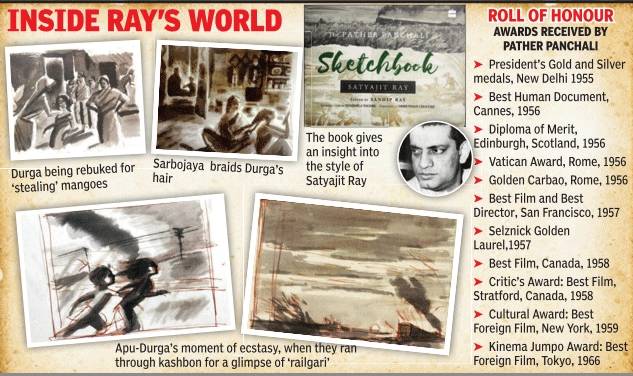
That ‘Pather Panchali’ is a film of international repute is a foregone conclusion but very few know how much labour it took for Satyajit Ray to come up with the masterpiece. A facsimile edition of the ‘Pather Panchali’ sketchbook, which has collated original contents of the film – sketches, notes and post-scripts, will now give an insight into how Ray had visualized and planned the film. It was released on the eve of Ray’s 95th birth anniversary on Sunday.

The sketchbook, as Ray’s son Sandip Ray has written in the preface, formed the very foundation of the filmmaker’s maiden film. Sandip Ray writes on the history of the book: “…Father donated it to the ‘Cinematheque Francais’ in Paris at the request of Georges Sadoul, the eminent French journalist and film scholar. In his final days, he expressed a desire to have a look at the visual script he had made for Pather Panchali. I contacted the Cinematheque Francais management, but they said the sketchbook had been missing. However, it was our good luck that last year we got hold of a scanned copy of it…and decided to bring out this facsimile edition,” Sandip Ray mentions in the preface.

The book not only gives the readers a rare glimpse into original sketches and notes made by Ray for the film, it also has several reviews and previews, original drafts, posters, booklets, letters written by eminent film personalities and some photographs and commemorative stamps.

InsideRaysWorldKOLKATA03may2016

The book also contains a few articles written by Satyajit Ray on the inspiration behind his maiden film. “I have no hesitation in saying that Aam Aantir Bhenpu, a childrens’ edition of Bibhutibhusan Banerjee’s novel ‘Pather Panchali’, was the source of the script of my film. I illustrated that edition. So I had to go through the book minutely,” writes senior Ray in his article ‘The Whole Film Was In My Head’.

“The sketchbook is the product of a painstaking effort put in by the ‘Society for Preservation of Satyajit Ray Archives’, also known as ‘Satyajit Ray Society’,” said Society CEO Arup Kumar De.

Sharmila Tagore, who has written an introduction for the sketchbook, says that the film holds a special place in her heart. “I owe my life in cinema to this film….No doubt impressed with the resounding international success of ‘Pather Panchali’ and the critical acclaim for its maker, my father took the extraordinary step of allowing me to work in Apur Sansar.,” she reminiscences in the introduction.

source: http://www.timesofindia.indiatimes.com / The Times of India / News Home> City> Kolkata / Suman Chakraborti / May 03rd, 2016

Eyewitness accounts

BoseBrothersKOLKATA30apr2016

A journey through the Indian independence movement of the 1920s through an illuminating collection of notes, letters and personal correspondence

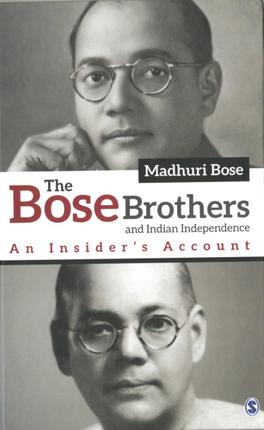
Author Madhuri Bose, granddaughter of Sarat Chandra Bose (elder brother of Subhas Chandra Bose) and daughter of Amiya Nath Bose, takes the reader through the most important period of the Indian Independence Movement of the 1920s by reproducing the personal correspondence between the Bose brothers — notes and information collected mostly from her father who was an eyewitness to happenings during the crucial years of freedom struggle. She declares in her introduction, “this is not a biography of the Bose Brothers but based on family perceptions, insights and analyses of the roles of the key personalities, with a focus on Sarat and Subhas over the three decades from the early 1920s”.

The story is told mostly from the view of her father and his notes. Chapter 1 describes Amiya’s close connection with the Bose brothers, though they are physically separated. The narration is both informative and highly touching. She talks of the time Subhas was detained on January 2, 1932.

For a few months, he was allowed to stay with his brother Sarat in prison, but was shifted to Madras penitentiary where he became ill. He was then transferred to Bhowali in Northern India when the seriousness of illness was recognised. Subhas was then sent to Europe — by train to Bombay and then aboard a ship to Vienna on February 22, 1933. The authorities allowed young Amiya to accompany Subhas from Calcutta to Bombay. It was then that Subhas showed Amiya the copy of his hand written thesis on Hindustani Samyavadi Sangha that he had written during his Madras detention. Incidentally the contents were discussed with three members of Comintern (Communist International) later by Subhas in Vienna.

Chapter 2 deals with the difficult time faced by the family when the brothers were under detention by the British. In 1921, 24-year-old Subhas had returned from London after declining to join the Indian Civil Service and joined the movement for freedom.

While interned in Mandalay jail, Subhas wrote Pebbles on the Seashore, a collection of stray thoughts.

The third chapter deals with his reaction to Gandhiji’s suspension of the Non-Cooperation movement and the starting of a new daily with C.R. Das as editor and Sarat as Managing Director.

Chapter 4, the most important chapter of the book, deals with parting of the ways between Gandhiji and the Bose brothers. Copies of telegrams are reproduced here, indicating the beginning of the divide. On January 31, 1939, Gandhiji wrote of the defeat of his candidate Pattabhi Sitaramaiyya and concluded that he rejoiced at the victory of Subhas “. . . after all, Subhas Babu is not an enemy of his country.” In a lengthy letter, Sarat addressed Gandhiji on the prevailing condition in the Congress and how unhappy he was by the turn of the events.

However, at a later date, Gandhiji asked Amiya to convince Sarat to join the Congress again, and Amiya, in hindsight, felt that Sarat could have played an important role had he re-joined the Congress then.

More recent past is explained in the chapter ‘Partition — a Bitter Pill’. Sarat was to write later, “Gandhiji’s acceptance of Rajaji’s formula is nothing short of a tragedy in India’s political life.”

The epilogue deals with all principal characters of the book and it is heart-rending to read some of the letters. The book closes with a touch of disappointment in Amiya’s feeling of not being able to realise his father’s dream.

K.R.A. Narasiah is a writer and historian.

The Bose Brothers and Indian Independence: An Insider’s Account; Madhuri Bose, Sage Publications, Rs. 750.

source: http://www.thehindu.com / The Hindu / Home> Books> Literary Review / by K.R.A. Narasiah / April 30th, 2016

Flower power pushes Kolkata Jewish population up by 1

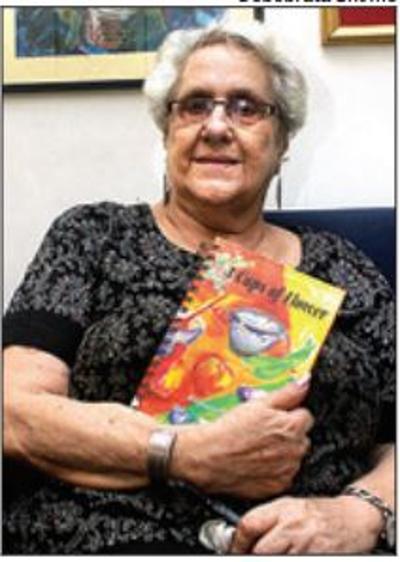
CHRONICLER OF TASTE : Flower Silliman

Kolkata :

For 30 years, Flower Silliman lived abroad, keenly observing and recording Jewish life in the Middle East, Europe and the US.

Now, the 86-year-old is back in the city she was born taking the community count up by one. And, she has taken upon herself the onerous task of keeping the authentic Jewish flavours alive for her nine-member strong community. Yes, you read it right: nine.

Demographers put the strength of the Jewish community in the city at less than 20, but the members are rather strict about who they call “pure”. Those that have married “outside” the community are strictly not “pure” Jews.

“I have come back to the city because this is where the Jews have lived most safe and free, but unfortunately , this is where our numbers have dwindled the most…but I am keeping the flame alive,” she says.

Silliman also happens to be among the last keepers of the community’s ancient recipes and has decided to chronicle the unique tastes for posterity.

“Even the food that Jews here have today is not what we are permitted by our religion. There’s so much of mix and match that most of the authentic cuisine that is over 5,000 years old and has its roots in the Middle East, is lost. I am trying to keep the tradition alive by documenting the recipes and rustling up dishes for feasts,” says Silliman.

Jewish food is special because Jews just can’t eat cause Jews just can’t eat anything and everything, Silliman says.

Their food -kosher -has to abide by strict dietary laws which not only lay down what is forbidden but also the process of cooking, the ingredients and the kitchen specifications. Kosher, for example, does not permit meat to be mixed with milk or milk products.So, neither can you mix the two while cooking, nor can you consume milk or milk products after having meat.

Flower Silliman says: “Judaism has a great similarity with Hinduism so far as its antiquity and dietary specifications go.

It’s another matter that most followers of both religions have drifted away from these guidelines… perhaps because they have often found it difficult to cope with such restrictions. I am not saying this by way of criticism, but the fact is that cuisines, and even cultures, become extinct because of such interpolation.”

A traditional sit-down Jewish feast on Friday night can ideally start with beet khatta with koobah (beet soup with chicken or vegetable balls), followed by Jewish roast chicken, which is different from the European roast in the kind of marinades and spices used. “The authentic Jewish roast will be far milder, both in flavour and sharpness, compared to the European roast,” Silliman says.

Kosher allows Jews to only have fish that have scales, and not those with shells (prawns, crabs or lobsters). “So you have items like fish shoofta, which is minced fish skewers. Vegetable lovers have choices like vegetable mahashas, which is stuffed tomatoes and capsicum.But the magic is in the recipe for the stuffing. The authenticity of the dish is heightened when served with aloo makalla (a special potato fry), hulba (a sort of fenugreek, mint and coriander chutney) and cucum ber zalata. Another speciality is mutton or vegetable ingree -a layered meat dish baked with brinjals, tomatoes and potatoes -not unlike the Greek moussaka, but without dairy to keep within kosher limits,” Silliman explains with the lucidity of an expert.

And why not? While abroad, Silliman served as a souschef at the Plaza in Jerusalem and launched the world’s only kosher Jewish restaurant, Maharaja.

She taught cooking and ran masterchef shows in US and London and authored two books. “I have come back to Kolkata because this is where the Jews have lived most safe and free, but unfortunately , this is where our numbers have dwindled the most… but I am keeping the flame alive.”

source: http://www.timesofindia.indiatimes.com / The Times of India / News Home> City> Kolkata / by Jhimli Mukherjee Pandey / TNN / April 29th, 2016