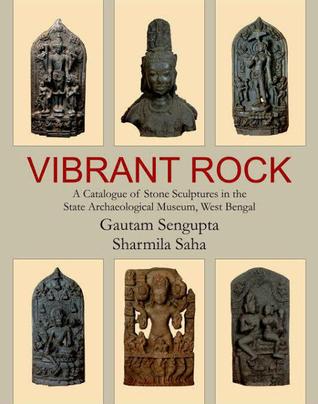
The first-ever catalogue of stone sculptures collected from different parts of West Bengal, Bihar, and parts of Bangladesh belonging to Brahmanical, Buddhist, and Jain pantheon has been published by Directorate of Archaeology and Museum, Department of Information and Cultural Affairs, Government of West Bengal.
Archaeologists say the first-ever catalogue of historical stone sculptures in the region titled Vibrant Rock contains a comprehensive details of 444 stone sculptures housed in the State Archaeological Museum at Behala in the southern parts of the city, dated between the sixth and 19th century AD.
Most of the stone sculptures belong to Pala-Sena period. However, the unique piece highlighted in this catalogue is a sculpture dating to the 19th century: the specimen is a stone plaque depicting in six different panels the story of birth of Lord Krishna. In each of the panels, there are depictions of the parturition rooms (labour room) in the palaces of Kansa and Nanda. The plaque is accompanied with an inscription in Sanskrit.
Another talked about is the image of Surya, discovered from Mahisantosh in Naogaon district of Bangladesh. The exquisitely sculpted piece of the ninth century is from the time of Pala King Mahendrapala.
“Through Vibrant Rock we have tried to introduce a major collection of sculptures of the region in form of a catalogue. The book offers not only iconography and stylistic affiliation of the sculptures but also an array of information about find spots, modes of acquisition, rock type, and inscriptional detail,” Guatam Sengupta, former director general of Archaeological Survey of India (ASI) and author of the book, said.
The book also deals with a wide range of rocks used in making these historical sculptures such as coarse-grained granite gneiss, ultramafic rock, ballast, chlorite schist, mica, and sandstone.
Sharmila Saha, the co-author of the book, said that an analysis of the sculptures provided in the book will prove useful to identify the influence of regional schools of aesthetics on the broad South Asian Art.
“Not only academicians like archaeologists and historians but laymen interested in ancient Indian heritage are laying their hands on the books,” Rajat Sanyal, an archaeologist of University of Calcutta, said.
source: http://www.thehindu.com / The Hindu / Home> News> Cities> Kolkata / by Shiv Sahay Singh / Kolkata – July 20th, 2014
Jadavpur University has approached the Indian National Trust for Art and Cultural Heritage for expert guidance in the mammoth restoration project that it has undertaken over Writers’ Buildings – the 236 year old seat of the state secretariat. At the moment JU architects are conducting a detailed survey on the condition of the building, preparing a layout of how the restoration process would progress and interiors would be re-organized once the work is over.
Objections were reportedly raised by the West Bengal Heritage Commission over the state PWD department’s decision to hand over the responsibility of restoration to JU and IIEST (formerly Besu) jointly. The Commission felt that a building of the rare stature of Writers’ Buildings should be handled by an agency whose expertise lies in restoring heritage institutions. The Commission felt that the architecture departments of neither JU nor IIEST had the required experience. However, belying such doubts the state PWD has gone ahead with its decision and has not interrupted the ongoing survey work that is being conducted by JU at the premises.
Intach has not only been formally invited by JU, talks have also happened between the national level heritage conservation agency and the PWD authorities over ways in which Intach would bring in its expertise in overseeing the project right from the drawing and testing stage now and also later during the execution. Most departments of the state government shifted out of Writers’ Buildings last October with the state secretariat shifted to Nabanna, so that the heritage building at Dalhousie can be restored. However, execution is yet to happen and the delay has raised several eyebrows.
“We must remember that Writer’s is no ordinary building and execution of the plan cannot happen immediately. We are conducting a series of tests on the structural status of the different portions of the building and the strength of its foundation. Once execution starts cracks should not develop in the portions that are relatively weak. Again, the building as we see it today, was not built all together; portions were added with time. Naturally the health of the building will also be somewhat heterogeneous,” said Madhumita Roy, head of JU’s architecture department, who is leading the project. She feels that the project report on how execution should be ready for submission to the state government by November. Once the state government approves it, execution should start immediately.
Confirming that she has tagged Intach in the project, Roy said, “I have closely followed the work that Intach has done in restoring institutional heritage e.g. Gwalior Monument, Princep Ghat, St John’s Church and Lalgola correctional home. I think it will be able to guide us well both on the methodology and progress.”
Intach state convenor, GM Kapur said that the main problem with Writers’ restoration is lack of original drawings which could guide the restoration team. “I am sure that the original drawings would exist in what was then known as the India Office library, a part of the British Library. We will write to them to see if they exist and then organize for copies so that they can be consulted.”
PWD officials said that JU experts are conducting the survey and the condition of the building. “Suggestions are invited from any consultancy or architectural firms as to how the restoration work could take place. All the suggestions will be discussed with the heritage commission following which work order of the actual work will be issued,” said a PWD official. Earlier, the demolition work of the extended portions was supposed top start off from this month.
source: http://www.timesofindia.indiatimes.com / The Times of India / Home> City> Kolkata / by Jhimli Mukherjee Pandey, TNN / July 10th, 2014
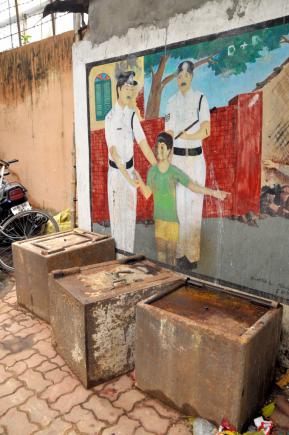
In 2007, three iron chests were dug up from 178 Rashbehari Avenue in Kolkata. They were kept at the Gariahat police station while their ownership was disputed.
On a sultry Monday afternoon in mid June this year, a group of about three hundred people—journalists, photographers and locals—crowded around the police station in Gariahat, in south Kolkata.
When Umesh, the istriwala, who presses police uniforms in his small shanty adjacent to the thana, stepped out to get a better look at the scene, he saw that the top of the thana’s high boundary wall had been fitted with bamboo poles, between which was strung a cloth screen. He told me that a few intrepid journalists and locals had climbed up on nearby trees to see what was going on inside, while others peeked through a side gate.
The focus of everyone’s interest was three iron chests that were inside the compound. The chests had been unearthed a few years earlier from a plot on Rashbehari Avenue that was being excavated for construction. Since then, speculation had grown about their contents, whetted, perhaps, by recent treasure hunts—both successful, such as at the Sree Padmanabhaswamy temple in Kerala in 2011, and comically unsuccessful, such as at Unnao, Uttar Pradesh, last year, launched on the promise of a godman’s dream. True, the Rashbehari chests were old and rusty, but who could say what they might contain? Murmurs of gold and hidden treasure filled the air, drawing more people to the scene. Officers from the Archeological Survey of India and Geological Survey of India supervised the opening of the chests, along with about fifty policemen.
The scene had been equally chaotic on 24 June 2007, the day the three chests were found. Constable Sudip Nayek recounted to me that he had been on patrol that morning, when he came upon construction workers unearthing a chest from plot 178 on Rashbehari Avenue. Nayek promptly informed his superiors at the station, and the police came out to the site. As a crowd gathered, police cordoned off the area. Over the course of the day, two more chests—each chest weighed around 100 kilograms—were dug up and lifted out with a crane.
The Indian Treasure Trove Act, 1878 defines treasure as “anything of any value hidden in the soil, or in anything affixed thereto,” and directs any such treasure worth more than Rs 10 to be handed over to the government. Thus, the chests became government property. Nevertheless, there were claimants to the chests, though their contents were unknown. Mahamaya Pal, a homemaker in her sixties, had recently sold the Rashbehari plot to a Kolkata-based shoe company called Sreeleathers, which had been excavating it. Both Sreeleathers and Mahamaya Pal staked their claim on the chests and were soon embroiled in a legal battle at the Alipore Civil Court.
After a long but inconclusive case that lasted for seven years, in December 2013, the court ordered that the chests be cut open. There was speculation that there would be riches hidden within them, and even archaeologists were hopeful. “I am excited,” said Ashok Patel, superintending archaeologist, ASI, to the Indian Express. “The chests may have anything. I am sending some experts there.”
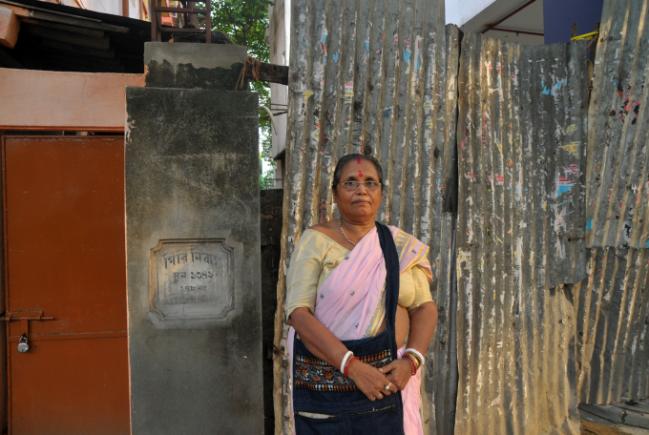
I met Mahamaya Pal at the Kalighat temple—a place she called her “own”—on a rain-soaked afternoon in late June. The chests had been opened earlier that month, but Pal still spoke of feeling a spiritual connection to them.
Mahamaya Pal, the former owner of 178 Rashbehari Avenue, who sold the plot to Sreeleathers, the company that discovered the chests. / Sudhiti Naskar / Agency Genesis
“Nothing but the truth can be spoken in the temple,” she insisted. Her eyes glazed over as she described how, as a child, she had been told stories about Kali and other Hindu deities by her grandmother. Now she believed that the chests had been kept for her by the dark goddess herself. She said that after they were discovered, she had started getting “messages” from “another world” telling her that the treasure belonged to her. “This is all secret knowledge,” she whispered, her face twitching. “This is a mystery of the secret chests that belong to Ma Kali.” Her faith in this belief had been fanned by the astrologers and tantriks she has been frequenting for a few years. She told me that she had spent over one lakh rupees on the ownership case with Sreeleathers, a sixteenth of the sum she got from selling her plot.
Pal’s long wait had come to an end on 16 June, about seven years since the chests were found. That morning, she said a prayer at home, applied a tilak of sandalwood paste on her forehead for luck and went to the police station with her family and lawyer. She waited expectantly, watching the shower of sparks fly from the cutters as the fire brigade personnel laboured at the chests.
Both Pal and Sub-inspector Bireswar Roy, the officer in charge of the case, gave me a recap of the events of that morning. It took two hours for the first chest to be cut open. A diamond cutter was used instead of a gas cutter to protect the “precious” content from damage. But the eager crowd were in for a sore disappointment. Roy told me that the chests only contained a few handfuls of latch needles (used in knitting machines) in polythene bags; a letterhead, dated 1975, of a local business, the Sri Ramkrishna Hosiery Factory; a desktop calendar; four Rs 5 notes with Hindi writing on them; and a lone one paisa coin dated to 1953. One chest was completely empty. “What a waste of time!” a photographer said as he walked away from the scene.
Some bravely maintained that the exercise hadn’t been a waste of time—The Hindu quoted an unnamed ASI official saying, “These needles were made in the 1970s. From them we will come to know how the textile industry functioned during that time. They may have some historic value.”
Roy believes that the location of the chests justified the excitement surrounding them. The plot was close to a Kali temple said to have belonged to “Roghu Dakat”—a famous dacoit—and around which there were rumours of human sacrifice and buried treasure. “There was a possibility that these chests contained jewellery or gold hoarded by the dacoit,” said Roy.
Though the contents of the chest were of little value, Roy still believes something about the situation doesn’t add up. After the outer iron casing of the chests was cut open, he said, the firemen found a layer of fire resistant clay. Within this was another iron casing that had to be cut through before the contents could be reached. “Why would someone put nothing of value inside those chests but take such great care to seal them impeccably?” Roy said.
Pal is equally mystified. “We never had any connection with a clothes business,” she said. “And none of my family members ever dealt with Ramakrishna Hosiery.” She was born in that same house on 178 Rashbehari Avenue to a family of traders and grocers, she said, and has been living there all her life. “The house is eighty years old,” she said. “It was built in 1935. How is a bill from 1975 buried in a chest underneath it without any of us knowing about it?”
source: http://www.caravanmagazine.com / The Caravan Magazine / Vantage> Web exclusives for the Caravan / Home> Case Diaries / by Sudhiti Naskar / July 17th, 2014
______________________________________________________________________
Sudhiti Naskar is a freelance journalist based in Kolkata. She likes to document people’s lives in moments of flux. She is regularly published in international magazines. She is currently represented by Agency Genesis.
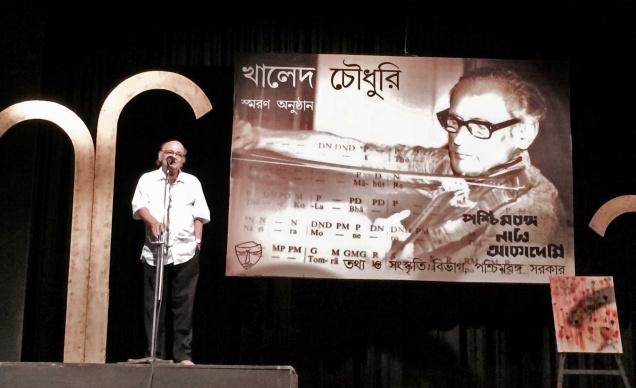
World is a stage: Theatre personality Manoj Mitra talks about his association with Khaled Chowdhury at a condolence meeting in Kolkata recently. Photo: Kathakali Nandi / The Hindu
Khaled Chowdhury was a stage designer who had worked with Shambhu Mitra, Ajitesh Bandopadhyay, Tripti Mitra, Meghnad Bhattacharya, and Manoj Mitra
Theatre personalities congregated on Saturday evening to reminisce the role of Chiroranjan Dutta Chowdhury and his prolific works at a city auditorium.
Known to the world as Khaled Chowdhury, he passed away on April 30 this year after a prolonged illness at the age of 95. The stage designer had worked with eminent Bengali theatre personalities like Shambhu Mitra, Ajitesh Bandopadhyay, Tripti Mitra, Meghnad Bhattacharya, and Manoj Mitra.
Mr. Chowdhury was first entrusted with designing the stage for Raktakarabi written by Rabindranath Tagore and directed by Manoj Mitra in 1954.
From then on, there was no looking back for him. Some of his famous works include working for the sets of Putul Khela, Pagla Ghora, Ebong Indrajit, Dakghar, Gudia Ghar, Sarhad Par Manto and Badnam Manto, Alakanandar Putrokanya, and Mudra Rakshas.
According to Mr. Chowdhury, designing a set was not just the mere arrangement of props on stage. He believed in innovating sets and props, and blending them with artistic flavours.
Born in a village in Assam in 1919, he lost his mother when he was nine years old. His relationship with his father was stormy, often forcing him to run away from home. He ran away to Sylhet, Bangladesh, in 1936.
However, he returned to India in 1943 and settled in Kolkata on the advice of novelist Tarasankar Bandopadhyay.
“Mr. Chowdhury was a man of very firm ideals. As a result, he let go of many awards as he felt they were against his policies. He had strong opinions and refused to budge from them. This led to him being misunderstood as an arrogant person. But those close to him knew his true nature,” veteran theatre personality Manoj Mitra said.
Apart from stage designing, Mr. Chowdhury had designed almost 4,500 book covers and folders for various theatre groups.
He also took interest in music and had composed several songs on the lines of folk music.
Pradip Dutta, one of his close aides, rued the lack of documentary preservation of Mr. Chowdhury’s works.
source: http://www.thehindu.com / The Hindu / Home> News> Cities> Kolkata / by Kathakali Nandi / Kolkata – July 01st, 2014