Category Archives: Historical Links / Pre-Independence

DOWN MEMORY LANE – A legendary doc

Dr. Hem Chandra Sen
Dr. Hem Chandra Sen

From curing ailments common and uncommon to initiating Durga Puja in Delhi, Dr. Hem Chandra Sen left behind an unforgettable legacy

Doc Holliday may have been a favourite with youngsters watching Western cowboy films over five decades ago, but long before that Delhi had its own bearded Doc whom few remember now. There were no motorised vehicles in 1879 when Dr. Hem Chandra Sen came here in a bullock cart all the way from Agra. Rich people travelled in palanquins, buggies or four-wheeled landaus and the poor in ekkas and carts. Women hardly showed their faces in public, they either wore burqas or ghoonghats and there was no electricity and piped water supply. In this milieu Dr. Sen became the first Indian allopathic doctor of Delhi.

From dispensing medicines to those building the E.I. Railways’ Agra-Delhi line, he started treating the local populace; women did not mind uncovering their heads and faces before him. Dr Sen was credited with “miraculous healing powers”, his day beginning at 4 a.m. and ending late at night. Rich and poor alike were treated by him. Those who couldn’t come to his chambers were visited by him, for which he used two sets of horse carriages — one for the morning and the other for the evening. He charged Rs. 2 (for the full treatment) from those whom he visited at home and nothing from patients who came to his clinic. He set up a pharmacy also, as getting medicines from Calcutta took a lot of time. Later it became a separate unit known as H.C. Sen and Company.

In 1883 Dr. Sen, founder of the Imperial Medical Hall, set up the Imperial Medical Press and type-setting moulding unit adjacent to his clinic. It was afterwards run by his nephew A.T. Roy, and the latter’s sons and grandsons, as one of the leading presses of Delhi. Member of the first management committee of Hindu College, Dr. Sen played a leading role in youth education along with Lala Shri Krishna Dass Gurwala (one of the founders of the college), M. M. Malaviya and many others of note.

Lala Krishan Dass Gurwala was among the seths who persuaded Dr. Sen to settle down in Delhi. It is interesting to note that the name Gurwala was appended to the family as it used to provide gur and gram to pilgrims, says the centenary brochure on Dr. Sen brought out in 1980. Gurwala’s grandfather was hanged by the British for supporting Bahadur Shah Zafar. The family traces its history to 1560 and Lala Nodhamal of Akbar’s reign. After Gurwala helped establish the Delhi Cloth and General Mills, it meant an extended practice for Dr. Sen. However when the good doctor fell seriously ill due to his exertions (“grace under pressure”, to quote Hemingway), the British Chief Commissioner of Delhi ensured that there was complete silence in the Fountain area of Chandni Chowk so that he was not disturbed. It’s worth mentioning that when Unani medicines were ineffective even the famous Ballimaran hakims did not hesitate in referring patients to Dr. Sen for a speedier cure.

Europeans also came to Dr. Sen, a Freemason, for treatment and for advice even on personal matters. Born in Calcutta before the 1857 Revolt, he died in 1906 and the Delhi markets were closed for a week as a mark of respect. He was succeeded by his sons, Dr B. C. Sen and Dr R.B. Sen (Adu Babu). From 1880 till his death Dr. Sen had stayed on in Delhi and among his guests were Rabindranath Tagore, Swami Vivekananda, novelist Sarat Chandra, Sir Surendranath Banerjee, Subhas Chandra Bose, Madan Mohan Malaviya, Hakim Ajmal Khan and the Maharajas of Jaipur and Jodhpur.

Interestingly, Vivekananda used to walk to the Yamuna every day through Chandni Chowk so long as he stayed in Delhi. The road from the Fountain leading to Old Delhi station is named after Dr. Sen and on Ansari Road in Daryaganj his descendants continue to maintain their 100-year-old pharmacy. Now a book on the legendary doctor, an initiator of Durga Puja in Delhi, is being written (at the behest of Anees Enterprises) by Shipra Sen to commemorate her ancestor whose medicines for curing diseases like jaundice, other liver infections and malaria are still popular. May be Doc Holliday too would have got rid of his bottle-induced problems had he cared to saunter (shoulder-strapped gun and all) into Dr. Sen’s celebrated 19th Century “Maktab” at the Fuwarra!

source: http://www.thehindu.com / The Hindu / Home> Features> FridayReview> History & Culture / by R. V. Smith / August 31st, 2014

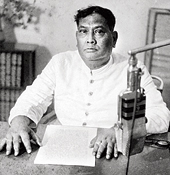
FORSAKEN BY HISTORY – Fazlul Huq’s actions directed history at many levels

First Person Singular – A.M.
FazlulHuqMPOs29aug2014

The significance of the year 1937 as a major milestone in the colonial history of India is often either brushed aside or missed altogether. The British parliament had, a couple of years ago, passed the new Government of India Act promising Indians limited self-governance and suggesting a federal structure of administration for the Indian empire. Provincial elections were ordered in 1937 all over ‘British India’ so that people’s representatives, though elected on the basis of restricted franchise, could still wield some power. The Indian National Congress, despite its reservations over the provision of the act, participated in the polls and, as was only to be expected, had a cakewalk victory in most of the ‘general’ constituencies everywhere; it also succeeded in electing its candidates from an impressive number of constituencies reserved for the scheduled castes and tribes. The All India Muslim League, presided over by Mohammed Ali Jinnah, did much below its expectations. Even in the provinces where Muslims constituted a clear majority of the electorate, its performance was none too impressive. In Punjab, it was defeated by the Unionist Party put together by Sikander Hyat Khan, representing the landowning interests, who became the prime minister (this was the nomenclature used in the 1935 Act) of the province. In Bengal, A.K. Fazlul Huq’s Krishak Praja Party prevailed over the League in a majority of the constituencies reserved for the Muslim community. His party lacked an overall majority in the provincial assembly; it nonetheless emerged as the largest single party. The Indian National Congress claimed the second place, the Muslim League was a not too impressive third. In Sind, it was a rag-bag coalition of regional parties which formed the provincial government, the Muslim League was isolated. In the North-West Frontier Province, given the popularity of Khan Abdul Gaffar Khan and his brother, Khan Sahib, the Congress did tremendously well; it won seats which fell short of a majority by just one; the Muslim League failed in its mission to capture the province. It was only the Indian National Congress in the rest of the country, including the United Provinces, the Central Provinces, Bihar, Assam, Orissa, as well as the Madras and Bombay Presidencies.

Jawaharlal Nehru was the Congress’s president that year. At his direction, the Congress set down two conditions for joining a coalition with others for forming a government in a province where it would be unable to form a ministry on its own: (a) the Congress would not enter into alliance with any ‘communal party’ and (b) even where it chose to form a coalition with another party to form the government in any province, the prime minister must be only from the Congress; it would supposedly be demeaning for the great national party to take orders from a prime minister who belonged to a nondescript political formation.

What was ironical was that in its anxiety to keep the Muslim League out of power in the NWFP, the Congress did not hesitate to breach immediately the first of these conditions and agreed to accommodate the sole Hindu Mahasabha legislator in the state assembly, Mehr Chand Khanna, in the ministry it formed. When it came to Bengal, the party’s high command, so-called, was adamant in sticking to principles. Fazlul Huq, having successfully snubbed the Muslim League in the just-held polls, was most reluctant to have any truck with the League and was keen to have the Congress as his partner. He sent a formal proposal to the Congress authorities inviting the party to form a coalition with the KPP and join the ministry he would form as the province’s prime minister. Sarat Chandra Bose, elected leader of the Congress in the Bengal assembly, was eager to respond affirmatively to Fazlul Huq’s invitation. His request to do so was contemptuously turned down by the high command. Poor Fazlul Huq had no alternative but to approach his erstwhile sworn enemy, the League, to join his ministry. The League responded with great alacrity; the KPP-Muslim League coalition regime took charge of the provincial administration in Bengal. The course of history changed in Bengal from that point onwards.

Fazlul Huq’s KPP had a clear-cut programme to protect the interests of the rural masses. Once installed in office, Fazlul Huq wasted no time in implementing the pledged promises to relieve the peasantry of the burden of unbridled exploitation by big landlords and loan sharks. A legislation imposed ceilings on land cess charged by intermediaries. Of far greater relevance was the introduction of a separate legislation concerning rural indebtedness. It either considerably reduced or even squashed altogether the burden of land cess charged by intermediaries in the recovery of past loans. Fazlul Huq did not quite stop here. He decided to set up a commission — the Floud Commission — to introduce major land reform all over the province. A further measure, perhaps of equal, if not greater, significance, was an order which, taking into account the denominational distribution of the province’s population, reserved 54 per cent of job opportunities in the provincial government henceforth for members of the Muslim community.

This series of measures had a tremendous impact on all sections of the Muslims in Bengal whose support for Fazlul Huq soared. The reaction of Hindus and the Indian National Congress was, perhaps not totally surprisingly, to the contrary. The prospect of losing the opportunity of making easy money by increasing exploitation of the rural poor disturbed the thinking process of the Hindu gentry and middle-class Hindus; the additional, very real, possibility of shrinkage in opportunities to enter government service further alienated them from Fazlul Huq and his administration.

Ignoring advice for restraint, the Congress launched a virulent campaign depicting Huq as an arch communalist. It was conveniently forgotten that, barely a couple of years ago, the same Fazlul Huq had made the Congress happy by taming the League in the polls. The news media in Calcutta, both English and Bengali, owned by Hindu fat cats, were full of reports, often concocted, of how much sections of the Hindu community were suffering in different parts of the province under the tyranny unleashed by the coalition government. Fazlul Huq withstood the calamity for a while. He was a man of emotions though. At one point he decided that enough was enough, if he was dubbed communal for being a friend of the poor, he would rather turn into a full-fledged communalist. He liquidated his own party and joined the Muslim League, along with the bulk of the KPP legislators. He, so to say, handed on a platter the crucial province of Bengal, with its huge density of Muslim population, to Mohammed Ali Jinnah.

The rest of the story is well known. Huq was persuaded to move at the League’s annual session in 1940 the resolution demanding the creation of Pakistan. The League reaped what Huq’s KPP had sown in Bengal. Muslim masses all over the country were bowled over by reports of what the League had supposedly done for poverty-stricken Muslims in the eastern province. Their loyalties got swiftly transferred to the League. Jinnah begun to roar like a real lion. Pressure was unbearable on Muslim politicians who till then had kept their distance from the League. Sikander Hyat Khan could read the signs, and capitulated in Punjab and joined the League too. It was the same story in the rest of the country. Only Abdul Gaffar Khan’s NWFP refused to bend all the way.

Since at heart Fazlul Huq, besides abhorring Jinnah’s overwhelming ways, could not reconcile himself to the League’s exceedingly aggressive communal stances, he soon fell out with the League leadership. He tried to form an alternative government in Bengal by parting with the League. Most of his former supporters were, however, no longer with him. Even so, Huq succeeded in scraping together a majority in the provincial assembly with the help of Sarat Chandra Bose, who too had now broken with the Congress following Subhas Chandra Bose’s expulsion. What raised a furore was Huq’s seeking and receiving support from the Hindu Mahasabha leader, Shyama Prasad Mookherjee. This latest move by Fazlul Huq unnerved the British rulers. They had been happy when he merged his party with the Muslim League, which kept the Congress out of power in Bengal. The Congress was turning increasingly hostile. Mahatma Gandhi was threatening to launch the Quit India Movement, and the spreading influence of the League was considered a good antidote by the foreign masters. That apart, the Second World War was reaching a critical stage. Subhas Chandra Bose had disappeared from the country and had surfaced in Berlin. And now his elder brother, Sarat Bose, was Fazlul Huq’s choice for the post of home minister in the new ministry he was proposing to form. This could not be allowed to happen, for the home department handled many sensitive and confidential matters. Sarat Bose was arrested under the Defence of India Act before he could be sworn in. A shaky new ministry anyway took office with Huq as prime minister. It did not last long because of more desertions by his past followers who did not like his associating with Mookherjee. Huq’s self-styled Progressive Coalition government soon collapsed and the Muslim League got back to power. Huq was by now a totally isolated figure; his soliciting the support of the Hindu Mahasabha leader added grist to the anti-Huq propaganda by the League, which succeeded in establishing absolute control over the Muslims in Bengal. It was equally true elsewhere in the country. In the provincial elections held in 1946 after the war was over, barring the NWFP, it was the Muslim League, and only the Muslim League, triumphing in nearly all the constituencies reserved for Muslims. The country got partitioned barely a year later. The League was almost a non-entity in 1937; it could divide the country exactly a decade later.

The Congress could infringe its principles in the NWFP in 1937, but would not do so in Bengal; it instead, made a gift of Fazlul Huq to the Muslim League. This individual, Huq, in that sense played the most important role in settling the destiny of the sub-continent. He is nevertheless a forgotten person as much in India as in Pakistan. What is even more astonishing, his name is barely mentioned these days in Bangladesh too. What remains under layers of oblivion is the fact that the Bangladeshi national ethos was created by the emergence of a self-assured Muslim middle class in Bengal, which in turn was the direct consequence of the measures introduced by Fazlul Huq on assumption of office in 1937. The reforms initiated by Huq emancipated an impressive percentage of the rural as well as urban Muslim masses, offering them opportunities to get educated, provided them with jobs, and thereby created a substantive middle class full of pride and self-confidence. It is this class which, in spite of its mistrust of the Bengali Hindu exploiters, had a deep attachment for their mother tongue, Bengali, in spite of its Hindu roots. The constituents of this class had been shapers of mass opinion in East Pakistan, and have continued in that role in Bangladesh. The national consciousness built around pride for their own language would not accept their mother tongue to be treated with contempt in Pakistan, where they — Bangladeshis — made up the nation’s majority. Resistance grew and grew and was compounded by rising resentment against the oppressive domination of their land and people by West Pakistanis both in civil as well as military administration. The parentage of this Bangladeshi national ethos belongs to Fazlul Huq. History however is habituated to bypass those who create history.

source: http://www.telegraphindia.com / The Telegraph, Calcutta / Front Page> Opinion> Story / Tuesday – August 26th, 2014
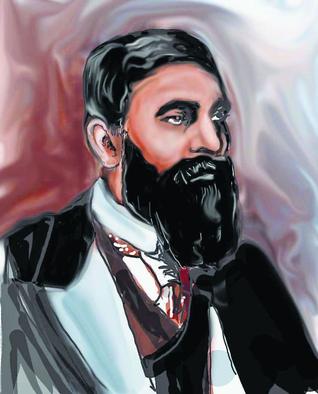
Gobbling up key links to history

Hubli :

Deep within the suburbs of Unkal in the city lies a key relic of our rich architectural history — the Chandramouleshwar temple — forgotten by many and being usurped by the unscrupulous. The temple, which dates back to reign of the Badami Chalukyas in the 11-12th century, has been crying for attention for years now, but no concrete measures have been taken to protect the historical monument despite the Archeological Survey of India (ASI) designating it as a protected monument under the Ancient Monuments and Archaeological Sites and Remains Act,1958.

Over the years, the land on which it stands has also been allegedly encroached upon by villagers.

Unkal was a border area between the Hoysala and Chalukya empires. The Chandramouleshwar temple, therefore, bears resemblance to both Hoysala and Chalukya styles of architecture. Its unique plus-shaped plinth sets it apart from other temples in the state, claim experts.

A facade of promises

The temple has about 4-5 acres of land around it, but most of it has allegedly been encroached upon by villagers. ASI had woken up to such encroachments five to six decades ago, had conducted a survey and planned a renovation of the temple. But, it then placed all plans on the back burner.

C B Marigoudra, a retired teacher and historian, recalls that the temple was declared a historical monument by ASI around 50 years ago. “But, no steps for development have been completed to date.”

Around five years ago, ASI again took a shot at reining in encroachments by constructing a wall around the site. But work on redevelopment came to a grinding halt a few years ago, alleges Marigoudra.

P S Parvati, a retired officer of information and broadcasting department, says the district administration had sent a proposal to the state government around two years on developing the temple, improving road connectivity to it and providing other facilities to visitors. That file has been gathering dust. “Citizens are forgetting the importance of the temple. Many people don’t known that such a historical monument is located right in our city. There is a need to renovate the temple and create awareness about its importance among the people,” suggests Parvati.

M S Koravi, a former corporator, says ASI had served notices to residents who had encroached upon the land a few years ago. But that zest fizzled out soon. “No action was taken by the department against the encroachers. If ASI wants to clear the encroachments, it should provide alternative rehabilitation to the residents. Only then should it develop the city’s only historical temple,” recommends Koravi.

J Ranganath, assistant superintending archaeologist engineer, ASI, Dharwad division, points at half-hearted measures taken: construction of a compound wall and a watchman to keep an eye on the temple. “The ASI division will soon get funds, with which we will take up renovation in two to three months. There is a technical problem with removing encroachments and that will looked into as well,” he claims.

source: http://www.timesofindia.indiatimes.com / The Times of India / Home> City> Hubli / TNN / August 07th, 2014

British Baptist Missionary William Carey to be remembered on his 253rd birthday

Kolkata :

British Baptist Missionary William Carey, who was the driving spirit behind the spread of modern English education in Kolkata, will once again be remembered on his 253rd birthday on August 17. The Bible Society has organised for a Carey Lecture to be delivered by Jawhar Sircar, the CEO of Prasar Bharati.

Sircar has been researching on old Kolkata for a long time and will focus his lecture on the Bengal Renaissance and the role of Carey behind it.
This will be followed by a dance drama, Dhrubojyoti Tumi directed by danseuse Alaknanda Roy. The performers are inmates of correctional homes.

source: http://www.timesofindia.indiatimes.com / The Times of India / Home> City> Kolkata / by Jhimli Mukherjee Pandey, TNN / August 07th, 2014

Top Gear’s ‘best taxi in the world’ to cease production

AmbassadorKOLKATA03aug2014

Originally based on the Morris Oxford, the Ambassador has been manufactured by Hindustan Motors in India since 1948.

The car manufactuer has announced that it will suspend production at its plant in West Bengal. Few see it returning to Indian roads, as more efficient, modern cars have taken over the market.

This car ruled Indian roads for the first 40 years, becoming a symbol of power and influence. By the end of the 1970s, it had a market share of 75 percent.

The entry of Suzuki though a local joint venture with Maruti, changed all that and by 1992, Ambassador’s share dropped to 20 percent.

Lack of investment, a militant workforce, an ageing plant and lack of interest and vision by the owners are cited as resons for the demise of this car.

In teh 1990s, Hindustan Modors enterd into a joint venture withGeneral Motors to manufacture and sell Opel vehicles. There was also a collaboration with Mitsubishi Motors to manufacture the Lancer. But none of these ventures took hold.

In a statement, Hindustan Motors blamed the shutdown on “worsening conditions at its Uttarpara plant which include very low productivity, growing indiscipline, critical shortage of funds, lack of demand for its core product the Ambassador and large accumulation of liabilities”.

Only 2,200 Ambassadors were sold in 2013-14; a small fraction of the 1.8 million passenger cars sold in India.

In a show, which was aired on the BBC last year, Top Gear organized a world taxi shootout in which Ambassador emerged a winner, beating competitors from all over the globe.

The Top Gear team’s verdict? “If performance is getting to your destination at some point of time, yeah, this is quite a performer.”

As reported in The Economic Times, Nida Najar notes: “Drivers complain that pedals break off after a few thousand miles, that the air-conditioners malfunction. Some use turmeric to stop up holes in the radiator; anything to avoid servicing with expensive and increasingly rare parts. Many carry water bottles to cool off radiators that frequently overheat.”

source: http://www.ferret.com.au / Ferret / Home / by Kevin Gomez / July 03rd, 2014

Toto language more endangered than tribe

Researchers and even the members of Toto community admit that the language is under threat and influence of others languages. File photo: Sushanta Patronobish / The Hindu

Language of primitive tribe has no script and is under influence of Nepali and Bengali: researchers

When scientists of the Anthropological Survey of India (AnSI) set out to conduct a study on language of the primitive Toto tribe, whose population has dwindled to 1,536, they did not realise that the language is more endangered than the tribe itself.

During their study they recorded the vocabulary, folklore, and even some songs in Toto language, and realised that the language has no script.

For centuries, the language that belongs to the Tibeto-Burman group of Indian languages, has survived in the small community completely orally without much research, Asok Kumar Mukhopadhyay, research associate, Linguistics (AnSI), one of the prominent members of the research team, who visited the hamlet of Toto tribe, told The Hindu.

“Being a small community, we found that the Totos communicate among themselves in their own language, but the moment they leave their hamlet of Totopara in Madarihaat block of Alipurduar district, they prefer to not communicate in the language even among themselves,” Mr. Mukhopadhyay said.

Under threat
Researchers and even the members of Toto community admit that the language is under threat and influence of others languages, particularly Nepali and Bengali, is increasing day by day.

Interestingly, despite the language lacking a script, members of the community, whose literacy rate as per a sample survey carried out in 2003 was just 33.64 per cent, have penned books and poems in their language albeit in the Bengali script.

Dhaniram Toto, one of the members of the community, has written two books in Toto language over the past two years.

Mr. Toto claims his book, Lokeswar, is about the folk culture of Totos and his other book Uttar Banga Lokpath is about folk tales of the community.

“Since our language does not have a script, I have to take help of the Bengali script,” he says, adding that there is an urgent need to develop a script for the language.

Mr. Toto, who is employed in West Bengal’s Backward Class Welfare Department, says there are others in the community such as Satyajit Toto, who write in the language taking the help of scripts of other languages.

Keep it alive
Their aim is just to keep the language alive. “We carried out this study to keep record of the language. It may happen in a few decades that the language may get extinct. The study of the Toto language is essential to understand the overall cultural ambit of the primitive tribe,” said Kakali Chakraborty, head of office, Eastern Regional Centre of (AnSI).

Day labourers
Totos, one of the primitive Himalayan tribes in the country, usually work as day labourers and porters carrying oranges from Bhutan to the local market in north Bengal.

Despite the geographical isolation of Totopara, the members have started laying emphasis on education, resulting in about half a dozen of graduates, which includes girls. But the elders point out that despite a number of schools being present in the locality, there is no one to teach the children in their own language, and as a result, the children are losing touch with their culture.

source: http://www.thehindu.com / The Hindu / Home> News> Cities> Kolkata / by Shiv Sahay Singh / Kolkata – August 01st, 2014

The Lede – Test of Metal : The Indian origins of a famous rugby trophy

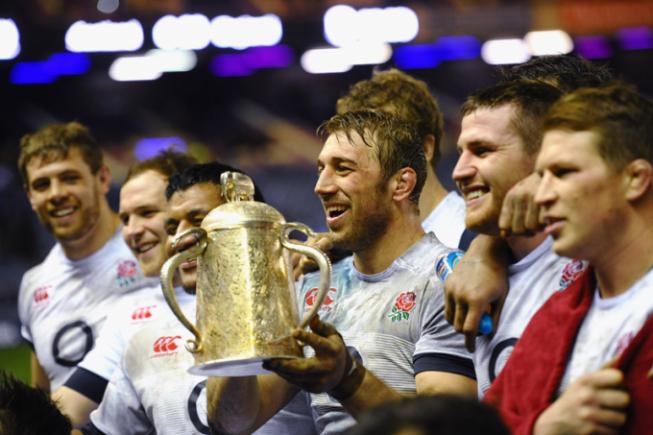
Chris Robshaw, the captain of the English rugby union team, holds the Calcutta Cup, which England retained in February - / Photo : Laurence Griffiths / Getty Images
Chris Robshaw, the captain of the English rugby union team, holds the Calcutta Cup, which England retained in February – /
Photo : Laurence Griffiths / Getty Images

On 8 FEBRUARY, before a crowd of 67,144 people, Scotland faced England at Murrayfield Stadium in Edinburgh as part of the 2014 Six Nations rugby championship. After 80 minutes of play on a muddy pitch, England secured an authoritative victory, with a score of 20–0. As disappointed home supporters filed out, up in the main stand Chris Robshaw, the jubilant English captain, held aloft an intricately engraved silver trophy, with three handles shaped like cobras and an elephant figure crowning its dome-shaped lid: the Calcutta Cup, the oldest trophy in international rugby.

The trophy Robshaw received was, in fact, a replica of the original cup, which is stored in the World Rugby Museum in Twickenham, near London. The museum’s curator, Michael Rowe, told me over the phone that although the cup’s significance has decreased in recent years, it was incredibly prestigious in its heyday, when it was “the Ashes in the sport of rugby.” What is most remarkable, Rowe said, was that the trophy’s origins can be traced back to the largely forgotten history of rugby in colonial India.

In the winter of 1872, a group of British émigrés having a hard time adjusting to life in Calcutta published letters in the Englishman, a prominent newspaper, asking that the administration organise rugby matches. A game was played on Christmas Day that year, with English players on one side and those representing Scotland, Ireland and Wales on the other. There is no record of who won, but the event was a success, and was repeated the following week. Those two matches led to the formation of the Calcutta Football Club in January 1873 (at the time, rugby was one of several related games called “football”). The club thrived—137 members joined in the first year alone—and it joined the Rugby Football Union, the sport’s governing body for all British territories, in 1874.

After a successful start, however, the club fell on hard times. A regiment of the British army left the city for a new posting, and new British arrivals were more interested in polo and tennis. According to Rowe, funds soon started running out, forcing the closure of the club’s free bar, which caused the membership to drop substantially. GA James Rothney, the club’s treasurer, secretary and team captain, considered several fundraising suggestions, but concluded that none of them would keep the club going.

Then, Rowe told me, in 1877, Rothney had an “ambitious” idea. He wrote to the Rugby Football Union suggesting that, to preserve the memory of the club, its remaining funds be used to make what he described as a trophy of “ornate Indian workmanship,” to be “devoted to the purpose of a Challenge Cup and presented to the Rugby Union to be competed for annually” in any way deemed “best for the encouragement of Rugby Football.” Both the Union and the club’s members agreed. Rothney withdrew the club’s remaining £60, a substantial sum at the time, in the form of 270 silver rupee coins. These were melted down in September 1878 by WE Jellicoe, a British silversmith and watchmaker on Calcutta’s Esplanade Row, to create the Calcutta Cup.

The cup was taken to Britain, and in March 1879 the Union organised the first Calcutta Cup match—a game in Edinburgh between England and Scotland, which ended in a draw. The contest was repeated in every following year, and the cup, Rowe said, quickly “became eponymous with the England–Scotland rugby game.” In 1883 it was incorporated into the Home Nations Championship, which eventually became the Six Nations—an annual rugby union competition involving France, Italy, Scotland, Wales, England and Ireland that is effectively the sport’s European championship. The cup has been contested every year since, except during the World Wars. England has won 68 of the 121 matches to date, with Scotland winning 39 and 14 matches ending drawn. England has retained the trophy since 2009.

Today, the original trophy is treated with special care. In 1988, on the night after England retained the cup, two drunk players, one English and the other Scottish, took it out onto the streets of Edinburgh, where they passed it between themselves and dropped it several times. The cobra handles were crushed, and the body and base badly dented. The Edinburgh jewellers Hamilton & Inches restored the cup to its original form, but, as Rowe told me, “silver is a soft metal,” and the restoration left the cup “in a fragile state.” The incident led to a decision to give both nations replica trophies, and store the original at the World Rugby Museum to avoid any further damage.

Rowe said that with the rise of other rugby-playing nations, the England–Scotland rivalry has mellowed in recent years, and so reduced the significance of the Calcutta Cup. But, he added, Rotheny’s idea to entwine the memory of the Calcutta Football Club into the history of rugby was a success. “It is quite remarkable that a short-lived club has such a place in the history of the sport,” he said.
_________________________________________________________________________

Atul Dev is a correspondent with The Sunday Guardian.
_________________________________________________________________________
source: http://www.caravanmagazine.in / The Caravan / Home> Reporting & Essays> The Lede / by Atul Dev / 2014

Prince Dwarakanath lies forgotten in a corner of London

On August 1, 1846, a treacherous thunderstorm raged through London. ‘Vivid flashes of lightning’ struck, the wind howled, and in a hotel room, very close to Bond Street, a ‘Prince’ died. Dwarakanath Tagore was only 52 when he died in the company of just two members of his vast family — a son and a nephew.

Four days later, they buried him, without ceremony in Kensal Green Cemetery. Among the mourners were his youngest son Narendranath, nephew Nabin Chandra Mukherji, four medical students who had accompanied him on his trip to England and his former partners Major Henderson and William Prinsep. Queen Victoria and Prince Albert — who had welcomed him to their court like ‘an old friend’ just over a year ago — sent four carriages. It was a princely send off.

Whatever may have been his reputation back home, in London Dwarakanath was the darling of fashionable society. He gave lavish parties, dined with royalty in England and France, showered his friends and hosts with expensive gifts and gave generously to charities. He was immensely popular with European ladies and made no attempt to conceal his many ‘friendships’. He even kept a boat on the Thames with a certain Mrs Caroline Norton — a divorced, small-time Victorian poet of some ‘beauty and wit’ — where he hosted the literati of the day from Charles Dickens to WM Thackeray.

It is all a very different picture today. Although, the city that he so loved continues to remain popular with most of his fellow countrymen, not many people come to see him. We took the Bakerloo Line on the Underground, got off at Kensal Green Station, and turned left. It was late September and the trees had started changing colour. Kensal Green is huge — 72 acres in fact — and is one of London’s oldest and most distinguished public burial grounds. It has many celebrated residents from scientists, botanists, actors and royalty — Ingrid Bergman and Freddie Mercury among them.

But just as we walked though the very impressive archway of the main gate, we realised we were quite lost. In the absence of any map or directions it was near impossible to find Dwarakanath. Although I knew what his grave looked like, I had no idea where it was. And there was not a soul in sight. A little later, a group of Americans ambled in for a guided walk with a ‘Friend’ of Kensal Green. And this ‘Friend’ – locals who volunteer their time – showed us the way.

Just yards from the main gate, where we had been rummaging the last half hour, lay Dwarakanath. The ground was a little sunken. The grave, simple and grey, simply said ‘Dwarkanath Tagore of Calcutta’. Obit 1st.

The ‘Friend’ who knew a bit about the man seemed curious in our interest. “Nobody visits him these days. Not even on his anniversary. You would think someone from the Indian High Commission or his fellow Bengalis would come to lay flowers. But, I have seen no one.”

Standing there — a little overgrown and overlooked by numerous other graves of different ages — it is difficult to imagine the life and times of Dwarkanath Tagore, once the ‘most prominent citizen’ of Calcutta and the leading force behind the first joint-stock commercial bank in India, Union Bank. Pioneer, philanthropist and partner in Carr, Tagore and Co, Dwarkanath dabbled in everything from customs, salt, tea, coal and steam navigation to indigo and sugar plantations and opium. A great friend of Rammohun Roy, he was a strong voice behind the anti-Sati movement, freedom of Press in India and women’s education. Never shy of controversy, he was almost the self-styled mayor of Calcutta at one point.

The hotel where he died still stands, although under a different name. Brown’s Hotel on 33, Albermarle Street is now a luxury five-star hotel in Mayfair. A room for a night costs anything between £460 and £3,000 and a Sunday three-course lunch for two will set you back by £100. A stay fit for a ‘Prince’ indeed.

— The author is a former journalist who has worked for British and Indian newspapers. She now works at Bath Spa University

source: http://www.timesofindia.indiatimes.com / The Times of India / Home> India / TNN / August 01st, 2014

Feast of Jesuit founder today

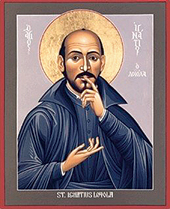
The 20,000 Jesuits and their institutions all over the world celebrate the feast of their founder, St. Ignatius of Loyola, on July 31.

FatherIgnatiusKOLKATA31jul2014

Ignatius was an unusual character of the 16th century, a brave knight and soldier under King Ferdinand of Spain. In 1521, he was wounded in the battle between France and Spain. His life was transformed during his long convalescence and he founded the Jesuit Order, the Society of Jesus, along with Francis Xavier at the University of Paris in 1537, which was approved by the Pope in 1540.

Perhaps Jesuits impart the best-known education in India and elsewhere. They have come to be known in the public mind for their educational work and have acquired the reputation of being among the world’s best educators and educationists.The Jesuit educational network is the largest in the world today.

The Jesuits conduct no less than 50 university colleges, 17 institutes of business administration and 210 high schools across the country; almost all of them are among the most reputable ones. More than 500,000 students belonging to every religious, linguistic and socio-economic group, receive their education at these institutions.

The situation is the same wherever the Society of Jesus has established itself for the greater glory of God. There are 28 Jesuit universities in the US.

As Malachi Martin has said in his book, The Jesuits, “Jesuits always aimed to be the best. And they were. They had a part to play in every major political alliance in Europe and America, in Asia and Africa. They became shapers not only of religious history, but also of world history. Even Nazi generals (incl. Hitler) dreamed of such a cadre of men; and even Lenin envied them.”

Historian Romila Thapar has stated that if India has a written history; the credit goes to the Jesuits.

St. Xavier’s college and school will remain closed on July 31 in honour of their founder. Here’s wishing all Xaverians, present and past, a very happy feast of St. Ignatius of Loyola.

The writer is the principal of St. Xavier’s College, Calcuta
source: http://www.telegraphindia.com / The Telegraph, Calcutta / Front Page> Calcutta> Story / by Fr. Felix Raj / Thursday, July 31st, 2014

Couple on clue chase track photo sites

PhotosBengalKOLKATA21jul2014

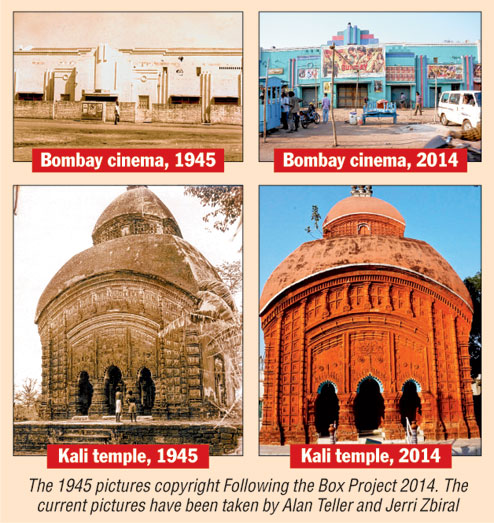
The photographer and artist couple Alan Teller and Jerri Zbiral have unearthed a wealth of stories while chasing clues to identify the places in photographs of Bengal taken by an unknown American in 1945.

“Astonishing” was how the American couple described their weeklong sleuthing across Kharagpur, Salua and Pingla in West Midnapore, helped by two IIT Kharagpur students, Subhajyoti Ghosh and Siddharth Agarwal.

Metro had on February 26 reported on Alan and Jerri’s research — funded by Alan’s 2013 Fulbright-Nehru senior scholarship — into the background of a bunch of black-and-white photographs found in a box they had picked up for $20 at an estate sale in Chicago.

In the box were photographs of six temples, three of which the couple have located in Kharagpur — Balaji, Kali and Nandeswar. One they had traced three years ago. “The Nandeswar temple has a new portico which destroys the façade’s splendour,” said Jerri.

The couple have identified the man standing beside the Balaji temple in one of the photographs. “He was A. Narayan Swamy Naidu, the priest of the Balaji temple. He had founded the temple in 1935. We met his great-grandson Raju Naidu and daughter-in-law Padmavati, who is over 80 now. She became emotional when presented with a copy of our 1945 photograph,” said Jerri.

A movie theatre in one of the photographs has been identified as Bombay cinema in the railway town. Residents who were shown two photographs of markets suggested that one is the sprawling Golbazar in the heart of the town and other is located in Salboni, around 50km from Kharagpur.

Alan and Jerri have learned that the photographer was attached to a regiment of American soldiers stationed in Salua — around 5km from Kharagpur — which functioned as an airbase during World War II. Since 1949, Salua has been the headquarters of the Eastern Frontier Rifles (EFR). Gorkha personnel of the EFR helped the couple identify a laundry, a wall and a pond seen in some of the pictures.

“We have come to know that at the Salua base African-American soldiers were housed outside the main camp, segregated from the whites. That is not surprising as the US army wasn’t integrated till the 1950s. What is surprising was that the black soldiers were housed next to the munition storage areas. So if the Japanese bombed the area, wouldn’t they be the first to suffer a direct hit?” asked Alan.

“The whole issue of American presence in Kharagpur is shrouded in mystery,” he said. The couple have come across brief mention of their presence in documents at the Nehru Museum of Science and Technology, housed in a sprawling Raj-era building where the country’s oldest Indian Institute of Technology was inaugurated in 1951.

Under the British rule, the building had served as a jail for political prisoners — Hijli Detention Camp — and later as the command post of the American airbases in the region.

“We know that the Americans were doing reconnaissance work anticipating a Japanese land invasion but are uncertain about some details relevant to our search, such as why our photographer left his base and wandered around clicking all those photos of village life and temples and people with what was then a cumbersome camera. India’s role in World War II is still foggy and our search will perhaps clear up some areas. We’re seeking permission to gain access to the interior of the Salua base,” said Alan.

The couple will submit an application to the American authorities under the Freedom of Information Act for the release of documents related to the Hijli Detention Camp/Command Post and the Salua base, so they could draw a clearer picture of the photographer.

The couple’s last stop in their search was Naya village in Pingla (50km from Kharagpur), where they commissioned two jorano pats (narrative story scrolls unfurled to the accompaniment of songs) by patua Swarna Chitrakar, based on the 1945 pictures. “She has constructed a personal narrative based on a dozen or so photographs,”said Jerri.

The couple will deliver a lecture on the photographs and their search for the locations at the Victoria Memorial Hall at 5.30pm on Monday.

source: http://www.telegraphindia.com / The Telegraph, Calcutta / Front Page> Calcutta> Story / by Sebanti Sarkar / Monday – March 03rd, 2014