Category Archives: Historical Links / Pre-Independence

Treasures of Bengal Renaissance on display till Jan 28

Kolkata :

An exhibition of rare colour etchings, manuscripts, letters and documents at the Sadharan Brahmo Samaj Library at Bidhan Sarani has brought alive the Bengal Renaissance — the days of Raja Ram Mohan Roy and Rabindranath Tagore, the two doyens of Bengal’s socio-cultural resurgence.

The exhibition, which will continue till January 28, is part of the 185th Maghotsava celebration, an annual event of Sadharan Brahmo Samaj. Some of the artifacts being exhibited are rare etchings that capture early-19th century life and rituals in Kolkata. None of these etchings, done by European artists, were formerly available in India. Art restorer and archivist Ganesh Pratap Singh painstakingly bought these back from different international auctions.

“These are our treasures of our country, lying with personal collections mostly of Europeans and Americans. Once they are up for sale, I don’t lose a moment in buying them back,” said Singh, who for the first time is showcasing his treasure trove, which includes Tagore’s rare photographs. An original deed of a loan agreement of Tagore during the 1900s is also part of the exhibition. “Tagore probably took the loan for his family business,” Singh said.

The colour etchings are the most remarkable portrayals of socio-religious life of Kolkata and Bengal in the early-19th century. There are scenes of Charak Utsav, from markets and a series on the custom of ‘sati’, where a widow would be burnt alive on her husband’s pyre. Father of Bengal Renaissance, Ram Mohan Roy, took the lead in abolishing this custom. Several letters written by Ram Mohan and Keshav Chandra Sen are also on display.

“We have also brought some of the pieces from our own collection at Ram Mohan Library,” said Subrata Dutta, joint secretary of the Samaj. The Brahmo Samaj Library in itself is a historic place visited by the who’s who of Bengal Renaissance for intellectual exchanges.

“The formative years of people like Sukumar Ray were shaped here,” said Bijon Chanda, another joint secretary and key custodian of the 25,000 rare books, manuscripts and photographs. But January 26 is a special day when Brahmos from different corners of the country would meet at the majestic prayer hall to pray for peace.

Sudin Chattopadhyay, a former professor of history at the then Presidency College, was delighted to see the etchings and pointed out that their depiction of ‘sati’ was still relevant for the current generation. “The word ‘sati’ now does not bring the horrible picture of the custom to one’s mind. The current generation that only has textual knowledge of the custom will get a glimpse of how horrible the practice was after seeing these paintings,” he said.

source: http://www.timesofindia.indiatimes.com / The Times of India / Home> City> Kolkata / TNN /January 25th, 2015
Hazarduari gets ‘Adarsh’ tag from ASI

Kolkata :

Hazarduari Palace in Murshidabad has been declared an Adarsh Monument by the Archaeological Survey of India (ASI) along with three others in eastern India.

The other three monuments are Vaishali-Kolhua in Bihar, Rang Ghar in Assam’s Sibsagar and the Konark Sun Temple in Odisha. These
will be in the focus of international tourism promotion plan developed by the central government.

ASI has selected only 25 out of 3,680 protected monuments under the Adarsh Samarak Yojona. The list was made on the basis of the number of tourists these monuments attract annually. The list includes some of the biggest crowd-pullers like Taj Mahal, Khajuraho, Qutab complex and Red Fort.

All of them can be of great interest to international tourists, believes the ministry of culture. “Keeping that in mind, we are developing amenities of international standards, including washrooms, drinking water, signs, cafeterias, audio-visual centres, Wi-Fi connectivity, interpretation centres and encroachment-free areas,” said ASI regional director (eastern region) P K Mishra.

But more than anything else, security will be enhanced. The Centre is thinking of introducing the ‘tourism police’ force that is quite common across the world.

Hazarduari Palace, earlier known as Bara Kothi, is located on the campus of Kila Nizamat in Murshidabad, on the banks of the Bhagirathi. It was built in the early 19th century by Duncan MacLeod under the reign of Nawab Nazim Humayun Jah of Bengal, Bihar and Orissa (1824-1838). In 1985, the palace was handed over to ASI. Kila Nizamat or Nizamat Kila was the old fort of Murshidabad which was demolished to build this grand palace.

Built in the 13th century, the Konark Sun Temple is shaped like a chariot of the Sun God with 12 pairs of ornamented wheels dragged by seven horses.

Rong Ghor, meaning ‘House of Entertainment’, is a two-storied building that used to serve as the royal sports pavilion. Ahom kings and nobles used to watch buffalo fights and other sports at Rupahi Pathar in Rangpur, particularly during the Rangali Bihu. Said to be one of the oldest surviving amphitheaters in Asia, the building was constructed during the reign of Swargadeo Pramatta Singha in 1744-1750.

Kolhua in Vaishali is where the Buddha is said to have preached his last sermon. To commemorate the event, emperor Ashoka erected one of his famous lion pillars here in the third century BC. A hundred years after the Buddha’s death, Vaishali hosted the second great Buddhist council. Two stupas were erected to commemorate it.

Jainism, too, has its origins in Vaishali. In 527 BC, Lord Mahavir was born on the outskirts of the city and lived in Vaishali till he was 22. Vaishali remains an important pilgrimage centre for both Buddhists and Jains.

source: http://www.timesofindia.indiatimes.com / The Times of India / Home> City> Kolkata / by Krishnendu Bandyopadhyay, TNN / January 11th, 2015

Anthology on Jesuit Fathers’ contribution

The Goethals Indian Library and Research Centre of St. Xavier’s College has published a book on the lives of the Jesuits who lived and worked in India, especially in Bengal, since the early 19th century.

The anthology was released by Father P. Franck Janin, Jesuit Provincial, South Belgian Province and Luxembourg, at Dhyan Ashram in Joka on Sunday.

Edited by Father Albert Huart and Father J. Felix Raj, Discovery of Bengal: The Jesuit Design marks the 200th year of the Restoration of the Society of Jesus. The book records the academic, social, cultural and spiritual contributions of the Jesuit fathers in shaping the moral growth of the race and the country.

Among the Jesuits who feature in the book are Fathers Henry Depelchin, Achille Verstraeten, Paul Joris, Cardinal Lawrence Picachy, Camille Bouche and Andre Bruylants.

“They attracted heartsby the qualities they displayed and posterity retains them as lessons of life learnt forever. Even after 200 years, their words and works reach those for whom they were intended – the inhabitants of The Kingdom of God. These men of moral might were armed with supreme sense of sacrifice and were gifted with grace and the zeal to establish ‘Good News of God’ and the promise of justice for humanity,” said Felix Raj, the principal of St. Xavier’s College.

“Humility, fortitude, power of prayer and passion for performing God’s will on earth endowed these Samaritans with the benediction that brought the light of the Lord to the masses of Bengal. This collection scripts the eternal immortal lives of the Jesuits who are today and forever in fellowship with us and with God.”

Copies of the anthology are available from the Goethals library at the college.

source: http://www.telegraphindia.com / The Telegraph, Calcutta / Front Page> Calcutta> Story / by Staff Reporter / Monday – December 29th, 2014

History in mint condition

Coins from Bengal are on display as part of Mudra Utsav, the annual exhibition and conference organised by Numismatic Society of Calcutta, at Haldiram Banquet Hall in Ballygunge till Sunday.

“Coins make history speak. They are not just a means of exchange but also a store of value. Their metallic quality helps judge the economic state of a reign while their spread indicates how far a ruler’s sovereignty extended,” said former finance minister and economics teacher, Asim Dasgupta, at the inauguration. He also referred to remarkable work by the numismatist fraternity, singling out Bratindra Nath Mukherjee’s discovery of an ancient script called Shell lipi.

Chhanda Mukherjee, former deputy keeper, numismatics and epigraphy, at Indian Museum, referred to areas in Bengal such as Chandraketugarh, Murshidabad and Pandua-Mahanad area of Hooghly where coins have been found. “The earliest hoard of Gupta coins was found right here in Kalighat,” she said.

Some of the coins mentioned by Mukherjee are on display at the exhibition. Ujjwal Kumar Saha’s Gupta coins date back to the reigns of Samudragupta and Chandragupta I. There are also gold dinars of the Kushan era. Somnath Basu’s collection is on independent rulers of Bengal, from Fakr al Din Mubarak Shah (1334-1349) to Daud Shah Karanani (1572-1576). Ravi Shankar Sharma has displayed Mughal coins from Bengal mints. There are Akbar rupees minted in Satgaon (also known as Saptagram, now in Bangladesh) and in Bang, a soobah of Bengal. “These coins were minted after Akbar’s conquest of Satgaon,” Sharma said.

Mints were there in Patna too, built by Magadh ruler Ajatashatru around 490 BC. A Shah Jahan rupee represents the Patna mint. The only Mughal coin in Bengali script was issued from Alamgirnagar, Aurangzeb’s name for Cooch Behar. “The coin is rare as the area changed hands soon,” Sharma added.

The East India Company, too, had issued bilingual sikkas, with both Bengali and Persian scripts, from their Benaras, Farukabad and Calcutta mints once they realised the Shah Jahan II Mughal coins that they had been copying did not suit the largely Bengali-speaking populace of the Bengal Presidency.

Another notable exhibit is a punch-marked coin from the Bari-Wateshwar area of present-day Bangladesh. Carrying a sun, a boat, an open cross and a six-armed symbol, the silver alloy coin dates back to 3rd to 2nd century BC. “I procured the coin just last week,” said Anup Mitra, president of the society.

Collectors of coins and stamps will also find a lot of interesting items on sale at stalls put up by dealers.

source: http://www.telegraphindia.com / The Telegraph, Calcutta / Front Page> Calcutta> Story> Caleidoscope / Sunday – December 28th, 2014

Researchers trace 57 addresses of Tagore

Kolkata :

“All our dwelling places contain varied partnerships of love…” Tagore wrote in 1935. What about is own spaces? Have they withstood the onslaught of time?

Not quite. One of the revered addresses that have been deleted forever is 49 Park Street where ‘Gitabitan’ and ‘Mayar Khela’ were composed. Researchers have recently recorded 57 places where the bard lived. Sixteen of them were in Kolkata, 14 in the Hills and 27 in south Bengal.

In a prelude to an ambitious heritage-tourism project of the government titled Tagore Circuit, history professors Shouvik Mukhopadhyay, Partha Sankha Majumdar and Ramanuj Mukherjee, at the behest of the West Bengal Heritage Commission (WBHRC), have come up with dates, anecdotes, addresses and several startling revelations about the poet.

Take Birjitalao where ‘Raja O Rani’ was staged and Tagore played Bikram in the 19th century. Wife Mrinalini played Narayani — her only stage appearance. The poet would frequent this house, rented by brother Satyendranath, next to the St Paul’s Cathedral.

“Indira Devi in her memoirs attests that the present day Calcutta Club was located on this land,” reads the study in its avatar as a coffee-table book. Chief minister Mamata Banerjee has a foreword: “Tagore has stayed in many different places which have earned for themselves the distinction of being temples of creativity, knowledge, literature, beyond any parallel.”

WBHRC chairman Shuvaprasanna writes: “The history of these abodes… testifies to the insight of a complete artist… throw light on the mental upheaval of a creative person who was never confided to a single place.”

Tagore would keep visiting the Hills; some of these structures continue to exist. The house that Scottish shipping magnate Daniel Hamilton built for the poet at Gosaba is one of the best maintained structures. But 16 such dwellings in Kolkata don’t exist any longer. The list includes 52/2 Park Street, 50 Park Street, 14 Lower Circular Road (now AJC Bose Road) and 237 Lower Circular Road. Soon after his marriage, the poet started living here and Mrinalini was admitted to Loreto House. Tagore wrote ‘Chhobi O Gaan’ here. Businessman Naliniranjan Sarkar later erected a building here. It’s now the Kolkata Police’s Foreigners Regional Registration Office.

“In a country like ours, it’s not possible to protect such buildings unless they are enlisted. The research on Tagoreean abodes is a significant beginning for such initiatives,” said Partha Ranjan Das, member, WBHR.

Places like 10 Sudder Street where Tagore lived with Jyotirindranath and his wife Kadambari Devi continue to exist. But the only trace of Tagore here is a plaque that reads that ‘Nirjharer Swapnobhango’ was composed here. After changing hands, the building is now Hotel Plaza.

The grand exception is the Art College, an enlisted heritage building. From 1928, the poet frequented the residential quarters of then principal Mukul Dey here and exhibited his paintings in February, 1932.

“His journey was external, physical as well as internal. The constraint of space often made him impatient and he continuously changed his locations, not only by moving outside but also relentlessly changing his dwelling places. Fluidity was integral to his creative genius,” write the researchers.

“The research is our labour of love, but there’s no stopping here. We are working on how the constant change of residences played a crucial role in Tagore’s creative genius,” said Mukhopadhyay. Both he and Majumdar have studied in Santiniketan.

source: http://www.timesofindia.indiatimes.com / The Times of India / Home> City> Kolkata / by Ajanta Chakraborty, TNN / December 28th, 2014

Sarat library without a librarian

Sarat01KOLKATA14dec2014

Factfile

Name:Sarat Smriti Granthagar
Estd: 1956
Address: Village and PO – Panitras, PS – Bagnan
No. of members: 1,029
Membership fees: Rs 2 per month for general members, free for children
Rare books: Collection of old volumes from Sarat Chandra Chattopadhyay’s personal library

Panitras in Bagnan is popularly known as Sarat Chandra Chattopadhyay’s home. Not only did Sarat Chandra live here, but his sister’s house was also in Gobindapur, in Bagnan. Sarat Chandra’s house in Panitras is now a tourist attraction and a heritage property. However, there are many other things in this village that are associated with the novelist. The local library is dedicated to him. It was named Sarat Smriti Granthagar by the local people, who started it in 1956. Sarat Mela is held on the ground adjoining the library.

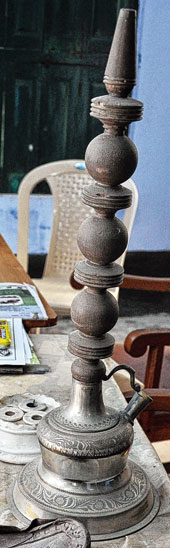
Some of Sarat Chandra’s belongings are also displayed at the library. An inkpot, a porcelain pen holder, an old pair of slippers, a torch, a hukkah and also a small wooden writing table. Although these have heritage value, the library authorities can only afford to keep these things stacked on top of an old cupboard. Interested people can take a look by bringing them down.

Sarat02KOLKATA14dec2014

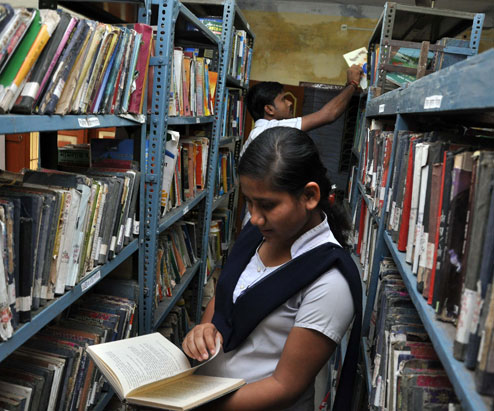
Sarat Smriti Granthagar was started by the local people who wanted to promote education in this area. Sarat Chandra being a popular figure at that time, they decided to name the library after him. It started functioning from a mud house in the locality. Some years later, in 1960, a permanent structure came up where the library now stands. In the same year, it became a government-sponsored library and in 1987 it was given the status of a town library. The total membership of the library now stands at 1,029 out of which only 235 are active members. The children’s section has 371 members, most of whom are students of the nearby schools, Panitras Boys’ School and Samta Sarat Chandra Uchha Balika Vidyalaya.

“Almost all students from the two schools come to this library for membership. Since we have a huge collection of reference books, they find it easier to study here,” said Gaurav Guria, a staff at the library. Students find this library useful since many old textbooks that have gone out of print, are available here. “Students studying in college or doing their post graduation in Bengali, often tell us that many of the texts here cannot be found in the market anymore,” said Guria. The library also has a career guidance section, which is useful to those studying for competitive exams.

Sarat03KOLKATA14dec2014

Although it is a popular library in this part of Howrah, Sarat Smriti Granthagar is operating without a librarian for more than two years. “The librarian and the assistant librarian retired some years back and both positions are lying vacant. A librarian was appointed for a year here in 2011, but after he left, no one has been appointed. The district library authorities are aware of the fact that there is no librarian at our library. However, they have not managed to appoint anyone in this position so far. So it is up to us to run the library on our own,” said Guria. The retired assistant librarian was asked to look into the running of the library, however, he could not continue due to illness.

The library has 11,245 titles. A collection of 133 encyclopaedias, gazettes and other books used by Sarat Chandra has been kept in this library. Copies of the Indian Quarterly Register and Indian Annual Register of 1920, 1925, 1929 and other years, are part of the novelist’s collection. Volumes of Nelson’s Encyclopaedia used by the author are also here. The books have been bound and preserved well. “The Howrah Municipal Corporation has taken initiative in 1999 to preserve these books,” said Guria.

Grants come regularly to the town library. It receives Rs 48,000 as annual grant. In 2010-11, the library received a computer from Raja Rammohun Roy Library Foundation (RRRLF).

source: http://www.telegraphindia.com / The Telegraph, Calcutta / Front Page> Howrah> Story / by Dalia Mukherjee / Friday – December 12th, 2014

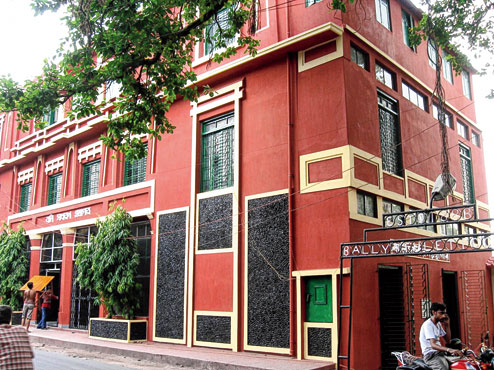
The men of Bally Granthagar

Bally01KOLKATA14dec2014

They are called ‘the men of the library’ because they are dedicated voluntary workers of the library. They help in cataloguing books, exchanging or issuing new books and even dusting the shelves — the members of Bally Sadharan Granthagar Karmisangha are as good as library staff, only they do it not for a salary but out of love for their local library.

Formed in Bengal in 1940, the group comprised dedicated library workers, who would help the library staff in all activities. The Karmisangha was formed under the leadership of Ratanmoni Chattopadhyay and the first director was Pravat Kumar Mukhopadhyay.

Over the years, Karmisangha has increased in size and activities. In 1981, when Bally Sadharan Granthagar became a government sponsored town library, Karmisangha was also registered as an association of library workers. Most of the library’s activities depend on the members of Karmisangha. The children’s section is entirely managed by these voluntary workers.

At present there are 88 members of Bally Sadharan Granthagar Karmisangha and any new entrant has to prove his or her dedication towards the library in order to be a member of the association. “Members are inducted on the basis of their dedication. Those who are regular visitors to the library and show interest in library activities are later inducted as members,” said Sumit Mukherjee, a member of the Karmisangha since 1975

Bally02KOLKATA14dec2014

“In our schooldays, our fathers or uncles would drag us to the library and make us remove the books and clean the shelves and also help in stock taking. We still do that once a year and also help the librarians and staff in indexing new books. The library is huge and the amount of work that accumulates is difficult for the staff to complete on their own,” added Mukherjee.

The traditional practice of inducting members includes taking an oath on Janmastami. “Janmastami is the foundation day of Karmisangha and new members are inducted on this day. A sloka from the Geeta on Karma is read out after which the new members take the oath,” said Utpal Kumar Mukhopadhyay, the secretary of Karmisangha.

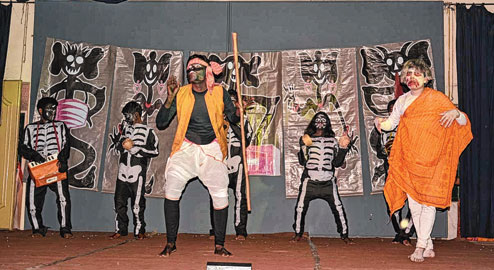
Karmisangha is celebrating its diamond jubilee this year with a variety of activities. A special screening of mountaineer trekker, Anindya Mukherjee’s cycling expedition from the Equator to the Tropic of Capricorn in Africa was done on one evening at the library seminar hall. The biggest event is the annual Soumen Charukala Utsav that continues for a month from November to December. A special workshop on masks will be held this year where school students will take part.

source: http://www.telegraphindia.com / The Telegraph, Calcutta / Front Page> Howrah> Story / by Dalia Mukherjee / Friday – December 12th, 2014

Maidan battle tank shifts to new location, Mig-27 to be part of display

Kolkata :

The battle tank that was kept on the maidan close to the east gate of Fort William (facing Park Street) has been shifted to a new location on St George’s Gate Road. The tank, a war trophy from the 1971 Indo-Pak War, has been placed on an ‘island’ between the two flanks of the road close to the head office of the Hooghly River Bridge Commissioners (HRBC).

“We plan to create a tri-services exhibit on the island. We have asked the Indian Air Force (IAF) for the shell of a Mig-27 aircraft and the Navy for an anchor. The tank, aircraft and anchor will be part of an exhibit at the spot. The HRBC has done a wonderful job at developing the island. The aircraft is expected to arrive in the next 10 days,”said Maj Gen Harsh Kakkar, chief of staff, Bengal Area.

The Army wants to put up more exhibits around the city to create awareness about India’s military history. Till now, there were two battle tanks in the Maidan area. One is the Chaffee tank that was shifted to St George’s Gate Road and the other one is a Vijayanta Tank close to Babughat. The Army has also made plans for proper upkeep of the trophies.

Chaffee tanks were made in the US and used by the Pakistan Army in the 1971 War. At that time, these were considered one of the best light battle tanks in the world. India pitted the indigenous Vijayanta tanks against the Chaffees. The Vijayantas were India’s first indigenous tanks built under licence from Vickers, UK.

“The 1971 War was fought from Kolkata but this is a city that doesnat have sufficient war trophies on display. Other cities have a large number of them. There is need to exhibit more of them in the city. There is sufficient space in the Maidan which is anyways under the control of the Army. This will be the first time that a Mig-27 aircraft will be on display in Kolkata. There are a couple of Mig-21s, one of them inside Nicco Park. The Mig-21s were used in the 1971 War but the Mig-27s came in later and were India’s first ground attack aircraft. They will be phased out soon,” an officer said.

Officers feel that government offices, educational institutions and even private establishments that have sufficient space should ask for these trophies from the Army and IAF to put up on display.

source: http://www.timesofindia.indiatimes.com / The Times of India / Home> City> Kolkata / by Jayanta Gupta, TNN / December 04th, 2014

UK scholar on indigo trail

Kolkata :

UK museum officer Helen Bradley’s quest for truth has landed her not just in Kolkata, but given invaluable insight into the atrocities committed by her British forefathers on Indian peasants in the 18th century. What began as a causal interest in the founder of Bradley’s workplace and his birthplace could well turn out to be one of the most candid versions of the Indigo Revolt (1859-61).

Bradley is the development officer, Llandudno Museum, Wales. She is on a research assignment not only on early life of Francis Chardon, son of an indigo planter, or the momentous event in history but to especially explore the potential of the indigo dye. Bradley has got a British Council grant for coming to Kolkata, seeking collaborations between her museum and the Indian Museum and the Victoria Memorial Hall (VMH).

“We want to learn more about Francis Chardon and his family, and to understand our collections better with help from colleagues in India. We are carrying out some initial research into the Chardons in India and the plantations that they managed throughout Bengal,” Bradley said, ahead of her meeting with Jayanta Sengupta, curator, VMH, on bringing Welsh and Indian museums together. She has spent hours at the National Library, the Indian Museum, Neelhat House and the VMH, compiling records on the Indigo Revolt.

Llandudno Museum was established in 1926, and Chardon was born in (then) Calcutta in 1865, to Maria and Edouard. His father, Benjamin, cousins and uncles were all indigo planters in lower Bengal, Bihar and Bangladesh between 1830 and 1890.

Chardon was born at Gallis Hotel, Dharamtala, his mother, Maria, was born on Mangoe Lane, and his father, Eduoard, lived at 5 Dacres lane. Bradley, whose week-long trip (her first to India) ends on Thursday, has clicked photographs of all these places that will figure in an exhibition on indigo in 2016, as part of project “Indigo Trail”.

The exhibition will begin at Llandudno and travel to several locations. A landscape survey and research which will include the location and layout of indigo houses and plantations will complement the exhibition. “The idea is to tell the true story of indigo – with the tales of oppression and also its significance as a time when national consciousness was growing in Bengal. We want to examine the Indigo Revolt not just from the Chardon family’s perspective, but from the ryot’s point of view — to view the picture of exploitation,” Bradley said.

source: http://www.timesofindia.indiatimes.com / The Times of India / Home> City> Kolkata / by Ajanta Chakraborty, TNN / December 02nd, 2014

‘Kolkata deserves Unesco tag’

Kolkata :

The word “Bengali” is most used in Penang, Malaysia, to refer to anyone of North Indian origin because the headquarters of Penang Presidency were located in Kolkata during the British Raj.

Such unknown facts about the heritage of Kolkata was up for discussion at the Indian Museum where the two-day annual conference of the Indian National Trust for Art and Cultural Heritage (Intach) ended on Saturday to discuss the impact of urbanization on heritage.

Many heritage conservationists and art historians converged at the Indian Museum to attend the event on Friday. Experts felt that Kolkata should find a place among the Unesco sites but unfortunately the fact that Kolkata was the centre from where the British Empire proliferated, hasn’t quite been marketed well.

“The city should make a consistent effort in getting its pivotal place in history registered in the world’s mindscape,” said historian and conservation architect from Delhi AGK Menon.

“There is a renewed interest in Malaysia in the contributions of this once capital of the British empire to the realm of art and architecture,” said Khoo Salma, a conservationist with the Penang Heritage Trust.

“Coming here almost feels like being where it all began, at least when it comes to colonial art and culture,” said Gwynn Jenkins, a cultural anthropologist working in Malaysia. Among others present were historian PT Nair, art historian Bhau Daji Lad Museum director Tasneem Mehta and art historian Saryu Doshi.

“There are heritage laws in place but they have no teeth. We are yet to see destroyers of heritage getting arrested. Promothesh Barua’s house got razed, the arch at the gateway of Bishop’s House was pulled down and nothing happened to the builder. This needs to be stopped,” said GM Kapur, Intach state convenor.

source: http://www.timesofindia.indiatimes.com / The Times of India / Home> City> Kolkata / TNN / November 23rd, 2014