Category Archives: Historical Links / Pre-Independence

Relic Hunter

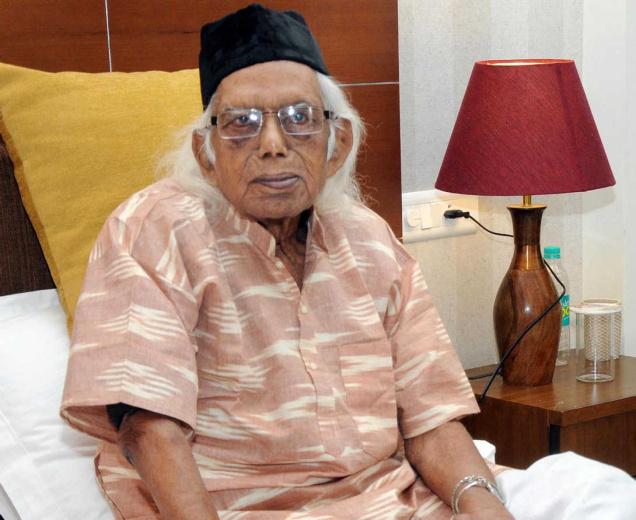
On a rainy afternoon, Chittaranjan Dasgupta sits hunched on a chair in his dimly lit room in Bankura’s Bishnupur, working on the manuscript of his latest book, ‘Dakshin Paschim Banger Itibritto’ (History of South West Bengal).

He is 90 years old. For more than 50 years, he has been working tirelessly for preserving the history of Bankura and its surrounding region. Age has not dulled his faculties.

He has authored two other books on Bishnupur’s terracotta temple art. Recently, he wrote a paper on ‘International Trade and Cultural Diffusion in Medieval Southwestern Bengal: Some Architectural Evidence’.

His son Basab Dasgupta, economic advisor with the World Bank in Washington, has sent it to the University of Cambridge.

Dasgupta’s tryst with history began in the prime of his youth. He taught Bengali at Bishnupur High School. “Those were heady days,” he recalls. “We were still basking in the glory of new-found freedom after the British left. Everyone, especially the youth, were fired by a deep passion and commitment towards our soil.” They were free spirits, too. “We would travel to villages in and around Bankura regularly. On these trips, we stumbled upon archaeological relics buried deep in the soil.”

Bishnupur, best known for its terracotta temple art and Baluchori sarees, is a treasure trove of relics dating back to the prehistoric era.

Bankura-Bishnupur’s history can be traced back to thousands of years ago, when Proto-Australoids and Proto-Dravidians inhabited the region. Bishnupur was the core of Mallabhum that in its heydays stretched up to the Chhota Nagpur Plateau in the west and Burdwan in the east.

Its monarchs were called Malla Rajas. Bishnupur saw a confluence of various religions and sects, including Vaishnavism, Jainism and Islam. Bishnupur’s kings were patrons of art, music and culture. The eponymous Bishnupur gharana originated here.

Tansen’s descendant Ustad Bahadur Khan, a musician at the court of Bishnupur’s King Raghunath Singh Deo II, established the gharana.

The writ of time, however, ensured Bishnupur’s link with its glorious past became tenuous.

In the 1940s, Jogesh Chandra Roy, who settled in Bankura after retiring as a professor of chemistry and botany from Cuttack’s Ravenshaw College, tried setting up a museum for relics, books, manuscripts of a bygone era. Around that time, the area around the Kangsabati river was being excavated. “Prof Roy was pained to see government officials and others walking away with priceless archaeological finds,” says Dasgupta. Roy then placed an announcement in a reputable Bengali magazine, seeking help to build the museum. He received no response. Then, came a band of enthusiasts who cherished their history.

Besides Dasgupta, the motley group comprised teachers, scholars, students, businessmen and government officials. They wanted to preserve testimonies of the past for posterity.

Inspired by Roy, they set up the Bishnupur chapter of Bangiya Sahitya Parishad in 1951. Dr Manik Lal Singha was a prominent member who contributed immensely to preserving Bishnupur’s history. Like Dasgupta, he, too, taught at Bishnupur High School and became the parishad’s secretary.

“In 1970s, Manik Babu discovered a Chalcolithic site at Dihar, north of Bishnupur on the north bank of Dwarakeshwar river,” Dasgupta says. Coins, beads, semi-precious stone jewellery and pottery were excavated. The find helped establish that Bankura-Manbhum-Singhbhum was the hinterland of the Tamralipta port and part of the trade route that opened into the Bay of Bengal.

Dr Singha wrote to the Calcutta University’s archaeological department, which took charge. Parishad members scoured villages to collect bits of Bishnupur’s past. “We would go to houses asking for ancient manuscripts written on palm leaves or tulot kagoj (handmade paper). These were heirlooms and several families didn’t want to part with them,” Dasgupta says.

For about a decade — from the 1980s, till he retired in 1990 — Dasgupta, like Dr Singha, travelled through villages to collect relics. They found numerous ancient stone sculptures. Coins, ornaments, pot shards, arrow heads, weapons and tools were excavated from the banks of the Kansai, Shilai and Darakeshwar rivers. “Often, we succeeded in retrieving the relics. But there were times when villagers didn’t allow us, especially if the relic was an idol of a deity who they worshipped,” he says. Gradually, when they had a collection of manuscripts, the parishad decided to set up a museum.

In January 1951, Kabishekhar Kalidas Roy inaugurated a room from where the museum began.

Later, Bishnupur’s Bhattacharya family donated about 10 bighas of land, where then Union education minister Humayun Kabir laid the foundation of the museum, Jogesh Chandra Purakriti Bhavan, in 1954. Named after Prof Roy, today it is a two-storeyed building. The state government, too, chipped in.

During the Left Front regime, the foundation was laid for a new wing. Victoria Memorial gave a grant of Rs 15 lakh for its modernization. Dasgupta is the museum’s member-secretary. The museum became a crucible of culture.

The Parishad organized various lecture series, discussions and music performances. The list of speakers had Bengal’s best — scientist Satyen Bose, author Tarashankar Bandopadhyay, scholars like Shashibhushan Dasgupta, Suniti Chattopadhyay, Sukumar Sen, Kalidas Nag, economists Ashok Mitra and Biplab Dasgupta.

Now, most parishad members are either dead or old. Lectures and performances are no longer held. “Nobody seems to be interested in intellectual pursuits anymore,” Dasgupta feels. Also, today, moving in villages in search of relics would have been tough. “Violence and suspicion stemming from politics have eroded the innocence and peace in Bengal’s villages,” he rues.

The museum boasts a collection dating back to the Paleolithic Age. There are sculptures of Jain Tirthankaras, Parasnath, Choumukha votives and Hindu gods, including Chamunda, Vishnu on Ananta Shajya, Ganesha, Kartikeya, Shankha Purush, Indrani, Pragya Paramita and Ambika. The music gallery chronicles the Bishnupur gharana, its exponents and their instruments.

Curator Tushar Sarkar and two guards are in charge of the museum. During peak season, the museum attracts about 400 visitors a day.

Yet, such priceless treasures of Bengal’s history are left practically unguarded with not even electronic surveillance or high-tech round-the-clock vigil.

source: http://www.timesofindia.indiatimes.com / The Times of India / Home> City> Kolkata / by Rakhi Chakrabarty, TNN / June 20th, 2015
India’s only double coconut tree artificially pollinated

The palm species bears largest seed known to science

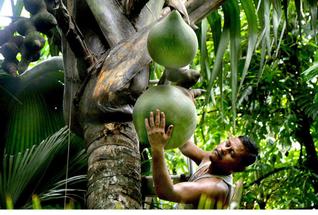
A double coconut tree stands at the Indian Botanical garden at Shibpur in Howrah district.— Photo: Sanjoy Ghosh

Scientists at the Indian Botanical Garden in West Bengal’s Howrah district have carried out artificial pollination of the only double coconut tree in India, which bears the largest seed known to science.

One of the rare and globally threatened species of palm, the double coconut ( Lodoicea maldivica ) tree was planted at the botanical garden in 1894 and the artificial pollination is a result of decades of work by scientists of the Botanical Survey of India (BSI).

“The tree took almost a hundred years to mature and when it started flowering, we started looking for this particular palm species in this part of world. We collected some pollen from palms from Sri Lanka but could not successfully pollinate it. Finally, with the help of pollen from another tree in Thailand, the pollination process was successful,” BSI Director Paramjit Singh told The Hindu .

Longest surviving palm

The Double Coconut tree not only bears the largest seed known to science — weighing around 25 kg — but this unique species is also the longest surviving palm which can live for as long as 1,000 years, he says. The palm tree also bears the largest leaf among palms and one leaf can thatch a small hut.

“Successful pollination means that we can have another Lodoicea maldivica in the country. In fact we have two fruits and it might take them another couple of years to mature,” said S.S. Hameed, BSI scientist who has been working on the pollination project since 2006.

This species of palm is diecious (where male and female flowers are borne on different plants). “Fortunately at the Botanical Garden, we had the female plant which can fruit and produce seeds,” Mr. Hameed said. The Indian Botanical Garden which serves as the repository 12,000 trees from 1,400 different species is careful in nurturing the palm.

The palm tree is located in the large palm house of the Botanical Garden which has the largest collection of palms in South East Asia with around 110 palm species.

This rare tree can be found in only two of the 115 Seychelles islands and is also called Coco de Mer (coconut of the sea), says Mr. Hameed

Legend

Legend bestows the seed with the power to bring good fortune to its owners. “There has also been a tradition of making kamandals [drinking vessels] from the double coconut by bisecting the shell. It was believed that those who consume water from these kamandals will be protected from poisoning,” Mr. Hameed said. Subsequently, sadhus started using Kamandals and it got its place in religious rituals.

source: http://www.timesofindia.indiatimes.com / The Times of India / Home> National / by Shiv Sahay Singh / Kolkata – June 13th, 2015

Kolkata’s wooden trams chug into stardom

The streetcars lend authenticity to the city’s 1942 avatar in “Detective Byomkesh Bakshy!”

An unexpected but delightful outcome of the making of Dibakar Banerjee’s film Detective Byomkesh Bakshy! that released on Friday was the rescue from obscurity of two tramcars that were used to recreate the city’s 1942 avatar.

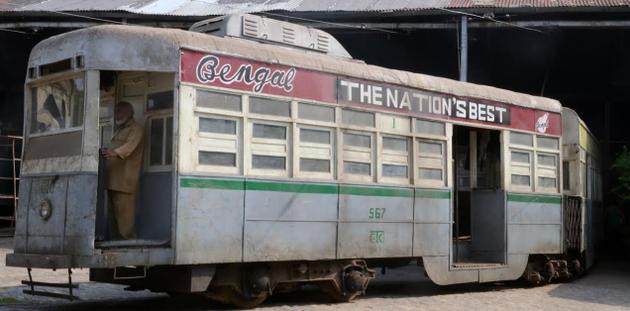
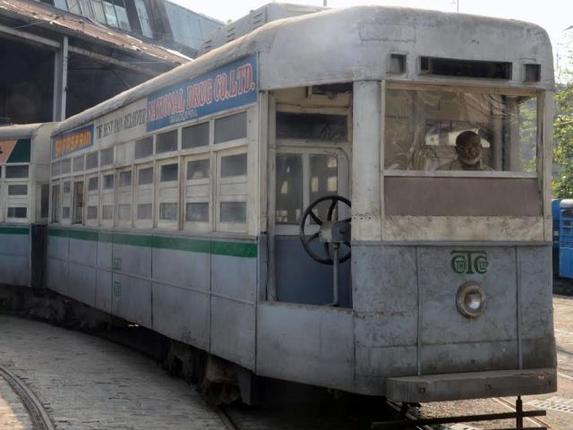
Tram No. 567, used in the film “Detective Byomkesh Bakshy!”, at the Nonapukur Tram Depot in Kolkata. Photo: Sushanta Patronobish / The Hindu

Using brands that have faded from public memory and antiquated ad campaigns, the project has revived interest in trams ‘No. 563’ and ‘No. 567’, now renamed ‘Byomkesh Bakshi’ Tramcars. The film, however, spells the detective’s last name as Bakshy.

The film used two wooden tramcars built in the 1930s and a watering car used to water the tram tracks of the city.

“The tramcar was renovated at their [the filmmakers] cost by us. They collected samples from old photographs and, accordingly, old-style branding was done on the top panel of the trams,” Nilanjan Sandilya, managing director of The Calcutta Tramways Company (CTC) Ltd. told The Hindu.

Mr. Sandilya said that trams were the main public mode of transport in the 1940s and were crucial to depict that period of the city.

Tram No. 567, used in the film “Detective Byomkesh Bakshy!”, at the Nonapukur Tram Depot in Kolkata. Photo: Sushanta Patronobish / The Hindu

The two tramcars used in the film are wooden ones that have seldom been taken out on the streets after the shooting of the film, said S.S. Ghosh, the Works Manager of the CTC. Tram No. 567 displayed advertisements of brands such as Bengal Lamp, Lux Toilet Soap and Dulaler Tal Mishri during the shooting. An old brand of palm candy was also advertised at Nonapukur tram depot. Tram No. 563, which was changed to No. 469 for the film, carried similar advertisements in English, Bengali and Hindi. Shooting was held at the Park Circus Tram Depot. The watering car used in the film predates the trams. According to Mr. Ghosh, watering cars were built between 1915 and 1920 and only two of them are now left with the tram company. Such is the enthusiasm surrounding the tram cars that a prototype called “Byomkesh Bakshi Tramcar” is on display at a tram museum-on-wheels called Smaranika.

source: http://www.thehindu.com / The Hindu / Home> News> Cities> Kolkata / by Shiv Sahay Singh / Kolkata – April 04th, 2015

A railway church in Liluah

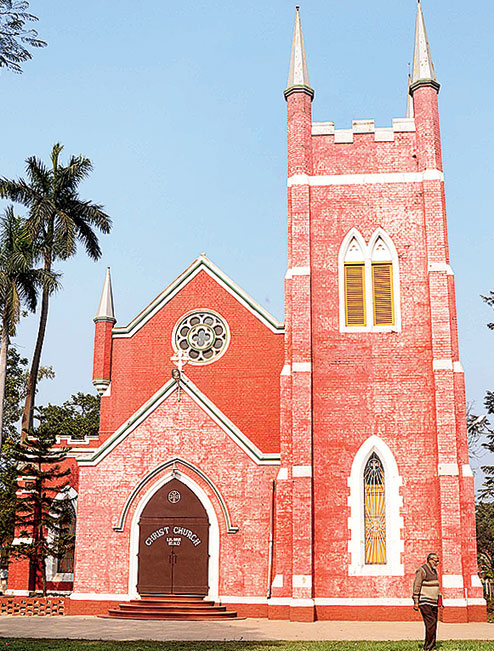
Christ Church in Liluah. Picture by Gopal Senapati

The old red Gothic structure on the eastern banks of a large pond looks huge from outside. The pond and the church stand on land that belongs to the Eastern Railway in Liluah. Despite the massive structure, inside, the church cannot seat more than 100 people on its pews. If there is a big congregation, authorities have to arrange for extra chairs for the parishioners.

Christ Church, under the Church of North India (CNI), has 160 parishioners on its list. Most of them are local residents, but there are some who come from other parts of Howrah and Hooghly as well.

The interiors of the church got a fresh lick of pink paint in December, before Christmas. Reverend Sailen Das, a senior member of the church committee, is expecting a good turnout for Good Friday on April 3. The service will start at 12 noon and will continue till 3pm. “Many people attend the church service on Good Friday because it is a significant day. The week before Good Friday is the Holy Week and every evening we have a mass for the Lent period that has started 40 days before Good Friday,” said Das.

Christ Church was built in 1915 for the European and Anglo-Indian employees of the then East Indian Railway. A plaque on the wall of the church reads, ‘This stone was laid on December 22, 1915 by Robert Swan Hichet Esq, Agent East Indian Railway.’ Since the inception of the Liluah workshop in 1900, the Christian employees wanted a
place of worship. “The church runs on donations from members,” said Das.

Inside the church, there are no other decorations, apart from the altar. An antique object inside the church has been removed some 20 years back. “A huge brass eagle with wings spread out, perched on a brass stand was placed in the front of the altar where the priest would keep the Bible during church service. There was an attempt to steal the eagle stand about 15 years back, but it was so heavy that the thieves could not carry it out of the church. After this, we were forced to give the eagle away to St Paul’s Cathedral,” said Das.

Christ Church will turn 100 at the end of this year and the committee members are planning to do some social work.

“We run a Sunday school for Biblical teachings. We are thinking of starting a dispensary at the local club where we could distribute free medicines,” said Das.

source: http://www.telegraphindia.com / The Telegraph, Calcutta / Front Page> Howrah> Story / Friday – April 03rd, 2015

Mother Teresa was a `butterfly’; an artist paints his viewpoint

TeresaKOLKATA01mar2015

Mumbai :

Even as the recent controversial statement of the RSS leader Mohan Bhagwat on Mother Teresa has received strong opinionated responses and also started an online war between opposing views on the issue, a Mumbai based artist has gently put forth his impression with charcoal and acrylic on canvas.

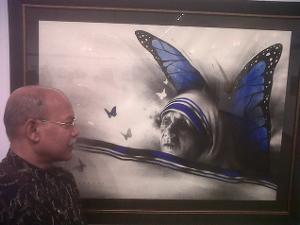
Artist Ajay De is currently holding an exhibition titled `Butterfly People’ at Jehangir Art Gallery where he has shown among other artworks two paintings in which Mother Teresa is a butterfly.

“I have correlated beautiful people as butterflies through art. In fact, I feel that everyone can be a butterfly, a creature that lives for just a few days but spreads beauty and happiness all around it,” explained De, whose exhibition is on till Monday (March 2).

When asked what he thinks of the latest controversy on whether Mother Teresa used to convert the people she rescued from the streets, De said: “I do not want to get into this political controversy, though I will say that it has not affected the reputation of Mother Teresa.”

The artist who had met Mother Teresa just once in the early ’80s in Kolkata, elaborated: “When a stone is thrown at a celebrity, his or her image is not tarnished, but someone else may get some publicity.”

His two artworks on Mother Teresa have already been sold, while the other paintings have also got a favorable response at the exhibition.

“From the time it breaks out of the chrysalis and transforms into a beautiful winged creature, the butterfly stuns the world with its beauty and soothes the world its spirit. In life, we humans come close to being the butterfly, yet only a few are able to embrace the life of a butterfly. That is the challenge we all have to think about,” he concluded.

source: http://www.timesofindia.indiatimes.com / The Times of India / Home> City> Mumbai / by Vijay Singh, TNN / March 01st, 2015

The last burra memsahib – Absolute Anglo-Indians

Sir Edward Barnes by William Salter

Satyajit Ray astonished me at our first meeting. I had trotted out various Santiniketan connections I expected him to know. He looked at me for a moment while I felt his brain darting through the lanes and bylanes of the genealogical network. Then he said, “You must be related to Bussa Susheila Das!” It was the last name I expected to hear from the Maestro. Bussamami – whose death last week, three years short of a century, must be counted a merciful release – was the most fashionable, Anglicized and probably richest of my relatives. In georgette and furs, sporting a long cigarette-holder, she was a vision of elegant grandeur, the Last Burra Memsahib. When I told her about Ray, she said, “It must be because of Keshub Sen!”

If so, the Brahmo Samaj meant more to Ray than anyone imagined. Although neither Bussamami nor her husband, Mohie R. Das, had set foot in a Brahmo temple for many years, she was Brahmananda Keshub Chunder Sen’s great granddaughter. She was also the great granddaughter of General Sir Edward Barnes, India’s commander-in-chief and governor of Ceylon. That connection was embarrassingly highlighted when Bussamami stayed with us in Singapore. On the day she arrived, the afternoon tabloid, New Paper, which normally confined itself to sensational local tidbits, went to town with an unexpected cover story on Barnes and his Ceylonese mistress. As governor, he lived in what is today Colombo’s Mount Lavinia Hotel from which a secret underground tunnel snaked away to his inamorata’s dwelling. Bussamami wasn’t disconcerted.

She had flown in wearing a saree. It was her habitual garb when travelling abroad she explained. “I get better service.” At one time people laughingly called her “Susheila please!” because of her strenuous but unsuccessful efforts to banish the Bussa nickname. She was indignant when a British Indian woman in Singapore asked why she didn’t have a British passport. “Why should I?” she retorted. “India is my home. I’m Indian. I have property there.” The patrial clause in British immigration law would at once have granted her British citizenship. But people like her didn’t need to emigrate to raise their living standards or become Westernized. They easily did both in India. Her sister, Moneesha Chaudhuri, whose husband was the first Indian head of Andrew Yule, the biggest British managing agency in India, and an army chief’s brother, was also like that. She once refused the then whites-only Saturday Club’s invitation to play the piano in a concert under her English mother’s maiden name. “After all, you could pass for English,” they pleaded. She didn’t take it as a compliment.

Singaporeans found it intriguing that Bussamami and I were related twice over. She and my mother were second cousins, great granddaughters of Annada Charan Khastagir, who presided over an All-India National Conference session in 1883, preparatory to the Indian National Congress being launched two years later. Her husband, Mohiemama, and my mother were first cousins, grandchildren of Bihari Lal Gupta, who was responsible for the Ilbert Bill, which led to the AINC and INC. She and her husband being related, the marriage presented difficulties: one version for which I can’t vouch was they went to French Chandernagore for the registration.

Mohiemama’s father, S.R. Das, founded Doon School. He himself was the first Indian head of Mackinnon Mackenzie, the Inchcape shipping giant. When he joined Mackinnon’s exalted band of covenanted hands (UK-based officers who had signed a contract with the company) in England, the Numbers One, Two and Three were known in inverse order as Three, Two and One. Those figures indicated their monthly salary in lakhs of rupees. Mohiemama’s ways were upper-class English, the legacy of public school in Britain and Cambridge. My son, Deep, quoted Bussamami in this newspaper (“Learning To Speak Like The Masters”, October 13, 2004) as saying when asked if her husband went to Mill Hill or Millfield school, “Mill Hill of course. Millfield was only for the post-war nouveau riche!” Being dark and heavily built, he borrowed a turban from Maharaja Sawai Man Singh II of Jaipur – husband of the beautiful Gayatri Devi, who was Bussamami’s cousin – to visit America in the Fifties. He enjoyed describing how he clamped the turban on his head before entering restaurants in the American Deep South.

They settled down in a gracious villa called Faraway in remote Coonoor. But their world straddled Calcutta, Darjeeling, Hong Kong, London and the south of France. Or rather, small gilded niches in all these places, with extensions to Simla, Colombo and Singapore. World War II and the 300 Club had lent zest to their cosmopolitan set. Not everyone could come to grips with this dizzy diversity. Raj Thapar, wife of Seminar magazine’s Romesh Thapar, betrayed her own provincialism by dismissing Bussamami in All These Years as “an erstwhile crooner”. Yes, she, Moneeshamashi and their only brother K.C. (Bhaiya or Kacy) Sen were all gifted musicians. In her youth, Bussamami had indeed given music lessons in Calcutta, and Moneeshamashi continued to do so for free at St Paul’s School, Darjeeling. But the sleaziness that Thapar’s comment sought to convey just didn’t go with the Ingabanga (Satyendranath Tagore’s term for Anglicized Bengalis) elite.

Kacy called his delightful memoirs The Absolute Anglo-Indian. He wasn’t “a person whose father or any of whose other male progenitors in the male line is or was of European descent, but who is a native of India”, which is how the Government of India Act, 1935, defines Anglo-Indian. Nevertheless, his was the culture of the Rangers Club, Grail Club and the club of which he says “if ever there was a place that separated the men from the boys, and no angels feared to tread, it was the good old Golden Slipper”. I was struck as a child by his imaginative wedding invitation, “Bridgette and I are going to be married at the Golden Slipper Club.” His Cavaliers was a popular band. He frequently compered at the Oberoi Grand Hotel’s open-air Scherezade night club, which occupied the space now taken up by the swimming pool.

He provided Ray with Devika Halder aka Vicky Redwood for Mahanagar “over a cup of tea on the verandah” of his flat. The voice off-screen in Mahanagar was Devika’s, but the song was a ballad, Time Gave Me No Chance, he had composed in his rowing days. Major Sharat Kumar Roy of the American army was an unusual wartime buddy and surely the only Indian to be commemorated by a mountain in Greenland: he discovered Mount Sharat. Laced into the light-hearted banter of Sen’s memoirs was the fear that the “Absolute Anglo-Indian” would become the “Obsolete Anglo-Indian”.

Bussamami built personal bridges to very different milieus. Cooch Behar, Mayurbhanj, Jaipur, Nandgaon and other royals, some also descendants of Keshub Sen, were relatives and intimates. When I mentioned the novelist, Maurice Dekobra, she told me she had known him as the Paris-born, Maurice Tessier. Axel Khan, whom I met as India’s ambassador in pre-unification Berlin, was another old friend. Rumer Godden produced a flood of memories, which were borne out by Ann Chisholm’s biography, Rumer Godden: A Storyteller’s Life. Her apology for arriving late for dinner with my wife and I in our Calcutta flat was that she had got lost in the suburban lanes to Kanan’s house. Kanan who? She meant the legendary star, Kanan Devi, whom the young Bussamami had taught her dancing steps in the Thirties. They had remained friends ever since.

The real burra memsahib didn’t need to keep up appearances. Neither did she have to try to be stylish. To adapt the Comte de Buffon, the style was the woman herself. There won’t be another like her.

source: http://www.telegraphindia.com / The Telegraph, Calcutta / Front Page> Story / by Sunanda K. Datta-Ray / Saturday – February 28th, 2015

A Classical Death

Once considered its mecca, classical music festivals are struggling to stray afloat in Kolkata. Tathagata Ray Chowdhury explores the reasons for the slow demise of the once thriving live music scene in the country’s ‘culture’ capital

Kolkata :

Not too long ago, Kolkata used to be steeped in the culture of live classical music. For the connoisseur, there was a plethora of fests to attend; for practitioners, a good show here, more than any where else, meant finally gaining acceptance among peers, perhaps even a chance to reserve a place in the pantheon of the greats. Cut to the last 10 years or so, and it’s clear that the once thriving culture is on the wane, with most classical music festivals staring at an uncertain future.

Even a couple of decades back, the city used to play host to a number of prestigious classical music gatherings. Now, only a few survive. Even fewer manage to do so with aplomb. Apart from a couple of names, most classical festivals are struggling to find sponsors, or are in the throes of a slow death.

But why this decay in the country’s “culture capital”? In a nutshell, it’s to do with the nature of classical music’s patronage. To start off with, it was the prerogative of the moneyed class, supported by zamindars and rajahs who truly valued it and understood its nuances. With the abolition of the feudal system, classical music finally travelled to the masses. Ironically, it was this that sounded its death knell.

In 1856, Lucknow’s exiled nawab, Wajid Ali Shah, had brought with him to the city the rich culture of classical music and established it in this part of the subcontinent. His court musicians — most notably Ustad Basat Khan and Ustad Sadiq Ali Khan — played a key role in establishing the genre in the city and its surroundings. By mid-20th century, Kolkata became a mecca for connoisseurs of this branch of the fine arts — so much so, that a number of stalwarts began to either settle down in the city or make it their second home.

Ustad Dabir Khan, the last khalifa of the Tansen family, made Kolkata his home, and other legends of the time — Ustad Allauddin Khan, Ustad Hafiz Ali Khan, Pandit Ravi Shankar, Ustad Vilayat Khan, Ustad Ali Akbar Khan and Ustad Amjad Ali Khan — all found a second home in this city. To all of them, this was the city where the real qadar daans (connoisseurs) lived. There were the music rooms — jalsaghars — of north Kolkata aristocrats, where both budding and prodigious musicians used to come for what then used to be called their “national audition”. And it was usual practice for the honorifics “Ustad” or “Pandit” to be bestowed on performers only after they gained enough acceptance in Kolkata’s aristocratic circles.

It is a matter of concern that a festival of the pedigree of All Bengal Music Conference is struggling to stay afloat nowadays. The first edition of the conference — on December 27, 1934, at Calcutta University’s Senate Hall — marked the day classical music breached the confines of north Kolkata’s aristocratic music rooms and reached the public. It was high time the lofty walls surrounding classical music were broken down: soon, the landed aristocracy would cease to exist, the country would become independent, and the zamindars would no longer be able to patronize the art form.

Sensing all this, Rabindranath Tagore, who was presiding over the event, had said: “We will have to keep in mind that Tansen and others were able to gift a certain form of music only because the royal opulence of the Mughal Empire could help them. That surrounding is no more there.”

Seventy-five years down the line, All Bengal Music Conference had to collaborate with another organization to hold this year’s event. “All Bengal Music Conference could not host any event because of lack of patronage and sponsorship for about 52 years,” says Robin Paul, general secretary of the conference and the founding secretary of Jalsaghar, an organization that promotes classical music. “It was Pandit Ravi Shankar who asked me to do whatever possible to revive the glorious organization. Pandit Asutosh Kanan also helped me revive it. When I associated myself with it in 2004, we could host events for a few years. But it is in very bad financial shape again. It is no longer in a position to host a soiree on its own. That is why it had to collaborate with ITC Sangeet Research Academy to host the music festival this year. Now that Babulal Ghosh, the last scion of the Pathuriaghata Ghosh family, who used to look after the once-famous music festival, also passed away a few weeks ago, I do not really know what the future holds.”

While the conference is staring at a possible extinction, many other music circles have either stopped functioning long ago or are counting their days. The reason is mainly to do with finances, particularly its lack.

Dipankar Sen, of the now defunct Calcutta Music Circle, has another take on the matter. “Organizers and sponsors often promoted a particular artist or gharana at the expense of others, and that also played spoilsport,” he feels. “Many organizations often used their platform to promote only a particular artist, or artists of one gharana. Naturally, connoisseurs started losing interest, as those concerts became repetitive.”

The lack of proper musical understanding by the sponsors — considered crucial in this genre — has also been a major issue. Tabla maestro Ustad Sabir Khan, who has been conducting an annual soiree under the banner of Ustad Keramatullah Khan Memorial Music Society for the past 28 years, has experienced this problem first-hand. “People who don’t know the first thing about music are directing organizers about which artist should perform, and who the accompanist should be on the tabla. It is not true that the money is not there. Corporate houses will happily spend crores to bring a Bollywood star on stage. But when it comes to classical music, the interest is just not there,” he rues.

Pandit Satish Vyas, of Gunidas Sangeet Sammelan, agrees. “Those who have money move toward sponsoring Bollywood events, as such events draw the crowds. But classical music traditionally catered to a niche crowd. It was never quite a mass thing. There was a time when corporate houses used to consider such kind of sponsorships a part of their corporate social responsibility. But the MBA guys who run corporate houses today first think about what they’ll get in return for sponsoring an event. This has diluted things. They take complimentary passes and give those to people who are not even interested in classical music. The front rows, thus, remain vacant these days, while the real music lovers wait outside for a pass to enter the venue.”

Vyas feels the media has a big role to play in introducing the masses to the stalwarts of classical music. “There is very little coverage for classical music events in most newspapers of the country,” he complains. “Today, there are also very few people in the media who can write with authority on classical music. So, it is natural that a five-year-old boy would know a Sachin Tendulkar, but not a legendary maestro. When Ustad Ali Akbar Khan passed away, there was no news in Mumbai. It was the same when Ustad Vilayat Khan died. Can you imagine that? They were like gods in the music industry. How would today’s sponsors come to know about great masters or budding talents if the media do not come forward to introduce them?”

Robin has a similar observation. “It’s difficult to get renowned artists on stage, as there is no one to sponsor us. We are running on donations. Some newspapers only write about some particular artists. There has been a fast and steady decline of general media coverage of classical music and musicians,” he says.

Indranath Pal, joint secretary of Uttarpara Sangeet Chakra, which completed its 59th annual soiree on the outskirts this year, said they were also struggling to make ends meet. “Our music festival was once as popular in the city and the suburbs as the Dover Lane Music Conference. But we are increasingly finding it difficult to sustain ourselves in the absence of sponsorship and media coverage — the two things that helped Dover Lane survive healthily. It is all the more difficult to find a sponsor in a mofussil town such as Uttarpara,” he says. Indranath also points to another very interesting aspect of the difficulty the organizers face in getting sponsors. “Most products available in the market are meant for young consumers. But most of those who come to attend a classical music concert are aged 50 and above. It is obvious that corporate houses are not interested in sponsoring events for this age group,” he says. An event manager, who did not want to be named, says: “Gone are the days of corporate social responsibility. In today’s corporate terminology, sponsorship of an event is termed as a ‘casual, soft advertisement’. The corporate houses are just not interested spending big money on it.”

Even the organizers of Dover Lane Music Conference — counted as one of the most prestigious in the country — admit that they face difficulties in promoting young but promising artists, primarily because of sponsorship issues. “The problem we face in getting sponsors is much less compared with what others face, because we have already established Dover Lane as a brand. Still, it is difficult for even us to present on stage an artist who is a very good performer but not famous, as sponsors prefer only some big names. A quantum leap in the remuneration of artists has also had an effect. Artists now charge about 300 to 500% more than what they used to charge even about two decades back,” says Bappa Sen, organizing secretary, Dover Lane Music Conference.

Vyas, who started the annual soiree of Gunidas Sangeet Sammelan in Mumbai in 1977, also feels that it would have been very difficult to keep the organization afloat, had he been settled in Kolkata. “It would have been impossible to look for a sponsor in Kolkata. So many external factors influence things in Kolkata, such as the political situation and so on. But this is not the case with other areas.”

These “external factors” have influenced the concert circuit in Kolkata — so much so that most music festivals that were once famous are now remembered only in the pages of old souvenirs or connoisseurs’ albums. Now, there are only a handful of concerts in Kolkata that have pockets deep enough to continue even in the face of losses. While the Shastriya Sangeet Sammelan, held at Rabindra Sadan every winter, is the only such event supported by the state government, in the private sector there are perhaps only the Ramakrishna Mission and ITC which have been running shows successfully without caring much for sponsorship. The spectre of financial losses looms large on almost all other concerts.

Sutanuti Parishad of north Kolkata, which was established in the early 1990s at the insistence of then mayor Kamal Basu, has also been conducting soirees every year despite incurring heavy losses. “We survive on donations. But we don’t know how long we will able to continue like this. The future of the about a century-and-a-half-old tradition of hosting classical music concerts in the city looks bleak if the government or private companies do not come forward to support us,” Subrata Dhar, the parishad’s secretary, signs off.

source: http://www.timesofindia.indiatimes.com / The Times of India / Home> City> Kolkata / by Tathagata Ray Chowdhury, TNN / February 21st, 2015

New start for grand lady – Descendants rededicate gravestone of botanist

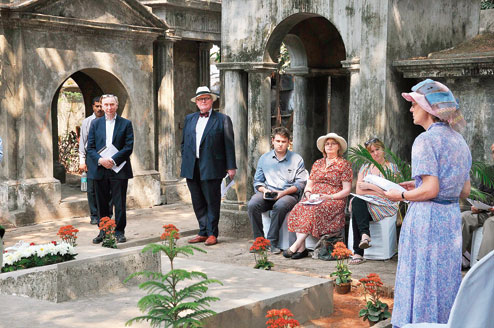
Lady Emma addresses the small gathering at the ceremony to dedicate the gravestone of her ancestor, Lady Anne Monson, at South Park Street Cemetery on Thursday morning. With her are Michael Dorrien Smith, Lady Emma Windsor-Clive, Isabella Monson (seated) and JM Robinson and James Miller (wearing panama).  Picture by Anup Bhattacharya
Lady Emma addresses the small gathering at the ceremony to dedicate the gravestone of her ancestor, Lady Anne Monson, at South Park Street Cemetery on Thursday morning. With her are Michael Dorrien Smith, Lady Emma Windsor-Clive, Isabella Monson (seated) and JM Robinson and James Miller (wearing panama).
Picture by Anup Bhattacharya

Calcutta :

Sleepy, leafy South Park Street Cemetery could have turned into a scene from the TV series Downton Abbey on Thursday morning as a small group of Englishmen and women gathered at the twin graves of Lady Anne Monson and her second husband, Colonel George Monson, for a quiet and solemn ceremony as a chorus of koels sang incessantly.

The frail, behatted Lady Emma Monson was with her granddaughter Isabella, her friend, the youthful Michael Dorrien Smith, a descendant of Lord Clive – Lady Emma Windsor-Clive – and two friends, architectural historian J.M. Robinson and art historian James Miller.

Lord Clive was a British officer who defeated Siraj-ud-Doula in the Battle of Plassey in 1757 and consolidated the East India Company’s rule.

Lady Emma was there to dedicate a tombstone inscription to her ancestor, Lady Anne Monson, who was a botanist, an exceptional figure in the 18th century, and great granddaughter of King Charles II.

Charles II, king of Great Britain and Ireland (1660-85), was restored to the throne after years of exile during the Puritan Commonwealth, according to Encyclopaedia Britannica. The years of his reign are known in English history as the Restoration period.

The genus Mansonia was named by Swedish botanist Carl Linnaeus in honour of Lady Anne. Colonel Monson was a member of the Supreme Council of Calcutta and an enemy of Warren Hastings. He died six months after his wife in September 1776. An inscription above his tomb was erected in 1908 by the Calcutta Historical Society. But Lady Anne’s tomb remained without an inscription. Both graves are quite nondescript by the monumental standards of this cemetery.

A wreath was laid on the spruced-up grave and newly inscribed tombstone by Ranajoy Bose, executive member, Christian Burial Board, with Ash Kapur, president of the Association for the Preservation of Historical Cemeteries in India, Bertie Da Silva, vice-principal of St. Xavier’s College, and Christina Mirza, who heads the English department of the college. Lady Emma said in her address that when she first visited Calcutta in 2012, both graves were in ruins and she wished to restore them. So she got in touch with the British Association for Cemeteries in South Asia (BACSA).

She thanked all concerned for refurbishing them. Both graves have been restored by an accredited architect and its surroundings have been cleared and neatly marked with brick dust. The service was conducted by Reverend Nigel Pope, vicar of St. Paul’s Cathedral.

source: http://www.telegraphindia.com / The Telegraph, Calcutta / Front Page> North Bengal> Story / A Staff Reporter / Saturday – February 14th, 2015

Grandniece continues Nivedita’s quest for truth

Kolkata :

When a 73-year-old woman stepped into Mayer Bari — Maa Sarada’s house at Bagbazar — everybody was busy with their daily chores. Sight of tourists is nothing unusual for them. But when they came to know that the lady was actually the grand-niece of Sister Nivedita, there was no leaving her alone. For rest of the day, a strong crowd milled around Selenda Margot Giardin, who came all the way from Newbury at Vermont in the US. By evening, it was a day well-spent for Saradha Math monks, students of Nivedita School and Selenda as well.

“I am fascinated. I feel like a celebrity,” beamed Selenda, who was the centre of attraction at Sarada Sarani on Monday. The pangs of Parkinson’s and acute arthritis could not dissuade Selenda from embarking upon the long journey in quest of “truth, love and God”.

Selenda didn’t know how to react when people touched her feet. Anushuya, a student at Nivedita School where Selenda led a prayer, said: “For us, it’s like being with Bhagini Nivedita herself.”

Some found the same eyes in Selenda, who shares her middle name (Margot) with her Irish grand-aunt Margaret Elizabeth Noble, whom Swami Vivekananda christened Nivedita. “My middle name is ‘curiosity’. From the age of seven, when I first read at the church that ‘God is Love’, I have been curious about God. The search continues…and now I am here, searching…” reminisced Selenda, who runs her choir at the United Church of Christ at Vermont.

The septuagenarian will be attending a host of programmes over the week. She will spend two days at Belur Math before flying back to the US on Saturday. Her son John Grow is accompanying her.

Selenda let out more about herself and the Nobles as she spoke to TOI: “Ever since I was a child, I remember my mother, Isabel Noble, telling me stories of her aunt who pursued her quest for truth and worked for the people living in this faraway land.”

She gifted the monks of Sarada Math the handwritten notes by Sister Nivedita circa 1909 and a replica of Michaelangelo’s Pieta, which Sister Nivedita had gifted Selenda’s mother Isabela. These items will be on display at the upcoming Nivedita Museum inside Nivedita House.

Mayer Bari head Swami Viswanathananda said: “Selenda’s amazing. We never imagined that a descendent of Sister Nivedita would come here after all these years.” Another monk Prabuddhaprana shared the euphoria: “We are glad to discover the Sister’s family at last.”

source: http://www.timesofindia.indiatimes.com / The Times of India / Home> City> Kolkata / by Ajanta Chakraborty, TNN / February 17th, 2015

If you missed Tansen, listen to his descendant

Abdul Rashid Khan will perform at Sursagar’s ‘Living Legends and Budding Masters’ series at Alliance Francaise on January 30 at 6.30 p.m. — Photo: Sampath Kumar G.P.

Ustad Abdul Rashid Khan (107), based in Kolkata, was the oldest living legend to be bestowed Padma Bhushan

He is the direct descendant of Tansen and has been performing for 75 years. He has performed nearly 3,000 concerts and composed 2,000 bandish , which are being sung by leading Hindustani musicians. In 2013, when he was conferred the Padma Bhushan, he was the oldest living legend to be bestowed the honour.

“I am Ustad Abdul Rashid Khan, 107 years young,” declares the maestro jokingly. “Some members of my family have lived up to the age of 110 and beyond,” he says.

Born in 1908 at Salon near Rai Bareli in Uttar Pradesh, Rashid Khan is the son of Chote Usuf Khan of the Gwalior Gharana. He is the 23{+r}{+d}generation of Tansen’s family and traces his ancestry to Surat Sen, one of the maestro’s four sons.

“My father, and uncle Bade Usuf Khan, trained me in a 10-hour schedule that was followed by a four-hour riyaaz (practice) every day for 22 years.

“Only when I touched 30 did my gurus allow me to step on a stage. That was the kind of integrity we followed,” says the Ustad, who once had Zakir Hussain, then 16, playing the tabla.

After obtaining a degree from Allahabad University, Rashid Khan went to Rae Bareli. He performed a slew of concerts in every nook and corner of India. “I have performed at every maharaja’s court in pre-Independent India. Rae Bareli alone had 22 maharajas and each would demand a particular raag ,” he says recollecting the traditional four to five hour concerts that were in vogue then.

In 1991, he was specially invited by the ITC Sangeeth Research Academy in Kolkata to take over as the senior guru. He has been teaching there for the last 25 years. His traditional compositions have been recorded by the BBC and Iraq Radio.

The UP Sangeet Natak Academi and the ITC Sangeet Research Academy have more than 1500 compositions of the ustad in their collection.

And the secret of his longevity?

“All we know is that he prays five times a day,” says grandson Bilal Khan, who accompanies the ustad on the tabla.

source: http://www.thehindu.com / The Hindu / Home> News> Cities> Bengaluru / by Ranjani Govind / Bengaluru – January 29th, 2015