Midnight on July 31 had ushered in a new freedom in Cooch Behar’s 51 Bangladeshi enclaves. It took the wail of a newborn 12 days later to underline what it actually meant. Named Azad, he is the first baby born in free territory -with his parents’ real names, and calling what was no-man’s land his home.
When TOI had met the pregnant 18-year-old Jharna Biwi a fortnight ago, the Bangladeshi enclave of Poator Kuthi in Cooch Behar was excited because this baby would be special. At 6.30am on Wednesday , Azad was born at Bamonhat primary health centre. Never has the birth of a newborn -to a teenage mother -been the cause of such joy in any enclave.
Gone are the days when even quacks, what to speak of doctors, would refuse to deliver babies of enclave residents.Would-be-mothers would suffer the ignominy of lying about their husbands’ name.Azad’s elder brother, born four years ago, was named Saheed (martyr). Grandfather Mujibur Ali is ecstatic but cannot forget the shame and agony of half a century .”When Saheed was born in 2011, we had to send Jharna to her maternal home in Dinhata’s Picnicdhora, evading BSF patrols. We had to lie about her husband’s name and give a fake Indian address just to get her into hospital. Not any more,” Ali said. “Azad signals the new dawn,” he said, before hurrying off to offer sweets to visitors flocking to his home.
When Jharna felt pre-mature labour pains in the predawn hours, her brother-inlaw Meharul and mother-inlaw Jamina Biwi took her in a van rickshaw to the primary health care centre, half-anhour away . This in itself would be a huge task a fortnight ago. Being Bangladeshis, they couldn’t step out of their villages for fear of being hounded by BSF or police.And getting admission in a state-run health facility was out of the question.
As Poator Kuthi savoured the sweets of Azad’s birth, 70year-old Mansoor Ali recalled how Asima Biwi was denied treatment in 2010.
“Nearly 3,500 enclave residents braved a nine-hour stand-off with police and BSF to get her treated at Dinhata sub-divisional hospital. The administration relented only when they realized the protest could snowball into a huge agitation. Her baby was born that day and we named him Jehad (struggle),” said Mansoor, president of Poator Kuthi enclave exchange committee. Mansoor said, “Jehad’s birth may have brought our plight before the people but it didn’t change our way of life. Expectant mothers had to fudge their husbands’ name (give an Indian’s name) and address to get admitted to hospitals. Nothing can be a bigger insult to a married woman than to lie about the father of her child.” He added, “But this morning, I held Jharna’s hand and told her to go with her head held high and tell them that she belongs to Poator Kuthi, India, and her husband’s name is Jamidul Ali. She did.”
source: http://www.timesofindia.indiatimes.com / The Times of India / News Home> India / by Kamalendu Bhadra, TNN / August 13th, 2015
Time is money but some particular currency is timeless. On the eve of Independence Day, Kolkatans will get see some of the most ancient coins of Bengal at an exhibition by the Numismatic Society of Calcutta. On display will be 2nd Century BC coins from Chandraketugarh, along with those from Sasanka and Samudragupta era, among others.
“This is the first time we will hold an exhibition at any college in Kolkata. Elsewhere we had held shows at IITs, NITs,” said Samarjit Ghosal, the society’s secretary. The exhibition will be held at Jogesh Chandra Chaudhuri College on Friday.
“The Chandraketugarh coin is identified by some specific symbols like the sun and boat. A telltale symbol is that of a conch on the reverse side,” said Anup Mitra, the society’s president.
Explaining how collectors get hold of such ancient coins, he said: “In old times, the practice of storing valuables underground was quite common. In case they are abandoned, they are discovered long after, mostly by accident. Those who find them take them to jewellers. In England, museums buy back such coins. But here there is no such system here. Across the country, small teams of traders keep a track on movement of coins at jewellery shops. Once they acquired, they are sold to museums or collectors.”
“Till recently, it was believed ‘kouri’ was the medium of exchange in early Bengal. But after discoveries of the last few decades, it is now proved that ‘kouri’ was a parallel currency till early 19th century,” said Shankar Bose, an authority on coins who has penned 10 numismatic books.
Bose will present a powerpoint presentation on ancient Bengali coins at the exhibition.
source: http://www.timesofindia.indiatimes.com / The Times of India / News Home> City> Kolkata / by Shounak Ghosal, TNN / August 10th, 2015
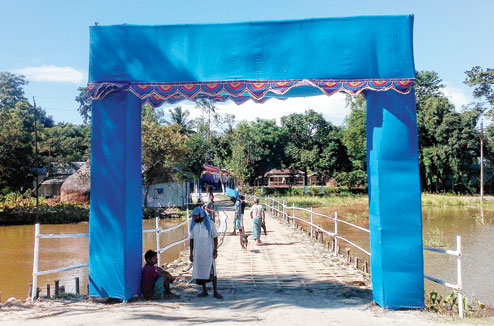
Preparations at Mashaldanga, the Bangladeshi enclave, for Friday’s transfer of territory. Picture by Main Uddin Chisti
Dinhata :
The people of Mashaldanga built the road themselves with mud and covered it with bamboo cane. A big gate draped in blue cloth stands at the start of the road which leads to a colourful canopy.
The road did not cost much but the pandal did – Rs 2 lakh. Yet the people of Mashaldanga, the biggest Bangladeshi enclave in India, paid for it out of their pockets because on Friday this is where they will celebrate their coming into being.
On July 31 midnight, as Bangladesh and India exchange territories, the borders of the enclaves will dissolve.
It will mean that Mashaldanga and 50 other Bangladeshi enclaves in India will become Indian territory. Similarly the 111 Indian enclaves in Bangladesh will become Bangladesh territory.
For the people of Mashaldanga it will mean having a country in the real sense for the first time in their lives.
For 67 years since Independence, the people in the enclaves have been overlooked by both the countries. They have been denied everything that a state can give its citizens, starting with identity.
From Saturday morning, for the first time 14,000 people on the Indian side and 41,000 people in Bangladesh will become citizens of the respective countries.
Enclave residents were given a chance to choose their country. No one from the Indian side – the Bangladeshi enclaves are mostly in Cooch Behar and a few in Jalpaiguri – is crossing over.
In total, 979 people are coming over from the four districts in Bangladesh with enclaves – Kurigram, Lalmanirhat, Nilkhamari and Panchagarh – said the superintendent of police of Kurigram, Mahammad Tabarukullah.
Mashaldanga illustrates perfectly what being denied a country is like.
Through the middle of the green fields of Madhya Mashaldanga, the part of the enclave where the celebrations are being held, run electricity lines.
Yet no house in Madhya Mashaldanga has electricity because it is in Bangladesh.
Through the middle of Mashaldanga runs a road, but not many step on it, because it leads into the outer world – India.
Only one house in Madhya Mashaldanga has electricity, because that house is in an Indian enclave within the Bangladeshi enclave.
This enclave, with its only house, since it is Indian territory, has electric lines reaching it, resting on a row of poles that cut through the green fields.
What applies to electricity also applies to jobs. No Mashaldanga resident has ever had one.
If the children go to school in Mashaldanga, they need to cook up the name of a father as no father here has identity proof.
Jainal Abdedin, a 23-year-old from Madhya Mashaldanga, who was at the forefront of the movement to exchange enclaves, is a third-year political science honours student at Deoanhat College in Dinhata. Even if he became a graduate, he would not be able to get a job, because he would need more identity proof than required so far.
He has been able to go through school and college using the name of another person, an Indian citizen, as his father. Because his father, like all other residents of Mashaldanga, has no papers.
“Mithye bolte bolte obhyesh hoye gechhe (I have got used to telling lies),” he says.
But may be that would change now. With him becoming an Indian citizen, he can think of having a job.
The enclave exchange has been achieved, says Diptiman Sengupta, the man behind the Bharat Bangladesh Enclave Exchange Coordination Committee, because of the will of the people. The organisation has led the movement for the exchange and Jainal is a member of this organisation. Jainal, with his friend Saddam Mian, also look after the social media presence of the movement.
Sengupta points out that the history of enclaves began in the displacement of people. From the 1880s, when land began to be organised in India by the British and be marked, the landowners of the areas in which the enclaves – chhitmahal in Bengali – lie, began to gift each other mauzas as stakes in card or chess games.
But that was undivided India, and the stakes got scattered over what would come up as borders between first, India and Pakistan, and then Bangladesh.
After Independence, depending on the ownership, these plots remained Indian land in Pakistan/Bangladesh or Pakistani/Bangladeshi land in India.
And all the countries forgot them, though there were agreements from time to time.
The first one was between Jawaharlal Nehru and Feroze Khan Noon, the Indian and Pakistani Prime Ministers in 1958. In 1947, the Land Boundary Agreement was signed by Indira Gandhi and Sheikh Mujibur Rahman. Many governments and working groups and decades later, Indian Prime Minister Narendra Modi ratified the agreement on June 6, 2015, during his visit to Bangladesh.
“The government moved aggressively when it felt the will of the people,” says Sengupta. He thinks the exchange is a triumphant example of a history-making event that political parties could not interrupt.
The Indian authorities are making arrangements to receive the people from Balngladesh, who are expected after November 30.
Tota Mian, a Mashaldanga resident in his seventies, said today: ” Akhon swadhinata pailam (We have got independence, finally).”
source: http://www.telegraphindia.com / The Telegraph, Calcutta,India / Front Page> North Bengal> Story / by Chandrima S. Bhattacharya and Main Uddin Chisti / Friday – July 31st, 2015
The green gate of 3 Peary Charan Sarkar Street has been leading thousands into the enchanting premises of the Eden Hindu Hostel for almost 130 years now. The lush green field, the wooden staircase, the kharkharis, the high-ceiling rooms, everything oozes an old-world charm that’s hard to ignore. And on Wednesday, the hostel closed down for renovations -its first overhaul since its establishment in 1886. CT celebrates the heritage and history of the colonial building and takes a trip down memory lane…
RICH HERITAGE
The hostel was initially built for the Hindu students of Presidency College, but later accommodated students from outside Kolkata. In 1988, the building was extended in order to accommodate postgraduate students and research scholars.Among its many famous boarders were the first President of India, Dr Rajendra Prasad, who studied in Presidency between 1902 and 1907, and professor Amartya Sen. Presidency University registrar Debajyoti Konar said, “Dr Rajendra Prasad was a student here and his room in the hostel is still not used.”
Divided into six wards, the hostel houses over 274 boarders, including undergraduate and postgraduate students.
HOME AWAY FROM HOME
With its seasonal tournaments, annual athletic meets, Saraswati Puja, reunions, freshers’ welcome, political meetings and farewell ceremonies, this hostel has been a second home for thousands of students.”It feels bad to leave this place. I’ve been here for over three years now and have spent some wonderful times with my friends and seniors,” third-year chemistry student Swarup Maji said. He added that they had been shifting to the new address in Rajarhat for the past three weeks. “We will be staying in Rajarhat for 11 months till the work gets done here. It’s going to be difficult, as we are used to staying in central Kolkata with so many facilities within reach,” Swarup said.
A NEW LOOK
Konar said an architect from the Heritage Commission will oversee the renovation. “As of now, Partha Das will supervise the work. This is a heritage structure and the plan has been made keeping that in mind,” he said. An amount of Rs 3 crore has been sanctioned for the first phase of renovation, while estimation is still under way for the second phase.
HELPING HAND
The University is more than happy to receive help from the government of West Bengal. “The renovation will span over 11 months and the higher education department has arranged for 80 flats in Rajarhat for the 150 students who have been shifted. A canteen, too, has been arranged. That’s not all. A subsidized bus will ferry the students from Rajarhat to Presidency,” Konar told us.
SAYING GOODBYE
For Sajan Dewan, a postgraduate political science student, it’s time to bid adieu to the hostel. “I’ve been here for the last four-and-a-half years. We’ve spent some of the best and worst days of our lives in this building. By the time the work gets done here, I’ll be out of college. But I’m taking back some fond memories with me, so we had a small party last night to say goodbye,” Sajan said.
HOSTEL HIGHLIGHTS
Eden Hindu Hostel was established in 1886 The hostel was built using funds raised by Ashley Eden, WB Gwyther was the architect The first president of India Dr Rajendra Prasad and Nobel laureate Amartya Sen are its alumni The hostel has eight guest rooms where parents of students and other guests are allowed to stay The six wards in the hostel include a kitchen, dining hall and staff-quarters, which occupy a total area of 26,000 sq ft.
source: http://www.timesofindia.indiatimes.com / The Times of India / News Home> City> Kolkata /by Kathakali Banerjee, TNN / August 03rd, 2015
A mighty fracas is raging between the descendants of Nawab Wajid Ali Shah in Calcutta and an Iranian woman who claims to be married to a scion of the Awadhi family. Hemchhaya De investigates the rumpus
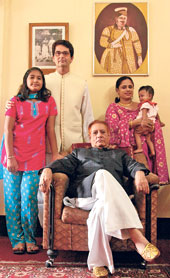
REGAL ROOTS: Shahebzade Wasif Mirza and his family pose before the portrait of Nawab Wajid Ali Shah;
A king-size portrait of Nawab Wajid Ali Shah will catch your eye the moment you step into the grand, old living room of Wasif Manzil on Talbagan Lane in Calcutta. “That’s my ancestor,” says Shahebzade Wasif Mirza, a dignified septuagenarian, pointing at the portrait — the pièce de resistance in a room bristling with Awadhi heirlooms.
“Satyajit Ray once asked me, ‘Why did the Nawab choose to move to Bengal after his kingdom was annexed?’ At that time, he had just made a film called Shatranj Ke Khiladi,” recalls the patriarch, a registered descendant of Wajid Ali Shah (1822-1887). “I told Ray that perhaps the Nawab felt he would get the respect he deserved only in Bengal.”
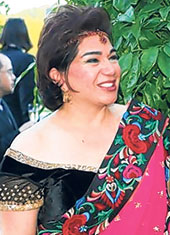
For Shahebzade Mirza, it’s a matter of family honour that he takes on what he calls “pretenders” to the Awadh legacy. In recent months, he has been fighting a fierce battle against Fay Ary, an Iranian woman who divides her time between Monaco, Paris and Dubai, and claims to have married a direct descendant of Nawab Wajid Ali Shah and his second wife Ronakara Begum.
Fay Ary
But she refuses to disclose her late husband’s name for “fear of being drawn into family feuds.” Ary also wishes to do something for the underprivileged in India through her charity organisation, Royal Awadh Cultural and Heritage Foundation (RACH).
“All this sounds very nice. But she calls herself Her Royal Highness Princess Jehan Ara Fay Ary. I have the complete family tree and she figures nowhere. I’d like to know where her imaginary kingdom is located,” says Mirza. In a recent letter to the French ambassador to India, Jerome Bonnafont, he complained against Ary and RACH. “Our objection is to the use of our family’s name …for large monetary gains,” wrote Mirza.
Fay held a charity auction in Paris this May where her “personal collection of jewellery” went under the hammer. “We don’t know what she auctioned as her Awadhi legacy. And we don’t know where the proceeds are going,” says Ibrahim Ali Khan, a descendant of a 19th century Awadhi vizier, who heads the Royal Family of Awadh Foundation in Lucknow.
It all began a couple of years ago when Nawab Jafar Mir Abdullah — who reportedly claimed to be the Awadh rulers’ “direct descendant” — came under media glare. Abdullah, who’s on the RACH advisory committee, was accused of faking his nawabi heritage and arranging Awadhi banquets for foreign tourists in collusion with “unscrupulous” travel operators in Lucknow. It was also alleged that he charged tourists hundreds of dollars for banquets and mujras (dances) at his Lucknow home. His partner in this enterprise is said to be Prateek Hira, who heads a tour operating agency called Tornos India and is also associated with RACH.
Hira maintains that Khan and others have launched a malicious campaign to defame Ary, Abdullah and his agency. “Abdullah is well respected in Lucknow,” says Hira.
d in Lucknow,” says Hira.
_______________________________________________________________________ Dramatis personae
■ Shahebzade Wasif Mirza, descendant of Nawab Wajid Ali Shah (1822-1887) of Awadh (Oudh).
■ Fay Ary, an Iranian who claims to have married a direct descendant of Wajid Ali Shah and his second wife Ronakara Begum. Ary runs a charity, Royal Awadh Cultural and Heritage Foundation (RACH).
■ Ibrahim Ali Khan, a descendant of a 19th century Awadhi vizier, who heads the Awadh Royal Family Foundation in Lucknow. Does not support Ary.
■ Jafar Mir Abdullah, who is described as Wajid Ali Shah’s direct descendant and is on the RACH advisory committee.
■ Prateek Hira, who heads a tour operating agency called Tornos India and is associated with RACH.
Fay Ary gained some publicity in Lucknow around this time after announcing her charity projects. “She wants to do something for the poor — like arranging cleanliness drives in various Indian cities and providing slum dwellers with clean drinking water. She sought my help to implement the projects,” says Hira.
Ibrahim Ali Khan and others tried to blow the lid off what they called a “nexus” between Abdullah, Hira and Ary last year. “The issue was almost dying down when a freelance journalist from Delhi wrote to Hira and threatened action against his activities. He wrote to me as well,” says Khan.
Fay didn’t take it lying down. In an email dated June 29 this year, she wrote to her friends in Lucknow, Dubai and Paris, “A very nasty activity is being undertaken …(by a journalist)… for want of some money to sustain himself …ignore this man who keeps changing his name to fool people.”
Speaking from Paris, Ary expresses her “anguish and disappointment” over the “concerted efforts to pull down RACH.” “I claim nothing from the Indian government or from the Awadh families. I auctioned my own jewellery in Paris. I am hankering after no title. All I wanted to say to these people was that I had the resources to do some good work in India,” says Ary.
She wants to start her “slum cleanliness drive projects” in early October. She will also host a gala event in Dubai this November to seek support for her charity work. “People who claim to be true nawabs in India should stop bickering and do something for their country.
There seems to be another point of clash between Ary and Shahebzade Mirza. Ary told the media last year that she would renovate Nawab Wajid Ali Shah’s mother’s grave in the Père Lachaise cemetery in Paris. The Nawab’s mother, Aliya Begum, went to England to plead with Queen Victoria for returning Awadh to her son. On her way back, she fell ill and died in Paris in 1856 and was buried in Père Lachaise. Ary wants to project her grave as a site of historical significance.
The Shahebzade Mirza family, on the other hand, wants to rectify an inscription near the grave which says that her son Wajid Ali Shah was killed by British forces in 1856. “The Nawab died of natural causes in 1887. We have written to the French consulate in Calcutta to do something about it,” says Mirza. A spokesperson from the French consulate, who prefers not to be identified, confirmed receiving the letter.
“I accompanied Fay to the Paris cemetery this year. She is planning a renovation,” says Abdullah, the controversial ‘nawab’ who refutes all allegations against himself. “She doesn’t lay any claim to the Awadh royalty. She is herself related to Farah Diba Pahalvi, the queen of the last Shah of Iran who ruled till 1979.”
Abdullah also goes on to say that he will go on hosting banquets for tourists in order to interact with people and entertain them. “I tour the world and get invited by top officials. I will also continue to be part of RACH and the commendable work it does,” says Abdullah. “I never claimed to be a descendant of Wajid Ali.”
Agrees Rosie Llewellyn-Jones, a British scholar who’s writing a biography of Wajid Ali Shah. “Abdullah does not really claim descent from Wajid Ali Shah, but from Nawab Mohammed Ali Shah, who ruled Awadh from 1837 to 1842,” she says. She adds that it’s important to remember that “Wajid Ali Shah’s descendants are not the only descendants of the royal family of Awadh.”
“Each Nawab, from the time of Asaf-ud-daula (1775 to 1797), had a number of wives, and inevitably, a large number of children and grandchildren. These people are also descendants of the Awadh royal family. On Wajid Ali Shah’s death he left about 45 sons, and a larger number of daughters, and the descendants of these sons and daughters can obviously claim direct descent from him.” On Ary, she says that unless she is prepared to reveal her husband’s name “we can’t really check out her claim.”
Indian historian Ravi Bhatt, who penned a book called The Life and Times of the Nawabs of Lucknow, begs to differ. “Just as Nagpur is famous for oranges and Benaras for silk, Lucknow is known for its nawabs,” says Bhatt. “Every Tom, Dick or Harry calls himself a nawab these days. But let me tell you there is no descendant of the Awadh royal family in Lucknow now,” says Bhatt.
Meanwhile, Shahebzade Mirza is gearing up for the next round of battle. “We hope the French government will act on our complaint against Ary. The war is far from over.”
source: http://www.telegraphindia.com / The Telegraph, Calcutta,India / Front Page> 7 Days> Story / Sunday – August 23rd, 2009
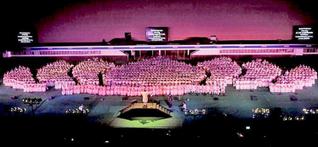
The Choir paid tribute to Tagore and his ‘Gitanjali.’
Thousand voices and one celebration… The Netaji Indoor Stadium in Kolkata, reverberated with poems of Nobel laureate Rabindranatha Tagore recently as Sangeet Bharati Muktadhara presented ‘Echoes of Gitanjali’ to commemorate 100 years of Rabindranath Tagore’s Nobel in Literature and Gitanjali.
For the 1000 singers from all over India – Chennai, Patna, Mumbai, Delhi, Gurgaon, Bengaluru, Baroda, IIT-Kanpur, Allahabad and Bhilai – the show, conceptualised, scripted and directed by Arundhati Deb, president, Sangeet Bharati Muktadhara, came after months of rigorous practice. The theme was the lotus, and sure enough, the singers on stage were positioned to represent the national flower.
For the group of 12 singers from Chennai group, it was a perfect opportunity to pay tribute to Gitanjali and its profoundly fresh beautiful verse.
Years ago, travelling abroad, Tagore witnessed western classical music concerts featuring musicians numbering 1000 to 2000. This left a lasting impression on him, observers had said. Nevertheless, Tagore had not voiced his latent desire – to give a similar treatment to his compositions.
“The programme titled ‘Echoes of Gitanjali’ commemorates 100 years of Tagore’s English Gitanjali,” said the 60-something-Arundhati Deb, who travelled from city to city to refine the performances of the different groups. She was in Chennai to help the team with singer Swati Bhattacharya taking the lead.
Hailing from a family deeply interested in music, Arundhati Deb grew up fascinated with Rabindra Sangeet. After a Master’s Degree in English and an editing stint, her desire to do some serious work with Tagore surfaced. The result? The first 1000 Voices Choir in 2007.
source: http://www.thehindu.com / The Hindu / Home> Friday Review / by Renuka Suryanarayan / July 10th, 2015
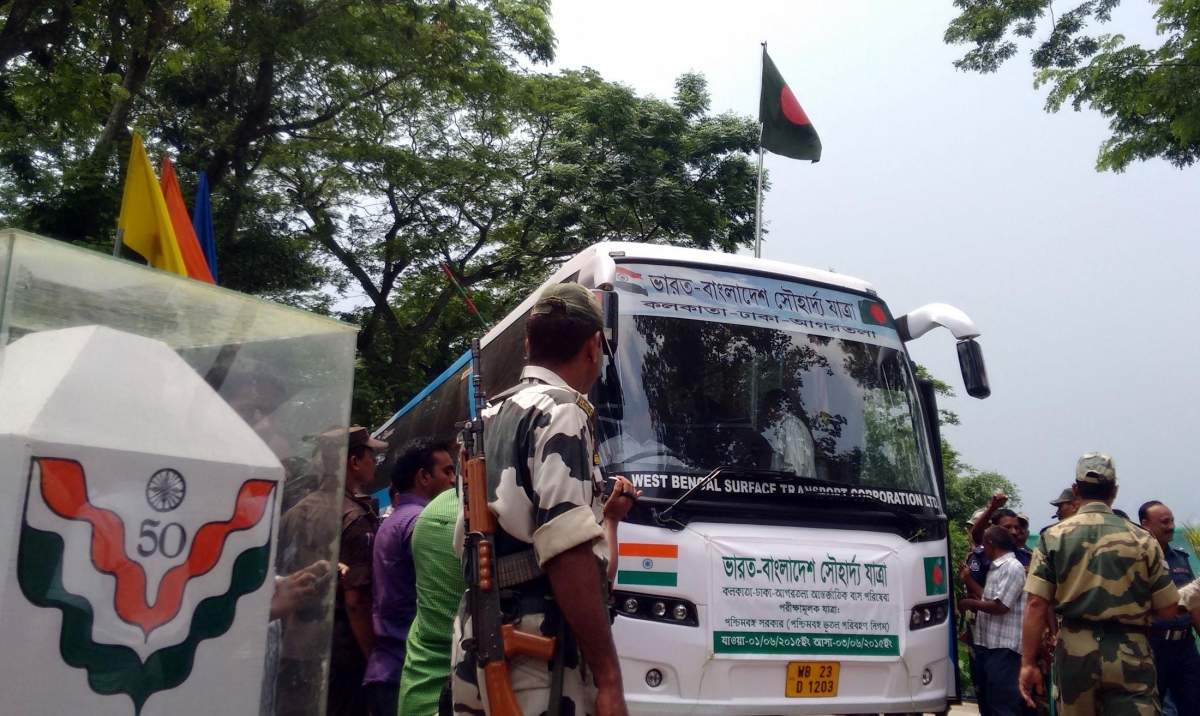
The first Kolkata-Dhaka-Agartala bus enters Agartala from Bangladesh through Akhaura integrated checkpost during a trial run on 2 June, 2015.IANS
Flagging off the Kolkata-Dhaka-Agartala bus service here on Thursday, West Bengal Chief Minister Mamata Banerjee said the initiative will turn the India-Bangladesh ties into an everlasting relationship.
“The launching of this service makes this day forever memorable and historically significant for both the countries,” Banerjee said at the flagging off event at the state secretariat, Nabanna, in Kolkata’s neighbouring Howrah district.
“This service will bring both India and Bangladesh closer and turn our cordial ties into an everlasting relationship,” she added.
The cross-border bus service was approved at a recent meeting between Bangladesh Road Transport Minister Obaidul Quader and his Indian counterpart Nitin Gadkari in New Delhi.
The bus service will facilitate visiting mainland Indian states for people of the mountainous northeastern region, reducing the distance by over 1,000 km.
Agartala via Guwahati is 1,650 km from Kolkata by road, but the distance between the tripura capital and the West Bengal capital via Bangladesh is only around 500 km.
Prime Minister Narendra Modi and his Bangladesh counterpart Sheikh Hasina are scheduled to flag off the Agartala-Kolkata direct bus service in Dhaka on June 6.
source: http://www.ibtimes.co.in / International Business Times / Home> News> Society / by IANS / June 04th, 2015
RIP Thomas Nelson Annandale, at the Scottish Cemetery.
Not many people know that the first director-general of Zoological Survey of India (ZSI), Thomas Nelson Annandale was buried at the Scottish Cemetery when he breathed his last on April, 1924. Or who he actually was. When ZSI kick-starts its centenary celebrations on Wednesday (the organization was founded on 1 July 2016), a plaque will be erected to pay homage to its Scottish founder at recently-discovered tomb.
Tracing the grave was far from easy for the premier institution on animal taxonomy that is adept at identifying species around the country. According to some records at ZSI, Annandale was buried inside the South Park Street cemetery. It took ZSI a while to fish out documents to prove that his remains had been shifted to the Scottish Cemetery where he has since been left to rest.
ZSI director Krishnamoorthy Venkataraman told TOI on Monday: “Now that we have found the grave, a plaque will be erected to honour Annandale’s contribution to ZSI and science at large.” Dhriti Banerjee, deputy director and head of office, ZSI, said, “It took us some time to find out that the ZSI founder was buried at the Scottish Cemetery and not at the Park Street Cemetery. But when we initiated the mission, we realized that the inscriptions were barely visible. We had a difficult time finding out Annandale’s tombstone.”
Most of the tombstones at the cemetery lie broken, defaced and forgotten. Weeds have obscured the gorgeous carvings. Annandale’s tombstone was unclean and the lead filling on the inscription had corroded. Established in 1820, the six-acre Scottish Cemetery was in use till 1940. Currently, it has around 4,300 graves. Apart from Scots, a few Bengalis who were converted to Christianity by Scottish priests were buried there.
After discovering the grave, ZSI officials had the tombstone spruced up and the inscription re-painted. On the occasion of ZSI’s centenary, new slabs will be installed on the grave and landscaping done around it.
An array of programmes have been planned to mark ZSI centenary. The authorities are organizing a run on July 1 to kick-start its centenary celebrations. The Centenary Run will begin from the Asiatic Society in Park Street, the place of ZSI’s origin, and end at Prani Vigyan Bhawan, the present headquarters in New Alipore.
Venkataraman said Prime Minister Narendra Modi will participate in the centenary celebrations in the third week of July at the ZSI headquarters and dedicate the “Digital ZSI” – the e-access to ZSI’s documents – to the country on 100 years of faunal inventory of India.
Going back to the organisation’s first founder, the director said: “We have learnt from a publication published by ZSI that the first director-general travelled across the country and also to China, Japan, Malaya and Morocco looking for different species of fauna in the beginning of 20th century.” The publication had described Annandale as a person of “slight physique, with high strung temperament and restless energy.” He was born in Edinburgh in June 1876 and died in Kolkata on April 10, 1924. During his short life of 48 years, Annandale had 528 scientific reports published.
Venkataraman said conducting authentic research on the country’s rich faunal diversity, undertaking studies on alien fauna, collecting samples of the country’s zoological wealth and setting up zoological museums in different parts of the country are some of the objectives of ZSI.
Annandale had founded the ZSI, which later started functioned under the ministry of environment, forests and climate change, to promote survey, exploration, research and documentation on animal taxonomy. It has identified more than 96,000 species of animals.
source: http://www.timesofindia.indiatimes.com / The Times of India / Home> City> Kolkata / TNN / by Ajanta Chakraborty / June 30th, 2015
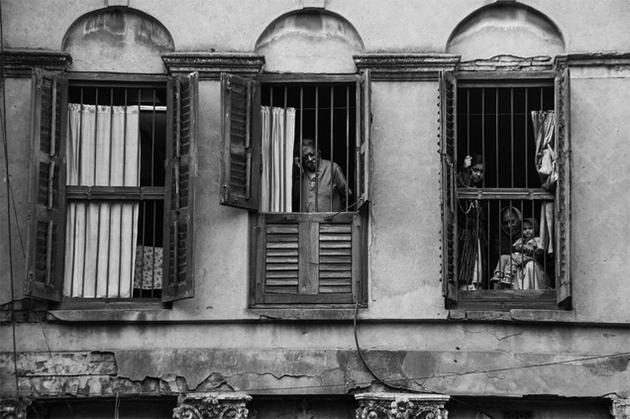
Thousands of Kolkata houses with red-oxide floors and sleepy green-shuttered windows, the spacious porches on the ground floor, with their intricate cornices, elaborate wrought-iron grills, and open terraces are being destroyed at an incredible pace. Photo: Akash Mondal
Kolkata’s heritage buildings are part of the city’s unique DNA, as distinct to its landscape as a fingerprint. The writers talk to novelist Amit Chaudhuri, who is spearheading the city’s brave fight to save its heritage.
In one of Kolkata’s most prosperous neighbourhoods stands a two-storey house. It has shuttered windows and large pillars, in the style typical of colonial Calcutta. The house belongs to Tapati Mukherjee, and was built by her grandfather in the 1930s, in an area called Hindustan Park. The house next to hers, built around the same time and in the same architectural style, is owned by a former chief of the Indian Football Association. It is being torn down. It will soon be replaced by an anonymous high-rise.
Mukherjee, however, is adamant that she will not let her house suffer a similar fate. The Director of Culture and Cultural Relations and the President of Rabindra Bhavan at Visva Bharati University in Santiniketan, she said, “I don’t want to live anywhere else. The house has a cultural ambience and feeling of old-world grandeur (that) I do not find elsewhere. I vow to protect this house till my death.”
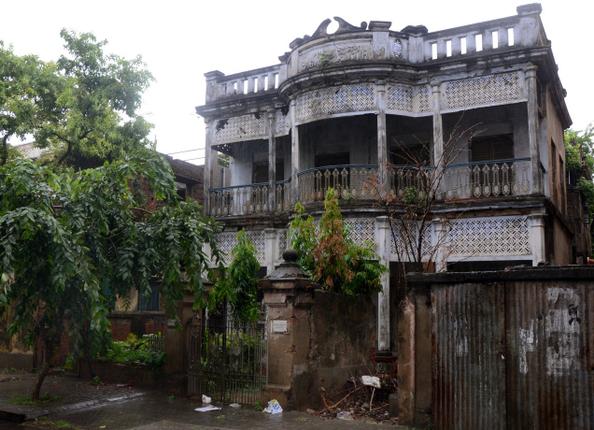
Unfortunately, not everyone thinks like Mukherjee. Thousands of Kolkata houses with red-oxide floors and sleepy green-shuttered windows, the spacious porches on the ground floor, with their intricate cornices, elaborate wrought-iron grills, and open terraces are being destroyed at an incredible pace. These houses give Kolkata its unique old-world charm and reflect the amazing architectural ethos of the city, but they are being lost in the mad rush for multi-storey buildings and concrete chaos.
Thousands of heritage buildings in with red-oxide floors and green-shuttered windows, spacious porches with intricate cornices, elaborate wrought-iron grills, and open terraces are being destroyed at an incredible pace in Kolkata. / Photo: Sanjoy Ghosh / The Hindu
This loss of heritage is not unique to Kolkata. Several Indian cities today are battling this dilemma. In Jaipur, for instance, many of the privately-owned historical havelis, with their jaali windows, false fronts and pink facades — which gave the city its moniker of Pink City — are in danger of being lost forever. They have become dilapidated over time and are slowly beginning to be pulled down to make way for modern buildings. Some of these havelis date back over 100 years.
Mumbai has a splendid architectural history, with a mix of Art Deco, Indo-Saracenic and Victorian, all contributing to a rich variety of features that contribute to the city’s signature ‘look’. But many of these buildings are crumbling today and, in the absence of government incentives, owners prefer to let the heritage homes decay rather than spend their own money on upkeep, which is understandably an expensive task. Once the buildings reach a certain stage of disrepair, the owners are allowed to demolish them and sell the rights to redevelopers for a lucrative sum. This makes it much more difficult to persuade owners to look after them. Bangalore and Chennai, too, are fighting the same battle, as is the state of Goa, with its stunning built legacy in the Portuguese-Baroque style.
The only weak but bravely flickering touch of silver in this bleak skyline is the fact that informed citizens across India are taking up cudgels to try and save the country’s heritage structures. The newest episode to this saga of protest is being staged in Kolkata, where several people — both ordinary and prominent citizens — have written to Chief Minister Mamata Banerjee, pointing to the urgent need to stop the destruction of these historic buildings. Most of these houses were begun in the 19th century and continued to flourish over the next hundred years. In fact, even during the recession of the 1930s, the cement industry was flourishing as the middle-class was constructing these huge houses.
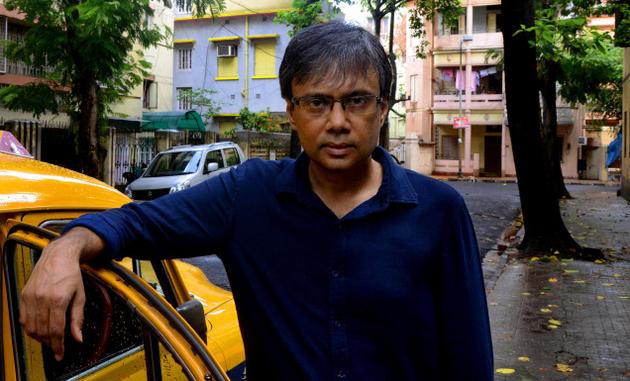
Author Amit Chaudhuri who is spearheading the protests to save the heritage buildings. / Photo: Sanjoy Ghosh / The Hindu
Eminent writer Amit Chaudhuri, who is leading the campaign, said, “Destroying these buildings is to destroy one of the chief characteristics of this city’s history of modernity. Kolkata is a modern city and these houses are emblems of the city’s modernity… they are as important as the painting, literature and music of Bengal.” For Chaudhuri, this is an old battle. He has been speaking and writing on the issue for many years now. He talks of how the architecture of many neighbourhoods in Kolkata is quite distinct from the Indo-Saracenic or neo-Gothic style of architecture that can be seen in other Indian cities. They represent a Bengali-European style that is not seen elsewhere.
The Kolkata heritage protest team includes architects, artists, film directors and academicians. And one common factor that everybody agrees upon is the fact that these old buildings are not important only because of the nostalgia that surrounds them but because they represent a certain time in history. If preserved well, these buildings can actually lead to very practical and modern benefits, such as increased tourism revenue and, in turn, a renewal of the city.
Take, for instance, the boutique hotel that opened in Kolkata a couple of years ago. Called Hotel 233 Park Street (based on the door number), it occupies the ground floor of an imposing Zamindari mansion located at the much less stylish but no less historical Park Circus end of the city’s famous restaurant street. Rather than tear the mansion down, with its classical pillars and high ceilings and wooden-slatted windows, the owner has recreated a piece of the city’s cultural history here. The rooms have antique mahogany or Burma teak furniture, and a potpourri of Zamindari and Colonial tapestries, lithographs, curios and floor lamps. The hotel’s revenues could be used to revamp the rest of the mansion over a period of time. It is testimony to how sensible restoration can go a long way.
As Nobel Laureate Amartya Sen has said, the rich history of early habitation in the Calcutta region has suffered not only from intellectual neglect but also from the destructive tendencies of the past. “We owe to future generations a preserved and unmutilated heritage of Calcutta’s eccentric but exciting old buildings,” Sen had said in response to the city’s petitioners.
Even as Kolkata’s mayor Sovon Chatterjee has claimed that it is “next to impossible” to preserve the old neighbourhoods and houses, the supporters of the campaign have agreed that a legislative intervention is required to preserve the buildings. Architect Partha Ranjan Das has also come up with another idea. He suggests that buyers must be incentivised by the introduction of a transfer of development rights. In other words, he says, “While the buyers (of heritage properties) will not be able to make changes to these old houses, they can transfer the floor area ratio to other projects that they are developing in other localities.” This is a unique solution that must be looked at seriously, not just in Kolkata but across cities.
Meanwhile, Sugata Bose, historian and MP from Trinamool Congress, has assured the petitioners that he will take up the matter with Chief Minister Mamata Banerjee. “During the Chief Minister’s upcoming visit to London, I will try to show her what the authorities have done there to preserve the neighbourhoods,” he said.
However, well-known artist Shuvaprasanna, who heads the West Bengal Heritage Commission, is very clear that the best of intentions cannot achieve anything unless there is a change in existing laws to prohibit the demolition of these houses. “The German author, Günter Grass, was awestruck by the city and had raised the issue of renovation with former Chief Minister Buddhadeb Bhattacharjee during the 1990s. However, the discussion was not taken forward and nothing much could be done.”
As he points out, most of the houses are owned by several members of a family and, in many of them, litigation is involved, so that most owners find it the easiest option to sell the houses to private builders. In fact, most owners don’t see any value in the structure itself, and sell it for the value of the land alone. Bose speaks of the need to change mindsets so that people can better understand the innate heritage value of the buildings.
But others say that none of this might work because rampant unemployment has resulted in real estate becoming one of the few growing sectors. In other words, the developers will not be stopped easily. “We have declared a number of these as heritage houses but we are failing to preserve them despite investing crores of rupees,” said the mayor, adding that the Kolkata Municipal Corporation has neither the resources nor adequate laws to deal with the issue.
A recent Bengali film, Bhooter Bhabishyat, (The Future of the Ghosts) was a huge hit. In the film, ghosts evict the greedy builders from a 19th century palace and settle down in it themselves. In real life, will the city’s heritage ever be able to evict the powerful builders and promoters?
source: http://www.thehindu.com / The Hindu / Home> Features> Magazine / by Shiv Sahay Singh & Suvojit Bagchi / June 27th, 2015
Crumbling buildings and filthy roads at Tiretta Bazar — or Old Chinatown — bear evidence to the depleting fortunes of the Chinese community in the city. But behind those closed doors lie a secret the community so proudly cherishes. The shabby buildings with a ‘falling-apart’ look and feel house some of the historic churches of Kolkata. Step inside and the regalia, incense sticks and intricate altars will give you a feel of the Chinese tradition.
The fact that KMC and the tourism department have joined hands with a Singapore-based organization to revive Old Chinatown has come as a shot in the arm for the community. They are happy that these churches, which were originally established in the 19th century and then rebuilt in the early part of the 20th century, will get restored.
The Indian Chinese Association has appealed to the project co-ordinators that the revival project should centre around the six churches (they were originally temples but later got converted to churches as most of the Chinese people embraced Christianity) that the community is guarding so dearly for so many years.
While the project so long centred around the Toong On Church and the famous Nanking restaurant that it houses, now five churches have also come into focus. A visit to the churches is an experience in itself. Take the case of the Namsoon Church, for example. It is the oldest of the six. It was established in 1820, almost immediately after the Chinese settlers abandoned Atchewpur near Budge Budge. Located at the far end of the snaky Damzen Lane, you will easily miss it. But the church, dedicated to Kwan Yin, the Chinese Goddess of War, has a magnificent altar complete with an intricately carved roof hanging.
There are three more churches on the same lane. Choong Hee Dong Thien, built in 1859, is in a sorry state but the deity, Kwan Kun, believed to be the God of Fortune, is still maintained and worshipped by the community. The Gee Hing Church was originally built in 1888 but it reached such a dilapidated state that the community rebuilt and relocated it in 1920 to its present location on 13, Blackburn Lane. Even that is in a sad state now, though the members of the community regularly visit for prayers and offerings there.
“Times are tough and you hardly find time to hang around as regularly as you did earlier. But we still try to meet up for our board games of Chinese Pair, after prayers as frequently as possible,” said Chang Yu Sen.
“Our tradition lives in these churches. It reminds us where we belong and the culture and tradition of that place. We cannot relate to the changes that have come over China today, so we guard these altars to remain close to our roots. Today many of us might have become Christians but we have not lost touch with Buddhism, Taoism and Confucianism that bind us,” explained Paul Chung, president of the Indian Chinese Association.
The other three churches — Sea Ip Church, Sea Voi Yune Leong Futh Church and Then Hane Miaw — too are crying for attention despite devotees’ best efforts at maintaining them.
source: http://www.timesofindia.indiatimes.com / The Times of India / Home> City> Kolkata / by Jhimli Mukherjee Pandey, TNN / June 23rd, 2015