Category Archives: Historical Links / Pre-Independence

Freedom fighter scores a century

Kolkata :

He was born the same year America released its first 12-reel film, ‘The Birth of a Nation’ and Ranajit Roychowdhury celebrated his 100th birthday on November 6. The former freedom-fighter is embarrassed that Karolbagh Bangiya Samsad, the club he founded in Delhi in 1958, has planned a grand felicitation to mark his “100 fruitful years” at Tapan Theatre come Sunday.

“I guess my birthday was just another day. By living life, we are only going through the motions. I am happy that I’m still active at 100,” the centenarian said.

Roychowdhury was an engineer with CPWD, which he joined in 1942 and was sacked by his Colonial bosses for his political involvement. “In those days everyone was a Gandhian. Though I spinned the charkha, I had met Bapu only once,” he recalls.

He believed the Partition was but a “temporary affair” and the sub-continent would be one again. “Instead, we had to free East Pakistan,” the lean frame, striding along a Salt Lake road, shrugged.

A look at his life shows how much can happen in a century. If Roychowdhury’s infant years were marked by WWI, his youth went through the tumultuous WWII, when Indian soldiers fought on behalf of the British. He talked of these matter-of-factly, even while treasuring his photograph with Nehru.

The former freedom fighter’s nonchalance about the burning political issues is intriguing. “The same intolerance was there earlie. At least, the society is more stable now and India has moved forward,” he said. said the CPWD chief engineer who retired in 1974 (he had been reappointed in 1946).

His reactions to inflation is no different. “When I was born, 38kg of rice cost Rs 2.50 at Narail (his hometown in Bangladesh). My first pay was Rs 150. So what?”

Roychowdhury credits his longevity to a disciplined lifestyle, frugal meals and good sleep. “The secret to a healthy life is not just good diet but nurturing positive thoug-hts,” Roychowdhury said, adding, “I have never thought ill of anyone.”

He loved playing the flute, but gave it up when he lost his wife, Kamala. “I was 80 then. She had been bed-ridden for 20 years. Thanks to my fitness, I could look after her till the end,” he added. sighed, looking out of the window of his neatly laid out living room on the ground floor of his AC block residence.

The rest of his schedule has remained more or less constant: regular exercise, eating fruits and vegetables and making sure he doesn’t consume plant and animal protein together. His English and Bengali dailies have remained unchanged. He does know about whatsapp, but doesn’t care to use his cell phone. “I am not tuned to mobile sets. For me, the landline works better,” said Roychowdhury, recalling the pre- Sam Pitroda era when the telephone couldn’t be taken for granted. “The life we lead now is better,” he mused, referring to his daily conversations with his eldest (71-year-old) daughter in Mumbai. Three of his five daughters live in the US, and son, Bikramjit, a retired IIT engineer, is on the first floor.

And There is one passion Roychowdhury has stuck to: writing. The best of his published works are his autobiographies on the three stages of his life. “Can’t concentrate enough to wrap up the fourth: ‘Shesh Prahar’ (the last hour)”, I don’t think it’ll be printed,” he laughed.

source: http://www.timesofindia.indiatimes.com / The Times of India / News Home> City> Kolkata / by Ajanta Chakraborty, TNN / November 20th, 2015
Nadia royal family bears Puja torch since Akbar era

Krishnanagar :

Illuminated by earthen lamps and torches (mashals), the idol of Ma Raj Rajeshwari looks resplendent in the Akbar-era Natmandir at the Krishnagar Maharaja’s palace.

The serenity is suddenly shattered by the town crier’s shrill call: “Attention! Agnihotri Bajpeyi Raj Rajendro Maharajadhiraj Nabadwipadhipati Mahashaya Krishno Chandro Roy Bahadur is arriving.”

On cue, 108 dhakis beat drums to frenzy.

The Maharaj arrives in an elaborately carved silver palanquin that was gifted to one of his forefathers by Emperor Jahangir. He approaches the pulpit. Shortly thereafter, the palace cannon booms, a signal for the beginning of sandhi puja. A hundred and eight buffaloes are assembled before the Goddess. At shandhikshan, the heads are severed and placed before the Goddess as offering to cleanse the human spirit of its evils. “As a child, I grew up watching these rituals being performed while sitting on my grandmother Maharani Jyotirmoyee Debi’s lap. Growing up, I always held a grudge against Ma Raj Rajeshwari. How could the divine mother, the supreme protector of good and the destroyer of evil, devour so many harmless, helpless lives? I would often bring this up with my father. Being a God-fearing man, he would stick to tradition till the resistance melted away when he saw my infant son Manish crying on witnessing the sacrifice.The practice was stopped in 1987,” said Saumish Chandra Roy , the 39th descendant of Nadia royal family .

Nadia Rajbari’s Durga Puja remains the oldest puja in what was then Anga-Banga-Kalinga or undivided eastern India region. Started in 1603 by Maharaj Rudra Rai, the great grandfather of Krishno Chandro, it has continued uninterrupted till date. “The puja began two years before the death of Emperor Akbar. Since it all happened at the height of the Mughal era, the influence is very strong in the architecture of the natmandir,” said Saumish’s son Manish. However, though the gran deur of celebrations have shrunk over the centuries, the rituals have remained intact.

Ma Raj Rajeshwari has seen Nadia during the most tumultuous of times.In medieval India, persecution and heinous tyranny on the grounds of religion was common.

Blood was spilt for the protection and defense of Nadia’s “honour”, for the protection of the freedom to choose and profess the religion of our choice.”Jato dharma Stato jayo” (Stay in the path of good dharma and victory will be yours) is embedded in the Krishna gar royal family’s coat of arms.

Ma Raj Rajeshwari’s power was tested during Partition. Nadia had initially been ceded to what was then East Pakistan on grounds of religion. “For three nightmarish days, we were Pakistanis. My father Saurish Chandra Roy , the last officially recognized maharaja, had told Sir Cyril Radcliffe (the chairman of the Boundary Commission in British India) that if Nabadwip was lost to Pakistan, then what would remain of the great Hindu faith in the Anga-Banga-Kalinga region?

After three days of rioting, rape and arson, a significant portion of Nadia was returned back to India. The entire population went wild with joy when the news was broadcast over All India Radio. People arrived in trucks from far and wide and assembled in front of the palace gates, shouting ecstatically “Ma Raj Rajeshwari’r Jai!” Though the princely order was abolished by former Prime Minister Indira Gandhi, some royal customs are still followed. The Maharaj was believed to be the protector of his people.Accordingly a clay model of a “shatru”, symbolizing evil, is created which is slain by the Maharaj every year during the Durga Puja. Saumish does the slaying now.

source: http://www.timesofindia.indiatimes.com / The Times of India / News Home> City> Kolkata / by Subhro Niyogi, TNN / October 19th, 2015

Reviving an 800-yr-old art

Kolkata :

Among the stories of torture, loot and oppression that the British left behind for us, one of the most common is that of how the thumbs of muslin weavers from Bengal were chopped off to wipe out the ancient art form from the face of the country. Muslin has since then been an item only to be seen in museums across the world.

A fine cotton textile making art that originated in India in the ancient times, with the maximum concentration in Bengal, and proliferated under Mughal patronage since the 17th century, muslin died an unnatural death when the British decided to smother it so that they can bring in their own mill-made textiles from Manchester to India.

Recently, the West Bengal chapter of Crafts Council of India has taken up a project to revive the art of muslin making. It started in 2010 and now weavers who were being re-skilled for producing muslin, have finally been able to reach an enviable thread count of 500.

After the Mamata Banerjee government came into power, the state micro, small and medium enterprises department also started thinking on how the fine textile making art can be revived in Bengal. The MSME department scouted for experts in villages across five districts of the state where muslin used to be produced traditionally. In this manner, some 793 weavers’ families were chosen from Birbhum, Murshidabad, Nadia, Bankura, West Misnapur and Burdwan, who had all been connected with muslin making some generations ago. The state government encouraged them to take to the art once again.

When the thread count reached 300 last year, muslin made by weavers under MSME made its way to the government’s Biswa Bangla Haat. MSME department is trying its best to increase the count further because the higher the count, the better is the quality of muslin.

During the time of the Mughals, muslin weavers from Dhaka were able to reach a count of 1500. Samples of these are available in museums across the world. A 500 count means that the two threads crisscross each other to create a mesh 500 times in the span of a square inch. “It all started quite by an accident. An American advertising honcho, Anne Johnson, had visited us with inquiries about muslin and whether any efforts were being made to revive it. She was fascinated with muslin and was even prepared to fund it if we took up a revival project, which we eventually did at a cost of Rs 70 lakh,” said Ruby Pal Chowdhury, who heads the Crafts Council of India here.

The Crafts Council project took place in Kalna, where master weavers, who are otherwise associated with the production of khadi yards under the aegis of the Khadi and Village Industries Commission (KVIC) of the central government and West Bengal Khadi Board (WBKB), kept experimenting with spinning of the yarn with the right thickness out of cotton sourced from Gujarat.

“Once the yarn is spun, it has to be soaked in starch made of kolma or dohor nagra varieties of rice. The water used is essentially rain water to keep the solution soft. There is no formula for this, these are part of family knowledge that are being gradually recalled through re-skilling,” said Pal Chowdhury.

The weavers of the council have not only been able to weave muslin yards but also entwine antique jamdani motifs in it. These have been christened as muslin jamdani and a pure saree woven thus costs nothing less than Rs 20,000. These creations are now available for viewing at Artisana, the council’s outfit at Chowringhee Terrace, while a mega debut is also being planned.

Considering the huge expense that such revival incurs, the council is also trying to tie up with Biswa Bangla to take the revival issue a step forward.

“We would welcome this because the final aim is to bring back muslin to its original glory. That will be possible only if we are able to keep giving incentives to weavers to sacrifice other commercial interests and concentrate on spinning finer yarns and then weaving finer counts,” said Sinha.

source: http://www.timesofindia.indiatimes.com / The Times of India / News Home> City> Kolkata / by Jhimli Mukherjee Pandey , TNN / October 11th, 2015

Danish tavern to be restored

FRUITS OF SERAMPORE INITIATIVE

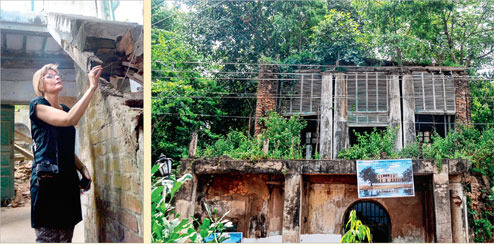
Bente Wolff, curator of the National Museum of Denmark, on Tuesday morning inspects the staircase of what was once the Denmark Tavern; (right) the Hooghly-facing facade of the tavern which will restored soon. Pictures by Pradip Sanyal

As our car tried to wriggle through vehicle-clogged Rishi Bankim Sarani of Serampore on Tuesday morning, I noticed that somebody has tried to prettify the miserable Subsidiary Correctional Home opened in 1803 by the rulers of this former Danish colony (1755 to 1845).

It was a modern institution based on humanitarian ideals and the then administration had taken into account the health problems, religions and caste system prevailing in India while planning it. And now its high walls are painted a blinding cobalt blue. A model park will soon be opened on the pavement in front of this jailhouse, and replicas of Chhota Bheem and other such cuties have been installed there.

In a few minutes we arrived at the ruins of what was once the double-storeyed Denmark Tavern & Hotel, where a ground-breaking puja was to be performed as the National Museum of Denmark will take it up for restoration. It is on the banks of the Hooghly, and Nishan ghat in front of it lies on the main axis connecting the main landing place near the ghat with the Government House, the seat of the former Danish government.

The museum had launched the Serampore Initiative in 2012 and took up the restoration of St. Olav’s Church (1806), whose steeple can be seen from Barrackpore on the opposite bank of the Hooghly; the south gate, once the guard house and used as a police lock-up as well facing Tin bazaar, then the main market; the main gate of the compound that houses the sub-divisional court.

It has acted in an advisory role in the restoration of what was once the old single-storeyed, colonnaded Danish Government House (1771) or Governor’s House. This compound dates back to 1755, when the Danish Asiatic Society Company established a trading post in Serampore.

The West Bengal Heritage Commission, which had taken up restoration of the Governor’s House, now exists only in name – most restoration work has come to a standstill. And the state government has made it clear built heritage is not uppermost on its mind.

However, Bente Wolff, curator, National Museum of Denmark, who is here to inspect the work being done by conservation architect Manish Chakraborti under the supervision of Intach, has good news.

Wolff has visited this town several times since the Serampore Initiative was launched and spends much of her time in the corridors of power to keep the dialogue with the government going. She has been in and out of Nabanna and the Chinsurah district magistrate’s office, and she has been informed that a tender will be floated soon for the last phase of the restoration work on the Governor’s House.

The cost of the ongoing projects: St. Olav’s Church and the South gate will be around Rs 3.5 crore when they are completed early 2016; the Denmark Tavern will be Rs 2.5 crore at least. The cost of restoring the main gate and some upgrading of the square in front of St. Olav’s Church and the court compound has not been estimated yet.

Wolff said the final phase of the Government House was kept in abeyance for a long time and its plinth will have to be constructed. An effort will be made to free the natural ventilation system. The government election building between the Government House and the South gate had to be demolished, which was not an easy task.

About Denmark Tavern & Hotel, Wolff said a painting of the establishment dating back to 1790 exists. The tavern found a mention in the March 1786 issue of Calcutta Gazette. According to the news item, Mr Parr, former owner of London Tavern, opened the Denmark Tavern & Hotel in the upper-roomed house near the flagstaff in Serampore.

It had a billiard table and coffee room, drinks were served and it did catering for wealthy people. The exact location of the hostelry was not known, but after examining archival sources, historian Simon Rasten came to the conclusion that it was adjacent to the SDO’s residence.

The rear section of this pile of bricks was used by the police, and a sign on the gateway reads Serampore Emergency Force Line, West Bengal Police. Once restoration work is done it will be handed over to the tourism department of the West Bengal government, which is expected to turn it into a coffee shop.

Chakraborti says it will take one-and-a-half months to clean the debris, and work will start in December. The central space will be an atrium for light and air, and accommodation for five to six guests will be provided. The Danish architect, Flemming Aalund, will be here in November to fine tune the work done.

G.M. Kapur, state convener of Intach, says he hopes this will become a nodal point and catalyst for such restoration projects and give a fillip to tourism in West Bengal.

The dilapidated main gate of the sub-divisional court dates from the late 18th century and has a high historic significance as part of the shared Indian-Danish heritage. Early drawings and photographs exist of the gate. These are being used for the restoration project. The cost will be defrayed by the National Museum of Denmark, and it will be reconstructed complete with a pediment and rustication to the original appearance based on verified evidence in 1851.

Restoration of St. Olav’s Church is in the last stages. The timber of the roofs in the ceiling has been replaced with steel beams and it will be opened for service next February. This is the historic core of the town, and the bus terminus is being relocated. Ideally, the square in front of the church should be cleared of the heart-shaped enclosure. The trees that obstruct the view should be transplanted elsewhere for a clear view of the magnificent church.

source: http://www.telegraphindia.com / The Telegraph, Calcutta,India / Front Page> Calcutta> Story / by Soumitra Das / Thursday – October 08th, 2015

Historian tips for Hooghly heritage

Kolkata :

The Hooghly isn’t just an Indian river but belongs to the world, historian and international authority on heritage conservation Philip Davies said at a seminar on heritage based urban development for the Hooghly riverfront held in the city on Wednesday.

Referring to the former European colonial posts—the Portuguese settlement in Bandel, Dutch in Chinsurah, French in Chandannagore, Danish in Serampore and Engligh in Barrackpore—along an 80-km stretch of the river’s western bank, Davies said the West Bengal government could source funds from the European Union as well as the World Monument Fund to revitalize these heritage precincts.

“The built heritage of West Bengal is greater than the entire United States and can be a powerful economic driver for the state,” Davies said while pointing out that much of it was crumbling and needed immediate repairs.

Conservation architect Manish Chakraborti agreed that the Hooghly riverfront heritage had an outstanding universal value and felt the way forward was to put it on the Unesco tentative list for world heritage sites. “Once it is on the list, the goal will be set. We can all then strive to achieve it,” he reasoned.

But stitching together a site that extends nearly 80 km along the river bank and covers Dalhousie Square, the central business district of a bustling metropolis like Kolkata, isn’t easy. This is particularly so about Kolkata and Bengal where things move at a snail’s pace.

Davies and architect Partha Ranjan Das have had a taste of it in the past. While it took Moe Chiba, the section chief and programme specialist (culture) Unesco, nine years to bring all stakeholders, including Kolkata Port Trust, Railways and PWD, on a single platform, Davies had prepared a blueprint for restoration and development of the Strand Warehouses in Kolkata 12 years ago but it is yet to take off. Das, too, had prepared a land use development plan for the entire heritage stretch along Hooghly but it has been gathering dust as well.

“There has been enough talk. It is time for decisive action,” Davies said at the seminar organized jointly by Unesco, the state government and non-government organization Indian Heritage Cities Network. “The inertia here is frustrating when compared to what is happening elsewhere. Kolkata has been extremely slow in taking advantage of its heritage resources. The delay could lead to destruction of what is unique. Already, one of the warehouses has been lost. Letting the warehouses rot is a dreadful waste of opportunity. In the past 50 years, they could have fetched crores of rupees in income and generated many jobs. Political will is needed to drive such an initiative. The involvement of chief minister and mayor is crucial,” he said.

While the heritage precincts in the erstwhile colonies have been identified and some restoration work funded by Dutch and Danish governments has already begun, Davies suggested that one of the options to fund the initiative could be to use cross-subsidy.

“There are areas along the riverbank that can be developed by private parties. The development will be in sync with the overall master plan. The funds generated from these projects can go into restoring the heritage zones and bringing them back to life,” he said.

source: http://www.timesofindia.indiatimes.com / The Times of India / News Home> City> Kolkata / TNN / October 04th, 2015

Indo-Bangla project on Partition

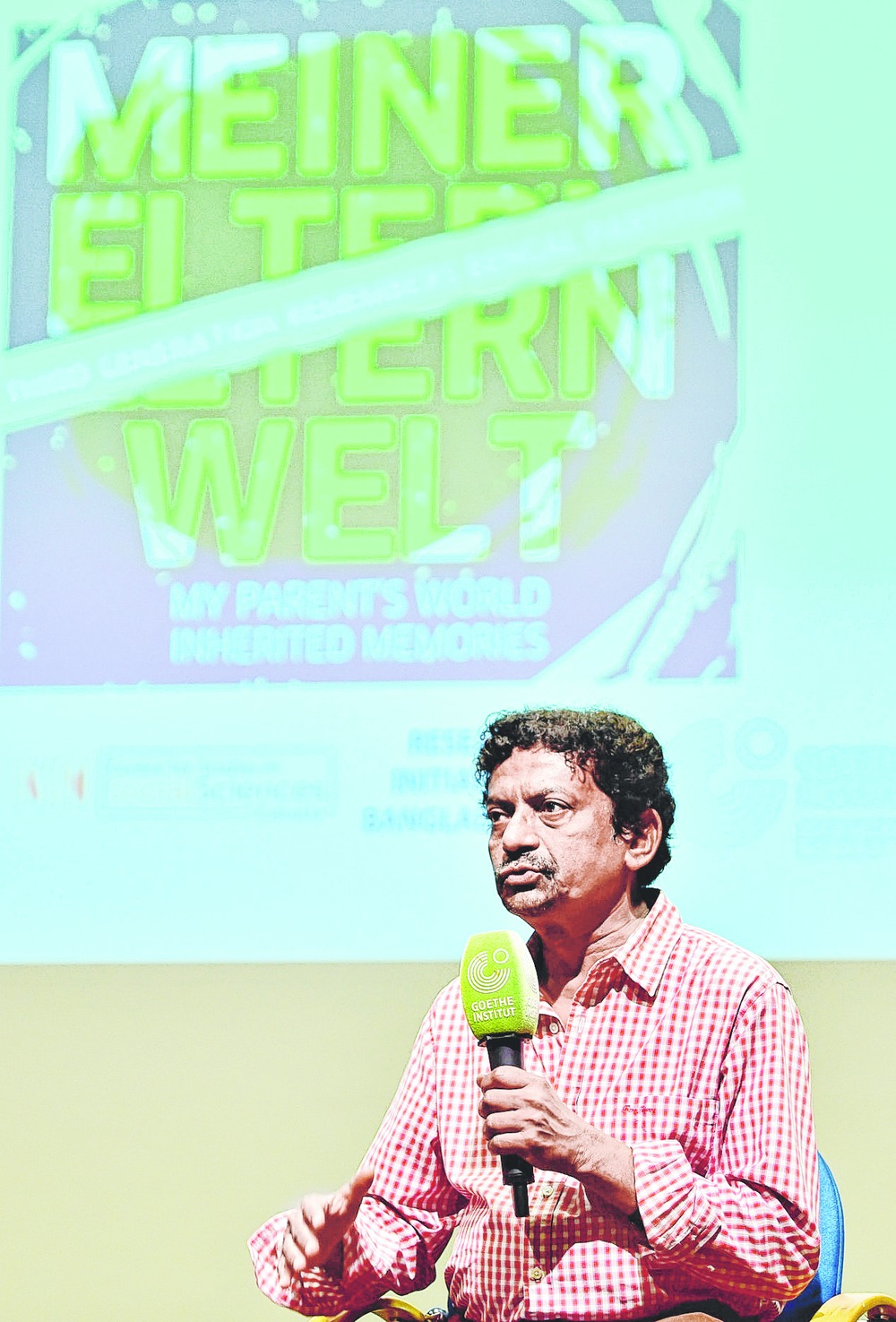
Goutam Ghose at the conference in Max Mueller Bhavan. (Anindya Shankar Ray)

Director Goutam Ghose often wondered as a 10-year-old why his friends could visit their desher bari during vacations while he could not.

“I remember asking my mother if we have a gramer bari. She would say, ‘achhe, but it is in East Pakistan and we don’t have easy access’,” Ghose said during a recent conference at Max Mueller Bhavan.

The conference kicked off a five-month Indo-Bangladesh project titled My Parent’s World – Inherited Memories, organised by Calcutta and Dhaka’s Goethe Institut.

Ghose narrated how he used to accompany his grandmother to refugee colonies in the Jadavpur and Bijoygarh areas to meet relatives. “I remember my grandmother telling me stories…. When I became a filmmaker, I thought let’s connect. Two races had been divided for a wrong reason. I wanted to go back to my ancestral home and make a film. So I made Padma Nadir Majhi and my father was really happy. He said he was happy that I had chosen the subject as I could go and shoot near the Padma.”

The conference saw speakers like Andrea Zemskov-Zuge from the Berghoff Foundation, Berlin; Manas Ray of the Centre for Studies in Social Sciences, Calcutta; Meghna Guhathakurta, executive director, Research Initiatives, Bangladesh, which works with the marginalised community; and former BBC journalist Nazes Afroz.

Ghose spoke about a village (Chakpanital) where he shot for his upcoming Indo-Bangla film – Shonkhochil. It is a village where there are houses of both sides and people live together.

“I find this two-nation theory absurd… that too on the basis of religion. While making the film, I was studying the Radcliffe Line. It is so strange… how on a huge water body you find a zigzag line separating two nations. Same people, same language, same culture divided by an absurd border. Why did Gandhi not launch a ‘Stop Partition Movement’ like the Quit India Movement?”

As part of the project, eight students from Calcutta travelled to Goethe Institut, Bangladesh, to meet eight students there. Together they will attend conferences and workshops on commemorative culture. “Once both sets of students are trained in interviewing techniques, they will interview third generation families of Partition on both sides of the border. People would be selected to travel to the country of their ancestors,” said Judith Mirschberger, director, Goethe Institut, Bangladesh. “So, someone living in Calcutta would travel to Bangladesh and vice versa to trace his/her family roots with these students.”

The project will end with the launch of a web platform where all interviews and background information will be put up.

From Shahid Minar in Dhaka to a memorial in Bhopal by a Dutch sculptor for victims of the Bhopal gas tragedy, Nazes Afroz, who is also the coordinator of the project, presented a slide show of pictures, while talking on the topic “Visual tool is very important in culture of memory”.

It was after a visit to Dhaka in February 2014 for an exhibition that Friso Maecker, the director of Goethe-Institut, Calcutta, started thinking about the possibility of working together. “I remember we were shooting a documentary film, which was about moving from one place to another…. There’s not been much research on the influence of Partition on third generation people in India as well as in Bangladesh…. Also from the viewpoint of an outsider… it is quite astounding that there is no memorial or place to remember the migration of more than eight million people… Which is why we started the project.”

source: http://www.telegraphindia.com / The Telegraph, Calcutta,India / Front Page> Calcutta> Story / by Malancha Dasgupta / Tuesday – September 15th, 2015

British-era vault still operating in Kolkata

Kolkata :

Inside the underground chambers of a non-descript office building on BBD Bag’s Netaji Subhas Road, lies a piece of Kolkata’s banking history. Here, in the basement of the four-storeyed structure, constructed by a Gujarati entrepreneur in 1940, Kolkata had one of its first private vaults — The Calcutta Safe Deposit Vault.

In the absence of locker facilities in banks then, it was a huge success with British citizens and business families. Seventy-five years later, the vault — probably the only privately owned one in Kolkata now — still survives.

Spread across 5,000 sqft, the vault has an astounding 8,600 lockers and three strongrooms. Dozens of safes, chests and almirahs, some of which are nearly a century-old, take up space in the strongrooms. Several lockers are still in the name of foreigners who rented them three generations ago. Around 2,000 of these lockers are now ‘dead’ and their holders are untraceable.

But the rest are active, says Sriram Ojha, a member of the board of management that runs the vault.

“We still have clients in USA, UK, Singapore and Canada, apart from all corners of the country. While many have stopped getting in touch with us, the rest are active users of the vault. They have been using it over generations and are keen to carry on. We are delighted to serve them because they are helping to keep this vault alive. It is part of our city’s great history,” Ojha said.

It was his father Amritlal Ojha, a successful industrialist from Kutch in Gujarat who started the vault in a building constructed by him. People like industrialists Badridas Goenka and Nalini Ranjan Sarkar attended the inauguration in January, 1940. It charged clients just Rs 8 every three months for a locker.

Four years later, on October 18, 1944, Amritlal passed away.

“My father had travelled to England to secure permission for the vault and building, which had been denied initially. He was on the board of more than a dozen companies and also president of the Indian Chamber of Commerce and FICCI at New Delhi, apart from numerous other business organizations. He enjoyed a tremendous goodwill in the elite circles of Kolkata, which made it easy for Calcutta Safe Deposit Vault to continue even after his death. Our clients never left us,” Ojha said.

Among those who stored valuables at the vault were the Dalai Lama and the Maharaja of Burdwan. Members of the royal family of Sikkim and the Tata and Birla families still hold some, apart from numerous other rich, aristocratic families in the city. Many of them still visit the vault regularly.

Fresh applications for lockers are still received, though there is hardly any available now. Recently, a client opened a locker that had not been operated for nearly 30 years — a Bengali woman from Texas claimed her husband’s trunk from a strongroom at the vault.

Reminders are sent to old clients to come and check their belongings. “Many respond enthusiastically while others are returned to us for the recipients are either dead or have shifted residence,” Ojha explained.

It is more to carry on his father’s legacy, than anything else, that the vault has been kept running with a workforce of only 20, said the 71-year-old Ojha. “None of his other businesses survive so I am keen that this one exists at least till I am alive. It is a hand-to-mouth existence for the vault since we have hundreds of defaulters. Charges have been revised but the earnings are still not enough to result in a decent profit. But we can still survive,” Ojha said.

There is a set of Reserve Bank of India guidelines for nationalized Bank lockers. But Ojha is not aware of them and he has not been questioned either.

“When my father started it, there was no RBI. But a demand for lockers must have existed as this vault was a runaway success. Our vault is not the only one in the country, there are several others in other cities. But ours was a huge hit,” he argues.

The vault now charges between Rs 800 and Rs 3,000 annually for a loc-ker, depending on its size. The char-ges for renting an almirah, a safe or a trunk are Rs 12,000, Rs 15,000 and Rs 5,000 respectively.

What worries Ojha now is the future. “Rent from the building sustains the company but the major tenant has been defaulting. Unless we can generate more revenue, the vault will pass into history. It sustains nearly a hundred people, which makes it important for me to ensure that it goes on,” Ojha explains.

source: http://www.timesofindia.indiatimes.com / The Times of India / News Home> City> Kolkata / by Prithvijit Mitra, TNN / September 13th, 2015

Neglected Coolie Darwaza turns into pile of rubble

Kolkata :

St George’s Gate, once a prominent structure of the city after which even a road was named, was long lost. And now, even its remains are sinking into oblivion.

The southern gateway to Fort William near the northern slope of Kidderpore bridge, the gate, also known as Coolie Darwaza, was abandoned by military authorities when the passageway was converted into a civilian road — St George’s Gate Road. The new St George’s Gate of Fort William was built a little west, near Prinsep Ghat.

TOI on Thursday found only the pillar on the side of southern flank partly intact, overgrown weeds covering most part of it. The other part on the northern side has vanished. Only its broken pieces are strewn all over the place. Who razed it? When was it razed? No one ever bothered to know. It is not known whether it was razed when the elevated approach road of Vidyasagar Setu was constructed.

The pathetic condition of the gate was brought to the notice of Archaeological Survey of India (ASI) by Anthony Khatchaturian, a passionate heritage activist. ASI regional director (east) Dr P K Mishra immediately took note of it and inquired about it. He also wrote to GoC Bengal Area, requesting him to look into how this important heritage gate got destroyed.

“Historically, it is a very important architecture. It would be great if we could restore the structure,” said Mishra. There is a detailed reference of St George’s Gate in M L Augustine’s book ‘Fort William: Calcutta’s Crowning Glory’.

“I was surprised how such a beautiful structure is being damaged systematically. I was surprised to find the signs of destruction still intact across the road. There must be some serious attempt to restore the structure and rebuild the destroyed one,” said Anthony, a passionate save heritage campaigner with an Armenian origin.

source: http://www.timesofindia.indiatimes.com / The Times of India / News Home> City> Kolkata / by Krishnendu Bandyopahyay, TNN / September 11th, 2015

Timely act saves heritage mansion

Kolkata :

A heritage building that had been granted the highest degree of protection to conserve its historical and architectural value was being systematically destroyed on the sly till locals alerted Kolkata Municipal Corporation (KMC) authorities. The latter has filed an FIR. Involvement of local politicians, musclemen and a section of police are suspected.

Located between Howrah bridge and Nimtala Ghat, Moribund House on 65/2 Strand Road is a 19th century single storey mansion with Roman Tuscan columns. It was once part of Rani Rashmoni Estate and was registered in the name of her husband Rajchandra Das. It was in this mansion that filmmaker Goutam Ghose shot a portion of the 1988 National Award winning film ‘Antarjali Jatra’.

Listed as Grade I heritage structure by KMC in 2009, no external change is permissible in the building. The grading also restricts the building’s use. But the building has fallen into disrepair following years of neglect. It would have been ground to dust had not KMC acted promptly following a tip-off. The compound had been shuttered by corrugated sheets to allow the demolition.

When TOI visited the building, it was in absolute ruins with evidence of fresh destruction everywhere. At least two columns lay in pieces on floor. Another was being hammered down when a visit by the police team following the KMC complaint forced a cease-work. Parts of the wall and roof have also been systematically pulled down to trigger a collapse of the entire structure.

The project management unit of KMC that oversees heritage buildings in the city filed a general diary (GD-PMU/108 15-16) with Jorabagan police station on August 25, 2015. In the complaint, the civic authority stated that the Grade I heritage building was being intentionally demolished.

“It is reported from local people that the house is being intentionally and systematically damaged by persons staying there which is illegal and unlawful. Please take necessary steps and keep strict vigil to prevent any sort of damage to the historical and heritage structure. This may be treated as FIR,” the complaint by the KMC PMU department stated.

The manner in which the demolition was being carried out pointed to the involvement of local politicians and musclemen. A few locals also hinted as much saying reputable builders would not have dared to act in that manner and get incriminated. The involvement of local cops is not ruled out wither. When TOI visited the police station, the cops initially feigned ignorance about the threat to any heritage building under its jurisdiction and acknowledged only when confronted with all details.

“I am totally disgusted at the state of affairs. We just had one Grade 1 building, the Ghoolam Rasul Mosque on Shamsul Huda Road, demolished without a murmur. No action was taken against anyone. Now, a second Grade I listed building is being demolished. At least some visible action should be taken,” said heritage activist GM Kapur.

Mayor Sovan Chatterjee has asked the KMC officials to keep a strict vigil on the building. “No one has the right to alter anything in a Grade-I heritage building, leave alone pulling it down. We have lodged a complaint. Let police investigate who are the culprits,” he said.

source: http://www.timesofindia.indiatimes.com / The Times of India / News Home> City> Kolkata / by Saikat Ray & Subhro Niyogi, TNN / September 04th, 2015

Google V for virtual tour of Victoria – Treasures find place in online museum

TreasuresKOLKATA06sept2015

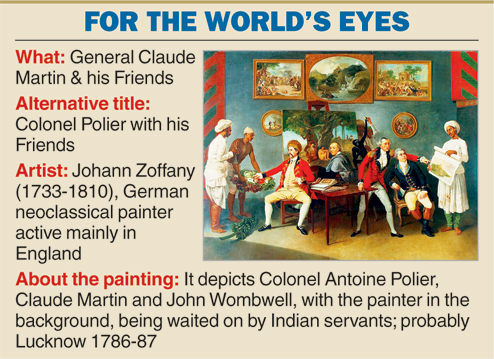
More than a hundred treasures from Victoria Memorial Hall, among them a painting by Johann Zoffany, will be showcased in a global online archive by Google featuring many well-known museums.

A team from Google was in the city last week, shooting at Victoria Memorial. A panoramic view of the inside as well as the outside area of the museum will also be available on the online platform.

Zoffany’s oil on canvas depicting General Claude Martin, the founder of the La Martiniere Schools, and his friends, will share space with paintings by European artists from 1770-1850-60, also known as Company Paintings, works of Thomas and William Daniell, Abanindranath Tagore, Jamini Roy, historic documents and Tipu Sultan’s handwritten and illustrated diary on the art of war and other treasures from Victoria Memorial on Google Cultural Institute, earlier Google Art.

Started by the tech giant in 2011, the institute is a not-for-profit initiative that partners with cultural organisations to make the world’s cultural heritage available online.

Victoria Memorial signed an MoU with Google Cultural Institute in 2013 and as part of the project 150 highlights of the museum would be found on the online platform. Fifty of these images will be available in ultra high-resolution images known as gigapixels.

“We are still deliberating on which 50 to choose. We are also planning to do a digital walkthrough of the museum,” said Jayanta Sengupta, the secretary and curator of Victoria Memorial Hall and Indian Museum. “The selection has to be balanced. We are choosing objects that are historically as well as visually attractive. The transformation into gigapixels of certain paintings, especially of the impressionist painters, will be extremely useful for art enthusiasts. Each and every brush stroke and intricacies of the paintings will be visible.”

The technology used by Google is expensive and patented. “Footfall at museums has been known to increase after digitisation. People are keen to check out the actual objects,” Sengupta said, adding that the Indian Museum would soon join Victoria for the project.

Courtesy the association with Google, Victoria Memorial can now put up exhibitions it is hosting on Google Cultural Institute. “We can select an exhibition, curate it and post on Google. Also, we can put up previews for our upcoming exhibitions,” Sengupta said. “Google is the most popular search engine. The project is not only beneficial for us but it also gives people a chance to go through our collection.”

Three museums from India – Crafts Museum, National Gallery of Modern Art and National Museum, all in Delhi – are already part of the association. Victoria and Google are aiming for a November launch, when a few more Indian museums will come on board.

The choice of German neoclassical painter Zoffany’s painting of General Claude Martin has made the La Martiniere family proud too. “This is a matter of pride and pleasure for us. We are delighted and it is a great honour for us,” said Supriyo Dhar, the secretary of La Martiniere Schools.

source: http://www.telegraphindia.com / The Telegraph, Calcutta,India / Front Page> Calcutta> Story / by Samabrita Sen / Saturday – September 05th, 2015