Category Archives: Historical Links / Pre-Independence

An indigo planters’ journals

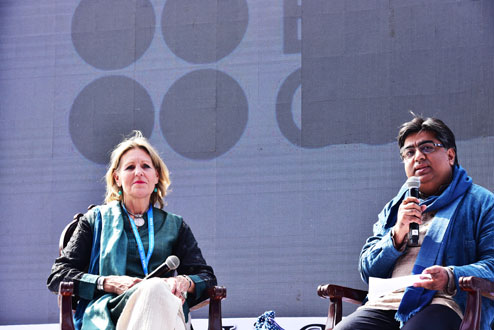
Jenny Balfour-Paul with Bappaditya Biswas at Kolkata Literary Meet on January 24. Picture by Anindya Shankar Ray

“It was serendipity,” said Jenny Balfour-Paul about how he chanced upon Thomas Machell’s journals in the British Library. She was speaking at the Tata Steel Kolkata Literary Meet, in association with the Victoria Memorial and The Telegraph on January 24.

Balfour-Paul’s book, Deeper than Indigo, based on these journals, seemed to her like a natural progression from her earlier works. For, it was indigo that lured her to Machell and shaped the 15 years of her life that she spent pursuing his trail.

Machell was a midshipman in the merchant navy and an indigo planter. He had travelled on an Arab ship dressed as an Arab and read the Bible to strict Muslims. He was taken aback at how much they had in common. Machell’s plea for religious tolerance is much more relevant now than it was in his times, said Balfour-Paul.

Balfour-Paul objects to her obsession with Machell being called a love affair across time. Yet, she seemed quite taken when it was pointed out that the Bengali translation of her book’s title, Ghana Shyam, not only means the darkest blue but is also another name for Krishna, bringing to mind an image of Radha and the themes of separation and union.

“It was a compulsion to know more about Machell and his spiritual search” that led Balfour-Paul to follow his path. Machell would love the way the world is connected at present, said Balfour-Paul, adding that had he been around he would probably have been quite active on Twitter.

Machell was ahead of his time in his empathy for the “natives” and his “criticism of colonialism”. His journals bear witness to him repeatedly “grappling with his conscience”. Machell, when he wrote the journals, only wanted to be heard. Balfour-Paul recalled how when she came across the first draft of the book, she shouted to the sea: “I’ve got you out there now.”

source: http://www.telegraphindia.com / The Telegraph,Calcutta,India / Front Page> Calcutta> Story / by Srimoyee Bogchi / Tuesday – March 08th, 2016
Bengal Area completes 121 years

Kolkata :

One of the oldest static formations of the Indian Army in the eastern region, Headquarter Bengal Area, celebrated its 122nd Raising Day in Kolkata on Tuesday. What makes this formation extremely crucial for civilians is that it liaisons with the West Bengal and Bihar governments for activities such as disaster relief, rescue efforts during natural calamities and deployment of troops to curb violence.

Lt Gen Rajeev Tewari, general officer commanding, Bengal Area, addressed all ranks of the formation at a special sainik sammelan and conveyed his greetings.

Bengal Area Headquarter was raised as Bengal Command at Fort William on March 1, 1895, by Lt Gen Sir WK Ells. It moved to its present location at 246, AJC Bose Road from Bengdubi in north Bengal in September 1995. Bengal Area participated with distinction during World War-II, the Sino-Indian conflict of 1962 and Indo-Pak War of 1971. Besides operational war time task, the formation also supports the logistics requirements of fighting formations and units of the Eastern Command in war and peace.

It is also the ‘local military authority’ acting as a link between the state government and the Army besides being the custodian of the ‘Maidan’ area and all Army land around Kolkata.

“With growing need of the military in combating natural disasters as well as man-made calamities, the importance of the formation has gone up by leaps and bounds. It also provides necessary assistance to the Eastern Command in maintaining bases in parts of south Bengal and bordering areas of Bihar,” an officer said.

source: http://www.timesofindia.indiatimes.com / The Times of India / News Home> City> Kolkata / by Jayanth Gupta / March 01st, 2016

Experts to Document Ashoka Circuit in State

Kalaburagi :

A joint initiative of HKRDB and Calcutta University to document an Ashoka Circuit for Karnataka from Sannati to Siddhapura has been launched.

Head of Ancient History Department of Calcutta University Prof Susmita Basu Majumdar is the Principal Investigator. As part of this expedition, a documentary will be filmed and a pictorial Pali-English-Kannada dictionary will be compiled.

Karnataka has perhaps the largest number of Ashoka sites and those dating back to the 3rd century BC are the earliest legible records found from Afghanistan in the northwest, Andhra Pradesh in the south, Odisha in the east to Girnar in the west. The project will first document all the Ashokan sites in Karnataka and then establish the full circuit from Afghanistan.

AshokaBF02mar2016

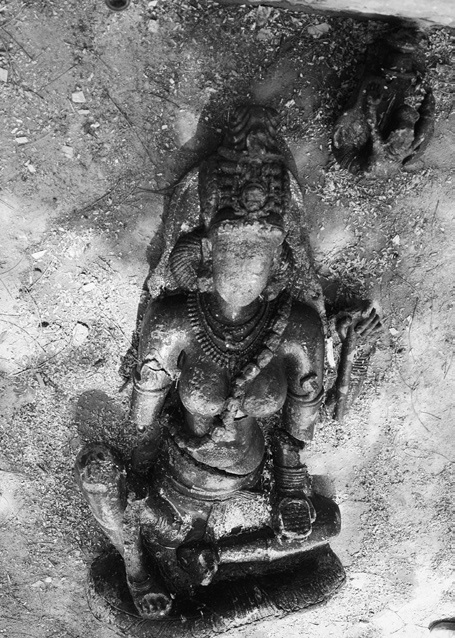
A team of three, Prof Susmita Basu Majumdar, artist Rajib Chakraborty and film maker Ranjay Ray Choudhury visited the Chandralaparameshvari temple at Sannati on Sunday, to document the spot where the Ashoka edict was found. They found the original idol of deity Mahakali broken into four pieces lying on the western side of the temple on the banks of river Bhima.

Prof Basu Majundar took the initiative to re-join the idol and narrated the interesting story behind the discovery of the Ashoka inscriptions. In 1986, a portion of the roof of the temple collapsed and caused damage to the 12th century seated four handed figure of goddess Mahakali wearing mundamala and holding damaru, trishula, kapala and sword.

Presently, this beautiful piece of sculpture only shows the trishula and kapala and the other two hands are broken but the temple authorities informed that the present image of Chandraparameshwari which is worshiped in the temple is a replica of the previous Goddess.

The khandita pratima of the deity lying on the banks of Bhima was almost awaiting the visit of this team and when the sculpture was joined it looked as if the beautiful Goddess had reappeared.

The idol base had a protruding pillar like hinge which was fitted into a stone socket. The stone on which the Ashoka inscription was engraved was used to form the base of this deity. When the idol was damaged, the inscription was discovered.

This inscription carried the separate edicts one and two and rock edits 12 and 14 of Ashoka (274-232 BC). Karnakata was the southernmost boundary of the Ashoka’s Mauryan Empire.

This inscription was discovered in 1989. Now the original idol which is about 600 years old is also restored to the temple. The matter is being reported to the ASI for further action.

source: http://www.newindianexpress.com / The New Indian Express / Home> States> Karnataka / by Express News Service / March 02nd, 2016

Part of history for eight centuries, Sen Dighi faces extinction threat

Kolkata:

Its rippling waters tell many a tale and history – dating back to the 12th century. Possibly the oldest waterbody in south Bengal, Sen Dighi in Boral on the southern fringes of Kolkata has survived centuries of negligence, contamination and encroachment. It has seen change of rule, dynasties, eras and witnessed the metamorphosis of the region from a marsh-infested forest land to a thriving habitat. While more than half the waterbodies in the area have vanished and an expanding city has consumed wetlands, Sen Dighi has existed for an incredible 800 years. The 23-bigha pond, a heritage waterbody, now faces a challenge from immersion-induced pollution and its fragile banks are steadily being eaten into by garbage dumps.

A study of its water revealed that the biological oxygen demand of Sen Dighi is high. The water quality has taken a beating ever since the pond was thrown open to immersions and Chhat festivities, according to locals and experts. Even though idols are removed quickly, the residue is enough to affect the water, they say. Perhaps, a bigger threat to the pond is posed by the eroding banks, made unsteady by devotees who have been clearing vegetation along the edges during Chhat. It has led to the uprooting of two trees and another has been left unsteady. These trees are crucial to the survival of Sen Dighi since they have been holding the banks together.

“Over the years, much of Sen Dighi has been lost through encroachment. It is important to protect the pond from pollution and infringement since it is part of our history. We must ensure that Sen Dighi retains its size and its water remains unpolluted,” said Dipayan Dey, chairman of SAFE, a green NGO that is now studying the pond’s water quality.

Around 20 km from Kolkata, Sen Dighi was dug by Ballal Sen, the second ruler of Bengal’s Sen dynasty, in the late 12th century. It must have measured close to a hundred bighas then and was the principal source of water for a large swathe of area to the south of Kolkata, according to Madhu Basu, who has chronicled the history of Sen Dighi. “The city didn’t exist then and it was a practice to dig huge waterbodies that would be taken care of by locals. Almost every house had a tank attached to it. But Sen Dighi stood out due to its size and the fact that it was maintained by the local Tripura Sundari temple that still survives. It is one of the last symbols of the region’s past prosperity,” said Basu, who runs an NGO called Economic Rural Development Society (ERDS).

Over the years, numerous archaeological relics of the Gupta, Maurya, Pala and Sen dynasties have been excavated from Sen Dighi and the areas around it. In the mid-Eighties, Sen Dighi was dried up and cleansed by ERDS. A local body of businessmen took the pond on lease for pisciculture. A part of the money earned from the lease goes to the Tripura Sundari trust. “We dug up numerous relics from the pond. They are now conserved at the Tripura Sundari temple, Ashutosh Museum and a few other places. That was the last time the pond was cleaned,” said Basu, who has penned a book on the history of Boral titled ‘Itihasher Darpane: Boral’.

Locals, on the other hand, pointed out that Sen Dighi is diminishing in size, bit by bit. Documents held by the Tripura Sundari trust mentions the size of the pond as 45 bighas. Less than half of it remains. “Immersions have led to the felling of trees and litter has filled up a portion along the northern bank. If this continues, the pond will get further reduced in size,” said a member of the local Boral Parliament Club that helps the temple trust in maintaining the pond. Basu, who is a resident of Boral, agreed. “Encroachments have always been a threat. With real estate activity being brisk in the area, the future is uncertain for Sen Dighi,” he said.

Till a hundred years ago, the pond would be surrounded by brick kilns. Legend has it that a trader named Maheshwar Shau from Odisha had introduced fish cultivation at Sen Dighi. “Locals got jealous of him and he was killed and thrown into the pond. For many years, people would keep away from Sen Dighi and believed it was haunted,” said Basu.

Green actvists believe immersions should be stopped and Sen Dighi should be cleaned to save it. “If it has to survive, Sen Dighi shouldn’t be used for bathing or washing. Once the water has been cleaned, a pump could be used to pull out water, which can then be used by locals. It would be a shame if Sen Dighi degenerates into a stinking pool like so many around it already have,” said environmentalist AK Ghosh.

source: http://www.timesofindia.indiatimes.com / The Times of India / News Home> City> Kolkata / by Prithvijit Mitra / TNN / February 10th, 2016

Mamata Renames Bengal’s Raj Bhavan Suites to Shed British Legacy

Kolkata :

West Bengal on Wednesday renamed all the suites at the Raj Bhavan, official residence of the Governor, to shed its British legacy. The palatial house, built in 1803 by the British when Calcutta was India’s capital till 1911, and known as Government House had suites named after the British.

Now, the Prince of Wales Suite has been renamed Kaviguru Rabindranath Tagore Kakhsha and Anderson Suite Swami Vivekananda Kakhsha (Kakhsha means rooms). A State government official said, “All new names were personally selected by Chief Minister Mamata Banerjee. She felt that when foreign dignitaries visit the state and stay in the Raj Bhavan and find suites with British names even after independence, it sends a wrong signal.”

The former Prince of Wales Suite on the first floor in the northeastern wing is reserved for the President, Vice-President, Prime Minister and visiting heads of states.

The Dufferin Suite, named after Lady Dufferin, was renamed Kanchenjungha Kaksha, after the Himalayan peak, while Wellesley Suite, named after the former British Governor General in India, was renamed Sagar Kaksha, after the holy Gangasagar Islands in the Bay of Bengal.

Government House was designed by Brit architect Captain Charles Wyatt as a copy of the British manor house of Lord Curzon’s family at Keddleston Hall, Derbyshire, UK.

Mamata also plans to rename Dhakuria Bridge in the city after Hindu preacher Sri Chaitanya Mahaprabhu, as Chaitanya Setu, and the Jerut Bridge after the wife of Ramakrishna Paramahamsa, as Ma Saradamoni Setu.

source: http://www.newindianexpress.com / The New Indian Express / Home> Nation / by Arup Chanda / January 28th, 2016

40 Buddhist relics unearthed at Moghalmari in a single day

Kolkata / Midnapur:

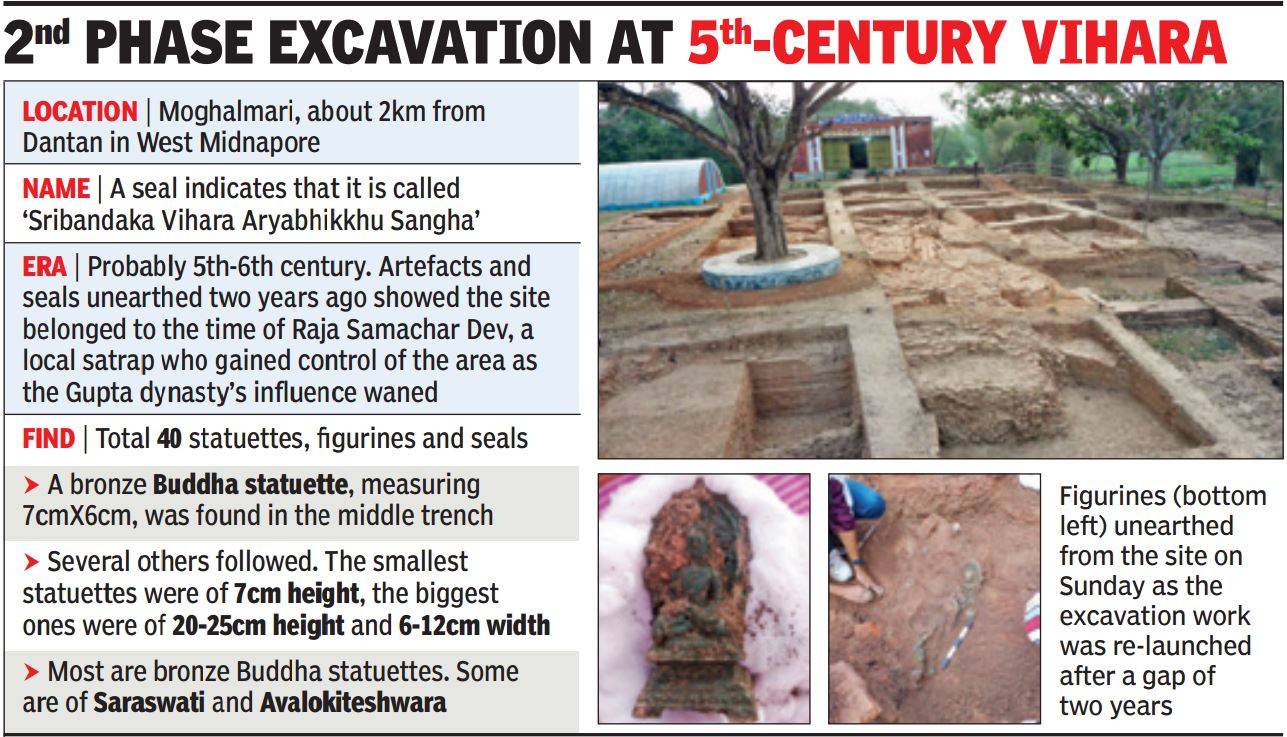
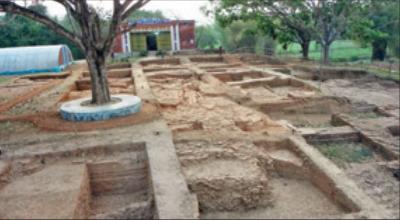
The ancient site at Moghalmari witnessed much excitement on Sunday morning when around 40 bronze artifacts, dating back to fifth and sixth centuries, tumbled out of the earth, as the state archaeology department re-launched excavation of the Buddhist vihara after a gap of two years. The digging work coincided with a two-day Moghalmari Festival inaugurated on Sunday.

BuddhistRelicsKOLKATA25jan2016

About two kilometres away from Dantan in West Midnapur as bronze artefacts dating back to fifth and sixth centuries started tumbling out of the ground, one after the other. The state archaeology department has re-started the excavations at the site after a gap of two years.

Around 11am, a bronze Buddha statuette, measuring 7cmX6cm, first surfaced in the middle trench of the site, which is about 2km from Dantan in West Midnapur. After this, several more statues of varying sizes started showing up to loud cheers from archaeologists as well as residents of the area. Monks from across the country, who have converged on Moghalmari for special prayers and seminars at the festival being organized by Kolkata-based Bauddha Dharmankur Sabha, were equally enthralled by the discoveries at the vihara, believed to be one of the oldest Buddhist sites in the country.

Of the area who gathered to watch the digging. A two-day Moghalmari Festival also started there on Sunday organised by the city based Bauddha Dharmankur Sabha. Invited by the Sabha, monks from across the country are camping at the site for special prayers and seminars. Naturally, the discovery of the bronze statuettes generated all around veneration for the site has already been established as one of the oldest Buddhist viharas of the country and definitely of Bengal.

While the smallest statuettes were around 7cm high, the biggest ones stood tall at 20-25cm, with widths varying from six to 12cm. While most were bronze Buddhas, statuettes of Saraswati and Avalokiteshwaras were also found. “We are going very slow with the digging work as relics are strwen across the entire zone. Finding over 40 antique figurines in a single day is definitely rare and prized. We are thrilled beyond explanation,” said Prakash Maity, who is in charge of the Moghalmari excavation. “Earlier, we found stucco figurines, gold, silver and mixed metal coins, pendants, votifs and seals.” The site dates back to the post-Gupta period when the dynasty’s influence waned and local satraps-here, Raja Samachar Dev, gained control. The pre-Pala phase of Bengal history was shrouded in mystery, experts said.

In fact, the state archaeology directorate halted the digging work as experts needed to analyse the coins and seals to verify the site’s dates. After research, historians were confirmed that they had found the key seal that revealed the vihara’s name as ‘Sribandaka Vihara Aryabhikkhu Sangha’ and the inscriptions on it established that the institute was founded and functioned in the 5th-6th centuries, if not earlier. The state government has decided to release funds for the new phase of excavation. Already, more than Rs 3 crore has been spent.

BuddhistRelics02KOLKATA25jan2016

Atanu Pradhan, a local enthusiast and secretary of Tarun Seva Sangha, who was instrumental in drawing the Calcutta University’s attention to the mound under which the vihara lay buried for centuries is elated. “I am sure that with time, archaeologists will stumble upon artifacts of greater value and the site will be officially announced a fifth-century vihara,” Pradhan said.

source: http://www.timesofindia.indiatimes.com / The Times of India / News Home> City> Kolkata / by Sujay Khanra & Jhimli Mukherjee Pandey, TNN / January 24th, 2016

Moghalmari fest to bring ‘buried’ Buddhist vihara under limelight

Kolkata:

Buddhist monks from different corners of the country are set to converge on Buddhist monks from different corners of the country are set to converge on Moghalmari near Dantan in West Midnapur on January 24 to stake their claim on a newly excavated site, believed to be one of the oldest Buddhist viharas in India.near Dantan in West Midnapur on January 24 to stake their claim on a newly excavated site, believed to be one of the oldest Buddhist viharas in India.

What was written off as just a mound, which residents of the area believed to hide an ancient lore, has turned out to be a 5th century Buddhist site. The state archaeological department’s excavation has pushed the Raktamrittika Vihara at Karna Subarna in Murshidabad, dated 7th century, to the second position on the Buddhist religious map and calendar.

The Bauddha Dharmankur Sabha, headquartered in the city, has organised the two-day Moghalmari Buddhist Festival, which will see a rare congregation of monks at the site that dates back to the era of Raja Samachar Dev. This was the time when the Gupta dynasty had waned and local satraps had managed to shake off its suzerainty to declare their independence, Raja Samachar Dev being one of them. Most details of the pre-Pala age of Bengal is shrouded in mystery owing to lack of any historical evidence but now, scholars believe that the Moghalmari vihara excavation would help them piece together this past.

The excavation of the site, which had been put on a hold for nearly two years, will be taken up again from Monday. The state archaeology directorate had stopped the digging after archaeologists found coins and seals that had to be analysed to verify the site’s antiquity.

With the inscriptions on the seals finally ascertaining the fact that the vihara was founded and fucntioned during the 5th-6th centuries, if not earlier, the state government has decided to release funds for the new phase of excavation. Already, more than Rs 3 crore has been spent.

“A total of 6,400 square-feet area has to be dug up. So far, we have been able to work our way through less than 2,000 square feet. There is a lot of work to be done. Apart from the stucco figurines, gold, silver and mixed metal coins, pendants, votifs and seals, we have also been able to unearth a seal that describes the vihara as the Sribandaka Vihara Aryabhikkhu Sangha. The vihara did not grow in one phase. So far, we have come across evidence that pinted at the fact that the establishment flourished over second and third phases. We will not stop till we get to see traces of the first phase of the vihara’s development which might put the dates back even further,” said Prakash Maiti, director of the Moghalmari excavation site and a senior archaeologist of the directorate.

During the festival, the Bauddha Dharmankur Sabha will organize special prayers and meditation sessions to spread the message of Buddhism. Visitors will be taken on tours through the excavated courtyard, pradakshin path, the cells in which the monks lived. Seminars have also been organised on Tagore’s writings on Buddha and how his teachings had inspired Vivekananda.

While on one hand, the festival would write a new page in Buddhist religious history, it would also help catapult Moghalmari from obscurity to an important position on the map of ancient Indian history.

“This phase is especially important to us because we will look for more seals to finally establish the name of the vihara. Also, we might stumble upon the first phase of the vihara’s growth while excavating further. We have not yet reached the Garba Griha,” Maiti said.

District magistrate of West Midnapur J P Meena said a lot of interest has already been generated around the forthcoming festival.

source: http://www.timesofindia.indiatimes.com / The Times of India / News Home> City> Kolkata / by Jhimli Mukherjee Pandey & Sujay KhanraJan / January 10th, 2016

Conservation architect Rohit Jigyasu speaks on sustainable recovery at Indian Museum

Kolkata :

The Indian Museum recently organized a special lecture on ‘First Aid to Cultural Heritage in Nepal For Sustainable Recovery and Risk Reduction’ by Rohit Jigyasu.

Rohit Jigyasu is a conservation architect and risk management professional from India, currently working as UNESCO Chair holswe professor at the Institute for Disaster Mitigation of Urban Cultural Heritage at Ritsumeikan University, Kyoto, Japan and Senior Advisor at the Indian Institute for Human Settlements (IIHS).

He is the elected president of ICOMOS-India since 2014 and ICOMOS International Scientific Committee on Risk Preparedness (ICORP) since 2010. Rohit is also currently serving as the elected member of the executive committee of ICOMOS since 2011.

After taking his post-graduate degree in architectural conservation from School of Planning and Architecture in New Delhi, Rohit obtained his doctoral degree from Norwegian University of Science and Technology, Trondheim, Norway. His multidisciplinary research was focused on the role of traditional knowledge in disaster mitigation in the context of South Asian region.

Rohit has been working with several national and international organizations such as Archaeological Survey of India, Indian National Institute of Disaster Management, UNESCO, ICCROM and Getty Conservation Institute for consultancy, research and training on Disaster Risk Management of Cultural Heritage.

Rohit has been teaching as the visiting faculty at several national and international academic institutions in India and abroad. He is on editorial board of some well reputed journals such as Journal of Cultural Heritage Management and Sustainable Development, and Disaster Prevention and Management. He has contributed to several international publications.

source: http://www.timesofindia.indiatimes.com / The Times of India / News Home> City> Kolkata / by Ajanta Chakraborty, TNN / December 16th, 2015

India’s sepia-tinted U.S. connections

USKolkata09dec2015

A unique photograph of the elephant (1797), archived by the New York Historical Society, is now exhibited in the city.

“It will be a great thing to carry the first elephant to America,” wrote Jacob Crowninshield, the captain of the ship America. The first living elephant, which was ferried all the way from Kolkata to the US, was later exhibited in Boston, New York and Philadelphia.

A unique photograph of the elephant (1797), archived by the New York Historical Society, is now exhibited in the city. Alongside The Elephant, 41 rare photos, collected over the last 150 years, form part of the exhibition titled ‘Kindred Nations: The United States and India: 1783-1947’at The Indian Museum here that opened during this weekend.

The exhibition tells the story of association between the two countries long before the latest thrust to step up diplomatic and trade ties were initiated.

One compelling example is the photograph of the Indian immigrant workforce in the US. It is perhaps a less-known fact that a significant share of the workforce involved in building modern America migrated from northern India.

At least two of the photographs taken around World War II underscore the role of Sikh immigrants in the construction of rail roads or them joining various other trades. The exhibits also narrate how Americans engaged in building ties with Indians.

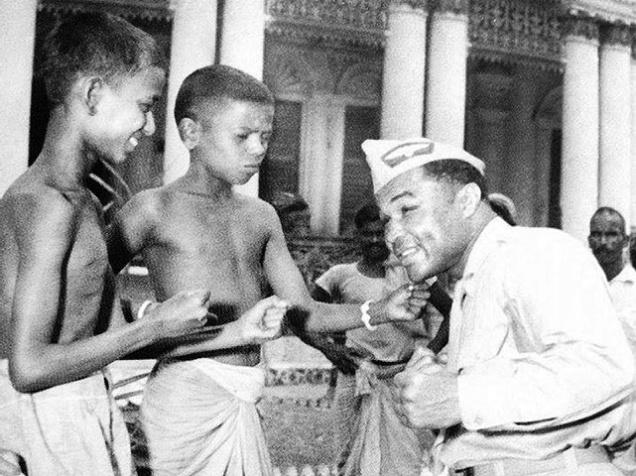
Henry Armstrong, one of the greatest American boxers of all times, visited India during World War II and graced an amateur boxing tournament in Kolkata. A candid picture of the pugilist giving spontaneous boxing lessons to local youth (1945) also forms a part of this exclusive exhibit.

Photographs of celebrated Anglo-Indian actor Merle Oberon, who shot in West Bengal for a film, and Charlotte Wiser, an American anthropologist, teaching childcare techniques to local villagers at Allenganj (1919), provide the viewers with an insight about the ever-evolving ties between the two countries.

It all started with bilateral trade relations. From education, cultural and religious values, cinema, jazz music, Kashmiri shawls, books on navigation — India and the U.S have shared them all. There was also a rare shot of Anandibhai Joshi (1880), the first Indian woman to earn a medical degree in the U.S.

Shots of Singer Manufacturing Company’s office (1897), the famous Atkinson house (1860), Swami Vivekananda with his American counterparts at Green Acre School (1894) and Rabindranath Tagore holding the delicate hands of the blind and deaf American activist and author Helen Keller are the other notable ones.

However, some these exhibits are widely circulated on the Internet.

Curated by the Meridian International Center in Washington D.C. and supported by the U.S. Department of State, the photographs and letters speak of what is described as ‘shared prosperity and peace’. Dr. Jayanta Sengupta, Director of Indian Museum, said it was “an honour” to host the exhibition.

“As a museum, we always explore the interstices of cultures and the connections between them, and what better way to do this than by celebrating the two centuries of historical connections between the world’s two largest democracies?” he asked.

Acting U.S. Consul General Cory Wilcox, on his part, complemented Dr Sengupta. “Through the medium of art, we begin a dialogue about our perspectives and values. We hope this exhibit of the past engagement sparks our imagination for the future, seeing how we can take steps to improve the lives of the next generations in both our countries,” Mr Wilcox told The Hindu.

The exhibit was earlier on display in New Delhi, Chennai, Hyderabad, Mumbai with Kolkata being the last stop, where it will continue till the last day of the year.

source: http://www.thehindu.com / The Hindu / Home> National / by Ayshika Mitra / Kolkata – December 07th, 2015

App brings Kolkata’s history alive

MemorialKOLKATA30nov2015

A smart phone application will enable users to explore rare archival images of more than 100 geographical points and heritage sites of the city.

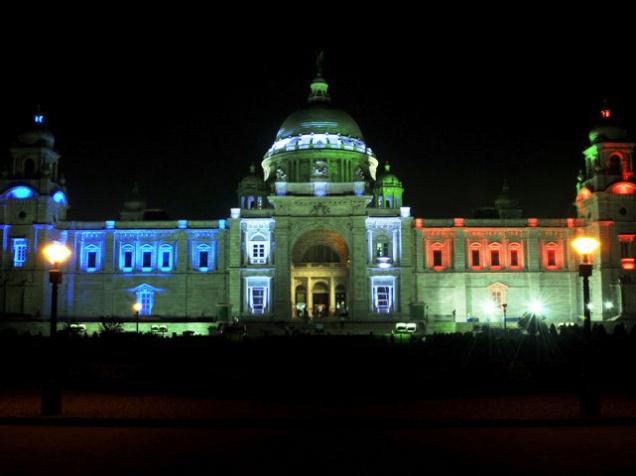
If you are going past any colonial and historic monument of Kolkata, such as the Victoria Memorial, all you need to do to get information about it is to point your smart phone camera towards it.

Now, a smart phone application will enable users to explore rare archival images of more than 100 geographical points and heritage sites of the city.

The application, Timescape: Kolkata, put together by the University of Liverpool, the Jadavpur University and the British Library, creates an augmented reality that allows the users to imagine themselves in the environment.

Material from archives
Photographs dating back to the 19th century were provided by the British Library.

“These photographs in the mobile app are one of the earliest of Kolkata. The British Library has provided the photographs, which were taken by Bourne & Shepherd Company, which has set up the world’s second studio in the city, and two other photographers Frederick Fiebig and W G Stretton,” Sujaan Mukherjee, a researcher at the Jadavpur University told The Hindu.

The richness of Kolkata’s historical buildings, often half-hidden behind the facade of an expanding modern city, is reflected in the copious archives of images of the British Library collection, said John Falconer, lead curator of prints, drawings and photographs at the library.

The setting of the application launch in the galleries of the Victoria Memorial was also fitting as the monument is undoubtedly one of the most magnificent colonial buildings in the country. The mobile app will showcase the city in a way that brings Kolkata history to life, said Nandini Das, project lead from the University of Liverpool’s Department of English. “It will allow users to experience urban space in a fresh and exciting way,” she said.

However, those behind the initiative do not want it to remain confined to the city’s colonial heritage.

Professor Supriya Chowdhury of Jadavpur University said there was a lot of scope for augmenting the application with historical data of non-colonial landmarks as well.

“We have added layers of historical data, photographs and geographic coordinates to the application which is open source and universally accessible,” Prof. Chaudhury said.

Researchers and academicians behind the application describe it as an outcome of broader research titled ‘Envisioning the Indian City’ between different departments of the Liverpool University and the Jadavpur University.

source: http://www.thehindu.com / The Hindu / Home> News> Cities> Kolkata / by Shiv Sahay Singh / Kolkata – November 29th, 2015