Category Archives: Historical Links / Pre-Independence

The brothers bose

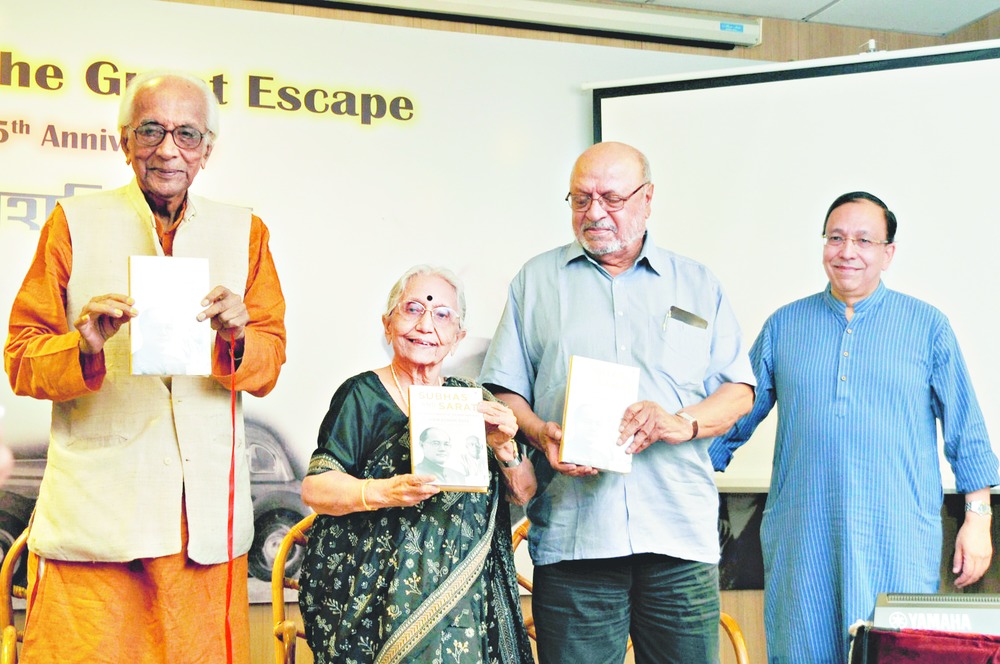
(From left) Poet Nirendranath Chakraborty, former MP Krishna Bose, film-maker Shyam Benegal and historian-MP Sugata Bose at the launch of SUBHAS AND SARAT: An intimate memoir of the Bose Brothers at Netaji Bhavan on Sunday evening. /  Picture by Sanat Kr. Sinha
(From left) Poet Nirendranath Chakraborty, former MP Krishna Bose, film-maker Shyam Benegal and historian-MP Sugata Bose at the launch of SUBHAS AND SARAT: An intimate memoir of the Bose Brothers at Netaji Bhavan on Sunday evening. /
Picture by Sanat Kr. Sinha

The book has been edited by Sumantra Bose, a professor of international and comparative politics at the London School of Economics and son of Sisir Kumar Bose.

Sisir Kumar Bose, Netaji’s nephew and son of Sarat Chandra Bose, had in the 1980s authored the Bengali version of the memoir: Basu Bari.

The book, which used to be serially published in Anandamela, a children’s magazine published by the ABP Group, focuses on the period from the mid-1920s to the 1940s, when the freedom movement was at its peak.

Sisir Kumar Bose, who died in 2000, had written a version of the memoir in English, said Harvard professor Sugata Bose, the elder son of Sisir Kumar Bose.

Chakraborty recounted how as editor of Anandamela he had convinced Sisir Kumar Bose to pen Basu Bari.

source: http://www.telegraphindia.com / The Telegraph,Calcutta,India / Front Page> Calcutta> Story / Monday- July 11th, 2016

Only military establishment to be named after Bengal icon

Kolkata :

One of his primary responsibilities is to encourage youngsters from West Bengal to join the Indian Navy and what better way to do this from the INS Netaji Subhas, the only military establishment in the country to be named after the Bengal icon. In a way, it was fateful that Commodore Suprobho K De took over as naval officer-in-charge (NOIC), West Bengal, on Monday. A day later, INS Netaji Subhas that De now commands celebrated its 42nd birthday.

“We shall continue to visit schools and colleges to encourage students to take up the Navy as a career. We would like more youth from West Bengal to join the Navy. A Naval Selection Board is also coming up at Diamond Harbour. This will be very crucial for youth in the eastern part of the country who now have to travel to Bhopal to get selected. The selection board will also provide employment and business opportunities for people of the area,” Cmde De said before attending a cake cutting ceremony and barakhana with officers and other ranks of INS Netaji Subhas.

The naval base in Kolkata is also in charge of warships that berth at the ports of Kolkata and Haldia. The NOIC also liasons with the civil administration on several issues including humanitarian aid and disaster relief. The Navy office in Kolkata also keeps a watch on shipping activities in the Bay of Bengal and security aspects. The Navy has also been eyeing a Forward Operating Base (FOB) at Sagar for better monitoring of the region. Sagar will also have a missile battery once the island is connected to the mainland by a road-cum-rail bridge.

The naval base in Kolkata was first set up at Marine House prior to World War II. The strategic importance of the Kolkata port during the war made it necessary for the Allied presence in India to bring up this naval presence to safeguard and strengthen its maritime assets in the east of the country which would also augment the capability to provide logistic support to Allied units and later Indian naval ships operating in the Bay of Bengal. Later the HMIS Hoogly was renamed INS Hoogly. On July 5, 1974, it was rechristened INS Netaji Subhas.

Cmde De, who was commissioned in 1985, is an alumnus of National Defence Academy, the Defence Services Staff College and Naval War College. A gunnery specialist, his previous appointment was as station commander of INS Angre, Mumbai. An alumnus of Sainik School, Purulia, he is married to Bandana De and they have a son who is an IPS Probationer.

source: http://www.timesofindia.indiatimes.com / The Times of India / News Home> City> Kolkata / Jayanta Gupta / July 05th, 2016

WRITER’S BLOCK – Inside India’s oldest hotel

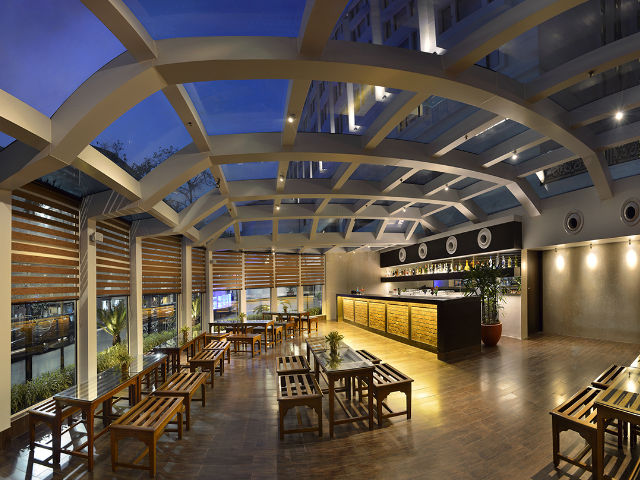
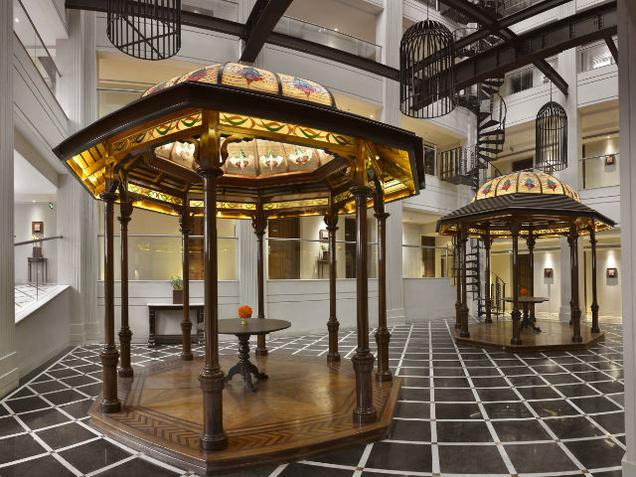
Past meets present: The atrium of the Lalit Great Eastern. /  by Special Arrangement
Past meets present: The atrium of the Lalit Great Eastern.
/ by Special Arrangement

In 1836 — when Bahadur Shah Zafar was yet to ascend the throne in Delhi to become the last Mughal — a man called David Wilson opened a bakery in Calcutta, which was fast growing into a second London. The bakery, a great source of comfort for homesick sahibs, did so well that Wilson soon acquired adjoining properties and in 1840 opened a hotel, cleverly naming it after Lord Auckland, the Governor-General of India who lived right across the road.

Until then, Calcutta boasted of only one hotel, Spence’s, also located a stone’s throw from Wilson’s bakery. Spence’s, which opened in 1830, had its share of admirers, who included Jules Verne. While scanning the archives of The New York Times, which I subscribe to online, I found only one mention of Spence’s, in an 1888 dispatch that was datelined ‘Spence’s Hotel, Calcutta’. Thereafter, for nearly a century, no Calcutta hotel merited mention in the paper other than Wilson’s, by then rechristened the Great Eastern Hotel. If you came to Calcutta, you had to stay at the Great Eastern, whether you were Mark Twain or Rudyard Kipling or Queen Elizabeth.

While no one seems to be sure when exactly Spence’s Hotel shut down, one knows for certain when exactly the Great Eastern was rescued from closure — in 2005, when the property, by now dilapidated and rat-infested, was bought over from the West Bengal Government by The Lalit group. Reopened to the public in 2013 as The Lalit Great Eastern, it is today the oldest existing hotel in India — a 176-year-old brassware restored and polished, its lifespan extended by another century or two.

Resurrecting history: The Wilson, which serves as the pub and backery.

At the hotel, where I checked in last weekend, it is hard to miss the advertisement placed in the October 1840 issue of The Englishman and Military Chronicle: “D. Wilson and Co. beg respectfully to announce having taken those splendid and spacious Four-storied Premises, No. 1, Old Court House Street, formerly occupied by Messrs. Thacker and Co. and the Sans Souci Theatre, opposite Government House, and are sparing no expense in the alterations, and fitting it up in a manner that will render it one of the most comfortable family hotels in India.”

Nearly two centuries later, the new owners are doing precisely the same thing — sparing no expense in the alterations — as they blend the Victorian, Edwardian and modern eras to give something unique to Kolkata, which has been notorious for neglecting its handsome colonial-era buildings. The Victorian block, comprising 49 suites, is still under renovation, and will open in February next year.

The three nights I stayed there, I skipped dinner, simply because I overate during lunch, gorging on Bengali food that was prepared in its sanitised kitchens, but tasted very home-cooked. On the third day, lunch was actually home-cooked: I had happened to mention to the resident manager that I had never had litti-chokha, the quintessential Bihari dish, during my decade-long association with Kolkata, and so he had got me litti-chokha from home.

To burn calories, I walked — outside the hotel and inside. I walked around Dalhousie Square, Kolkata’s Westminster, where the hotel is located; I walked the streets of Kumartuli, watching Durga idols being made; I took a ferry across the Hooghly and walked on the Howrah Bridge. Walking in the corridors of the hotel was also as good as walking back in time. From time to time, one came across glass wine decanters, silver napkin-holders, silver water jugs, ancient teapots — all belonging to the time when the Great Eastern was known as the Jewel of the East.

It is one thing to recreate the past with the help of imagination, quite another to recreate it with actual pieces from the past — The Lalit Great Eastern has achieved the latter. When you hold an old wine decanter, you are forced to wonder whether it bears the fingerprints of Rudyard Kipling. It just might — who knows?

source: http://www.thehindu.com / The Hindu / Home> Features> Metroplus> Society / by Bishwanath Ghosh / Chennai – July 01st, 2016

JU offers rare live recordings for free listening

JadavpurKOLK22jun2016

Kolkata :

Imagine being present at a mehfil where Begum Akhtar is presenting a ghazal. Imagine listening to a house concert of Annapurna Devi. Imagine listening to Ustad Amir Khan singing a bandish in Persian. All these can be a part of reality if one goes to Jadavpur University’s School of Cultural Text and Records (SCTR). On World Music Day today, any connoisseur can walk into the kiosks set up in the school and listen to the treasure trove of archived music. The best part is that all that comes free of cost!

Director of the School, professor Amlan Das Gupta said, “Collectors from across India have generously donated to this archive that was set up in 2003. The work done here helps in cultural preservation.” In a country where rare records and tapes are lost at regular intervals, such an endeavour has been welcomed by all.

Barring weekends, the archive storing more than 10,000 hours of music is open to any listener between 11 am and 5 pm. Musicologist Anindya Banerjee donated rare live recordings of courtesans like Malkajaan, Bade Moti Bai, Rasoolan Bai and Siddheswari Devi to this archive. “I’ve donated rare live recordings of my guru, Ustad Ali Akbar Khan’s rendition of ‘Lankadahan Sarang’ too,” Banerjee said.

Some years back, Delhi-based collector James Stevenson had sent an aluminium trunkload of cassettes by train. Many still talk about the excitement of receiving that trunk at the Howrah station and then transporting a slice of history to the School. Resoom Pal, an intern at SCTR, said, “I was floored to stumble upon Vidushi Annapurna Devi’s surbahar recital in raag ‘Kaushiki’ and ‘Manjh Khamaj’ from this collection.” All recordings are of superior quality than what is available at any online portal, insists Shantanu Majee, project fellow of SCTR. “We try to preserve these tracks in audio files of superior quality that are uncompressed and preserved in large ‘WAV’ format. This is possibly sound at its best quality,” Majee said.

Some years back, collector Ghulam Naeem donated his collection of spool recordings from house concerts at his residence. In the 70s, Naeem used to import spools to record the programmes! After digitization, the clarity and sound precision of these recordings are of international standards.

One such recording is from a mehfil of Begum Akhtar where she sang a rare ‘ghato’ song – ‘Jal jaumuna bharan ke jaun sajni’ – that was usually sung when women went to fetch water. This ‘ghato’ song leads on to another song – ‘Chha rahi kari ghata’ – in the same recital. Arnab Ghosh, PhD scholar at the JU’s Bengali department, was pleasantly surprised when he discovered a live recording of Ustad Amir Khan’s recital of raga ‘Yaman’ in this collection.

“It was a revelation to hear Khan sahab sing ‘Shah Ze Karam Bar Man-E-Darvesh Negar’ by Amir Khusrau. Listening to such superior quality of music is as good as reliving the live performance,” Ghosh said.

So, what are you waiting for? Just pick up the headphones and let the music play!

Rare recordings:

The Hemanga Biswas archive includes the legendary folk singer’s world music collection of English contralto singer Kathleen Ferrier and German actress and singer Gisela May.

Apart from his created ragas like ‘Chandranandan’, ‘Alamgiri’ and ‘Gaurimanjuri’, this archive also has rare recordings of Ustad Ali Akbar Khan playing raag ‘Gour Sarang’, ‘Barhans Sarag’ and ‘Maligaura’.

One house concert has Ustad Vilayat Khan exploring various kinds of raag ‘Kannada’. This leisurely performance is almost like a lecture demonstration.

There is a recording of Ustad Allauddin Khan playing raag ‘Nat’ and ‘Darbari Kanada’ in sursringar. A rare interview of the maestro with Bhopal radio has him singing raag ‘Komal Bhimpalasri’ and raag ‘Sugadh’.

Pt Ravi Shankar’s early 1950s rendition of raag ‘Mian ki Todi’ and ‘Aalahiya Bilawal’ at the Dixon Lane residence of guru Gyan Prakash Ghosh.

A pre-independence duet of Vidushi Annapurna Devi and Pt Ravi Shankar playing raag ‘Yaman Kalyan’ at Delhi’s Constitution Hall.

source: http://www.timesofindia.indiatimes.com / The Times of India / News Home> City> Kolkata / by Priyanka Dasgupta / TNN / June 21st, 2016

A window on history – Remains of Portuguese days

WindowKOLKATA04jun2016

Memory can be extraordinarily flexible. As the Portuguese coast recedes and our ship edges into Spanish waters, Évora’s reticence about the communist upsurge in the surrounding region called Alentejo reminds me of the stonewall I encountered in Hyderabad trying to talk of the Telangana revolt. Most people assumed I meant the agitation for a separate state. Few even remembered the earlier armed rising linked to the 1948 Calcutta Conference which also resulted in Malaya’s prolonged and bloody Emergency.

“In the Alentejo, you travel naturally with and to History,” writes a local chronicler. It didn’t know a revolution that never was like West Bengal where revolution means speeches, and revolutionaries fatten in office for decade after decade. Alentejo’s was a revolution that failed like Telangana’s. But without the violence. It also suffered from a confusion of aims. Both mixed the local with the global. The immediate impetus in Telangana was opposition to the Nizam of Hyderabad’s regime. However, the Calcutta Conference spoke of a wider ideological purpose. In fact, many believe the insurrection petered out because Moscow’s rapprochement with New Delhi prompted the Comintern to abandon the conference’s ostensible hosts, the World Federation of Democratic Youth and the International Union of Students.

The peasantry around Évora where we spent several delightful days also felt betrayed. Évora is a charming medieval walled town whose university students in black medallion-studded cloaks over their frock coats sing and dance in the cobbled central square, the Praça do Giraldo, chasing away horrible memories of the burnings that took place there during the Inquisition. Founded in 1559, the university closed down in 1759, when the authoritarian prime minister of the day turned out the Jesuits. It didn’t reopen until 1973. Évora was under Muslim rule for 400 years. They came to help a local contender for power and stayed to consolidate their own rule.

The real contradiction was between radical young officers of the Movimento das Forças Armadas and peasant and student protesters clamouring for reform in 1974. The officers overthrew Portugal’s long dictatorship in a last-ditch attempt to pre-empt more drastic change. The protesters in the streets who gave them carnations which they put into the barrels of their guns – hence the name Carnation Revolution – hoped for a drastic social and political transformation. The organizations of workers and young people that sprouted all over the Alentejo resembled the proletarian councils (soviets) associated with Russia’s October Revolution.

Ordinary soldiers weary of war also set up their own committees to demand democratic rights and an end to Lisbon’s imperialist wars. If national liberation movements could rock the foundations of colonial rule in the so-called “overseas provinces” of Angola, Cape Verde, Guinea-Bissau, Mozambique, and São Tomé, they asked, why should the metropole remain under the corporatist yoke? Landless labourers who toiled on the great estates called latifundio seized the fields they farmed. According to government estimates, about 2,200,000 acres were occupied. Some 1,000 estates were collectivized.

Something like the Spanish Civil War seems to have been fought out in miniature but with roles reversed. Claiming that fascism had to be defeated, Portugal’s reformist Socialist Party and Stalinist Communist Party sprang to support the MFA and the junta it had installed. Social historians believe they destroyed the chance of a socialist revolution. Lisbon promulgated the Land Reform Review Law in 1977. The collectives were dissolved. The original owners repossessed the latifundio. Portugal’s aristocracy has retained its wealth through centuries of upheavals. Some of the mansions and manor houses have been in the same family for generations. Hoardings in the vineyards along the road from Évora to Lisbon proudly proclaim the ownership of families like the Fonsecas. No lingering memory of the 1974 uprising disturbs Évora’s tranquillity.

The official justification is that the Alentejo collective farms could not be modernized. In the mid-1980s, agricultural productivity was half that of the levels in Greece and Spain and a quarter of the European average. Land holdings were polarized between small and fragmented family farms in the north and inefficiently large collectives in the south. Even Bangladeshi immigrants who had managed to acquire Portuguese work permits fled to more prosperous economies. Decollectivization was said to be the only hope.

I learnt more about Évora and its unexpected links with Bengal from Trilokesh Mukherjee, my graphic artist friend who lived in the Dordogne in France for many years. Now he seems to spend more time in Oxford and South Wales but remains a storehouse of the minutiae of Indo-European culture. Trilokesh told me Évora was the birthplace of Manuel da Assumpção, an Augustinian monk who spent many years near Dhaka and is credited with writing and printing the first dictionary and grammar of the Bengali language, Vocabulario em idioma bengalla e portugueza. “The Portuguese even cast some Tamil and Malayalam types. But they never could cast Bengali types.” It’s a matter of everlasting regret to Trilokesh that this final triumph eluded the Portuguese. “The first book to be printed in Bengali was printed in Lisbon though the writer, translator and the compiler came from Évora,” he wrote. Alas, it was set in Latin type.

Évora’s state library treasures another historic document, the manuscript of Brahman-Roman-Kyathalik-Samvada: an argument on Law between a Roman Catholic and a Brahmin by the Bengali Dom Antonio de Rozario. Dom Antonio’s life is shrouded in mystery. No one knows his Bengali name. He was apparently a princeling of Bhusana, which some place near Dhaka and others near Jessore. According to one version, Mug pirates took him to Arakan as their prisoner. Another has it he was sold into slavery in Goa. Both agree that another Portuguese Augustinian priest was his saviour and that he converted to Christianity.

The reinvented Dom Antonio is believed to have converted 30,000 Hindus in and around his estate, thereby arousing the wrath of the Jesuits in Goa who sent a senior priest to investigate. He confirmed Dom Antonio’s proselytizing success but added the converts had little knowledge of Christianity and had been paid to be baptized. It must be added before ghar wapsi fanatics reach for their purifying water that this was the competing camp’s verdict. No rivalry is more relentlessly bitter than that between the pious who are convinced of their monopoly of the truth.

Religion and language are the two main links. Vasco da Gama wasn’t quite the pirate in priest’s clothing that Bharatiya Janata Party loyalists made out on the 400th anniversary of his landing at Calicut, but he did have a strong religious motivation. Another Portuguese sailor, Luís de Camões, called Portugal’s Shakespeare, immortalized his achievement in the epic poem, The Lusiads. If Calcutta had Anthony Feringhee (Hensman Anthony), Dhaka’s Christians revere Sadhu Antoni (St Anthony of Padua). Some credit the Portuguese with creating Bengal’s first modern city in Hooghly. Others hold their imports of tobacco, potato and guava changed Bengali taste for all time.

With so many connections, it was exciting to stumble upon a Bengali gift to Portuguese (or so I imagined) when my wife was allotted the janela seat on the train to Sintra. I emailed a friend in Calcutta who passed it on to Aditi Roy Ghatak who messaged me from Macau, where she was holidaying, to say the former Portuguese colony had given her a janela on Portugal. I now learn that far from being Bengali, janla is an import like potato, guavas or tobacco. Derived from the vulgar Latin januella, the Portuguese janela travelled east with those first Europeans to inspire the Sinhalese janelaya and Tamil cannal. Our own janla is like almirah or kameez. Borrowing within reason is all right providing it doesn’t prompt Mamata Banerjee to follow the late P.N. Oak and claim that Big Ben and the Eiffel Tower are really Bengali creations.

source: http://www.telegraphindia.com / The Telegraph,Calcutta,India / Front Page> Opinion> Story / by Sunanda K. Datta-Ray / Saturday – June 04th, 2016

Hill royal relic now rubble – GTA pulls down Bangla king’s centuries-old palace to set up hotel management school

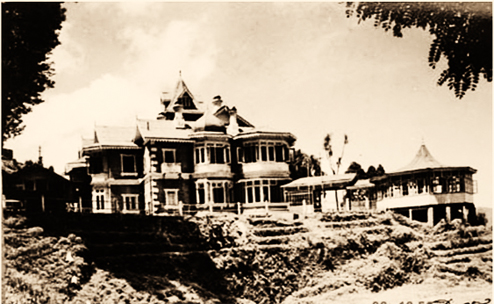
An undated photo of Sailabash: Courtesy Das Studio in Darjeeling

Darjeeling :

Darjeeling’s rare connection with present-day Bangladesh and a part of the hill town’s rich history has been reduced to rubble.

The GTA has pulled down Sailabash, the over-a-century-old summer retreat of the raja of Digapatia, to set up a modern hotel management institute and guesthouse in one of the last few available green spaces in Darjeeling.

Digapatia is now in Rajshahi, Bangladesh.

The palace under the tourism department of the GTA near Jalapahar and was brought down about two weeks ago. “The building was in a dilapidated state and recent earthquakes too had caused some damage,” said Kishore Ghimire, an executive engineer of the GTA.

In his book, A Concise History of The Darjeeling District Since 1835, which was published in 1922, E.C. Dozey, a writer and historian, said the building had been set up on land that was once owned by Capt J. Masson, the superintendent of Tukvar tea estate, by the “Digapatia Rajah”. The retreat was earlier called Girivilash and the name was changed to Sailabash after Independence.

The Late Nayan Subba’s soon-to-be-published book, Heritage buildings of Darjeeling, Kalimpong and Kurseong, says Raja Pramatha Nath Rai Bahadur had founded Girivilash whose garden was laid out by a German floriculturist and horticulturist, Morgenstern, and was looked after by 12 gardeners.

Nobody could say exactly in which year the building had been constructed. But its believed it was built in the last decade of the 19th century.

“Girivilash was a favourite place for the British governors of Bengal….The British army took over the palace in 1942. Later on, it was acquired by the government. It also served as a Tibetan school for a while. The palace has lost the historical grandeur of Girivilash,” writes Subba.

According to Subba, the colonial building had an attic with miniature gables and a small dome, and an all-weather glazed rotunda with small square windows in classical style. There was a tennis court as well.

“Raja Pramadanath Roy occupied the front suite on the ground floor, which included the library, with its precious screens of velvet and ornate wooden pelmets,” writes Subba.

The front suite of the upper storey with the snow view rooms was “for the rani”,

Subba writes. It was “beautifully furnished with a curtained brass cot and a chandelier. There was a huge grandfather clock, which indicated the days of the month and the full moon day (Ekadashi). On the ground floor were the drawing room, dinning room, tash khana (card room) and the billiards room,” Subba adds.

Despite being in a dilapidated state, Sailabash was still a landmark in Darjeeling and used to house a guesthouse after Independence. Once the building was taken over by the Darjeeling Gorkha Hill Council, the office of the hill body’s vice-chairman was housed there. For the past 20 years, the building had been lying vacant.

Bharat Prakash Rai, convener of the Indian National Trust for Art and Cultural Heritage (Darjeeling chapter), said: “How foolish can we be to dismantle such structures in the name of development. Could it not have been repaired? We have lost a piece of history and that is very sad.”

Dawa Lepcha, the GTA Sabha member in charge of tourism, said: “A big-scale hotel management institution will be coming up and the requirements were such that the building had to come down.”

GTA executive engineer Ghimire said the project cost had been pegged at Rs 55 crore. “Apart from the institution, there will also be a guesthouse with 24 rooms for in-house training. The infrastructure is being set up as per the parameters laid down by AICTE (All India Council for Technical Education)”

The five-acre plot in which the Sailabash was located has Annapurna and Kafal guesthouses, along with a pond built by the DGHC. “The Annapurna guesthouse will be used as an administrative building for the institution, while a part of Kafal will have to be dismantled. The pond will be smaller in size and we will have facilities for rainwater harvesting,” said Ghimire.

The engineer said restoration of the building would have cost much more.

source: http://www.telegraphindia.com / The Telegraph, Calcutta,India / Front Page> North Bengal> Story / by Vivek Chhetri / Wednesday – June 01st, 2016

On a mission to save old buildings

CAL wants to go beyond heritage structures
ChaudharisKOLKATA29may2016

The Chaudhuris of Latu Mullick Lane in north Kolkata have unknowingly become part of a rather silent movement. Once part of Bengal’s landed gentry, they now have just this two-storeyed building left to their name. Built some time in late 19th century, the house does not offer much in terms of heritage value, given it was just the residential building of a family that had no great role in uplifting Bengal’s social or political consciousness. It is buildings like this that interests author Amit Chaudhuri.

Chaudhuri does not share any links with the said family, except a surname spelt the same way. Neither is this particular building, tucked away in a dingy lane, part of the initiative that is taking up much of his time these days. The author, however, is concerned with how the “heritage” tag is used in Kolkata. He feels somewhat disturbed that heritage only refers to buildings that had some role to play, even though the term should encompass much more than just achievements, he believes.

Once the second city of the British Empire after London, Kolkata, offers a visual feast of old houses, which stand out for remarkable architecture. These buildings represent not only an era but also stand testimony to the city’s history, giving an insight into the structural changes that influenced architecture over the years. Chaudhuri’s love for the architectural aesthetics in old buildings inspired him to launch the Calcutta Architectural Legacies (CAL), a mission to save old buildings.

It is also probably not a coincidence that the acronym spells out as CAL, the name most English-speaking Kolkatans refer to their home town by. CAL is what one would call a citizen’s initiative, with Chaudhuri bringing together a group of interested people. From conservation architect Partha Ranjan Das to G M Kapur of heritage preservation group INTACH, to activists Bonani and Pradeep Kakkar, ad guru Ram Ray and even Nobel laureate Amartya Sen, they will all pull in their ideas to help conserve buildings that have not found place on state’s heritage list.

Although CAL was formally launched in February, Chaudhuri has been working towards this for more than a year. In an article for The Guardian in June 2015, he laid down his ideas. He pointed out that in Kolkata, a heritage building is a landmark, either because it is a “significant institutional building” or “because a famous person frequented it or lived there”. “The architectural distinctiveness of the building is a secondary concern, or is a pre-ordained, generic feature of the structure: that is, we already know it qualifies as a heritage structure because it adheres to our idea of what a heritage colonial building looks like,” he wrote.

The author went on to say that heritage for Kolkata also “…means we cease to engage with the architectural individuality and difference of buildings and precincts. We don’t periodise, falling back on catch-all terms like ‘colonial’ or historicise; or describe; or define. Simply put, ‘heritage’ means we don’t see, or think about, buildings.”

While launching CAL, he pointed out that the time has come to rethink words like “architecture” and “heritage” in order to save buildings “before these are brought down and turned into generic multi-storeyed buildings”. CAL would also attempt to move beyond heritage and take the initiative to everywhere in Kolkata.

Chaudhuri pointed out how the city developed into neighbourhoods, “para” in Bengali, which were oases of resident communities, and stressed on the need to preserve their distinct characters, before these fall prey to realtors. He is of the opinion that the heritage tag should include far more than landmarks and involve buildings, which give the city its character. He also talked about the need for residents of such buildings to come forward and join the initiative, if they are keen on preserving their individual heritage, instead of a generic sense of history.

Chaudhuri’s campaign among the urban educate class for more than a year found fruition when Kumartuli Sarbojanin Durgotsav, the Durga Puja committee at the idol-makers’ district in north Kolkata, decided to turn his efforts into the theme for its Puja offering last year.

A much-visited Durga Puja marquee, the committee celebrated its 84th year with a cause that has faced criticism from some quarters as “elitist”. Disparagement aside, artist Subal Pal persuaded the Puja committee to go with the theme.

Chaudhuri observed how a number of aesthetic old buildings are being razed to ground, making way for box-like high-rises, on the Pratapaditya Road in south Kolkata. Pal, who has been noticing similar changes in north Kolkata, felt one with Chaudhuri’s woes and etched out the theme in his Puja marquee. The artist, however, admitted that without proper conservation of these buildings, there would be no point in having the theme, at a time when such houses are getting lost across the city. “…the message needs to be sent out to people before it’s too late,” he said.

A regular visitor to Europe, he pointed out in his Guardian article how the British have managed to preserve even the most mundane, old buildings, just because of their architectural and aesthetic brilliance.

The author, who first started the campaign online and sought signatures, stated in his expression note how the old-world Kolkata is fast falling prey to the real estate mafia. While the online petition received nearly 2,000 signatures in a matter of days, Chaudhuri said, “I am an admirer of Kolkata’s neighbourhoods. Its architecture is not just confined to colonial legacy or north Kolkata-based buildings owned by landed families. But there are many interesting architectures spread across the city which were built by the educated middle-class in the past,” Chaudhuri said. This petition also drew support from Sen, who has spent years amid the heritage corridors of educational institutes in Kolkata, England and the US.

The real deal for such an initiative, however, is to get the administration’s attention, admitted those pushing the initiative. While Das talked about the apathy of Kolkata Municipal Corporation, which is in charge of refreshing the city’s ‘heritage list’, Mayor Sovan Chatterjee seemed oblivious to such concerns.

Chaudhuri noted how bodies like the West Bengal Heritage Commission, entrusted with the job of refurbishing the list from time to time seem mostly toothless. “…the list of heritage buildings should be urgently revised and various neighbourhoods should be declared heritage zones,” Chaudhuri said.

While the author asked for empowering the Commission for better functioning, Das echoed his thoughts. A former member of the commission, he submitted a proposal to introduce transfer of development rights or TDR in 2013. A successful process at Mumbai and Ahmedabad, TDR provides a residential building owner to retain it, with the developer buying the land getting to build elsewhere where new construction is not an issue. There has been no move in the direction of allowing TDR, he said.

Chaudhuri hopes that like in Europe, owner of old buildings will take up the cause themselves and fight to preserve the character of their localities. The administration, however, continues to remain aloof, even after the Nobel laureate economist wrote a letter of support to Chaudhuri, stating, “We owe to future generations a preserved and un-mutilated heritage of Calcutta’s eccentric but exciting old buildings.

source: http://www.deccanherald.com / Deccan Herald / Home> Special Features / by Drimi Chaudhuri,Kolkata / May 29th, 2016
Kolkata’s Indian Museum Collection Going Online With Google

IMAGE CREDIT : indianmuseumkolkata.org

Kolkata :

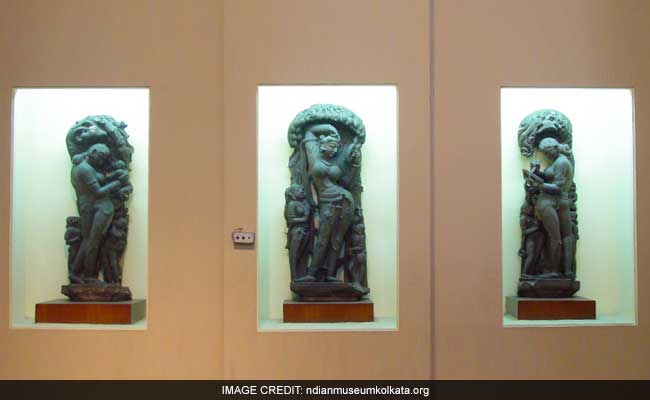
Beginning with its prized collection of Buddhist art including the famous Gandhara sculptures, the Indian Museum is now putting all of its galleries for 360- degree panoramic viewing for anyone to see online.

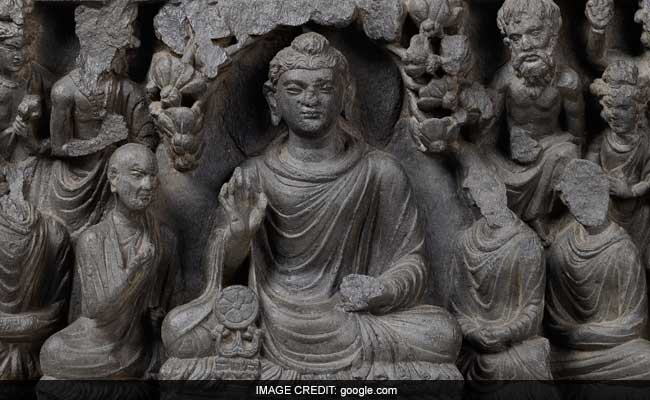
As part of a tie-up with the Google Cultural Institute, which allows art lovers to explore artifacts from all over the world on its website, the Indian Museum is launching an e-version of its exquisite exhibition titled Indian Buddhist Art on Wednesday.

Among the important highlights in the exhibit include a sculpture of the head of Buddha from fifth century in Sarnath which is featured even in school textbooks.

“This is the first virtual exhibition we are organising after which all our galleries will gradually be available on the Google Cultural Institute website,” museum director Jayanta Sengupta told PTI.

IMAGE CREDIT : google.com  /  Buddha' First Sermon (100-200 C.E) by unknown exhibited at Indian Musuem pubilshed on google cultural institute website.
IMAGE CREDIT : google.com / Buddha’ First Sermon (100-200 C.E) by unknown exhibited at Indian Musuem pubilshed on google cultural institute website.

Three galleries, including those on Buddhist sculptures, are ready for 360-degree panoramic viewing on the internet. “This allows anyone to have a walk through the gallery and see it as you do it with your eyes. You can scroll around to see even the ceiling and the floor,” he said.

Since last year a team of Google from the UK and the US have been working hard with their specialised and patented camera technology to click high-resolution photos of the treasures lying in the museum.

The process is taking time because the work can only be done on Mondays when the museum is closed to visitors. It is expected that all galleries will be online within a year’s time.

Over 200 years old, Indian Museum is the oldest and the largest multi-purpose museum in Asia.

The biggest repository of Indian antiquity, some of the museum’s prized possessions include an Egyptian mummy, Buddhist stupa from Bharhut, Buddha’s ashes, Ashoka pillar, fossil skeletons of pre-historic animals and a collection of meteorites.

For some of such cultural and historical treasures, the museum is also planning to have gigapixel images which will allow magnification upto a thousand times.

“If it’s a painting then you can see all intricate details like even the brush strokes. Seeing a gigapixel image is like putting the object under microscope,” Mr Sengupta said.

The musuem director rejects suggestions that once all galleries are online the number of visitors at their campus will decrease.

“Internationally this has been the case. After people see it online they are more motivated to see the real thing and so they walk into the museum,” he said.

Spread over 10,000 square feet area, it boasts of over sixty galleries of art, archeology, anthropology, geology, zoology and botany sections.

It houses rare artifacts of great archival and heritage value numbering more than a lakh.

source: http://www.ndtv.com / NDTV / Home> Sections> All India / Press Trust of India / May 24th, 2016

Bristol will always remember Rammohan Roy, says mayor

Continuing along city tradition, the Lord Mayor of Bristol on Sunday led the annual service at the sylvan Arnos Vale Cemetery to pay tributes to Indian social reformer Rammohan Roy, who died here on 27 September 1833 of meningitis.

The service at the tomb built to an Indian temple style, was attended by many people from across Britain, including representatives of the Indian high commission, Brahmo Samaj and the Unitarian church.

Lord mayor Alastair Watson recalled Roy’s many contributions, and said Bristol would always remember and cherish his memory. The annual service at Roy’s tomb has been held for nearly a century.

A new documentary, titled ‘Relics of the Raja’ by academic Suman Ghosh, was shown at the event, which included new research on Roy’s contribution to the anti-slavery movement in early nineteenth century.

It also showed the newly-discovered replica in back of Roy’s original death mask.

Carla Contractor, local historian, who has led several initiatives to preserve, cherish and celebrate Roy’s life and work, recalled his accomplishments. Her latest research is focussed on Roy’s last days in England.

“The Raja was a remarkable man in his day.

He fought for women’s rights and for the reform of legal and fiscal services in India. All Indians can take pride in what the city of Bristol has done in memory of the Raja and be proud too of their own roots in the Indian subcontinent,” Contractor said.

source: http://www.hindustantimes.com / Hindustan Times / Home / by Prasun Sonwalkar, Hindustan Times,Bristol / September 29th, 2014

Brand Bengal to steal the show in London, Edinburgh and Glasgow

Kolkata :

Two-fifty-nine years after East India Company brought business to Bengal, the roles have reversed. Brand Bengal, aka Biswa Bangla, has travelled the British Isles, and it means business.

Starting Tuesday, shows are being organized in London, Edinburgh and Glasgow to hard-sell the exotic arts and crafts of Bengal. The exhibitions will be a prologue to the grand Biswa Bangla showroom coming up in London three months later, as announced by chief minister Mamata Banerjee during her London visit in July, last year.

Titled “Gods and Demons”, the event will include live demonstrations and workshops on the making and rich history of the masks of Bengal. There will be visual storytelling from Patachitra, which was used originally as ways of spreading ancient mythology. The integration of modern social themes and issues in the artwork makes patachitra and mask-making inspiring tools for today’s artists.

Talking to TOI about UK’s exposure to “Bengal summer” at the Nehru Centre (till Friday), the Scots in the Museum of Edinburgh on May 12 and 13, Rajiva Sinha, secretary, micro and small and medium scale enterprises (MSME) and textiles, said, “The Biswa Bangla tagline ‘where the world meets Bengal’ says it all. The most exciting part of the event are the live shows by artisans Suman Chitrakar and Sankar Das. They have blended the traditional art-forms into the modern-day usage.”

In Glasgow, the location for the grand event is the Art Village Scotland which will be held on May 14 and 15, as part of the Southside Fringe festival.

“Biswa Bangla believes there is a keen appreciation for Bengal arts and crafts in the modern global community and we want the British to be a part of it, keep these art forms alive by bringing the magic of Bengal’s temples into the UK living rooms,” said London-based designer Neishaa Gharat, who represents Biswa Bangla in the UK.

Das, who hails from Sabdalpur village in South Dinajpur, will tell the British audience how “there was no rain in Kushmundi 200 years ago and people started praying to the gods for rain and to restrict the evil powers. Many characters became part of the dance, Kali, Rakshasa, Hanuman and Dakini – these are the faces we still carve today.”

Chitrakar, a villager from Naya who has applied patachitra to modern-day products like painted bags, apparels and crockery said, “Patachitra painting started many years ago. Patuas were mostly Muslims but painted Hindu gods. They moved house-to-house, singing for grains and money. Gradually, this took the shape of the art form we see today. In 2004, there were only 18 patuas in Naya, now there are 300.”

Gharat, who has been working with traditional Indian arts, crafts and textiles promoting artisans and creating designs for a global audience, sounded exited “because this is a government initiative to revive the art and craft of Bengal, which is one the most culturally diverse states in India. The art forms are fascinating because they give away such a stark dichotomy between tradition and modernity. There’s a tremendous legacy of skilled work out there and the willingness to take it forward.”

John Bell, former chairmen of the British Guild of Travel Writers and a consultant for the United Nations World Tourism Organisation, delivered the key note speech. Bell, who started his career with the BBC in London, producing and reporting for its travel and transport programmes on radio and television, said, “The work is not just a question of design, its jobs and poverty … this beautiful art is not just beautiful art, its beautiful art for good … the more we trade, the more we work, the more work we give to our friends Shankar Das and Suman Chitraker here, the more we are doing for the people of West Bengal and doing good for ourselves.”

– Aimed at rejuvenating the state’s handloom and handicraft products, Biswa Bangla was conceptualized in 2013
– The first store to sell products under the brand opened in 2014
– With 7 stores, the venture clocked a Rs 15 crore in 2014
– In the next two years, revenue is expected to increase six-fold to about Rs 100 crore.
– Among the arts being revived at Biswa Bangla are:
– Indo-Portuguese shawls (takes six months to embroider)
– Muslin
– Darjeeling tea
– Masks
– Attar perfumes
– Kalimpong cheese
– Mustard sauce
– Sundarbans honey
– Bonolokkhi ghee
– States like Rajasthan and UP are adopting the Biswa Bangla model
– Biswa Bangla markets 5,000 products, including 24 kinds of dolls from various parts of the state

source: http://www.timesofindia.indiatimes.com / The Times of India / News Home> City> Kolkata / by Ajanta Chakraborty / May 04th, 2016