Category Archives: Arts, Culture & Entertainment

Akademi Ratna was most unexpected, says Vijay Kichlu

Kolkata :

Sangeet Natak Akademi’s decision to confer the prestigious Akademi Ratna Sadasyata award on Pt Vijay Kichlu has come as a perfect birthday gift for the legend, who will turn 85 this year. Away on a buddy-trip with his gang of eight friends in Mashobra, Kichlu was both surprised and elated with the news.

“This was the most unexpected news for me. I was the member of the last council of Sangeet Natak Akademi. As a member, one can’t receive any awards. The new chairman was announced only recently. This news came as a great surprise to me. I am humbled,” Kichlu told TOI. Musicologist S R Janakiraman, film-maker MS Sathyu and musician Tulsidas Borkar are the other recipients of the prestigious fellowships for 2014.

The last time a musician from Kolkata received the Akademi Ratna Sadasyata was in 2010. It was given to Girija Devi-ji. The fellowship constitutes a cash award of Rs 3 lakh beside an angavastram and a tamrapatra.

Of late, Kichlu has been keeping himself busy with a Prasar Bharati assignment. For this, he has to prepare 52 episodes of content that will offer a holistic view of Indian classical music. Work for this began early this year. “We have just about finished work on nine to 10 episodes,” he said.

Kichlu is being assisted by a team of researchers from Kolkata and Delhi. “Apart from Meena Banerjee and Arpita Chatterjee from Kolkata, our team also has Prashant Mallick from Delhi,” he said. As part of this project, Kichlu has himself interviewed Pt Hariprasad Chaurasia, Pt Rajan and Pt Sajan Mishra and Ashwini Bhide, among others.

source: http://www.timesofindia.indiatimes.com / The Times of India / Home> City> Kolkata / TNN / June 16th, 2015

Bengali on Queen’s honour list

Kolkata :

Seventy-year-old Pratima Sengupta, who pressed on with her charity and social activities despite debilitating arthritis, is among those being appointed Member of the Order of the British Empire (MBE) in the birthday 2015 Honour List of the Queen.

The honour is recognition for her services to the community in East Renfrewshire, Scotland. Sengupta has been living in Glasgow since 1969 and is now confused about which of her five grandchildren she will take along to accept the honour from the Queen.

On April 30, Sengupta got a letter from the Cabinet Office stating that the British Prime Minister had proposed her name to the Queen. On June 12, her name was published in the London Gazette. “I started shivering when I heard this news. All those who are on the Honour List will be invited to an investiture. The events are organized by the Central Chancery of the Orders of Knighthood in St James’ Palace. I was told that I will receive the invitation about five weeks before the event,” Sengupta told TOI from Glasgow.

Sengupta had spent her early years in Kolkata where her father, Dr Promodranjan Dasgupta, was a teacher at Presidency College. After marriage, she moved to Glasgow where she worked at the tax office. Due to arthritis, she was forced her to take early retirement in 2002. Pain in her joints notwithstanding, she continues to do voluntary service at a hospital.

“I started the Women’s Voluntary Royal Service (WVRS) at the Victoria Infirmary. I loved to give company to patients. Some of them couldn’t speak English and I worked as their translator,” she said. But her failing health didn’t make it easy. “They made special shoes so that I could walk properly. I refused to use a wheelchair. Sometimes, I’d fall down or bleed from my hands. At night, I’d cry in pain. Yet, I never stopped working,” she said.

Wearing a sari with a red bindi, Sengupta would stand out in the crowd. “Initially, people would ask me about the red blot on my forehead!” she laughs. She became a director with Voluntary Action group in Glasgow that worked with children who couldn’t afford higher education. “I’d sing ‘Phule phule dhole dhole’ to them. I also got in touch with an NGO in Tollygunge that worked with impaired children,” she added. She joined an organization called Women Across the World. “I’d go door to door asking for donations. I remember telling people: ‘You don’t need to give me more. Even one penny is enough.”

Meeting the Queen is the big event on her calendar now. “My husband and I had once attended the Queen’s Garden party at Edinburgh. I have been told that I can take four guests to this event. But I have five grandchildren. And all of them want to go to see the Queen,” Sengupta laughed.

source: http://www.timesofindia.indiatimes.com / The Times of India / Home> City> Kolkata / by Priyanka Dasgupta, TNN / June 16th, 2015

State honour for Budhaditya, Rani Karnaa

Kolkata :

West Bengal State Music Academy will confer this year’s Allauddin Purashkar on sitar maestro Pandit Budhaditya Mukherjee.

The award, instituted in the name of legendary classical musician Ustad Allauddin Khan in 1987, carries a citation and a cash prize of Rs 25,000. Previous recipients of the award include Pandit Buddhadev Dasgupta, Pandit Manilal Nag and Manna De.

Mukherjee, who earlier won the Allauddin Khan Memorial Fellowship offered by the Madhya Pradesh government, plays sitar and surbahar in the Imdadkhani tradition of Etawah. Speaking to TOI, he said, “I am pleasantly surprised and honoured that the state government considered my name for this award.”

Academy’s member secretary and deputy director of information and cultural affairs department Malabasri Das said, “We will also honour dancer Vidushi Rani Karnaa with Uday Shankar Purashkar, tabla maestro Pandit Gobinda Bose with Jnan Prakash Ghosh Purashkar and Agra gharana vocalist Subhra Guha with Girija Shankar Purashkar for their contribution to various forms of performing arts.”

“I was born in Sindh in Pakistan. But Kolkata has been my second home for the last 40 years. It is great to see that the Bengal government has selected me for this honour,” said Karnaa, a disciple of Odissi legend Guru Kelucharan Mohapatra.

Chief minister Mamata Banerjee will hand over the awards to the maestros at an event at Nazrul Mancha on Tuesday.

source: http://www.timesofindia.indiatimes.com / The Times of India / Home> City> Kolkata / TNN / May 26th, 2015

Vanishing magic caught on reel

Kolkata :

Even a few decades ago, city’s theatres used to remain booked for months for magic shows. Newspapers were splashed with huge advertisements portraying magicians in prince-like attires spreading the net of ‘indrajal’. Now, the city’s hobbyists and illusionists slowly watch the glory fading away.

‘Fading Magic — The Story of Kolkata’s Magicians’ is a documentary film that brings those artists on celluloid once again. Some of them are old enough to perform, some are fighting with poverty and a lucky few are trying to make a decent living out of the passion that has driven them since childhood.

While India was known for illusions such as Indian rope trick which mesmerized the court rooms of the princes and zamindars, magic in Kolkata was mostly restricted to pavements and roadside kiosks even during the early 70s. It went through a huge facelift after Protul Chandra Sorcar catapulted the shows into theatre halls. The journey of Bengal’s magic from sidewalks to theatres continued under PC Sorcar Senior and K Lal.

Sam Dalal, a magician and one of the largest magic instrument manufacturers in the world, felt that while Kolkata had magicians such as Mrinal Roy and H M Wakil, hosting shows in theatres such as Mahajati Sadan was not common. “Kolkata was the magic capital those days. Magicians such as Samiran, Gautam Guha and Raj Kothari ruled the roost,” he said. Dalal, an engineer from Indian Institute of Technology, joined the profession to turn into a manufacturer and an innovator later on.

There were others such as Sanmay Ganguly, who continued to perform on stage despite being a doctor by profession. New names came to surface as magicians started getting handsome payments even beyond cabaret acts at bars. Some chose magic to be their sole profession. But times started changing even before they could fathom the reasons.

“Finance was always a problem. For feats such as vanishing the Statue of Liberty you need huge investments,” felt Rana Banerjee. Rana had even appeared in the Roland Joffe directed ‘The City of Joy’. But such achievements only added feathers to the city’s magicians’ caps and the coffers remained dry.

D Subhash, who used to perform across the states is now finding it difficult to arrange money for his ailments.

“There has been a shift again and magic in Kolkata went back to streets once again,” said director of the documentary Amit Sahai.

Jasjit Singh said the fading glory of the art needs to be showcased. “Kolkata needs to be reminded of the glorious past it had,” he said.

source: http://www.timesofindia.indiatimes.com / The Times of India / Home> City> Kolkata / TNN / April 26th, 2015

E-networking reunites alumni after 2 decades

Kolkata :

Online socialization paved the way for an ‘offline’ chat at a city hotel, bringing together many former students of Apeejay School, Park Street. They revisited their colourful school days and felicitated their teachers at a reunion ceremony, ‘Rejoice’.

The revelers were thrilled to have come across their classmates after a gap of as many as 25 years. Around 15 former students of the school’s 1988 batch chalked out the event over social networking sites, though they had been toying with the idea for the past two years.

The members of the school’s alumni association, APJOSA, Kolkata, who passed out between 1985 and 1993 reminisced about their bygone student life, reconnected with their school friends and sought the blessings of their teachers including Rita Chatterjee, current principal and administrator and Neville McNamara, former principal of the school.

The main objective of the event was to increase the membership of the alumni association, which was formed in the 1980s, according to Rajib Basu, a chartered accountant who was among the school’s 1988 batch. Around 10 alumni of the school, settled in different places outside the city, had also joined the party.

The school anthem, ‘Soaring High’, set the right mood for the evening that revolved around unadulterated fun mixed with nostalgia. Jyoti Vardhan Sonthalia, a corporate professional, said: “I left the school way back in 1988 but my bond with the alma mater is so strong because of the teachers who imparted discipline and value education to us; who groomed us for what we are today.” The party ended on a happy note when Manoj Lunia, an alumnus of the 1985 batch, sang the Hindi version of Kishore Kumar’s ‘Chirodini tumi je amar’. On McNamara’s request, silence was observed in memory of the students who passed away untimely.

source: http://www.timesofindia.indiatimes.com / The Times of India / Home> City> Kolkata / by Sarthak Ganguly, TNN / April 06th, 2015

Kolkata’s wooden trams chug into stardom

The streetcars lend authenticity to the city’s 1942 avatar in “Detective Byomkesh Bakshy!”

An unexpected but delightful outcome of the making of Dibakar Banerjee’s film Detective Byomkesh Bakshy! that released on Friday was the rescue from obscurity of two tramcars that were used to recreate the city’s 1942 avatar.

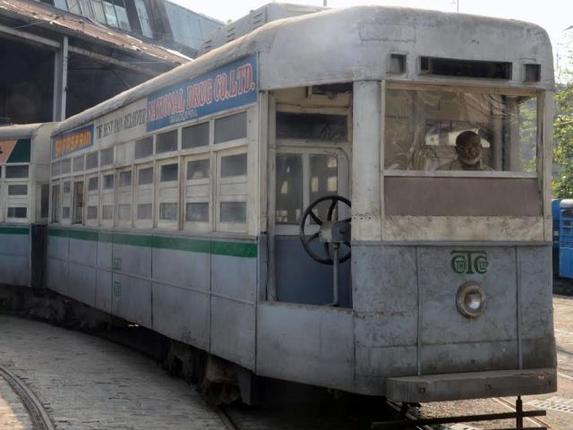
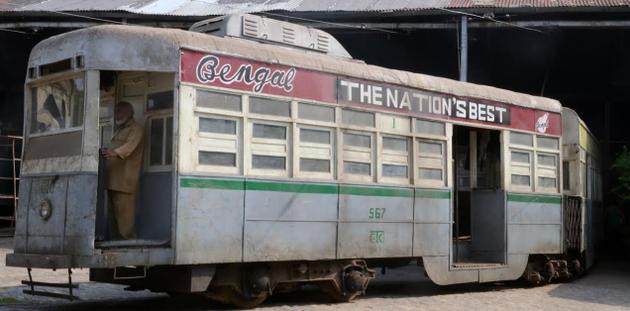
Tram No. 567, used in the film “Detective Byomkesh Bakshy!”, at the Nonapukur Tram Depot in Kolkata. Photo: Sushanta Patronobish / The Hindu

Using brands that have faded from public memory and antiquated ad campaigns, the project has revived interest in trams ‘No. 563’ and ‘No. 567’, now renamed ‘Byomkesh Bakshi’ Tramcars. The film, however, spells the detective’s last name as Bakshy.

The film used two wooden tramcars built in the 1930s and a watering car used to water the tram tracks of the city.

“The tramcar was renovated at their [the filmmakers] cost by us. They collected samples from old photographs and, accordingly, old-style branding was done on the top panel of the trams,” Nilanjan Sandilya, managing director of The Calcutta Tramways Company (CTC) Ltd. told The Hindu.

Mr. Sandilya said that trams were the main public mode of transport in the 1940s and were crucial to depict that period of the city.

Tram No. 567, used in the film “Detective Byomkesh Bakshy!”, at the Nonapukur Tram Depot in Kolkata. Photo: Sushanta Patronobish / The Hindu

The two tramcars used in the film are wooden ones that have seldom been taken out on the streets after the shooting of the film, said S.S. Ghosh, the Works Manager of the CTC. Tram No. 567 displayed advertisements of brands such as Bengal Lamp, Lux Toilet Soap and Dulaler Tal Mishri during the shooting. An old brand of palm candy was also advertised at Nonapukur tram depot. Tram No. 563, which was changed to No. 469 for the film, carried similar advertisements in English, Bengali and Hindi. Shooting was held at the Park Circus Tram Depot. The watering car used in the film predates the trams. According to Mr. Ghosh, watering cars were built between 1915 and 1920 and only two of them are now left with the tram company. Such is the enthusiasm surrounding the tram cars that a prototype called “Byomkesh Bakshi Tramcar” is on display at a tram museum-on-wheels called Smaranika.

source: http://www.thehindu.com / The Hindu / Home> News> Cities> Kolkata / by Shiv Sahay Singh / Kolkata – April 04th, 2015

A railway church in Liluah

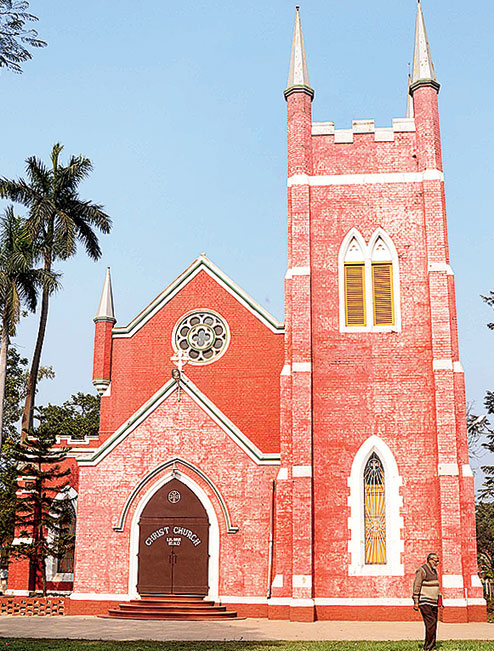
Christ Church in Liluah. Picture by Gopal Senapati

The old red Gothic structure on the eastern banks of a large pond looks huge from outside. The pond and the church stand on land that belongs to the Eastern Railway in Liluah. Despite the massive structure, inside, the church cannot seat more than 100 people on its pews. If there is a big congregation, authorities have to arrange for extra chairs for the parishioners.

Christ Church, under the Church of North India (CNI), has 160 parishioners on its list. Most of them are local residents, but there are some who come from other parts of Howrah and Hooghly as well.

The interiors of the church got a fresh lick of pink paint in December, before Christmas. Reverend Sailen Das, a senior member of the church committee, is expecting a good turnout for Good Friday on April 3. The service will start at 12 noon and will continue till 3pm. “Many people attend the church service on Good Friday because it is a significant day. The week before Good Friday is the Holy Week and every evening we have a mass for the Lent period that has started 40 days before Good Friday,” said Das.

Christ Church was built in 1915 for the European and Anglo-Indian employees of the then East Indian Railway. A plaque on the wall of the church reads, ‘This stone was laid on December 22, 1915 by Robert Swan Hichet Esq, Agent East Indian Railway.’ Since the inception of the Liluah workshop in 1900, the Christian employees wanted a
place of worship. “The church runs on donations from members,” said Das.

Inside the church, there are no other decorations, apart from the altar. An antique object inside the church has been removed some 20 years back. “A huge brass eagle with wings spread out, perched on a brass stand was placed in the front of the altar where the priest would keep the Bible during church service. There was an attempt to steal the eagle stand about 15 years back, but it was so heavy that the thieves could not carry it out of the church. After this, we were forced to give the eagle away to St Paul’s Cathedral,” said Das.

Christ Church will turn 100 at the end of this year and the committee members are planning to do some social work.

“We run a Sunday school for Biblical teachings. We are thinking of starting a dispensary at the local club where we could distribute free medicines,” said Das.

source: http://www.telegraphindia.com / The Telegraph, Calcutta / Front Page> Howrah> Story / Friday – April 03rd, 2015

Sculpting A Dream

Kolkata :

This is a unique story of a man not only going to the mountain, but also taking it on to realize a daring dream — that of leaving his permanent imprint on it.

The last time man attempted such a feat was nearly 14 centuries ago, at Mahabalipuram.

A similar exercise is now underway in West Bengal’s Purulia district, where a group of craftsmen, led by master sculptor Chitta Dey, are sculpting giant birds in flight on the rock face of a big hill and burrowing a network of caves inside it to create a wonder that generations to come will marvel at.

To say that the 57-year-old Dey, a graduate from the Government College of Art & Craft in Kolkata, is creating history would be too much of a cliche. The dream that Dey is pursuing with liberal help from the erstwhile Planning Commission is nothing short of the monumental projects that only kings and emperors, with enormous resources at their command, could muster the courage to undertake.

The gargantuan dimensions of the project, which he conceived in 1991, could not faze the portly Dey. “I wanted to create yet another showpiece of Indian craftsmanship for the world to appreciate. And so it had to be grand in scale. If you dream, then dream big,” he says.

The 800-foot-high hill, part of the Matha range that’s connected to the well-known Ayodhya range of hills, was chosen by Dey in 1994. “I had toured many places in Maharashtra, Uttar Pradesh and Orissa to choose a hill to sculpt my dream on in the early 1990s. Ultimately, the West Bengal government requested me to narrow down my choice to a hill in this state,” says Dey, who first came to this site, about 46km west of Purulia town near the Bengal-Jharkhand border, in 1992. Sourcing funds for the project took a lot of time, he says, adding that it was Pranab Mukherjee who was instrumental in getting the Planning Commission to sanction Rs 4.26 crore for the project.

Buddhadeb Bhattacharjee, who was the culture minister then, also helped. After getting permission to implement his dream on the hill, which is now known as ‘Pakhi Pahar’ (Bird Hill), Dey went about selling his project to the people of eight surrounding villages. “They were sceptical initially and laughed off the idea. But I persevered and ultimately, could rope in about 35 of them to undergo training in sketching and sculpting. I finally selected 24 of them for this project,” he says. These men were also trained in rock-climbing by coaches from the Himalayan Mountaineering Institute in Darjeeling.

Geologists were involved to test the nature of the rock and only after their green light did the actual work start in 2004. The first step was to paint the birds on the rock face. “That was a laborious process and we often went wrong with the dimensions. We had first planned that the smallest bird would have a wing span of 17 feet but when we painted a bird of that size on the rock face, it looked too small from even the base of the hill. Now, the smallest bird has a wing span of 55 feet and the largest one a wing span of 120 feet,” Dey says. This process took about four and a half years.

The entire project is under the aegis of Dey’s Flight To Harmony Foundation. The sculptor roped in civil and mechanical engineers to guide the team in erecting scaffoldings, fixing two 25-tonne anchor bolts on the peak of the hill to enable the craftsmen to rappel down the rock face and work and other such works.

They craftsmen wear harnesses, helmets, eye shields and take all safety measures, he says, adding that they have individual insurance policies and are covered by the workmen compensation policy as well. They are paid Rs 160 a day. Every morning, they congregate at ‘Pakhipahar Ghar’, a nondescript, three-storey house that squats at the base of the hill and is home to Dey and some of his companions, around 8am, discuss the work of the day and head to the hill around 8.30am. They work till 3pm and return to their homes after that. “We can only work from late October to March because of the extreme heat and the rain during the rest of the year,” says Upen Chandra Mahato, 35, who believes he is creating a beautiful masterpiece for posterity.

Dey took his 24-member team to the Ajanta-Ellora caves as well as Aurangabad in 2010. “That was hugely inspirational for us. We realized the importance of what we were doing,” says Mangal Ghatwal, 34. “Sir (Dey) pointed out the intricate carvings there and showed us how to achieve that fine craftsmanship. We gained a lot of confidence from the trip and felt proud that we were part of a project that would be like those caves which future generations would admire,” says Shankar Handsa, 30.

Along with the relief sculptures of birds on the rock face, the team is also chiselling away at the base of the hill to burrow 20 caves, the walls of which will have carvings of locally found animals like deer, pangolin, turtle, squirrels, peacocks and other birds as well as trees and plants indigenous to that region. “If these animals or plant species ever become extinct, future generations will know from the carvings that they once existed here,” Dey says. Many of the boulders that lie at the base of the mountain or on the way to the peak also have local flora and fauna carved on them.

About 30% of the work on this project has been completed and, says Dey, ‘Pakhi Pahar’ will start taking its proposed shape by 2020 if work continues uninterrupted. “This work has gained a momentum of its own and will continue even after I am no more. The community of local sculptors that has grown here from this project will continue the work and will hand over and further hone their skills from one generation to the next. The local community has taken ownership of the project just as I had intended,” he says.

Dey has also created another group of stakeholders in the project — six inmates of the Alipore Central Correctional Home, who were taken to the site last weekend and given the opportunity to take the chisel and make their marks on the rock face. Marks that, when viewed from afar, will look like giant birds in motion which will stand testament yet again to humankind’s enterprise and perseverance.

source: http://www.timesofindia.indiatimes.com / The Times of India / Home> City> Kolkata / by Jaideep Mazumdar, TNN / March 28th, 2015
Start-off to Story

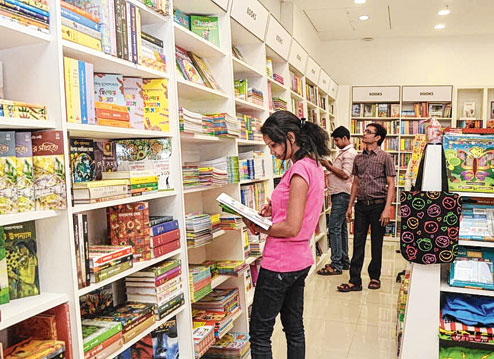
Story at Avani Riverside Mall. Picture by Gopal Senapati

Its Story time in Howrah, with the Elgin Road bookstore opening an outlet in Avani Riverside Mall. The 685 square feet store on the ground floor that opened on January 15 is drawing many customers, who are walking in to browse through the titles.

A lookaround reveals that Story focuses on children’s books. Activity books, drawing and handwriting books and illustrated story books for the little ones line up the shelves. Parents walk in from time to time looking for something for their growing children. For those who can read, there are a large number of colourful Enid Blyton and Roald Dahl books to choose from. For the studious ones, there are illustrated encyclopaedias or guide books on how to write essays and letters. “One of the main reasons behind making a store dedicated to children’s books is that Avani Riverside Mall is primarily a family mall. People come with their children and usually like to shop for them,” said Sidharth Pansari of Story. “In Howrah, there is no good standalone bookstore and so we thought of opening a branch in Avani Riverside Mall,” he added.

Reema Sen, a weekend shopper at the mall, said, “I came looking for stationery items and educational toys for my son. This is the first time I came to Story and found that they have a good collection of books, but I didn’t go through them properly.”

This is the third branch of Story with another two in Junction Mall in Durgapur and Diamond Plaza in Jessore Road. Due to its small size, this store is being called an express outlet. “Since we do not have the space to stock up on a large number of books at a time, we try to keep the best titles and popular authors at this store,” said Pansari.

The Bengali customers are delighted to see a bookstore with Bengali books at Avani Riverside. However, some feel that some more titles and authors could be accommodated. “The collection of novels and short stories here are good. They have some popular writers too but I am sure booklovers will also want to see titles by Tasleema Nasreen, Tilottama Majumdar, Nrisingha Prasad Bhaduri, Tarapada Roy, Syed Mustafa Ali and so on,” said Arun Kumar Mitra, a resident of Shibpur who had come to browse through the collection at Story.

Ranjan Das, the store manager said, “We have already sold several copies of Byomkesh Samagrah and Satyajit Ray’s Feluda compilations. For those who are looking for some serious books, Suchitra Bhattacharya, Sunil Gangopadhyay, Sirshendu Mukherjee and other well-known authors’ works have been stocked up as well.”
There are some buyers who ask for poetry collections. Although all books may not be available off the shelf, Pansari promises that if a customer places an order for any particular book, he or she will get it within a day. “We have a large stock of books at our main store and can supply the required books overnight,” he said.

Among the young generation, Chetan Bhagat is a craze, specially his new book, Half Girlfriend. John Green’s The Fault in Our Stars and Looking for Alaska are also selling at Story. Collections of short stories by O’Henry, Rabindranath Tagore or books on assorted short stories are also in demand.

source: http://www.telegraphindia.com / The Telegraph, India / Front Page> Howrah> Story / by Dalia Mukherjee / Friday – March 27th, 2015

Guv attends Garia school’s lit fest

Kolkata :

Governor Keshari Nath Tripathi recently presided over the literary festival celebrating the golden jubilee celebration of BDM International school near Pratapgarh in Garia. Tripathi, who was accompanied by Usha Mehta, director and administrator, Shailesh Khaitan, chairman and Shankar Lal Gupta, secretary of the school, stressed on the promotion of Hindi literature by the students and teachers of the school.

The governor was praised students for their performances at the event, which revolved around the richness of Indian culture, art and literature. He described the five-decade journey of BDM International as a story of success, which began with Usha Mehta, and just two learners, in 1966. It is now a leading CBSE-affiliated institution with nearly 8,000 students.

Speaking about the late Draupadi Devi Khaitan and the late G N Khaitan, who dreamt of the school changing the academic landscape of the area, Tripathi said, “I am happy to know that the school authorities have introduced subjects like mass media and biotechnology to keep pace with global education trends.”

The governor told his audience, “If you get good marks in exams, don’t think yourself to be an educated or learned person. Rather imbibe moral values to become ideal citizens of India in the future. The society has high hopes from you and I want you to fulfil them.”

An author and poet, whose chief literary works include anthologies like ‘Manonukriti’ and ‘Aayu Pankh’, Tripathi lauded the students for depicting different segments of Hindi literature in their presentations.

source: http://www.timesofindia.indiatimes.com / The Times of India / Home> City> Kolkata / TNN / March 30th, 2015