Category Archives: Arts, Culture & Entertainment

Zoological Survey of India discovers founder’s grave in 100th year

Kolkata :

RIP Thomas Nelson Annandale, at the Scottish Cemetery.

Not many people know that the first director-general of Zoological Survey of India (ZSI), Thomas Nelson Annandale was buried at the Scottish Cemetery when he breathed his last on April, 1924. Or who he actually was. When ZSI kick-starts its centenary celebrations on Wednesday (the organization was founded on 1 July 2016), a plaque will be erected to pay homage to its Scottish founder at recently-discovered tomb.

Tracing the grave was far from easy for the premier institution on animal taxonomy that is adept at identifying species around the country. According to some records at ZSI, Annandale was buried inside the South Park Street cemetery. It took ZSI a while to fish out documents to prove that his remains had been shifted to the Scottish Cemetery where he has since been left to rest.

ZSI director Krishnamoorthy Venkataraman told TOI on Monday: “Now that we have found the grave, a plaque will be erected to honour Annandale’s contribution to ZSI and science at large.” Dhriti Banerjee, deputy director and head of office, ZSI, said, “It took us some time to find out that the ZSI founder was buried at the Scottish Cemetery and not at the Park Street Cemetery. But when we initiated the mission, we realized that the inscriptions were barely visible. We had a difficult time finding out Annandale’s tombstone.”

Most of the tombstones at the cemetery lie broken, defaced and forgotten. Weeds have obscured the gorgeous carvings. Annandale’s tombstone was unclean and the lead filling on the inscription had corroded. Established in 1820, the six-acre Scottish Cemetery was in use till 1940. Currently, it has around 4,300 graves. Apart from Scots, a few Bengalis who were converted to Christianity by Scottish priests were buried there.

After discovering the grave, ZSI officials had the tombstone spruced up and the inscription re-painted. On the occasion of ZSI’s centenary, new slabs will be installed on the grave and landscaping done around it.

An array of programmes have been planned to mark ZSI centenary. The authorities are organizing a run on July 1 to kick-start its centenary celebrations. The Centenary Run will begin from the Asiatic Society in Park Street, the place of ZSI’s origin, and end at Prani Vigyan Bhawan, the present headquarters in New Alipore.

Venkataraman said Prime Minister Narendra Modi will participate in the centenary celebrations in the third week of July at the ZSI headquarters and dedicate the “Digital ZSI” – the e-access to ZSI’s documents – to the country on 100 years of faunal inventory of India.

Going back to the organisation’s first founder, the director said: “We have learnt from a publication published by ZSI that the first director-general travelled across the country and also to China, Japan, Malaya and Morocco looking for different species of fauna in the beginning of 20th century.” The publication had described Annandale as a person of “slight physique, with high strung temperament and restless energy.” He was born in Edinburgh in June 1876 and died in Kolkata on April 10, 1924. During his short life of 48 years, Annandale had 528 scientific reports published.

Venkataraman said conducting authentic research on the country’s rich faunal diversity, undertaking studies on alien fauna, collecting samples of the country’s zoological wealth and setting up zoological museums in different parts of the country are some of the objectives of ZSI.

Annandale had founded the ZSI, which later started functioned under the ministry of environment, forests and climate change, to promote survey, exploration, research and documentation on animal taxonomy. It has identified more than 96,000 species of animals.

source: http://www.timesofindia.indiatimes.com / The Times of India / Home> City> Kolkata / TNN / by Ajanta Chakraborty / June 30th, 2015
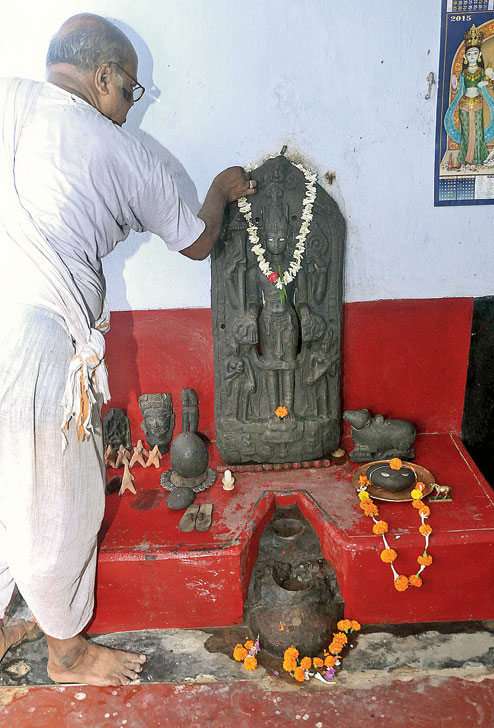
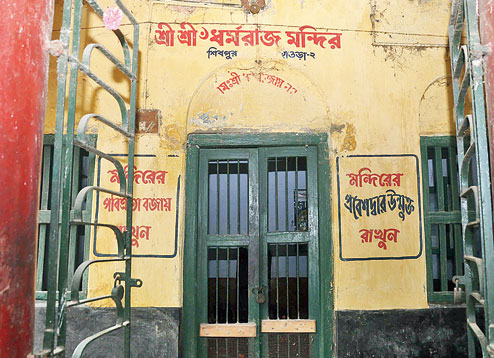
The god of death worshipped in a backyard

TEMPLE TRAIL

A purohit offers flowers to the deity at the Dharmaraj temple in Shibpur. Pictures by Gopal Senapati

A nondescript house that stands dark and invisible behind the cramped row of flower and fruit stalls at Shibpur Dharmatala More houses the Dharmaraj temple. It is hard to imagine that a temple exists in the milieu of a marketplace. An old wooden door leads to the tiny temple inside where a black stone relief sculpture is the presiding deity, known as Dharmaraj to the common people of Shibpur. According to Howrah Itihas- Aitijhya, written by local historian Sibendu Manna, this sculpture is a figure of Vishnu, standing on a blooming lotus flower. Next to the Dharmaraj idol are other smaller black stone idols of Kali, Jarasur and Vishnu.

The inconspicuous temple at Shibpur Dharmatala

Shibpur’s Dharmatala gets its name from this Dharmaraj temple which is estimated to be more than 300 years old. Although there is little historical information available about the temple, it is said that the temple was built by one of the members of the Roychowdhury family, the zamindars of Shibpur. “We have seen this temple since childhood and always knew that our forefathers had built it. The first settler of our family, Rambrahma Roychowdhury, had come here in 1683. His son Sukdeb Roychowdhury came to power in 1707. We assume that the temple must have been built during his tenure,” said Samir Roychowdhury, a member of the family.

Dharmaraj is a form of Yama. The god of death is usually worshipped by members of lower caste Hindus. Inside the temple, one can find a number of earthen horses placed near the deity. Mothers who have ailing children or those whose infants cannot walk properly, usually pledge these horses to the deity.

Buddha Purnima is an auspicious day at the Shibpur temple. Special puja is offered to the god on this day and devotees come in droves to offer prayers at the temple. “We have been sevaits at the temple for several generations. This temple is revered by most people in Shibpur area. On Buddha Purnima, we have a special puja and many people come to offer puja to the deity,” said Madhusudhan Bhattacharya, the priest at the Dharmaraj temple.

source: http://www.telegraphindia.com / The Telegraph, Calcutta, India / Front Page> Howrah> Story / Friday – July 03rd, 2015

ZSI celebrates a century of magic finds

Kolkata :

Scientists at the Zoological Survey of India (ZSI) have discovered 176 new animal species in the run-up to their centenary year that kicked off on Wednesday.

Speaking to TOI, ZSI director K Venkataraman said 93 new species of insects were recorded by the team last year along with 24 species of amphibians, 23 species of fish and two species of reptiles. The other new finds were 12 species each of arachnida and crustacea, one type each of nematoda, trematoda and mollusca.

“It has been an exciting year with our scientists contributing to the inventory of animal species on the planet. Apart from the new finds, 61 species of animals that were found elsewhere in the world were also found and recorded in the country,” Venkataraman said.

Of the new insects discovered, several were found in Bengal. Agricnemis kalinga was found in Panchala, Howrah; Amemboa bifucrata in Kalikhola, Jalpaiguri; Amemboa mahananda in Mahananda Wildlife Sanctuary, Darjeeling; Onchotrechus dooarsicus in Buxa Tiger Reserve, Jalpaiguri; Pleciobates bengalensis in Alipurduar; Calvia explanata in Darjeeling and Forcipomyia parasecuris in Burdwan. In addition, several other species were found across the state.

ZSI deputy director Dhriti Banerjee said Bengal has one of the richest faunal diversities in the country due to its diverse climatic zones. “Of 96,000-odd recorded animal species in India, 11,042 species, or more than 10%, are found in the state. Different climate zones — alpine temperate forest in Darjeeling, tropical forest in north Bengal, desiduous forest in south Bengal, dry grassland in the middle and mangroves in Sunderbans — support the varied animal life,” she said.

In fact, north Bengal, particularly Darjeeling, is considered a animal diversity hotspot by zoologists as the Eastern Himalayas is the gateway for faunal elements coming to India. “Any experienced scientist can confidently set out on a trip to Darjeeling and find a new species. The insect and ambhibian population in Darjeeling is very high,” Banerjee said.

While new species are being discovered in the state, several species have become extinct, including Javan rhinoceros, Asiatic two-horned rhinoceros, musk deer, monal pheasant, mombin quail, pink headed duck, marbled cat, golden cat, three-banded palm civet, mock viper and gore’s bronze back viper.

While ZSI has traditionally focused on surveys, collection of specimens, identification, naming and preserving, it has now started working on a GIS platform so they can be spacially and temporally mapped for reference. An ambitious programme to digitize the specimens is underway.

“A databank of high resolution photographs of type specimens, along with their full profile — what it looks like, where it was discovered, where it is found now and its DNA bar code — will be created,” Banerjee said.

Banerjee is heading the Rs 3 crore project to digitize information on 7,286 species, most of which are 100-200 years old.

source: http://www.timesofindia.indiatimes.com / The Times of India / Home> City> Kolkata / TNN / July 02nd, 2015

Nadia gets U.N. pat forachieving total sanitation

The district Magistrate of Nadia along with chief of Nadia Zilla Parishad in West Bengal was on Saturday presented the United Nations Public Services Award 2015 for eliminating open defecation in the district.

Nadia district, located in south Bengal, had half of its population defecating in open till October 2013. The district administration, under a programme called Sabar Souchagar, built 3.56 lakh toilets in the district. As a result, the number of people continuing with the practice dropped to mere 0.2 per cent.

The award was presented by the acting Secretary-General of the U.N., Lenni Montiel, along with Head U.N. Women Stefani Senese, on conclusion of the U.N. Day celebrations 2015, on June 26 at Medellin in Colombia, District Magistrate P.B. Salim informed The Hindu over email.

Banikumar Roy, chief, Nadia ZP, was also present.

‘Unique model’
The U.N. has described Sabar Shouchagar (Toilets for All) as a “unique model developed to generate awareness, improve access to sanitary toilets, and bring substantial health improvement through improved sanitation.”

The U.N. added that the scheme has mobilised all stakeholders, “especially women and schoolchildren and saw involvement of faith-based organisations” and “if replicated, it has the potential to eliminate open defecation from across the world.”

West Bengal Chief Minister Mamata Banerjee had on April 30 held a programme in Nadia district highlighting the success of the scheme and announced that ‘Nirmal Bangla Divas’ will be observed across the State every year.

source: http://www.thehindu.com / The Hindu / Home> News> National / by Special Correspondent / Kolkata – June 28th, 2015

The old Calcutta chromosomes

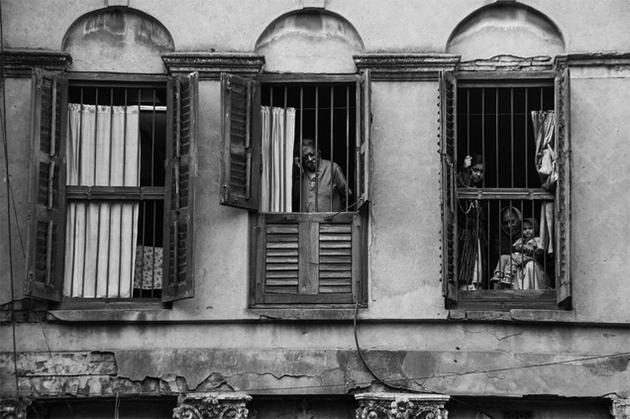
Thousands of Kolkata houses with red-oxide floors and sleepy green-shuttered windows, the spacious porches on the ground floor, with their intricate cornices, elaborate wrought-iron grills, and open terraces are being destroyed at an incredible pace. Photo: Akash Mondal

Kolkata’s heritage buildings are part of the city’s unique DNA, as distinct to its landscape as a fingerprint. The writers talk to novelist Amit Chaudhuri, who is spearheading the city’s brave fight to save its heritage.

In one of Kolkata’s most prosperous neighbourhoods stands a two-storey house. It has shuttered windows and large pillars, in the style typical of colonial Calcutta. The house belongs to Tapati Mukherjee, and was built by her grandfather in the 1930s, in an area called Hindustan Park. The house next to hers, built around the same time and in the same architectural style, is owned by a former chief of the Indian Football Association. It is being torn down. It will soon be replaced by an anonymous high-rise.

Mukherjee, however, is adamant that she will not let her house suffer a similar fate. The Director of Culture and Cultural Relations and the President of Rabindra Bhavan at Visva Bharati University in Santiniketan, she said, “I don’t want to live anywhere else. The house has a cultural ambience and feeling of old-world grandeur (that) I do not find elsewhere. I vow to protect this house till my death.”

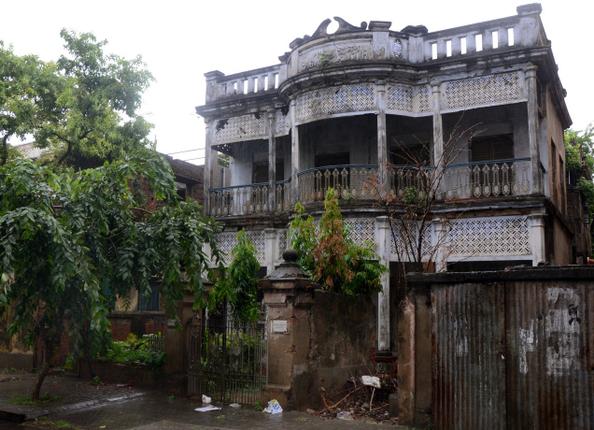
Unfortunately, not everyone thinks like Mukherjee. Thousands of Kolkata houses with red-oxide floors and sleepy green-shuttered windows, the spacious porches on the ground floor, with their intricate cornices, elaborate wrought-iron grills, and open terraces are being destroyed at an incredible pace. These houses give Kolkata its unique old-world charm and reflect the amazing architectural ethos of the city, but they are being lost in the mad rush for multi-storey buildings and concrete chaos.

Thousands of heritage buildings in with red-oxide floors and green-shuttered windows, spacious porches with intricate cornices, elaborate wrought-iron grills, and open terraces are being destroyed at an incredible pace in Kolkata. / Photo: Sanjoy Ghosh / The Hindu

This loss of heritage is not unique to Kolkata. Several Indian cities today are battling this dilemma. In Jaipur, for instance, many of the privately-owned historical havelis, with their jaali windows, false fronts and pink facades — which gave the city its moniker of Pink City — are in danger of being lost forever. They have become dilapidated over time and are slowly beginning to be pulled down to make way for modern buildings. Some of these havelis date back over 100 years.

Mumbai has a splendid architectural history, with a mix of Art Deco, Indo-Saracenic and Victorian, all contributing to a rich variety of features that contribute to the city’s signature ‘look’. But many of these buildings are crumbling today and, in the absence of government incentives, owners prefer to let the heritage homes decay rather than spend their own money on upkeep, which is understandably an expensive task. Once the buildings reach a certain stage of disrepair, the owners are allowed to demolish them and sell the rights to redevelopers for a lucrative sum. This makes it much more difficult to persuade owners to look after them. Bangalore and Chennai, too, are fighting the same battle, as is the state of Goa, with its stunning built legacy in the Portuguese-Baroque style.

The only weak but bravely flickering touch of silver in this bleak skyline is the fact that informed citizens across India are taking up cudgels to try and save the country’s heritage structures. The newest episode to this saga of protest is being staged in Kolkata, where several people — both ordinary and prominent citizens — have written to Chief Minister Mamata Banerjee, pointing to the urgent need to stop the destruction of these historic buildings. Most of these houses were begun in the 19th century and continued to flourish over the next hundred years. In fact, even during the recession of the 1930s, the cement industry was flourishing as the middle-class was constructing these huge houses.

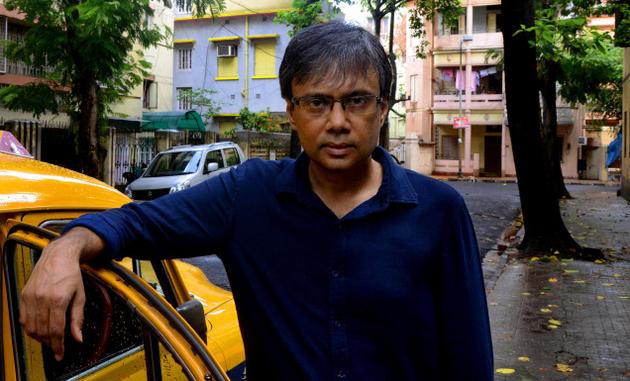
Author Amit Chaudhuri who is spearheading the protests to save the heritage buildings. / Photo: Sanjoy Ghosh / The Hindu

Eminent writer Amit Chaudhuri, who is leading the campaign, said, “Destroying these buildings is to destroy one of the chief characteristics of this city’s history of modernity. Kolkata is a modern city and these houses are emblems of the city’s modernity… they are as important as the painting, literature and music of Bengal.” For Chaudhuri, this is an old battle. He has been speaking and writing on the issue for many years now. He talks of how the architecture of many neighbourhoods in Kolkata is quite distinct from the Indo-Saracenic or neo-Gothic style of architecture that can be seen in other Indian cities. They represent a Bengali-European style that is not seen elsewhere.

The Kolkata heritage protest team includes architects, artists, film directors and academicians. And one common factor that everybody agrees upon is the fact that these old buildings are not important only because of the nostalgia that surrounds them but because they represent a certain time in history. If preserved well, these buildings can actually lead to very practical and modern benefits, such as increased tourism revenue and, in turn, a renewal of the city.

Take, for instance, the boutique hotel that opened in Kolkata a couple of years ago. Called Hotel 233 Park Street (based on the door number), it occupies the ground floor of an imposing Zamindari mansion located at the much less stylish but no less historical Park Circus end of the city’s famous restaurant street. Rather than tear the mansion down, with its classical pillars and high ceilings and wooden-slatted windows, the owner has recreated a piece of the city’s cultural history here. The rooms have antique mahogany or Burma teak furniture, and a potpourri of Zamindari and Colonial tapestries, lithographs, curios and floor lamps. The hotel’s revenues could be used to revamp the rest of the mansion over a period of time. It is testimony to how sensible restoration can go a long way.

As Nobel Laureate Amartya Sen has said, the rich history of early habitation in the Calcutta region has suffered not only from intellectual neglect but also from the destructive tendencies of the past. “We owe to future generations a preserved and unmutilated heritage of Calcutta’s eccentric but exciting old buildings,” Sen had said in response to the city’s petitioners.

Even as Kolkata’s mayor Sovon Chatterjee has claimed that it is “next to impossible” to preserve the old neighbourhoods and houses, the supporters of the campaign have agreed that a legislative intervention is required to preserve the buildings. Architect Partha Ranjan Das has also come up with another idea. He suggests that buyers must be incentivised by the introduction of a transfer of development rights. In other words, he says, “While the buyers (of heritage properties) will not be able to make changes to these old houses, they can transfer the floor area ratio to other projects that they are developing in other localities.” This is a unique solution that must be looked at seriously, not just in Kolkata but across cities.

Meanwhile, Sugata Bose, historian and MP from Trinamool Congress, has assured the petitioners that he will take up the matter with Chief Minister Mamata Banerjee. “During the Chief Minister’s upcoming visit to London, I will try to show her what the authorities have done there to preserve the neighbourhoods,” he said.

However, well-known artist Shuvaprasanna, who heads the West Bengal Heritage Commission, is very clear that the best of intentions cannot achieve anything unless there is a change in existing laws to prohibit the demolition of these houses. “The German author, Günter Grass, was awestruck by the city and had raised the issue of renovation with former Chief Minister Buddhadeb Bhattacharjee during the 1990s. However, the discussion was not taken forward and nothing much could be done.”

As he points out, most of the houses are owned by several members of a family and, in many of them, litigation is involved, so that most owners find it the easiest option to sell the houses to private builders. In fact, most owners don’t see any value in the structure itself, and sell it for the value of the land alone. Bose speaks of the need to change mindsets so that people can better understand the innate heritage value of the buildings.

But others say that none of this might work because rampant unemployment has resulted in real estate becoming one of the few growing sectors. In other words, the developers will not be stopped easily. “We have declared a number of these as heritage houses but we are failing to preserve them despite investing crores of rupees,” said the mayor, adding that the Kolkata Municipal Corporation has neither the resources nor adequate laws to deal with the issue.

A recent Bengali film, Bhooter Bhabishyat, (The Future of the Ghosts) was a huge hit. In the film, ghosts evict the greedy builders from a 19th century palace and settle down in it themselves. In real life, will the city’s heritage ever be able to evict the powerful builders and promoters?

source: http://www.thehindu.com / The Hindu / Home> Features> Magazine / by Shiv Sahay Singh & Suvojit Bagchi / June 27th, 2015

Chinese churches stand test of time

Kolkata :

Crumbling buildings and filthy roads at Tiretta Bazar — or Old Chinatown — bear evidence to the depleting fortunes of the Chinese community in the city. But behind those closed doors lie a secret the community so proudly cherishes. The shabby buildings with a ‘falling-apart’ look and feel house some of the historic churches of Kolkata. Step inside and the regalia, incense sticks and intricate altars will give you a feel of the Chinese tradition.

The fact that KMC and the tourism department have joined hands with a Singapore-based organization to revive Old Chinatown has come as a shot in the arm for the community. They are happy that these churches, which were originally established in the 19th century and then rebuilt in the early part of the 20th century, will get restored.

The Indian Chinese Association has appealed to the project co-ordinators that the revival project should centre around the six churches (they were originally temples but later got converted to churches as most of the Chinese people embraced Christianity) that the community is guarding so dearly for so many years.

While the project so long centred around the Toong On Church and the famous Nanking restaurant that it houses, now five churches have also come into focus. A visit to the churches is an experience in itself. Take the case of the Namsoon Church, for example. It is the oldest of the six. It was established in 1820, almost immediately after the Chinese settlers abandoned Atchewpur near Budge Budge. Located at the far end of the snaky Damzen Lane, you will easily miss it. But the church, dedicated to Kwan Yin, the Chinese Goddess of War, has a magnificent altar complete with an intricately carved roof hanging.

There are three more churches on the same lane. Choong Hee Dong Thien, built in 1859, is in a sorry state but the deity, Kwan Kun, believed to be the God of Fortune, is still maintained and worshipped by the community. The Gee Hing Church was originally built in 1888 but it reached such a dilapidated state that the community rebuilt and relocated it in 1920 to its present location on 13, Blackburn Lane. Even that is in a sad state now, though the members of the community regularly visit for prayers and offerings there.

“Times are tough and you hardly find time to hang around as regularly as you did earlier. But we still try to meet up for our board games of Chinese Pair, after prayers as frequently as possible,” said Chang Yu Sen.

“Our tradition lives in these churches. It reminds us where we belong and the culture and tradition of that place. We cannot relate to the changes that have come over China today, so we guard these altars to remain close to our roots. Today many of us might have become Christians but we have not lost touch with Buddhism, Taoism and Confucianism that bind us,” explained Paul Chung, president of the Indian Chinese Association.

The other three churches — Sea Ip Church, Sea Voi Yune Leong Futh Church and Then Hane Miaw — too are crying for attention despite devotees’ best efforts at maintaining them.

source: http://www.timesofindia.indiatimes.com / The Times of India / Home> City> Kolkata / by Jhimli Mukherjee Pandey, TNN / June 23rd, 2015

Woman teaches slum girls to dream big

Kolkata :

Girls at Gobindopur railway colony would never dream of building their lives on their own terms with hardly any of them ever getting the opportunity of attending school and most of them being married off by 16. Many would face regular abuse at home, but they would not dare to protest. Finally, one of them, Uma Singh (27), decided to change things around and took up the cudgels for her tormented sisters in the colony, one of the largest slums in south Kolkata.

The first woman to graduate from the slum, Uma gathered youngsters from the area to launch a door-to-door campaign aimed at sending girls to school instead of marrying them off early. Eight years later, the number of girls dropping out of school has fallen dramatically, while underage marriages have stopped. Several girls from the slum are now training to be schoolteachers, painters or computer instructors.

Uma is pleasantly surprised with the transformation. “It pained me to see girls around me suffer like that. They had no ambition, no dream or desire. They were just happy to be alive which, I felt, was unfair,” she said. Uma got together a few of her like-minded friends and formed a group to fight for girls’ rights. It wasn’t a smooth start in troubled Gobindopur, where settlers were being evicted. Fighting to hold on to their shanties, residents did not really care about how their daughters should be treated. But Uma and her group didn’t give up.

They held meetings and workshops, performed street plays and screened films to spread the message of girls’ rights. Initially, they would be snubbed and asked to stay away from “personal affairs”. “It was a challenge for we were fighting a social evil and the deep-rooted belief that girls were not supposed to be ambitious. They were never treated on a par with boys. What’s worse, they didn’t have access to basic rights, such as education or even two square meals a day,” Uma said.

With her 20-member team, which was christened Nabadisha in 2008, Uma went from door to door, asking women to send their daughters to school. Some refused, fearing their husbands’ wrath. “We started sending those children to school without letting the men in the family know about it. Those who couldn’t be admitted to nearby schools were tutored at a centre in the slum. We noticed a slow change in the girls’ attitude. Even after the men learnt that their daughters were attending school, they didn’t really object,” said Uma.

Ratna Mandal said she would have been married off by now, had it not been for Uma. “She gave me the courage to dream of building a career,” said Ratna who is training to be a dancer.

Over the next two years, Nabadisha spread their work to five slums in the area. Most girls even in those slums now attend school, with more than 20 of them having cleared their higher secondary exams. Many are now preparing to work, which was unthinkable 10 years ago. Early marriages have been curbed but not stopped.

Nabadisha runs computer, drawing, dance and spoken English classes for girls who are counselled and guided every Sunday. “We hold ‘self-exploration’ sessions where we discuss their strengths, weaknesses and their future plans. Their problems are addressed. Girls in the slums have gathered the courage to dream big and stand up to wrongs within and outside the family,” said Poonam Sadhukhan, a Nabadisha member. Around 150 girls, aged between 10 and 18 years, are now being tutored, while over 100 have been assisted in three years.

Uma says she wouldn’t stop her work till drop-out rate among Gobindopur girls turns zero and they can support themselves financially. “We have managed to convince slum dwellers that girls deserve to be treated as equals and should be given a chance to realize their dreams. Once we have more girls working, their families will fall in. We are not going to rest till then,” Uma signed off.

source: http://www.timesofindia.indiatimes.com / The Times of India / Home> City> Kolkata / by Prithvijit Mitra, TNN / June 23rd, 2015

Diocese of Calcutta gets 1st Indian priestess

Kolkata :

It was a historic moment for the Diocese of Calcutta, Church of North India (CNI) on Sunday as Margaret Nilanjana Ali made it to the pulpit even as the diocese completed 200 years.

“It feels nice to be the first woman ordained as presbyter (priest) in the full time ministry of the Diocese of Calcutta, CNI. Rev Priscilla Papiya Durairaj was ordained earlier, but only in the part-time ministry,” Rev Ali told TOI.

The special service at St Paul’s Cathedral was officiated by Bishop Rt Rev Ashoke Biswas. On Sunday, he became the first bishop from the diocese to have ordained an Indian woman. Rev Biswas, a firm believer in gender equality, has been instrumental in having Ali take part in service along with the male priests.

Apart from Ali, the bishop ordained two male priests — Sebastian Hansda and Saikat Nath. At the ordination ceremony, he told the congregation, “Today is a very special day in the life of the Diocese of Calcutta. Ali, Hansda and Nath will now become Presbyter with God’s call upon their lives to serve.”

The solemn and elaborate oath-taking ceremony started at 6pm and continued till 7.30pm.

“Christianity was always a part of my growing up; my father (Rev John Nelson Ali) is a priest. My vocation evolved under his tutelage and today I feel complete,” Rev Ali said.

The clergy at Calcutta Diocese, the oldest diocese in the CNI, dating back to May 2, 1814, has been male-dominated and all a woman interested in theology could dream of was to become a lay worker in a parish or a deaconess.

Ordination of women remains a controversial issue in religious circles, either because of cultural prohibition, theological doctrine, or both.

In 1978, the ‘Movement for the Ordination of Women’ was founded in England. “There are a lot of women clergy now, and several women are entering theological colleges all over the world. But there are still pockets of resistance. If a woman felt that her vocation is to be a priest, she must be given the chance to explore the calling,” Rev Ali said.

The revolution came when a legislation for women priests was passed in 1994. On March 12 that year, the first batch of 32 women were ordained as priests of the Church of England.

As a priestess-designate, Ali was in charge of 40 children at the St Elizabeth Girls’ Hostel and had been attached to the Church of Epiphany where she gave sermons, read gospels and visited the sick as part of her grooming. She has been conducting services at St Paul’s Cathedral. She was groomed to succeed Margaret Macgregor, a Scottish woman who was the only other full-time priest.

“But she was white. I will be the first Indian priest from the diocese,” Rev Ali signed off.

source:http://www.timesofindia.indiatimes.com / The Times of India / Home> City> Kolkata / by Ajanta Chakraborty, TNN / June 22nd, 2015

Portrait of an artist as a singer

RamanandaKOLKATA19jun2015


Sudeshna Banerjee

The country knows him as an eminent painter, a significant torch-bearer of the revivalist movement started by Abanindranath Tagore and developed by Nandalal Bose. Barely a month after he turns 80, a new facet of his accomplishments will be unveiled when Ramananda Bandyopadhyay’s first album of songs, Surer Anubhab, will be released on Friday.

A Visva-Bharati pass-out, Ramananda was trained by Santideb Ghosh. “Music was in the air in Santiniketan. In Kala Bhavan, we were encouraged to sing in the classroom. I remember Kinkarda (sculptor Ramkinkar Baij) singing Aj taray taray dipta in front of the sculpture studio. On seeing me, he stopped and said: ‘Bakita gao (Sing the rest)’. We all had to attend Baitalik (morning prayer songs). A music period was also scheduled for us which Santida took.”

The training was hardly structured. “Santida played the esraj and we sang along. Even now, I do not know notations.”

Young Ramananda was part of Visva-Bharati’s drama troupe as dresser. “We used to tour other states with productions like Notir Puja, Tasher Desh etc. Mohordi (Kanika Bandyopadhyay) used to sing. Santida insisted that I attend the rehearsals. The time coincided with my football practice, leaving me itching to slip out. But later I realised how watching the rehearsals helped me.”

He also had to hold the scale on the harmonium for the singers. Possibly not trusting him to stay focused, Ashesh Bandyopadhyay, a teacher, stuck two matchsticks under the Sa and Pa reeds so they stayed pressed. “All I had to do was bellow. The moment I stopped, getting engrossed in watching the play, he would rap me with the esraj bow.”

The other musical practice he recalls was singing in a group at the house of ” mastermoshai” Nandalal Bose on his birthday.

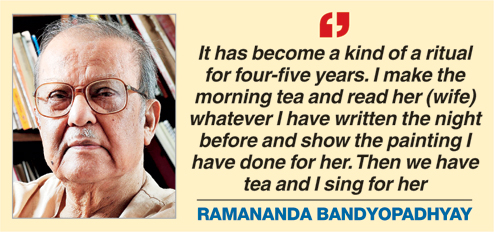
Five years at Kala Bhavan instilled in him the habit of singing while painting. And when his wife Krishna lost her mobility, he started singing three Rabindrasangeets to her daily. “It has become a kind of a ritual for four-five years. I make the morning tea and read her whatever I have written the night before and show the painting I have done for her. Then we have tea and I sing for her.”

He was unsure about going public with his singing. “But Biswa (Roy, the proprietor of Bhavna Records) persisted till I yielded.”

Weeks of practice followed. Ten songs were chosen, including Oi asontoler matir pore, “a Santida favourite”. The album, which bears a sketch by him for each song, has his wife’s illustration of Notir Puja on the cover.

The album will be launched at Calcutta Press Club at 5pm on Friday by Soumitra Chattopadhyaya and an hour later at Raj Bhavan by governor K.N. Tripathi.

source: http://www.telegraphindia.com / The Telegraph, Calcutta, India / Front Page> Calcutta> Story / by Sudeshna Banerjee / Friday – June 19th, 2015

Relic Hunter

On a rainy afternoon, Chittaranjan Dasgupta sits hunched on a chair in his dimly lit room in Bankura’s Bishnupur, working on the manuscript of his latest book, ‘Dakshin Paschim Banger Itibritto’ (History of South West Bengal).

He is 90 years old. For more than 50 years, he has been working tirelessly for preserving the history of Bankura and its surrounding region. Age has not dulled his faculties.

He has authored two other books on Bishnupur’s terracotta temple art. Recently, he wrote a paper on ‘International Trade and Cultural Diffusion in Medieval Southwestern Bengal: Some Architectural Evidence’.

His son Basab Dasgupta, economic advisor with the World Bank in Washington, has sent it to the University of Cambridge.

Dasgupta’s tryst with history began in the prime of his youth. He taught Bengali at Bishnupur High School. “Those were heady days,” he recalls. “We were still basking in the glory of new-found freedom after the British left. Everyone, especially the youth, were fired by a deep passion and commitment towards our soil.” They were free spirits, too. “We would travel to villages in and around Bankura regularly. On these trips, we stumbled upon archaeological relics buried deep in the soil.”

Bishnupur, best known for its terracotta temple art and Baluchori sarees, is a treasure trove of relics dating back to the prehistoric era.

Bankura-Bishnupur’s history can be traced back to thousands of years ago, when Proto-Australoids and Proto-Dravidians inhabited the region. Bishnupur was the core of Mallabhum that in its heydays stretched up to the Chhota Nagpur Plateau in the west and Burdwan in the east.

Its monarchs were called Malla Rajas. Bishnupur saw a confluence of various religions and sects, including Vaishnavism, Jainism and Islam. Bishnupur’s kings were patrons of art, music and culture. The eponymous Bishnupur gharana originated here.

Tansen’s descendant Ustad Bahadur Khan, a musician at the court of Bishnupur’s King Raghunath Singh Deo II, established the gharana.

The writ of time, however, ensured Bishnupur’s link with its glorious past became tenuous.

In the 1940s, Jogesh Chandra Roy, who settled in Bankura after retiring as a professor of chemistry and botany from Cuttack’s Ravenshaw College, tried setting up a museum for relics, books, manuscripts of a bygone era. Around that time, the area around the Kangsabati river was being excavated. “Prof Roy was pained to see government officials and others walking away with priceless archaeological finds,” says Dasgupta. Roy then placed an announcement in a reputable Bengali magazine, seeking help to build the museum. He received no response. Then, came a band of enthusiasts who cherished their history.

Besides Dasgupta, the motley group comprised teachers, scholars, students, businessmen and government officials. They wanted to preserve testimonies of the past for posterity.

Inspired by Roy, they set up the Bishnupur chapter of Bangiya Sahitya Parishad in 1951. Dr Manik Lal Singha was a prominent member who contributed immensely to preserving Bishnupur’s history. Like Dasgupta, he, too, taught at Bishnupur High School and became the parishad’s secretary.

“In 1970s, Manik Babu discovered a Chalcolithic site at Dihar, north of Bishnupur on the north bank of Dwarakeshwar river,” Dasgupta says. Coins, beads, semi-precious stone jewellery and pottery were excavated. The find helped establish that Bankura-Manbhum-Singhbhum was the hinterland of the Tamralipta port and part of the trade route that opened into the Bay of Bengal.

Dr Singha wrote to the Calcutta University’s archaeological department, which took charge. Parishad members scoured villages to collect bits of Bishnupur’s past. “We would go to houses asking for ancient manuscripts written on palm leaves or tulot kagoj (handmade paper). These were heirlooms and several families didn’t want to part with them,” Dasgupta says.

For about a decade — from the 1980s, till he retired in 1990 — Dasgupta, like Dr Singha, travelled through villages to collect relics. They found numerous ancient stone sculptures. Coins, ornaments, pot shards, arrow heads, weapons and tools were excavated from the banks of the Kansai, Shilai and Darakeshwar rivers. “Often, we succeeded in retrieving the relics. But there were times when villagers didn’t allow us, especially if the relic was an idol of a deity who they worshipped,” he says. Gradually, when they had a collection of manuscripts, the parishad decided to set up a museum.

In January 1951, Kabishekhar Kalidas Roy inaugurated a room from where the museum began.

Later, Bishnupur’s Bhattacharya family donated about 10 bighas of land, where then Union education minister Humayun Kabir laid the foundation of the museum, Jogesh Chandra Purakriti Bhavan, in 1954. Named after Prof Roy, today it is a two-storeyed building. The state government, too, chipped in.

During the Left Front regime, the foundation was laid for a new wing. Victoria Memorial gave a grant of Rs 15 lakh for its modernization. Dasgupta is the museum’s member-secretary. The museum became a crucible of culture.

The Parishad organized various lecture series, discussions and music performances. The list of speakers had Bengal’s best — scientist Satyen Bose, author Tarashankar Bandopadhyay, scholars like Shashibhushan Dasgupta, Suniti Chattopadhyay, Sukumar Sen, Kalidas Nag, economists Ashok Mitra and Biplab Dasgupta.

Now, most parishad members are either dead or old. Lectures and performances are no longer held. “Nobody seems to be interested in intellectual pursuits anymore,” Dasgupta feels. Also, today, moving in villages in search of relics would have been tough. “Violence and suspicion stemming from politics have eroded the innocence and peace in Bengal’s villages,” he rues.

The museum boasts a collection dating back to the Paleolithic Age. There are sculptures of Jain Tirthankaras, Parasnath, Choumukha votives and Hindu gods, including Chamunda, Vishnu on Ananta Shajya, Ganesha, Kartikeya, Shankha Purush, Indrani, Pragya Paramita and Ambika. The music gallery chronicles the Bishnupur gharana, its exponents and their instruments.

Curator Tushar Sarkar and two guards are in charge of the museum. During peak season, the museum attracts about 400 visitors a day.

Yet, such priceless treasures of Bengal’s history are left practically unguarded with not even electronic surveillance or high-tech round-the-clock vigil.

source: http://www.timesofindia.indiatimes.com / The Times of India / Home> City> Kolkata / by Rakhi Chakrabarty, TNN / June 20th, 2015