Category Archives: Arts, Culture & Entertainment

TOI gets 3 honours at scribe awards

Kolkata :

Journalist Uday Banerjee received the Lifetime Achievement Award at the 6th edition of the Journalism Awards on Sunday. Banerjee, who covered government and administration for four decades, is known for his honesty and is revered in the fraternity. Tripura governor Tathagata Roy presented him with the trophy and citation.

Consumer affairs minister Sadhan Pande presented the ‘Hall of Fame Award’ to sports journalist Debashish Dutta at the same ceremony.

Of the 18 other categories of awards, the Times of India group bagged five. Out of the total 10 journalists from TOI and 12 from Ei Samay shortlisted as finalists, three each from TOI and Ei Samay won the honours. Two TOI scribes shared the Best Journalist News (English) award while another won the Best Journalist Lifestyle & Cinema (English) award. Ei Samay picked up Best Journalist Lifestyle & Cinema (Bengali), Best Journalist Sports (Bengali) and Best Journalist Features (Bengali).

Judges included Abhijit Dasgupta, retired station director of Doordarshan and secretary of Kolkata Sukriti Foundation, Dilip Banerjee, former photo editor of Mail Today, Tapas Ganguly, former chief of bureau of The Week, Manik Banerjee, former chief of bureau of UNI, Pradipta Sankar Sen, vice-president of Calcutta Film Society and ex-resident editor of Hindustan Times, Shyam Afif Siddiqui, visiting faculty at Management Development Institute, Murshidabad.

source: http://www.timesofindia.indiatimes.com / The Times of India / News Home> City> Kolkata / TNN / August 11th, 2015

Presi girl on Booker longlist

Anuradha Roy
Anuradha Roy

A former student of Presidency College has been nominated for the Man Booker Prize 2015. Writer-publisher Anuradha Roy’s third novel, Sleeping on Jupiter, was named among 13 novels longlisted for the prestigious £50,000 (around Rs 50 lakh) prize on Wednesday.

“It feels surreal. I had never expected it; didn’t know the longlist was being announced today until my publisher in Britain told me I was on it a couple of hours ago,” Roy, who has been living mostly in Ranikhet for the past 15 years, told Metro from Delhi.

Sleeping on Jupiter is published by MacLehose Press, an imprint of Quercus, in the UK and by Hachette in India.

The 48-year-old writer was born in Calcutta and had attended South Point School till she was about seven. She also spent some years in Sikkim, Ranchi and Hyderabad. She returned to Calcutta to complete her Plus 2 at St. Thomas’ Girls’ School, Kidderpore, and went to Presidency College, graduating in English in 1989.

Thereafter, she went to Cambridge University on a scholarship.

“Presidency meant College Street and lots of Coffee Housing and buying books on loan from the understanding shopkeepers in Boi Para. They were so sympathetic to our perpetually broke condition. I remember Presidency with great affection because I made friends there who are still my closest friends and I had some wonderful teachers,” she said.

source: http://www.telegraphindia.com / The Telegraph, Calcutta,India / Front Page> Calcutta> Story / by Samhita Chakraborty / Thursday – July 30th, 2015

Bicentenary of Bengali author today, a year late

Kolkata :

The father of modern Bengali language, in which books are written now, seems to have been relegated to the a mere footnote.

Wednesday was the 201st birth anniversary of Peary Chand Mitra, which passed unnoticed in the blaze of celebrations that are forever being added to Bengal’s calendar. Though Mitra’s name or his pseudonym, Tekchand Thakur, would not ring a bell among the youth, his ‘Alaler Ghare Dulal’ is the first Bengali book written in the “novel” form, a tradition taken up by Bankim Chandra Chatterjee and others. The novel is said to be the first major experiment with the subaltern language.

A key member of Henry Vivian Derozio’s Young Bengal, that played a leading role in the Bengal Renaissance, Mitra was born on 22 July 1814, but the only people who remember the date are his successors. His bicentenary last year was observed without any fanfare. “A milestone that would have proponents of Bengali Asmita (pride) unfurling the flags on the streets has barely been acknowledged. Mitra’s achievement is all the more significant because he had strong public support,” said great great grandson Debabrata Mitra.

A year later, his family and the Kolkata Little Magazine Library and Research Centre have organized Mitra’s bicentenary celebration on Sunday at their ancestral property, “Madanmohan Jeu”, which was built at the behest of the writer’s aunt. Young Bengal members would meet at the historical venue to debate and thrash out ideas on how to usher in reforms in society.

His father, Ramnarayan, sent him to Hindu College where he was taught English by Derozio. David Hare, who was instrumental in spreading education in India, was also fond of him.

Despite his strong orientation in the English ways, it was Mitra’s role in vernacular that should be celebrated. In fact, Rev. James Long, who translated Dinabandhu Mitra’s Neeldarpan in English, had christened him the “Dickens of Bengal”. Mitra, indeed, had changed the course of the Bengali language, from the formal, pundit’s style (shadhubhasha) to the language of the masses (chalitbhasha).

Mitra’s family has drafted a charter of demands, including a research centre, a place where discussions on improving society and spreading education would be held, naming of College Street after him and an awareness campaign to spread Bengali language.

source: http://www.timesofindia.indiatimes.com / The Times of India / Home> City> Kolkata / by Ajanta Chakraborty, TNN / July 26th, 2015

In the groove for 50 years

Kolkata :

For more than 50 years now, his fingers have strummed the bass guitar, while his deep sonorous voice has kept pace with lead singers.

Noel Martin is 70 today and Park Street recognizes him as the senior most performing pop musician, who is hardly ever absent from his perch between 9pm and 11.30pm at Trincas, which remains a rare place where English pop music still rules the roost at dinner hour, a reminder of the heady Sixties.

Immediately after completing 56 years of existence in June, the Trincas management has now decided to felicitate Noel.

This is perhaps the first time that a senior musician will be publicly feted.

Naturally, hardcore Trincas fans and fellow musicians are thrilled. Music happened quite early to Noel. He started playing bass guitar at the Great Eastern Hotel, inspired by none less than Arthur Gracias. After being there for two years, Park Street beckoned. As the Flintstones rolled into Trincas, Noel joined them and rolled in with his bass guitar and unmistakable voice that jammed like a house on fire with Eddy Ranger, the lead singer. Bands have come and bands have gone, and Noel, too, has punctuated his stints with stops at Blue Fox (where he played with Carlton Kitto) and Mocambo (where he was a part of the electrifying psychedelics), but Trincas and its trademark ambience that the likes of Usha Uthup and Nondon Bagchi swear by has remained Noel’s most comforting shelter forever.

After the tea room of Mr Trincas got converted into a licensed nightclub in 1959, run jointly by Om Prakash Puri and Ellis Joshua, Trincas simply set Park Street on fire with sensations like Eve, Molly, Jenny, Linda, Brenda (who later went on to marry Jaideep Mukherjee), Usha Iyer (later Uthup), Vivian Hanson, Benny Rozario of the Elite Aces fame and crooner Flora.

Noel came to Trincas in the 60s and played with almost all of them. Usha Uthup, with whom he was a regular accompanist, remembers him as a person “who naturally had rhythm in his body and a way with his guitar that made the singer want to sing. As a new singer in a saree, completely foreign in the Trincas locale, Noel simply put me at ease, one of the finest humans I have come across… an institution.” Bagchi, too, had only praise for Noel. “Music is worship for him, you don’t see the likes of him any more. He plays with such harmony behind the lead singer, something that can be counted as a rare gift. I have jammed with Noel often and I am so happy that he will finally be recognized for the relentless work that he has put in.

Kolkata is gradually losing its original brand of musicians who practiced English pop music, and the likes of Noel are becoming rare. I can only say that the felicitation is very well deserved,” he said. ‘Black Magic Woman’, the Fleetwood Mac tune made popular by Carlos Santana, is perhaps the best loved of all the songs that Noel sings.

Sitting in his modest drawing room deep inside the Wellesley 2nd Bye Lane, Noel sings away, strumming his bass, by way of practice.

Today, as part of Sweet Agitation, he performs along with Cornel Bloud (singer), Candice Gray (singer) Gavin Keys (lead guitarist), Dibayan Banerjee (keyboard) and Nigel Gomes (drums). “I am lucky to have played and jammed with several generations of music-makers on Park Street. The scintillating 60s are no more, when so many corporate head offices were here and the place buzzed with young upwardly mobile professionals who looked only for Western pop. So we re-created Frank Sinatra, Cliff Richards, Elvis Presley, Tom Jones, Neil Diamond, Harry Belafonte and Bruce Springsteen. The patrons reciprocated with equal verve.

Today, tastes have changed and so Hindi and Bengali music are played in the evening tea time hours. It is only after 9pm that we come in to play for the dinner clientele that still comes here for Western pop alone,” Noel says.

Deepak and Shashi Puri, who run Trincas today, feel it is because of musicians like Noel that Trincas still remains a class apart. “As Trincas moves from strength to strength, it is a duty on our part to also felicitate its makers. Noel, being the seniormost, comes first on the list,” Deepak signs off.

source: http://www.timesofindia.indiatimes.com / The Times of India / Home> City> Kolkata / by Jhimli Mukherjee, TNN /July 11th, 2015
Legendary playwright remembered

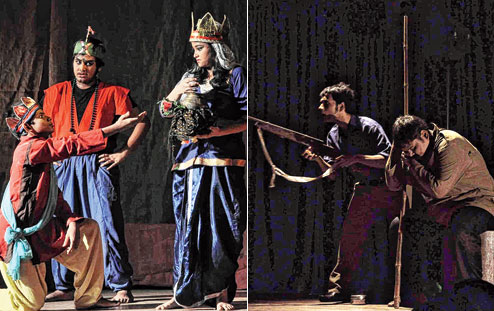
Scenes from Nagchampa (left) and Aborodh. Pictures by Anup Bhattacharya

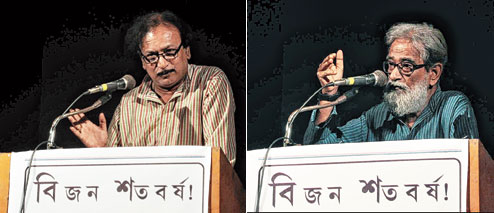
Bijon Bhattacharya has inspired a number of theatre personalities but in Howrah most have not had the temerity to work on his plays or do any research on his works. On the birth centenary of this revolutionary playwright-director-actor, Natadha decided to pay tribute to Bijon Bhattacharya through some of his well-known plays and through discussions by theatre personalities. The three-day programme started from July 17, Bijon’s birth anniversary and continued till July 19 at Ramgopal Mancha.

“It is indeed a great effort by Natadha to organise a workshop on Bijon Bhattacharya when no other theatre group has yet done that. However, Bijon Bhattacharya was a playwright with a different vision who few people understand,” said Ashok Mukhopadhyay, the director of Theatre Workshop, who was present to speak about Bhattacharya on the last day of the festival. He also read a poem and an excerpt from one of Bhattacharya’s plays.
Other speakers of the evening included directors Chandan Sen, Debasish Majumdar, Soumitra Basu and Goutam Mukhopadhyay. “Few directors understood the villages of Bengal the way Bijon Bhattacharya did. Also, he had seen and felt revolutions, riots and destruction closely. Which is why there were magnified expressions of emotions in most of his scripts,” said Basu.

Portions of Bhattacharya’s plays like Nabanna, Aborodh, Hans Khali Hans and Nagchampa were enacted during the three days of the festival by members of Natadha.

“On the first day, we had staged a portion of Nabanna and Aborodh, which we had to re-stage on the last day on audience request. Because of inclement weather on July 17, many people could not come to watch the plays,” said Shib Mukhopadhyay, the director of Natadha.

“While the members of Natadha acted in all the plays, we had included actors from other groups as well in Nabanna. Subir Goswami from Bally Bidushak, Badal De from Samipesu and Chandrasekhar Ghosh from Trisha had acted in the play,” said Mukhopadhyay.

Meghnad Bhattacharya (Left) and Bibhash Chakraborty speak on Bijon Bhattacharya

School students were also involved in the festival. Students of different schools of Howrah had prepared short speeches on Bijon Bhattacharya, based on whatever information was provided to them. Students of Howrah Vivekananda Institution had even prepared a skit on the playwright.

Speakers like Shyamal Chakraborty, Kamal Saha, Kaushik Chattopadhyay, Bibhash Chakraborty and Meghnad Bhattacharya were invited to speak on Bijon Bhattacharya as well. An exhibition on Bijon’s life and works was on display at the entrance to Ramgopal Mancha.

source: http://www.telegraphindia.com / The Telegraph, Calcutta,India / Front Page> Howrah> Story / by Dalia Mukherjee / Friday – July 24th, 2015

Librarian lifeline for library

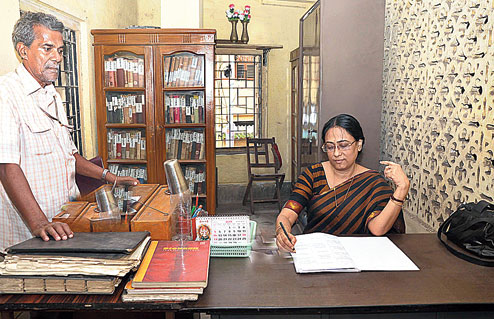
Gouri Sanyal has joined as librarian of Howrah Seva Sangha library from February this year. Picture by Gopal Senapati

After a seven-year fight, Howrah Seva Sangha Library finally got a librarian in February this year. The little room on the first floor of the clubhouse on Narasingha Dutta Road, has 9,500 books and since 2008, it was run by the club members themselves.

Howrah Seva Sangha, started as a social welfare group in 1923 and its members were involved in the freedom struggle. The library was established at around the same time, but later became a government-sponsored primary unit library. The club is popular for its sports, yogasana, gymnastics and multigym. The Durga Puja is also one of the oldest in the town. However, the library has been struggling to stay afloat for the past seven years. “Although this is a government sponsored library, we did not get a librarian after the previous one retired, even after repeated requests. The club members would open the library every evening,” said Amarnath Basumullick, the president of Howrah Seva Sangha Library.

Gouri Sanyal, who was earlier the librarian at Sahid Smriti Sangha Granthagar at Bakultala, was transferred to this library in February this year. “I visit this library three days a week. At present I am trying to bring some order to it, by making a fresh catalogue of books and arranging the shelves properly,” said Gouri. Funds had also stopped coming to the library in the past seven years but after the new librarian was appointed, a sum of Rs 30,000 was also sanctioned.

“The fund will be used for some basic furniture like a table, chairs and stationery for the librarian to work. This has been sanctioned from the library’s contingency fund. As the library starts coming back to the mainstream, we will sanction the regular annual grant as well,” said Tushar Kanti Chattopadhyay, the district library officer, who has taken an active interest in reviving this library. “We are trying to revive several such libraries in Howrah that are struggling to stay afloat. We have started with those in the Howrah Municipal Corporation (HMC) area and we are trying to help revive them,” added Chattopadhyay.

Although the library has started functioning, another huge task is to bring back readers to the library. “I think a career guidance section and a children’s section are necessary to attract young readers to the library. There are a number of schools in this area and we can try to get the students from the schools to come to the library regularly,” said Sanyal. Other interactive programmes and discussions like the one on the importance of books held at the club on July 4 on the 92nd annual programme of the club and library are being organised.

Barid Baran Ghosh, the president of Bangiya Sahitya Parishad, Arup Roy, agriculture marketing minister, Chaitali Dutta, professor at the library sciences and information department of Jadavpur University and Tushar Kanti Chattopadhyay, the district library officer were present at the July 4 programme and spoke about how books can be a person’s best friend.

source: http://www.telegraphindia.com / The Telegraph, Calcutta,India / Front Page> Howrah> Story / by Dalia Mukherjee / Friday – July 10th, 2015

When 1,000 voices sang

The Choir paid tribute to Tagore and his ‘Gitanjali.’

CoirKOLKATA10JUL2015

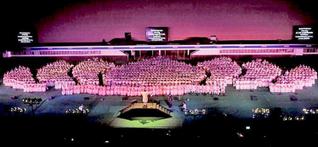
Thousand voices and one celebration… The Netaji Indoor Stadium in Kolkata, reverberated with poems of Nobel laureate Rabindranatha Tagore recently as Sangeet Bharati Muktadhara presented ‘Echoes of Gitanjali’ to commemorate 100 years of Rabindranath Tagore’s Nobel in Literature and Gitanjali.

For the 1000 singers from all over India – Chennai, Patna, Mumbai, Delhi, Gurgaon, Bengaluru, Baroda, IIT-Kanpur, Allahabad and Bhilai – the show, conceptualised, scripted and directed by Arundhati Deb, president, Sangeet Bharati Muktadhara, came after months of rigorous practice. The theme was the lotus, and sure enough, the singers on stage were positioned to represent the national flower.

For the group of 12 singers from Chennai group, it was a perfect opportunity to pay tribute to Gitanjali and its profoundly fresh beautiful verse.

Years ago, travelling abroad, Tagore witnessed western classical music concerts featuring musicians numbering 1000 to 2000. This left a lasting impression on him, observers had said. Nevertheless, Tagore had not voiced his latent desire – to give a similar treatment to his compositions.

“The programme titled ‘Echoes of Gitanjali’ commemorates 100 years of Tagore’s English Gitanjali,” said the 60-something-Arundhati Deb, who travelled from city to city to refine the performances of the different groups. She was in Chennai to help the team with singer Swati Bhattacharya taking the lead.

Hailing from a family deeply interested in music, Arundhati Deb grew up fascinated with Rabindra Sangeet. After a Master’s Degree in English and an editing stint, her desire to do some serious work with Tagore surfaced. The result? The first 1000 Voices Choir in 2007.

source: http://www.thehindu.com / The Hindu / Home> Friday Review / by Renuka Suryanarayan / July 10th, 2015

A beehive for a club

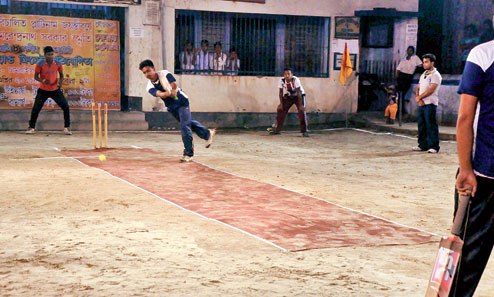
An inter-club underarm cricket tournament organised by Mouchak at  Chamrail High School ground. Picture by Gopal Senapati
An inter-club underarm cricket tournament organised by Mouchak at
Chamrail High School ground. Picture by Gopal Senapati

The name sounds unusual for a club, but the founders of Mouchak wanted the club to run exactly like a beehive, where the Queen bee orders around and the servants follow the orders. In this case, the secretary is the Queen Bee and all members are her workers. Mouchak has been functioning this way through its 75-year journey.

The club is one of the oldest among those around Kona, Chamrail and Jagadishpur. Senior members of the club remember seeing Martin Rail pass from the front of the club. Although established in the pre-Independence years, the members were not associated with the freedom struggle. “At that time, this was a remote village in Howrah with only a handful of residents, most of whom were farmers. Gradually, people from other places have come and settled in Chamrail,” said Sailendranath Mondal, the secretary of the club.

Those who liked to do physical training or were involved in music, did not have a place to practise. “They would go to local resident, Tarapada Mondal’s house which became a centre for physical exercise and cultural activities,” said Mondal. Later, the local zamindar, Panchkari Santra, donated land for a club. This was a low-lying pond which was filled to make the first club house. “Initially, the club house had a mud floor and bamboo walls and a tiled roof. Later, the building was made into a concrete structure,” said Mondal.

Mouchak was initially started with the purpose of providing space for gym and physical training. Later, however, the members took interest in social welfare of Chamrail, including literacy drives. The founders of the club were Sisir Kumar Ganguly, Rohini Kumar Mondal, Naresh Chandra Manna and Ashwini Kumar Mondal and they began several welfare activities. “Many institutions in Chamrail had started from this club. Chamrail High School was initiated at this club. When the school building was not there, classes were held at the club. Members were involved in welfare activities like clearing overgrowth in residential areas, cleaning drains and other activities,” said Sachin Das, a member of the club.

The children’s section of the club started 45 years ago. It started with bratachari sessions at the club and the children from this club would go to Sab Peyechir Asar. Much later, the club band was formed. The library was a part of the club at one time but became a government sponsored library in 1982. A blind school also ran from the club, till the school found its own building nearby. The new club house was built in 1998 and the first floor was extended in 2010.

At present the club is involved in cultural activities like holding classical dance and music, recitation and art and craft lessons. A handwritten magazine, Pora, was earlier published by the club members, but it stopped after a wall magazine started at the library. Yogasana is also practised at the club.

There are not too many sports activities, the reason being that the club does not have its own ground. “The club never had its own playground which is why we could never carry out regular coaching camps. We do have a volleyball team, but they practise at the barowari committee ground. We also organise an inter-club cricket tournament with underarm bowling,” said Mondal.

The platinum jubilee celebration started from January 4 with a colourful procession. More events are coming up later this year. “We will have cultural competitions at different times of the year and we also plan to organise an inter-district underarm bowling cricket tournament where 16 teams from Howrah, Hooghly and other districts will be participating,” said Mondal.

FACTFILE

Name: Mouchak
Estd: 1940
Address: PO and Village, Chamrail
Activities: Music, dance, recitation and yogasana

source: http://www.telegraphindia.com / The Telegraph, Calcutta,India / Front Page> Howrah> Story / by Daila Mukherjee / Friday – July 03rd, 2015

All that jazz: Catch The Bodhisattwa Trio in Mumbai

Kolkata's experimental jazz rock outfit - The Bodhisattwa Trio.
Kolkata’s experimental jazz rock outfit – The Bodhisattwa Trio.

If you’re a fan of funky arrangements and odd time signatures, head to Blue Frog on Sunday to catch Kolkata experimental jazz rock outfit, The Bodhisattwa Trio, in concert. Led by Bodhisattwa Ghosh on the guitar, the band whips out mean progressions, backed by Premjit Dutta’s drumming and Bijit Bhattacharya’s bass lines.

This is the band’s second stint in Mumbai after having played with Ehsaan Noorani earlier this year. The trio has roped in Toronto-based jazz musician and saxophonist Andrew Key to improvise and collaborate on stage for the event, which is titled Phase Anomaly.

“Andrew had come to study Indian classical music earlier, when we did a show together. We have continued that collaboration,” says Ghosh.

“At this gig, we will play some new material that will make into our album, scheduled to release next year,” he adds.

The band has accrued some touring experience after playing at independent venues in London, Paris, Slovenia and Bangladesh, apart from performing at the Kolkata International Jazzfest.

From fiery progressive rock tracks like Annihilation to the downtempo melodies of 0305, the trio has been experimenting with soundscapes since they started in 2012.

Meanwhile, city gaming arena Smaaash will see some heavy duty metal acts from across the country, at the eighth edition of the popular crowd-funded gig series Control Alt Delete. The acts include Mumbai’s Bhayanak Maut, Zygnema and The Minerva Conduct, Aberrant from Shillong, Bengaluru/Chennai band Escher’s Knot and Delhi band Kraken. City band Cosmic Infusion and Pune-based Abraxas complete the line-up, which ranges from black metal to contemporary metal.

WHAT: Performance by The Bodhisattwa Trio (above)
WHERE: Blue Frog, Todi Mills Compound, Lower Parel
WHEN: Sunday, 9.30 pm
Call: 6158-6158
ENTRY: Rs 350 per head

WHAT: Control Alt Delete, featuring Bhayanak Maut, Zygnema and others
WHERE: Smaaash, Kamala Mills Compound, Lower Parel
WHEN: Saturday, 9 30 pm onwards
Call: 4914-3143;
ENTRY: Pay as you like

source: httpL.//www.hindustantimes.com / Hindustan Times / Home> Cities / by Mohan Kumar K / June 13th, 2015

HIT wins accolades

Kolkata :

It was a proud moment for Heritage Institute of Technology Kolkata when the students of the Rotaract Club of Heritage Institute received the Best Club Award in the Rotaract District out of 30 clubs on June 28, 2015 in the district award ceremony.

Rotaract Club of Heritage Institute won 16 awardsfor the term 2014-2015. Since 2009 the club has maintained the record of winning the Best Club award and this time it was no different from the previous years. The list of awards received included, best club, best president, secretary, best in community service, best in spreading community literacy and of course the best social media presence.

“It was a great moment for Heritage Institute as the students worked hard in organizing various projects for social welfare,” said P.K. Agarwal, CEO, Heritage Group of Institutions Kolkata. Both in Heritage School and its specialized higher education institutes, a great deal of stress is laid on social service. Children are taught to share their good fortunes with the underprivileged and spend time with them so that they realize that it is their responsibility to take up the cause of the less fortunate.

source: http://www.timesofindia.indiatimes.com / The Times of India / Home> City> Kolkata / by Jhimli Mukherjee Pandey, TNN / July 03rd, 2015