Category Archives: Arts, Culture & Entertainment

Mecca of rare books

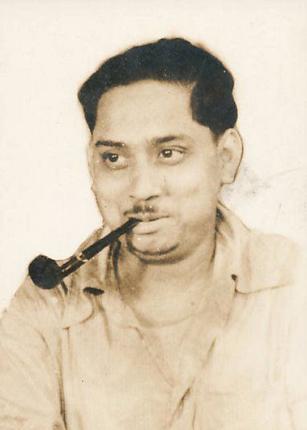
Nirmal Chandra Kumar / Special Arrangement / The Hindu

Nirmal Kumar was probably the first Indian bookseller to publish a rare books catalogue in the best tradition of bespoke antiquarians around the world.

One can only imagine it today: a set of cosy rooms in an ancestral home on a busy street in Calcutta in the 1950s resembling a finely appointed private library with a complex of bookcases and furniture that was actually an antiquarian bookshop one could walk into for a browse and for long conversations with its bohemian-bibliophile owner. His name was Nirmal Chandra Kumar, and his bookshop was called, simply, Kumars. From 1945 until his death in 76, Kumar ran a rare bookshop from his home. It took up several rooms and the stock ranged widely, from fine bindings to prints to maps.
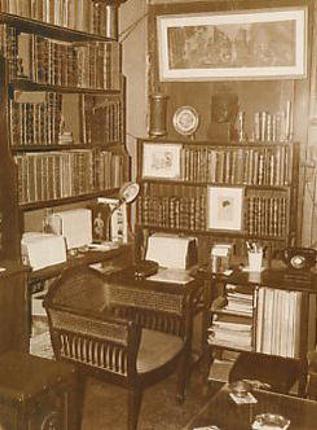
Kumar's bookshop / Special arrangement / The Hindu
Kumar’s bookshop / Special arrangement / The Hindu

I first learnt about Kumar and his bookshop when I stumbled upon a blog by his son, Aloke Kumar, on his father’s bookshop and its influence on the life and work of many Bengali artists and intellectuals of that time who were all regulars at Kumars. I was delighted to discover there had once been such a marvellous bookshop in India — a genuine antiquarian bookshop in a country where antiquarian bookselling and buying is not an ingrained tradition. In this sense, Kumar was no doubt a maverick and thank God for that. Eager to know more, I managed to contact his son, Professor Aloke Kumar, for a brief chat on the phone.

In one of his writings, Kumar describes his father: “a stocky Bengali… he wore a white collared shirt, half-sleeved, and a lungi; his formal dress was a dhoti and kurta with pump shoes. Can you imagine somebody wearing this dress and smoking a pipe or a Davidus cigar sitting in his library surrounded by books?” Kumar was probably the first Indian bookseller to publish a rare books catalogue in the long tradition of all bespoke antiquarian booksellers around the world, especially the legends Kumar had done business with, Quaritch and Maggs. The city’s bibliophiles, artists, luminaries, antiquarians and bohemians all frequented Kumars. Satyajit Ray, a regular browser here, consulted Kumar when he was making The Chess Players: in a London book auction, Kumar had bid for and won a priceless scrapbook on the Mutiny.

Ray went on to pay his own little tribute to Kumar in the character of the encyclopaedic Sidhujata in the Feluda stories. Well-known antiquarian Sir Ashutosh Mukherjee was also a customer. When he donated thousands of rare books to the National Library, several books in the collection had once come from Kumars. “In the early 1940s,” writes Aloke Kumar, “rare book collection was in a dismal, class-bound rut. The famous rare book shop Cambray… was already fading, Thacker and Spink was alive, but there were hardly any rare books… Kumar helped to change all that. His enthusiasms included the then unheralded British painters, Thomas and William Daniel, to be re-introduced to Calcutta once more. He bought the rare elephantine folio of 144 Views of T&W Daniell from Sotheby’s to ship it to Calcutta.”

What was just as remarkable about Kumar — reading his son’s reflections — was how generously and freely he gave to his customers, friends and family even though the bookshop wasn’t a profitable business and . It just broke even most of the time, but Kumar, right in the middle of his struggles to keep the bookshop afloat and provide care for the needs of his own family, invited his parents (who had faced a financial loss) to come live with him. He was also apparently a gourmet and “organized the very best of fine cooking to be presented to his friends. Sometimes such delicacies that you would only find in the pages of some rare Mughal document.”

Aloke recalls a regular errand for his father: being sent off with books in hand to be delivered to Satyajit Ray; he also remembers how cautious everyone in the house was about handling the books, tiptoeing around the shelves, careful not to disturb them. One of the things that broke Kumar’s heart was the sharp practice in the antiquarian trade in the late 1970s of breaking up rare books, atlases and maps to make a bigger profit. Some of his fellow booksellers had begun to buy books with rare prints and maps and tear them up in order to sell each print or map individually. You made more money this way than when you sold the set or the atlas as a whole.

“Kumar did not want to be a part of this and lost out,” says Aloke. “And it was with a sense of bowing to the inevitable that Kumars mentally gave up. Nirmal Kumar died in 1976 and with his death, the literary world lost a sweet and genuinely unselfish man who freely gave of his vast knowledge and delighted in the achievements of those he influenced so profoundly.”

My interest in this impassioned, unsung bookman and his cherished antiquarian bookshop is not so much for the luminaries who once buzzed around it as much as for imagining the regular traffic of ordinary bibliophiles, scholars, and collectors for whom Kumars must have been a Mecca of fine and rare books.

Pradeep Sebastian is a bibliophile, columnist and critic.

source: http://www.thehindu.com / The Hindu / Home> Opinion> Columns> Pradeep Sebastian / September 05th, 2015
Timely act saves heritage mansion

Kolkata :

A heritage building that had been granted the highest degree of protection to conserve its historical and architectural value was being systematically destroyed on the sly till locals alerted Kolkata Municipal Corporation (KMC) authorities. The latter has filed an FIR. Involvement of local politicians, musclemen and a section of police are suspected.

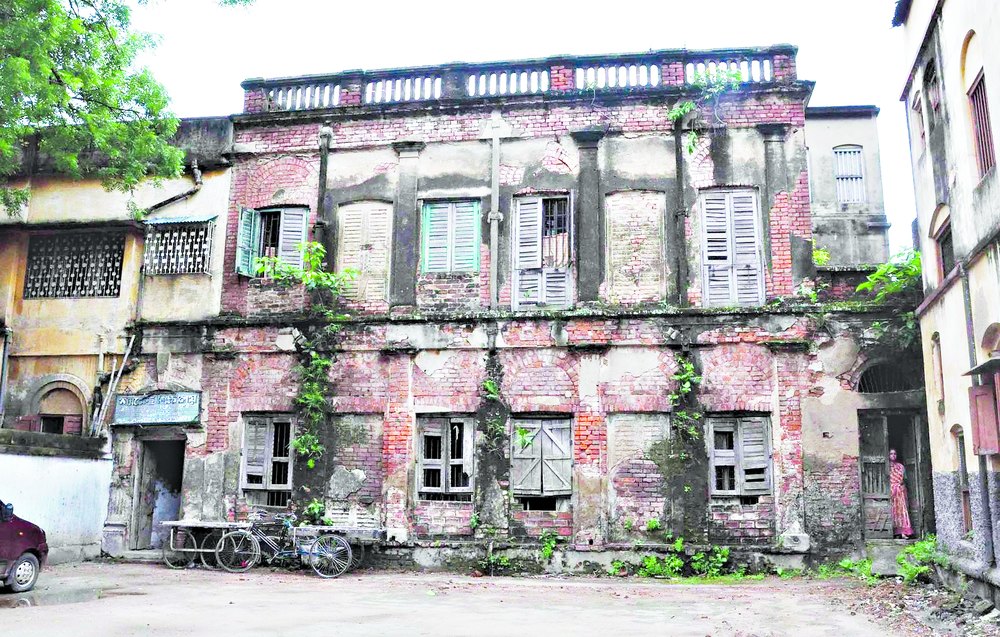
Located between Howrah bridge and Nimtala Ghat, Moribund House on 65/2 Strand Road is a 19th century single storey mansion with Roman Tuscan columns. It was once part of Rani Rashmoni Estate and was registered in the name of her husband Rajchandra Das. It was in this mansion that filmmaker Goutam Ghose shot a portion of the 1988 National Award winning film ‘Antarjali Jatra’.

Listed as Grade I heritage structure by KMC in 2009, no external change is permissible in the building. The grading also restricts the building’s use. But the building has fallen into disrepair following years of neglect. It would have been ground to dust had not KMC acted promptly following a tip-off. The compound had been shuttered by corrugated sheets to allow the demolition.

When TOI visited the building, it was in absolute ruins with evidence of fresh destruction everywhere. At least two columns lay in pieces on floor. Another was being hammered down when a visit by the police team following the KMC complaint forced a cease-work. Parts of the wall and roof have also been systematically pulled down to trigger a collapse of the entire structure.

The project management unit of KMC that oversees heritage buildings in the city filed a general diary (GD-PMU/108 15-16) with Jorabagan police station on August 25, 2015. In the complaint, the civic authority stated that the Grade I heritage building was being intentionally demolished.

“It is reported from local people that the house is being intentionally and systematically damaged by persons staying there which is illegal and unlawful. Please take necessary steps and keep strict vigil to prevent any sort of damage to the historical and heritage structure. This may be treated as FIR,” the complaint by the KMC PMU department stated.

The manner in which the demolition was being carried out pointed to the involvement of local politicians and musclemen. A few locals also hinted as much saying reputable builders would not have dared to act in that manner and get incriminated. The involvement of local cops is not ruled out wither. When TOI visited the police station, the cops initially feigned ignorance about the threat to any heritage building under its jurisdiction and acknowledged only when confronted with all details.

“I am totally disgusted at the state of affairs. We just had one Grade 1 building, the Ghoolam Rasul Mosque on Shamsul Huda Road, demolished without a murmur. No action was taken against anyone. Now, a second Grade I listed building is being demolished. At least some visible action should be taken,” said heritage activist GM Kapur.

Mayor Sovan Chatterjee has asked the KMC officials to keep a strict vigil on the building. “No one has the right to alter anything in a Grade-I heritage building, leave alone pulling it down. We have lodged a complaint. Let police investigate who are the culprits,” he said.

source: http://www.timesofindia.indiatimes.com / The Times of India / News Home> City> Kolkata / by Saikat Ray & Subhro Niyogi, TNN / September 04th, 2015

Google V for virtual tour of Victoria – Treasures find place in online museum

TreasuresKOLKATA06sept2015

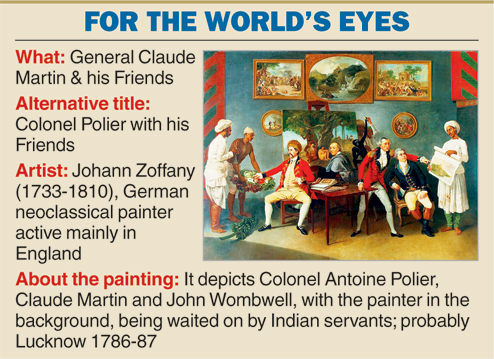
More than a hundred treasures from Victoria Memorial Hall, among them a painting by Johann Zoffany, will be showcased in a global online archive by Google featuring many well-known museums.

A team from Google was in the city last week, shooting at Victoria Memorial. A panoramic view of the inside as well as the outside area of the museum will also be available on the online platform.

Zoffany’s oil on canvas depicting General Claude Martin, the founder of the La Martiniere Schools, and his friends, will share space with paintings by European artists from 1770-1850-60, also known as Company Paintings, works of Thomas and William Daniell, Abanindranath Tagore, Jamini Roy, historic documents and Tipu Sultan’s handwritten and illustrated diary on the art of war and other treasures from Victoria Memorial on Google Cultural Institute, earlier Google Art.

Started by the tech giant in 2011, the institute is a not-for-profit initiative that partners with cultural organisations to make the world’s cultural heritage available online.

Victoria Memorial signed an MoU with Google Cultural Institute in 2013 and as part of the project 150 highlights of the museum would be found on the online platform. Fifty of these images will be available in ultra high-resolution images known as gigapixels.

“We are still deliberating on which 50 to choose. We are also planning to do a digital walkthrough of the museum,” said Jayanta Sengupta, the secretary and curator of Victoria Memorial Hall and Indian Museum. “The selection has to be balanced. We are choosing objects that are historically as well as visually attractive. The transformation into gigapixels of certain paintings, especially of the impressionist painters, will be extremely useful for art enthusiasts. Each and every brush stroke and intricacies of the paintings will be visible.”

The technology used by Google is expensive and patented. “Footfall at museums has been known to increase after digitisation. People are keen to check out the actual objects,” Sengupta said, adding that the Indian Museum would soon join Victoria for the project.

Courtesy the association with Google, Victoria Memorial can now put up exhibitions it is hosting on Google Cultural Institute. “We can select an exhibition, curate it and post on Google. Also, we can put up previews for our upcoming exhibitions,” Sengupta said. “Google is the most popular search engine. The project is not only beneficial for us but it also gives people a chance to go through our collection.”

Three museums from India – Crafts Museum, National Gallery of Modern Art and National Museum, all in Delhi – are already part of the association. Victoria and Google are aiming for a November launch, when a few more Indian museums will come on board.

The choice of German neoclassical painter Zoffany’s painting of General Claude Martin has made the La Martiniere family proud too. “This is a matter of pride and pleasure for us. We are delighted and it is a great honour for us,” said Supriyo Dhar, the secretary of La Martiniere Schools.

source: http://www.telegraphindia.com / The Telegraph, Calcutta,India / Front Page> Calcutta> Story / by Samabrita Sen / Saturday – September 05th, 2015

On the street where you live

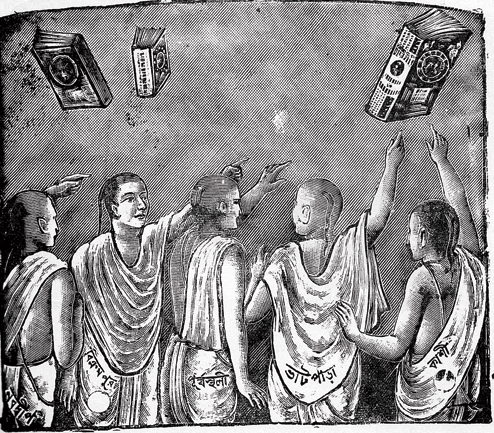
An advertisement in the PM Bagchi Directory Panjika proclaiming its superiority to other almanacs as pundits of all centres of learning depended on it

The last entry of the Calcutta Street Directory of 1915 published by P.M. Bagchi & Company Private Limited is on Halliday Street named after Sir Frederick James Halliday, KCB, the first lieutenant governor of Bengal (1854-1859).

The street was swept aside when the Calcutta Improvement Trust (set up in 1911) began the construction of Central Avenue, later renamed Chittaranjan Avenue. What only remains of this street is Motilal Seal’s Free College, whose headmaster in 1915 was Jagabandhu Ghosh, BA, according to the “directory”. This entry provides the names and sometimes the professions of the residents of each building on this thoroughfare, as it does in the case of all the other streets and lanes of the city of Calcutta listed in the “directory”. Its function, as scholar Gautam Bhadra pointed out at the launch of the tremendously value-added version of the original last Wednesday, was to “direct”.

Originally an appendage of the almanac or panjika published by P.M. Bagchi, the street directory in Bengali, unlike Thacker Spink & Company’s older one in English of mostly “white” neighbourhoods, covers the “native” areas too, and is part of the urban ethos, said Bhadra.

However, he pointed out that the first such “directory” was Bhabanicharan Bandyopadhyay’s satire published in 1823 titled Kolikata Kamalalaya where city slickers point out to country bumpkins the city landmarks. Marketing Bengali almanacs was a highly competitive business, and P.M. Bagchi had undertaken this huge survey of the city. Playwright and humorist Amritalal Basu had written in Kautuk Jautuk that sadly, Bengalis were losing their hold over Calcutta. But Basu was wrong, said Bhadra, for the city never belonged to Bengalis alone. This street directory presents a layered and complete picture of those living in the city. He congratulated Jayanta Bagchi, grandson of Kishorimohan Bagchi and current director of the firm, for bringing back to life this century-old street directory, adding valuable material to it. The book carries a wealth of old advertisements which indicate prevailing popular tastes.

“Current histories on Calcutta are sterile and irrelevant,” said scholar Sukanta Chaudhuri, on the occasion. There is hardly any material on the city’s growth and development, its present and future and public utilities. However, this street directory, unlike websites, telephone directories and Yellow Pages, presented a total picture.

Scholar Samik Bandyopadhyay, who is one of the two editors of the street directory, said when one goes through the book one gets a clear idea of community building. It initially projects a macro history, and a micro history thereafter.

The other editor, urban historian Debasis Bose, has written the preface which presents a history of P.M. Bagchi and that of other such directories. He traced the rag-to-riches story of the entrepreneur, Kishorimohan Bagchi, who had established the firm in 1888 and became a resident of Masjidbari Street in Darjipara, where he specialised in making rubber stamps, stamp pads, various kinds of inks, syrups, glue and toiletries.

The brand was so much in demand, fakes swamped the market. So he got the inimitable labels printed in Germany. Kishorimohan named the firm after his father, Peary Mohan, who had once disowned him for he feared his son would turn out to be a loser.

In mid-19th century, people could not think of beginning the day without consulting an almanac or panjika. But to give his products a cachet, Kishorimohan imported two printing presses from England. Besides churning out typical Battala fare, he also brought out Harisadhan Mulhopadhyay’s popular history of Calcutta in novel form titled Kolikata Ekaler O Sekaler. Kishorimohan died at the age of 55 in 1923.

During the days of the East India Company, the pundits of Bhatpara, Nabadwip and other centres of learning, on an invitation from Maharaja Krishnachandra, put their heads together and standardised the dates of all festivals. Almanacs began to be printed probably at the beginning of the 19th century. To make them even more popular, invaluable information on postal and legal fees and suchlike, began to be added as these tomes became weightier. Thacker Spink’s almanac dominated the scene for 80 years.

Among Bengalis, Ramanath Das was the first to publish an almanac with a treasure trove of information needed all the time. When Kishorimohan first published the street directory priced at one and half rupee (against Rs 24 for the Thacker Spink one), a review read: “A Bengali Directory with a Bengali Almanac on the model of Messrs Thacker, Spink and Co’s work on the same line. This is perhaps the first attempt of its kind that has been made by a native of Bengal.”

But Kishorimohan did not ape the English. His team of field workers fanned out all over the city to gather information and nothing was untouchable for them. Even the names of the denizens of Sonagachhi and other red-light areas are mentioned here. Sadly we have no inkling about the identity of these field workers.

In those days, when there was no compulsion for being politically-correct, there was no reason for concealing regional chauvinism, and derisive nicknames for settlers from our neighbouring states in eastern India were freely used. Many neighbourhoods were named after the caste which perhaps dominated that area. Take for instance Chasha Dhobapara (now Girish Park north) from No. 146 Baranasi Ghosh Street. It was intersected by Brahmanpara Lane. Nothing escaped the attention of those who did the field work – thus vacant plots, ponds, slums…everything was indicated along with the address.

There are interesting nuggets on the history of Calcutta. There are several entries on the Banaji family, the first Parsi family to settle down in Calcutta – Parsi Church Street, where Rustomji Cowasjee Banaji established the first fire temple of the city in 1839, Parsibagan Lane near Maniktala, Parsibagan Street. Falgun Das Lane, which intersects Sankharitolla Street, was named after a man from Odisha who made a fortune by supplying coolies to ships.

What we know as Loudon Street was actually Loudoun. The wife of Lord Hastings was in her own right the Countess of Loudoun. The “u” was dropped at some point of time. An entry recounts how electric lights were introduced in the Kalighat temple (Kalighat First Lane). At No. 15 Gobinda Sarkar Lane near Banchharam Akrur Lane was a Philharmonic Orchestra, and a Bengali circus company belonging to Nabagopal Mitra operated from Canal West Road. Asutosh Mukherjee’s slum at 1-6 Kankulia Road included paddy fields, and the man owned other properties on the road. Was this Mukherjee our ” Banglar Bagh”

source: http://www.telegraphindia.com / The Telegraph, Calcutta,India / Front Page> Calcutta> Story / by Soumitra Das / Friday – September 04th, 2015

The foodie traveller … visits Kolkata’s last Jewish bakery

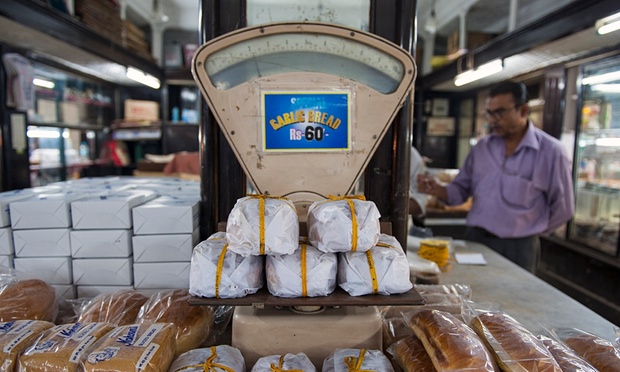
The Nahoum and Sons bakery is one of the last vestige’s of Kolkata’s Jewish heritage – but it still attracts the odd very important patron

Dough Calcutta … Nahoum and Sons bakery, Kolkata. Photograph: Leisa Tyler/LightRocket via Getty Images

Stepping inside the Nahoum and Sons bakery in South Kolkata is a trip back in time. The legendary confectioner’s shop hasn’t changed much since it first opened 113 years ago; the same teakwood furniture and display cases remain, and the same list of sugary treats based on old family recipes.

Kolkata’s region, Bengal, is known throughout India for its delectable sweets – from rosogolla (spongy milk balls soaked in sugar syrup) to shor bhaja (deep-fried milk cake) to chenna (a moist and crumbly sweetened cow’s cheese), though in a majority-Hindu city it’s unusual that the most popular dessert haven is run by a Jewish family.

But a taste of a rum ball or a slice of lemon tart explains exactly why Nahoum’s has been going for over a century, despite the local Jewish population dwindling to just 20 in recent years.

Between the late 18th and mid-20th centuries, Kolkata was home to a small but significant community of Jews – a consistent 4,000 over that period. Nahoum’s, the city’s last remaining Jewish bakery, is a symbol of this disappearing heritage.

The bakery’s most famous offering is a rich fruitcake. At Christmas queues span three streets to buy it and “our rich fruit cake is internationally known,” says owner Isaac Nahoum.

“The cake used to be supplied to government houses. When Archbishop of Canterbury Geoffrey Fisher came to Kolkata, they served him Nahoum’s fruit cake and he said it was the best fruit cake he had ever eaten.”

• Bertram Street, New Market Area, Taltala, Kolkata, +91 33 6526 9936, no website

source: http://www.theguardian.com / The Guardian / Home> Travel> Kolkata> The Foodie Traveller / by Lauren Razavi / Sunday – August 30th, 2015

Kolkata’s truffle rosogolla gets Forbes stamp

Kolkata :

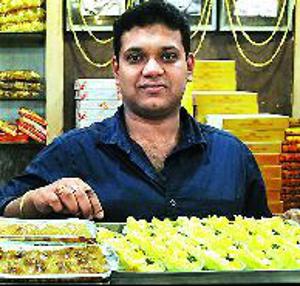
For the last 11 years, this entrepreneur has experimented with sweets, taking his traditional yet popular family business to the next level. Today, this 33-year-old director of Balaram Mullick and Radharaman Mullick Sweets has made it to the list of six most promising entrepreneurs in the country selected by Forbes India Magazine.

Sudip Mullick displays some of the innovative sweets at his shop.

While working in the Oberoi Grand kitchen, Sudip Mullick picked up a European taste for desserts and dreamt of fusing them with the typical Bengali sweets their family shop was famous for. Now, the once-traditional sweetshop has become a one-stop destination for new age fusion mishti in the city.

Sudip is ecstatic that his efforts have got the 130-year-old brand recognized by Forbes India.

Names like strudles, pudding, truffles and souffles are now common on the Balaram Mullick racks and though they are mostly variants of the traditional sandesh and Bengali rosh er mishti in their myriad forms, you will be confused as to whether you are tasting a European delicacy or a Bengali favourite.

Sudip has mechanized the entire process by using machines he imported from Denmark, Taiwan, Japan and Italy, and fused various processes to churn out his own delicacies.

The Japanese machine used to make rice dust desserts there is used to make the jol bhora sandesh with a Japanese twist, the machine from Denmark that is used to churn out pure chocolate truffles is used to make chocolate-coated sandesh and rossogolla truffle and the Italian machines designed to make cookies are making golapi pera sandesh. There is a type of singara being made by a German machine originally used to bake patties.

“People have become health conscious and they avoid deep fried savories. The baked singaras have a big fan following,” Sudip said.

Other promising entrepreneurs on the Forbes list are Rahul Gonzalvez of Bangalore, for his digital design agency, Ashoke Thakur, for churning out vada paos by thousands in Mumbai’s Dadar, Sirish Duttatreya who is a third-generation second-hand book shop owner with over 9,00,000 titles in Pune and Parvatlal Kanhaiyalal Dubey who is the country’s biggest wedding planner.

source: http://www.timesofindia.indiatimes.com / The Times of India / News Home> City> Kolkata / by Jhimli Mukherjee Pandey, TNN / August 14th, 2015

Les Clefs d’Or India Concierge holds its 9th AGM in Kolkata

LeClefKOLKATA31aug2015

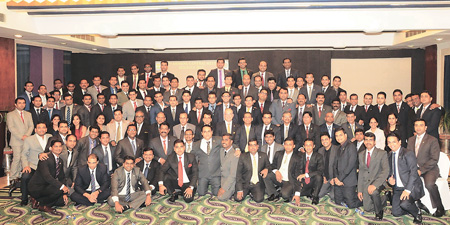
Les Clefs d’Or India Concierge recently held its ninth Annual General Meeting (AGM) in Kolkata recently.

The AGM was inaugurated by Zaid Farooqi, resident manager, Taj Bengal, Kolkata; James Ridenour chief concierge, InterContinental, Sydney and general secretary, Les Clefs d’Or International; Stephen Fernandes, past president, Les Clefs d’Or India; and Edwin Saldanha, president, Les Clefs d’Or India and Asian zone director, Les Clefs d’Or International.

Regional presentations were made by Rajesh Kumar Yadav from northern region, Sachin Singh and Apeksha Boricha from western region, David Aaron from eastern region, and Sri Kishen from southern region.

The treasurer and PRO reports were shared by Arun Baidya and Shaunak Vengurlekar respectively, and a speech on current trends was given by George Kuruvilla, general manager, The Oberoi Grand, Kolkata. A brand presentation on social media was conducted by James Ridenour who urged for maximum participation in the communications committee.

The new executive committee for the period 2015-2017 was also announced during the AGM.

The AGM continued with the opening of networking eve by Samrat Dutta, general manager, Taj Bengal Kolkata.

During the pinning ceremony 32 new members received adherent membership to Les Clefs d’Or India and 36 adherent members were upgraded to full membership status.

The UICH Honorary Member was awarded to Biswajit Chakraborty, general manager, Sofitel BKC, Mumbai for his contribution and support extended to the concierge society in India.

This was followed by the Concierge of the Year 2015 award which was given to Debayan Ghosh from Shangri-La, Bengaluru.

source: http://www.financialexpress.com / Home> Food & Hospitality World / by FWH Staff – Mumbai / August 18th, 2015

Heritage tag on Bankim house

Bankim’s house at Panchanantala Road. Picture by Anup Bhattacharya

The house where Bankim Chandra Chattopadhyay lived during his stint as deputy magistrate and deputy collector of Howrah has been declared a heritage building.

The 17-cottah park adjoining the house at 218 Panchanantala Road – called Bankim Park – has been included in the Howrah Municipal Corporation’s “demand register” for development grants.

Bankim Chandra, who wrote the national song Vande Mataram, had worked and lived in Howrah between 1881 and 1886.

“We have granted heritage status to 218 Panchanantala Road. The park adjoining the house will also be developed and a grant of Rs 5 crore has been sanctioned for the project. An archive on Bankim Chandra along with a library and other facilities will be set up,” said mayor Rathin Chakraborti.

A bronze statue of the litterateur and administrator will adorn the park while the heritage structure will house a conference hall, a guesthouse and the proposed archive.

At the beginning of his first stint as an administrator in Howrah in 1881, Bankim Chandra would travel from his Calcutta home to his workplace every morning. He later decided to shift to the rented house at 218 Panchanantala Road.

Bankim Chandra lived in the same house during his second stint in Howrah from 1883. He wrote Muchiram Gurer Jibancharit while living in Howrah.

source: http://www.telegraphindia.com / The Telegraph, Calcutta,India / Front Page> Calcutta> Story / by Dalia Mukherjee / Saturday – August 01st, 2015

I got more than I had expected!

Samir Chanda was one of the best production designers in the Bollywood film industry.

Beginning as an assistant to Nitish Roy who would do the production design for many mainstream films along with off-mainstream filmmakers like Shyam Benegal, he turned independent and went on to win a string of awards that included several National Awards for excellence in production design. He made his directorial debut with Ek Nadir Galpo, a full-length feature film in Bengali that was part of the Indian Panorama at the IFFI in Goa and was premiered at the 13th Kolkata Film Festival. Mithun Chakrabarty, who plays the central character, perhaps gives his career-best performance in this film. I interviewed Chanda back in 2007 and find it ironic that he should have missed the theatrical release of this beautiful film in the city last week. He passed away in 2011 of a heart attack. Excerpts:

What inspired you to get into direction in the first place?

It is a kind of knowing oneself, of looking within, of testing oneself with a new measuring rod. As production designer, I had read many scripts, visualised the story, underscored its meaning and translated its concept into reality for the moving image for directors I worked with. Time and again I would wonder, “How would I shoot this scene if I was directing the movie?” “Do I understand cinema?” “Will I be able to narrate a story for celluloid?” For the past few years, a longing to be on the other side of the fence, to share my original thoughts with other technicians and to tell a story in the simplest manner would plague me constantly.


You must have been going through many stories and story ideas. What is it that made you pick this particular story of Sunil Gangopadhyay?

I had read it when I was in college. It stayed with me forever! Whenever I thought of making a film — with other stories around — Ekti Nadir Naam kept coming back. Working with stalwarts of Indian cinema has given me a tremendous sense of aesthetics. I thought my first film should have a sense of strong visual appeal and also be aesthetically strong, a quality my directors transferred on to me. The river, the village, the sky, the people, the ambience of this story gave me the chance to show all that! The manner in which the writer had woven the bureaucracy, religion and the caste system of Bengal with an old man’s struggle to rename a river in memory of his young daughter was riveting. This was a story I was dying to tell, a story of a father who was unlike any other father. A father whose love for his daughter knew no bounds. But who would play the father? My first and last choice was Mithun Chakraborty, a multi-award winning Indian actor, one of the most popular actors of the ‘80s and ‘90s. I felt a miracle happening when he agreed to do the film even before I had completed the script or put the funds together.

SamirChandaKOLKATA27aug2015

How do you direct? Do you explain the character, scene, shot details and ask your actors to interpret? Or do you actually get down to physically showing them how to enact a given scene? Or, is it a combination of these two?

It was combination of both. With Mithunda and Shweta playing the two main roles, I did not dare to enact any scene. It was more of showing the actors positioning and a rough sketch of the scene. For Mithunda, I had to win him over by giving him a logical explanation of a particular scene and my job was over. With Shweta, my job was to emotionally move her into the character. She is an excellent actress. I genuinely feel I got more than I had expected!

How different was it to direct a senior actor like Nirmal Kumar, an award-winning actor like Mithun Chakravarty, a very young girl like Sweta who has also won the National Award, the little boy, and television actors like Krishnakishore?

I think actors are actors, whether senior or junior, TV or cinema. Unless they are on the same wavelength as you are, they cannot or may not perform well. My job was not to push anybody, but to explain where and how a given scene was placed within the film. Everyone was finely tuned in advance and was on the same wavelength as I was. This made it easier to ensure that I made a really good film. Can you imagine Mithunda doing his homework early in the morning while having his first cup of tea? He came on the sets without making a point. His dedication to his work after all these years is amazing.

Did you have a complete written script before you began to shoot the film? Or did the script get written while shooting was on?

Yes, I had a bound script with me. On location, I deleted some dialogues and changed the pattern of the scene sometimes. I focused on the father-daughter relationship and in the end, where the District Magistrate steps in to help. It was the human side of the Magistrate that helped this old man and not the official persona. I built the first half of the film because I needed to grow a plant, which holds a flower to blossom. Some evildoers came and trampled on this flower and destroyed it forever. The pain you then experience is something different. I wanted my audience to enjoy the presence of Anu and miss her too in the latter half! The location, the crowds, the situation, made me change a bit from the original in places — but without compromising on the content of the scene.

Your film is shot mostly on location. What pitfalls and obstacles did you face?

The film was shot on location in Burdwan district at a place call Naliapur, on the banks of the Bhagirathi river. The main pitfall was of accommodation; there was no hotel nearby, so we had to accommodate technicians in villagers’ houses, sharing one or two rooms in every house. Hot water had to be organised every morning as it was pretty cold. My unit was a big mix of different cultures. I had Tamilians, Maharashtrians, Oriyas and Bengalis. Mithunda, Shweta and the camera team were living on the first floor of a big house in a neighbouring village 60 km from the location. But nothing could come in the way of our collective motto of making a good film. My art department had created a market square, a bus stand and so on. The houses were altered according to the needs of the film and the morgue was built in a real health centre. We got so involved with the local people that the villagers were crying when we packed up.


As a production designer, pick a few films that you deem to be your career bests.

Mani Ratnam’s Iruvar, Shyam Benegal’s Sardari Begum, Ketan Mehta’s Sardar, Rakeysh Om Prakash Mehra’s Aks and Rang De Bassanti. As a production designer, it is only one department you are handling, such as creating the right atmosphere, right ambience, etc. Direction means handling every department to see that the final result is just the way you wanted it. You must have patience to achieve this goal.

source: http://www.thestatesman.com / The Statesman / Home> Marquee / by Shoma A. Chatterji / August 22nd, 2015

Darjeeling hotel to be pulled down – Housing complex and hotel to come up

Mount Everest Hotel in Darjeeling. Picture by Suman Tamang

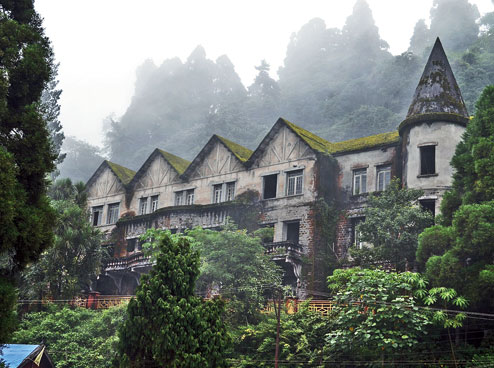
Hotel Mount Everest that in its hey day had hosted Mohammed Ali Jinnah and Amitabh Bachchan will soon be dismantled and a housing complex and a new hotel will come up in its place.

East India Hotels (EIH) Limited, which owns the Oberoi and Trident brand of hotels, has announced that it has sold the property to a consortium of businessmen led by B.M. Garg, a Darjeeling-based multiplex owner, for Rs 11 crore.

Today, Garg said: “The property has been bought by a consortium of businessmen. We plan to dismantle the hotel as it is a 100-year-old structure. The property was ravaged by fire and it has been closed for 30 years now.”

Garg said they had not yet finalised the details of the housing complex and the hotel that would come up.

“We have not yet given any name to our business consortium or to the project. We will soon hire an architect to work out the details of the housing complex — given its demand in Darjeeling — and a high-end modern hotel.
We plan to start work after the winter.”

The land on which the hotel stands now and two residential buildings near it — Rutland House and Newstead House — were owned by Darjeeling resident Nemy Chandra Bose.

The property, which stands on a plot measuring around 5 acres, is along Gandhi Road.The stretch was earlier known as Auckland Road.

It is hardly a kilometre away from Chowrasta and is close to the Circuit House.

Bose leased out the property to Arathon Stephen for 99 years, which was to end on December 31, 2013.

Stephen turned the property into a hotel and named it Hotel Mount Everest.

In 1925, Stephen transferred the hotel to Everest Hotels Limited.

In 1963, it was transferred to a firm called Hotel 1938 Private Limited.

In September 9, 1968, the property was transferred to East India Hotels Limited.

According to author Sanjay Biswas, who wrote the book Pahar Theke Hariye Jaowa Padachinhaguli, Jinnah had stayed at Hotel Mount Everest in 1917.

Actors like Dev Anand, Raj Kapoor, Sunil Dutt, Rajesh Khanna and Rekha had also stayed at the hotel.

Suresh Periwal, the owner of Clubside Tours and Travel, the oldest travel agency in Darjeeling that was set up in 1948, said: “It is sad that an international chain of hotels is leaving Darjeeling. Their presence in Darjeeling would have meant lot of publicity for the place.”

Periwal was one of the first residents of Darjeeling to hold his marriage reception at Hotel Mount Everest.

“The hotel was devastated by a fire on October 19, 1978, and my marriage was on November 22, 1978. The hotel authorities ensured that the reception was held there. They closed down a section of the hotel with 30 rooms and opened the remaining 40 rooms for the marriage,” Periwal said.

Hotel Mount Everest was finally shut in June 1984.

Periwal said in 1969, a double room in the hotel would cost Rs 115 a day, while a single room came for Rs 85.

Today, Garg said they were hopeful that they would be able to start the construction soon.

Asked if the land mutation was under the name of EIH Limited, he said: “As of now, no. But we are confident that all issues would be resolved soon.”

source: http://www.telegraphindia.com / The Telegraph, Calcutta,India / Front Page> North Bengal > Story / by Vivek Chhetri / Friday – August 07th, 2015