The 28th Japanese language speech contest of eastern India will be held at Kalakunj Auditorium in Kolkata on October 10. Forty one students from various institutes will be participating in the contest which will be organised by Consulate General of Japan in Kolkata in collaboration with Indo-Japan Welfare & Cultural Association.
Winners from the eastern zone will get a chance to participate in the all-India speech contest to be held in New Delhi. Students winning at the national level may get a grand opportunity to go to Japan.
MOSAI, an initiative of the Japanese consulate, started the all India speech contest in 1985. The first round of contests (Zonal Contests) is held in North, South, East and West Zones and the finals will happen in Delhi. Students can participate either in junior or senior category depending upon the level of training in the language. Candidates are nominated by the organisation where he/she is learning Japanese language.
The speech contest is meant to encourage students to express spontaneously their own thoughts in Japanese language. It is not merely a memory test of a written speech. This is followed by a round of questions from the judges.
Mr Kazumi Endo, Consul General of Japan in Kolkata, will address the occasion and will hand over the awards and certificates to the successful contestants Gouri Bakshi, General Secretary, Indo-Japan Welfare & Cultural Association will also grace the occasion.
source: http://www.timesofindia.indiatimes.com / The Times of India / News Home> City> Kolkata / by Jhimli Mukherjee Pandey, TNN / October 09th, 2015
The Hooghly isn’t just an Indian river but belongs to the world, historian and international authority on heritage conservation Philip Davies said at a seminar on heritage based urban development for the Hooghly riverfront held in the city on Wednesday.
Referring to the former European colonial posts—the Portuguese settlement in Bandel, Dutch in Chinsurah, French in Chandannagore, Danish in Serampore and Engligh in Barrackpore—along an 80-km stretch of the river’s western bank, Davies said the West Bengal government could source funds from the European Union as well as the World Monument Fund to revitalize these heritage precincts.
“The built heritage of West Bengal is greater than the entire United States and can be a powerful economic driver for the state,” Davies said while pointing out that much of it was crumbling and needed immediate repairs.
Conservation architect Manish Chakraborti agreed that the Hooghly riverfront heritage had an outstanding universal value and felt the way forward was to put it on the Unesco tentative list for world heritage sites. “Once it is on the list, the goal will be set. We can all then strive to achieve it,” he reasoned.
But stitching together a site that extends nearly 80 km along the river bank and covers Dalhousie Square, the central business district of a bustling metropolis like Kolkata, isn’t easy. This is particularly so about Kolkata and Bengal where things move at a snail’s pace.
Davies and architect Partha Ranjan Das have had a taste of it in the past. While it took Moe Chiba, the section chief and programme specialist (culture) Unesco, nine years to bring all stakeholders, including Kolkata Port Trust, Railways and PWD, on a single platform, Davies had prepared a blueprint for restoration and development of the Strand Warehouses in Kolkata 12 years ago but it is yet to take off. Das, too, had prepared a land use development plan for the entire heritage stretch along Hooghly but it has been gathering dust as well.
“There has been enough talk. It is time for decisive action,” Davies said at the seminar organized jointly by Unesco, the state government and non-government organization Indian Heritage Cities Network. “The inertia here is frustrating when compared to what is happening elsewhere. Kolkata has been extremely slow in taking advantage of its heritage resources. The delay could lead to destruction of what is unique. Already, one of the warehouses has been lost. Letting the warehouses rot is a dreadful waste of opportunity. In the past 50 years, they could have fetched crores of rupees in income and generated many jobs. Political will is needed to drive such an initiative. The involvement of chief minister and mayor is crucial,” he said.
While the heritage precincts in the erstwhile colonies have been identified and some restoration work funded by Dutch and Danish governments has already begun, Davies suggested that one of the options to fund the initiative could be to use cross-subsidy.
“There are areas along the riverbank that can be developed by private parties. The development will be in sync with the overall master plan. The funds generated from these projects can go into restoring the heritage zones and bringing them back to life,” he said.
source: http://www.timesofindia.indiatimes.com / The Times of India / News Home> City> Kolkata / TNN / October 04th, 2015
Memorial service of former TOI Kolkata editor Sumit Sen was attended by friends and family members on Sunday.
Kolkata :
‘Celebrating Sumit’… What could be a better tribute to someone who was so dear to so many and one who made every moment count?
Sunday’s memorial service for Sumit Sen, former editor of The Times of India, Kolkata, who passed away on September 20, was a celebration of the life of a “journalist and a gentleman” – one who was as passionate about his profession as he was about wildlife, music, photography and films.
The gathering at Rabindranath Tagore Centre, ICCR, was a reflection of this — there were members of the judiciary, painters, thespians, actors, senior police officers and bureaucrats and, of course, journalists. MP Derek O’Brien conducted the event that began with a recital of shlokas, followed by reminiscences by minister Amit Mitra, minister and thespian Bratya Basu, The Times of India executive editor Arindam Sengupta, Ei Samay editor Suman Chattopadhyay, British Council director (east) Sujata Sen, industrialist Harsh Neotia and journalists Marcus Dam and Anindya Jana.
Both Mitra and Basu spoke of Sen’s sincerity as a journalist and his eye for detail. Basu mentioned how the former RE had a soft corner for those who joined politics from other fields of life.
Sengupta spoke of Sen’s talents as a team-builder and editor, and his love for wildlife. “He’d tell me that I had seen nothing in life if I hadn’t been to the Sunderbans,” Sengupta recalled, adding: “He did not give in to cancer and fought till the last day. I do not believe that we should mourn somebody like him. We should celebrate the life he lived.”
Sengupta released a memoir, ‘Celebrating Sumit’, and handed over the first copy to Sumitda’s wife, noted Bharatnatyam dancer Malabika Sen. The book was brought out by Sen’s colleagues and friends in only two days.
Chattopadhyay recalled how Sen helped build the Ei Samay team even before he took over as editor. Sujata Sen mentioned how he made “page 2 more exciting than the glamour of page 3”. She also said that she was moved by how he bore pain bravely. Neotia recalled how every meeting with Sen was memorable. And Dam, a close friend, spoke of their days together and their unfinished plan of a vacation together in the Hills. Jana recalled how he looked up to Sumitda as a teacher, though he had never been too close. “I have always wanted to be like him and watched him as Eklavya. I knew Sumitda would never ask for my thumb as gurudakshina,” Jana said.
The next session was more of an adda where journalist Uday Basu, former police commissioner Gautam Mohan Chakrabarti, Nepal consul-general Chandra Kumar Ghimire, friend Pritimoy Chakraborty, wildlife enthusiast Joydip Kundu, former journalist P K Chakraborty, former colleague Priyanka Raja and TOI Kolkata sports editor Sumit Mukherjee shared anecdotes of Sumitda.
The former police commissioner, who was a schoolmate, spoke on how Sen would gather information from him but would always cross-check before publishing anything. Pritimoy noted how Sumitda got to know how ill he really was despite efforts to keep the details from him. Mukherjee narrated anecdotes relating to Sen’s passion for Mohun Bagan while Kundu pointed out that the only thing that could cheer him up after a Bagan loss was the latest photograph of a Bengal tiger. Basu spoke of Sen’s younger days.
The event ended with a moving rendition of Tagore’s ‘Tumi Robe Nirobe’ – one of Sen’s favourite songs – by family member Aneek Dhar.
source: http://www.timesofindia.indiatimes.com / The Times of India / News Home> City> Kolkata / TNN / September 28th, 2015
It was almost like Durga Puja had arrived early at the historic Basubati at Bagbazar on Friday as a curated showcasing of the best from contemporary national design — The India Story 2015 — was unveiled at the venue.
Madhu Neotia, restaurateur-food writer Abhilasha Sethia, scenographer Swarup Dutta and designer Nil have put together the exhibition, which will be held at Swabhumi from Octorber 29 to November 1.
“We were at Jaipur when I noticed that the hotel I was staying at had the most gorgeous decor, with everything made in India. That’s when the idea struck. I felt nothing would be more beautiful if we can showcase India’s art and culture from all corners of the nation,” Neotia explained.
Dutta took visitors around some of the objects on display, including a few by Terra Indica, Dev ‘r’ Nil, Sneha Arora and his own.
“This is simply a preview. We are not revealing the names of artists coming from other places. Around 100 will be participating in the grand show,” the artist said.
Asked about the venue, Dutta said: “We felt this place was ideal to start a resurgence story.”
Nil told TOI: “Exhibitions happen all the time but we plan to take this to a different level. That’s why we chose Basubati for the preview — where Rabindranath Tagore had presided over the meeting to revive Indian craft traditions in 1905. We are playing with Indian elements and presenting them in a contemporary context.”
Along with artwork, food is also a key element in the India Story concept. There is ‘gondhoraj-ginger-aloe vera mix’ (a concoction of basil, blood orange and lemongrass) on one hand and ‘pat patar bora’ (fried tender jute leaves) and ‘smoked chhana paturi’ on the other.
“Food is the binding element in Indian culture. We wanted to include traditional Indian ingredients and present them in a new way,” Sethia said. Industrialist Harsh Neotia and other dignitaries were also present as guests.
source: http://www.timesofindia.indiatimes.com / The Times of India / News Home> City> Kolkata / TNN / September 26th, 2015
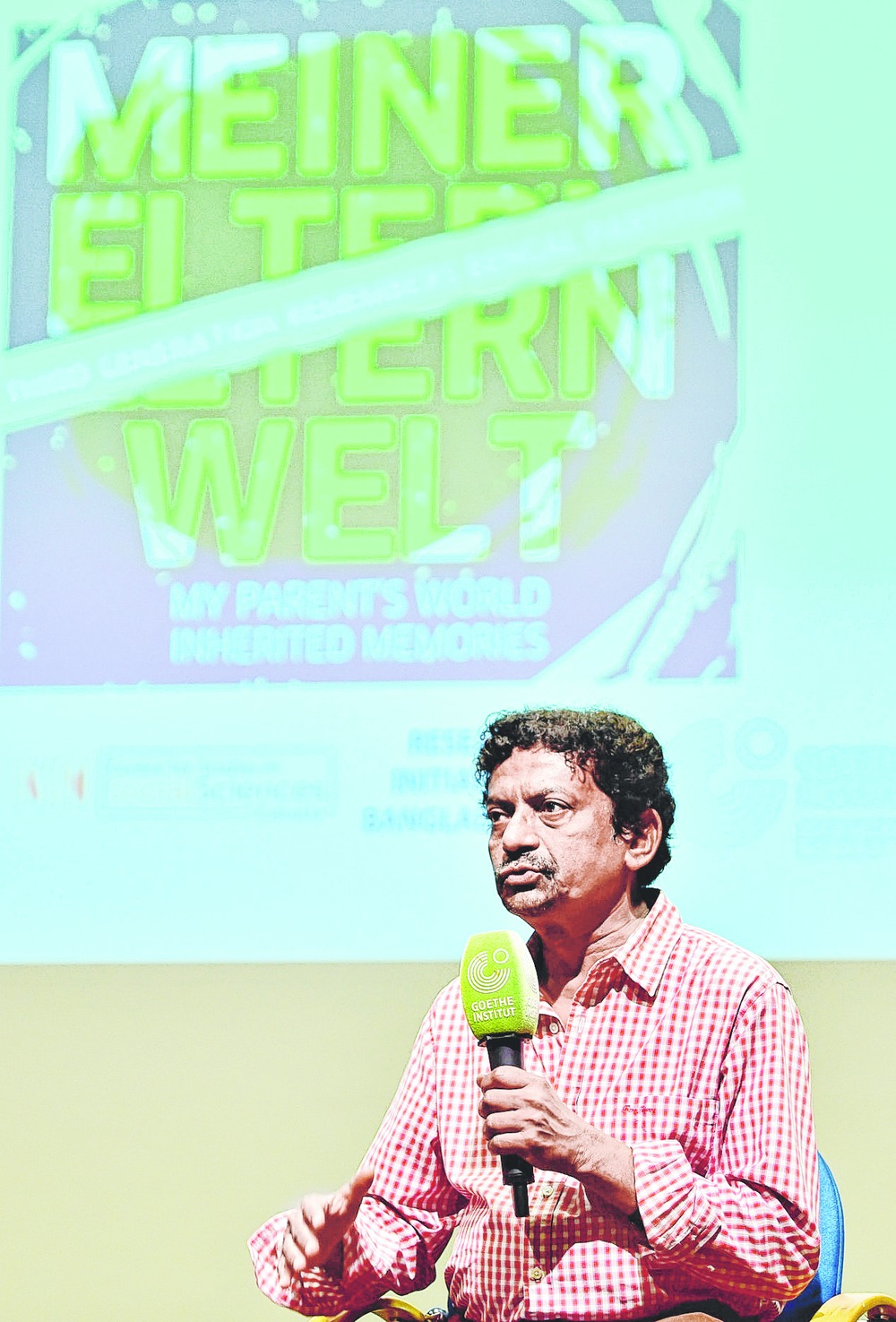
Goutam Ghose at the conference in Max Mueller Bhavan. (Anindya Shankar Ray)
Director Goutam Ghose often wondered as a 10-year-old why his friends could visit their desher bari during vacations while he could not.
“I remember asking my mother if we have a gramer bari. She would say, ‘achhe, but it is in East Pakistan and we don’t have easy access’,” Ghose said during a recent conference at Max Mueller Bhavan.
The conference kicked off a five-month Indo-Bangladesh project titled My Parent’s World – Inherited Memories, organised by Calcutta and Dhaka’s Goethe Institut.
Ghose narrated how he used to accompany his grandmother to refugee colonies in the Jadavpur and Bijoygarh areas to meet relatives. “I remember my grandmother telling me stories…. When I became a filmmaker, I thought let’s connect. Two races had been divided for a wrong reason. I wanted to go back to my ancestral home and make a film. So I made Padma Nadir Majhi and my father was really happy. He said he was happy that I had chosen the subject as I could go and shoot near the Padma.”
The conference saw speakers like Andrea Zemskov-Zuge from the Berghoff Foundation, Berlin; Manas Ray of the Centre for Studies in Social Sciences, Calcutta; Meghna Guhathakurta, executive director, Research Initiatives, Bangladesh, which works with the marginalised community; and former BBC journalist Nazes Afroz.
Ghose spoke about a village (Chakpanital) where he shot for his upcoming Indo-Bangla film – Shonkhochil. It is a village where there are houses of both sides and people live together.
“I find this two-nation theory absurd… that too on the basis of religion. While making the film, I was studying the Radcliffe Line. It is so strange… how on a huge water body you find a zigzag line separating two nations. Same people, same language, same culture divided by an absurd border. Why did Gandhi not launch a ‘Stop Partition Movement’ like the Quit India Movement?”
As part of the project, eight students from Calcutta travelled to Goethe Institut, Bangladesh, to meet eight students there. Together they will attend conferences and workshops on commemorative culture. “Once both sets of students are trained in interviewing techniques, they will interview third generation families of Partition on both sides of the border. People would be selected to travel to the country of their ancestors,” said Judith Mirschberger, director, Goethe Institut, Bangladesh. “So, someone living in Calcutta would travel to Bangladesh and vice versa to trace his/her family roots with these students.”
The project will end with the launch of a web platform where all interviews and background information will be put up.
From Shahid Minar in Dhaka to a memorial in Bhopal by a Dutch sculptor for victims of the Bhopal gas tragedy, Nazes Afroz, who is also the coordinator of the project, presented a slide show of pictures, while talking on the topic “Visual tool is very important in culture of memory”.
It was after a visit to Dhaka in February 2014 for an exhibition that Friso Maecker, the director of Goethe-Institut, Calcutta, started thinking about the possibility of working together. “I remember we were shooting a documentary film, which was about moving from one place to another…. There’s not been much research on the influence of Partition on third generation people in India as well as in Bangladesh…. Also from the viewpoint of an outsider… it is quite astounding that there is no memorial or place to remember the migration of more than eight million people… Which is why we started the project.”
source: http://www.telegraphindia.com / The Telegraph, Calcutta,India / Front Page> Calcutta> Story / by Malancha Dasgupta / Tuesday – September 15th, 2015
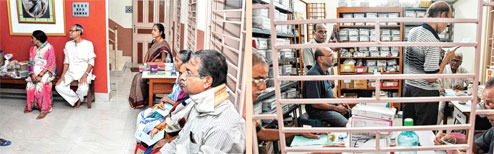
Patients wait for their turn inside the clinic; (right) the medicine counter. Pictures by Anup Bhattacharya
Two do-gooder Calcutta cousins have helped set up a clinic in Chandernagore that offers treatment to those who cannot afford it.
Cousins Rishabh Badoni, 19, a former student of La Martiniere for Boys now studying at Bard College in New York, and Siddharth Sengupta, 23, a Calcutta-based architect, have organised fund-raising exhibitions for three years to develop NGO Ram Mohan Roy Seva Pratisthan’s clinic by the same name – a lifeline for those who cannot avail themselves of costly medical services.
Despite the presence of government medical centres and a sub-divisional hospital in Chandernagore, the common belief is that no other place can provide the same service with care as the doctors and social workers at this clinic can.
Take for instance, Kakoli Singha from Burdwan’s Memari, a widow with two children. She travels for more than an hour by train every morning carrying fresh paneer, which she sells in Chandernagore.
Three years ago she had a skin allergy and got herself treated at Ram Mohan Roy Seva Pratisthan for a nominal fee. Since then, Kakoli has been visiting this clinic for her or her children’s medical needs.
“I used to live with my husband in Chandernagore. After his death, I moved to Memari to live with my in-laws,” Singha said. “But I prefer this clinic as I can consult a doctor and get medicines for a nominal charge. This NGO has been providing good service for so many years… I have faith in them.”
Like Singha, many underprivileged patients from various parts of Hooghly, Burdwan and Bankura get themselves treated at the clinic for a fee of Rs 10.
Every week, from Tuesday to Thursday, the 1,200sq ft clinic is chock-a-block with patients. Three doctors are available for consultation from 4pm. Fifty patients, on average, turn up every day.
“Apart from general physicians, we have a gynaecologist, cardiologist, paediatrician, dermatologist, orthopaedist, psychiatrist and psychologist visiting the clinic throughout the three days,” said Ranjit Kumar Ghosh, the treasurer of Ram Mohan Roy Seva Pratisthan. “We can refer serious cases to doctors who run private chambers in Chandernagore. They see patients for free.”
Medicines are collected from various sources. “We collect free samples from medical representatives as well as from doctors,” said skin specialist Dr Sunil Chandra Dutt, who’s been associated with the clinic for seven years.
Homemaker Surupa Chakraborty visits the clinic in the evenings to take stock of and distribute medicines.
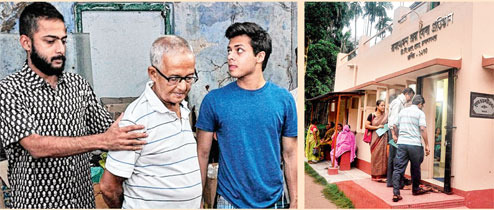
Sunil Chandra Dutt flanked by his grandsons Rishabh Badoni (right) and Siddharth Sengupta; patients outside Ram Mohan Roy Seva Pratisthan
“What we need are nutritional supplements for babies and mothers. I see a several patients with anaemia and gynaecological problems and children suffering from malnutrition,” said gynaecologist Dr Roma Sengupta, who visits the clinic once a week.
A member of the NGO sponsors tests for those who cannot afford it. “We avoid expensive tests, but if there are serious cases where specialist doctors would want more investigation, we request for a discount from diagnostic centres,” said Dutt. “We have several volunteers at the clinic. An executive body runs the NGO… but now we are thinking of setting up a trustee board so that, after us, no one tries to sell or rent the property for other purposes.”
The NGO has been working for the welfare of the underprivileged for the past 42 years.
“The clinic was started by Renuka Betaille, nee Mukherjee, in 1973 in the old post office building. Later, it shifted to the building of the primary school, of which I was the headmaster,” said Ghosh. It was not until 2014 that the clinic got its own building at Goabagan in Chandernagore’s Lalbagan. “Most of what you see here is donated. We collected funds from local people. A resident donated the land.”
Dutt found support in his grandsons, Rishabh and Siddharth, and their friends. A corpus of Rs 1.5 lakh was collected towards constructing the building through an art and photography exhibition and donations from close friends.
The dedication of those working at the clinic motivated Rishabh and Siddharth to do something more for the NGO.
“We have started a new design collective called 145 East, where we design products with traditional Indian handicrafts,” said Rishabh, a student of engineering and literature at New York’s Bard College. “Our first exhibition at Weavers Studio had a theme of gamchha. We designed skirts, tops, tablemats and a whole lot of things using the gamchha.”
Metro had reported in July 2013 how Rishabh, along with Siddharth and friends, had turned his Jodhpur Park home into an art gallery with photographs, paintings and artefacts collected from friends and acquaintances to raise money for the Chandernagore NGO.
The French Consulate and Alliance Francaise, Calcutta, had extended their support to the exhibition-cum-sale that fetched Rs 56,000.
In December 2011, Rishabh with his friend had rushed to AMRI Hospitals in Dhakuria to help in the rescue operation following the fire in Annexe I that took 90 lives.
“Social work runs in our blood and Rishabh and Siddharth have got it from there,” said Dutt.
Rishabh said it was important to support people who were devoted to social work.
Siddharth, who studied architecture at Sardar Vallabhbhai Patel Institute of Technology in Gujarat’s Vasad, is helping with design and production at 145 East. “The last exhibition helped create an awareness about the NGO and we managed to collect Rs 12,000 through it,” said the architect who has just completed a year’s teaching in Gujarat.
source: http://www.telegraphindia.com / The Telegraph, Calcutta,India / Front Page> Calcutta> Story / by Dalia Mukherjee / Monday – September 14th, 2015
The second edition of the three-day Bengal Fashion Week, partnered by t2, was brought to a close by city boy Abhishek Dutta.
The showstopper? Shraddha Das (in picture), who has earned her spurs in Telugu, Malayalam and Kannada films, dabbled in Tollywood and is now poised to make it big in Bollywood.
Abhishek presented Anno Domini, a neo-chic fall/winter 2015 line marked by graphic prints, ombre shading, structured silhouettes and layering.
Picture by Rashbehari Das
source: http://www.telegraphindia.com / The Telegraph, Calcutta,India / Front Page> Calcutta> Story / Monday – September 14th, 2015
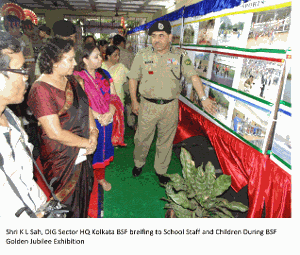
As part of the Border Security Force’s Golden Jubilee celebrations, the South Bengal Frontier is organizing exhibitions at schools across Kolkata and neighbouring districts to raise awareness on the activities of the border guarding force among students and teachers.
On Thursday, an exhibition was held at the St Joan’s School in Salt Lake where weapons and surveillance equipment were displayed. A photo exhibition also highlighted the force’s achievements over the last 50 years.
“The BSF’s history, participation in the Republic Day parades, training activities and roles played by the air, water and artillery wings were explained to hundreds of students at the school during the day. High-tech communications equipment systems were also displayed. BSF soliders and mahila constables briefed students about the functions of various weapons and equipment used by the BSF during war and peace. The exhibition was inaugurated by K L Sah, DIG, Sector HQ Kolkata, in the presence of Devyani Ghosh, principal and Lucia Ghosh, vice principal and over a thousand students,” a senior officer said.
Sah and S P Tiwari, DIG, Frontier HQ South Bengal briefed students about the genesis of the force, its role and task, duties and how effectively BSF sentinels guard the border from Kashmir to Kutch and Sundarbans to Mizoram with utmost professionalism. A short film on the role and task of the BSF, its functioning and parade at the Joint Retreat Ceremony of Indo-Bangladesh Border at Petrapole and Indo-Pakistan Border at Attari was also screened for students.
“The initiative has been taken to inculcate patriotic spirit in young school children and to make them aware about India’s borders and duties performed by the BSF. The patriotic tunes played by the BSF brass band were highly appreciated by the young children. The next programme will be organized by BSF on September 16 at The Heritage School,” the officer added.
source: http://www.timesofindia.indiatimes.com / The Times of India / News Home> City> Kolkata / by Jayanta Gupta, TNN / September 10th, 2015
St George’s Gate, once a prominent structure of the city after which even a road was named, was long lost. And now, even its remains are sinking into oblivion.
The southern gateway to Fort William near the northern slope of Kidderpore bridge, the gate, also known as Coolie Darwaza, was abandoned by military authorities when the passageway was converted into a civilian road — St George’s Gate Road. The new St George’s Gate of Fort William was built a little west, near Prinsep Ghat.
TOI on Thursday found only the pillar on the side of southern flank partly intact, overgrown weeds covering most part of it. The other part on the northern side has vanished. Only its broken pieces are strewn all over the place. Who razed it? When was it razed? No one ever bothered to know. It is not known whether it was razed when the elevated approach road of Vidyasagar Setu was constructed.
The pathetic condition of the gate was brought to the notice of Archaeological Survey of India (ASI) by Anthony Khatchaturian, a passionate heritage activist. ASI regional director (east) Dr P K Mishra immediately took note of it and inquired about it. He also wrote to GoC Bengal Area, requesting him to look into how this important heritage gate got destroyed.
“Historically, it is a very important architecture. It would be great if we could restore the structure,” said Mishra. There is a detailed reference of St George’s Gate in M L Augustine’s book ‘Fort William: Calcutta’s Crowning Glory’.
“I was surprised how such a beautiful structure is being damaged systematically. I was surprised to find the signs of destruction still intact across the road. There must be some serious attempt to restore the structure and rebuild the destroyed one,” said Anthony, a passionate save heritage campaigner with an Armenian origin.
source: http://www.timesofindia.indiatimes.com / The Times of India / News Home> City> Kolkata / by Krishnendu Bandyopahyay, TNN / September 11th, 2015
Sept. 6: Bengal has turned conventional economic wisdom on its head.
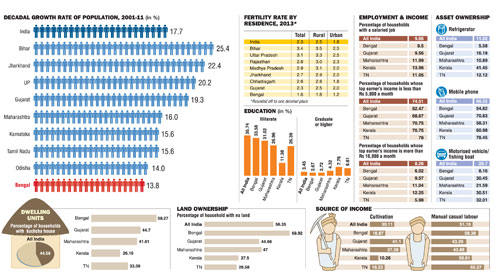
Data released by the Centre last month revealed that Bengal had one of the lowest population growth rates, 13.8 per cent, in the country for the 2001-11 decade. This is of a piece with the number thrown up earlier in 2013 for Bengal’s total fertility rate, which placed the state at the bottom of the table.
This development has taken place without being accompanied by the level of economic and social progress that has so far been seen to create conditions for low population growth.
Saswata Ghosh, economist and mathematical demographer at the Institute of Development Studies, Calcutta, said: “The basics in economics tell us that population growth rates tend to stabilise with rise in income and social well-being. We have seen such trends in the advanced economies of Europe around the 1960s and 1970s.”
Japan’s experience has been the same.
Bengal bucks that trend. The provisional socio-economic caste census (SECC) data of 2011 paints a dismal picture of rural Bengal: one-third of the population are illiterate and nearly three-fifths live in kuchcha houses and three-fifths earn their livelihood through manual labour. The breadwinner in 82 per cent of the households makes less than Rs 5,000 a month.
The situation of Odisha is somewhat similar. The state has witnessed a decadal population growth rate of 14 per cent but the socio-economic conditions of the rural population cannot be regarded as favourable for such a dip in the population growth rates.
“This is a demographic puzzle and I think it calls for more research,” said Anup Sinha, professor of economics at IIM Calcutta.
According to him, a proper social safety net can push down fertility rates – as it has been witnessed in various European countries – because people think that the government will take care of them in their old age. India is far from a situation like that.
Given the uncertainty about the future and the widespread misery, conventional wisdom expects the poor to have more children in the hope of augmenting future income. Besides, the lower probability of survival of all the kids also encourage the poor to procreate more.
But the finding from Bengal is different, as the total fertility rate has dipped. This rate is defined as the average number of children a woman would have over her reproductive life. Bengal’s fertility rate of 1.6 is not only below the national average but also lower than the replacement rate of 2.1 children per woman. This rate is taken to be 2.1 with the notion that a couple will be replaced by two children; 0.1 is added to factor in infertility among some women.
“The dip in the fertility rate in urban areas in Bengal is more to do with aspirations for their children, where parents are reducing fertility in search of social uplift. But in rural areas, the decline is distress-driven, as there are fears that the next child may starve to death,” said Ghosh, who has been tracking the trend for some time.
This sense of insecurity can be understood in the context of results from the census. Some 70 per cent of the rural households are landless, around 47 per cent of the rural population do not have primary education (national average of 50 per cent) and the percentage of graduates in the state is less than the national average and all the western and southern states.
The low decadal population growth might make Bengal’s current administrators happy as it means less strain on scarce public and private resources. As for the state’s poor social and economic scores, Mamata Banerjee can well blame her predecessor, the Left Front, as the survey related to the years to 2011, the year she took charge.
Several economists, however, said the trend of deprivation seen during Left rule doesn’t seem to have changed.
“Had there been a significant improvement in the situation after 2011, it would have been discernible to even non-expert eyes…. At least I haven’t seen any major changes in terms of job opportunities or education,” said Sinha.
Economists may wait for numbers, but till the next such survey results are out, Mamata can keep claiming that the Left destroyed both industry and agriculture, but the tables tucked in the voluminous report have several lessons for the chief minister.
Governments in Bengal have boasted about rapid industrialisation, never producing the numbers to support their claims. The provisional SECC data show that only 8.5 per cent of the rural population have salaried jobs -evidence of the lack of industrialisation. Agriculture offers a picture that is as gloomy: only 19 per cent of the rural population – against a national average of 30 per cent – earn their main livelihood from cultivation.
If more than 58 per cent of a state’s rural population earn their primary living through manual casual labour – which means they do not use skills and employment is irregular – there is little doubt that the state needs industrialisation for which availability of land is a precondition. But Mamata’s stated stand is against government acquisition of land.
“If the present government sticks to its stand on land, the next census will produce a more dismal picture of the state,” said an city-based economist who did not wish to be named.
Over the past few years, the Mamata government has been claiming that Bengal is ahead of the national average in terms of all the major indicators like the growth rate of the economy and the rate of growth in industry, agriculture and services.
“From a small base, one can achieve higher growth numbers. Besides, the national average includes other laggard states. So, clocking a higher than national average is no big deal. Instead of patting herself on the back for what she has achieved, she should take a lesson from these numbers and change her approach,” said the economist.
source: http://www.telegraphindia.com / The Telegraph, Calcutta,India / Front Page> Story / by Devadeep Purohit / Monday – September 07th, 2015