It is surely a proud moment for the city, which lays its claims to three of the six authors shortlisted for the DSC award for South Asian Literature 2016. While Neel Mukherjee and Raj Kamal Jha spent their childhood and youth in south Kolkata, Anuradha Roy had a brief stint with this city when she studied at Presidency College.
“Calcutta will always enter whatever I write because that’s the city I have walked the most, got lost the most in. ‘She Will Build Him A City’ is about the imagined cities inside our head, the magic that we need to live with reality,” said Jha, editor-in-chief of a national English daily. Jha, who was born in Bihar and had his schooling at St Joseph’s, put the city in his first novel ‘The Blue Bed Spread’ where the former IITian went beyond the cordons of the concrete city. Similar seemd to be the case with his fourth novel, where humans, under strain or facing irrevocable loss, find themselves deprived even of their names. Their narratives, fragmented and with a constantly shifting relationship to any recognisable version of events, are interspersed with characters allowed to keep their nominal identities.
Neel Mukherjee studied at Don Bosco School, Park Circus and then took up English at Jadavpur University before proceeding to University College, Oxford on a Rhodes Scholarship where he graduated in 1992. He completed his PhD at Pembroke College, Cambridge. In his second novel, ‘The Lives of Others’, Mukherjee gives us finely-grained descriptions of daily life. It is a complete world, where political unrest is always visible on the fringes, casting ever-darker shadows over the domestic. The fragmented versions of families particularly in north Kolkata is carefully penned in his novel.
Anuradha Roy, novelist, journalist and editor, has been shortlisted for her ‘Sleeping on Jupiter’. Born in Uttarakhand and brought up in Sikkim and Hyderabad, she came to Kolkata to study English at Presidency College before moving to Cambridge University. The co-founder of publishing house Permanent Black said, “I did college in Kolkata, where I made lifelong friends, and became aware of a whole cultural universe. I have wonderful memories of wandering in the second-hand bookstores and films at Lighthouse and phuchkas and rolls in New Market.”
source: http://www.timesofindia.indiatimes.com / The Times of India / News Home> City> Kolkata / by Saibal Gupta, TNN / November 29th, 2015
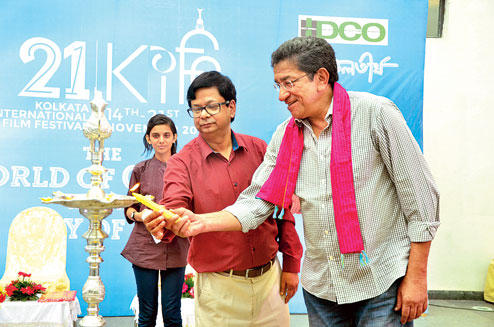
Sabyasachi Chakraborty and Debashis Sen inaugurate the Nazrul Tirtha chapter of the Kolkata International Film Festival on Sunday (Shubham Paul)
Actor Sabyasachi Chakraborty inaugurated the New Town chapter of the 21st Kolkata International Film Festival (KIFF) at Nazrul Tirtha on Sunday. Nazrul Tirtha is the only venue where the festival’s films are being screened in New Town.
“Please come and watch these films as they encourage us to keep making films and encourage the organisers of such festivals to keep hosting them,” said Chakraborty, adding that he wasn’t sure how many movies he himself would be able to make time for amidst his busy schedule.
This is the second year that Nazrul Tirtha has been a venue for the festival. “Last year we were screening two films a day and this time there would be three films a day,” said Debashis Sen, chairman cum managing director of Housing and Infrastructure Development Corporation (Hidco) that is in charge of Nazrul Tirtha. “We have also installed dolby digital sound system in the auditorium this time for enhanced viewing experience.”
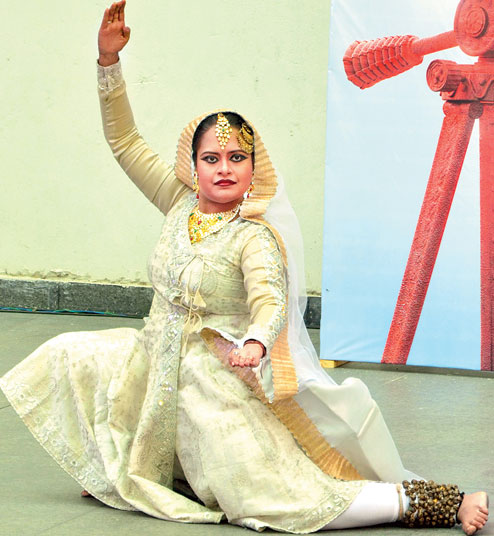
Before the inauguration, kathak dancer Anurekha Ghosh, a resident of Salt Lake’s CB Block, performed (picture above).
Nazrul Tirtha, on the Major Arterial Road, was inaugurated last year to facilitate research on poet Kazi Nazrul Islam but from August this year it has also started screening films on a regular basis. “Ever since the movie hall opened here I’ve watched several good films,” said Kumkum Chattopadhyay, a resident of the nearby East Enclave Co-operative Housing Society who had come for the inauguration. “As for the festival, it was not possible to travel to far-off destinations to watch the films before. This venue is convenient and I hope to watch the Asian films on offer, especially the Bengali film 9 no. Peara Bagan Lane on Saturday.”
The festival will continue till November 21 and the timings at Nazrul Tirtha are 1pm, 3.30pm and 6pm. Tickets are priced at Rs 80 and 60.
In Salt Lake, KIFF films are being screened at Carnival Cinema in IB Block (11am, 3pm) and Inox City Centre (3pm, 5.30pm). Tickets cost Rs 80 at both venues. EZCC had been hosting KIFF for several years but has been discontinued this year.
source: http://www.telegraphindia.com / The Telegraph,Calcutta,India / Front Page> Salt Lake> Story / by A Staff Reporter / Friday – November 20th, 2015
He was born the same year America released its first 12-reel film, ‘The Birth of a Nation’ and Ranajit Roychowdhury celebrated his 100th birthday on November 6. The former freedom-fighter is embarrassed that Karolbagh Bangiya Samsad, the club he founded in Delhi in 1958, has planned a grand felicitation to mark his “100 fruitful years” at Tapan Theatre come Sunday.
“I guess my birthday was just another day. By living life, we are only going through the motions. I am happy that I’m still active at 100,” the centenarian said.
Roychowdhury was an engineer with CPWD, which he joined in 1942 and was sacked by his Colonial bosses for his political involvement. “In those days everyone was a Gandhian. Though I spinned the charkha, I had met Bapu only once,” he recalls.
He believed the Partition was but a “temporary affair” and the sub-continent would be one again. “Instead, we had to free East Pakistan,” the lean frame, striding along a Salt Lake road, shrugged.
A look at his life shows how much can happen in a century. If Roychowdhury’s infant years were marked by WWI, his youth went through the tumultuous WWII, when Indian soldiers fought on behalf of the British. He talked of these matter-of-factly, even while treasuring his photograph with Nehru.
The former freedom fighter’s nonchalance about the burning political issues is intriguing. “The same intolerance was there earlie. At least, the society is more stable now and India has moved forward,” he said. said the CPWD chief engineer who retired in 1974 (he had been reappointed in 1946).
His reactions to inflation is no different. “When I was born, 38kg of rice cost Rs 2.50 at Narail (his hometown in Bangladesh). My first pay was Rs 150. So what?”
Roychowdhury credits his longevity to a disciplined lifestyle, frugal meals and good sleep. “The secret to a healthy life is not just good diet but nurturing positive thoug-hts,” Roychowdhury said, adding, “I have never thought ill of anyone.”
He loved playing the flute, but gave it up when he lost his wife, Kamala. “I was 80 then. She had been bed-ridden for 20 years. Thanks to my fitness, I could look after her till the end,” he added. sighed, looking out of the window of his neatly laid out living room on the ground floor of his AC block residence.
The rest of his schedule has remained more or less constant: regular exercise, eating fruits and vegetables and making sure he doesn’t consume plant and animal protein together. His English and Bengali dailies have remained unchanged. He does know about whatsapp, but doesn’t care to use his cell phone. “I am not tuned to mobile sets. For me, the landline works better,” said Roychowdhury, recalling the pre- Sam Pitroda era when the telephone couldn’t be taken for granted. “The life we lead now is better,” he mused, referring to his daily conversations with his eldest (71-year-old) daughter in Mumbai. Three of his five daughters live in the US, and son, Bikramjit, a retired IIT engineer, is on the first floor.
And There is one passion Roychowdhury has stuck to: writing. The best of his published works are his autobiographies on the three stages of his life. “Can’t concentrate enough to wrap up the fourth: ‘Shesh Prahar’ (the last hour)”, I don’t think it’ll be printed,” he laughed.
source: http://www.timesofindia.indiatimes.com / The Times of India / News Home> City> Kolkata / by Ajanta Chakraborty, TNN / November 20th, 2015
Bhawanipore, a conservative, middle-class neighbourhood in south Kolkata, had broken away from tradition and started worshipping an aggressive image of Goddess Kali as Chamunda way back in 1941.
While the rest of the city worshipped the divine Shyama, Harish Park has stood out with its 20-feet-tall idol of Chamunda
Nothing much about this Puja seems to have changed in the last 75 years. The height of the idol has increase, but the rituals remain same.
Legend has it that the Puja, which started off with a regular Shyama idol, took its present form when the priest had a dream in which the Godess advised him to worship Chamunda instead of Kali at the venue. After the dream, the priest himself made the idol of Chamunda.
Debashish Mukherjee, member of the Puja committee, said, “Ever since, we have worshipped Chamunda. There has been minor alterations in the image, but it remains essentially the same.”
It was the late artist Prahlad Pal, who made the Chamunda image popular. Every year, thousands from across the city and beyond visit the Puja. During the festive days, a fair is held at the adjoining ground.
In keeping with the tradition, more than 50 members of the organizing committee fast for 24 hours. “Wherever they are, they don’t touch food or water till the puja is over. It usually gets over after midnight. But none breaks their fast till the the bhog has been offered to the Goddess,” said Mukherjee.
source: http://www.timesofindia.indiatimes.com / The Times of India / News Home> City> Kolkata / TNN / November 12th, 2015
A galaxy of prominent artists from all over the country will gather in this city for a six-day festival of art being hosted by ArtsAcre Foundation from this weekend. This will be the biggest such gathering of artists in the city in recent memory.
Thirty-one artists will paint, interact, hold workshops, participate in seminars and provide inspiration to budding artists during the festival, which is also the first of its kind in many decades. The renowned artists from outside Bengal who will be attending the festival include Himmat Shah, Madhvi Parekh, Prabhakar Kolte, Rameshwar Broota and Vasundhara Tewari Broota, Ravinder Reddy, Surya Prakesh, S.G Vasudev, Thota Vaikuntam, Veer Munshi and Vrindavan Solanki. Bengal artists Ganesh Haloi, Jogen Chowdhury, K.G. Subramanyam and Rabin Mondal, besides ArtsAcre founder Shuvaprasanna, will be part of the festival.
“The primary objective of this festival is for it to become a platform for art workshops that will immensely benefit students of fine arts and budding and young artists,” said Shuvaprasanna. This will be the first time that artists like Himmat Shah and Rameshwar Broota will come to the city for such a festival, he said.
The sprawling ArtsAcre campus at Rajarhat will be a beehive of activity on all the six days from November 1. “In the evenings we’ll have attractive cultural programmes. Films like the award-winning ‘Asha Jaoar Majhe’ and U R Ananthamurthy’s ‘Samskara’ will be screened. Soumitra Chatterjee will stage his ‘Kalmrigaya’ one evening, while a Chhau dance will be presented by Dilip Mahato and his troupe on another evening. Apart from musical performances, two books on Bismillah Khan and K G Subramanyam will be released at the festival.
ArtsAcre, a world-class integrated arts facility at Rajarhat, was conceived as an institution for nurturing young artists in the field of visual arts. Its foundation stone was laid by Gunter Grass in March 1984 and the new campus inaugurated 30 years later by Chief Minister Mamata Banerjee in March last year. ArtsAcre houses a museum of modern Bengal art showcasing many contemporary artists of Bengal, four art galleries spread over nearly 7500 square feet, a world-class auditorium, a conservation laboratory, studios, space for workshops, a conference room, and amphitheater and 18 guest apartments, besides many other facilities.
source: http://www.timesofindia.indiatimes.com / The Times of India / News Home> City> Kolkata / TNN /October 31st, 2015
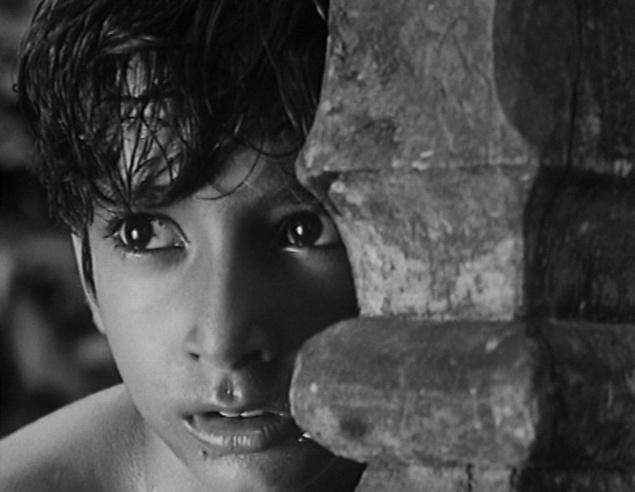
A still from Satyajit Ray’s classic Pather Panchali
The man responsible for the distinct visual vocabulary of “Pather Panchali”, has unfortunately been forgotten.
Subrata Mitra was an observer of Jean Renoir when he was shooting The River at Kolkata in the late 40s. It was at this juncture he came across Satyajit Ray who was also a keen Renoir observer. Both struck a creative chord and agreed to work together.
No wonder when Satyajit Ray made his debut as a writer-director with Pather Panchali, he had Mitra as his cinematographer. The teaming of Ray, Mitra Ravi Shankar, Dulal Dutta and Banshi Chandra Gupta was perhaps the greatest combination in Indian cinema. With a Michele camera, Mitra created wonders in Pather Panchali. The incomparable use of natural light during the monsoon rains, shots of the kash flowers and a running train in the distance created cinematographic magic. Mitra won a National Award for his camera work in Pather Panchali.
By the time Aparajito went on floors, the Arriflex camera had arrived in the cinematic world. Mitra made superb usage of bounce lighting during the indoor shots in Aparajito. Prior to Aparajito, bounce lighting was unknown to Indian cinema. Even the iconic Ingmar Bergman made use of this technique years later in Through A Glass Darkly.
Mitra can best be described as the perfect cinematic eye of Satyajit Ray. So well did he understand Ray’s thoughts, imagination and visualisation that his camera interpretation of them was sans any flaws. Apur Sansar, Jalshaghar, Devi, Teen Kanya and all Ray films bore the masterly Mitra stamp of cinematography. When Ray decided to shoot Kanchenjungha in colour, it was a challenge for Mitra. Without opting for too many special effects or cinematographic jugglery, he used close-ups to capture the panorama of the Himalayas. The montages were lyrical. The first ever freeze shot in Indian cinema was used to perfection by Subrata Mitra in Charulata.
After Nayak in 1966, Ray and Mitra parted ways. It was mainly due to creative and not egoistic differences. Mitra believed in certain visions which did not gel with Ray’s.
They drifted apart with dignity never criticising each other in public. Ray’s films after Nayak lacked the genius of Mitra’s cinematography. Mitra sans Ray was also not at his altruistic best. One of Indian cinema’s greatest tragedies.
James Ivory and Ismail Merchant worked with Mitra very well in Householder, Shakespearewala, Bombay Talkies and The Guru. In Householder, Mitra used tight close-ups of Shashi Kapoor and Leela Naidu, five in quick successions creating visual poetry. Raj Kapoor made sure Mitra cinematographed Teesri Kasam for Basu Bhattacharya. The shot of the train through a hole in Hiraman’s (Raj Kapoor) cart shot without a tilt still haunts.
The genius took a sabbatical from cinematography in mid 70s. He returned in 1986 to shoot Ramesh Sharma’s New Delhi Times. The shot of Shashi Kapoor running in a dream sequence as his newspaper office burns remains a lesson in cinematography.
Mitra spent his last years teaching cinematography at SRFTII, Kolkata. He was an expert of monochrome and favoured soft colours compared to stark ones. He considered Saath Pake Bandha, Dakhal and Drishti truly well-lit films.
As Pather Panchali is completing 60 years Pather Panchali it is sad that the camera architect of the classic has been forgotten. Mitra still is an idol for any aspiring cinematographers.
source: http://www.thehindu.com / The Hindu / Home> Features> Friday Review / by Ranjan DasGupta / October 22nd, 2015
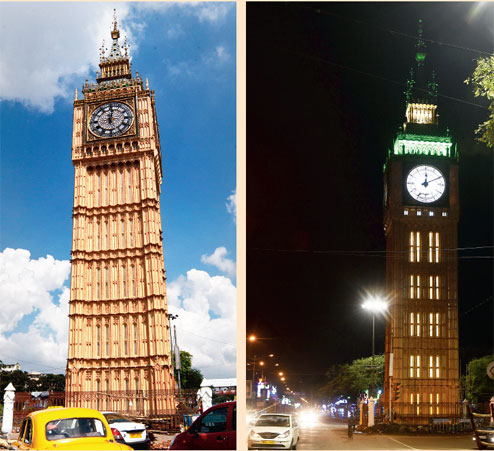
A replica of Big Ben, the famous clock tower of London, has come up at the Lake Town crossing on VIP Road. The 135ft-tall structure, however, falls far short of the original, which towers at 314ft.
The replica, designed by artist Sunil Chandra Pal, is made of concrete and has a fibre casing. Work on the structure had started in December.
Big Ben is the nickname of the Great Bell of the clock at the north end of the Palace of Westminster in London. Like the original, the replica will ring every hour, but the sound will not be produced by a bell like that in the London tower. Instead, a recorded sound will play from a speaker.
South Dum Dum Municipality spent over Rs 1 crore to build the clock tower.
Architect Partha Ranjan Das said the replica looked good but the money should have been spent on building something original.
“If they were so interested in making a tower’s replica, they could have chosen from Gour-Pandua (in Malda). There are many towers there,” he said.
source: http://www.telegraphindia.com / The Telegraph, Calcutta,India / Front Page> Calcutta> Story / picture by Amit Datta / Monday – October 19th, 2015
Illuminated by earthen lamps and torches (mashals), the idol of Ma Raj Rajeshwari looks resplendent in the Akbar-era Natmandir at the Krishnagar Maharaja’s palace.
The serenity is suddenly shattered by the town crier’s shrill call: “Attention! Agnihotri Bajpeyi Raj Rajendro Maharajadhiraj Nabadwipadhipati Mahashaya Krishno Chandro Roy Bahadur is arriving.”
On cue, 108 dhakis beat drums to frenzy.
The Maharaj arrives in an elaborately carved silver palanquin that was gifted to one of his forefathers by Emperor Jahangir. He approaches the pulpit. Shortly thereafter, the palace cannon booms, a signal for the beginning of sandhi puja. A hundred and eight buffaloes are assembled before the Goddess. At shandhikshan, the heads are severed and placed before the Goddess as offering to cleanse the human spirit of its evils. “As a child, I grew up watching these rituals being performed while sitting on my grandmother Maharani Jyotirmoyee Debi’s lap. Growing up, I always held a grudge against Ma Raj Rajeshwari. How could the divine mother, the supreme protector of good and the destroyer of evil, devour so many harmless, helpless lives? I would often bring this up with my father. Being a God-fearing man, he would stick to tradition till the resistance melted away when he saw my infant son Manish crying on witnessing the sacrifice.The practice was stopped in 1987,” said Saumish Chandra Roy , the 39th descendant of Nadia royal family .
Nadia Rajbari’s Durga Puja remains the oldest puja in what was then Anga-Banga-Kalinga or undivided eastern India region. Started in 1603 by Maharaj Rudra Rai, the great grandfather of Krishno Chandro, it has continued uninterrupted till date. “The puja began two years before the death of Emperor Akbar. Since it all happened at the height of the Mughal era, the influence is very strong in the architecture of the natmandir,” said Saumish’s son Manish. However, though the gran deur of celebrations have shrunk over the centuries, the rituals have remained intact.
Ma Raj Rajeshwari has seen Nadia during the most tumultuous of times.In medieval India, persecution and heinous tyranny on the grounds of religion was common.
Blood was spilt for the protection and defense of Nadia’s “honour”, for the protection of the freedom to choose and profess the religion of our choice.”Jato dharma Stato jayo” (Stay in the path of good dharma and victory will be yours) is embedded in the Krishna gar royal family’s coat of arms.
Ma Raj Rajeshwari’s power was tested during Partition. Nadia had initially been ceded to what was then East Pakistan on grounds of religion. “For three nightmarish days, we were Pakistanis. My father Saurish Chandra Roy , the last officially recognized maharaja, had told Sir Cyril Radcliffe (the chairman of the Boundary Commission in British India) that if Nabadwip was lost to Pakistan, then what would remain of the great Hindu faith in the Anga-Banga-Kalinga region?
After three days of rioting, rape and arson, a significant portion of Nadia was returned back to India. The entire population went wild with joy when the news was broadcast over All India Radio. People arrived in trucks from far and wide and assembled in front of the palace gates, shouting ecstatically “Ma Raj Rajeshwari’r Jai!” Though the princely order was abolished by former Prime Minister Indira Gandhi, some royal customs are still followed. The Maharaj was believed to be the protector of his people.Accordingly a clay model of a “shatru”, symbolizing evil, is created which is slain by the Maharaj every year during the Durga Puja. Saumish does the slaying now.
source: http://www.timesofindia.indiatimes.com / The Times of India / News Home> City> Kolkata / by Subhro Niyogi, TNN / October 19th, 2015
Among the stories of torture, loot and oppression that the British left behind for us, one of the most common is that of how the thumbs of muslin weavers from Bengal were chopped off to wipe out the ancient art form from the face of the country. Muslin has since then been an item only to be seen in museums across the world.
A fine cotton textile making art that originated in India in the ancient times, with the maximum concentration in Bengal, and proliferated under Mughal patronage since the 17th century, muslin died an unnatural death when the British decided to smother it so that they can bring in their own mill-made textiles from Manchester to India.
Recently, the West Bengal chapter of Crafts Council of India has taken up a project to revive the art of muslin making. It started in 2010 and now weavers who were being re-skilled for producing muslin, have finally been able to reach an enviable thread count of 500.
After the Mamata Banerjee government came into power, the state micro, small and medium enterprises department also started thinking on how the fine textile making art can be revived in Bengal. The MSME department scouted for experts in villages across five districts of the state where muslin used to be produced traditionally. In this manner, some 793 weavers’ families were chosen from Birbhum, Murshidabad, Nadia, Bankura, West Misnapur and Burdwan, who had all been connected with muslin making some generations ago. The state government encouraged them to take to the art once again.
When the thread count reached 300 last year, muslin made by weavers under MSME made its way to the government’s Biswa Bangla Haat. MSME department is trying its best to increase the count further because the higher the count, the better is the quality of muslin.
During the time of the Mughals, muslin weavers from Dhaka were able to reach a count of 1500. Samples of these are available in museums across the world. A 500 count means that the two threads crisscross each other to create a mesh 500 times in the span of a square inch. “It all started quite by an accident. An American advertising honcho, Anne Johnson, had visited us with inquiries about muslin and whether any efforts were being made to revive it. She was fascinated with muslin and was even prepared to fund it if we took up a revival project, which we eventually did at a cost of Rs 70 lakh,” said Ruby Pal Chowdhury, who heads the Crafts Council of India here.
The Crafts Council project took place in Kalna, where master weavers, who are otherwise associated with the production of khadi yards under the aegis of the Khadi and Village Industries Commission (KVIC) of the central government and West Bengal Khadi Board (WBKB), kept experimenting with spinning of the yarn with the right thickness out of cotton sourced from Gujarat.
“Once the yarn is spun, it has to be soaked in starch made of kolma or dohor nagra varieties of rice. The water used is essentially rain water to keep the solution soft. There is no formula for this, these are part of family knowledge that are being gradually recalled through re-skilling,” said Pal Chowdhury.
The weavers of the council have not only been able to weave muslin yards but also entwine antique jamdani motifs in it. These have been christened as muslin jamdani and a pure saree woven thus costs nothing less than Rs 20,000. These creations are now available for viewing at Artisana, the council’s outfit at Chowringhee Terrace, while a mega debut is also being planned.
Considering the huge expense that such revival incurs, the council is also trying to tie up with Biswa Bangla to take the revival issue a step forward.
“We would welcome this because the final aim is to bring back muslin to its original glory. That will be possible only if we are able to keep giving incentives to weavers to sacrifice other commercial interests and concentrate on spinning finer yarns and then weaving finer counts,” said Sinha.
source: http://www.timesofindia.indiatimes.com / The Times of India / News Home> City> Kolkata / by Jhimli Mukherjee Pandey , TNN / October 11th, 2015
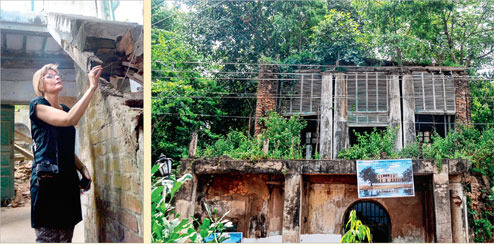
Bente Wolff, curator of the National Museum of Denmark, on Tuesday morning inspects the staircase of what was once the Denmark Tavern; (right) the Hooghly-facing facade of the tavern which will restored soon. Pictures by Pradip Sanyal
As our car tried to wriggle through vehicle-clogged Rishi Bankim Sarani of Serampore on Tuesday morning, I noticed that somebody has tried to prettify the miserable Subsidiary Correctional Home opened in 1803 by the rulers of this former Danish colony (1755 to 1845).
It was a modern institution based on humanitarian ideals and the then administration had taken into account the health problems, religions and caste system prevailing in India while planning it. And now its high walls are painted a blinding cobalt blue. A model park will soon be opened on the pavement in front of this jailhouse, and replicas of Chhota Bheem and other such cuties have been installed there.
In a few minutes we arrived at the ruins of what was once the double-storeyed Denmark Tavern & Hotel, where a ground-breaking puja was to be performed as the National Museum of Denmark will take it up for restoration. It is on the banks of the Hooghly, and Nishan ghat in front of it lies on the main axis connecting the main landing place near the ghat with the Government House, the seat of the former Danish government.
The museum had launched the Serampore Initiative in 2012 and took up the restoration of St. Olav’s Church (1806), whose steeple can be seen from Barrackpore on the opposite bank of the Hooghly; the south gate, once the guard house and used as a police lock-up as well facing Tin bazaar, then the main market; the main gate of the compound that houses the sub-divisional court.
It has acted in an advisory role in the restoration of what was once the old single-storeyed, colonnaded Danish Government House (1771) or Governor’s House. This compound dates back to 1755, when the Danish Asiatic Society Company established a trading post in Serampore.
The West Bengal Heritage Commission, which had taken up restoration of the Governor’s House, now exists only in name – most restoration work has come to a standstill. And the state government has made it clear built heritage is not uppermost on its mind.
However, Bente Wolff, curator, National Museum of Denmark, who is here to inspect the work being done by conservation architect Manish Chakraborti under the supervision of Intach, has good news.
Wolff has visited this town several times since the Serampore Initiative was launched and spends much of her time in the corridors of power to keep the dialogue with the government going. She has been in and out of Nabanna and the Chinsurah district magistrate’s office, and she has been informed that a tender will be floated soon for the last phase of the restoration work on the Governor’s House.
The cost of the ongoing projects: St. Olav’s Church and the South gate will be around Rs 3.5 crore when they are completed early 2016; the Denmark Tavern will be Rs 2.5 crore at least. The cost of restoring the main gate and some upgrading of the square in front of St. Olav’s Church and the court compound has not been estimated yet.
Wolff said the final phase of the Government House was kept in abeyance for a long time and its plinth will have to be constructed. An effort will be made to free the natural ventilation system. The government election building between the Government House and the South gate had to be demolished, which was not an easy task.
About Denmark Tavern & Hotel, Wolff said a painting of the establishment dating back to 1790 exists. The tavern found a mention in the March 1786 issue of Calcutta Gazette. According to the news item, Mr Parr, former owner of London Tavern, opened the Denmark Tavern & Hotel in the upper-roomed house near the flagstaff in Serampore.
It had a billiard table and coffee room, drinks were served and it did catering for wealthy people. The exact location of the hostelry was not known, but after examining archival sources, historian Simon Rasten came to the conclusion that it was adjacent to the SDO’s residence.
The rear section of this pile of bricks was used by the police, and a sign on the gateway reads Serampore Emergency Force Line, West Bengal Police. Once restoration work is done it will be handed over to the tourism department of the West Bengal government, which is expected to turn it into a coffee shop.
Chakraborti says it will take one-and-a-half months to clean the debris, and work will start in December. The central space will be an atrium for light and air, and accommodation for five to six guests will be provided. The Danish architect, Flemming Aalund, will be here in November to fine tune the work done.
G.M. Kapur, state convener of Intach, says he hopes this will become a nodal point and catalyst for such restoration projects and give a fillip to tourism in West Bengal.
The dilapidated main gate of the sub-divisional court dates from the late 18th century and has a high historic significance as part of the shared Indian-Danish heritage. Early drawings and photographs exist of the gate. These are being used for the restoration project. The cost will be defrayed by the National Museum of Denmark, and it will be reconstructed complete with a pediment and rustication to the original appearance based on verified evidence in 1851.
Restoration of St. Olav’s Church is in the last stages. The timber of the roofs in the ceiling has been replaced with steel beams and it will be opened for service next February. This is the historic core of the town, and the bus terminus is being relocated. Ideally, the square in front of the church should be cleared of the heart-shaped enclosure. The trees that obstruct the view should be transplanted elsewhere for a clear view of the magnificent church.
source: http://www.telegraphindia.com / The Telegraph, Calcutta,India / Front Page> Calcutta> Story / by Soumitra Das / Thursday – October 08th, 2015