Category Archives: Arts, Culture & Entertainment

Back where the music started

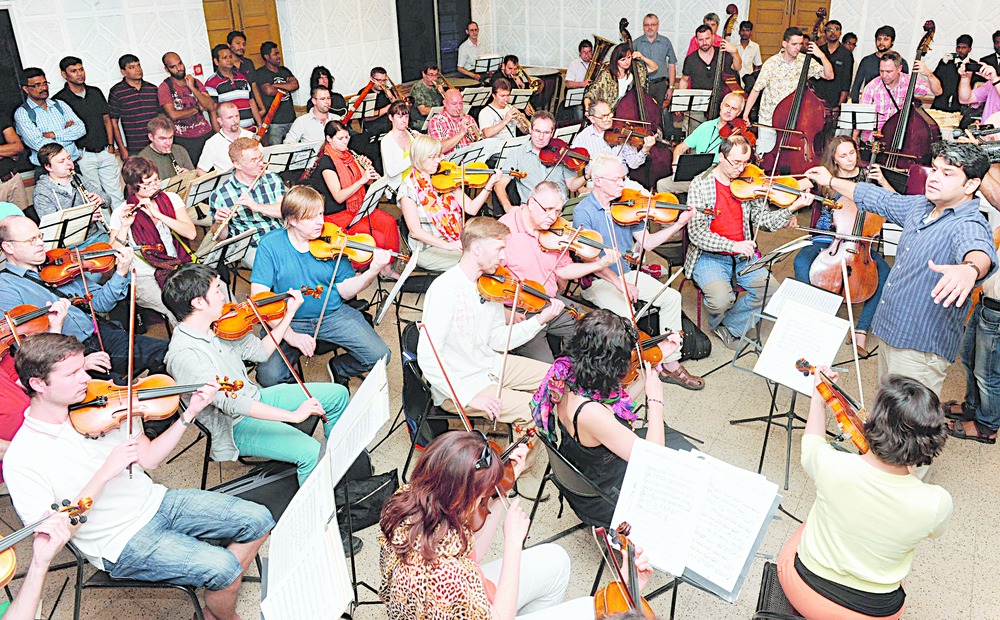
Members of Bohuslav Martinu Philharmonic Orchestra under Debashish Chaudhuri's baton at Calcutta School of Music on Friday. (Sanjoy Chattopadhyaya)
Members of Bohuslav Martinu Philharmonic Orchestra under Debashish Chaudhuri’s baton at Calcutta School of Music on Friday. (Sanjoy Chattopadhyaya)

A Ballygunge boy whose first tryst with French horns, bassoons and trumpets was at the Calcutta School of Music is back home as conductor of a premier European orchestra that would perform at his alma mater’s centenary celebrations.

Debashish Chaudhuri, 40, will wield the baton for the Bohuslav Martinu Philharmonic Orchestra from Zlin in the Czech Republic, which will perform along with members of the Calcutta Chamber Orchestra on Sunday evening. The concert at Kala Mandir will mark the end of the centenary celebrations.

Chaudhuri, an alumnus of St. James’ School who has performed at some of the best-known concert venues in the world, is thrilled at the prospect of entertaining his home audience. “My parents still live in Calcutta. It has always been the home I come back to from Prague. I am thrilled to be performing here at the conclusion of the centenary celebrations of the school where my musical journey started,” he said.

Chaudhuri recalled how, as a student in the music school in the 1990s, he had discovered instruments like trumpets and bassoons in packing boxes in a room near the library and taught himself how to play them.

After completing school, Chaudhuri joined a night college to concentrate on music before moving to the Czech Republic to study a conductor’s course. Chaudhuri’s wife Jana, a pianist, is also part of the orchestra and would perform solo on Sunday.

“I don’t remember the last time such a big orchestra played in Calcutta. Generally chamber orchestras, which comprise mostly string sections, perform here. But Sunday’s performance would have an equal spread of strings, woodwinds, brass and percussion,” said Prodipto Banerjea, secretary of the Calcutta School of Music.

source: http://www.telegraphindia.com / The Telegraph,Calcutta,India / Front Page> Calcutta> Story / by Rith Basu / Saturday – February 27th, 2016

Part of history for eight centuries, Sen Dighi faces extinction threat

Kolkata:

Its rippling waters tell many a tale and history – dating back to the 12th century. Possibly the oldest waterbody in south Bengal, Sen Dighi in Boral on the southern fringes of Kolkata has survived centuries of negligence, contamination and encroachment. It has seen change of rule, dynasties, eras and witnessed the metamorphosis of the region from a marsh-infested forest land to a thriving habitat. While more than half the waterbodies in the area have vanished and an expanding city has consumed wetlands, Sen Dighi has existed for an incredible 800 years. The 23-bigha pond, a heritage waterbody, now faces a challenge from immersion-induced pollution and its fragile banks are steadily being eaten into by garbage dumps.

A study of its water revealed that the biological oxygen demand of Sen Dighi is high. The water quality has taken a beating ever since the pond was thrown open to immersions and Chhat festivities, according to locals and experts. Even though idols are removed quickly, the residue is enough to affect the water, they say. Perhaps, a bigger threat to the pond is posed by the eroding banks, made unsteady by devotees who have been clearing vegetation along the edges during Chhat. It has led to the uprooting of two trees and another has been left unsteady. These trees are crucial to the survival of Sen Dighi since they have been holding the banks together.

“Over the years, much of Sen Dighi has been lost through encroachment. It is important to protect the pond from pollution and infringement since it is part of our history. We must ensure that Sen Dighi retains its size and its water remains unpolluted,” said Dipayan Dey, chairman of SAFE, a green NGO that is now studying the pond’s water quality.

Around 20 km from Kolkata, Sen Dighi was dug by Ballal Sen, the second ruler of Bengal’s Sen dynasty, in the late 12th century. It must have measured close to a hundred bighas then and was the principal source of water for a large swathe of area to the south of Kolkata, according to Madhu Basu, who has chronicled the history of Sen Dighi. “The city didn’t exist then and it was a practice to dig huge waterbodies that would be taken care of by locals. Almost every house had a tank attached to it. But Sen Dighi stood out due to its size and the fact that it was maintained by the local Tripura Sundari temple that still survives. It is one of the last symbols of the region’s past prosperity,” said Basu, who runs an NGO called Economic Rural Development Society (ERDS).

Over the years, numerous archaeological relics of the Gupta, Maurya, Pala and Sen dynasties have been excavated from Sen Dighi and the areas around it. In the mid-Eighties, Sen Dighi was dried up and cleansed by ERDS. A local body of businessmen took the pond on lease for pisciculture. A part of the money earned from the lease goes to the Tripura Sundari trust. “We dug up numerous relics from the pond. They are now conserved at the Tripura Sundari temple, Ashutosh Museum and a few other places. That was the last time the pond was cleaned,” said Basu, who has penned a book on the history of Boral titled ‘Itihasher Darpane: Boral’.

Locals, on the other hand, pointed out that Sen Dighi is diminishing in size, bit by bit. Documents held by the Tripura Sundari trust mentions the size of the pond as 45 bighas. Less than half of it remains. “Immersions have led to the felling of trees and litter has filled up a portion along the northern bank. If this continues, the pond will get further reduced in size,” said a member of the local Boral Parliament Club that helps the temple trust in maintaining the pond. Basu, who is a resident of Boral, agreed. “Encroachments have always been a threat. With real estate activity being brisk in the area, the future is uncertain for Sen Dighi,” he said.

Till a hundred years ago, the pond would be surrounded by brick kilns. Legend has it that a trader named Maheshwar Shau from Odisha had introduced fish cultivation at Sen Dighi. “Locals got jealous of him and he was killed and thrown into the pond. For many years, people would keep away from Sen Dighi and believed it was haunted,” said Basu.

Green actvists believe immersions should be stopped and Sen Dighi should be cleaned to save it. “If it has to survive, Sen Dighi shouldn’t be used for bathing or washing. Once the water has been cleaned, a pump could be used to pull out water, which can then be used by locals. It would be a shame if Sen Dighi degenerates into a stinking pool like so many around it already have,” said environmentalist AK Ghosh.

source: http://www.timesofindia.indiatimes.com / The Times of India / News Home> City> Kolkata / by Prithvijit Mitra / TNN / February 10th, 2016

Web home for Chandernagore

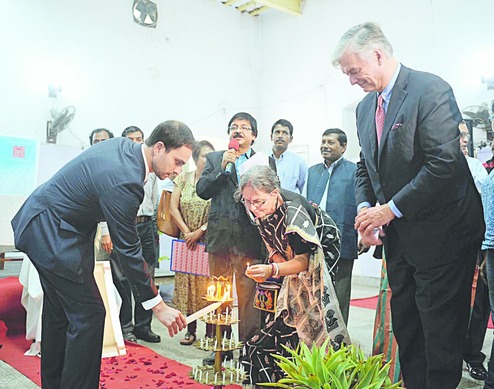
French consul-general Damien Syed lights a lamp to start the foundation celebrations at the Institut de Chandernagor as Vieilles Maisons Francaises president Philippe Toussaint (right) looks on. (Sanjoy Chattopadhyaya)

Five years ago, a project that took off as an inventory of the heritage buildings of Chandernagore has blossomed into an interactive website that acts as a repository of memories, a tool for heritage consciousness and a global platform for the former French colony.

The website www.heritagechandernagore.com will be unveiled on Wednesday at Alliance Francaise du Bengale. “The website enables people to see the magnificent built heritage of Chandernagore. Once one knows what is there to protect, there is no excuse not to do it,” Philippe Toussaint, president of Vieilles Maisons Francaises, the NGO which has provided most of the funds for the website, told Metro.

“The inventory was necessary to protect the buildings which would otherwise disappear,” said French consul general Damien Syed.

Syed and Toussaint had travelled to Chandernagore to be a part of the foundation day celebrations at the Institut de Chandernagor (IdC), marking the signing of the treaty of cession of Chandernagore in 1951.

“The website will evolve as it is not static like the one we built for Chinsurah,” said architect and conservation planner Aishwarya Tipnis, who led the project and has also built www.dutchinchinsurah.com on the history of neighbouring Chinsurah. “A blog will be part of the website where people will continue to contribute. There will be a continual crowd-sourcing of history.”

While the inventory of 99 buildings was ready by 2012, a host of community engagement activities was held in May 2015. “Contests were organised for schoolchildren alongside various workshops and a citizens’ forum. Local youths went door to door collecting memories which form a part of the website. They are now trained to take tourists on guided walks,” Tipnis said.

Toussaint is ready with another gift for Chandernagore. “We want to fund the digitisation of the important documents at IdC.” IdC curator Arup Ganguly has drawn up the list of documents. “Some, like our single copy of Le Petit Bengali, need immediate attention before crumbling to dust,” he says. The project awaits government approval.

source: http://www.telegraphindia.com / The Telegraph,Calcutta,India / Front Page> Calcutta> Story / by Sudeshna Banerjee / Wednesday – February 03rd, 2016

Bengal school with Slovenia heart – Couple united by a calling

SloveniaKOLKATA01FEB2016

• Name of school: Piali Ashar Alo
• Where: In Piali village, around 27km from Calcutta
• Students: Underprivileged children
• Founders: Anup and Mojca Gayen
• Sponsors: Slovenian schoolchildren and various other individuals and families; two German NGOs

A bright village boy who might have been grazing cattle had a German lady not funded his education is giving many others a shot at education through a school he and his Slovenian wife have set up with donations from Europe.

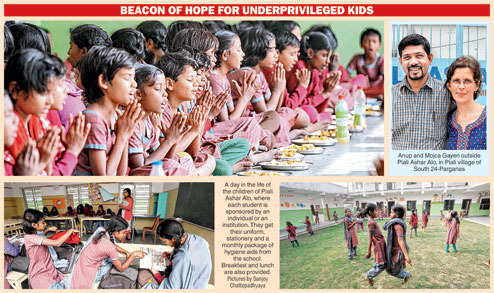
Anup and Mojca Gayen’s Piali Ashar Alo, in Piali village of South 24-Parganas, isn’t just an extraordinary act of charity. It is a mission spanning continents and small contributions – from Mojca digging into her personal savings to provide Rs 12,000 as seed money to students of 30 schools in Slovenia collecting newspapers over two years to sell them in bulk and raise Rs 4.5 lakh for a plot of land.

The school, which had started out from a rented space in February 2008, has since gone from a class of 12 students to a roll call of 140, mostly children of daily-wage earners, van rickshaw-pullers, fisherfolk and brick kiln workers. Most of the students are girls.

The genesis

Anup, 45, had always wanted to do something for the underprivileged, a feeling that found an echo in wife Mojca, 38. She was on a six-month internship in India in 2006 when she decided to leave her job as a psychologist in Slovenia and stay back.

“If there is no education, children of the poor will continue to remain poor. I believe that if not all, at least 50 per cent of our students will grow up and stand by another poor child,” says Anup.

In the early days, Anup and Mojca would go from door to door to convince parents to send their children to Ashar Alo. The school still sends teachers to homes in the village, but only to ensure that the seats are filled by children who wish to study.

Each student, from kindergarten to Class VII, is sponsored by an individual or an institution, most of them based abroad. They get their uniform, stationery and a monthly package of hygiene aids from the school. Breakfast and lunch are provided too.

The school has two floors with open-plan classrooms and a playground spread across a bigha and two cottahs of land. The building was designed by a Slovenian who was then studying architecture and had spent a year in Piali observing the place, its people and climate.

“He took note of how most villagers spend a lot of time on the verandas of their home and felt that his design should reflect that. So we have open classrooms,” explains Mojca.

The playground bustles with energy during a break between classes, badminton and skipping being the students’ favourite activities. This they are allowed to do only after they have finished their meal and cleaned up, for etiquette and discipline are as important at Ashar Alo as learning to read and write.

The school also teaches its students to dream. Twelve-year-old Sanchita Mondal’s father earns a living as a hawker on local trains, but she aspires to be a doctor. She is one of three students from Ashar Alo who now go to a CBSE-affiliated English-medium school in Sonarpur, about 5km away.

“We are not from rich backgrounds but the importance of education was obvious to our families when we were young. But the importance of education is not obvious to many in Piali,” says Mojca.

Ashar Alo’s focus is on educating girls, although the school remains a co-ed institute. “Women must learn to read and write. Even at home, they should not have to listen quietly to everyone who has an opinion. They should be able to speak and go to the bank or the post office,” says Mojca.

According to Anup, “80 per cent of the girls in the area” wouldn’t go to school until the start of the previous decade.

Momina Bibi, who works in the school’s kitchen, is one of them. Her daughter Jasmina Khatoon is a Class VI student, though. “I couldn’t study but I want my daughter to earn a decent living,” says the 29-year-old.

Many girls leave their education midway to get married. A six-year-old who studies in the school also accompanies her grandmother to beg.

A couple of years ago, the school started charging between Rs 30 and Rs 50 a month from the parents of some children who can afford to pay the fees. “Otherwise, they tend to take everything for granted,” explains Anup.

Flashback

Anup remembers carrying hay on his head and helping his grandfather graze cattle. It was a life he would have probably continued to lead in Champahati, the village next to Piali, had his mother not sent him off “with a pair of clothes, a plate and a glass in an aluminium box” to catch a train to Sealdah and from there to Behrampur.

He was eight then and headed for the Children’s Home run by the Christian Mission Service. He next moved to Azimganj, then Bhadrakali and again to Konnagar College to complete his education. In 1993, Anup enrolled for a mechanical and motor vehicles training course at the Industrial Training Institute near Kanyakumari. He topped his batch.

His first job was with a courier service in Calcutta that earned him Rs 700 a month. A succession of jobs later, he found his calling in educating needy children. “I owe my education to a German lady. We would write to each other but I never got a chance to meet her then, because it was meant to be confidential,” says Anup.

But he finally did manage to meet her in the middle of 2008 when his wife helped track Haide Marie Schneider in Germany through a friend who had searched the “telephone dictionary and managed to locate her despite Schneider being a common name”.

“I travelled to Germany to meet her,” he recalls.

Wife Mojca first came to India in 2006. “I had always wanted to serve poor children…and I went to Africa and then came to India…not to travel but to serve. But my work was for a limited period and I didn’t intend to stay,” she recalls.

That was, of course, until she met Anup. “I had a wish and he had more experience in the field and we decided to do it together,” says Mojca.

Funding

After Ashar Alo started, Mojca wrote to people she knew in Slovenia for help. One of them, Romana Jordan, mobilised schoolchildren to collect newspapers and sell them to raise the money that helped buy a plot.

Christlicher Entwicklungsdienst, a German NGO, came into the picture after one of its members visited the “empty plot with a gate” and offered to help. “Given our resources, we would have maybe built 10 rooms in 10 years!” says Mojca.

Another German organisation called FAMI helped the couple build the boundary wall. “Before them, there were only individuals and families sponsoring us,” says Mojca.

Today, she and Anup can look back at a job well done, altgough far from complete. “Not many might know about us in Bengal, but not less than a million people know us in Slovenia,” smiles Anup.

What message do you have for Anup and Mojca? Tell ttmetro@abpmail.com

source: http://www.telegraphindia.com / The Telegraph,Calcutta,India / Front Page> Calcutta> Story / by Jhinuk Mazumdar / Monday – February 01st, 2016
Mamata Renames Bengal’s Raj Bhavan Suites to Shed British Legacy

Kolkata :

West Bengal on Wednesday renamed all the suites at the Raj Bhavan, official residence of the Governor, to shed its British legacy. The palatial house, built in 1803 by the British when Calcutta was India’s capital till 1911, and known as Government House had suites named after the British.

Now, the Prince of Wales Suite has been renamed Kaviguru Rabindranath Tagore Kakhsha and Anderson Suite Swami Vivekananda Kakhsha (Kakhsha means rooms). A State government official said, “All new names were personally selected by Chief Minister Mamata Banerjee. She felt that when foreign dignitaries visit the state and stay in the Raj Bhavan and find suites with British names even after independence, it sends a wrong signal.”

The former Prince of Wales Suite on the first floor in the northeastern wing is reserved for the President, Vice-President, Prime Minister and visiting heads of states.

The Dufferin Suite, named after Lady Dufferin, was renamed Kanchenjungha Kaksha, after the Himalayan peak, while Wellesley Suite, named after the former British Governor General in India, was renamed Sagar Kaksha, after the holy Gangasagar Islands in the Bay of Bengal.

Government House was designed by Brit architect Captain Charles Wyatt as a copy of the British manor house of Lord Curzon’s family at Keddleston Hall, Derbyshire, UK.

Mamata also plans to rename Dhakuria Bridge in the city after Hindu preacher Sri Chaitanya Mahaprabhu, as Chaitanya Setu, and the Jerut Bridge after the wife of Ramakrishna Paramahamsa, as Ma Saradamoni Setu.

source: http://www.newindianexpress.com / The New Indian Express / Home> Nation / by Arup Chanda / January 28th, 2016

40 Buddhist relics unearthed at Moghalmari in a single day

Kolkata / Midnapur:

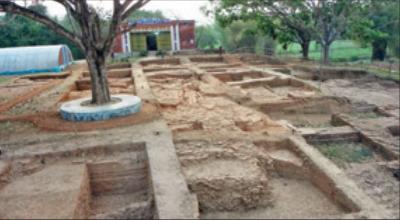
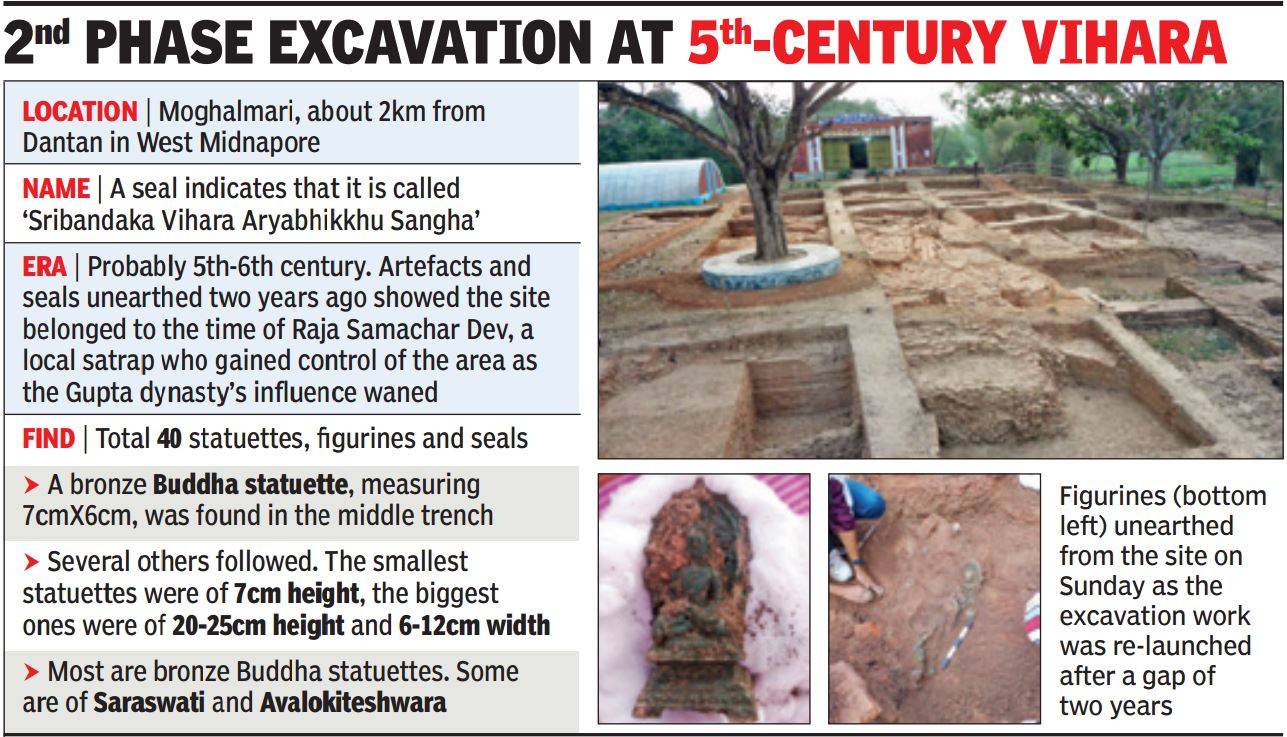
The ancient site at Moghalmari witnessed much excitement on Sunday morning when around 40 bronze artifacts, dating back to fifth and sixth centuries, tumbled out of the earth, as the state archaeology department re-launched excavation of the Buddhist vihara after a gap of two years. The digging work coincided with a two-day Moghalmari Festival inaugurated on Sunday.

BuddhistRelicsKOLKATA25jan2016

About two kilometres away from Dantan in West Midnapur as bronze artefacts dating back to fifth and sixth centuries started tumbling out of the ground, one after the other. The state archaeology department has re-started the excavations at the site after a gap of two years.

Around 11am, a bronze Buddha statuette, measuring 7cmX6cm, first surfaced in the middle trench of the site, which is about 2km from Dantan in West Midnapur. After this, several more statues of varying sizes started showing up to loud cheers from archaeologists as well as residents of the area. Monks from across the country, who have converged on Moghalmari for special prayers and seminars at the festival being organized by Kolkata-based Bauddha Dharmankur Sabha, were equally enthralled by the discoveries at the vihara, believed to be one of the oldest Buddhist sites in the country.

Of the area who gathered to watch the digging. A two-day Moghalmari Festival also started there on Sunday organised by the city based Bauddha Dharmankur Sabha. Invited by the Sabha, monks from across the country are camping at the site for special prayers and seminars. Naturally, the discovery of the bronze statuettes generated all around veneration for the site has already been established as one of the oldest Buddhist viharas of the country and definitely of Bengal.

While the smallest statuettes were around 7cm high, the biggest ones stood tall at 20-25cm, with widths varying from six to 12cm. While most were bronze Buddhas, statuettes of Saraswati and Avalokiteshwaras were also found. “We are going very slow with the digging work as relics are strwen across the entire zone. Finding over 40 antique figurines in a single day is definitely rare and prized. We are thrilled beyond explanation,” said Prakash Maity, who is in charge of the Moghalmari excavation. “Earlier, we found stucco figurines, gold, silver and mixed metal coins, pendants, votifs and seals.” The site dates back to the post-Gupta period when the dynasty’s influence waned and local satraps-here, Raja Samachar Dev, gained control. The pre-Pala phase of Bengal history was shrouded in mystery, experts said.

In fact, the state archaeology directorate halted the digging work as experts needed to analyse the coins and seals to verify the site’s dates. After research, historians were confirmed that they had found the key seal that revealed the vihara’s name as ‘Sribandaka Vihara Aryabhikkhu Sangha’ and the inscriptions on it established that the institute was founded and functioned in the 5th-6th centuries, if not earlier. The state government has decided to release funds for the new phase of excavation. Already, more than Rs 3 crore has been spent.

BuddhistRelics02KOLKATA25jan2016

Atanu Pradhan, a local enthusiast and secretary of Tarun Seva Sangha, who was instrumental in drawing the Calcutta University’s attention to the mound under which the vihara lay buried for centuries is elated. “I am sure that with time, archaeologists will stumble upon artifacts of greater value and the site will be officially announced a fifth-century vihara,” Pradhan said.

source: http://www.timesofindia.indiatimes.com / The Times of India / News Home> City> Kolkata / by Sujay Khanra & Jhimli Mukherjee Pandey, TNN / January 24th, 2016

Pandit Shankar Ghosh passes away at 80

Kolkata :

Pt Shankar Ghosh left for his eternal concert on Friday, aged 80. Born in Kolkata on October 10, 1935, the legendary tabla player was comatose for 40 days after an angioplasty. He is survived by his wife Sanjukta Ghosh and son Pt Bickram Ghosh.

Bickram Ghosh said, “Baba was the one man from Bengal who single-handedly took tabla to the heights that it has reached today. Tabla in Bengal was defined by him.” Pt Hariprasad Chaurasia said, “I heard about Mrinalini Sarabhai’s death today morning. And now, it is this news. I have played at so many concerts with him. It is a big loss.”

Last month, Ustad Amjad Ali Khan had visited him in hospital and wished him speedy recovery. Ustad Zakir Hussain had played his composition when he had come down to perform in the city this month. The iconic table player has been a guru to not just his son but also Pt Tanmoy Bose and Pt Arup Chatterjee. Nephew Pt Swapan Chaudhuri is devastated. “I lost my mother long back. When my father died last year, I felt reassured since my uncle was still alive. Jantam je boromama toh ache. He was always jovial and it pained me to see him in such a state in hospital,” he said.

Childhood memories with his uncle flooded his mind as Chaudhuri recalled his days with ‘boromama’. “He was my uncle, my friend and my mentor too,” he said. Memories of his uncle’s landmark concerts in Kolkata continue to inspire the table player who is based in California. Those days, Ghosh would accompany all the legendary musicians like Pt Ravi Shankar, Ustad Vilayat Khan and Ustad Ali Akbar Khan. “In the early ’60s, I had the good fortune of listening to his concerts in Kolkata, Allahabad, Maihar and Delhi. He was a regular at the Tansen Festival, the Sadarang Festival and the All India Music Conference. I still recall his recitals with Ustad Vilayat Khan and Ustad Ali Akbar Khan at two separate concerts at Mahajati Sadan. What concerts they were!”

His stint at the Ali Akbar College of Music in California was equally memorable. “At first, he had gone there in the early 60s. Then he came back to Kolkata. Later, between 1968 and 1972, he went back to California. When I started teaching in California, he had already returned to India. But there are such great stories of his contribution to music during his stay there,” said Chaudhuri, who described his uncle an ‘all-rounder with great skills of an excellent singer, talented composer and an author of short stories and novels”. “Not too many know that in sarod, he was a ‘ganda bandh shagird’ of Ustad Ali Akbar Khan. I have heard him play the sarod and he was excellent,” Chaudhuri recalled.

Tabla player Pt Anindya Chatterjee’s uncle was Ghosh’s disciple. That’s how Chatterjee had got introduced to the icon. “Every year, he used to come to our village in Dutta Pukur for a picnic. I would to sit on his lap and listen to him discuss music. Though I wasn’t his direct disciple, I have learnt so much from him,” Chatterjee said. Learning from Ghosh became a regular exercise when Chatterjee would go to listen to his concerts. “I would hear him accompany Ustad Ali Akbar Khan and Ustad Vilayat Khan. When it would get late at night, he would ask me to stay over at his Kabir Road residence. In the morning, he would go to the market and buy fish for us. So my lessons from him were accompanied with good food too!” he fondly recalled.

Most musicians agree that it is extremely rare to simultaneously become a great performer and a teacher. “Boromama excelled in both fields. That’s a rarity. His stage presence has always been an inspiration. While on stage, he didn’t fear anyone. That was so inspiring. I remember the first orchestra that he had formed. It was called Music of the Drums. That too was held at Mahajati Sadan. My mother was then alive. Bickram was still a kid then. Amar kaaj chhilo green room-e tabla miliye dewa,” said an emotional Chaudhuri.

Performance-wise, Chatterjee had noticed how Ghosh’s style of playing changed over the decades. “In the 70s, I was awestruck by his clarity and speed. I liked the way he introduced new techniques during accompaniment. Later on, I liked the richness of bol-bani and compositions. Even today, I often play some of his compositions on stage. Four months back when he came for my house-warming party, he told me that he feels happy when I say that I am playing his composition on stage!” Chatterjee said.

But what amazes both Chatterjee and Chaudhuri was Ghosh’s success as a guru. “He was the best guru I have seen in the music world after Pt Gyan Prakash Ghosh. From Bickram to Arup Chatterjee, from Parimal Chakraborty to Tanmoy Bose – all were his disciples. India, sadly, never recognised his true worth,” Chatterjee said. Chaudhuri added, “All these years, he never got his due. I am happy that Mamata Banerjee’s government had bestowed the Banga Bibhushan on him. But I believe, he deserved a Padhma Bibhushan.”

source: http://www.timesofindia.indiatimes.com / The Times of India / News Home> City> Kolkata / TNN / Priyanka Dasgupta / January 23rd, 2016

Moghalmari fest to bring ‘buried’ Buddhist vihara under limelight

Kolkata:

Buddhist monks from different corners of the country are set to converge on Buddhist monks from different corners of the country are set to converge on Moghalmari near Dantan in West Midnapur on January 24 to stake their claim on a newly excavated site, believed to be one of the oldest Buddhist viharas in India.near Dantan in West Midnapur on January 24 to stake their claim on a newly excavated site, believed to be one of the oldest Buddhist viharas in India.

What was written off as just a mound, which residents of the area believed to hide an ancient lore, has turned out to be a 5th century Buddhist site. The state archaeological department’s excavation has pushed the Raktamrittika Vihara at Karna Subarna in Murshidabad, dated 7th century, to the second position on the Buddhist religious map and calendar.

The Bauddha Dharmankur Sabha, headquartered in the city, has organised the two-day Moghalmari Buddhist Festival, which will see a rare congregation of monks at the site that dates back to the era of Raja Samachar Dev. This was the time when the Gupta dynasty had waned and local satraps had managed to shake off its suzerainty to declare their independence, Raja Samachar Dev being one of them. Most details of the pre-Pala age of Bengal is shrouded in mystery owing to lack of any historical evidence but now, scholars believe that the Moghalmari vihara excavation would help them piece together this past.

The excavation of the site, which had been put on a hold for nearly two years, will be taken up again from Monday. The state archaeology directorate had stopped the digging after archaeologists found coins and seals that had to be analysed to verify the site’s antiquity.

With the inscriptions on the seals finally ascertaining the fact that the vihara was founded and fucntioned during the 5th-6th centuries, if not earlier, the state government has decided to release funds for the new phase of excavation. Already, more than Rs 3 crore has been spent.

“A total of 6,400 square-feet area has to be dug up. So far, we have been able to work our way through less than 2,000 square feet. There is a lot of work to be done. Apart from the stucco figurines, gold, silver and mixed metal coins, pendants, votifs and seals, we have also been able to unearth a seal that describes the vihara as the Sribandaka Vihara Aryabhikkhu Sangha. The vihara did not grow in one phase. So far, we have come across evidence that pinted at the fact that the establishment flourished over second and third phases. We will not stop till we get to see traces of the first phase of the vihara’s development which might put the dates back even further,” said Prakash Maiti, director of the Moghalmari excavation site and a senior archaeologist of the directorate.

During the festival, the Bauddha Dharmankur Sabha will organize special prayers and meditation sessions to spread the message of Buddhism. Visitors will be taken on tours through the excavated courtyard, pradakshin path, the cells in which the monks lived. Seminars have also been organised on Tagore’s writings on Buddha and how his teachings had inspired Vivekananda.

While on one hand, the festival would write a new page in Buddhist religious history, it would also help catapult Moghalmari from obscurity to an important position on the map of ancient Indian history.

“This phase is especially important to us because we will look for more seals to finally establish the name of the vihara. Also, we might stumble upon the first phase of the vihara’s growth while excavating further. We have not yet reached the Garba Griha,” Maiti said.

District magistrate of West Midnapur J P Meena said a lot of interest has already been generated around the forthcoming festival.

source: http://www.timesofindia.indiatimes.com / The Times of India / News Home> City> Kolkata / by Jhimli Mukherjee Pandey & Sujay KhanraJan / January 10th, 2016

Women-only chauffeur service ready to hit road

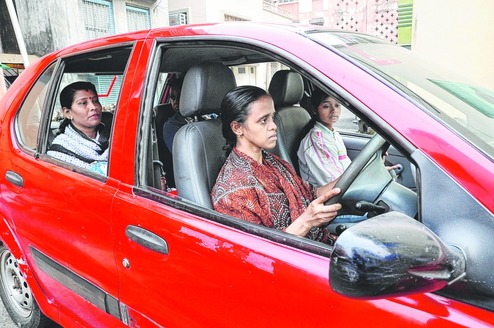
A woman aspiring to become a chauffeur-on-call at the wheel with a trainer watching over her. Picture by Sanat Kumar Sinha

A woman returning home alone in a cab at night need no longer make her family and friends anxious. Come February, she will have the option of choosing a woman to steer her home safe.

Calcutta’s first women-only chauffeur-on-call service is apparently the launch pad for a regular taxi fleet with women drivers in less than a year.

The Azad Foundation, a non-profit-organisation that had launched the service first in Delhi in 2008 and recently in Jaipur and Indore, has trained around 500 women as drivers and is looking to fill a gap in Calcutta that has become pronounced in recent years.

“We keep getting mails and phone calls asking when women drivers would be available here (in Calcutta). For now, only the chauffeur-on-call service would be available. This will be just like hiring a private car for a few hours,” said Dolon Ganguly, programme director at the Azad Foundation.

Nine women aged between 20 and 35 have trained for six months to become as adept at changing a flat tyre as they are at changing gear. Another nine are being readied to become chauffeurs-on-call by May. Sometime next year, the first batch would be eligible for commercial driving licences to work as cabbies.

In a city where taxi drivers often refuse passengers on a whim, the advent of app-cab services like Ola and Uber changed the way people could hire transport even in the dead of night. But from the perspective of women on the move, the women-only chauffeur-on-call service has the potential to be a game changer.

A large section of women in Calcutta who work till late in the evening are exposed to the possibility of harassment the moment they hire a cab with a male at the wheel. Women returning from a night out face the same plight and are often left with no choice but to call family members or male friends to escort them.

“There is always the fear that the driver will take a wrong turn and take me to an unknown location. Screaming on a deserted road wouldn’t help; so I remain extra alert whenever I am in a cab at night. If I have a woman at the wheel, I wouldn’t need to keep a finger ready to dial a helpline,” said a young fashion designer who works in a New Alipore studio and often needs to take a cab at night.

The nine chauffeurs ready to hit the road next month in crisp green uniform with red collars feel just as empowered. “I had never thought about learning to drive a car until someone told me about this job opportunity. My first day at the wheel was scary. But as time went by, driving a car came naturally,” said Khurshida Begun, a mother-of-one from Rajabazar.

Each of the women has received training in first-aid, basic English, gender sensitisation and Wenlido, a self-defence module popular in many parts of the world.

The last round of evaluation that each candidate needs to clear to start working as a professional is conducted by the Azad Foundation’s revenue-earning unit Sakha, which also takes care of placements.

Programme director Ganguly said the training programme had been designed to give each of the trainees at least two-and-a-half months at the wheel under supervision.

The period is sometimes increased, depending on individual need.

Shehnaz Khatoon, 18, is one of the aspiring chauffeurs in the second batch. “I had always dreamt of flying a plane, although that didn’t become a reality. But I get the same thrill out of driving that flying a plane would have given me,” she said.

Shehnaz plans to surprise her father in her uniform once she completes the training, which she was encouraged to join by her mother.

Would you hire a woman chauffeur? Tell ttmetro@abpmail.com

source: http://www.telegraphindia.com / The Telegraph, Calcutta,India / by Monalisa Chaudhuri / Front Page> Calcutta> Story / January 08th, 2015

‘An Indian singer with an international tone’

Kolkata :

When the news of the demise of singer Subir Sen broke out on Tuesday morning, many echoed that it was the end of an era, an era where an Indian musician mastered an international tonal quality and impressed not just with his singing and compositional skill but also his large-hearted nature.

Sen was 82 when he succumbed to cancer on Tuesday at a private nursing home in the city . He is survived by his daughter.

Known for his work in Chhoti Bahen’ and ‘Katputli’ in Bollywood, Sen is popular for his songs like `Dheere chalao zara’ with Lata Mangeshkar and `Humein un rahon par’, besides his hits in Bengali like `Oi ujjawalo dwip’ and Eto sur aar eto gaan’.

Chief minister Mamata Banerjee condoled his death.In her tweet, she wrote: “Saddened at the passing away of legendary singer Subir Sen. He is our Banga Bibhushan. He will always be in our hearts.”

Music director Abhijit Banerjee, who had composed Monalisa tumi ki bolona’ for Sen, described the singer as a king with a big heart and a wide perspective’. While the initial stage of his career saw him singing Hemant Kumar’s songs, Sen had soon graduated to carve a niche for himself. “From Jim Reeves, he picked up the tonal quality .From Nat King Cole, it was the drama that appealed to him.He punched the two style to create an international tone.He even learnt ghazal during his stint in Mumbai,” Banerjee said. Going back in time, he recalled how Sen had made him listen to Jim Reeves’ `I hear the sound of distant drums’ and `Snow Flakes’.”The first song inspired me to compose `Saradin tomae bhebe’. The first line of `Snow Flakes’ song inspired me to compose `E jeno shei chokh’. Nat King Cole’s `Mona Lisa’ helped us to create our own `Monalisa’ in a different form,” he recalled.

Few know that Sen was a good composer too. Sen had composed for an international film called `Midnight’ that had Geeta Dutta, Mohammad Rafi and himself singing in the soundtrack. It was an endearing relationship that Nirmala Mishra shared with him.”One day , I was speaking to him in a certain tone and he told me: `You are talking like a pishima!’ That’s how I got my name `pishima’. In return, I said that I should have the liberty of calling him `pishemoshai’,” Mishra said.

Sabita Chowdhury , wife of music director Salil Chowdhury , said, “Subir-da was very close to our family . My husband used to like his style of singing. He specially composed `Dhoronir pothe pothe’ and `Pagol hawa’ for him.” On being asked the similarity between Sen and Hemant Kumar, Chowdhury said, “His voice has a softness to it and a texture that was different from that of Hemanta-da.”

Singer Banasree Sengupta was impressed with Sen’s acting skills too. “I remember going to watch him film `Momer Putul’ where he had acted opposite Sabitri Chatterjee,” she pointed out, adding, “Composer Sudhin Dasgupta and he were friends. I was a favourite student of Sudhin Dasgupta.When Subir Sen came over to discuss Puja songs with my guru. I would also tag along to be a part of those musical sessions. I regret my luck that I could never sing a duet with him,” she said.

While in Bollywood, Shankar Jaikishan seemed to have kar Jaikishan seemed to have a special liking for Sen. The composer duo account for Sen most well-known songs. “Who can forget his `Manzil wohi hai’ from `Kathputli’?” Sengupta wondered aloud. No one is sure why Sen returned to Kolkata despite a successful stint in Mumbai. Mishra claimed that it was because of “internal politics that prevented his rise in Mumbai”.

But Sen never cribbed publicly and was happy to be singing in Bengali. “He deserved much more recognition than what he got. While remakes are common at reality shows these days, nobody dares to sing his songs,” Sengupta said. The reason, Banerjee pointed out, is his “international sound”. In unison, music industry believe that there will never be another Subir Sen who has so much of `sur’ and `gaan’ in him.

source: http://www.timesofindia.indiatimes.com / The Times of India / News Home> City> Kolkata / Priyanka Dasgupta, TNN / December 30th, 2015