Category Archives: Arts, Culture & Entertainment

Lessons of life on 22 yards – The bat stands for intellect and the ball weaknesses of the mind. Brinda Sarkar tunes in

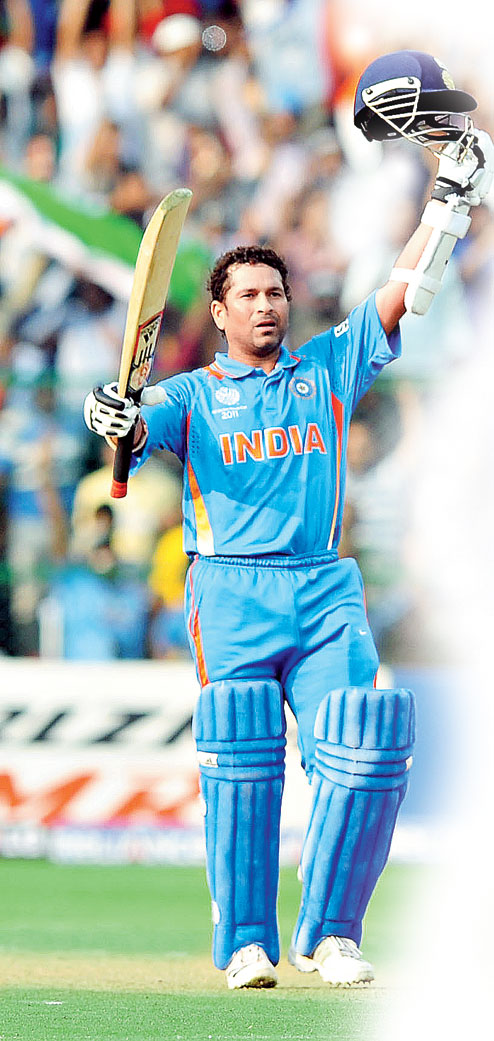
If cricket is a religion, Sachin Tendulkar is God

More than Vedanta, cricket is a religion in India. It unites the country and Sachin Tendulkar is god,” began L. Ramaswamy, of the Vedanta Academy, as the audience broke into titters.

Ramaswamy was addressing a gathering at Bharatiya Vidya Bhavan and the audience comprised members of IIT Kharagpur Alumni Association, Salt Lake Chapter. The association was hosting the meet in collaboration with Bharatiya Vidya Bhavan and the topic for discussion was “Vedanta and cricket”.

Life, he said, is a lot like a game of cricket. “Cricket is a batsman-centric game. The batsman wants to score but every ball coming at him tries to get him out. The ball symbolises the weaknesses of the mind. The way the ball can be slow, fast, spin or swing the mind can be overcome by emotions like lust, anger, greed, jealousy etc and they can get us ‘out’,” Ramaswamy explained.

The batsman only has one weapon — the bat — which symbolises a person’s intellect. “The mind is like a river trying to overflow with emotions but if the banks (intellect) are strong the river will reach its destination as well as nourish the land it passes. But if the banks are weak the river will flow off course, flood and destroy wherever it flows.”

The cricket ground is like our life, he explained. For instance, the crease is our spiritual discipline and the fielders are the sense objects trying to get us “out”. This happens if we fall prey to the temptations of our sight, taste, touch etc. The runner is our only friend and this symbolises “satsang” or getting together for spiritual development. It is with the help of the runner that the batsman at first starts scoring singles. It is later, after he is set that he aims for fours and sixes to increase his run rate.

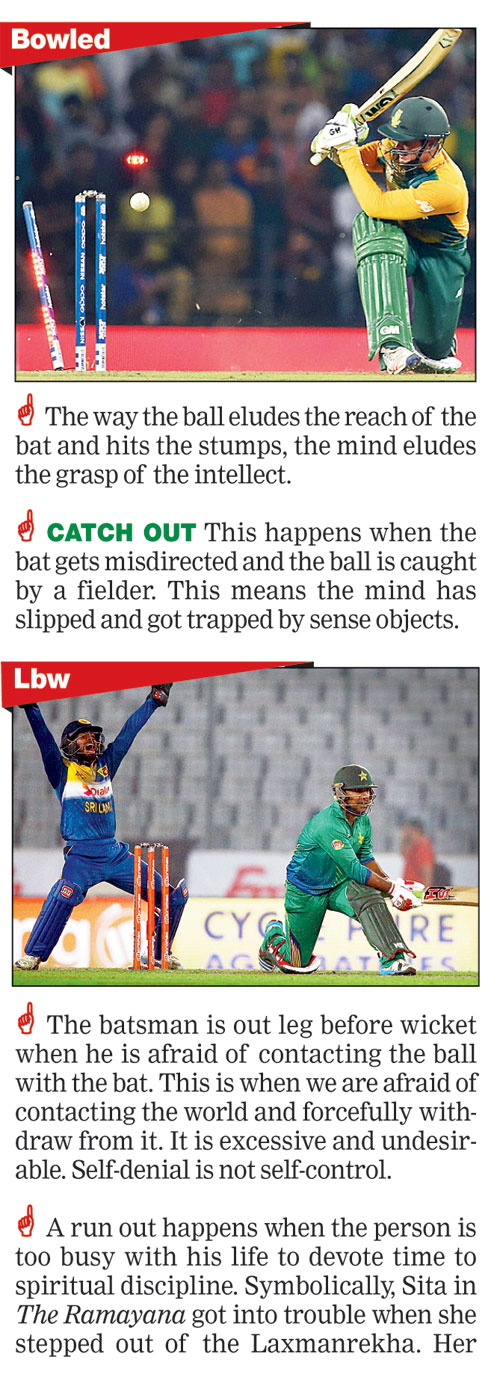
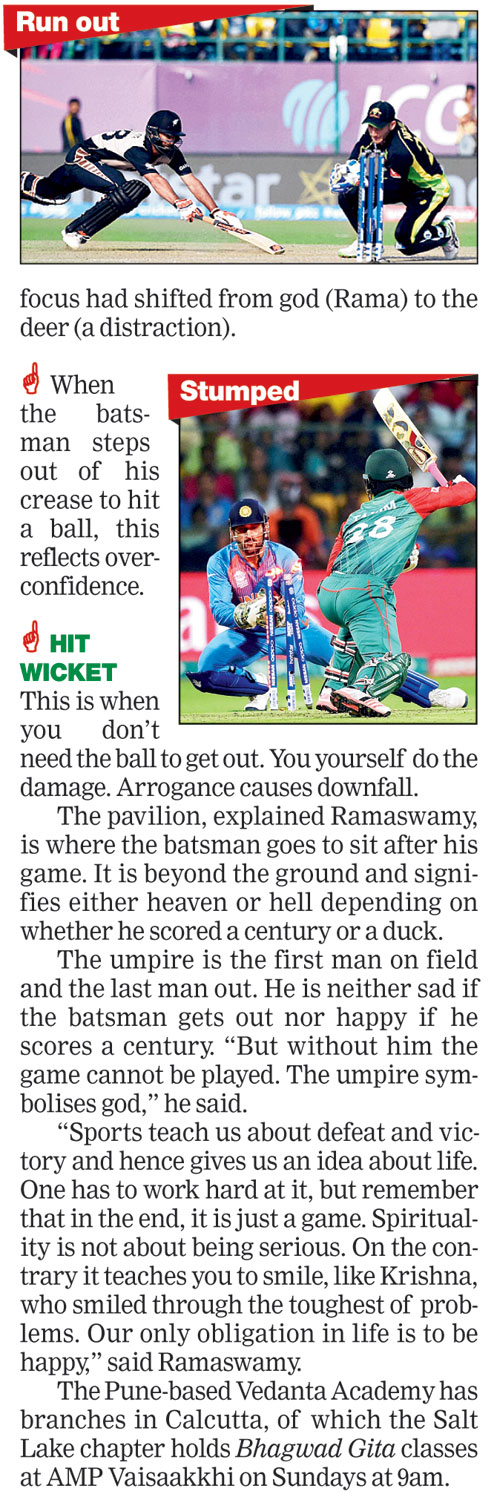
Ramaswamy then picked up every form of dismissal in cricket and found parallels with life —

Cricket01KOLKATA02apr2016

Cricket02KOLKATA02apr2016

source: http://www.telegraphindia.com / The Telegraph,Calcutta,India / Front Page> Salt Lake> Story / by Brinda Sarkar / Friday – April 01st, 2016

Pages from city’s past – Young Metro

The 88-page book with a black-and-white cover may not grab eyeballs, but flipping through it will make one realise what a treasure trove it is.

The first edition of Uttaradhikar, brought out by the Oriental Seminary archive, is not a mere school journal but a compilation of memoirs and tales about the city from a host of writers.

The bilingual publication edited by C.P. Ghoshal, a teacher at the school and in-charge of the archive, took around eight months to put together. “I wanted the contributors to write about Chitpore or their school memories or about the history of Calcutta in the 18th and 19th centuries. A publication by a school that goes back to 1829, should bring out the flavour of the various periods that it has been part of,” he said.

The book, being sold for Rs 50, has write-ups from current and ex-students as well as from historians and researchers. The English essays are by Subha Das Mollick, the founder-member of Bichitra Pathshala, and Mary Ann Dasgupta, an educationist.

Mollick writes about the Our Living Memory project that involved several schools in the city. The project attempted to link family history and collectibles to history textbooks and underline the latter’s relevance in today’s world. Dasgupta takes readers on a tour of St. Paul’s Cathedral and its relics.

Other contributors include historian Soumitra Srimani, researchers Simanti Sen and Rajat Kanti Sur and current student Ayan Ghosh.

There are six write-ups in Bengali – a heady mix of Calcutta in the 19th century, Chitpore’s culture, old boys’ memories and a current student’s journey. The book cover, designed by a former student, is a throwback to Chitpore’s popular woodcut printing.

The book was launched by former student and academician, Ashok Chowdhury, the current principal of the school, Diptiman Kundu, and Srimani at a cultural programme on the school premises.

source: http://www.telegraphindia.com / The Telegraph,Calcutta,India / Front Page> Calcutta> Story / by Chandreyee Ghose / Friday – April 01st, 2016

The call of tabla

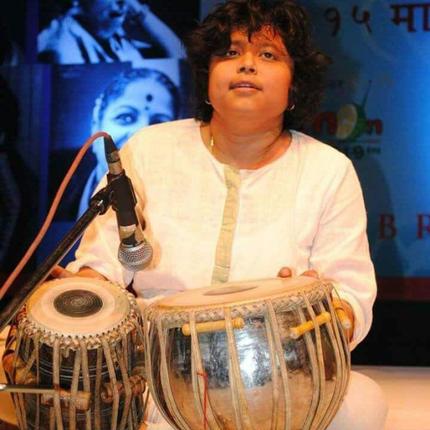
Tabla player Rimpa Siva.

Tabla artiste Rimpa Siva on her passion and why she has no role models.

Hyderabad :

At three, when most of her friends were busy playing with dolls, Rimpa Siva was mesmerised with the sounds of tabla that resonated at home. She would sit next to her father pandit Swapan Siva, a respected tabla artiste and guru in Kolkata as he taught his disciples. “Initially, my father thought I would either choose vocals or some other instrument but never imagined I would take to the tabla,” she reminisces. However, her teacher-father saw the lingering passion in the child and began with the basics of tabla. “He realised my ‘shaukh’ for tabla was not casual and felt if he tutored me, I would take it forward.”

With her father’s guidance, Rimpa Siva was hailed as a child prodigy and she gave a stage performance in Kolkata when she was just eight! She soon started giving performances in music festivals and concerts; a high point was her performance in USA when she was in Standard VI. It was followed by performances in Holland and UK.

As a teenager, did she miss out on going out with friends? “I never felt anything like that. Tabla mera sab kuch hai (It is everything in my life,” she states. Her passion and accomplishments earned laurels and a French documentary titled ‘Rimpa Siva Princess of Tabla’ was made in ’98. “The crew came to Kolkata and shot the documentary in 26 days. They showed my school, the environment, the time I spent for practice and training sessions with my father. The documentary showed how I spend my day,” she recalls with a smile.

Speaking about her riyaaz, Rimpa states, “There is no set time. Sometimes, I practice for three hours. When I play tabla, I am lost in it and do not know how much time I have spent. I guess it is the same in any creative field. When you are passionate, it becomes a part of your being,” she points out.

The 30–year–old says the audience is very appreciative of her tabla concerts. “Woman playing tabla is no big deal for the urban crowd,” she says and adds, “Tabla is not easy to learn. “There is no gender issue but playing tabla requires dexterity and concentration. In singing too, one has to sit for long hours and practice; so that is not an issue. Only thing is we play with the fingers and women’s fingers are delicate,” she explains.

Rimpa belongs to the Farukhabad gharana and delights in playing kaida, peshkar and gat. Her inspiration is her father but she has no role models. “One should strive to be unique and not try to be someone else. If you try to be someone else, that will be a copy,” she smiles.

All-woman band
Formed a year ago, Nari Shakti, an all-woman band is another significant feature of her artistic career. “I play the fusion tabla and there are women musicians playing instruments like Pakhawaj and sitar. I wanted to encourage women musicians to come forward. The response has been good. For this year’s Woman’s Day, we did a show for television in Kolkata on March 17,” she states. Among the tabla artistes across the country, Rimpa makes a mark as a woman tabla artiste. What is unique is the fact that she has carved a place for herself among the male tabla players across the country.

Rimpa adds how music has taught her the truth of life. “I have interacted and observed many people. I have realised that our hearts have to be pure with no malice. If you cause pain to others, that pain will come back to you. One should also never lie and hurt others.”

(Rimpa Siva was in Hyderabad recently for a performance at State Art Gallery as part of the National Exhibition of Contemporary Art 2016.)

source: http://www.thehindu.com / The Hindu / Home> Features> Friday Review / by Neeraja Murthy / Hyderabad – March 31st, 2016

Baroness bats for Bengali books – Life peer on digitisation drive

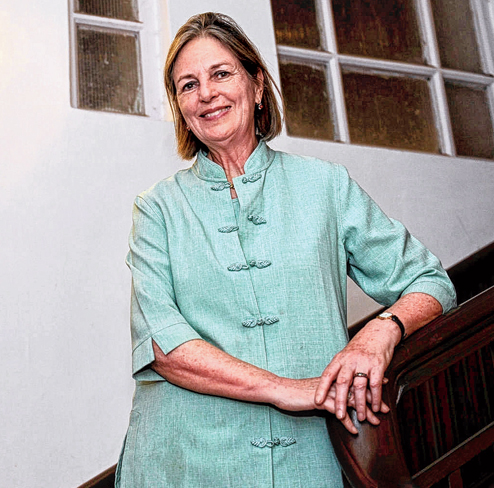
Baroness Tessa Blackstone at Bengal Club on Thursday evening. (Sanjoy Chattopadhyaya)

Baroness Tessa Blackstone, the chairman of the British Library, is in Calcutta to speak with various stakeholders in a massive British Library project to digitise its collections of South-Asian language printed books dating from 1714 to 1914.

Digitisation will not only preserve the rare and priceless — and often brittle — books for posterity but also make them available to people across the world, transforming the scope of research in these languages.
Titled Two Centuries of Indian Print, the project is expected to encompass 22 South Asian languages and some 11 million pages.

The first phase involves the British Library’s collection of early printed Bengali books as well as the cataloguing of these resources, for which the library is collaborating with the School of Cultural Texts and Records at Jadavpur University, Srishti Institute of Art, Design and Technology, Bangalore, National Library of India, the National Mission on Libraries and other institutions in India as well as the library of SOAS, University of London.

On Thursday, the 73-year-old Baroness visited Jadavpur University and met with the university registrar and some senior professors to discuss how this project would take shape and move forward.

“This was an official meeting regarding the pilot project for Two Centuries of Indian Print that we have been talking to the British Library about. Among other things the baroness spoke about the importance of digitisation as well as funding avenues in future,” said Abhijit Gupta, an associate professor at Jadavpur University, who is one of the co-investigators in the project.

On Friday, Baroness Blackwell will meet with Arun Kumar Chakraborty, the director-general of the National Library to discuss digitisation and collaboration between the national libraries of the UK and India.

Name: Tessa Blackstone
Title : The Rt Hon. the Baroness Blackstone of Stoke Newington
Politics: Labour MP, House of Lords. Former minister for education (1997-2001) and former minister for the arts (2001-2003)
Current posts: Chair, British Library board, and chair, Great Ormond Street Hospital Trust, among others
Former posts: Vice-chancellor of Greenwich University, Master at Birkbeck College and lecturer at London School of Economics, among others
Family: The baroness was born in 1942. According to The Guardian, “her father was the chief fire officer for Hertfordshire, her mother an actress and model for the House of Worth in Paris.” House of Worth is a French house of high fashion that specialised in haute couture and perfumes

source: http://www.telegraphindia.com / The Telegraph,Calcutta,India / Front Page> Calcutta> Story / by Staff Reporter / Friday – March 25th, 2016

Chinese Indians fight shy of politics, netas

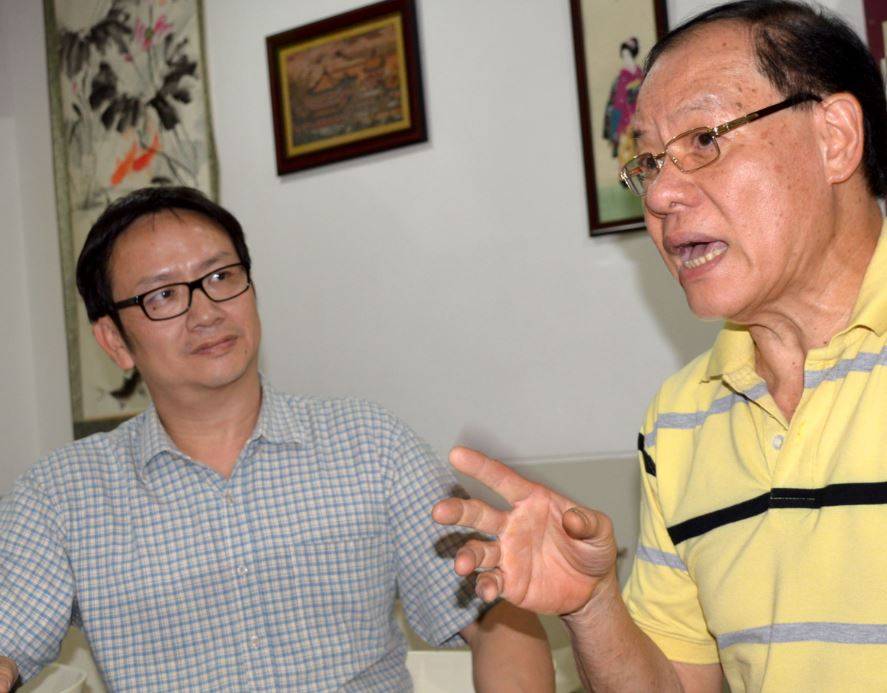
ChineseKOLKATA23mar2016

Kolkata :

The Chinese community is finally emerging from the ghettos at Terreti Bazaar in north Kolkata and Tangra in the east. A realization seems to have dawned on the community that has resided in Kolkata for over two centuries that they need to come out of the cocooned existence and assimilate with rest of Kolkata.

“For generations, Chinese Indians have lived in an insular world. The thinking has been that money will solve all the problem. But it does not. We have to connect to better the condition,” said Bean Ching Law, president of Chinese Indian Association (CIA), who has been persuading senior citizens in the community to get out of their shell.

Tannery owner Chi Chiang Wu, who was born in Kolkata in 1947 but had to struggle for nearly two decades to finally get an Indian passport, said the past continued to haunt the elders. Only Chinese born after 1951 became naturalized citizens.

“The persecution and internment of Chinese at the concentration camp in Deoli, Rajasthan, left a scar that took decades to heal. Hundreds left for foreign shores. When things were just beginning to settle down, the tannery shift happened that devastated many families. Some more Chinese migrated. These twin incidents added to the sense of unease that had prevailed in the community as few could initially converse in a language other than Chinese. The sense of being looked upon as foreigners despite being born here also led to the introvert behaviour,” Wu explained.

Though there were over 20,000 Chinese Indians split between Terreti Bazaar and Tangra till the 1970s before migration began and numbers rapidly dwindled, hardly anyone voted. The language barrier meant that most didn’t understand the nuances of Bengal politics. Also, no political party ever bothered to engage with the community till a decade ago as the 3,000-odd voters in the community split are split between two constituencies and do not make a substantial vote bank. Incidentally, 70% of the eligible Chinese Indians vote now.

Hsieh Ying Hsing, owner of restaurant Big Boss, said though the community was gradually opening up to other communities, they remained wary of politicians. “One reason why even the politically conscious Chinese Indian does not express support to any party in public is the fear of getting identified and persecuted. Since we are Chinese and look different, it is not just the individual but the entire community that could get marked,” he reasoned.

CIA is making a conscious effort to integrate with the mainstream and impress upon community elders the need to involve local politicians and bureaucrats in Chinese festivals and celebrations. Though the proposal met with stiff resistance, Law is hopeful of cutting through the ice.

“Today, we cannot survive without political leaning. The elders and women in the community feel insecure. We have to be practical and discard the baggage of the past,” said Law, an architect by profession.

source: http://www.timesofindia.indiatimes.com / The Times of India / News Home> City> Kolkata / by Subhro Niyogi & Sumati Yengkhom / March 22nd, 2016

Old boys get together to give back to their alma mater

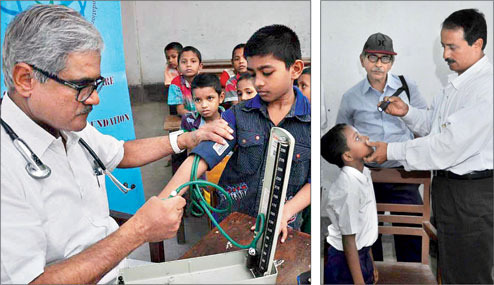
Rabin Chakraborty examines a student and a free eye check-up camp on at Uttarpara Government High School on Sunday. Pictures by Anup Bhattacharya

The 1972 batch of Uttarpara Government High School, which calls itself UGHS72 Soulmates, has got together to give back its due to its alma mater. On a Sunday morning, the classrooms are abuzz with children and their parents. Aritra Ghosh of Class IV cannot read small letterings and so Bablu Ghosh his father, a BSNL employee, has brought him to the free eye camp organised by Soulmates with the help of a medical trust, the Salt Lake City Global Health Welfare and Social Research Foundation.

“The doctor said he is myopic and will have to be given glasses,” said Bablu, who also got his eye power checked for free. Aritra’s classmate Arka Pramanick, probably wanted to spend the Sunday morning with his friend. “He came and complained that he cannot read properly and told me that the school was going to have an eye camp. So I brought him here to get his eyes checked,” said Narendra Pramanick, a tailor at Bally, Howrah. But Arka’s eyes are just fine, assured the ophthalmologist at the camp.

Not just eye camp, a general health camp was also held at the school by the Soulmates earlier. Leading cardiologist Rabin Chakraborty, psychiatrist Moloy Ghoshal, both of who belong to the ’72 batch, and oncologist Arundhati Chakraborty participated in the camp to assess the physical and mental wellbeing of the children and their parents in the school. “I was shocked to find young children and their young mothers suffering from hypertension and stress,” said Chakraborty.

“I found a Class III child had blood pressure that measured 124/86. It is dangerous. On top of that he was obese. I found out that he hardly does any physical activity. He watches cartoon shows on television most of the time,” said Chakraborty. And his mother, a 41-year-old, suffers from hypertension with her blood pressure reading 164/96. “I found out from her that there was a lot of tension at her home. Though they live in a joint family, the kitchens are separate. The husband works at the race course. She knows that she has hypertension and is undergoing homeopathy treatment but she is not regular with her medicines. I prescribed medicines for her and counselled her on how to cope with stress,” said the cardiologist.

The camps are aimed to increase health awareness. “I always tell them to avoid the four Fs, Fast Fried Fatty Food,” said Chakraborty. Oncologist Arundhati Chakraborty does family history screenings and symptom screenings at the health camps. “I try to make them aware about breast and cervical cancer,” she said. Psychiatrist Moloy Ghoshal has also held a stess management programme, all under the aegis of Soulmates.

It was in 2013, prior to the WhatsApp boom, that the batch of 1972 of Uttarpara Government High School got together. “It was Jhantu Banerjee, based in Delhi, who got us together. Out of a class of 78, a total of 65 got together. Unfortunately, eight of us are no more. So without wasting time, we met with the motto of giving back to the school what it gave to us. We want to help the teachers, help the present students and also improve the infrastructure of the school,” said Dipankar Roy, member of Soulmates.

A cycle stand for the school children funded by the alumnus is just the beginning of this journey.

source: http://www.telegraphindia.com / The Telegraph,Calcutta,India / Front Page> Calcutta> Story / by Special Correspondent / Monday – March 14th, 2016

Gold crown dug up at Moghalmari in West Bengal

Kolkata:

Excitement and expectation over the Moghalmari excavation site near Dantan in West Midnapore peaked on Monday as the state archeology department, which is digging up the ancient Buddhist vihara ruin, confirmed that it has found a portion of a gold crown over the weekend.

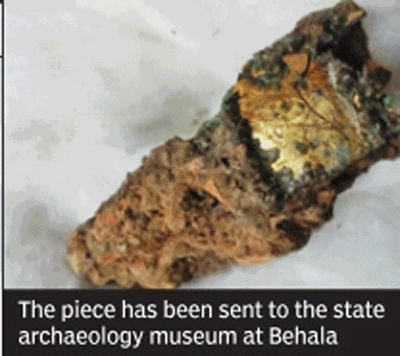
GoldCrownKOLKATA12mar2016

Archaeologists say the find is extremely rare since gold and silver ornaments have almost never been dug up at Buddhist excavation sites. The recovered piece, 7.5x4cm in size, looks like the tip of a crown set in a chunk of terracotta, probably part of a Buddha statue. It has been sent to the state archeology museum at Behala for further examination.

The Moghalmari vihara is gradually emerging as one of the oldest in the country, dating back to at least 6th century if not older. A large number of statuettes, pottery fragments and bronze items have been recovered from the mound since excavation re-started in January. Recently, gold coins bearing the name of Samachar Deva, a king of the pre-Pala dynasty, were dug up.

“We were stunned to find the portion of the gold crown.We feel it was part of the main Buddha statue of the vihara. Gold ornaments were normally not part of Buddha statues. But the Vajrayana sect of Buddhism worshipped what was known as the Crown Buddha. It seems this gold crown was worn by a Crown Buddha,” said Prakash Maity , the chief archaeologist at the site.

“It is possible that the Moghalmari vihara received royal patronage during the pre-Pala times from Samachar Deva, a local satrap who came into prominence in south Bengal after the fall of the Guptas in 550 AD. Notably, king Shashanka had not emerged on the scene yet.Again, while this crown might be indicative of religious harmony , Shashanka was a Shaiva and might not have been too kind towards other religions. Naturally , these matrices have to be studied while establishing the antiquity of the vihara,” Maity said.

He went on to suggest that since Moghalmari was part of an important trade route, the gold ornaments might have been gifted by traders. Two important seals have already been discovered that suggest the name of the vihara was `Sribandaka vihara’.

source: http://www.timesofindia.indiatimes.com / The Times of India / News Home> City> Kolkata / TNN / March 08th, 2016

An indigo planters’ journals

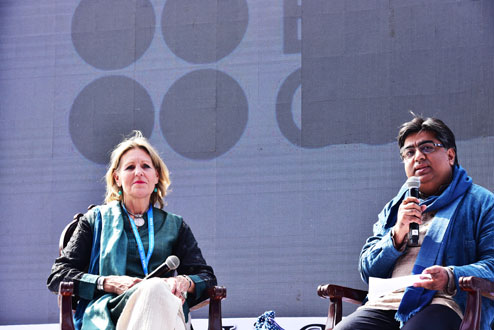
Jenny Balfour-Paul with Bappaditya Biswas at Kolkata Literary Meet on January 24. Picture by Anindya Shankar Ray

“It was serendipity,” said Jenny Balfour-Paul about how he chanced upon Thomas Machell’s journals in the British Library. She was speaking at the Tata Steel Kolkata Literary Meet, in association with the Victoria Memorial and The Telegraph on January 24.

Balfour-Paul’s book, Deeper than Indigo, based on these journals, seemed to her like a natural progression from her earlier works. For, it was indigo that lured her to Machell and shaped the 15 years of her life that she spent pursuing his trail.

Machell was a midshipman in the merchant navy and an indigo planter. He had travelled on an Arab ship dressed as an Arab and read the Bible to strict Muslims. He was taken aback at how much they had in common. Machell’s plea for religious tolerance is much more relevant now than it was in his times, said Balfour-Paul.

Balfour-Paul objects to her obsession with Machell being called a love affair across time. Yet, she seemed quite taken when it was pointed out that the Bengali translation of her book’s title, Ghana Shyam, not only means the darkest blue but is also another name for Krishna, bringing to mind an image of Radha and the themes of separation and union.

“It was a compulsion to know more about Machell and his spiritual search” that led Balfour-Paul to follow his path. Machell would love the way the world is connected at present, said Balfour-Paul, adding that had he been around he would probably have been quite active on Twitter.

Machell was ahead of his time in his empathy for the “natives” and his “criticism of colonialism”. His journals bear witness to him repeatedly “grappling with his conscience”. Machell, when he wrote the journals, only wanted to be heard. Balfour-Paul recalled how when she came across the first draft of the book, she shouted to the sea: “I’ve got you out there now.”

source: http://www.telegraphindia.com / The Telegraph,Calcutta,India / Front Page> Calcutta> Story / by Srimoyee Bogchi / Tuesday – March 08th, 2016

Experts to Document Ashoka Circuit in State

Kalaburagi :

A joint initiative of HKRDB and Calcutta University to document an Ashoka Circuit for Karnataka from Sannati to Siddhapura has been launched.

Head of Ancient History Department of Calcutta University Prof Susmita Basu Majumdar is the Principal Investigator. As part of this expedition, a documentary will be filmed and a pictorial Pali-English-Kannada dictionary will be compiled.

Karnataka has perhaps the largest number of Ashoka sites and those dating back to the 3rd century BC are the earliest legible records found from Afghanistan in the northwest, Andhra Pradesh in the south, Odisha in the east to Girnar in the west. The project will first document all the Ashokan sites in Karnataka and then establish the full circuit from Afghanistan.

AshokaBF02mar2016

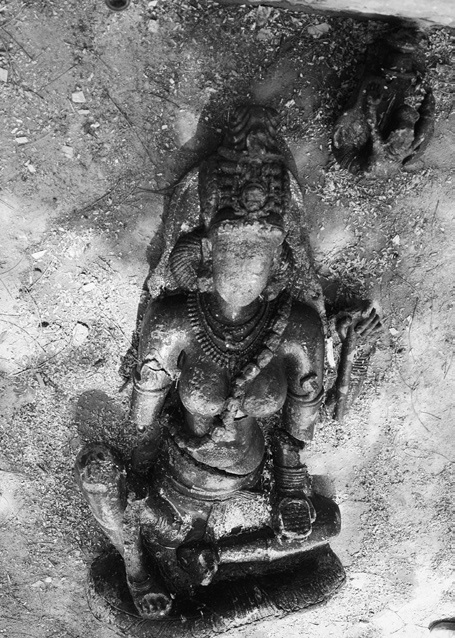
A team of three, Prof Susmita Basu Majumdar, artist Rajib Chakraborty and film maker Ranjay Ray Choudhury visited the Chandralaparameshvari temple at Sannati on Sunday, to document the spot where the Ashoka edict was found. They found the original idol of deity Mahakali broken into four pieces lying on the western side of the temple on the banks of river Bhima.

Prof Basu Majundar took the initiative to re-join the idol and narrated the interesting story behind the discovery of the Ashoka inscriptions. In 1986, a portion of the roof of the temple collapsed and caused damage to the 12th century seated four handed figure of goddess Mahakali wearing mundamala and holding damaru, trishula, kapala and sword.

Presently, this beautiful piece of sculpture only shows the trishula and kapala and the other two hands are broken but the temple authorities informed that the present image of Chandraparameshwari which is worshiped in the temple is a replica of the previous Goddess.

The khandita pratima of the deity lying on the banks of Bhima was almost awaiting the visit of this team and when the sculpture was joined it looked as if the beautiful Goddess had reappeared.

The idol base had a protruding pillar like hinge which was fitted into a stone socket. The stone on which the Ashoka inscription was engraved was used to form the base of this deity. When the idol was damaged, the inscription was discovered.

This inscription carried the separate edicts one and two and rock edits 12 and 14 of Ashoka (274-232 BC). Karnakata was the southernmost boundary of the Ashoka’s Mauryan Empire.

This inscription was discovered in 1989. Now the original idol which is about 600 years old is also restored to the temple. The matter is being reported to the ASI for further action.

source: http://www.newindianexpress.com / The New Indian Express / Home> States> Karnataka / by Express News Service / March 02nd, 2016

Rebel at seventy-one – Eternal quest of a thinking mind

by Sunanda K. Datta-Ray
SasthibrataKOLKATA28feb2016

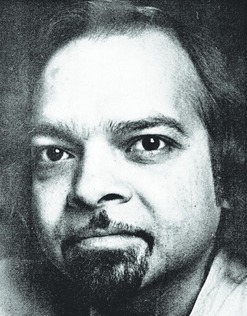
Sasthi – I could never bring myself to use the contrived Brata surname – was dead long before he died. If publicity is oxygen for terrorists, Sasthi demanded recognition as a writer. Despite the impressive bravado, it must have killed him telling me on a visit to Calcutta that he sold air-conditioners in London and no longer thought of himself as a writer. Decades later Amitendu Bhattacharya of The Third Realm blog quoted him saying, “‘A Writer’ is one who writes, not someone who has written or is going to write.”

In a forgotten long ago Sasthibrata Chakravarti, to restore his birth name, blazed across Calcutta’s sky like a meteor driven by its own angry passions. What he had to say and the way he said it resonated with his peers. But he was dead in every sense when Pujitha Krishnan of Aleph Book Company approached me because M.J. Akbar wanted to include him in “a collection of India’s greatest journalism”. For a while I assumed whispers of his demise were greatly exaggerated. Sasthi once wrote his doctor had given him only six months. Another column poetically described the sunlight shining through the long golden hair of his (actually his partner’s by another mate) little daughter whose days were cruelly numbered. Sasthi survived those six months to pick fights with many men in many bars. He and his partner had gone their different ways before the little girl’s time was up. If, indeed, it was up and the whole thing wasn’t another self-advertising hoax.

Partha Sen at the Delhi School of Economics first mentioned his death. Bikash Sinha in Calcutta thought it likely. Revealingly, Amit Roy in London knew nothing. Sasthi never had time for London Bengalis. When Roy did confirm the news in this paper three weeks ago, he had it from a British actor. I had already seen – belatedly – The Third Realm’s bleak announcement of September 16, 2011, “I am sorry to tell you that Mr Sasthi Brata has recently been diagnosed with liver cancer. The doctors have given him 2 to 6 months time.” I posted a message and wasn’t surprised when it wasn’t acknowledged.

Sasthi left behind a scattering of meteorites. Some were novels disguised as autobiographies, some autobiographies were fiction. “All my fiction has been supremely autobiographical,” he boasted. Sasthi couldn’t get away from himself. That, as well as a gift for delivering unpleasant home truths in ringing prose, may partly explain why he was more talked about than read. Someone who organized a debate at Calcutta’s Park Hotel with Sasthi and Tilottama Mukherji, who became Shashi Tharoor’s first wife, as speakers, described how “a crude remark by Sasthi aimed at Tilottama caused a massive ruckus resulting in a substantial bill for crockery and furniture damage”. There were similar scenes in Delhi. The frontispiece of his first book, My God Died Young, showed Sasthi with a cigarette striking an Oscar Wilde pose. Confessions of an Indian Woman Eater was dedicated to 50 girls. He must have gloated on the Traitor to India phrase in another book’s title.

He was 21 when we met. I was nearly 23 and felt ancient against his exuberance. The fact that I had worked on newspapers in England for some years before joining The Statesman in London widened the gulf. Deb Kumar Das, busy packing his bags to follow a then unknown Gayatri Chakravorty to the new world, introduced us in the Olympia bar which nursed Left Bank pretensions in the Sixties. They had attended P. Lal’s Writers Workshop which published Sasthi’s Eleven Poems in Lal’s trademark saree binding. Sasthi had also briefly flirted with journalism: Philip Crosland of The Statesman discovered his genius when he was a shoeshine boy in Delhi. He had outgrown Writers Workshop and The Statesman. They languished in the mofussil. He would shine in London.

It was a brave decision. Sasthi had no contacts there but suffered from the Bengali obsession with London that has given Calcutta an imitation Big Ben. Brought up in middle class Entally, he grieved that “south of Park Street” was terra incognita. Like Nirad Chaudhuri, he invested cheese (which both discovered late in life) with cultural symbolism. But he refused to give the deference Chaudhuri expected. Sasthi was entitled to his pride. My God Died Young had just been published in London. He attacked me at the launch for wearing a three -piece suit. His chic friends wouldn’t approve. I explained I had come straight from covering a House of Lords debate. It made no difference. At dinner afterwards at L’Escargot restaurant in Soho he had a flaming row with Brenda (“but for whom the book would not have been possible” gushed the dedication) with whom he lived in Chelsea. “Throw him out,” urged her friends. “Just put his things on the doorstep…” The party threatened to split into camps. Sasthi spared me an uncomfortable choice. A few honeyed words and all acrimony vanished.

Bengali London, licking its wounds, was cock-a-hoop when a smart-alecky critic wrote Sasthi should hitch up his dhoti before attempting his next novel. But any comment by that reviewer, especially a long notice in a highly regarded Sunday paper, confirmed My God Died Young had made a mark. Those were early days for Indians in English fiction. G.V. Desani ( All About H. Hatterr) and Raja Rao (The Serpent and the Rope) had gone. Vikram Seth and Amitav Ghosh had not emerged. It filled Sasthi with frustrated fury that instead of being regarded as a mainstream English writer he floated in “Indo-Anglian” ambiguity. He was mightily offended when Brian Lapping, whom the Wall Street Journal called “the acme, the Rolls-Royce of documentary makers”, said he sounded like me. “He lumped us together as Indians!” Sasthi stormed. “It’s all right for you, you live in India. I am a Londoner. I can’t afford to be typecast.” He rebelled against the categorization as he had rebelled against his upbringing. So much resentment made him increasingly embarrassing company. Perhaps Sasthi himself saw the absurdity. “Well, you can’t be a rebel at seventy or near about seventy, can you?” he asked an interviewer. He was shooting a line even then. He was not “near about seventy”. He was 71.

Sasthi disappeared. His articles no longer appeared in any British newspaper. His column in The Statesman – I often wondered if he regarded it as a triumphant return to the world of letters or consolation prize for not making it in Fleet Street – had ended long ago. People didn’t want to know when I inquired about him on visits to London. He told The Third Realm he had been working for 20-25 years on a novel titled Damned by the Rainbow. I gathered he turned his hand to any job he could get – lavatory attendant, postman, kitchen porter – to supplement Britain’s state pension. Then, seeing his byline in Outlook, I found out his email address – email didn’t exist when we were in touch – and sent a welcome-back message. His instant reply ordered me to use my influence as editor of The Statesman to arrange two weeks’ free stay at the Oberoi Grand. I explained it would have been impossible to do that even if the paper and I hadn’t parted company 14 years before. How do you live then? he demanded. End of correspondence.

I hope he was at peace with himself at the end. “Rimbaud stopped writing poetry at nineteen… Jesus was crucified at thirty-three; Jack Kennedy was shot in Dallas at forty-six. I am twenty-nine years old. What have I done? What am I capable of doing? Who am I?” he asked in My God Died Young. Even if Sasthi had said everything he had to say, those questions reflected the eternal quest of a thinking mind. They deserved answers.

source: http://www.telegraphindia.com / The Telegraph,Calcutta,India / Front Page> Opinion> Story / by Sunanda K. Datta-Ray / Saturday – February 27th, 2016