Bangladesh deputy high commission in Kolkata this week observed the setting up of first Bangladesh government in Meherpur in 1971. They held the programme at Aurobindo Bhawan as it was the place where for the first time outside Bangladesh their national flag was hoisted, as the new government had its base in Kolkata.
The priovisional government of Bangladesh was established on 10 April 1971 in the town on Baidyanathtala in Meherpur, Kusthia, while Mujibur Rehman, Bangabandhu was not in Bangladesh. The day is celebrated as Mujib Nagar, when the first government of Bangladesh started functioning.
A seminar was organsied at Aurobindo Bhawan and journalists Manas Ghosh and Bhabesh Das who had witnessed the Liberation war narrated their experiences.
Zokey Ahad, deputy high commissioner of Bangaldesh also spoke on the event. SM Ali, high commissioner of Bangaldesh also narrated how important was Aurobindo Bhawan during the independence of Bangladesh.
Even a photo-exhibition was also held at ICCR where 180 plus pictures of the Liberation War and that of Mujibur Rehman were also displayed.
source: http://www.timesofindia.indiatimes.com / The Times of India / News Home> City> Kolkata / Debashish Konar / TNN / April 19th, 2016
Chess pieces from Mohenjodaro made of terracotta, a Tibetan stirrup, dashavatar cards from Bengal, playing cards from Rajasthan made of leather, and toys made of terracotta will be on display at the Indian Museum during the World Heritage Week starting April 19, in connection with World Heritage Day, which falls on April 18.
The theme for this year as decided by the International Council on Monuments and Sites (ICOMOS) is, ‘The Heritage of Sport’.
“The chief purpose of celebrating World Heritage Week is to increase awareness and to encourage the people about the preservation and safety of the cultural heritage and monuments of the country,” said Sayan Bhattacharya, education officer of the Indian Museum.
“Made with materials like bones, snail-skins, marbles and terracotta, these pieces tell us the history of prosperity of a country, which is embedded in the success story of sports and entertainment,” said Tanuja Ghosh, senior guide lecturer of Zoology at the museum.
The stirrup, brought down from Tibet, is made of iron, ingrained with gold damacine (works from Damascus) work whereas the chess pieces made of stone and terracotta, are from the Indus Valley civilization. The dashavatar playing cards made of cloth and paper are from West Bengal.
Now-a-days, cricket having almost gobbled up every other sport, regional sporting traditions are being lost. “Games like pittu, danguli (gilli danda), daria bantha which were very famous while we grew up, have hardly been even heard of by today’s generations,” said Jayanta Sengupta, director of Indian Museum.
On this occasion, a lecture-cum demonstration will also be organised by the museum authorities, where “Visitors will get to know how these regional games were once played,” said Sengupta.
The exhibition will kick off on 18 April through an internal lighting ceremony. “As the museum remains closed on Mondays, the exhibition will be open to the public only from Tuesday and continue till 30 April,” said education officer Bhattacharya.
Present only in the history pages, these artefacts are being brought out from Indian Museum’s reserved collection, and have been selected from the Art, Anthropology and Archaeology section of the museum.
World Heritage Day is globally celebrated every year on 18 April to raise public awareness about the diverse cultural heritage of mankind; about the efforts that are required to protect and conserve it; and to draw attention to its vulnerability.
source: http://www.thestatesman.com / The Statesman / Home> Bengal / by Shreyosi Chakraborty, SNS / Kolkata – April 17th, 2016
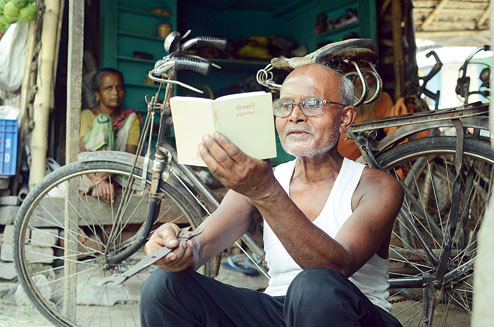
Kashi Nath Naskar reads a Tagore poem in his CK Market shop. Picture by Shubham Paul
Kobida’s shop?” That’s the response you will get from anyone in CK Market if you ask for directions to the local cycle repair shop.
An ageing man sits at the edge of the market all smeared in grease, tightening the bolts of a cycle. He answers to the name “Kobi” too. It’s neither his name nor surname but a title he has earned.
“My real name is Kashi Nath Naskar but since I’m always talking poetry everyone calls me Kobi (poet),” smiles the man. Naskar breathes poetry. He knows most poems in Tagore’s Gitanjali and Naibedya by heart and quotes British Romantic poet Samuel Taylor Coleridge and Urdu poet Daagh Dehlvi with equal felicity. And all this while oiling cycles.
Of fishing net and black robe Naskar is the first graduate in his family. “…in my village,” he corrects. He was born in Mahisbathan, behind what is now Sector V, in 1948. His mother was unlettered, his father had studied till Class III or IV and he has four brothers. “We are fisherfolk and milkmen but I loved studying and completed my B.Com from Maharaja Srish Chandra College, Shyambazar,” he says.
It was in college that Naskar borrowed Gitanjali from an acquaintance and fell in love with it. “Since then, I started reading whatever I could lay my hands on. I also started writing poetry.”
Naskar wanted to study law thereafter or join the West Bengal Civil Service but couldn’t afford the courses. “The rich people in our village wanted to pull me down as I was getting more educated than them. They lobbied against my family and made it difficult for us to sell our products. For the next 15 or so years, I tried to form a co-operative of us poor fishermen and fight the rich in court. It didn’t work out. I had to give up my dream of working in an office,” says Naskar, his bespectacled eyes blinking away tears. “I was almost suicidal at that point but poetry kept me alive,” he says, beginning to recite Tagore’s Kothay Alo but getting interrupted by a customer walking in with a punctured tyre.
Wherever he did the rounds for government paperwork, he discovered libraries — at Writers’ Buildings, Commercial Library in Dalhousie Square, National Library in Alipore, Asiatic Society library… “We could barely afford food those days so there was no question of buying books. It is at libraries that I got to read the entire works of Sarat Chandra Chattopadhyay and many works of Bankim Chandra Chattopadhyay and Sunil Ganguly. My favourite novel is Tagore’s Shesher Kobita.
Tarasankar Bandyopadhyay’s Saptapadi was also great but not its film version,” he says.
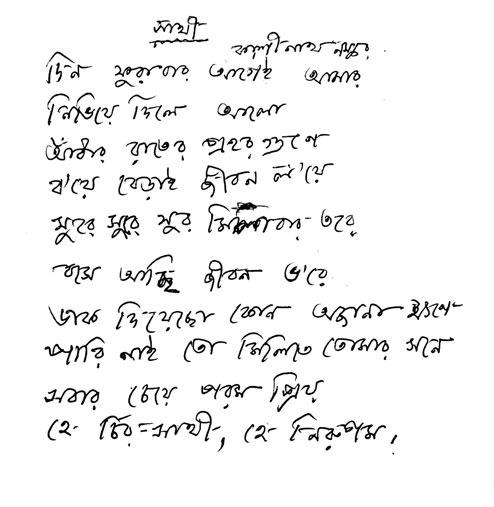
Part of a poem, titled Sathi, by Naskar.
Wrench to Gitanjali In the 80s, Naskar helped his brother start the sweet shop Panchanan Mistanna Bhander, that still stands in CK Market. His cycle repair shop came up a few years later.
“In the beginning, I was a fish out of water,” he recalls. “Wrenches were thrust into hands that only knew how to hold the pen. I had to learn everything from my employees.”
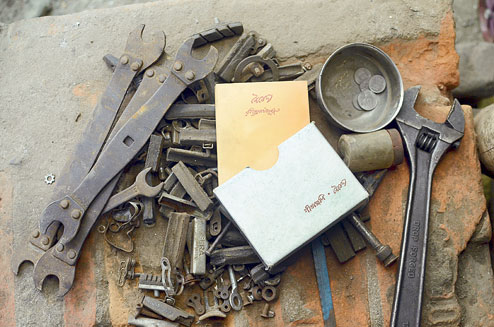
Even today a pocket-sized Gitanjali and Naibedya find pride of place amid his nuts and bolts. “I read them when I get tired of working,” he smiles. He knows the poems by heart.
Naskar writes poetry too. “My favourite subjects are god and peace although I also adapt Tagore’s poems such as Sathi and Duhswapna,” he says. “But since I work all day there’s not much time or energy to write these days,” says the 68-year-old.
Many of Naskar’s original writings got lost when he was shifting home a few years back but he’s not upset. “Dil gaya, tum ne liya/ Hum kya kare/ Jane wali cheez/ Ka gham kya kare,” he says, quoting a couplet by Urdu poet Daag Dehalvi.
Naskar got married some 25 years back and though his wife isn’t into poetry, his daughter is. “I don’t force it on her. She has done her graduation in geography and is studying animation now,” says the proud father.
His poetry books amid his repair kit. (Shubham Paul)
Everyman’s poet Naskar’s reputation has spread far and wide and residents come to chat with him about poetry or hear him recite.
“My husband Arnab and I come to CK Market for tea after our evening walk,” says Seemanti Dutta of AN Block in Sector V. “But truth be told, the tea is just an excuse to hear Kobida recite. He knows even long poems like Tagore’s Borsho Shesh by heart!”
Chittaranjan Bera, of Karunamoyee G Block, appreciates Naskar so much that he bought him the copies of Gitanjali and Naibedya that are his most prized possessions today. “I am a retired librarian from Konnogor College, so I encourage anyone who loves books,” he smiles. “His interest and talent are both extraordinary.”
Govinda Chatterjee of AL Block believes it is from poetry that Naskar draws his energy. “I am so impressed with Kobi that I had even invited him to come recite at our block’s Holi programme but he could not make it,” he says.
Not everyone admires Naskar’s talent. “Sometimes people get annoyed with my recitation and ask me to stop,” Naskar confesses.
“The other day someone said Tagore was overrated and that he was a bourgeois poet. I got livid and defended him. Shelley, Keats, Wordsworth, Byron are all great. I myself count Coleridge’s The Rime of the Ancient Mariner among my favourites,” he says taking a moment to recite the famous “Water, water, everywhere” line from the poem. “But have any of these poets been as prolific as Tagore? Have any of them contributed as much to literature?”
If he could, Naskar says he would read and write poetry all day. “But I have to work,” he says. “If you are a poet at heart then no matter what profession circumstances force you to choose, the poet in you will emerge.”
What is your message for Naskar? Write to saltlake@abpmail.com
source: http://www.telegraphindia.com / The Telegraph,Calcutta,India / Front Page> Salt Lake> Story / Brinda Sarkar / April 15th, 2016
Bengali communities enjoying their New Year (Poila Baisakh) through ‘Suryanamaskar’ . ( TOI photo: Anindya Chattopadhyay)
Kolkata :
As poll-bound Kolkata took a break on Thursday to celebrate Poila Baisakh, the Bengali new year, stand alone eateries and restaurants of major hotels rolled out new dishes to greet the Bengali gourmet.
Typical Bengali veg and non-veg items were served in some restaurants while lip-smacking street foods took centre stage in some.
‘Sonargaon’ of Taj Bengal rolled out specialities of the region like topse fish fry, kosha mangsho, echorer kaliya, shukto, radha bolobi, kacha aam er chutney.
‘The Junction’ of the same hotel introduced a specially crafted menu drawing heavily from street food items machher chop, mangshor chop, mochar chop to postor boda, a Taj Bengal spokesperson told PTI.
Joining two provinces of different frontiers, the Park Plaza introduced ‘Kapurthala to Kolkata’ culinary journey where ‘Macchi Amritsari’, Masala Aloo Dum, Sarson Ka Saag will complement Chingri Malai curry, Kadai Chicken and Doi Potol, Executive Chef Jayanta Banerjee said.
General Manager Avneesh K Mathur said the culinary route, reflecting the nature of both Punjabis and Bengalis to celebrate life, can be explored from April 13 to April 23.
At the speciality Saptapadi Restaurant, themed on Bengal’s evergreen matinee idol couple Uttam Kumar and Suchitra Sen, fusion is the buzz word with typical Bengali items like Mochar tarkari has been given a Latin American spin in ‘Tex Mex Nachos With Refried Mocha’.
Similarly, there is ‘Ranga Aloo, Karai Suti, Mangshor Pie’ (A Scottish dish made with Bengal mutton and sweet potato served with garlic bread and house salad), ‘Baked Dab Chingri Alaska’ and ‘Ilish Steak’, are also there.
Its chef and co-owner Ranjan Biswas said, “Timeless songs from Uttam-Suchitra films were played in the background when food is served on earthenware cutlery.”
‘Durbari’ and ‘Caf Swiss’ of the Swiss tel offered an array of mouth watering Bengali dishes even for overseas guests .
The ‘Bengali Food Festival’ offers a lavish spread of Gaach pathar chop (Crumb fried jackfruit patty), Agune pora parshe (Parshe fish marinated with freshly ground spices and cooked in tandoor), Posto diye potoler dolma (Stuffed sweet gourd cooked in spicy poppy seed gravy) etc, Subhrajit Bardhan, General Manager of the Swiss tel Kolkata Neotia Vista said.
source: http://www.timesofindia.indiatimes.com / The Times of India / News Home> City> Kolkata / PTI / April 14th, 2016
Visitors to Mother’s Wax Museum in New Town will be able to see a statue of pop icon Michael Jackson. (EPA/Representative Photo)
After seeing statues of Mahatma Gandhi, Rabindranath Tagore, Maradona, Ramkrishna Paramhansa, Mother Teresa, Amitabh Bachchan and many others, visitors to Mother’s Wax Museum in New Town will be able to see a statue of pop icon Michael Jackson.
In addition, they will also be able to see statues of various Hollywood stars like Angelina Jolie, who is a familiar face in India. These would become possible after the museum undergoes an expansion.
Hidco authorities have decided to add 12,000 square feet to the existing museum. The tender process is over and work has already begun. If things go as per planned, then the phase II of the museum will be completed and commissioned in six months from now.
The existing wax museum is also spread across 12,000 square feet and is located on the sixth floor of the Finance Centre building which is located opposite Eco Park.
The phase 2 of the museum will be located a floor below the existing museum. After expansion, the museum will have a total area of 24,000 square feet. Besides Hollywood stars, the expanded museum will have a place dedicated to statues of well-known personalities of the West.
In addition, the new museum will also have a children’s zone, a fun area, Limca Book of Records and light zones.
“The construction work began on Monday. We will have a lot of surprises for children in the zone,” Debashis Sen, chairman of Hidco, said.
“Not everything in the children zone will be made of wax,” he said. The chairman did not want to disclose names of other Hollywood stars whose statues would feature in the Limca Book of records zone.
The museum was inaugurated by chief minister Mamata Banerjee on November 10, 2014. Since then, the museum has recorded a two lakh footfall till date.
The country’s first wax museum, it has statues of famous personalities on the lines of Madame Tussauds wax museum in London. The museum gained immense popularity along with the Eco Park.
source: http://www.hindustantimes.com / Hindustan Times / Home> Kolkata / by Saptarshi Banerjee, Hindustan Times,Kolkata / March 25th, 2016
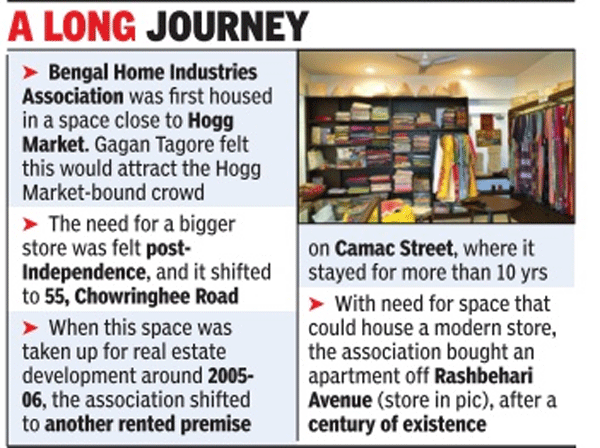
After 100 years, the Bengal Home Industries Association has finally moved into its own home.
Founded in 1916 by a group of intellectuals to give a boost to the swadeshi movement, the association had to run around from one rented place to another all these years. Touted as the country’s first NGO to promote Bengal’s handloom and handicraft, the association has bought its own outlet and reinvented itself to be in tune with the changing times.
The swanky outlet off Rashbehari Avenue is now ready to compete with other pan-India brands that promote handloom and handicraft. The focus has changed too: items for sale have been designed as lifestyle products to attract the urban cli entele. There is no shift from the basic theme of promoting village products, only that they are more stylish now.
In 1914, Rabindranath Tagore’s nephew, a prominent master of the Bengal school himself, Gaganendranath Tagore and his brother, Aba nindranath Tagore, along with some friends like Burdwan Maharaja Bijoy Chandra Mahtab and the royal family of Coochbehar, formed the association as a symbol of swadeshi. The idea behind forming the Bengal Home Industries Association was that it was not enough to just reject foreign goods but to also encourage our own weavers and craftsmen to make indigenous products. The association’s job was two-pronged: to network among village craftsmen and collect and sell their products.
The artist duo of Gaganendranath Tagore and Abanindranath Tagore added value and novelty to the products, making them a hit even with the elite clientele.
One such patron was Carmichael Duck. The story goes that Lady Carmichael -wife of the then Bengal Governor -who was close to members of the association, asked Gaganendranath to create some interesting designs that could be used on blocks. “Gagan Tagore created a motif of a duck created out of a simple geometric pattern.The design became popular overnight and was used widely for block printing on scarves, stoles and sarees,” said Nandini Mahtab, the “queen” of the Burdwan royal family and a member of the association.
The Bengal Home Industries Association has tied up with Banglanatak.com, a revivalist organization that is working on indigenous tangible and intangible art forms in Bengal. It is helping the association to use art forms, such as `patachitra’, on textiles to make lifestyle products like cushion covers, throws, runners and even tshirts and trousers.
The association was famous for items like its Portuguese cutwork and shadow work and a unique weave called Roshanara, which is created by mixing rayon and cotton yarn. “We have once again trained our artisans in these arts. While the Portuguese cutwork in home linen is available in our new store, Roshanara will make its entry any day now,” Mahtab added.
source: http://www.timesofindia.indiatimes.com / The Times of India / News Home> City> Kolkata / by Jhimli Mukherjee / April 11th, 2016
A research on the treasure trove of tea in India has earned an associate professor of art history at Syracuse University, with roots in Kolkata, the prestigious National Endowment for the Humanities Fellowship 2016.
Romita Ray is not oblivious to the crisis ailing the tea industry, but she is working to strike a balance between the desolation associated with the sector and the shining aspect of the golden brew. “These (starvation deaths at tea estates) are a reality of the industry, but one needs to balance the bleakness with identifying tea as a botanic exotic. After all, it’s a living history that continues to connect Kolkata and Britain even after so many years,” said the Loreto House alumna who migrated to the US many years ago.
Her unique research is set to culminate in a book, tentatively titled ‘From Two Leaves and a Bud: The Visual Cultures of Tea Consumption in Colonial and Modern India’.
This will be the second literary attempt by the Yale University scholar, who specializes in art and architecture of the British empire in India, her earlier work being ‘Under the Banyan Tree: Relocating the picturesque in British India’.
Her passion for the evergreen shrub seems to run in the family, her great grandfather, Tarini Prosad, being the founder chairman of the Indian Tea Planters’ Association in Jalpaiguri.
Her current project, funded by the exalting and year-long National Endowment for the Humanities Fellowship (NEH) 2016, will be her second literary attempt. NEH is one of the largest funders of humanities programs in the United States, and highly competetive.
Ray now is set to deliver her first “tea talk” in Kolkata on Monday at Victoria Memorial Hall, when she is going to deliver a lecture on ‘Botanical treasure, ornamental wonder: Aestheticizing tea in Britain and Colonial Calcutta’.
She will focus on how Chinese tea, once a botanical novelty in the 18th-century Britain, crystalized into a paradigm of the “tea time”, a fashionable culinary ritual in the 21st century Britain.
“Calcutta’s (‘Kolkata’ doesn’t roll off Ray’s tongue so easily) connection with tea goes back to the 18th century when East India Company started the Canton tea trade,” said Ray, explaining why she had to be in Kolkata, away from her classes in the US, for her research.
“My book is about the visual cultures and landscapes… it is about consumption of tea in colonial and post-colonial India. It looks at the tea plant as an ornamental curiosity, the tea planter (British and Indian) as a pioneer figure whose portraits are rarely discussed, and the tea plantation as a multi-layered landscape of cultivation and leisure.”
The book will not be launched soon. “Academic books take a long time to research and write,” Ray said. The task involved extensive research at museums, archives, private collections, tea estates and libraries in the UK, India and Sri Lanka.
Being the epicentre of the Indian tea industry, Kolkata houses the Tea Research Association, Indian Tea Association and the Tea Board, along with auction house J Thomas, and even tea companies McLeod Russell and Goodricke are headquartered here.
This is where she will find the East India Company records.
“The Shibpur botanic garden is a mine of information,” said Ray, who has visited Assam, Darjeeling and the Dooars and intends to travel to south India as well as Sri Lanka.
She also intends to dig out family records with the help of multi-generations of tea families.
source: http://www.timesofindia.indiatimes.com / The Times of India / News Home> City> Kolkata / April 10th, 2016
Seventy-two rare oil paintings by Rabindranath Tagore and other masters of the Bengal School that were lying in the strongroom of Rabindra Bharati University have been restored. The university authorities are also planning a public display of these paintings.
Most of these paintings by Tagore, his relatives, students and other legendary painters of the Santiniketan Kala Bhavan were in possession of the Jorasanko Thakurbari and were handed over to RBU when the house was converted into a state university in 1956. Some of these belonged to the Tagore family at Pathuriaghata.
After the Rabindra Bharati Museum was set up on the Jorasanko campus of RBU, several paintings by Tagore and his nephews, Abanindranath and Gaganendranath, and other family members were put up for display. But most of these were pencil sketches, water colour, crayons and pastels.
The Tagores were not known to have a great penchant for oil paintings, except when they were painting portraits or self portraits, feel scholars.
This makes ‘The Three Witches’ particularly so important. This is one of those rarest Tagore oil paintings, which has always generated a lot of interest among the scholars. However, it was never made available for public viewing. This, scholars say, is the most valuable painting in the collection, not only because it is a Tagore original but also because it was influenced by Shakespeare’s Macbeth. It is a dark painting showing three hooded women stirring the potion inside the cauldron. The three women are seen in moonlight and the suggestion of magic comes from a spark near the cauldron, deftly created by the light and shade used by the artist.
A portrait of Tagore by his grandnephew Subhogendranath Tagore was also restored. It’s a mammoth oil on canvas, that has been done by putting together geometric shapes. You have to move away from the painting to understand the pattern. “Today you have the concept of pixels in your camera. This painting, made more than 100 years ago, gives a perfect idea of pixel,” explained Indrani Ghosh, curator of the museum.
There are also some rare oil paintings by JP Ganguly, who also belonged to the Tagore family (he was Tagore’s elder brother’s daughter’s son) and Ramendranath Chakraborty, one of the most accomplished students of Kala Bhavan, Santiniketan.
It took two years for painting conservationists at the National Research Laboratory for Conservation of Cultural Properties (Lucknow) under the ministry of Culture to complete the job.
There were layers of dust all over the paintings, which were also torn in many places; in some the canvases had come out of the frames.
RBU is planning to hold a public viewing of all the 72 paintings at the ICCR.
source: http://www.timesofindia.indiatimes.com / The Times of India / News Home> City> Kolkata / by Jhimli Mukherjee Pandey, TNN / April 08th, 2016
The bells will again chime, the ancient clock tick and hymns resonate through the air as the 210-year-old St Olav’s Church is Serampore rises like a phoenix from the ruins.
St Olav’s Church of Fredricksnagore, as the Danes called Serampore, is being restored back to its former glory, with the first service being slated for April 16.
After decades, people will pray inside the 210-year-old church that has risen like phyoenix, not from ashes, but from ruins. St Olav’s of Fredricksnagore (as the Danes called Serampore) has been restored back to its former glory.
If the former Danish colony, which administered Serampore from 1755 to 1845, boasted of a landmark, it was St Olav’s, which was built from 1800 and opened to the public in 1806. Now, it is an example of one of the most successful conservation projects in the country.
A part of the “Serampore Initiative”-launched by the National Museum of Denmark (NMD) in 2008 with the revival plans for the former Danish colony monuments-the restoration of the church began in January 2015.
The Danes started building the church in 1800 and finally opened it in 1806., as a relic of the time when the Danish ruled Serampore.
From a distance, the church’s magnificence is not quite visible. But as one walks into the narrow alley, the majestic steeple of St Olav’s church which would be the identity of the Danish settlement on the banks of the Hooghly centuries ago-towers over. The clock in the tower is getting the finishing touches, symbolic of the eras gone by, and the ones to come.
But the grandeur of the project-now touted as a major collaboration India-Denmark collaboration-can be truly perceived only after entering the compound.
Bente Wolff, curator of NMD, to attend the historic moment of reviving the church, sounded excited: “The church looks new, not in the flashy sense, but in its authenticity. Very high standards of international restoration protocol are maintained. We are proud of the fruits of our hard labour.”
She recalled how Danish historian Simon Rasting and architect Flemming Aalund had meticulously conducted the pre-project social survey, hunting through archives in India and Denmark for original designs and photographs as part of the scientific analysis.
“Doing this in our own country would have been easier, but we loved the challenge and how all the stakeholders, especially the locals, helped us achieve this,” said Rastin, adding the project would not have been possible without the craftsmanship of Aalund and conservation architect Manish Chakraborti, chief conservation architect for the project and director of historic buildings conservation firm Continuity.
“St Olav’s can serve as a model for conservation projects,” said Chakraborti. “The restoration was carried out after thorough research.” for adopting an appropriate strategy executed with utmost care.”
Ashis Mukherjee, proprietor of Mascon, who is executing the project, said, “The greatness of the project lay in the filigree work, strictly carried out with lime and mortar.” Everything, from piecing together the almost-shattered marble tablet of J S Hohlenberg to recreating the timber of the roof-it collapsed in 2003 -that has been replaced with steel beams, polishing the church bells with ‘Frederiksvaerk 1802’ inscribed on them to restoring the original Burma teak furniture, is noteworthy.
History of St.Olav’s Church
‘Governor’ Ole Bie – born in Norway, buried in Serampore , Between 1755 and 1845 Serampore was administered by Denmark under the name Frederiksnagore. Until 1814 Denmark and Norway formed one kingdom
The longest sitting head of Serampore’s Danish government was the Norwegian Ole (Olav) Bie. During his service from 1776 to 1805 Serampore grew nto a prosperous town. In 1800 Ole Bie began the construction of a Lutheran church for Serampore’s Protestant citizens.
Originally planned as a simple three-aisle building with a flat roof, the church was later enlarged with an open portico in front, and a vestry and a spiral staircase behind the altar.
The church was completed in 1806, but Bie died in 1805 and never saw the final result.
An epitaph honouring his achievements can be seen in the Church together with five other commemorative tablets. Olav was a Norwegian saint, but it is not known when the name St. Olav’s Church came into use.
source: http://www.timesofindia.indiatimes.com / The Times of India / News Home> City> Kolkata / by Ajanta Chakraborty / TNN / April 07th, 2016
As many as six Bengali films have been shortlisted for the Cannes short film corner that will be held between May 11 and 22. They are among the 40 films from India to have been selected for the same section.
The selected short films are Anirban Guha’s ‘Elixir’, Abhiroop Basu’s ‘Afternoon With Julia’ (‘Cum Iulia Meridiem’), Aniket Chattopadhyay’s ‘Saubala’, Lubdhak Chatterjee’s ‘In A Free State’, Charles Kinnane’s ‘Generation Hope’ and Moumita Mondal’s ‘Adieu’.
Guha’s 35-minute film is about a journey that begins in a cafe. Basu’s film, starring Neha Panda and Samadrashi Dutta, is about a casual conversation between a young couple, while ‘Saubala’ is a fantasy drama that comes with the tagline – Rebirth of Shakuni. Mondal’s 12-minute ‘Adieu’ looks at a hospital ward through the eyes of a young boy admitted there. ‘In a Free State’ deals with the story of an aspiring filmmaker and an artist who paints amputated figures. They embark on a journey to explore the true essence of freedom when their choices are antagonistic to popular social norms.
While all these films are in Bengali, Kinnane’s 34-minute ‘Generation Hope’ has been made in Bengali, Creole and English. It was filmed at Mary’s Meals projects in Malawi, Haiti and India and shows what difference receiving a daily meal in school can make to children growing up in some of the world’s poorest communities.
An Economics masters from Kolkata’s Indian Statistical Institute, Guha works in a multinational bank. “I used to do theatre in school and college. Post that, I also did stage productions in Bangalore and Delhi. Eventually, I wanted to tell my story to more people and wanted to experiment further. That pulled me into filmmaking,” he said. His film stars Daminee Basu, Arindom Ghosh, Mahul Brahma and Dr Koushik Dutta.
Guha will be off to Cannes for the screening. Accompanying him will be wife Sinjini Sengupta, who wrote the story on which ‘Elixir’ is based. “When my husband decided to make a short film based on my story, the first question was finance. Some fixed deposits were dissolved. Good friends had volunteered to do their bit, too. Cast, crew, searches and many calls later, we found ourselves in Kolkata. Mine is basically a story of magic realism and a journey of the soul,” said Sinjini.
Basu claims he made ‘Afternoon With Julia’ keeping Cannes short film corner in mind. Samadarshi, who has already started receiving congratulatory messages, said, “Abhiroop is a young director, but I can say he is someone to watch out for. This film was part of his student project. I have watched some of his earlier works and they have a lot of promise.””After completing my schooling from South Point, I had studied commerce at St Xavier’s College. But I always wanted to make movies. My earlier films had gone to some festivals and won accolades there too. But none of that was in the league of Cannes,” Abhiroop said.
However, he won’t be making it to the French Festival. “For a middle class family, it isn’t easy to go to Cannes without any financial assistance. I am happy that my film is going. May be, some years later, I too will be able to make it to Cannes too,” he said.
But before that happens, Abhiroop will be off to Prague in September to study cinema at the Prague Film School.
source: http://www.timesofindia.indiatimes.com / The Times of India / News Home> City> Kolkata / Priyanka DasGupta / March 31st, 2016