Category Archives: Arts, Culture & Entertainment

From Hooghly to the Nile

All set to represent India at a festival in Egypt, dancer Dona Ganguly says the classical arts should get as much promotion as Bollywood and cricket
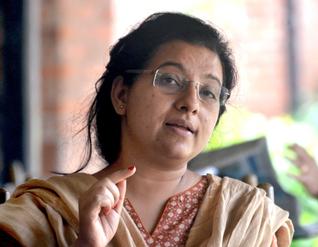
DonaGangulyKOLKATA02may2016

Long before she married former Indian cricketer Sourav Ganguly, Odissi dancer Dona Ganguly had been making news for her prowess in the art form. Having trained since age three under the likes of Amala Shankar and Guru Kelucharan Mohapatra, the dancer has come a long way. With several successful performances under her belt and a thriving dance school called Diksha Manjari, Dona is a force to reckon with when it comes to Odissi.

Now, the dancer, along with her troupe, is all set to take her art form from the banks of the Hooghly River to the Nile. She is to perform at the India by the Nile festival in Egypt. Dona talks about how arts play a role in diplomatic relations.

Excerpts from an interview.

Tell us about your journey as a dancer.

Just like kids in South India are expected to learn some classical art form, in West Bengal too we are supposed to join art, dance or music classes. My parents had first enrolled me for dance classes with renowned dancer Amala Shankar. From there on, I gradually gravitated towards Odissi. Not before long, Guru Kelucharan Mohapatra took me under his wing. I would either train under him at his house in Cuttack, or he would come to Kolkata and stay with us to teach me.

I never consciously decided to become a professional dancer, but after a steady stream of performances with Guruji and then as a soloist, I was a professional; without even realising it.

What are your views on events like India by the Nile?

Indian classical dance forms have a certain aesthetic value. They cannot and should not be presented anywhere and everywhere. More than politicians, who just want a cultural skit either before or after a major event, artists know the true elegance with which their art can be presented. An occasion like this festival gives one a chance to represent the nation at an international level with realistic and tasteful art.

What are you presenting at this festival?

I am planning to present traditional choreographies of Kelu baba such as ‘Saveri pallavi’ and ‘Shankarabharnam’, and abhinaya items like ‘Ardhanareshwar’ and ‘Naba Durga’. It will be traditional, because I wish to promote Odissi in its purest form.

What is Sourav’s take on your career?

Well, he’s often a silent spectator. Sourav never holds me back, but he also does not go out of his way to promote me. This is a blessing, since it lets me express my artistic sensibilities. It is a boon that I have a loving husband and a co-operative mother-in-law, who looks after my daughter when I’m practising or touring.

What is your opinion on the current situation of Indian classical arts?

I strongly believe that Indian classical arts should get as much promotion as Bollywood and cricket. Their popularity, to a large extent, is due to the glamour associated with their professions and the kind of promotion that is done. I often wonder what would happen if we were given just as much publicity. How easily we would have become celebrities and spread our art!

Sourav never holds me back, but he also does not go out of his way to promote me

source: http://www.thehindu.com / The Hindu / Home> MetroPlus / by Madhur Gupta / April 30th, 2016
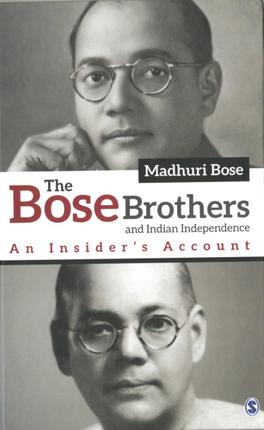
Eyewitness accounts

BoseBrothersKOLKATA30apr2016

A journey through the Indian independence movement of the 1920s through an illuminating collection of notes, letters and personal correspondence

Author Madhuri Bose, granddaughter of Sarat Chandra Bose (elder brother of Subhas Chandra Bose) and daughter of Amiya Nath Bose, takes the reader through the most important period of the Indian Independence Movement of the 1920s by reproducing the personal correspondence between the Bose brothers — notes and information collected mostly from her father who was an eyewitness to happenings during the crucial years of freedom struggle. She declares in her introduction, “this is not a biography of the Bose Brothers but based on family perceptions, insights and analyses of the roles of the key personalities, with a focus on Sarat and Subhas over the three decades from the early 1920s”.

The story is told mostly from the view of her father and his notes. Chapter 1 describes Amiya’s close connection with the Bose brothers, though they are physically separated. The narration is both informative and highly touching. She talks of the time Subhas was detained on January 2, 1932.

For a few months, he was allowed to stay with his brother Sarat in prison, but was shifted to Madras penitentiary where he became ill. He was then transferred to Bhowali in Northern India when the seriousness of illness was recognised. Subhas was then sent to Europe — by train to Bombay and then aboard a ship to Vienna on February 22, 1933. The authorities allowed young Amiya to accompany Subhas from Calcutta to Bombay. It was then that Subhas showed Amiya the copy of his hand written thesis on Hindustani Samyavadi Sangha that he had written during his Madras detention. Incidentally the contents were discussed with three members of Comintern (Communist International) later by Subhas in Vienna.

Chapter 2 deals with the difficult time faced by the family when the brothers were under detention by the British. In 1921, 24-year-old Subhas had returned from London after declining to join the Indian Civil Service and joined the movement for freedom.

While interned in Mandalay jail, Subhas wrote Pebbles on the Seashore, a collection of stray thoughts.

The third chapter deals with his reaction to Gandhiji’s suspension of the Non-Cooperation movement and the starting of a new daily with C.R. Das as editor and Sarat as Managing Director.

Chapter 4, the most important chapter of the book, deals with parting of the ways between Gandhiji and the Bose brothers. Copies of telegrams are reproduced here, indicating the beginning of the divide. On January 31, 1939, Gandhiji wrote of the defeat of his candidate Pattabhi Sitaramaiyya and concluded that he rejoiced at the victory of Subhas “. . . after all, Subhas Babu is not an enemy of his country.” In a lengthy letter, Sarat addressed Gandhiji on the prevailing condition in the Congress and how unhappy he was by the turn of the events.

However, at a later date, Gandhiji asked Amiya to convince Sarat to join the Congress again, and Amiya, in hindsight, felt that Sarat could have played an important role had he re-joined the Congress then.

More recent past is explained in the chapter ‘Partition — a Bitter Pill’. Sarat was to write later, “Gandhiji’s acceptance of Rajaji’s formula is nothing short of a tragedy in India’s political life.”

The epilogue deals with all principal characters of the book and it is heart-rending to read some of the letters. The book closes with a touch of disappointment in Amiya’s feeling of not being able to realise his father’s dream.

K.R.A. Narasiah is a writer and historian.

The Bose Brothers and Indian Independence: An Insider’s Account; Madhuri Bose, Sage Publications, Rs. 750.

source: http://www.thehindu.com / The Hindu / Home> Books> Literary Review / by K.R.A. Narasiah / April 30th, 2016

The Butterfly Brigade of Kolkata

Roy teaching students about nature ina butterfly garden

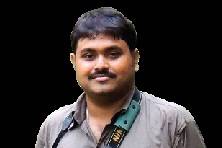
Arjan Basu Roy has a dream—to turn the City of Joy into the City of Butterflies. Luckily for Kolkata, it hosts at least a hundred butterfly species. Roy and his band of nature lovers are on a mission to transform, restore and conserve the disappearing urban wildlife in the city. As secretary of Nature Mates, one of Kolkata’s foremost nature conservation groups, Roy has overseen multiple conservation projects, the most prominent of them being Banobitan, India’s first open air butterfly garden.

Arjan Basu Roy
Arjan Basu Roy

Nature Mates was formally launched in 2006, but it started much earlier in 1993 when wildlife enthusiast Roy and his schoolmates set up a WWF Nature Club in their school to pursue their interest in wildlife. As part of the school’s nature club activities, Roy and his friends participated in wildlife rescue missions and wildlife monitoring. Growing up with financial constraints meant that Roy could not visit wildlife reserves, nature parks or forests as a child. “That was when I realised that I did not have to go to a forest to see wildlife. I could find it here, in my city, around me. It was then that I started following urban wildlife,” he says.

The club works in tandem with the West Bengal Forest Department in conservation activities. “A healthy butterfly population is an indicator of biodiversity. They are the best pollinators; birds, lizards and frogs feed on them, so conserving butterflies will give opportunity for an entire spectrum of other species to thrive,” says Roy. “This biodiversity can be initiated by everyone. Any area can be transformed into a butterfly habitat—a sprawling garden, a front yard, a terrace or even a balcony. Placing butterfly-friendly plants in a home or garden will augur these colourful biodiversity agents.”

Roy believes that affirmative action to preserve nature makes a bigger difference than protesting or criticising wrong-doings. According to him, token gestures of planting saplings when a tree is uprooted to make way for construction amount to very little in the big scheme of nature. “We offer assistance to builders in relocating trees that would otherwise have been uprooted and replaced by five saplings elsewhere,” he explains. Nature Mates addresses a wide spectrum of conservation activities, including animal rescue, restoring endangered animal species, cleaning wetlands around Kolkata, working with the forest department to set up butterfly gardens, wildlife surveys, installing bird nests, etc.

One of the key contributions of Nature Mates is the research the group undertakes on biodiversity, wildlife conservation. “We present the data in the form of usable information to guide people. This information is made available in English and Bengali to ensure even rural communities can make use of it,” he says.

Over the years, Roy has noticed a change in people’s attitudes that is positively impacting urban wildlife, “but it is very slow, much slower than needed”. To augment this progress, Roy and his team are continuing their mission to improve biodiversity in Kolkata, one butterfly garden at a time.

source: http://www.newindianexpress.com / The New Indian Express / Home> Magazine / by Venkata Susmita Biswas / April 16th, 2016

Flower power pushes Kolkata Jewish population up by 1

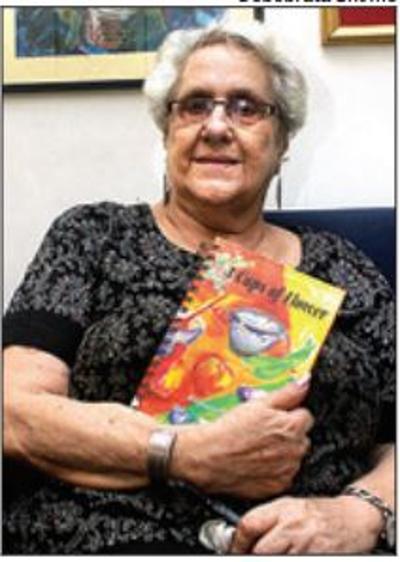
CHRONICLER OF TASTE : Flower Silliman

Kolkata :

For 30 years, Flower Silliman lived abroad, keenly observing and recording Jewish life in the Middle East, Europe and the US.

Now, the 86-year-old is back in the city she was born taking the community count up by one. And, she has taken upon herself the onerous task of keeping the authentic Jewish flavours alive for her nine-member strong community. Yes, you read it right: nine.

Demographers put the strength of the Jewish community in the city at less than 20, but the members are rather strict about who they call “pure”. Those that have married “outside” the community are strictly not “pure” Jews.

“I have come back to the city because this is where the Jews have lived most safe and free, but unfortunately , this is where our numbers have dwindled the most…but I am keeping the flame alive,” she says.

Silliman also happens to be among the last keepers of the community’s ancient recipes and has decided to chronicle the unique tastes for posterity.

“Even the food that Jews here have today is not what we are permitted by our religion. There’s so much of mix and match that most of the authentic cuisine that is over 5,000 years old and has its roots in the Middle East, is lost. I am trying to keep the tradition alive by documenting the recipes and rustling up dishes for feasts,” says Silliman.

Jewish food is special because Jews just can’t eat cause Jews just can’t eat anything and everything, Silliman says.

Their food -kosher -has to abide by strict dietary laws which not only lay down what is forbidden but also the process of cooking, the ingredients and the kitchen specifications. Kosher, for example, does not permit meat to be mixed with milk or milk products.So, neither can you mix the two while cooking, nor can you consume milk or milk products after having meat.

Flower Silliman says: “Judaism has a great similarity with Hinduism so far as its antiquity and dietary specifications go.

It’s another matter that most followers of both religions have drifted away from these guidelines… perhaps because they have often found it difficult to cope with such restrictions. I am not saying this by way of criticism, but the fact is that cuisines, and even cultures, become extinct because of such interpolation.”

A traditional sit-down Jewish feast on Friday night can ideally start with beet khatta with koobah (beet soup with chicken or vegetable balls), followed by Jewish roast chicken, which is different from the European roast in the kind of marinades and spices used. “The authentic Jewish roast will be far milder, both in flavour and sharpness, compared to the European roast,” Silliman says.

Kosher allows Jews to only have fish that have scales, and not those with shells (prawns, crabs or lobsters). “So you have items like fish shoofta, which is minced fish skewers. Vegetable lovers have choices like vegetable mahashas, which is stuffed tomatoes and capsicum.But the magic is in the recipe for the stuffing. The authenticity of the dish is heightened when served with aloo makalla (a special potato fry), hulba (a sort of fenugreek, mint and coriander chutney) and cucum ber zalata. Another speciality is mutton or vegetable ingree -a layered meat dish baked with brinjals, tomatoes and potatoes -not unlike the Greek moussaka, but without dairy to keep within kosher limits,” Silliman explains with the lucidity of an expert.

And why not? While abroad, Silliman served as a souschef at the Plaza in Jerusalem and launched the world’s only kosher Jewish restaurant, Maharaja.

She taught cooking and ran masterchef shows in US and London and authored two books. “I have come back to Kolkata because this is where the Jews have lived most safe and free, but unfortunately , this is where our numbers have dwindled the most… but I am keeping the flame alive.”

source: http://www.timesofindia.indiatimes.com / The Times of India / News Home> City> Kolkata / by Jhimli Mukherjee Pandey / TNN / April 29th, 2016

West Bengal gets its first transwoman presiding officer

Kolkata :

Early this year, Riya Sarkar had spoken out about the ‘terrible alienation’ she was facing from some of her colleagues of Dum Dum Prachaya Bani Mandir For Boys’. She was being treated as an untouchable at her workplace for having undergone sex realignment surgery. Three months down the line, Sarkar finds herself empowered. She is perhaps the first transwoman in India to have been entrusted with the job of a presiding officer. On April 30, Sarkar will be seen at a South Kolkata booth manned only by women in Rashbehari area.

In the last Loksabha elections, Sarkar was approached for discharging election duty. “Back then, I was a transgender and was undergoing hormone therapy. I was too weak and had informed the authorities about my medical condition,” Sarkar recalled. This year when Sarkar was approached, she accepted the offer gladly. She is overwhelmed by the huge “honour” that Election Commission (EC) has given her.

Back in her school, her colleagues are sharing her happiness too. Teacher-in-charge of her institute Amar Nath Chatterjee told TOI that he is glad with the news. “Bhaloi toh (It’s good). We had a small misunderstanding earlier. But now everything is normal. All our staff members congratulated her. Since there is a vacation in school, students don’t know the news yet.”

Sarkar is satisfied with the turnaround of people who initially had problems accepting her sex realignment surgery. “I am grateful to TOI for standing by me and helping me in my fight for equal rights. Dr Manabi Bandopadhyay and my parents have also been very supportive. My colleagues, particularly Maitreyi Das and Subrata Biswas, have always stood by me. Those who were apprehensive subsequently apologised for their behaviour. They are saluting me now,” Sarkar said.

Subrata Biswas, who teaches Bengali in Sarkar’s school, feels this move by the EC will go a long way in empowering those who are undergoing sex realignment surgery. “It is a commendable decision for the EC to rope her for a job that’s linked to nation building. This is a great way to encourage her acceptance in the mainstream,” Biswas said.

Incidentally, Biswas too has served as a presiding officer at a booth in New Barrackpore on April 25. “Before the polls began, we exchanged notes on how to discharge our duties. There was no problem of fake voting in my booth. I’ve assured her that the Central Forces are doing a great job and that she should not feel scared at all,” Biswas added.

Does poll violence scare Sarkar? “No, I’m expecting complete cooperation from our polling agents. I’m a law-abiding and politically neutral person. I hope to get full support from the CRPF and female constables to conduct a fair poll,” she replied.

source: http://www.timesofindia.indiatimes.com / The Times of India / News Home> City> Kolkata / by Priyanka Dasgupta, TNN / April 28th, 2016

Armenia still lives in the heart of Kolkata

City’s 195-year-old Armenian school had a near-death experience when its student body shrank to one. But it has now returned to life, thanks to immigrant students.

What Parsis were to Mumbai, Armenians were to Kolkata -a refugee race that washed up on Indian shores before the British, and proceeded to establish iconic businesses and institutions that live to this day.One such in Kolkata is the Armenian College and Philanthropic Academy (ACPA), nearly two centuries old.

Built in 1821 as a residential school for children of Armenian descent, ACPA was founded by two Armenian merchants, Astvatsatur Muradkhanian and Manatsakan Vardanian who hailed from Julfa (now in Iran). The school was founded to impart an `Armenian’ education to its students, in their language, and about their culture.

In the early 19th century, the Armenians were a prominent business community in Kolkata that ran coal mines, indigo and shellac businesses, and built some of the city’s famous landmarks, including Stephen Court on Park Street and Grand Hotel (today Oberoi Grand).

But after the British quit India, so did most of the Armenians, who migrated abroad. Half a century ago, Kolkata’s Armenian population dwindled to just 2,000, vanishing still further to leave behind only around 150. Two of these Indo-Armenians are counted among the 68 students currently studying at the school; the rest are immigrant Armenians from Iraq, Iran, Russia and Armenia.

The school -in whose original building novelist William Makepeace Thackeray was born -has had its ups and downs. Its student body shrank and expanded -going from 138 in 1932, to 149 in 2003, and even plummeting to a solitary student in 1990, perhaps marking the most trying year in the school’s long history.

In February 1999, a Calcutta high court ruling transferred the school’s administration to Armenia’s Mother See of Holy Etch miadzin, the administrative headquarters of the Armenian Apostolic Church. It is now the Pope of Armenia who appoints the school manager.

“Since the institution’s guardianship was vested with the church, the school has maintained its standards and a minimum number of students,” said Rev. Zaven Ya zichyan, manager of Armenian College and pastor of the Indian-Armenian Spiritual Pastorate.

Following the transfer of power, the first batch of 34 immigrant students reached Kolkata from Iraq, Iran, Russia and Armenia -sent here for the free education and boarding provided by the school. Often, Armenian families in places like Iraq and Iran send their children here even as they plan to migrate to the West, the school be coming an interim harbour for their children. ACPA now routinely invites the diaspora abroad to enroll their children here.

In the run-up to their 200th year celebrations in 2021, Rev. Yazichyan has been at tempting to revive the institution. Among the ambitious projects is the preservation and digitization of the Araratian library, set up in 1828 and named after Mount Ara rat, the place where Noah’s Ark landed after the Flood. Other efforts include the creation of a databank of all Armenians from Kolkata (the last was created in 1956) and for malassociations with other international educational organizations.

To retain a cultural identity , ACPA teaches Armenian history , language and religion.

On visiting the campus on Free School Street (some say it got its name from the free Armenian school), the students seem content. Hovhannes Saringulyar, who teach es Armenian history, says, “If they miss their parents, they talk to them on Skype.”

Incidentally , the school also provides boarders with a free passage back home once every three years.

source: http://www.timesofindia.indiatimes.com / The Times of India / News Home> City> Kolkata / Ajanta Chakraborty / TNN / April 24th, 2016

‘This one is special’

Monali Thakur on winning the National Award for Best Playback Singer (Female) for ‘Moh Moh Ke Dhaage’

Monali Thakur
Monali Thakur

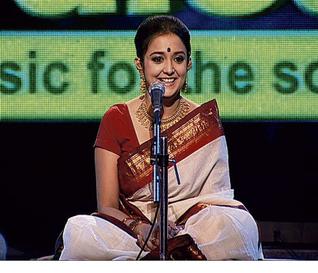
Monali Thakur shot to fame with ‘ Zara Zara ’ from Race in 2008. She sang two songs in the film, which instantly became favourite dance numbers.

But it is ‘Moh Moh Ke Dhaage’ from Dum Laga Ke Haisha , an Anu Malik semi-classical composition, that recently won her the National Award for Best Playback Singer (Female).

The Bengali beauty, who has also acted in a few Bengali and Hindi movies, is busy writing and composing songs for her singles, where she will also be seen flaunting her dance skills. In a telephonic interview, she spoke about her career, industry stereotypes, indie music scene and more. Excerpts:

How does it feel to win the National Award?

(Laughs) Awesome! But honestly, I think I need time to believe it, especially because I never thought of it, nor did I expect it. My phone was on flight mode and once I switched it on, messages were pouring in. I thought I probably got a big film offer, or I was getting married. A filmmaker friend of mine from Bengal then called and gave me the news.

For a moment, I was silent, and then I started jumping around. I called my mother at home, who was equally overwhelmed.

You started your Hindi film career with pop numbers like ‘Khwab Dekhe Jhuthe Muthe’ and then surprised music lovers with the melodious ‘Sawaar Loon’. Do you think that helped music directors notice your versatility?

It is unfortunate that the industry stereotypes people. And especially for women, there is not much scope in film music to experiment. Because music in the movies is created according to the script, and these days, even the female lines are sung by male singers. But mine, fortunately, is a different story. I started getting offers for similar kind of songs — songs that conveyed no meaning — so I consciously refused them, although I was not earning enough. Then, I met Amit Trivedi, who offered me ‘Aga Bai’ for Aiyyaa . He liked my work and then ‘Sawaar Loon’ happened. Amit knew I was trained in Hindustani classical (Patiala gharana). So, it certainly helped people notice the other side of me, that I can even sing a thumri.

You are also an actor. Your last big-ticket venture, Lakshmi may not have got rave reviews, but you were appreciated. Are we going to see you more on screen now?

Well, I like to think of myself as an entertainer. You meet creative minds as you move ahead in life. I met a few people who saw that I was interested and can act, so that’s how it all started. I enjoy filmmaking and I want to express myself as an artiste in every creative form possible.

So yeah, sure, why not?

Given that you had started acting and singing almost simultaneously, as a child, what did you want to become?

I always wanted to become a musician. At the age of six, I had my first song recorded with HMV. So, I was clear that in order to reach the maximum number of people I needed to become a playback singer, because sadly, only film music gives you that kind of recognition.

But now, I want to do different things, from dancing and composing to writing songs: anything that interests me.

Who has been your biggest inspiration?

Definitely family. Baba [her father, Shakti Thakur] himself being a professional singer and even Maa, who is also a singer, have always been a great inspiration. Other than that, I have also been influenced by the music of the West. I would listen to indie music, blue, pop rock, basically anything that appealed to me. It will be unfair to name just one; there are many.

What is your take on the present indie music scene in India?

Not much is happening in the indie scene, and the reason is that there is not much support from big banners. If producers start taking initiative in individual projects, things will improve.

We need to push harder to reach the level where we have singing divas and superstars in the country because we have so much talent.

What are your future projects?

I am working on my album. In film music, ‘Cham Cham’ from the Tiger Shroff and Shraddha Kapoor-starrer Baaghi has been released and there are a couple of other songs that are yet to release. But I don’t want to name any until they are out.

I have finished shooting for Mango , which is yet to be released. Last Christmas, a short film, Jangle Bells , was released.

source: http://www.thehindu.com / The Hindu / Home> MetroPlus / by Debashree Purkayastha / April 15th, 2016

Strains to awaken the soul

Since the dawn of Indian civilisation, music has been an integral part of our culture as is amply evident from our ancient scriptures. Music became popular through instruments seen in the hands of gods and goddesses — be it Lord Krishna playing the flute, Saraswati playing the veena and mesmerising the world with her recital or Lord Shiva dancing to the beat of the mridangam played by Ganesha or his bull, Nandi.

From 1500 BC onwards, classical music penetrated our roots and it only gained momentum during the Mughal Period when Mia Tansen adorned the court of Emperor Akbar as one of the “nine gems”. It is said that Emperor Akbar himself sang in Dhrupad style, rich in texture and solemn in mood — famed to be the genre of classical music that awakens the soul of the performer.

KeyaBanerjeeKOLKATA22apr2016

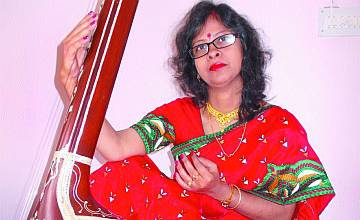
Keya Banerjee is one of the exponents from the younger generation of the Dagar Bani School who resides in Dab gram, Siliguri. It is her mission to spread classical music among children, motivate them to take up music as their profession and build their character by inculcating the values of tolerance and unity. She believes violence can be shunned and peace of mind achieved by practicing classical music.

Banerjee has recently launched her CD entitled Naad Brahma — all about prasing the divine — by Bihan music at the International Dhrupad Mela in Banaras.

Along with her husband Sanjay Banerjee who is an established Pakhawaj exponent having performed across the country, the couple have opened up their music academy called Gurukul Academy Sangeet Vidyalaya.

Banerjee says, “Classical music is a legacy which we are trying to acquire and pass on to the future generation. It is aimed at the betterment of society and upholding our culture and musical tradition. Like nature that is so bountiful in North Bengal, we have many talented children who wonderfully sing classical tunes but are unfortunate as they have no specialised voice trainers for guidance.

“Even I faced the same problem but am very grateful to my guru from Dagar Gharana, Kaberi Kar, Ustad Rahim Fahimuddin Khan Dagar sahab, Manojit Mallick and Dilip Karmakar for their taalim, care and blessings.

Whatever I have achieved it is all because of them. My album is a humble tribute to my parents who inspired me in classical music, my teachers who made me what I am today and of course, my husband Sanjay who has always encouraged me. I am also indebted to the young children who perform so well in our classical programmes which Sanjay and I conduct in our residence. We invite reputed artists to build a positive environment of promoting classical music among youngsters.

We came to Siliguri in 2011 and since then have been trying to promote this culture. In 2015, we conducted three classical musical programmes from our residence and now, would like to award the children who performed well in those programmes.”

With this perspective, Banerjee and her husband Sanjay are going to organise an evening dedicated to classical music on 24 April at Jatio Yubak Sangha Club in the city where not only artists of repute but young talents will get to perform. Lovers of classical music are also invited to feast their ears on soothing strains that will transport them to a state of bliss.

Speaking about her vision, Banerjee said that it is two-fold — first, to assist her husband in providing a platform to young children for showcasing their talent in classical music, guiding them to acquire the requisite skill and motivate them with awards so that they can consider taking up the profession seriously and to make them aware of the different opportunities that are available to young classical vocalists through scholarships provided by the government as well as different NGOs. “It would be also our effort to provide opportunities to children by getting them to perform in different music festivals, and competitions. That would enable them to fully realise their potential,” she said.

Her second aim is, of course, personal development as an artiste of repute and spreading her wings in the international arena where she would like to be remembered as a performer who served the form with all her heart.

Banerjee believes that in this age of stiff competition, stress is inevitable and the strains of classical music can act as a succor for rejuvenating tired minds. It is the medicine for building up strong willpower and become reflective while performing duties with grace.

She is fond of singing in the Dhrupad style, which speaks of the devotee’s wish to reach the divine. Naada Brahma puts the artiste in the role of a devotee singing with effusive praise for Lord Shiva with compositions in chautal, rag multani and rag shankara in Dhamar composition.

Banerjee is working at Subhasini Girls High School, Malbaazar, as an assistant teacher in music. She loves her job as it affords her chances of futhering her mission in life. She also fondly recalls her days in Shantinikeatan where she attained a post graduate degree in music.

Sparks fly over museum ashes

Kolkata:

More than 25 days have passed since the Centenary Heritage Zoological Museum was gutted and now there seems to be a series of allegations and counter-allegations being thrown about within the zoology department.

On Monday, Ena Ray Banerjee, who heads the Immuno Biology and Regenerative Medicine Research Unit of the zoology department in Calcutta University and was in charge of the museum since 2012, alleged that not only were some of the partially charred specimens lying under lock and key under high temperature and humidity, but even those exhibits which could have been recovered may now be lost

She further pointed out that the fact that skulls and skeletons have just been kept in a room by the department shows a degree of apathy towards a world-class heritage museum. “It’s an irony that on the World Heritage Day, instead of celebrating the natural history heritage we have inherited, the department chose to keep the partially damaged, rescue-worthy, ancient, rare and even extinct animal specimens in a room at a temperature which was over 40 degrees last week. The high humidity is also detrimental for the specimens because fungal contamination can set in very quickly,” Ray Banerjee said.

The former museum head also said that the collections are now exposed to vehicular pollution from the Ballygunge Circular Road towards which the rooms’ windows are open.

“It does not have air-conditioning. It is a practical laboratory table on which the specimens are strewn indiscriminately and they are also handled by bare hands. The fungal bacteria will decay the flesh, denature the protein, preempting any proteomic studies. The nucleases present on human hands will destroy the nucleic acid, forbidding DNA bar coding of the specimens,” she alleged.

Citing a letter from senior scientist Alan Warren of the Natural History Museum in London, Ray Banerjee said, “In his letter, Warren has categorically mentioned that there is an optimum condition in which such archival specimens must be stored. But over the past 25 days there is no such attempt.”

“While the decay progresses in a linear manner in the first few days, once it sets in, the growth is exponential and the flesh is irreversibly lost taking with it valuable information of a time gone by. Science and technology would have been able to decode the information, but in the absence of proper preservation this will be impossible.”
“The specimens which were over 90% burnt and yet DNA barcoded for the database are capuchin monkeys, Hhwler monkeys, spider monkeys, three-toed sloth, marmoset and a giant squirrel. The south Asian river porpoise, whose skull with skin had remained, is out of bounds for anyone. It may also have been lost,” she said.

Some of the other exhibits which are reportedly threatened with destruction due to being locked under inappropriate conditions are the skulls of royal Bengal tigers. These were partially burnt. “But the bone has been damaged by the huge temperature fluctuation which took place after the fire broke out. Hundreds of old, ancient bones from several animals were stacked together in a shelf, which were being restored and sorted. Sadly, these now lie covered with cement and plaster dust, which is corrosive,” the museum head said.

“The ZSI has done a preliminary survey and has given a list of around 10 specimens which can be recovered. Those exhibits have been kept separately. On Tuesday, a team will again visit us at the Ballygunge Science College campus. A process to rebuild the museum is on. Where will we keep the exhibits? We have asked for a larger space at a suitable location from the university authorities. The museum was not for public display and was only dedicated to academic teaching and learning. She has made a number of claims, which do not have much foundation. She is no longer the head of the museum, which has now been placed under the HOD’s custody,” said Parthib Basu, HOD of the Zoology department of CU.

source: http://www.timesofindia.indiatimes.com / The Times of India / News Home>City> Kolkata / April 19th, 2016

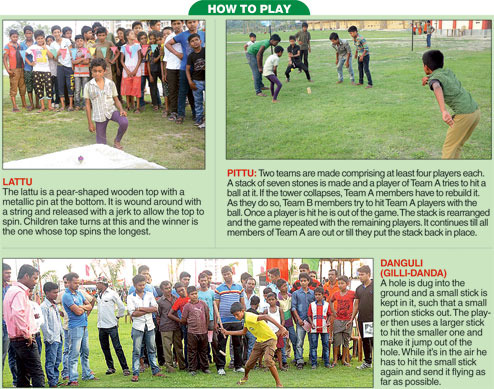
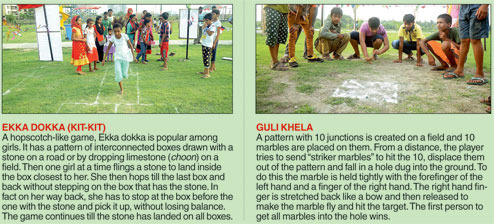
Games we played – Ahead of the Bengali New Year, Eco Urban Village played host to traditional games that left children from the neighbouring complexes gaping, reports Brinda Sarkar

Just as people can barely recall which Bengali year we stepped into yesterday, sports of our soil are getting wiped off people’s collective memories.

At a traditional sports meet organised at New Town’s Eco Urban Village recently, the show was stolen by children from the urban fringes while those living in swanky apartments stared in awe at the games being played and lamely asked how they were played and what they were called.

The sports were part of Lok Tirtha, a three-day festival presented by Housing and Infrastructure Development Corporation (Hidco) and implemented by the NGO Art Illuminates Mankind (AIM).

For a generation that is constantly told off for not going outdoors to play anymore, the kids who turned up were spoilt for choice. The ground had been divided into zones for five different games and over 80 names had been registered till the time the event started. Plenty more joined thereafter and every child spoken to said they would be playing every game.

The girls hopped across the ekka-dokka boxes and the boys threw balls at one another to stop the rival team from rebuilding the stack in pittu (see box for rules). “Pittu is not a game for the faint-hearted. I know many kids who’ve broken their arms playing it,” said Md Imtiaz Molla, a Class VII student who lives in a nearby village called Pakapol. “And it’s definitely not suitable for the kids who live in the apartments. They can’t play these rough games.”

PlayKOLKATA22apr2016

Play02KOLKATA22apr2016

Sneha Bhattacharya, a Masters’ student, had driven down from her Moulali home with her nine-year-old brother Debopriya, and the boy was wonderstruck at the new world of sports. “I mostly play games on the computer or the mobile,” said the boy, without looking away from a lattu (top) that a village boy, Sain Ali, had set spinning for 56 seconds. “I’ve never even seen a lattu before, let alone spin one. These boys are such experts that I’m felling shy to try and spin it today.”

His sister Sneha recalled how she would play kumir-danga and kit-kit (ekka-dokka) as a child. “And that wasn’t too long ago. But computers and mobiles have very quickly replaced all outdoor games for kids,” she said.

Surjaprobha Das, a student of a girls’ school in Lake Town, was too shy to play these “new” games but watched intently how other kids aimed their marbles to hit those of others in guli khela. “My daughter is only in Class II but her afternoons are already chock-a-block doing homework, attending tuitions and studying for tests. She doesn’t have the time to play anything and even if she goes out no other kids would come,” said her mother Sabita, who hoped her daughter would play pittu and ekka dokka, her own childhood favourites.

In fact, many adults joined the kids’ queue too. Hidco officials, the manager and security guard of Eco Urban Village, all played danguli. “There are many attempts to keep alive traditional food, music and dances but sports get overlooked. We wanted urban children to come and get a feel of these games so they at least know what other options they have,” said Debashis Sen, chairman cum managing director of Hidco, after trying a hand at danguli. “In fact, the winners of these games would be given medals, certificates and game kits consisting marbles, lattoos etc to propagate the games further.”

Sonali Chakraborty, secretary of AIM, said she was delighted to see such huge participation in the festival. “We would’ve been happier if more urban children had turned up but we shall try and make this an annual event now and I’m sure they’ll come next time around,” she smiled.

Pictures by Shubham Paul

Do you have memories of playing these games?
Write to The Telegraph Salt Lake, 6, Prafulla Sarkar Street, Calcutta 700001. Email: saltlake@abpmail.com

source: http://www.telegraphindia.com / The Telegraph,Calcutta,India / Front Page> Salt Lake> Story / Friday – April 15th, 2016