Category Archives: Arts, Culture & Entertainment

Hill royal relic now rubble – GTA pulls down Bangla king’s centuries-old palace to set up hotel management school

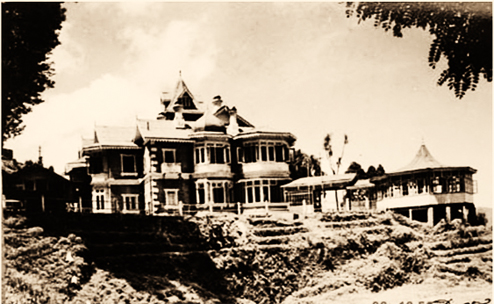
An undated photo of Sailabash: Courtesy Das Studio in Darjeeling

Darjeeling :

Darjeeling’s rare connection with present-day Bangladesh and a part of the hill town’s rich history has been reduced to rubble.

The GTA has pulled down Sailabash, the over-a-century-old summer retreat of the raja of Digapatia, to set up a modern hotel management institute and guesthouse in one of the last few available green spaces in Darjeeling.

Digapatia is now in Rajshahi, Bangladesh.

The palace under the tourism department of the GTA near Jalapahar and was brought down about two weeks ago. “The building was in a dilapidated state and recent earthquakes too had caused some damage,” said Kishore Ghimire, an executive engineer of the GTA.

In his book, A Concise History of The Darjeeling District Since 1835, which was published in 1922, E.C. Dozey, a writer and historian, said the building had been set up on land that was once owned by Capt J. Masson, the superintendent of Tukvar tea estate, by the “Digapatia Rajah”. The retreat was earlier called Girivilash and the name was changed to Sailabash after Independence.

The Late Nayan Subba’s soon-to-be-published book, Heritage buildings of Darjeeling, Kalimpong and Kurseong, says Raja Pramatha Nath Rai Bahadur had founded Girivilash whose garden was laid out by a German floriculturist and horticulturist, Morgenstern, and was looked after by 12 gardeners.

Nobody could say exactly in which year the building had been constructed. But its believed it was built in the last decade of the 19th century.

“Girivilash was a favourite place for the British governors of Bengal….The British army took over the palace in 1942. Later on, it was acquired by the government. It also served as a Tibetan school for a while. The palace has lost the historical grandeur of Girivilash,” writes Subba.

According to Subba, the colonial building had an attic with miniature gables and a small dome, and an all-weather glazed rotunda with small square windows in classical style. There was a tennis court as well.

“Raja Pramadanath Roy occupied the front suite on the ground floor, which included the library, with its precious screens of velvet and ornate wooden pelmets,” writes Subba.

The front suite of the upper storey with the snow view rooms was “for the rani”,

Subba writes. It was “beautifully furnished with a curtained brass cot and a chandelier. There was a huge grandfather clock, which indicated the days of the month and the full moon day (Ekadashi). On the ground floor were the drawing room, dinning room, tash khana (card room) and the billiards room,” Subba adds.

Despite being in a dilapidated state, Sailabash was still a landmark in Darjeeling and used to house a guesthouse after Independence. Once the building was taken over by the Darjeeling Gorkha Hill Council, the office of the hill body’s vice-chairman was housed there. For the past 20 years, the building had been lying vacant.

Bharat Prakash Rai, convener of the Indian National Trust for Art and Cultural Heritage (Darjeeling chapter), said: “How foolish can we be to dismantle such structures in the name of development. Could it not have been repaired? We have lost a piece of history and that is very sad.”

Dawa Lepcha, the GTA Sabha member in charge of tourism, said: “A big-scale hotel management institution will be coming up and the requirements were such that the building had to come down.”

GTA executive engineer Ghimire said the project cost had been pegged at Rs 55 crore. “Apart from the institution, there will also be a guesthouse with 24 rooms for in-house training. The infrastructure is being set up as per the parameters laid down by AICTE (All India Council for Technical Education)”

The five-acre plot in which the Sailabash was located has Annapurna and Kafal guesthouses, along with a pond built by the DGHC. “The Annapurna guesthouse will be used as an administrative building for the institution, while a part of Kafal will have to be dismantled. The pond will be smaller in size and we will have facilities for rainwater harvesting,” said Ghimire.

The engineer said restoration of the building would have cost much more.

source: http://www.telegraphindia.com / The Telegraph, Calcutta,India / Front Page> North Bengal> Story / by Vivek Chhetri / Wednesday – June 01st, 2016
Restaurant school with French help

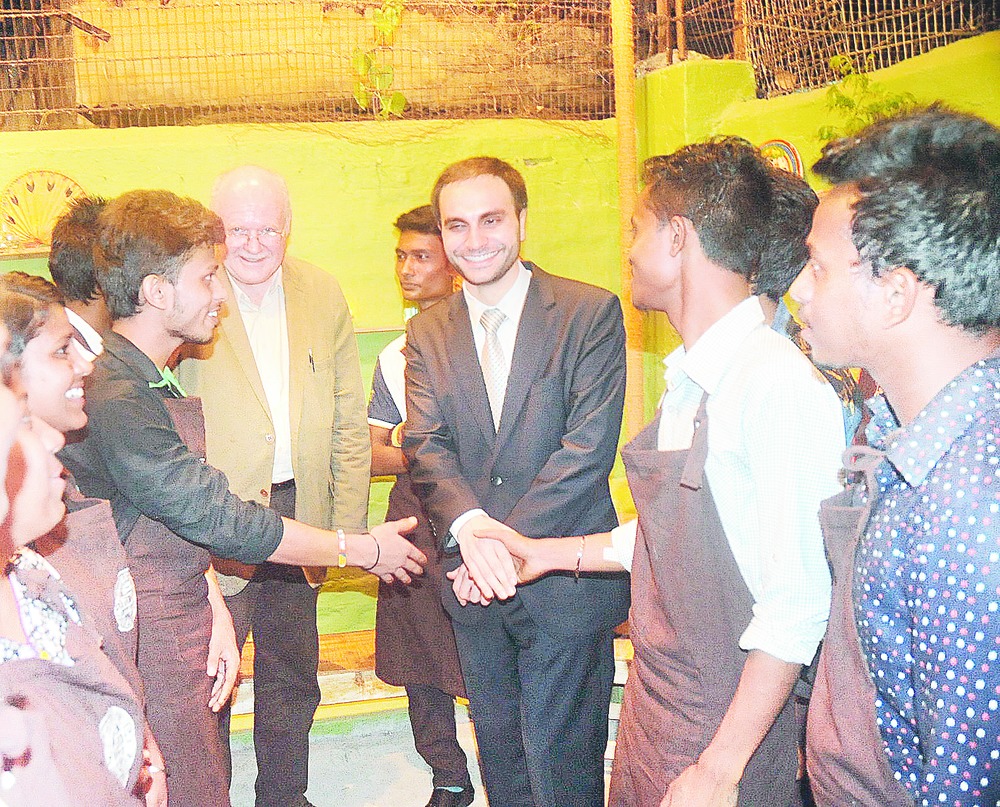
French consul general Damien Syed and German consul general Olaf Iversen meet the underprivileged youths being trained at Toto in Chetla. Picture by Bishwarup Dutta

Falafel served with pita bread. Chocolate cake. Apple pie.

These dishes were part of the food served by underprivileged youths from colonies in Kalighat and Tollygunge. The occasion was the inauguration of French restaurant school Toto in Chetla.

The school, which will also run a café, is a joint initiative of the local NGO Tomorrow’s Foundation and the French NGO Life Project 4 Youth (LP4Y), and is being supported by the French consulate in Calcutta.

“Our objective is education to employability. This is an entrepreneurship development project and we are looking at it as a business school,” said Arup Ghosh, founder of Tomorrow’s Foundation. Four volunteers of LP4Y have come from France to start the Calcutta project. “They are providing the knowhow, we are providing local help.”

In a two-storeyed house in Chetla which is housing both the school and the eatery, 15 youths are being trained to run a business when they are not busy picking up European recipes in the kitchen. “We had started off in October by recruiting five girls. When we started to think of the kind of business activities we should focus on, they suggested baking. It was important to take the idea from them based on their interest,” said Constance Delawstre, one of the volunteers.

That is how the seed of Café Toto germinated. The management is intent on serving only vegetarian fare. “We want to serve fresh and healthy food. We do not want to take a chance with meat in this heat,” says Delawstre.

The French volunteers are taking recipes of chosen Western dishes off the internet, preparing the dishes themselves for the students to taste and teaching them how to cook them. And if the reactions at the opening of guests like Marc Salesse, head of the consulate’s visa section, are anything to go by, their apple pie and chocolate cake are already tasting “just like back home”.

Not just cooking, the youths are also being trained in soft skills, like greeting a guest and taking orders, and management. “The youths have too much fire in the belly to not succeed. Once they complete the 12-month course, they should get entry-level jobs or set up their own place,” said Ranadeb Banerjee, a food and beverage industry veteran who is one of the coaches. The school offers them the option to continue beyond the course duration till they become self-sufficient.

Rama Rao and Gobindo Das, both orphans brought up in a Tollygunge NGO, are the biggest instances of the will to succeed. Rama had dropped out of school after Class VI but has taught himself spoken English. After a six-year gap, he has enrolled in an open school to appear in Madhyamik. Gobindo, too, picked up English on his own and took the Higher Secondary exams last year.

Other students stay with their families in slums. “I have to support my mother and two sisters. I am learning how to run a business,” said Sonu Kamti, who aims to deal in garments. Others like Laltu Singh and Gobindo Das are in it to learn computers. Such is their involvement that they have even sawed the café’s furniture themselves.

The guests left with a promise to return. “There was a need for such a café in our neighbourhood. The food is authentic and simple and the atmosphere convivial,” said Damien Syed, the French consul general. “It is a wonderful idea to create jobs through vocational training. Perhaps they can cook some German dishes too,” said Olaf Iversen, Syed’s German counterpart.

For now, the café will deliver food home on order and stay open only on advance booking. “Once the youths get trained, we will open thrice a week,” said Daniella, another volunteer.

source: http://www.telegraphindia.com / The Telegraph,Calcutta,India / Front Page> Calcutta> Story / byu Sudeshna Banerjee / Wednesday – June 01st, 2016

On a mission to save old buildings

CAL wants to go beyond heritage structures

ChaudharisKOLKATA29may2016

The Chaudhuris of Latu Mullick Lane in north Kolkata have unknowingly become part of a rather silent movement. Once part of Bengal’s landed gentry, they now have just this two-storeyed building left to their name. Built some time in late 19th century, the house does not offer much in terms of heritage value, given it was just the residential building of a family that had no great role in uplifting Bengal’s social or political consciousness. It is buildings like this that interests author Amit Chaudhuri.

Chaudhuri does not share any links with the said family, except a surname spelt the same way. Neither is this particular building, tucked away in a dingy lane, part of the initiative that is taking up much of his time these days. The author, however, is concerned with how the “heritage” tag is used in Kolkata. He feels somewhat disturbed that heritage only refers to buildings that had some role to play, even though the term should encompass much more than just achievements, he believes.

Once the second city of the British Empire after London, Kolkata, offers a visual feast of old houses, which stand out for remarkable architecture. These buildings represent not only an era but also stand testimony to the city’s history, giving an insight into the structural changes that influenced architecture over the years. Chaudhuri’s love for the architectural aesthetics in old buildings inspired him to launch the Calcutta Architectural Legacies (CAL), a mission to save old buildings.

It is also probably not a coincidence that the acronym spells out as CAL, the name most English-speaking Kolkatans refer to their home town by. CAL is what one would call a citizen’s initiative, with Chaudhuri bringing together a group of interested people. From conservation architect Partha Ranjan Das to G M Kapur of heritage preservation group INTACH, to activists Bonani and Pradeep Kakkar, ad guru Ram Ray and even Nobel laureate Amartya Sen, they will all pull in their ideas to help conserve buildings that have not found place on state’s heritage list.

Although CAL was formally launched in February, Chaudhuri has been working towards this for more than a year. In an article for The Guardian in June 2015, he laid down his ideas. He pointed out that in Kolkata, a heritage building is a landmark, either because it is a “significant institutional building” or “because a famous person frequented it or lived there”. “The architectural distinctiveness of the building is a secondary concern, or is a pre-ordained, generic feature of the structure: that is, we already know it qualifies as a heritage structure because it adheres to our idea of what a heritage colonial building looks like,” he wrote.

The author went on to say that heritage for Kolkata also “…means we cease to engage with the architectural individuality and difference of buildings and precincts. We don’t periodise, falling back on catch-all terms like ‘colonial’ or historicise; or describe; or define. Simply put, ‘heritage’ means we don’t see, or think about, buildings.”

While launching CAL, he pointed out that the time has come to rethink words like “architecture” and “heritage” in order to save buildings “before these are brought down and turned into generic multi-storeyed buildings”. CAL would also attempt to move beyond heritage and take the initiative to everywhere in Kolkata.

Chaudhuri pointed out how the city developed into neighbourhoods, “para” in Bengali, which were oases of resident communities, and stressed on the need to preserve their distinct characters, before these fall prey to realtors. He is of the opinion that the heritage tag should include far more than landmarks and involve buildings, which give the city its character. He also talked about the need for residents of such buildings to come forward and join the initiative, if they are keen on preserving their individual heritage, instead of a generic sense of history.

Chaudhuri’s campaign among the urban educate class for more than a year found fruition when Kumartuli Sarbojanin Durgotsav, the Durga Puja committee at the idol-makers’ district in north Kolkata, decided to turn his efforts into the theme for its Puja offering last year.

A much-visited Durga Puja marquee, the committee celebrated its 84th year with a cause that has faced criticism from some quarters as “elitist”. Disparagement aside, artist Subal Pal persuaded the Puja committee to go with the theme.

Chaudhuri observed how a number of aesthetic old buildings are being razed to ground, making way for box-like high-rises, on the Pratapaditya Road in south Kolkata. Pal, who has been noticing similar changes in north Kolkata, felt one with Chaudhuri’s woes and etched out the theme in his Puja marquee. The artist, however, admitted that without proper conservation of these buildings, there would be no point in having the theme, at a time when such houses are getting lost across the city. “…the message needs to be sent out to people before it’s too late,” he said.

A regular visitor to Europe, he pointed out in his Guardian article how the British have managed to preserve even the most mundane, old buildings, just because of their architectural and aesthetic brilliance.

The author, who first started the campaign online and sought signatures, stated in his expression note how the old-world Kolkata is fast falling prey to the real estate mafia. While the online petition received nearly 2,000 signatures in a matter of days, Chaudhuri said, “I am an admirer of Kolkata’s neighbourhoods. Its architecture is not just confined to colonial legacy or north Kolkata-based buildings owned by landed families. But there are many interesting architectures spread across the city which were built by the educated middle-class in the past,” Chaudhuri said. This petition also drew support from Sen, who has spent years amid the heritage corridors of educational institutes in Kolkata, England and the US.

The real deal for such an initiative, however, is to get the administration’s attention, admitted those pushing the initiative. While Das talked about the apathy of Kolkata Municipal Corporation, which is in charge of refreshing the city’s ‘heritage list’, Mayor Sovan Chatterjee seemed oblivious to such concerns.

Chaudhuri noted how bodies like the West Bengal Heritage Commission, entrusted with the job of refurbishing the list from time to time seem mostly toothless. “…the list of heritage buildings should be urgently revised and various neighbourhoods should be declared heritage zones,” Chaudhuri said.

While the author asked for empowering the Commission for better functioning, Das echoed his thoughts. A former member of the commission, he submitted a proposal to introduce transfer of development rights or TDR in 2013. A successful process at Mumbai and Ahmedabad, TDR provides a residential building owner to retain it, with the developer buying the land getting to build elsewhere where new construction is not an issue. There has been no move in the direction of allowing TDR, he said.

Chaudhuri hopes that like in Europe, owner of old buildings will take up the cause themselves and fight to preserve the character of their localities. The administration, however, continues to remain aloof, even after the Nobel laureate economist wrote a letter of support to Chaudhuri, stating, “We owe to future generations a preserved and un-mutilated heritage of Calcutta’s eccentric but exciting old buildings.

source: http://www.deccanherald.com / Deccan Herald / Home> Special Features / by Drimi Chaudhuri,Kolkata / May 29th, 2016

Kolkata’s Indian Museum Collection Going Online With Google

IMAGE CREDIT : indianmuseumkolkata.org

Kolkata :

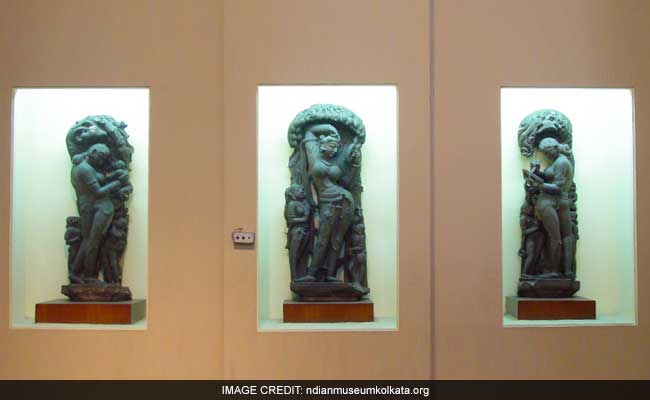
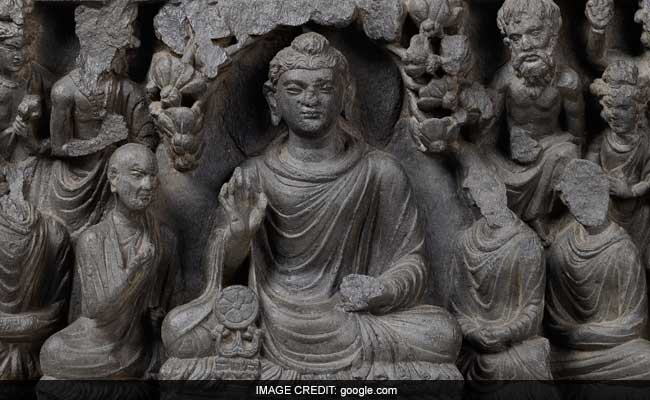
Beginning with its prized collection of Buddhist art including the famous Gandhara sculptures, the Indian Museum is now putting all of its galleries for 360- degree panoramic viewing for anyone to see online.

As part of a tie-up with the Google Cultural Institute, which allows art lovers to explore artifacts from all over the world on its website, the Indian Museum is launching an e-version of its exquisite exhibition titled Indian Buddhist Art on Wednesday.

Among the important highlights in the exhibit include a sculpture of the head of Buddha from fifth century in Sarnath which is featured even in school textbooks.

“This is the first virtual exhibition we are organising after which all our galleries will gradually be available on the Google Cultural Institute website,” museum director Jayanta Sengupta told PTI.

IMAGE CREDIT : google.com  /  Buddha' First Sermon (100-200 C.E) by unknown exhibited at Indian Musuem pubilshed on google cultural institute website.
IMAGE CREDIT : google.com / Buddha’ First Sermon (100-200 C.E) by unknown exhibited at Indian Musuem pubilshed on google cultural institute website.

Three galleries, including those on Buddhist sculptures, are ready for 360-degree panoramic viewing on the internet. “This allows anyone to have a walk through the gallery and see it as you do it with your eyes. You can scroll around to see even the ceiling and the floor,” he said.

Since last year a team of Google from the UK and the US have been working hard with their specialised and patented camera technology to click high-resolution photos of the treasures lying in the museum.

The process is taking time because the work can only be done on Mondays when the museum is closed to visitors. It is expected that all galleries will be online within a year’s time.

Over 200 years old, Indian Museum is the oldest and the largest multi-purpose museum in Asia.

The biggest repository of Indian antiquity, some of the museum’s prized possessions include an Egyptian mummy, Buddhist stupa from Bharhut, Buddha’s ashes, Ashoka pillar, fossil skeletons of pre-historic animals and a collection of meteorites.

For some of such cultural and historical treasures, the museum is also planning to have gigapixel images which will allow magnification upto a thousand times.

“If it’s a painting then you can see all intricate details like even the brush strokes. Seeing a gigapixel image is like putting the object under microscope,” Mr Sengupta said.

The musuem director rejects suggestions that once all galleries are online the number of visitors at their campus will decrease.

“Internationally this has been the case. After people see it online they are more motivated to see the real thing and so they walk into the museum,” he said.

Spread over 10,000 square feet area, it boasts of over sixty galleries of art, archeology, anthropology, geology, zoology and botany sections.

It houses rare artifacts of great archival and heritage value numbering more than a lakh.

source: http://www.ndtv.com / NDTV / Home> Sections> All India / Press Trust of India / May 24th, 2016

National Award for HA girl

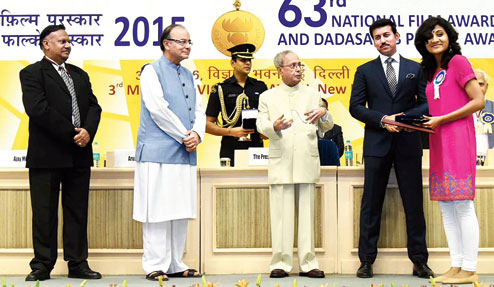
Moumita Roy on stage with President Pranab Mukherjee, Arun Jaitley and Rajyavardhan Rathore

HA Block has produced a National Award winner. Twenty-eight-year-old Moumita Roy earlier this month was awarded the National Film Award for Best Non-Feature Film Audiography for Edpa Kana, a film in the Kurukh language of Jharkhand.

“I wasn’t expecting this award. In fact, I had forgotten that the film had been sent for the National Awards,” laughs the fresh pass-out of Satyajit Ray Film and Television Institute (SRFTI). The winning film was the final year diploma project that she and three of her classmates had to make as part of their course and Moumita was handling the audiography.

“Audiography includes all the dialogues, music and sounds that we hear while watching a film. One has to get the right balance between them,” says Moumita. The director of the film was her classmate Niranjan Kujur who belongs to Jharkhand’s Oraon tribe and speaks Kurukh. The film is about a tribal boy of the Sarna faith who falls in love with a tribal girl who follows Christianity.

“Most of the film was shot in Jharkhand and the actors were Niranjan’s relatives. We were using sync sound (in which dialogues do not get dubbed over in the studio later) so mics had to be hidden in the actors’ clothing. We were shooting in the winter of 2014 and the mics kept picking up rustle of the actors’ winter garments,” recalls the HA 36 resident.

The 26-minute-long Edpa Kana has been making a mark in the festival circuit too but the National Award is the icing on the cake. “The ceremony in New Delhi was very formal. I received the award from the President and was off stage in a few seconds. There was a lot of security protocol too so I didn’t get to speak to other award recipients but I got to meet Sanjay Kurien, who won best audiography (location sound recordist) for the film Talvar.

Her parents watched the ceremony from the audience. “Our daughter. is good at everything she does,” says mother Sikha.

“I have been receiving calls and Facebook messages from relatives, neighbours and even school friends I had lost touch with,” she laughs.

She also won Rs 50,000 with which she plans to buy sound equipment. “As of now I’m working on a freelance basis in Calcutta. Let’s see what happens next,” she smiles.

source: http://www.telegraphindia.com / The Telegraph,Calcutta,India / Front Page> Salt Lake> Story / by Brinda Sarkar / Friday – May 20th, 2016

German ambassador revives Dresden-Kolkata creative tie

Kolkata :

Two years after Germany reunited, four artists from Dresden had come to Calcutta and casually met with painters, sculptures and poets here, not knowing they were sowing seeds for this creative collaboration a quarter century later.

The Dresden-Calcutta initiative was formally launched by German ambassador Martin Ney at ArtsAcre, Museum of Bengal Modern Art, last Tuesday, 24 years after artists Michael Freudenberg, Eberhand Goschel, Max Uhlig and Sonia Zimmermann, facilitated by the Goethe Institut, had the most meaningful interface with members of ArtsAcre in Kolkata. The German artists had been briefed about Pandit Ravi Shankar laying the foundation of ArtsAcre, a nest for budding artists in north Kolkata, and Nobel laureate Gunter Grass inaugurating it in 1986, with an exhibition of his own drawings. Subsequently, Shuvaprasanna, director of ArtsAcre visited Dresden and conceived the idea of “Dresden-Calcutta/Calcutta-Dresden”.

The project promises regular exchange of ideas and workshops between Dresden and Kolkata, with its nucleus at ArtsAcre, the grand 4.5 acre arts hive for artists, enthusiasts and creative communities in Kolkata that chief minister Mamata Banerjee inaugurate two years ago.

The project kicked off with a portfolio of graphics and lyrics, titled “Shuttle”., comprising intaglio, etchings and poetry of seven mainstream artists and seven poets from Dresden and Kolkata, displayed at the permanent Dresden gallery inside ArtsAcre. The participating artists from Desden are Lutz Fleischer, Eberhand Goschel, Peter Herrmann, Reinhard Sandner, Claus Weidensdorfer and Uhig and Zimmermann, who came to Kolkata 24 years ago.

Lothar Barth, Andreas Hegewald, Uwe Hubner, Lothar Koch, Gregor Kunz, Bernhard Theilmann and Michael Wustefeld are the participating poets from the German city.

From Kolkata, Dip Banerjee, Shipra Bhattacharya, Kinkar Ghosh, Shakti Karmakar, Somenath Maity, Munindra Rajbongshi and Shuvaprasanna were those who contributed in the art section. Lending their creative expertise with words were the late Shakti Chattopadhyay, Sunil Gangopadhyay and Mallika Sengupta, Sankha Ghosh, Joy Goswami, Alokeranjan Dasgupta and Dibyendu Palit — Shashi Despande, Subodh Sarkar, Kalyan Ray and Dipak Rudra are the translators.

Shuvaprasanna, executive trustee of ArtsAcre Foundation, said, “The aim of Dresden-Kolkata initiative is providing space for the young and experienced artists, allowing them to express their message and present their creations in all kinds of arts – from painting, to photography and installations.” He said the artists speak of globalization, intolerance and openness through their works.

Grass remains the pivot of the project. Nay watched Gautaim Ghose’s “Shuva & I”, a film on Grass and Shuvaprasanna at Grass’ home in Germany in August 2013.

Pointing at “Shuttle”, the ambassador said, “These works by the poets and artists were created when Germany was passing through the most difficult circumstances – through a totalitarian regime. They will show how important this kind of creative exchange is for countries.”

source: http://www.timesofindia.indiatimes.com / The Times of India / News Home> City> Kolkata / Ajanta Chakraborty / TNN / May 21st, 2016

Homeopath Parimal Banerji explains origin of life in new book

Kolkata :

Paving a new path in the field of the biosciences, eminent homeopath Parimal Banerji shared his discovery on the origin of life at the launch of his book, ‘Discovery Of The Source Of Life Force’ throwing light on the enigma of life called Life-Force. The book was launched on Monday by governor, Keshari Nath Tripathi.

Over the past few decades, Banerji has carried out extensive research on the subject: The Origin of Life or Source of Life – Force which scientists across the globe have been striving to discover since the beginning of civilization. Hypotheses and facts about how the organs and cells work are known but why they function and what the energy is or the force behind them could not be established.

This book will provide a breakthrough in medical world and an exploration in the human quest for the ultimate.

Banerji discovered a new molecular energy, ASA (Anubik Shakti Abarta) Supra molecular energy, which has revolutionized many concepts of physics.

Speaking on the occasion Banerji said, “Anubik Shakti Abarta is a special type of molecular energy which remains in very high dilutions and can exist for an indefinite period even in concentration much beyond 1 in decillion. Molecular composition in each cell in our human body varies widely, which creates the constitution of men so different from each other and are responsible for their individual behaviors, intellect, mental capabilities, memory, manifestation or resistance to diseases, immunity, genetic effects, physical structures, etc. Explanation to all these has taken the life science to a very advanced status with the creation of a new horizon.”

Banerji has been working in search of the source of life-force in the living organisms since the beginning of his medical education. It has remained undiscovered despite extensive researches being carried out by the biosicentists all over the world. He has been successful in discovering the source of life force and presented a paper on it at the Mihijam Institute of Homoeopathy in 1980. Its various aspects were being worked out and were presented at Cultivation of Science at Kolkata. The discovery now explains how consciousness is generated, what makes the cells to work and why a living unicellular animal has the ability to think and react unlike the dead.

Former Prime Minister of India Morarji Desai, Late Prime Minister Narshimaha Rao, Late Air Marshal Subrata Mukherjee were Banerji’s patients, to name a few. Apart from his proficiency in homoeopathy, he has also been working in the domain of physics, relating to life sciences.

source: http://www.timesofindia.indiatimes.com / The Times of India / News Home> City> Kolkata / by Jhilmil Pandey / TNN / May 16th, 2016

Barcelos comes to Kolkata

Kolkata :

Costa Mazzis-owned Barcelos has brought Afro-Portugese cuisine to the city. Rohit Malhotra, India Business Head of Barcelos, told Business Line that the franchised 100-seater casual dining restaurant was result of a tie-up with MP Jewellers family outfit Trivia Food & Beverages Pvt Ltd.

Indranil Roychowdhury, Director of Trivia, said that collaboration was likely to be replicated in the near future for a few more in West Bengal.

For Barcelos, it is the fourth outlet after setting up two in New Delhi and one in Gurgaon. “By July we would be present in Jaipur and Mumbai through the franchisee route”, Malhotra said. Apart from one company owned outlet in the Capital, Barcelos is following the franchise model for expansion in the country.

Portuguese restaurateur Mazzis, who first set up his shop in South Africa, linked his brand to a village in Portugal – Barcelos – with legends attached to cockerel or rooster.

Though its low-oil flame grilled chicken along with “peri-peri” or a number of table sauces made of African chili are the menu drivers, for India, Barcelos has created a range of vegetarian dishes.

Barcelos official said that the chain now popularising a typical flavour and taste of the fiery African peri-peri in the country where Portuguese traders centuries ago introduced chili. Variants peri-peri sauce is also used by Barcelos chefs as a secret marinade for meat or seafood before they are roasted or grilled, Malhotra said.

source: http://www.thehindubusinessline.com / Business Line / The Hindu, Bureau / Kolkata – May 16th, 2016

Brand Bengal to steal the show in London, Edinburgh and Glasgow

Kolkata :

Two-fifty-nine years after East India Company brought business to Bengal, the roles have reversed. Brand Bengal, aka Biswa Bangla, has travelled the British Isles, and it means business.

Starting Tuesday, shows are being organized in London, Edinburgh and Glasgow to hard-sell the exotic arts and crafts of Bengal. The exhibitions will be a prologue to the grand Biswa Bangla showroom coming up in London three months later, as announced by chief minister Mamata Banerjee during her London visit in July, last year.

Titled “Gods and Demons”, the event will include live demonstrations and workshops on the making and rich history of the masks of Bengal. There will be visual storytelling from Patachitra, which was used originally as ways of spreading ancient mythology. The integration of modern social themes and issues in the artwork makes patachitra and mask-making inspiring tools for today’s artists.

Talking to TOI about UK’s exposure to “Bengal summer” at the Nehru Centre (till Friday), the Scots in the Museum of Edinburgh on May 12 and 13, Rajiva Sinha, secretary, micro and small and medium scale enterprises (MSME) and textiles, said, “The Biswa Bangla tagline ‘where the world meets Bengal’ says it all. The most exciting part of the event are the live shows by artisans Suman Chitrakar and Sankar Das. They have blended the traditional art-forms into the modern-day usage.”

In Glasgow, the location for the grand event is the Art Village Scotland which will be held on May 14 and 15, as part of the Southside Fringe festival.

“Biswa Bangla believes there is a keen appreciation for Bengal arts and crafts in the modern global community and we want the British to be a part of it, keep these art forms alive by bringing the magic of Bengal’s temples into the UK living rooms,” said London-based designer Neishaa Gharat, who represents Biswa Bangla in the UK.

Das, who hails from Sabdalpur village in South Dinajpur, will tell the British audience how “there was no rain in Kushmundi 200 years ago and people started praying to the gods for rain and to restrict the evil powers. Many characters became part of the dance, Kali, Rakshasa, Hanuman and Dakini – these are the faces we still carve today.”

Chitrakar, a villager from Naya who has applied patachitra to modern-day products like painted bags, apparels and crockery said, “Patachitra painting started many years ago. Patuas were mostly Muslims but painted Hindu gods. They moved house-to-house, singing for grains and money. Gradually, this took the shape of the art form we see today. In 2004, there were only 18 patuas in Naya, now there are 300.”

Gharat, who has been working with traditional Indian arts, crafts and textiles promoting artisans and creating designs for a global audience, sounded exited “because this is a government initiative to revive the art and craft of Bengal, which is one the most culturally diverse states in India. The art forms are fascinating because they give away such a stark dichotomy between tradition and modernity. There’s a tremendous legacy of skilled work out there and the willingness to take it forward.”

John Bell, former chairmen of the British Guild of Travel Writers and a consultant for the United Nations World Tourism Organisation, delivered the key note speech. Bell, who started his career with the BBC in London, producing and reporting for its travel and transport programmes on radio and television, said, “The work is not just a question of design, its jobs and poverty … this beautiful art is not just beautiful art, its beautiful art for good … the more we trade, the more we work, the more work we give to our friends Shankar Das and Suman Chitraker here, the more we are doing for the people of West Bengal and doing good for ourselves.”

– Aimed at rejuvenating the state’s handloom and handicraft products, Biswa Bangla was conceptualized in 2013
– The first store to sell products under the brand opened in 2014
– With 7 stores, the venture clocked a Rs 15 crore in 2014
– In the next two years, revenue is expected to increase six-fold to about Rs 100 crore.
– Among the arts being revived at Biswa Bangla are:
– Indo-Portuguese shawls (takes six months to embroider)
– Muslin
– Darjeeling tea
– Masks
– Attar perfumes
– Kalimpong cheese
– Mustard sauce
– Sundarbans honey
– Bonolokkhi ghee
– States like Rajasthan and UP are adopting the Biswa Bangla model
– Biswa Bangla markets 5,000 products, including 24 kinds of dolls from various parts of the state

source: http://www.timesofindia.indiatimes.com / The Times of India / News Home> City> Kolkata / by Ajanta Chakraborty / May 04th, 2016

‘Pather Panchali’ vignettes now in print

Pather Panchali
Pather Panchali

Kolkata:

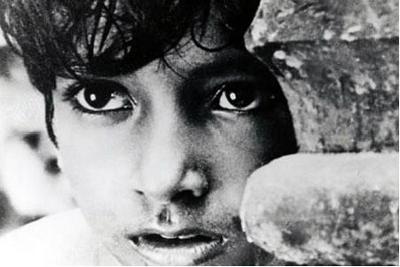
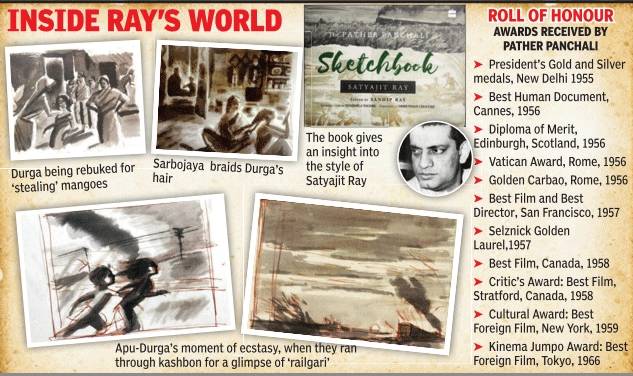
That ‘Pather Panchali’ is a film of international repute is a foregone conclusion but very few know how much labour it took for Satyajit Ray to come up with the masterpiece. A facsimile edition of the ‘Pather Panchali’ sketchbook, which has collated original contents of the film – sketches, notes and post-scripts, will now give an insight into how Ray had visualized and planned the film. It was released on the eve of Ray’s 95th birth anniversary on Sunday.

The sketchbook, as Ray’s son Sandip Ray has written in the preface, formed the very foundation of the filmmaker’s maiden film. Sandip Ray writes on the history of the book: “…Father donated it to the ‘Cinematheque Francais’ in Paris at the request of Georges Sadoul, the eminent French journalist and film scholar. In his final days, he expressed a desire to have a look at the visual script he had made for Pather Panchali. I contacted the Cinematheque Francais management, but they said the sketchbook had been missing. However, it was our good luck that last year we got hold of a scanned copy of it…and decided to bring out this facsimile edition,” Sandip Ray mentions in the preface.

The book not only gives the readers a rare glimpse into original sketches and notes made by Ray for the film, it also has several reviews and previews, original drafts, posters, booklets, letters written by eminent film personalities and some photographs and commemorative stamps.

InsideRaysWorldKOLKATA03may2016

The book also contains a few articles written by Satyajit Ray on the inspiration behind his maiden film. “I have no hesitation in saying that Aam Aantir Bhenpu, a childrens’ edition of Bibhutibhusan Banerjee’s novel ‘Pather Panchali’, was the source of the script of my film. I illustrated that edition. So I had to go through the book minutely,” writes senior Ray in his article ‘The Whole Film Was In My Head’.

“The sketchbook is the product of a painstaking effort put in by the ‘Society for Preservation of Satyajit Ray Archives’, also known as ‘Satyajit Ray Society’,” said Society CEO Arup Kumar De.

Sharmila Tagore, who has written an introduction for the sketchbook, says that the film holds a special place in her heart. “I owe my life in cinema to this film….No doubt impressed with the resounding international success of ‘Pather Panchali’ and the critical acclaim for its maker, my father took the extraordinary step of allowing me to work in Apur Sansar.,” she reminiscences in the introduction.

source: http://www.timesofindia.indiatimes.com / The Times of India / News Home> City> Kolkata / Suman Chakraborti / May 03rd, 2016