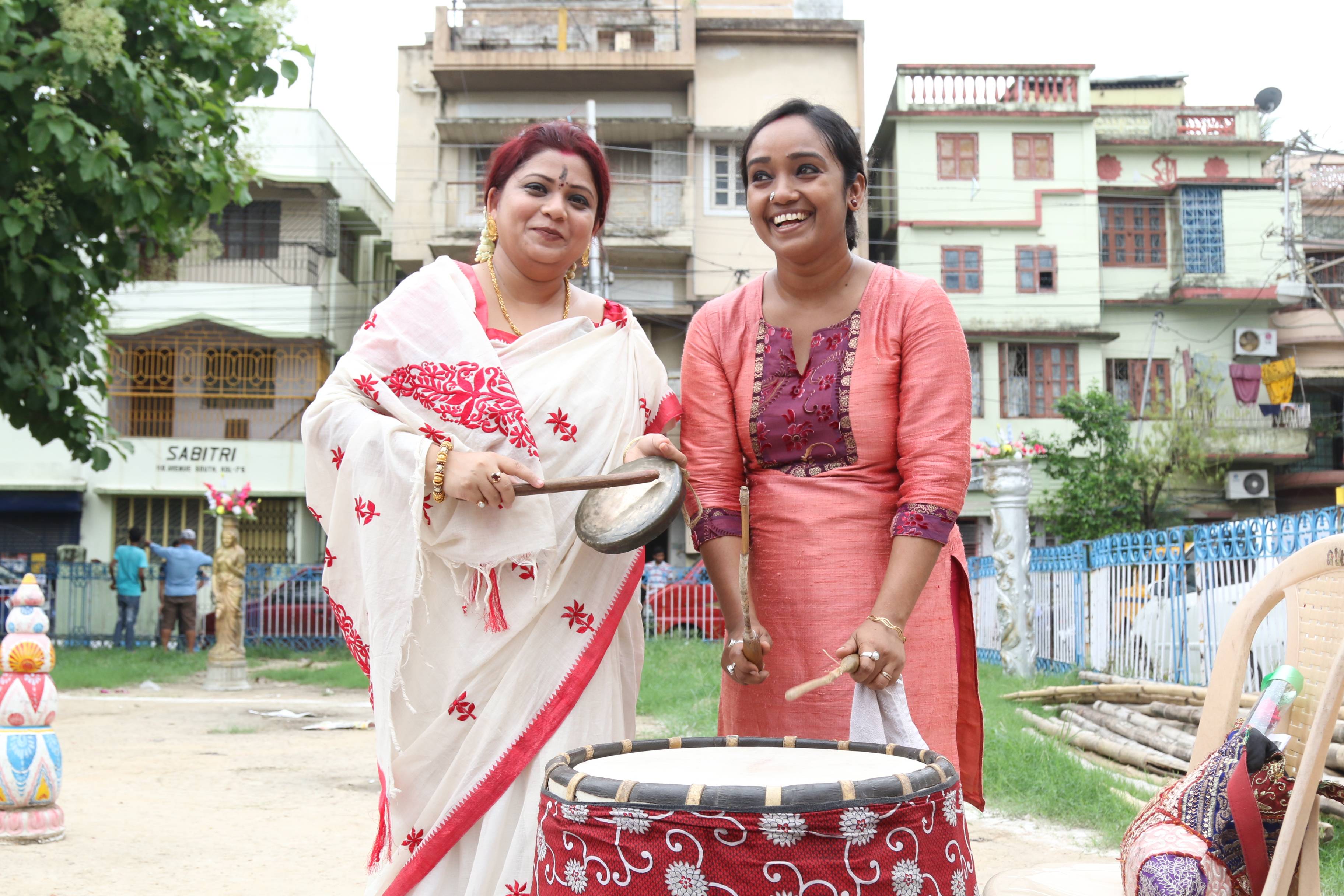
Aditi Chakraborty is a known name in the Durga Puja circuit, as one of the most sought-after idol makers of Kolkata.Subhamita Dinda, on the other hand, is a debutante, though her husband Sanatan Dinda commands huge respect in the same circuit. In a first, these two women are putting together one of the costliest Durga puja idols and pandals this year. They claim to be the first women-only team in this male dominated profession. Now that’s a reason why Santoshpur Lake Palli Pujo must feature in your must-visits list this year.
Aditi, who is in charge of decorating the pandal, said, “We are trying to present tradi tion in a never-seen-before manner. Our theme is `puja’ itself. We will be making use of many traditional items such as tambul dani and stitch-art that used to adorn the walls of homes in our childhood.”
We went to see the two ladies at work on the day of the khunti pujo, where we met Somnath Das, executive member of Santoshpur Lake Palli pujo. On being asked about the USP of their puja, Das said, “For most pujas these days, the theme is planned first and the idol and the pandal are then crafted around the theme.However, we have decided to keep the idol in focus. There will be many rare materials used in the making of the idol which have never been used for this purpose before. The pandal will feature detailed wood-carvings too.”
Aditi and Subhamita have already started work a couple of months back. On being asked how it is to try to make a footprint in this primarily male-dominated industry, Aditi shrugged it off. “I am an artist.It does not matter whether I am a male or a female. What matters is that the work is done well. My bonding with Subhamita is strong and I am enjoying working with her,” she said.
Subhamita, on her part, promises surprise for the visitors. “All I can say is that people will find it in their heart to fold their hands and pray to the idol, once they see it. But for that, one needs to wait a little bit more,” she signed off.
Reporting done by Pratik Banerjee
source: http://www.timesofindia.indiatimes.com / The Times of India / News Home> City> Kolkata / July 11th, 2016
Bengali film star Jeet’s Grassroot Entertainment Private Limited on Wednesday announced that they have signed a long-term agreement with Premier Futsal to acquire the Kolkata franchise of the league.
The agreement, for an undisclosed sum, makes Kolkata the second franchise to be sold after the promoters of football club Chennai City FC — among the oldest in the city — picked up the league’s Chennai team.
“Football has a huge, fervent following in Kolkata, where love for the sport is passed on from one generation to the next. It is therefore a matter of great pride for me to introduce the faster, shorter version, of the beautiful game to Kolkatans,” Grassroot Entertainment Pvt. Ltd director Jeet said in a release.
“Through futsal, the young generation can hone their skills and talent, which will uplift their quality and eventually benefit in long-term development of footballers. I’m certain it will capture people’s imaginations and thrive and I urge people to come forward and support our initiative to lead the Kolkata franchise of Premier Futsal to glory.”
The Kolkata franchise will be called Kolkata 5s. In the inaugural season, each team will be similarly named. The franchise-owners will then be allowed to rebrand their respective teams from the second season onward.
Premier Futsal managing director Dinesh Raj said, “It gives me immense pride to announce Jeet and Grassroot Entertainment Pvt. Ltd. Asowners of our Kolkata franchise. We are delighted to have a superstar of Jeet’s stature backing Premier Futsal and playing his part to grow it in what is football’s Indian heartland.”
“The response we have received from prospective owners across all cities validates our decision to get behind Futsal as sport. We will unveil owners of the other franchises very soon.”
Each franchise will be assigned a marquee international football player, seven international and five Indian Futsallers for their squad to participate in the inaugural season through a player draft scheduled later this month.
The league, which has roped in international stars like Alessandro Rosa Vieira, fondly known as ‘Falcao’, Deco, Paul Scholes and Michel Salgado will kick start from July 15.
Portuguese legend Luis Figo is the president of the tournament.
–IANS
dd/ajb/dg
source: http://www.timesofindia.indiatimes.com / The Times of India / News Home> City> Kolkata / IANS / July 06th, 2016
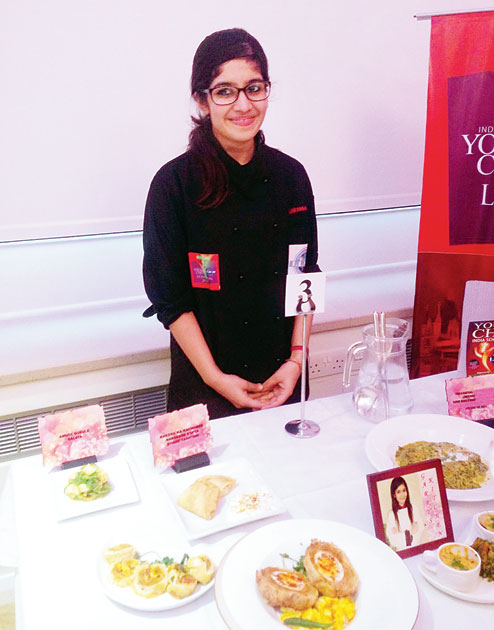
Garima Poddar plates her dishes at IIHM Young Chef India Schools 2014 at the University of West London
Garima Poddar likes her friends calling her Garry after Gary Mehigan, her favourite judge on Masterchef Australia.
And true to the Masterchef nickname, the Calcutta Girls High School Class XII student won the IIHM Young Chef India Schools 2014 contest at the University of West London on Saturday and retained the crown that Simran Kapur had won for Calcutta last year.
The finals of the inter-school cooking competition — held by the International Institute of Hotel Management (IIHM), in association with t2 — saw six finalists from six Indian cities (Calcutta, Delhi, Hyderabad, Bangalore, Pune and Ahmedabad) battle it out with their plates and pans to serve up meals to some of the best-known Indian chefs in London.
Wearing the judges’ hat at the London finale were Andy Verma, who owns restaurants Vama and Chakra in the UK, Dipna Anand whose family owns and runs Brilliant restaurant in London’s Southall area largely inhabited by Indians, Romy Gill of Romy’s Kitchen in South Gloucestershire, and closer home t2 columnist Shaun Kenworthy and Sector V IIHM’s chef Sanjay Kak.
How apt it was for the IIHM Young Chef India Schools contest to culminate in London was underlined by Virendra Sharma, MP, Ealing Southall, the chief guest at the evening prize distribution, who pegged the number of Indian restaurants in the UK at 60,000.
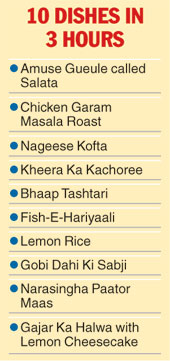
But what did Calcutta girl Garima do that the others didn’t? For one, she churned out 10 dishes in a three-hour-long cookout, a number unmatched by any other contestant. “Her biggest challenge was getting all her dishes right because she made so many,” agreed the judges, all of who gave Garima the highest score.
The Southern Avenue resident pinned her win down to two factors — confidence and practice. “I know it sounds cliched but practice does make perfect. I strived to make at least three dishes a day to prepare for the finals. One day, I did a 100 roti challenge just to get that perfect roti shape and all the rotis were given to the needy,” said Garima.
Like Garima, her other five competitors made it past 8,000 students who participated in the Young Chef competition over six months. Two got their visas in the nick of time and reached two hours before the contest kicked off while the Jaipur girl had to give it a miss, cutting down the number of finalists to six from seven.
In the two days they all spent in London before the finals, food was the only thing on Garima’s mind. Ask the Lebanese hairdresser at Eli’s Hair & Beauty on Kew Bridge Road who was unexpectedly pulled into a casual conversation on tahini, babaganoush and shawarma as she settled down for a wash-and-blow dry! Or the Kadai Chicken that was sampled at a local restaurant down the road from the hotel.
“In fact, it was for this competition that I started having non-veg,” said the spunky Marwari girl. “Non-veg is not cooked at home but we eat it outside. Initially, I would nibble on chicken; now I can eat a whole chicken meal!”
Which is why chicken featured on what the judges called her “buffet”. There was Chicken Garam Masala Roast, Nageese Kofta (egg wrapped in chicken keema) “learnt from my mom’s friend”, Kheera Ka Kachoree “learnt from dadi”, Bhaap Tashtari, Fish-E-Hariyaali, Lemon Rice, Gobi Dahi Ki Sabji and a fusion dessert Gajar Ka Halwa with Lemon Cheesecake. She also made an Amuse Gueule called Salata (frozen salad) and an Assamese dish called Narasingha Paator Maas “inspired by a YouTube video of Gordon Ramsay cooking Assamese food in Assam”.
The commerce student who loves economics also made all the right calculations and moves. Like when she used micro-greens to garnish her dishes, an idea picked up from Shaun’s cooking demonstration the previous day. Or when “I decided not to make rotis because they would have to be made last and would eat into my plating time”, she said.
Her future plans? “It’s either economics or cooking and after this contest, the scales are tilting more in favour of the latter,” she signed off, clutching in her hands the winning trophy, a cheque for Rs 5 lakh and a placard that read ‘Garry’s Kitchen’, which she had proudly displayed on her table.
What is your message for Garima? Tell ttmetro@abpmail.com
source: http://www.telegraphindia.com / The Telegraph,Calcutta,India / Front Page> Calcutta> Story / by Karo Christine Kumar in London / Monday – October 20th, 2014
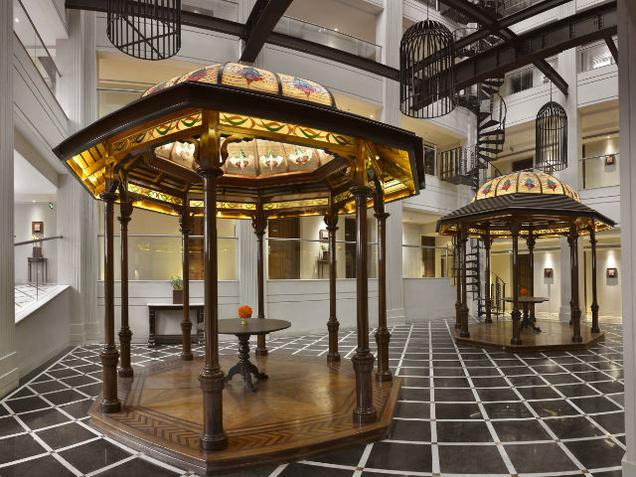
Past meets present: The atrium of the Lalit Great Eastern. / by Special Arrangement
In 1836 — when Bahadur Shah Zafar was yet to ascend the throne in Delhi to become the last Mughal — a man called David Wilson opened a bakery in Calcutta, which was fast growing into a second London. The bakery, a great source of comfort for homesick sahibs, did so well that Wilson soon acquired adjoining properties and in 1840 opened a hotel, cleverly naming it after Lord Auckland, the Governor-General of India who lived right across the road.
Until then, Calcutta boasted of only one hotel, Spence’s, also located a stone’s throw from Wilson’s bakery. Spence’s, which opened in 1830, had its share of admirers, who included Jules Verne. While scanning the archives of The New York Times, which I subscribe to online, I found only one mention of Spence’s, in an 1888 dispatch that was datelined ‘Spence’s Hotel, Calcutta’. Thereafter, for nearly a century, no Calcutta hotel merited mention in the paper other than Wilson’s, by then rechristened the Great Eastern Hotel. If you came to Calcutta, you had to stay at the Great Eastern, whether you were Mark Twain or Rudyard Kipling or Queen Elizabeth.
While no one seems to be sure when exactly Spence’s Hotel shut down, one knows for certain when exactly the Great Eastern was rescued from closure — in 2005, when the property, by now dilapidated and rat-infested, was bought over from the West Bengal Government by The Lalit group. Reopened to the public in 2013 as The Lalit Great Eastern, it is today the oldest existing hotel in India — a 176-year-old brassware restored and polished, its lifespan extended by another century or two.
Resurrecting history: The Wilson, which serves as the pub and backery.
At the hotel, where I checked in last weekend, it is hard to miss the advertisement placed in the October 1840 issue of The Englishman and Military Chronicle: “D. Wilson and Co. beg respectfully to announce having taken those splendid and spacious Four-storied Premises, No. 1, Old Court House Street, formerly occupied by Messrs. Thacker and Co. and the Sans Souci Theatre, opposite Government House, and are sparing no expense in the alterations, and fitting it up in a manner that will render it one of the most comfortable family hotels in India.”
Nearly two centuries later, the new owners are doing precisely the same thing — sparing no expense in the alterations — as they blend the Victorian, Edwardian and modern eras to give something unique to Kolkata, which has been notorious for neglecting its handsome colonial-era buildings. The Victorian block, comprising 49 suites, is still under renovation, and will open in February next year.
The three nights I stayed there, I skipped dinner, simply because I overate during lunch, gorging on Bengali food that was prepared in its sanitised kitchens, but tasted very home-cooked. On the third day, lunch was actually home-cooked: I had happened to mention to the resident manager that I had never had litti-chokha, the quintessential Bihari dish, during my decade-long association with Kolkata, and so he had got me litti-chokha from home.
To burn calories, I walked — outside the hotel and inside. I walked around Dalhousie Square, Kolkata’s Westminster, where the hotel is located; I walked the streets of Kumartuli, watching Durga idols being made; I took a ferry across the Hooghly and walked on the Howrah Bridge. Walking in the corridors of the hotel was also as good as walking back in time. From time to time, one came across glass wine decanters, silver napkin-holders, silver water jugs, ancient teapots — all belonging to the time when the Great Eastern was known as the Jewel of the East.
It is one thing to recreate the past with the help of imagination, quite another to recreate it with actual pieces from the past — The Lalit Great Eastern has achieved the latter. When you hold an old wine decanter, you are forced to wonder whether it bears the fingerprints of Rudyard Kipling. It just might — who knows?
source: http://www.thehindu.com / The Hindu / Home> Features> Metroplus> Society / by Bishwanath Ghosh / Chennai – July 01st, 2016
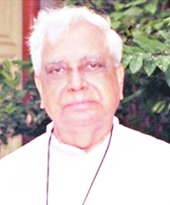
Archbishop Emeritus Henry Sebastian D’Souza, who served the Archdiocese of Calcutta from 1986-2002, passed away on Monday afternoon at Vianney Home on Middleton Row. He was 90 years old.
Archbishop Henry was born on January 20, 1926, in Calcutta and ordained as the first Archbishop of Cuttack-Bhubaneswar on May 5, 1974. He became the seventh Archbishop of Calcutta on April 5, 1986.
He is known to have revolutionised the educational scenario in the Archdiocese of Calcutta through proper policies. He had a close association with Mother Teresa.
The Funeral Mass will take place at St. Thomas’ Church, Middleton Row, on Thursday at 10am.
His mortal remains will then be interred at the Lower Circular Road Cemetery.
source: http://www.telegraphindia.com / The Telegraph,Calcutta,India / Front Page> Calcutta> Story / June 29th, 2016
State information and cultural affairs department (I&CA) organizes a workshop
Kolkata :
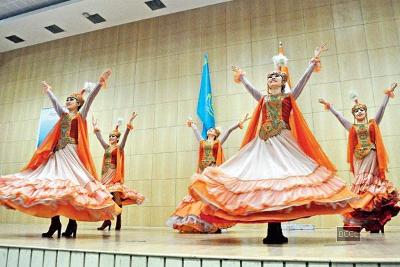
The state information and cultural affairs department (I&CA) is organizing a workshop on Saturday involving folk dancers from different districts along with their dance groups in an initiative to revive the dying folk dance forms. The government will also distribute folk dance dresses, masks and music instruments to encourage the groups to revive the dance forms. About 70 folk dancers of five different folk dance forms will participate in the one day workshop.
According to I&CA department officials, there are a number of old folk dance forms having its origin in different districts that are slowly dying and are almost becoming obsolete. “These dance forms like Gajon, Bhandi, Chandi etc reflect the age long social, religious and cultural traditions of Bengal. However, these folk dance forms have now become dying art forms. The state government wants to revive and rejuvenate these dying dance art forms by promoting and encouraging the folk artists,” said an official.
The workshop will have dancers of five such folk dance forms – Chandi, Bhandi, Rabankata, Gajon and Swasan who will participate. Experts of such folk dance and its dresses along with researchers will also attend the workshop. The folk dancers who will participate in the workshop will also be encouraged with traditional folk dance dress, masks and instruments
source: http://www.timesofindia.indiatimes.com / The Times of India / News Home> City> Kolkata / by Suman Chakraborti, TNN / June 24th, 2016
Neil Aloysius O’Brien, who pioneered quizzing in India and led the Anglo-Indian community for nearly two decades, passed away in Kolkata on Friday. He was 82.
A former member of Lok Sabha, O’Brien was a three-time nominated Anglo Indian MLA in West Bengal and an educationist. He was chairman of the Council for Indian School Certificate Examinations (CISCE) and chairman and managing director of Oxford University Press.
But it was O’Brien the quizmaster that was the most popular. He hosted the prestigious Dalhousie Institute Invitational Quiz for more than four decades. “Extremely saddened to hear about the passing away of the very talented Neil O’Brien. He will be missed by lakhs of quiz fans across India,” CM Mamata Banerjee tweeted on hearing the news.
O’Brien is survived by his wife Joyce and sons Derek, Andy and Barry.
source: http://www.timesofindia.indiatimes.com / The Times of India / News Home> India / TNN / June 25th, 2016
Way before Shyam Benegal directed ‘Netaji Subhas Chandra Bose: The Forgotten Hero’, another Hindi film was made on the freedom fighter. The Piyush Basu-directed film titled ‘Subhas Chandra’ had got the National Award for National Integration in 1966. A DVD of the Bengali version, which had Lata Mangeshkar’s cult ‘Ekbar biday de maa’ in the soundtrack, was released but the Hindi version never saw the light of day. Fifty years later, the film’s print will be restored, along with a number of Bengali classics.
In 1968, Sachin Adhikari had released ‘Pathe Holo Dyakha’, starring Bhanu Bandopadhyay, Jwahar Roy and Nripati Chattopadhyay. However, the prints of the movie weren’t good enough for a DVD release. If all goes well, the print will be restored soon. Another such Bhanu Bandopadhyay film that has never been released on DVD but might soon release is ‘Ogo Shuncho’.
Not just fresh releases of old movies, this year will see the re-release of DVDs of many Bengali films that have attained cult status. YouTube uploads, VCDs and DVDs of the original prints are available but most of these films have problems regarding fungus deposition, stabilisation, white droplet issues, stains, patches and vertical line formation. Poor audio quality is also a major headache. Dialogues are often inaudible and there is a lot of noise in the background. However, things are looking up what with copyright holders now understanding the importance of preservation.
One such important film that is being restored is KS Saigal’s Bengali film ‘Jeevan Maran’. “Gopalkrishna Gandhi, the former governor of West Bengal, had released a DVD of this movie. But we had used the original print. Hence, the quality had suffered. Now, we have decided to restore this film and re-release it,” said Abhay Tantia, the founder of Angel Video that owns the rights of the film.
In the pipeline is restoration work of Mrinal Sen’s ‘Chorus’, ‘Ek Din Pratidin’, Soumitra Chatter-starrer ‘Baghini’ and ‘Monihar’, Robi Ghosh-starrer ‘Aashite Ashiona’, Tarun Mazumdar-directed ‘Palatak and ‘Sreeman Prithviraj’. The 1964-Rajen Tarafdar film titled ‘Jiban Kahini’ is also expected to get restored soon. Work is currently on progress for Soumitra Chatterjee-starrer ‘Ajona Sapath’.
However, restoration work of such films is a pain-staking job. One minute of a shot has at least 1500 frames. “Each frame has to be restored individually. On an average, restoring of a film requires Rs 4 lakh. We have 20 technicians working on three shifts. Yet, it takes more than a month to complete one film,” said Sushanta Das, who is overseeing the project.
However, restoration of classics doesn’t ensure huge dividends. “It’s not financially very rewarding. But monetary rewards is not always the concern when we are dealing with cult films,” said Akshay Tantia, who considers it his responsibility to preserve Bengal’s culture.
source: http://www.timesofindia.indiatimes.com / The Times of India / News Home> City> Kolkata / by Priyanka Dasgupta / TNN / June 23rd, 2016
Imagine being present at a mehfil where Begum Akhtar is presenting a ghazal. Imagine listening to a house concert of Annapurna Devi. Imagine listening to Ustad Amir Khan singing a bandish in Persian. All these can be a part of reality if one goes to Jadavpur University’s School of Cultural Text and Records (SCTR). On World Music Day today, any connoisseur can walk into the kiosks set up in the school and listen to the treasure trove of archived music. The best part is that all that comes free of cost!
Director of the School, professor Amlan Das Gupta said, “Collectors from across India have generously donated to this archive that was set up in 2003. The work done here helps in cultural preservation.” In a country where rare records and tapes are lost at regular intervals, such an endeavour has been welcomed by all.
Barring weekends, the archive storing more than 10,000 hours of music is open to any listener between 11 am and 5 pm. Musicologist Anindya Banerjee donated rare live recordings of courtesans like Malkajaan, Bade Moti Bai, Rasoolan Bai and Siddheswari Devi to this archive. “I’ve donated rare live recordings of my guru, Ustad Ali Akbar Khan’s rendition of ‘Lankadahan Sarang’ too,” Banerjee said.
Some years back, Delhi-based collector James Stevenson had sent an aluminium trunkload of cassettes by train. Many still talk about the excitement of receiving that trunk at the Howrah station and then transporting a slice of history to the School. Resoom Pal, an intern at SCTR, said, “I was floored to stumble upon Vidushi Annapurna Devi’s surbahar recital in raag ‘Kaushiki’ and ‘Manjh Khamaj’ from this collection.” All recordings are of superior quality than what is available at any online portal, insists Shantanu Majee, project fellow of SCTR. “We try to preserve these tracks in audio files of superior quality that are uncompressed and preserved in large ‘WAV’ format. This is possibly sound at its best quality,” Majee said.
Some years back, collector Ghulam Naeem donated his collection of spool recordings from house concerts at his residence. In the 70s, Naeem used to import spools to record the programmes! After digitization, the clarity and sound precision of these recordings are of international standards.
One such recording is from a mehfil of Begum Akhtar where she sang a rare ‘ghato’ song – ‘Jal jaumuna bharan ke jaun sajni’ – that was usually sung when women went to fetch water. This ‘ghato’ song leads on to another song – ‘Chha rahi kari ghata’ – in the same recital. Arnab Ghosh, PhD scholar at the JU’s Bengali department, was pleasantly surprised when he discovered a live recording of Ustad Amir Khan’s recital of raga ‘Yaman’ in this collection.
“It was a revelation to hear Khan sahab sing ‘Shah Ze Karam Bar Man-E-Darvesh Negar’ by Amir Khusrau. Listening to such superior quality of music is as good as reliving the live performance,” Ghosh said.
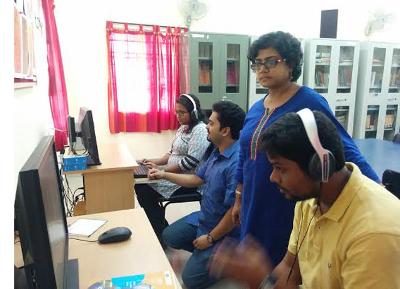
So, what are you waiting for? Just pick up the headphones and let the music play!
Rare recordings:
The Hemanga Biswas archive includes the legendary folk singer’s world music collection of English contralto singer Kathleen Ferrier and German actress and singer Gisela May.
Apart from his created ragas like ‘Chandranandan’, ‘Alamgiri’ and ‘Gaurimanjuri’, this archive also has rare recordings of Ustad Ali Akbar Khan playing raag ‘Gour Sarang’, ‘Barhans Sarag’ and ‘Maligaura’.
One house concert has Ustad Vilayat Khan exploring various kinds of raag ‘Kannada’. This leisurely performance is almost like a lecture demonstration.
There is a recording of Ustad Allauddin Khan playing raag ‘Nat’ and ‘Darbari Kanada’ in sursringar. A rare interview of the maestro with Bhopal radio has him singing raag ‘Komal Bhimpalasri’ and raag ‘Sugadh’.
Pt Ravi Shankar’s early 1950s rendition of raag ‘Mian ki Todi’ and ‘Aalahiya Bilawal’ at the Dixon Lane residence of guru Gyan Prakash Ghosh.
A pre-independence duet of Vidushi Annapurna Devi and Pt Ravi Shankar playing raag ‘Yaman Kalyan’ at Delhi’s Constitution Hall.
source: http://www.timesofindia.indiatimes.com / The Times of India / News Home> City> Kolkata / by Priyanka Dasgupta / TNN / June 21st, 2016
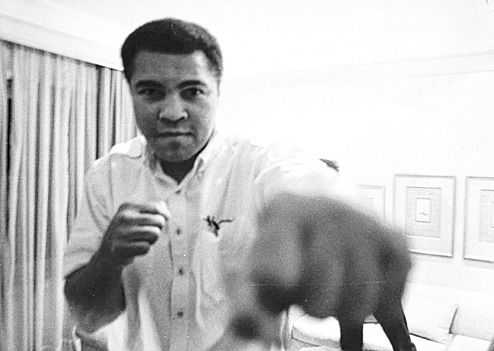
Muhammad Ali in his Taj Bengal room in December, 1990
I chased 100m drug cheat Ben Johnson from the 1988 Seoul Olympics and caught him… for an interview at his home in Toronto. I bit my nails during the football World Cup final in Rome in 1990 when Germany’s Andreas Brehme scored against Maradona’s Argentina in a penalty shootout to win the trophy. I joined Carnivale-style Brazilian fans in downtown Los Angeles after they won the World Cup of football in 1994. I was with Sunil Gavaskar when he presented Kapil Dev with a bottle of champagne at the WACA in Perth in 1992 after the Indian all-round legend got his 300th wicket. I saw Kapil dance on the bed of his Ahmedabad hotel room after becoming the highest wicket taker in the world in 1994. I had goosebumps when the Indian national anthem played to announce P.T. Usha as the sprint queen of Asia in South Korea in 1986. I’ve seen Boris Becker ‘boom boom’ his way to a Wimbledon title.
You could say that I’ve been there and done numerous international sporting events as a sports journalist in the 1980s and 1990s. But whenever I am asked about the highlight of my life, my answer is always the same: my encounter with Muhammad Ali at Taj Bengal, Calcutta, in 1990.
It went down like this. Word got around that The Greatest was visiting Calcutta for a community event, unrelated to sport. We at Sportsworld magazine (from the ABP Group of publications) were desperate to get an interview, and needed to identify the organisers of the community event. Having done so, we sought to find a ‘connection’ to the organisers. The link was a man named Dada Osman, a leading figure in Calcutta’s rugby scene and an old family friend of my parents.
Osman organised for me to meet Ali in his hotel room for 15 minutes! The arrangements included permission for us to take a photographer and one other person. This made for plenty of problems because everyone I knew wanted to be my chaperone. You would expect enthusiasm from a bunch of young journalist colleagues. But the demand to accompany me to meet Ali went far beyond my colleagues and friends. My father, Neil O’Brien, known to be an avid boxing fan, put in a request as well. How could I turn him down, when it was part of folklore that the quiz legend Neil O’Brien could rattle off every world heavyweight boxing champion in chronological order since the titles began!
So off we went, father, son and another legend, Calcutta’s best-know sports photographer, Nikhil Bhattacharya, to see the ultimate Legend. To set the scene, it must be pointed out that by this time Ali’s Parkinson’s was well publicised, and we were warned that it would not be a smooth-sailing question-and-answer session.
I knocked on the hotel room door a couple of times and after a little while, it opened. I stood there looking at this big white bath robe right in front of my face. My eyes travelled upwards, and there IT was: the Louisville Lip. From the photographs I had seen, Ali didn’t seem as big a man in comparison to some other boxers of his generation. But I was astounded to see this large frame standing in front of me. It was later that I realised it was not only his physical stature; it was also his awesome presence and aura which made him look bigger than he actually was. There is only one word which comes to mind every time I tell this story.
MAJESTIC! That’s what he was. And mind you this was way past his glory days. He still floated gently like the butterfly he claimed to be. The raving and ranting had been replaced by slow and soft speech. But there was no denying that there was something special about this man. He radiated greatness by his mere presence. I honestly don’t remember what questions I asked, but I recall he wasn’t able to provide long answers. Just a simple ‘yes’ or ‘no’. As an interview it wasn’t very informative.
All I remember is that he sat back on the large sofa, white bathrobe wrapped around as if he had just come out of the boxing ring. I sat at the other end of the sofa… on the edge of it really. My dad sat on the single sofa at the side. Nikhil da went about his business, click, click, click.
There are two other things which are etched in my memory. At the end of our 15 minutes, my dad, unannounced to me, pulled out an enlarged black-and-white print of a photograph of Ali in the famous pose after he had knocked out Sonny Liston to win his first of three world titles. I recall feeling a bit embarrassed, because as a journalist I always refrained from asking sportspersons for autographs, and posing for photos with them. I remember thinking; I had never witnessed my father pay such reverence to any other person. Such was dad’s passion for this legend that he stooped to break my unwritten rule of no autograph/photograph.
Dad’s request gave me courage to ask my last question; and I couldn’t help but ask it. “Ali sir, may I take a photo with you?”
He stood up very slowly, I jumped to my feet. Nikhil da set himself up to take the shot. Just when Nikhilda said “ready?” something got into me. I raised my right fist and placed it on Ali’s jaw to pose for the photo. Perhaps at the back of my mind I was aware that his Parkinson’s would not allow him to ‘sting like a bee’ in reaction to this bold step of mine. I was right. He merely looked at me, leaned forward and the man, known for his classic one-liners, whispered in my ear, “BE COOL, FOOL!”
The champion, his body ravaged by something beyond his control, had not lost his wit, his class and his dignity.
Over many years, when I came across media reports that he was ill, I always told myself that one day I would write again about our meeting to relive the Legend of Ali to the current generation. Sadly, that day has arrived today, when my teenage son, born 20 years after Ali retired, burst into the room to announce, “Dad, sad news: Muhammad Ali has died.” My son knew it would be sad news for his dad, because he has heard on numerous occasions his dad tell the story of the encounter with Muhammad Ali. The time had come for me to write the story, as a eulogy and tribute to the great man. I’m glad I passed on the Ali legacy to my children. I had to, because I have never been so in awe of a person ever in my life as I was with Muhammad Ali that day in the hotel room in Calcutta.
Truly the Greatest! RIP.
Andy O’Brien, always a sports fan and always a Calcuttan, worked for 13 years with Sportsworld magazine. He migrated to Australia in 1996.
source: http://www.telegraphindia.com / The Telegraph,Calcutta,India / Front Page> Caclutta> Story / by Andy O’Brien / Sunday – June 05th, 2016