A Good Friday tradition among workers from Odisha continues at former colonial firm
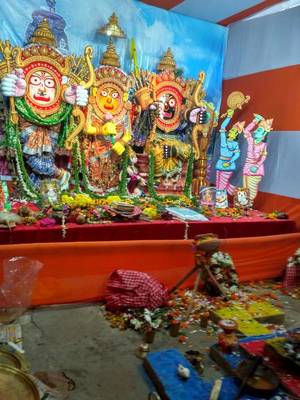
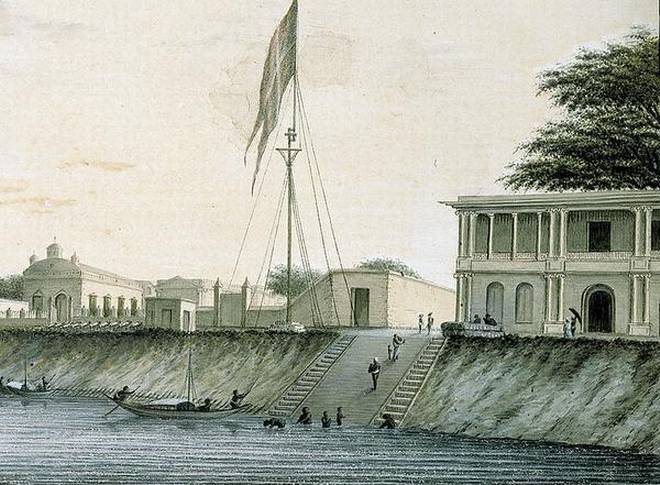
This Good Friday, the headquarters of the 154-year old Andrew Yule Company resonated with verses from the Bhagavat Gita along with a puja for Lord Jagannath.
A practice started by the Odisha employees of this erstwhile colonial managing agency, under the patronage of Scotsman David Yule has continued uninterrupted through the ups and downs of the company and marks its 100th year in 2018.
Heritage building
Yule House, the headquarters of AY, which managed cotton and jute mills, tea gardens, coal companies, railways and a printing press, with over 80,000 on its rolls in its heyday, is listed as a heritage building in the heart of Kolkata’s business district.
The company was set up in 1863 when Andrew Yule, a strapping Scottish entrepreneur arrived in Calcutta, the then imperial capital of India. He founded a company as a managing agency at a time when railways, telegraph and postal services were making a beginning in the country.
George Yule, Andrew ‘s elder brother took over the reins in 1875. David Yule assumed AY’s control, after his uncle’s death and by 1902, Andrew Yule managed over 30 businesses including a printing press and even a zamindari in Midnapore district, where it promoted agriculture, forestry , fisheries, roads schools, and healthcare facilities.
Among its many employees were several from Odisha. Says septuagenarian Praful Das from Kendrapara, a special invitee to the centenary celebrations: “ Four generations of our family have been working here and since those days, people of all faith have been participating in this puja…It was a small affair then… it has grown in pomp now.”
Fluctuating fortunes
AY’s fortunes dived with the abolition of the managing agency system in 1969 and nationalisation of the coal and the insurance industry. The process of government acquisition ended with AY becoming a public sector enterprise.
However, the puja tradition goes on. Bijoy Panda a third generation employee, explained that the priest comes from Puri carrying a bit of the flag that flies atop the Puri Jagannath Temple and some special offerings from the Temple. The first invite is sent to the titular King of Puri.
source: http://www.thehindu.com / The Hindu / Home> News> Cities> Kolkata / by Indrani Dutta / Kolkata – March 30th, 2018
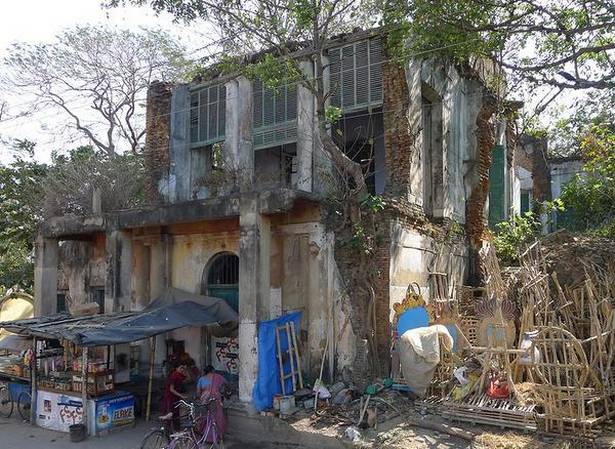
The Greek community has long vanished from Kolkata. Besides the Greek Orthodox Church at 2A Library Road, the Panioty Fountain (named after Demetrius Panioty) at Curzon Park that is featured in Satyajit Ray’s ‘Paras Pathar’ still stands testimony to Kolkata’s Greek connection. Tucked behind the Metro construction at Phoolbagan rests the only cemetery meant for this community in India.
Locals vouch for its historic relevance and claim that the Greek President had also visited it in 1998. All the above addresses are Grade 1 Heritage Buildings in KMC records.
Yet, today the cemetery lies in neglect. Father Raphael, priest of the Greek Church which also takes care of it, is keen that the either the state government or any private organisation takes up the initiative of renovating this dilapidated cemetery that is a Grade 1 heritage building by KMC records.
In 1777, this cemetery had started functional at 105 Abul Kalam Azad Sarani. Curiously enough, the first tombstone belongs to that a Greek businessman named Alexander! In 1771, Alexander Argeery was sent to Cairo by Warren Hastings on a diplomatic mission to obtain permission for British merchants to trade with Egypt. Once he managed to do that, he was rewarded by Hastings with a permission to build a Greek church in Amratollah Street. Eventually, he shifted his business to Dhaka, where he died on August 5, 1777. Later, his body was buried at this Phoolbagan cemetery on August 7, 1777.
A blue tarpaulin sheet almost hides the entrance. Passers-by can easily overlook the inscription mentioning ‘Greek Cemetery’ beside the gate. Even those staying in the residential apartments, which literally surround the cemetery, wouldn’t think that this can be an attraction for tourists and students of world history.
But in reality, it deserves all their attention and more.
Built on 26 cottah of land, this cemetery is now home to some 300 odd graves. Caretaker Basanta Das, whose grandfather and father also worked here, says this includes even those that don’t have a tombstone.
Unfortunately, most of the tombstones are broken. They are either nameless or have illegible inscriptions. Some have inscriptions written in Greek as well. “Not all the graves have bodies buried underneath. Even when some Greeks died in other India cities and were buried there, their tombstones were erected here. That has been done so that memorial services for all Greeks in India can be collectively held here,” says Raphael.
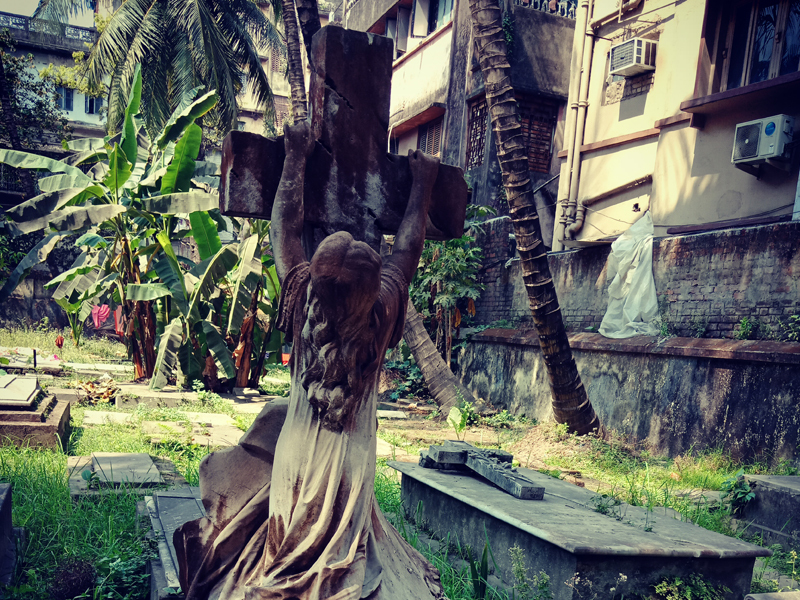
A small chapel – Prophet Elias – stands inside the cemetery. Few sculptures still remain. Among the first one to draw the attention is the sculpture on the grave of Sir Gregory Charles Paul who was the advocate general of Bengal. Next to this grave rests his widow Lady Aglaia Elizabeth Paul. At the far end of the cemetery rests another grave with inscriptions written in Greek. A striking sculpture of a lady kneeling and holding on to a cross looks arresting.
The once-beautiful garden has now been reduced to just mini bushes. A well has been dug right inside the premises. That’s where Das and his family take a bath and wash utensils. Sometimes when guests come visiting, the graves serve as dining tables for their sumptuous lunches. Ask them if they are scared of spirits on rainy nights and Das and his family break into a peal of laughter. “Never have spirits bothered us here,” Das insists.
The fund crunch in renovating this cemetery is obvious. “The Greek community abroad has been financially supporting our church as well as the upkeep of the cemetery. But in recent times, Greece has been reeling under economic crisis. The community is still trying to help us but currently, we have had to cut down 50% of our projects because of the financial crisis,” says Raphael, adding that any initiative for the upkeep of the cemetery is welcome.
The only Greek representative in Kolkata is 66-year-old old Sister Nectaria Paradesi who is responsible for looking after two orphanages. In the absence of Greek families in Kolkata, the church allows people of other faith who now belong to the Greek Orthodox Community to get buried here. “It is difficult to get burial space in this city. Since this cemetery still has space to accommodate tombs, we allow those who have converted to our congregation to get buried here,” Raphael says.
That’s why one spots the tombstone of Philoythei Tina Khatoon. “The last burial – that of a lady in her 40s – happened some six months ago,” says Das, who gets a meagre salary of Rs 4,500. He is now pinning hopes on the Metro rail authorities to help with the renovation. He had heard that once the Metro Rail station gets built, the authorities might be interested in renovating this place. Das is now hoping these words will not just rumours.
source: http://www.timesofindia.indiatimes.com / The Times of India / News> City News> Kolkata News> India / by Priyanka Dasgupta / TNN / March 25th, 2018
Prasun Chaudhuri meets the gentle spirit rallying for Chandernagore’s endangered heritage
HERSTORY: Neline Mondal poses where Antony Firingi had once performed Picture Credit: Prasun Chaudhuri
The 24-year-old Belgian scientist arrived in Calcutta one autumn 30 years ago. She was part of a Unesco delegation that was visiting India to raise awareness about the HIV virus in these parts. Like the rest of her colleagues, Neline Colassin was suitably qualified. She had a triple Master’s in Physiology, Cellular Biology and Biochemistry.
In her spare time, she wanted to explore her new habitat. Someone told her about the erstwhile French colony of Chandernagore, 50 kilometres from Calcutta. Neline remembers listening with rapt attention about the small Bengal town and its famed Jagaddhatri Puja. The spectacular fireworks that were part of the celebratory experience and how the tradition possibly owed itself to French administrators who would organise something similar to celebrate the Fall of the Bastille every year.
Neline, who had spent several years at École Normale Supérieure – a school of science in Paris – was fascinated, and one weekend, she decided to see for herself what Chandernagore was all about.
She was referred to a local, a certain Ujjal Mondal, who was involved in another Unesco project – something to do with the restoration of the French institute there. Reminisces Neline, “I did meet that certain Ujjal Mondal and have been meeting him every day ever since.”
In love stories, things have a pace of their own. There is no too soon or too late. Before a year was up, Neline and Ujjal were married.
Neline came to live in the Mondal Mansion, a 277-year-old family house of French colonial-style architecture on the banks of the Ganges, which had definitely seen better days. Says Neline, “Though I had been a scientist, my marriage into the Mondal family turned me into a heritage conservationist.”
As Neline explored the locale, she discovered how French architectural styles had mingled with indigenous ones. “There’s a confluence of French and Bengali styles in architecture, furniture and town-planning. You can see a similar blend of Tamil and French styles in Pondicherry,” she says in mellifluous Bengali with French top notes.
Most houses from that time retain a basic Indian plan – a courtyard in the centre and rooms built around it. The foreign influence is apparent in the facades, intricate stucco detailing – a fine plaster – decorative cast iron grilles, crafted murals and gargoyles. The Mondal Mansion is no exception.
The Mondals, we are told, were essentially traders dealing in salt, swords, wine and foodgrains, among other things. But they seem to have made most of their money from escorting merchant ships in the high seas. “The family had a small private army that fought Portuguese pirates in the Hooghly with expertise. In fact, the pirates were forced to sign a deal that they’d never attack a ship that carried this family’s flag. Thereafter, the Mondals would escort ships of other traders for a fee,” Neline explains.
According to the Mondals, their ancestors ranked among the 20 richest families of India in the late 18th century. The house itself was built in 1741. It took 10 years to complete all 85 rooms. In time, of course, a large part of the house was swallowed by the elements – earthquakes, floods and the changing course of the Hooghly.
Neline, who very graciously takes The Telegraph on a walk-through of the Mondal Mansion, points out the ornate staircase made of Burma teak, the colonnade, the grand Belgian mirror, centuries-old wine bottles and frescoes on the walls. “You’ll find the same frescoes in Napoleon Bonaparte’s house in Paris,” says Ujjal.
The ballroom is said to have hosted performances by Antony Firingi, the poet-singer of Portuguese origin, famed for his devotional songs to Kali. “He was a manager at the salt godown owned by my forefathers,” claims Ujjal. He has been told that Antony was encouraged notwithstanding the disapproval of the locals – they didn’t want a Christian to sing songs in praise of a Hindu deity. Adds Neline, “They [the Mondals] were liberals influenced by the French. Unlike the British, French colonialists were much more open-minded and loved the fusion of the two cultures.”
Despite the crumbling heritage around them, or probably because of it, Neline and Ujjal have become passionate members of The Heritage & People of Chandernagore, a heritage conservation project in association with the Embassy of France in India. Says Neline, “The unique cultural and architectural heritage is being systematically decimated here. Every other week you’ll find a structure demolished. Recently, a century-old printing press was razed.” And then there are all those real estate sharks casting their long shadows. “Several structures have disappeared but we can save the remaining few with a concerted effort,” says Neline.
The Mondal Mansion has managed to survive so far. On a moonlit night, while walking on the expansive terrace, Neline says she feels excited to be the inhabitant of such a grand old place: “The old walls talk to me. They tell me their stories.”
source: http://www.telegraphindia.com / The Telegraph,Calcutta,India / Home> West Bengal / by Prasun Chaudhri / March 25th, 2018
Rail board chief inspects toy train route and stations
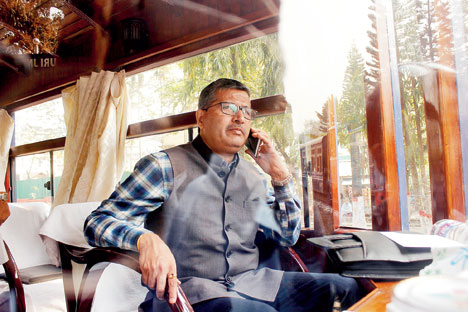
Lohani seated on a toy train near Sukna on Tuesday. Picture by Passang Yolmo
Siliguri:
Ashwani Lohani, the chairman of Indian Railway Board, on Tuesday promised that all necessary restoration works would be taken up for preservation of the world heritage status of the Darjeeling Himalayan Railway (DHR).
The chairman said he would look into possibilities of reducing toy train fares and said more second class coaches would be introduced in toy train services so that tourists as well as locals could afford the travel.
The railway official arrived at New Jalpaiguri on Tuesday morning and took a special toy train – two coaches hauled by a steam loco – to the hills.
He visited a number of stations, the DHR workshop at Tindharia, the printing press at Kurseong and also interacted with railway employees, local people and passengers of other toy train services.
“We are aware of the world heritage value of the DHR and will do all necessary work for the conservation and restoration of the DHR,” said Lohani at Sukna, from where he started his inspection.
During the statehood agitation in the hills last year, the toy train services had come to a halt in June. Also, a section of agitators had torched two stations -Tindharia and Gayabari-and damaged a portion of Elysia Building, the DHR headquarters in Kurseong.
source: http://www.telegraphindia.com / The Telegraph,Calcutta,India / Home> West Bengal / by Bireswar Banerjee / March 21st, 2018
A team of scholars from the English department of the Vidyasagar University has travelled through one tribal village to another in an effort to save dying tribal dialects, scripts and folk performances.
The entire body of nearly lost dialects and scripts that was conserved from there will now be a part of a massive digital archive. Folk performances will also be showcased in a two-day open-air public presentation on the university campus, starting Tuesday.
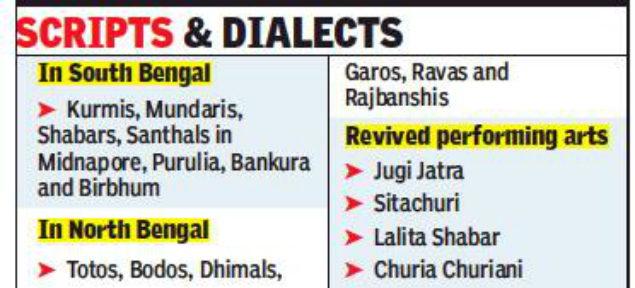
The team visited habitats of communities like Kurmis, Mundaris, Shabars, Santhals in West Midnapore, Purulia, Bankura and Birbhum in south Bengal and also documented their visit to the Totos, Bodos, Dhimals, Garos, Ravas and Rajbanshis of north Bengal. The team visited the villagesto conserve their dialects and scripts, which are nearing extinction.
During field work, they witnessed performances like Jugi Jatra, Sitachuri, Lalita Shabar, Churia Churiani that were popular in the folk life of the Jangalmahal tribes even two decades ago, but are now no longer practised because they are not considered entertaining enough anymore and do not get audience.
The research team extensively quarried written scripts in old diaries, faded manuscripts and oral traditions from homes of elderly people, many of whom were also performers of these folk art forms. “Linguists working in the team have deciphered the texts, which are a curious mix of Oriya and Bengali dialects.
They are transcribed in phonemic forms and then translated into English for a wider audience,” said Debashish Bandyopadhyay, head of the department of English and also co-ordinator of the project.
The project, because of its uniqueness, has been supported under the departmental research support (DRS) scheme of UGC’s special assistance programme. Vice chancellor and historian Ranjan Chakraborty, has also helped out in the research.
The project and the two day programme, that has been christened, “Performance and the Prospects of Tribal Folkloric Culture of Eastern India”, has generated a lot of attention among international publishers and scholars of indigeneous cultures, who work towards conserving endangered cultures.
source: http://www.timesofindia.indiatimes.com / The Times of India / News> City News> Kolkata News / by Jhimli Mukherjee Pandey / TNN / March 20th, 2018
From ship builders, dentists, shoe-makers — to chefs. How did the Chinese in India get stuck with the identity of the Chinese chef? A report from Kolkata, the only Indian city with two Chinatowns where the Chinese came 220 years ago
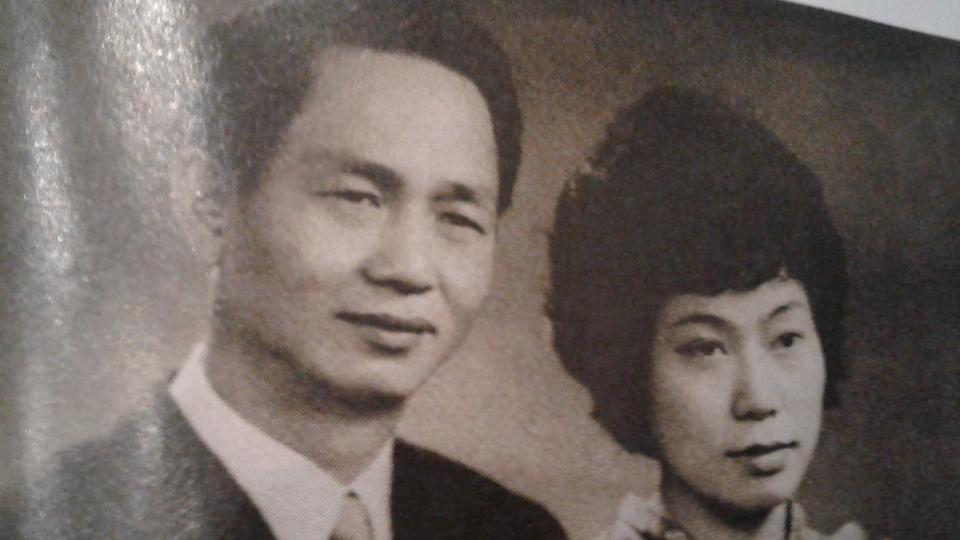
(R) Monica Liu with her husband. Liu, an Indian Chinese, is one of the most successful restauranteurs of Kolkata. (Photo courtesy: Monica Liu)
You could almost say Tong Atchew was a good mushroom growing on foreign soil. A mushroom does wonders for the soup, the stir fry and as stuffing. No flash, no permanent dash, but it still stands on its own even as it adds to the flavours of the mix into which it is thrown.
Atchew, a middleman, believed to be the first Chinese immigrant in India, arrived in 1798. He managed to strike a deal with Warren Hastings, the governor-general of British India, and became the owner of a sugar mill near Kolkata.
In the late 18th century, Kolkata was the terminus, the port and the transit point to pretty much everywhere else. The Chinese in India, especially the Chinese of Kolkata, the only Indian city with two Chinatowns –– the first in Tiretta Bazaar has existed since the 1800s, the second, in Tangra since 1910 –– consider Atchew The Ancestor. Here was someone who made ‘leaving home’ a success story, in contrast to staying put, the established wisdom for that age. He consolidated the image of the Chinese as a hardy migrant who slogs for his success, is a credit to his community, and keeps his own counsel.
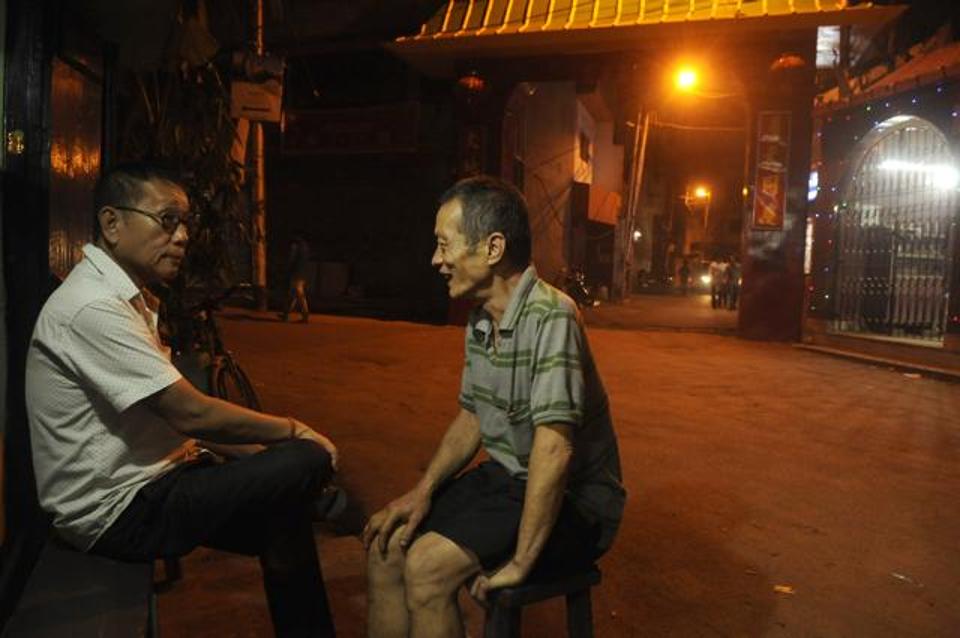
At Tangra, the second Chinatown, of Kolkata. (Samir Jana/HT PHOTO)
The Chinese who came to Kolkata were mainly from coastal China, then ravaged by civil wars; many landed in between the two world wars too. All had different skills and traditions, which they innovated, in order to survive. The Hubeis, who were “teeth-setters”, became dentists. The Cantonese were ship-fitters; by the ’50s they had moved into carpentry. The Hakkas were talented shoe-smiths and leather manufacturers. All of them came to India to work. None of them came here to cook.
But as the example of Monica Liu, a Hakka housewife who has become Chinatown’s most well-known businesswoman over the past 10 years, shows, the restaurant business can become an area where race or ethnicity may find accommodation, and success –– if it does not challenge established tastes too much.
In the ’90s, Liu cooked for the late chief minister Jyoti Basu at his home after his return from China. In 2012, writer Amitav Ghosh did a lunch with the Financial Times at Liu’s flagship restaurant, Beijing. Here, he discussed the opium trade, linguistic adjustments made by men who met at sea featured in his Ibis trilogy over beer and steamed bhetki. In 2018, Liu is preparing to face cricketing legend Sourav Ganguly in the popular Bengali television game-show, Dadagiri.
Two Bengali boys watching Liu, as she does the rounds of the tables at the Beijing restaurant, delay stuffing the last tiger prawns into their mouths and greet her saying they have seen her appear in some TV programme. In block heels, cropped hair and thinly pencilled eyebrows, Liu’s is as public a public face as is possible in a community that shuns the media.
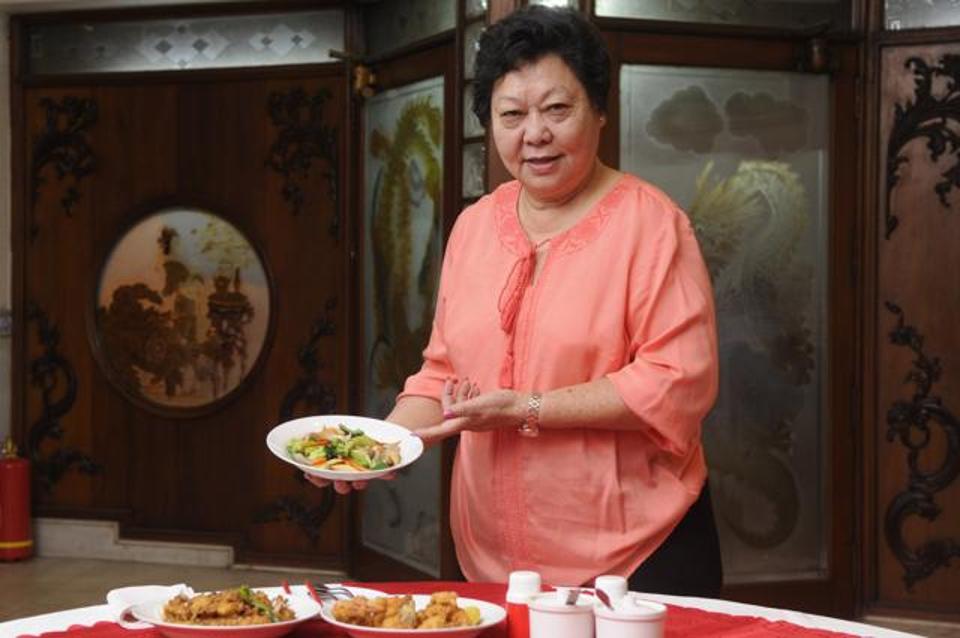
Proprietor and head chef Monica Liu at her Beijing restaurant in Tangra, Kolkata. (Samir Jana/HT PHOTO)
Image issues
“Our food is suited to Indian tastes,” says the owner of five restaurants in and outside Chinatown, returning to our table. Liu opened Kimling, her first, in 1991. “In my restaurants, I always keep a chilli-garlic gravy, popular with customers, ready. Sometimes they want their chicken dry or with gravy. But this is not to say my food is Indian-Chinese. It is Chinese,” says Liu playing the elder stateswoman of Chinese cuisine to the hilt.
Restauranteurs in Tangra, riding the restaurant boom in the ’90s, had no problem saying they sell Indian-Chinese to create a space, as it were, for selling their food. “It was part of their entrepreneurial logic to boost saleability,” says anthropology researcher Piya Chakraborty. But the renown of many Chinese restaurants now owned by non-Chinese (such as hotelier Anjan Chatterjee’s Mainland China, which he started in Mumbai in 1994 and which he brought to Kolkata, and musician Debaditya Chaudhury’s Chowman chain in 2010) has produced a new kind of anxiety. So the assertion of ‘authentic Chinese’ to be got at Tangra, and not just at central Kolkata, the original Chinatown, is important now.
Food networks
The small eating houses in Tiretta Bazaar, central Kolkata, was originally meant to feed the local Chinese working men, numbering around 25,000 till the early ’60s, before the outbreak of the Indo-China war of ’62. Central Kolkata was a Cantonese stronghold. When a new throughfare split the area, the Hakkas, the other sizeable Chinese immigrant group, re-located to Tangra. The collective sense of security in mixed neighbourhoods, where each minority recognises the other as such (central Kolkata had substantial Anglo Indian, Jewish, Sindhi, Bihari populations), however, stopped many Hakkas from moving out.
Dominic Lee, a Hakka, who owns Pou Chong, one of the most well-known brands of sauce and noodles made by the community near Tiretta Bazaar, is perceived as Mr Lee, the sauce-maker, not the Indian-Chinese sauce-maker by the neighbourhood. His professional identity, he says, has never felt eclipsed by his racial identity. (That is why he is able to field questions of “authenticity” without feeling defensive about it.)
This is not to say that the Chinese do not maintain strong community networks. Lee’s products are used by Tangra outlets like Liu’s Beijing, as much as all over central Kolkata eateries. When casting directors of the Salman Khan-starrer Tubelight were scouting for a youth to portray “a Chinese”, Lee recommended Thomas Chen, a Cantonese mechanical engineer and singer in Kolkata, for the cameo.
David Rocco, the popular Canadian-Italian TV host, has interviewed Lee for his programme Dolce India. When quizzed about the ‘authenticity’ of his sauces, Lee’s answer is pat: “It’s authentic for this area. The Hakkas are gypsies. Each group of Hakkas has its own Hakka cuisine.” No two Bengalis, he says to further explain his point, make pulao or paturi the same way.
Owner of the Pou Chong brand, Dominic Lee at his shop at Tiretta Bazaar, the first Chinatown. The combination of the Pou Chong tomato and Pou Chong green chilli sauce is usually used with the Kolkata kathi roll. (Samir Jana/HT PHOTO)
The Pou Chong brand, started by Lee’s father to cater to the large Chinese population, was badly hit, a second time, when families were uprooted at the outbreak of the Indo-China war in 1962. “It was a collective trauma for the community, which may explain the wall of silence it maintains now,” says Chakraborty.
The war with China nearly emptied central Kolkata; hundreds of Chinese were deported to and jailed in camps in Rajasthan on mere suspicion of being ‘Chinese agents’. Monica Liu and her family were picked up and sent to a prison camp as was Thomas Chen’s mother in her teens; they were released without compensation or apology after several years. In a cruel twist of fate, the role he had to enact to crack the Tubelight audition was to play a Chinese soldier interrogating an Indian spy.
“I can never touch a potato or a gourd since then. Even the smell of their cooking scares me,” says Liu. They were a staple in her prison camp. For many Indian Chinese with similar experiences, family traditions around food have just not come together because of interrupted family life. Chen says he learnt to make a Chinese-style whole steamed fish, but not from his mother. The lack of schooling, because of formative years in jail, may also have pushed many of those from the earlier generation towards informal sectors like food, other than ‘office jobs.’
By the ’70s, the situation stabilised. Local Chinese boys entered the city’s five-star kitchens as hotels opened their first Chinese restaurants. “They popularised our products. Chinese, by then, had become part of the city’s street food. Every street corner had someone selling chow on carts. The combination of the Pou Chong tomato and Pou Chong green chilli became the Kolkata kathi roll sauce,” says Lee.
The eating culture of the central Kolkata Chinese developed in close contact with other migrant communities at the margins of Bengali society. Their restaurant clientele – fellow Chinese – was assured due to their still sizeable population in this area so they were under no pressure to suit their food to a ‘Bengali’ palate. Jayani Bonnerjee of OP Jindal Global University, a specialist on the Indian-Chinese community, talks of a dish called ngapi, a shrimp paste of Burmese origin, that was eaten at both Chinese and Anglo-Indian homes on Bentinck Street, though it’s not clear who influenced whom.
“The Chinese and Anglo-Indians had an affinity for one another; for ease of schooling and professional networks, many Chinese had become Christians. They shared schools, met each other in church, visited each other’s homes,” says Bonnerjee. When Waldorf, the famous Kolkata Chinese restaurant on Park Street, changed hands, the ownership went to an Anglo-Indian family, the Mantoshes, most probably in the ’90s, she points out.
At Bow Barracks, central Kolkata. The Central Kolkata Chinese stay in mixed neighbourhoods. (Samir Jana/HT PHOTO)
Indianisation
The Supreme Court ultimatum in 2002 to shift out 592 tanneries in Tangra, where the Hakkas on leaving central Kolkata went, was another big jolt for the community. It nearly emptied out Tangra. Most left for Canada. Those who could not; converted the godowns into restaurants. This is where the Indianisation of Chinese restaurants began.
The story of Tangra’s Indianisation is classic migrant-nama: left with lemons, they made lemonade. But when they did, that was inadvertently the first step taken by the community to build, with the Bengalis, a shared culinary mythology.
Chinese eating houses probably took their initial reluctant steps towards serving ‘Indian Chinese’ when Kolkata’s office-goers passed through the tannery areas in Tangra on their way home and showed up at the factory-cum-kitchens of the Chinese to request for fried chicken to go with booze.
Bengalis who frequented these Chinese joints wanted Chinese food, but on their own terms — fried, spicy and saucy. Enter the Chilli Chicken (chicken nuggets dipped in corn slurry, deep fried and finished up with soya sauce) and Schezwan Chicken (made by tossing deep fried chicken with a reddish sauce out of a bottle and Sichuan pepper, a key ingredient). Sichuan pepper, when it met Bengalis inside Chinese restaurants, began to be called ‘Schezwan’, so goes the joke.
Authenticity-seekers eat in Central Kolkata places like Eau Chew and Tung Nam now; Tangra is the spice-lovers’ haunt. Such customers might, says Monica Liu, on the rare occasion, ask her the passive-aggressive question, “what is your cooking medium?”, which she knows how to answer. “We use the same oil, or as much oil – the way you like your biryani,” she says fixing the customer with gimlet eyes.
The last Chinese waiter to take orders at the tables of Chinese restaurants like Liu’s Beijing, is not known. Till the ’70s, the Chinese restaurant was not the first place where Bengali boys looked for jobs. Now they do. This is now Beliaghata boy Babu’s stage. In Liu’s kitchen, Biharis are firing up the woks, and two Hakkas are chopping the vegetables and supervising them. The word is in many ‘Chinese restaurants’ Nepalis and south Indians are doing the cooking. Peter Chen, who runs the famous carpentry firm in Poddar Court, central Kolkata, says as much but won’t identify the restaurants. “They are doing a fine job, let them be,” he says.
Mechanical engineer Thomas Chen with his son, Travis, at his home in Bow Bazaar, central Kolkata. ‘I am almost Bangali,’ he says. Chen has done a cameo in a Salman Khan film and also sings in Bengali, Hindi and Mandarin. (Samir Jana/HT PHOTO)
The Chinese have taken up Indian food as well. When dal poori entered Chinese homes has not yet been documented, but Peter Chen, the businessman likes it. Chang Chen Fa, a Hubei chef loves it. Thomas Chen, the singer, eats it. Chen, who welcomes us into his home with tea and Chinese prawn wafers, says his pork is spiced with Everest turmeric masala. “I am almost Bangali,” says Thomas Chen, who speaks the flat, unaccented Bengali spoken in urban Kolkata.
Many young Indian-Chinese like Chen, especially those who were born in India, say experts, are increasingly trying to define their Chinese-ness in the context of their immediate surroundings. Chen and his family participate in community art projects around Tiretta Bazaar, the area he grew up in. He is not looking to be Chinese in China.
As we leave Kolkata, two images remain with me. Monica Liu barking at her employees to slice the carrots well, which pretty much sounds the same in every language. And Chen singing khayal at his home, which he says, helps him hit the high notes when singing in Mandarin.
People often say the Chinatowns of Kolkata are going or gone. Both, I think, daily renew themselves.
source: http://www.hindustantimes.com / Hindustan Times / Home> Lifestyle> Art & Culture / by Paramita Ghosh, Hindustan Times / March 10th, 2018
Across the ages: The Denmark Tavern in a painting by Peter Anker, dated 1790 | Photo Credit: Historical Museum of Oslo/Special Arrangement
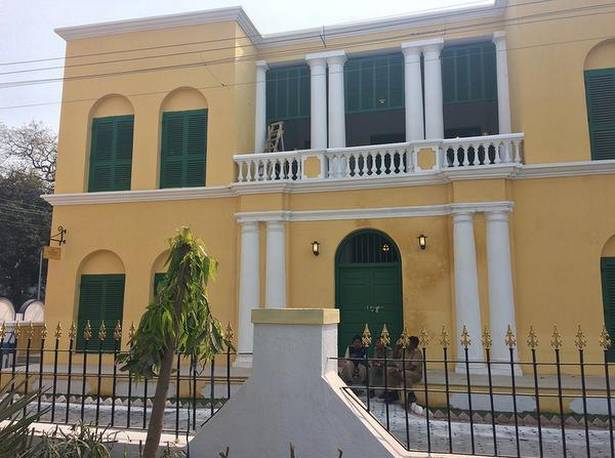
After two years of renovation that cost ₹5 crore, the building is ready to host visitors to the historical town of Serampore in West Bengal
Mr Parr, who formerly kept the London Tavern, has taken the new upper-roomed house near the flag-staff in Serampore, directly facing the Barrackpore Cantonments and fitted up the same in an elegant and convenient manner, both as a Hotel and Tavern.
This was one of the advertisements published in the Calcutta Gazette on March 16, 1786, announcing the opening of a tavern by James Parr on the banks of river Hooghly.
Another advertisement, two years later on April 3, 1788, makes a mention of the establishment.
Noting a change of hands from James Parr to John Nichols, who formerly kept the Harmonick Tavern in Calcutta, the advertisement goes on to say: The gentlemen of cantonments, or parties going up and down the river, and all others who may honour Mr. Nichols with their countenance, may depend on the utmost civility and every endeavour to give satisfaction and very moderate charges. Bed, Lodging, and Board, by the week or month.
In 2010 – 11, more than 200 years after the tavern’s heyday, a group of restoration experts studied a building that stood in complete ruins, surrounded by debris.
“Nobody remembered the original name and function of the ruined building. It was like detective work to search the archives for information, and it felt great when I realised that it must be the well-known Denmark Tavern and Hotel, which was located at the Nishan Ghat where the Danes kept their flagstaff and salutation cannons,” said Simon Rastén, historian, National Museum of Denmark. It was decided that the building would be restored and reused.
Grand unveiling Across the ages: The Denmark Tavern in ruins in 2009.
After two years of painstaking restoration work, the Denmark Tavern was reopened on Wednesday. Ambassadors of a number of Scandinavian countries, including Denmark, were present on the occasion.
The renovation cost of ₹5 crore has been borne by Realdania, a private association in Denmark which supports philanthropic projects in the realms of architecture and planning, and the Department of Tourism, Government of West Bengal.
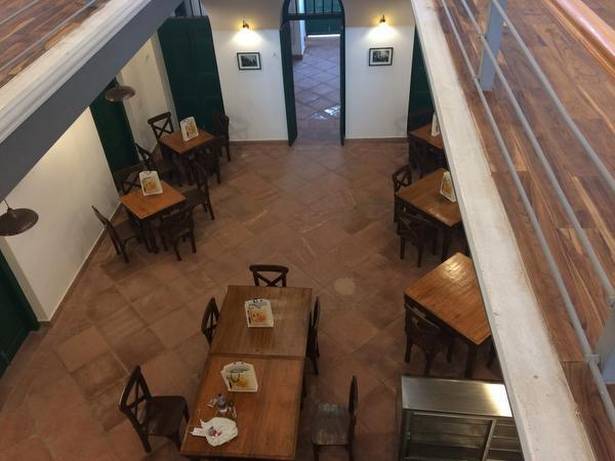
The State Tourism Department is in talks with an agency that will maintain the restored building, which will serve both as a café and a lodge.
The coffee house is inspired by the double height central atrium of the Indian Coffee House in Kolkata and five rooms have been opened for boarders. Officials are hopeful that within a few weeks the tavern would be buzzing with visitors as it was in the late 18th century.
Experts from the National Museum of Denmark, officials from the West Bengal government and conservation architect Manish Chakraborti have tirelessly worked on the restoration of the building since October 2015.
Bente Wolff, project head of the Serampore Initiative, National Museum of Denmark, said that Serampore was administered by Denmark under the name of Frederiksnagore till 1845, when Denmark sold its Indian possessions to Britain.
Stressing on the importance of maintaining the identity of old trading towns like Serampore, Ms. Wolff said that The Denmark Tavern was located on a peaceful stretch of the river, only a two-minute walk from Serampore’s main street. “This would be an be an attractive space for citizens and tourists where you go for shopping, restaurants and cafés, and a morning or evening stroll along the river front.”
Meticulous work
Mr. Chakraborti, whose work on the St. Ola Church in Serampore won the UNESCO Asia Pacific Heritage Award in 2016, said the conservation of the tavern was a more difficult job.
He said that archival research in terms of topographical maps, paintings and photographs were supplemented by building archaeology and sample excavations of foundations and plinth by clearing all the debris.
Along with the tavern, the experts have also restored an old registration building built by the British that will serve as a heritage canteen on the Court complex of Serampore.
Ms. Wolff said that the former Danish Government House built in 1776 and predating the tavern was being restored. “By the end of this year, we hope to put together an exhibition on Serampore’s history at the former Danish Government House,” she said.
source: http://www.thehindu.com / The Hindu / Home> News> Cities> Kolkata / by Shiv Sahay Singh / Serampore – March 01st, 2018
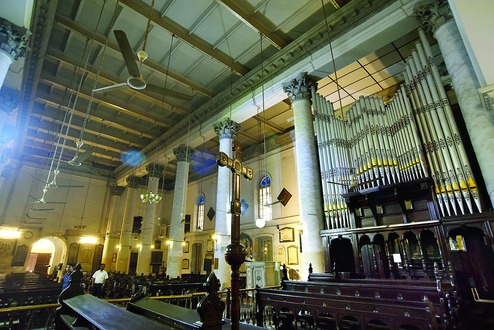
Man who made music at St John’s during Sunday prayers passes away UNFINISHED NOTES: The pipe organ at St John’s Church that Johnny Purty used to play. (Sanjoy Chattopadhyaya)
Calcutta:
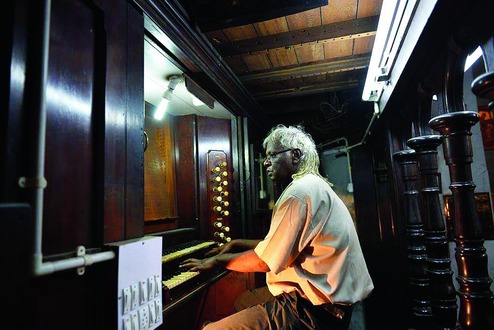
The sonorous ebb and flow of pipe organ notes won’t fill St John’s Church this Friday. Johnny Purty, the dreadlocked wizard of the keys whose music churchgoers say elevated the soul, died on Tuesday aged 57.
Johnny had been an unmissable presence during Sunday prayers at the church for years, his back to the congregation but his music always upfront in its purpose. On Fridays and Saturdays, he would play almost all day. Over the years, he became as famous as the grand instrument he played.
Noel Ronnie Purty, Johnny’s brother, told Metro on Thursday that his sibling inherited his love of the organ from their father, who had also played the instrument in a church. An alumnus of Assembly of God Church School and St Xavier’s College, Johnny was wedded to music and so remained a bachelor in life.
“He had a cardiac arrest around 3.45pm. A doctor was called and he pronounced Johnny dead,” Noel said.
A memorial service for Johnny was held at Wesleyan Church on Thursday, from where his family and friends proceeded to the Bhowanipore cemetery for the funeral.
“The hall was packed today. He was a master at playing the organ,” said Peter Hyrapiet, a close friend of Johnny.
Johnny Purty on the pipe organ at St John’s Church Picture courtesy: Subhadip Mukherjee
The pipe organ at St John’s Church on Council House Street was installed in the early nineteenth century and remains the grandest in Calcutta. “I have seen Johnny play even when there was none in the church. He used to play the whole day because he loved doing so,” said Subhadip Mukherjee, a friend and member of the Church of North India (CNI) that runs St John’s.
A college teacher who had visited St John’s last winter with her colleagues remembers the warmth with which Johnny greeted them. “He escorted us in. As we went around the church, Johnny started to play the organ. He seemed so happy just playing for us. It’s shocking to hear that he is no more,” she said.
At least five churches in Calcutta have pipe organs but regulars say that the one at St John’s is the grandest in terms of the quality of sound. Johnny’s finesse had as much to do with it as the maintenance that is put in to keep the instrument in shape.
Johnny also played the pipe organ at Wesleyan Church on Sudder Street for two decades. He had been playing there before he first touched the instrument at St John’s.
Unlike a piano, playing the pipe organ requires the use of both hands and feet. “The chords are played using the feet while the lead is played using the hands,” said a church member.
Mukherjee, whose blog Indian Vagabond has a detailed guide to St John’s Church, explained that the instrument has “stops” on either side of the seat that are adjusted to produce the sound the musician desires.
Johnny knew how to adjust these to produce the right music at the right moment, he said.
While a pipe organ player sits with his back to the audience, there is usually a mirror in front that enables the person to see the congregation and play to it.
Johnny’s death means St John’s Church will have to look for a musician to take his seat. “We are looking for a new player as quickly as possible,” said Pradeep Kumar Nanda, the vicar at St John’s.
The church, whose construction started in the late eighteenth century, stands on land gifted by Maharaja Nabo Kishen Bahadur of Sovabazar.
source: http://www.telegraphindia.com / The Telegraph,Calcutta,India / Home> Calcutta / by Subhajoy Roy / March 16th, 2018
The six-city tour of Bonjour India’s ‘Jazz meets Indian Classical’ started off in Kolkata with a packed audience and a mesmerising performance by the city’s tabla maestro, Bickram Ghosh, in collaboration with Mezcal Jazz Unit from France.
The programme was organised by Alliance Francaise at the Tollygunge Club’s main lawn recently. “I am happy that Alliance Francaise is organising such enriching events. I am really enjoying the night. I love tabla more than jazz,” said Fabrice Plancon, director, Alliance Francaise du Bengale.
Bickram Ghosh and Mezcal Jazz Unit had collaborated about 12 years ago.
The tabla maestro said, “Jazz and Indian classical are very similar in nature. Collaborating with top jazz artistes can bring out the best in each other’s culture. We have also recorded a video that will be out soon.”
Ghosh also added that he was very happy to see the audience enjoying the music. He added, “Kolkata still has an audience for good music. This show didn’t get much publicity yet the chairs were all full. I am glad that such collaborative projects interest the music lovers of Kolkata.”
source: http://www.timesofindia.indiatimes.com / The Times of India / Home> City News> Kolkata News / by Shrutanwita Chakraborty / March 05th, 2018
‘My grandparents, refugees from Bangladesh, have kept their house exactly the way they received it.’ | Photo Credit: Chirodeep Chaudhuri
Like many things in Calcutta at the turn of the 20th century, Park Mansions was built by Armenian merchant Thaddeus Mesrope Thaddeus
Can you love a beautiful thing without understanding what beauty is? I was eight years and something when I first saw Charulata, considered to be Satyajit Ray’s finest film and sometimes listed among the greatest films ever made. Ray had died that Calcutta summer, and Doordarshan was showing a retrospective of his films late at night, in remembrance. Those were the pre-DVD days, and even in VHS, Ray’s films were hard to come by. My parents would wake me late at night so I could watch with them, the only late-night activity I was allowed to participate in.
“Just watch a bit,” my mother would say, “it doesn’t matter if you don’t understand it.” At eight, even for the precocious, full-of-themselves Bengalis, I was a bit young for Tagore’s story of a young bored housewife falling for her brother-in-law, and recognising the loneliness of her marriage to an older, professorial man. (It was the typically uneven marriage of high-caste Hindus of the day — a young woman, a man at least a decade-and-a-half older.)
But I liked the film. I liked it from the start, because I liked Charu’s windows — the slatted windows through which she watched a man with a black umbrella on a Calcutta street, one of Bengali cinema’s most beloved scenes (and one of international cinema’s most recognisable scenes). My grandfather’s house had the same windows; windows operated with a spine to pry them open. The kharkhari, as we call it in Bengali, lets you glimpse the outside without letting the inside out. It is said to be designed specifically for tropical heat, and is typical of old, statuesque Calcutta homes from the turn of the 20th century.
Of stillness
I felt at home in Charulata’s world, though her emotional dilemma was several years of understanding away from me. I felt like I was in my grandfather’s house, 25 Park Mansions, with its books, and long corridors and curvaceous, dark wood furniture. (Today’s furniture is a lot more angular, a lot more straight lines, no?) More than anything else, the house has the same air of stillness and non-fidgetiness that you sense in the film. Despite Charulata’s emotional turmoil, you see her sewing or writing or playing cards, rarely fidgeting.
My grandfather’s house has that same quality — even now, it makes me forget my phone and the notifications on my post. It keeps the outside out, and holds me inside. I had little idea then that the building would one day be classified as “heritage” property, that I had grown up in something that deserves to be preserved for the public and the future. I had loved it without understanding it, much like I did with the film.
The foundation stone of Park Mansions was laid in 1910, one year before the British announced that the imperial capital would be shifted to Delhi. Like many things in Calcutta at the turn of the century, it was built by an Armenian, a merchant and philanthropist called Thaddeus Mesrope Thaddeus. Park Street, Calcutta’s iconic restaurant and bar street, has at least three other buildings credited to Armenians. Stephen Court, which stands diagonally opposite to Park Mansions, was built by Arathoon Stephen, who also built the adjacent complex, Queen’s Mansion. These three majestic mansions were conceived as residential quarters.
A little further down the street, close to the beloved Olympia Pub, is the Masonic (Freemasons’) Lodge and Hall, built by Johannes Carapiet Galstaun. Many of the city’s most loved and recognised hotels have also been built by Armenians — the Grand Hotel, the Kenilworth, the Astoria and the late Shashi Kapoor’s favourite hotel, the Fairlawn.
What is most interesting about this building spree is the timing — the turn of the 20th century was the zenith of the Raj in India. Calcutta is widely considered to be built by the British, and little credit is given to the Armenians. The early 20th century was also the time of the genocide of Armenians by the Turkish state — in her book A Problem from Hell, the American academic Samantha Powers describes this as the first genocide of the modern period.
The Armenian touch
But the presence of Armenians in Calcutta predates the 20th century. The oldest church in Calcutta is the Armenian church on Armenian Street. The earliest grave in the churchyard adjoining it dates to 1630, says Iftekhar Ahsan, who runs one of the most popular walking tour companies in the city. The Armenian college near Park Street still admits and educates children of Armenian origin only. Geographically, Armenia is a land-locked country, and the Armenians have been subject to invasions over the centuries. Waves of Armenians have left and settled across the world. They are among the most resourceful and successful immigrant communities worldwide.
According to the Kolkata Municipal Corporation (KMC), “a heritage building means any building… which requires preservation and conservation for historical, architectural, environmental and ecological purpose…” This definition suggests that a heritage building is a public good meant to be sustained for the city as a whole.
When the heritage status came in for Park Mansions, a plaque was put in in memory of the company managing the estate. In the four years since, nothing has been put up about Thaddeus, about the Armenians of Calcutta, the style of Armenian buildings, or even the distinct architectural features of Park Mansions.
However, a whole lot of signage has come up on the façade of the building itself — advertising for commercial and institutional tenants. The KMC website on heritage specifically mentions that no display of signage or hoardings is allowed on heritage buildings unless it is approved, and in harmony with the building.
Gleaming new commercial tenants have arrived — the country’s largest car company has a showroom in Park Mansions, a store for a global computer giant whose favourite colour is white, the tech gadgets branch of India’s largest industrial conglomerate, a hip global café franchise known for live music performances. There are new institutional tenants too — the cultural wings of two prominent Western governments have set up office. In the course of these arrivals, the interiors of the mansion complex have been almost completely stripped. The hip café is set to its global décor template, and could well have been in a mall for all that it has retained of its 107-year-old setting. One of the cultural institutes has stripped the original floors and replaced them with a polished wood material. The arrangement of rooms and spaces has been wholly reimagined.
Crumbling edifice
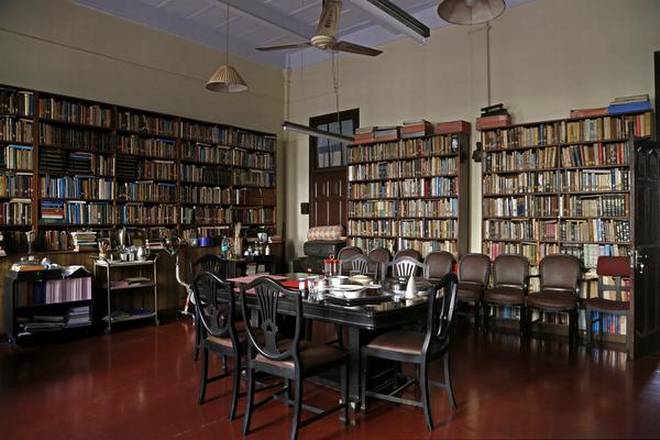
My grandparents, refugees from Bangladesh who came to Calcutta with nothing, have kept it exactly the way they received it. Not a thing has been taken out. The laal mejhe (red floor) — red oxide mixed with cement — typical of old Calcutta homes is intact, still deliciously cold and creamy on bare feet. Our ceilings are still ages away, held up by criss-crossing beams and joists. They make the unreasonable Calcutta summers reasonable and the embarrassing winters a bit more draughty and respectable. His house is, perhaps, the only unit to have retained the space as it was originally conceived.
But the innards of the apartment are falling apart. The sewage pipes, after more than a century of use, often spill out waste in the bathrooms. They leak faecal matter into the walls and ceilings. The estate managers, puffed with the heritage tag, swat us residents away.
What is happening to Park Mansions is known as ‘adaptive reuse’ in urban planning language. A building conceived primarily for residential use is being refashioned for commercial and institutional use. In the process, the character of the building is changing. The interiors are being stripped away. The identity of Park Mansions is eroding.
I see this unfolding before me. When I walk down Park Street in the evenings, there is invariably a knot of people in front of the hip new café at Park Mansions. They wait to take selfies below the name of the café. Where they knock their heads close and ready their faces for the camera, they stand in front of the foundation plaque of the complex: “Park Mansions: The foundation stone of this building was laid by Lizzie, wife of T.M. Thaddeus, on the 1st May 1910.” Their photographs have no space for Thaddeus’ Park Mansions. It’s only the building housing the global café chain.
Park Mansions Adda: On a semi-regular basis on Sundays, my family welcomes people via a public post on Facebook to walk through our apartment, feel the red oxide floor, look out of our slatted windows, run hands along the spines of my grandfather’s library. And then we sit in the living room and talk, just like people still do in any apartment in the world.
The Kolkata-based writer and independent journalist writes on public health, politics and film. Her hobby is writing about herself in the third person.
source: http://www.thehindu.com / The Hindu / Home> Rubric> Society / by Sohini Chattopadhyay / March 03rd, 2018