Category Archives: Arts, Culture & Entertainment

Magic memoirs: A son pens his tribute

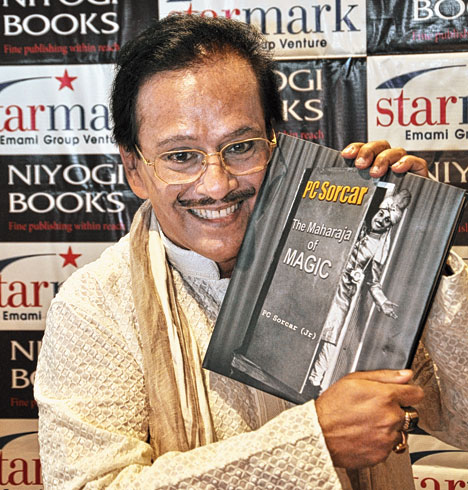
P.C. Sorcar (Jr) at the launch of a memoir of his father on Friday. (Anup Bhattacharya)

Calcutta:

On April 9, 1956, a live telecast of a magic show in London seemed to have gone awfully wrong. The scheduled 15-minute slot on BBC was almost over but the assistant cut in half by the turbaned Indian magician was not coming back to life.

As the channel switched to the news bulletin, viewers jammed the studio lines with calls, convinced that the woman had been murdered. Such was the furore that the event made the next day’s headlines, with interviews of the assistant, alive and well.

“It had all been part of a grand plan. He had deliberately instructed the lady assistant to lie unresponsive… at the critical moment… This man was Protul Chandra Sorcar. He was also my father,” the writer of a book titled PC Sorcar: The Maharaja of Magic describes the incident.

A memoir of the illustrious father Protul Chandra Sorcar penned by his torch-bearer and son Prodip Chandra Sorcar or P.C. Sorcar (Jr) was launched on Friday at Starmark. It is replete with anecdotes that demonstrate how the senior Sorcar single-handedly revived a dying Indian art and went on to be hailed by the International Brotherhood of Magicians in 1948 as “The World’s Greatest Magician”.

The book is also a storehouse of photographs, publicity material, newspaper clippings and cartoons on the phenomenon that was P.C. Sorcar. His reception in the 35 nations where he performed is nothing short of spectacular. If The Sunday Times carried a photo of him reading the newspaper blindfolded, one of Japan’s top newspapers The Yomiuri Shimbun ran the headline on an article on him “Invaluable Living Asset From India Brings Black Art” while The Australian Women’s Weekly did a full page feature on him when he was touring the continent in 1958.

“The book was five years in the making,” said Bikash D. Niyogi, the managing director of the publisher Niyogi Books.

At the launch of the book on Friday, Sorcar (Jr) revealed that his grandfather was bitterly against his son taking up magic as a profession. “‘Do not do public shows. Society is not ready. You will be taken as a dabbler in hocus pocus,’ he kept telling his son. He wanted him to become an engineer instead,” said Sorcar (Jr).

In a way, he was right. “Even after my father’s body was flown in from Japan where he suddenly passed away in January 1971, people gathered outside our house at night expecting him to return, much like he would at the end of his disappearing tricks, appearing from a distant corner with the shout ‘I am here’. People were so gullible that they could not distinguish between his stage persona and the person he was in real life.”

Sorcar, as a child, had an opposite problem. He took the sombre man keeping a strict eye over his son and the smiling magician on stage as different people. The book is a testimony as to how the two avatars of PC Sorcar come together in the eyes of a fellow magician who is also his son.

source: http://www.telegraphindia.com / The Telegraph,Calcutta,India / Home> Calcutta / by Sudeshna Banerjee / May 12th, 2018

Second life for folk museum

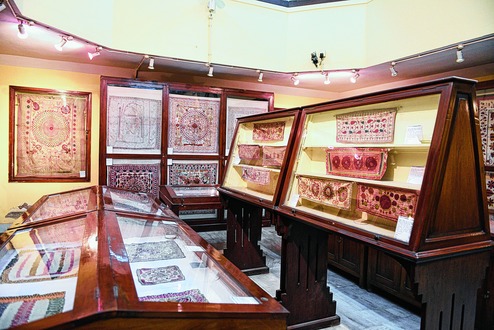
A view of the kantha gallery at Gurusaday Museum

Calcutta:

Free entry from 10am to 7pm, selfies with exhibits, mementoes inspired by artefacts and more kept Gurusaday Museum abuzz with activity on Thursday, the private collector’s 136th birth anniversary.

The museum in Joka, a treasure trove of kanthawork, patachitra, dokra and other artefacts, fell on hard times after the central government stopped funding it in December last year.

A sustained social media campaign by two research scholars, an archaeologist and an anthropologist has given the museum a fresh lease of life. The campaign to Save Bengal’s Folk History is aimed at reviving the cash-strapped museum and attracting more visitors.

The efforts bore fruit as hundreds of visitors, including schoolchildren, dropped in at the museum on Thursday.

Banners with the slogan Love the Museum welcomed all visitors. Food stalls, cultural programmes and merchandise on sale kept the visitors happy. They were also invited to take selfies with any exhibit of their choice.

“We are just trying to jazz up the birth anniversary celebrations and make the museum more attractive. People should be aware of the rich treasure it houses,” said Malavika Banerjee, the director of Kolkata Literary Meet and Byloom and one of the players in the museum’s revival.

Banerjee first visited the museum 15 years ago and was taken aback by all the folk art lying in oblivion. Some of the artefacts at the museum date back to the 10th century.

Research scholars Shrutakriti Dutta and Sujaan Mukherjee, archaeologist Tathagata Neogi and anthropologist Chelsea McGill, along with Banerjee, ran an online campaign and uploaded a campaign video on YouTube to spread the word.

“We want to start a crowdfunding effort to save the museum and help it sustain itself. We want to work in tandem with the staff and authorities here,” Dutta said.

The museum’s 13-member staff have not received their salaries for over seven months, said the museum’s executive secretary and curator, Bijan Mondal. “Today we have seen many firsts, including the selfie fest. A celebration of this scale till 7pm would have been unthinkable before,” he said.

The celebrations culminated in a discussion on The Life of Our Heritage that had panellists – Jayanta Sengupta, the secretary-curator of Victoria Memorial Hall; Bappaditya Biswas, the creative partner of Byloom; and Snehangshu Sekhar Das, designer at the Regional Design and Technical Development Centre, office of the development commissioner (handicrafts), ministry of textiles – offering suggestions on how to make the museum attractive.

Sengupta spoke about how a museum must be more than just a silent custodian of the past. “It has to reach out to people through smart storytelling,” he said. His advice: Organise workshops, reach out through the social media, engage the audience through proactive and interactive smart thinking, improve display and hook kids with the help of audio-visual clips.

The Victoria Memorial curator offered to hold an exhibition of items from Gurusaday Museum on the Victoria grounds. “We can help restore some collectibles,” he said.

Devsaday Dutt, grandson of Gurusaday Dutt, welcomed the idea. “The museum should be of a seat of knowledge. There are 275 paintings of Abanindranath Tagore and several Jamini Roys here. The storytelling in kantha artworks here will entice anybody,” he said.

source: http://www.telegraphindia.com / The Telegraph,Calcutta,India / Home> Calcutta / by Chandreyee Ghose / May 11th, 2018

Music, folklore and life lessons from Sonajhuri, a hamlet in Bengal

The rhythmic hum became clearer the deeper I ventured into the forest. The man, wearing a saffron kurta over a white dhoti, seemed to be the least bothered by the visitors that his music was drawing. Seated on a mat spread over the red earth of the forest clearing, he carefully plucked the strings of the ektara and filled the air with his soulful voice. The movement of the beaded malas dangling from his neck complimented his head movement whenever he caught a high-pitched note.

It was hard to imagine, that in just a few hours, the imperturbable forest clearing would be buzzing with exuberance. The spirit of the weekly market held every Saturday, popularly known as Shonibarer Haat, would permeate through the meshwork of the sonajhuri or acacia trees. Sonajhuri, the place in the Khoai region of Bengal, lovingly named after the trees, would come alive.

During lunch at the resort, authentic Bengali food — shukto, alu posto, maacher kalia and chutney — kept piling on my plate, the way food accumulates during religious rituals.

As the afternoon progressed, the bauls arrived with their own entourage and took over the concourse with furious musical fervour. The harmonium, tabla and flutes accompanied the primary musical instrument used by the bauls — the ektara. Plucking the solitary string of an ektara, the bards continued reciting melodious folklore in Bengali. With hands thrown up in the air, the visitors danced — men and women, young and old alike. The pounding footsteps of the tourists stormed up red dust clouds. The performers don’t demand any monetary compensation in return; visitors are free to leave on the baul’s mat whatever they wish.

The weekly market was an exhibit of authentic craftsmanship, which belongs to the State of Bengal. Junk jewellery, saris and other clothing, bags, footwear, paintings, wood products, bamboo, cane, jute and terracotta products for kitchen use and home decor, were on display over rugs under the shade of trees. The handicrafts found in this part of the world are iconic to the region of Bolpur. Most of the sellers here are the artisans themselves. Unfortunately, many still struggle to make ends meet. I got a miniature ektara for myself.

Next morning, I walked through the maze of sonajhuri trees to Bonerpukur Adivasi Gram. Little mud huts with drooping ceilings of hay lined the dirt path. A few had relief work mimicking their own village life engraved on their hut walls. When plush bungalows peeked through the foliage of the trees, I knew the rustic village had ended to make space for farmhouses of the rich.

‘Fun on one bank, Fun-eral on the other.’

The greatest irony of life was scribbled on a board on the Kopai riverside. A battery-operated rickshaw, known in this part of the world as ‘toto’, brought me here. A timid silence prevailed all around, only to be broken by the voice of the solo mystic minstrel. On the other bank, village women were fetching pails of water. The baul started playing as I was exploring the riverside. He struck a chord on his ektara, with lyrics describing the beauty of life and the importance of living in the moment. As he was doing so, I stepped on some consumed pyre material.

That day on the river bank, something changed in me as I encountered the transient nature of life. The solitary string of the ektara holds it together. When the string breaks, the instrument dies. Just like the ektara, we have just one chance at life.

source: http://www.thehindu.com / The Hindu / Home> Life & Style> Travel / by Tania Banerjee / May 09th, 2018

Landmark nuggets in 75th year

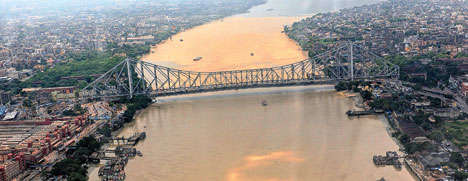
Desi steel for Howrah Bridge

• When Howrah bridge was built in the late 1930s, nearly 90 per cent of its steel was made in India.

• When Vidyasagar Setu was built in the 1980s, all the steel was imported.

• The 705m-long Howrah bridge was built in 41 months. The 823m-long Vidyasagar Setu took 14 years to be built.

Calcutta:

These and more such nuggets of information about the two bridges across the Hooghly were shared at the Bengal Chamber of Commerce and Industry on Wednesday during a lecture on the completion of the Howrah bridge’s 75 years.

Amitabha Ghosal, an engineer who was part of the team that built Vidyasagar Setu, spoke about the history of the Howrah bridge and its engineering.

Ghosal began by saying why the Howrah bridge was built. Traffic to and from Howrah station had been slowly but gradually on the rise. A pontoon bridge that stood over the Hooghly and connected Calcutta and Howrah had to be lifted whenever a large ship came under it.

“River traffic was then more important than road traffic, which was however increasing. So a need was felt to build a bridge,” said Ghosal, who studied the design, construction and tendering of the Howrah bridge while working on Vidyasagar Setu.

There had been talk about building a bridge since 1900 but the actual planning didn’t begin till 1921. World War I was one of the reasons for the delay.

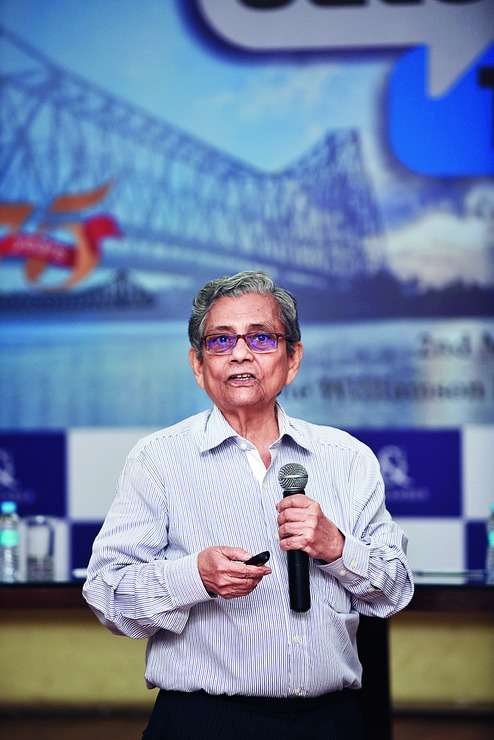
Amitabha Ghosal at the Bengal Chamber of Commerce and Industry.
(Sanjoy Chattopadhyaya)

The pontoon bridge was commissioned in 1874 for 25 years, but remained in use till 1943, when the Howrah bridge was commissioned. Construction began in November 1938 and carried on till March 1942.

Four companies from England, Scotland, Germany and India had placed bids in a global tender floated for the construction of the Howrah bridge. The German company was rejected because World War II was brewing.

Cleveland Bridge of England won the bid but British-owned Indian company opposed it. “It was a tiff between the British in India and the British in England. The British in India managed to convince the authorities that the entire work cannot be given to an England-based company,” said Ghosal.

A compromise was worked out. The Indian company – BBJ Construction Company Limited, a consortium of Braithwaite, Burn and Jessop – was asked to make the steel. Most of the steel – 23,500 tonnes out of 26,500 tonnes – was manufactured and supplied by Tata Iron and Steel Company (Tisco), now Tata Steel.

The foundation of the bridge was built by the Indian-owned Hindustan Construction Company, which is now building the Parama flyover in Calcutta.

source: http://www.telegraphindia.com / The Telegraph,Calcutta,India / Home> Calcutta / by Subhajoy Roy / May 03rd, 2018

1.5-million-year-old tools found in Museum vault

Indian Museum is pushing back the history it has been narrating thus far. It has ‘excavated’ Paleolithic stone age tools, some of which are up to 1.5 million year old, from its own sub-terranian store and will put them on display at a new pre-historic gallery that will open next month

Kolkata :

Indian Museum is pushing back the history it has been narrating thus far. It has ‘excavated’ Paleolithic stone age tools, some of which are up to 1.5-million year old, from its own sub-terranian store and will put them on display at a new pre-historic gallery that will open next month.

The collection, handed over to the museum in the 19th century by geologist-cum-archeologist Robert Bruce Foote, had been gathering dust in the underground store till they was re-discovered recently. Foote is considered the father of Indian pre-history and was the director general of Geological Survey of India.

Museum officials stumbled upon the collection of 100-plus tools that were discovered by Foote in south India. The oldest among them were unearthed in Atiram Pakkam, an area in Pallavaram, Chennai. These finds were named Atiram Pakkam tools.

“The Bruce Foote Collection is indeed the oldest collection of human tools anywhere in India. This treasure trove has never been viewed since it was brought to the museum. The inventory has swelled for 200 years without proper cataloguing. We are now sorting and classifying the collections scientifically,” said Indian Museum director Rajesh Purohit.

About 40 stone tools comprising of hand axes, scrappers, cleavers and arrow heads, mostly made of quartzite, will be brought out from that collection and displayed in the new gallery that will replace the Harappa gallery which had been till now the starting point of history at Indian Museum. The Harappa gallery has remained shut to public for nearly 15 years. Handpicked items from the Indus Valley Civilisation will also be exhibited at the new gallery.

The focus though will no longer be on Harappa and Mohenjo Daro, because these are both in Pakistan today and a large number of excavations on the Indian side around a circumference of 1.22 lakh sq km have revealed footprints of contemporary civilisations. “We can build our own history around these sites that have been unearthed in Haryana, Gujarat and Rajasthan. While in the earlier case, the civilisation developed along the Indus, on the Indian side the civilisations sprung up along Ravi, Chenab, Beas, Sutlej, Jhelum, Saraswati, Hakra and Ghaggar,” Purohit explained.

While Lothal (Gujarat) and Kalibangan (Rajasthan) excavations are well-known, other explorations in Rakhigarhi, Krunal, Birhana, Banawali and Firmana that have happened later and have led to discovery of thousands of archaeological remains like pottery, figurines and seals will now be part of the new gallery.

source: http://www.timesofindia.indiatimes.com / The Times of India / Home> News> City News> Kolkata News / by Jhimli Mukherjee Pandey / TNN / April 15th, 2018

Gate-way to a new Calcutta

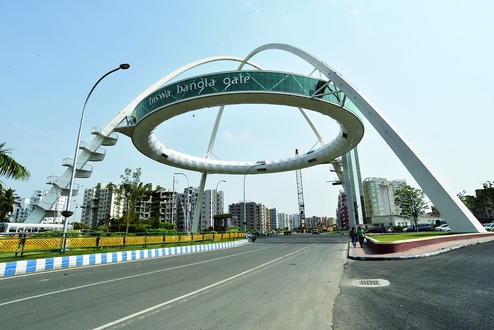
Kolkata Gate, a steel-and-glass structure with giant arches at the Rabindra Tirtha crossing of New Town, is almost ready. The two steel arches that criss-cross each other 55m above the ground can be spotted from several kilometres away.

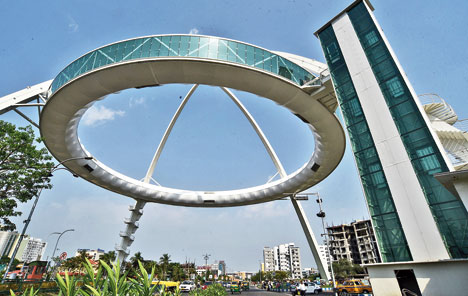
A circular viewing gallery made of steel and toughened glass has been set up at 25m above the ground level. The 10ft-wide and 60m-long gallery has been constructed by interlinking four prefabricated structures that resemble aerobridges. These structures in turn are welded and attached to the steel arches at designated points. The facade is made of toughened glass with laminated silicone sheets that can withstand gale-force winds, hailstorms and extreme heat.

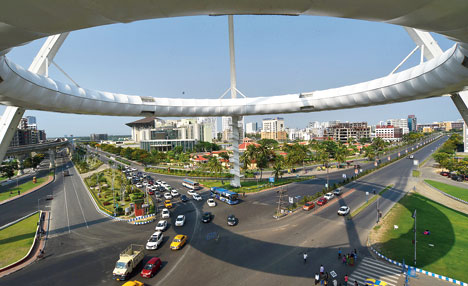
A bird’s-eye view of New Town clicked from a landing a few feet below the viewing gallery of the Kolkata Gate. The view from the gallery will be unhindered as nothing taller than the gate will come up in the area, New Town being a planned city and with pre-determined floor levels for every plot.

Programmable LED lights and flashers have been placed along the length of the steel arches to give it a snazzy look at night. The viewing gallery will have a snacks counter during the day and a fine-dining restaurant after 7pm. At night, only diners will be allowed inside the gallery that will offer a panoramic view of the township. The walls of the gallery have been painted with murals with an entire wall dedicated to the schemes and achievements of the state government.

“The restaurant will offer a one-of-a-kind experience. It will be unlike any other in the city and will offer cuisines from across the world,” said Debashis Sen, the chairman of Hidco. It is likely to open doors in June, officials said.

Two lifts with a glass facade made of toughened glass similar to that used in the viewing gallery will take visitors up to the gallery. The lifts are equipped with telephones at every level so that the operators can get in touch with visitors in case of an emergency. Hidco is mulling a Rs 30 fee per person for a visit to the gallery. Diners at the restaurant won’t need to pay the fee.

source: http://www.telegraphindia.com / The Telegraph,Calcutta,India / Home> Calcutta / by Snehal Sengupta / Photos by Sanjoy Chattopadhyaya / April 30th, 2018

A trick in time past

Magicians tell Uddalak Mukherjee why the fun has gone out of their craft

Gillee, Gillee, Gone! Most magicians today are happy to replicate popular tricks without innovating

Dipak Roychowdhury’s life had changed one evening in 1983. Roychowdhury, a magician – he had learnt the ropes from the legendary Gautam Guha, who had taught the tricks of the trade to even Satyajit Ray – was scheduled to perform at an event organised by the Communist Party of India (Marxist). The problem was that P. Ramamurthi, the veteran Marxist, was expected to speak before Roychowdhury’s performance. The magician, he was a young man then, feared that the crowd would leave with the politburo member. But the crowd, a packed house at Rabindra Sadan, chose to stay. Since that day, Roychowdhury – he now teaches magic to children in a school in Brahmapur – spent 12 years travelling all over Bengal with his bag of tricks. He still loves talking about that evening in 1983.

Sanjoy Chatterjee’s life, on the other hand, had been changed by a book. Chatterjee had bought Ganapati Chakraborty’s Jadu Bidya for four-and-a-half rupees almost three decades ago. The book, a sort of a Bible for amateur magicians, was Chatterjee’s key to a magical kingdom that he has called home since.

The Magic Mela organised by the Federation of Indian Magic Associates (Fima), now in its fourth edition, had brought together young and old performers like Chatterjee and Roychowdhury at Calcutta’s Mohorkunja ground recently. A motley crowd hung around savouring not just the acts performed by magicians – they had gathered for the occasion from near and far – but also the merchandise that was on show.

Chatterjee and Roychowdhury shared their stories and their views on the art of magic at Fima’s tiny office at the venue. The Magic Mela, held between March 28 and 30 this year, is an initiative that seeks to provide a durable platform for magicians all over the country to reach out to a wider audience and a market. According to Chatterjee, Fima has enlisted almost 950 performers in its ranks. Hearteningly, it also accommodates affiliates that are integral to magic’s ecosystem. For instance, at the Magic Mela, one also came across Samdari Lashkar, whose family firm has been supplying magic equipment for over three generations to almost 48 countries.

The conversation with the artists mostly centred on the changes that magic has had to endure as a profession. Some of these transformations are encouraging. Chatterjee talked about the support from the government. The venue for the Magic Mela had been provided free of cost. He added that there has been some progress in talks with a telecommunications giant to build a magic academy in New Town, Rajarhat. There has also been noticeable improvement in the quality of props – without these a magician would be crippled on stage.

But some of the other challenges, Chatterjee said, merit concern. Even though magic as a profession has become far more accessible, there has been a precipitous decline in the spirit of individual innovation. Most magicians seem to be content with replicating popular tricks without adding new dimensions to them. Funds remain short, perennially. Magicians, especially underprivileged performers who ply their trade in, say, local trains, lack medical insurance. There is also an acute need for pension for aged artistes. But the biggest threat – Chatterjee mentioned this more than once during the interview – comes from new-age technology. The digital media, no less mighty a sorcerer, is weaning children, magic’s most trusted patrons, away.

Roychowdhury, however, confided that he has a trick up his sleeve to bring children back to magic – education. As a teacher, he insists that budding magicians would first have to learn the trick of striking a chord with spectators. Magic, in his opinion, should transcend the trappings of illusion. It should, instead, function as a tool that helps the audience relate to their own lives.

Evidently, Roychowdhury views magic not merely as a livelihood. Magic’s philosophical dimensions consume him. For instance, he talked animatedly about the decline in the purity of form in magic. This he attributed to the increasing commercialisation of the craft. Incidentally, Roychowdhury’s reservations had been echoed by Ray in his short story, Dui Magician, where Tripuracharan Mallick, an advocate of magic as an aesthetic sensibility, accuses his ward, Surapati Mondal, of falling prey to the lure of razzle-dazzle.

Roychowdhury also described the relationship between the performer and his audience as one of power and asymmetry. Perhaps he was referring to the magicians’ temporary hold over the patrons.

So does he miss it now? The thrill of putting a spell on an audience?

The crowd outside the Fima office was leaving as the first day of the Mela was coming to a close. Roychowdhury heard the question, took sometime to reflect, and then answered in a rather quiet tone: “I miss the sight of a packed hall the most.”

source: http://www.telegraphindia.com / The Telegraph,Calcutta,India / Home> Calcutta / by Uddalak Mukherjee / April 21st, 2018

Hidden collections

Did you know that the City of Joy is also a city of museums? We’re not talking about the most obvious ones, but several that are tucked in forgotten corners, waiting for the elusive visitor to drop in. In fact, many of these museums provide a wealth of material for those who are interested, but lose out because few people know they exist. Utsav Basu does the rounds of a few of Kolkata’s lesser-known museums

Sabarna Sangrahashala

Located in Barisha, Sabarna Sangrahashala is a museum on the Sabarna Roy Choudhury family and the city of Kolkata. Developed by the Sabarna Roy Choudhury Paribar Parishad in 2005, the museum mainly caters to young students and researchers who wish to learn more about the history of the City of Joy. The museum – or rather a collection by the family trust – possesses rare documents and articles, including ‘kabilatipatras’ dating back to the 18th and 19th centuries. Among them is an important artefact which bears the signature of Kavi Rama Prasad Sen dated 1794. The highlight of the museum is the historic judgment of the Calcutta High Court in the Kolkata birthday case and the expert committee report on the matter, which states that Job Charnock was not the founder of Calcutta (Kolkata), nor is August 24 the city’s birthday.

Other articles include a huge earthen rice pot dating to 1840 with can carry 240kg of grain, a metal hookah from 1878, a metal candelabra from 1795, grinding wheels from 1845 and a wooden table used by Antony Firingee’s grandfather, John Firingee, from 1680.

Timings 10am-12pm and 5pm-7pm every day except Thursday
Entry free

Gurusaday Museum

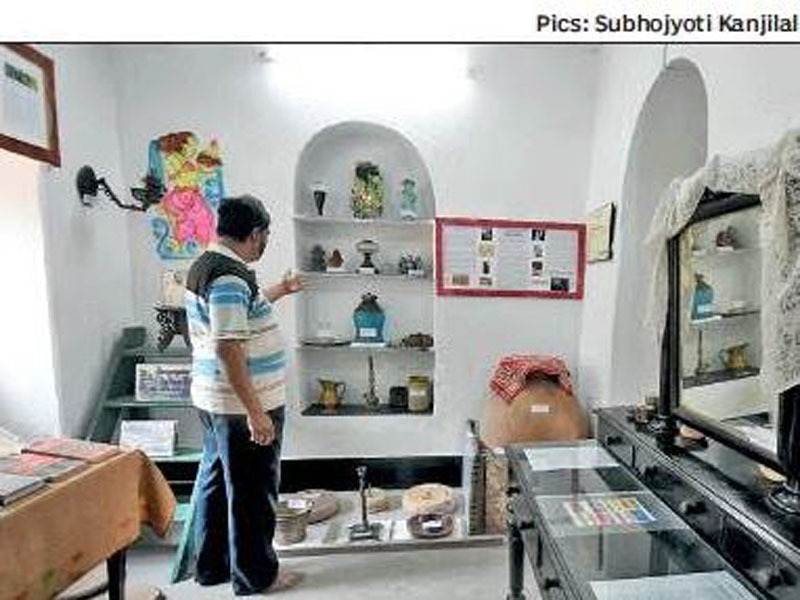
Tucked away in a corner of Joka, Gurusaday Museum, run by Bengal Bratachari Society, is a house of folk art forms conceptualised by civil servant, folklorist, and writer Gurusaday Dutt. A deep interest in Bengal’s folk art led Dutt to collect around 2,325 specimens of various art forms of Bengal. These artefacts were later housed in a museum, which was thrown open to the public in 1963 by Humayun Kabir, the then Union minister of education. The museum now reels under financial crunch, after the Centre, in a notification, asked it to run on its own. The museum authorities claim this is a breach of agreement between the President of India and the Bengal Bratachari Society of May 23, 1984. Before the recent turn of events, it was funded by the Ministry of Textiles.
From specimens of Bengal’s ‘kanthas’ to ‘patachitras’, the museum is a paradise of eclectic artefacts that range from clay dolls to sandesh chhach (sweet moulds) and Dutt’s personal belongings. A few interesting things include ornaments made of paddy, archaeological specimens from the 1st and 2nd centuries BC, dokra crafts and manuscripts of undivided Bengal.

Timings 11am to 5pm (Tuesday-Sunday) Entry 10; IRs 2 (students); 50 (foreigners)

Raja Rammohun Roy Memorial Museum

Located on Raja Rammohun Roy Sarani near the Amherst Street crossing, the nearly 200-year-old house owned by Raja Rammohun’s family houses a history that talks about his life and work. Through various documentations, the museum talks about his ideological battles with his father, compatriots and with a few British officials.

Though the museum does not have any of the real documents or objects used by Roy, a beautiful recreation of the period talks about his life. There are, however, a few original documents such as the original cover of the ‘Tuhfatu’l-Muwahhidin’ (A Gift to Deists), which was a frontal attack launched by Roy against idolatry and superstition plaguing Hinduism in the 18th and 19th centuries, the cover page of the first sermon of the Brahmo Samaj, and photocopies of a few letters written by Roy to various luminaries of the day.

Started in 2000 as a permanent exhibition, the museum slowly took shape through donations from many quarters and the tireless efforts of teachers and professors of Raja Rammohun Roy College. The museum, like any other lesser-known museums of the city, reels under a financial crunch and is thus not being able to expand and house many other artefacts related to the reformer.

Timings: 11am to 4.30pm, all days except Mondays Entry 10;50 for photography

State Archaeological Museum

Located near the Behala tram depot, the State Archaeological Museum, under the state government, is divided into six departments – Site and Sights, Early Historic Period, Sculptures of Bengal, Paintings of Bengal, Metal Sculptures gallery and the Nandadirghi Vihara: Jagjivanpur.

Inaugurated in 1980 by then chief minister Jyoti Basu, the museum has a collection of rare tools of the Early, Middle and Late Stone Ages from Susunia (Bankura) and other sites, proto-historic antiquities from Pandu Rajar Dhibi (Burdwan), sculptures, stone and stucco from the Gupta, Maurya, Shunga, Kushana, Pala and Medieval times.
The painting section of the museum boasts Mughal miniatures, paintings on wooden planks, Kalighat patachitras and watercolours. Primarily painted by court painters of different rulers, the section also has paintings that tell stories.

The main attraction of the museum, however, is the Nandadirghi Vihara: Jagjivanpur section, which documents the 1992 excavation activities at the site in Malda. The section doesn’t have all the real artefacts found in the excavation, but has flawless replicas, apart from a few real exhibits. It also has a model of the excavation site in Malda.

Timings 11am-4.30pm (Wednesday to Sunday) Entry Rs 5

Cultural Research Institute

Barely a two-minute walk from the Kankurgachi crossing, beside the Bureau of Indian Standards building is the Ambedkar Bhawan Cultural Research Institute, which houses a museum divided into four sections. Run by the state government, the museum was earlier at the New Secretariat building. In 1980, it was shifted to Ambedkar Bhawan.
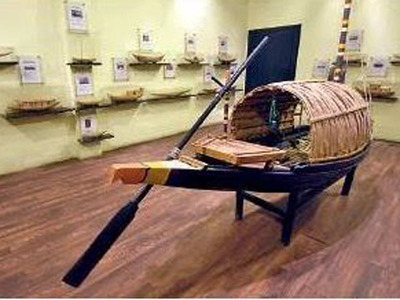
The cultural institute, through the four sections – Ethnographic, Puppet, Kantha and Boat – has an interesting collection that talks about Bengal and its varied cultural background.

The ethnographic section displays baskets of several tribes, tribal musical instruments, Birbhum paintings, masks and other artefacts that talk about Bengal’s ethnic milieu at length. The puppet section breaks the popular belief that Rajasthan is the only land from where puppetry originated. This section has a collection of puppets that were used to tell stories of Dakshin Rai and Bon Bibi and that of other kings who ruled Bengal and their valour. The Kantha section is also quite interesting. This section displays some of the finest examples of kantha.

The main attraction is the boat museum, which boasts a collection of around 40 models of several boats of Bengal, used for various purposes. This section is a virtual boat-ride through a wave of stories. Through detailed descriptions about the type of boats used for specific reasons, the narratives also throw light on the areas of Bengal where the boats were used or made.

Timings 10am-5.30pm (Monday to Friday)

Entry Free

Acharya Bhawan

The museum on Acharya Jagadish Chandra Bose at his house built in 1902, beside the Bose Institute on APC Road, houses furniture used by Bose and his wife, the original instruments used by him for his various scientific experiments and his personal belongings. A request to the trustees can also take you to the attic room where Bose used to carry out his experiments.

Restored by INTACH and looked after by the Sir J C Bose Trust, Acharya Bhawan has not been changed a bit from its original glory. The trust has arduously taken the task of keeping intact the feel of the house as it was more than 100 years ago.

A section of the museum has the original chairs and the table which Bose exclusively used while interacting with his friend, Rabindranath Tagore. The museum also has the dark room and the observatory used by Bose for his experiments.

Timings 2pm-4pm (Wednesday and Friday) Entry | Free

source: http://www.timesofindia.indiatimes.com / The Times of India / Home> City News> Kolkata News / Utsav Basu / TNN / April 28th, 2018
A streetcar named Calcutta: trams are part of the city’s charm

The city’s trams may have been sidetracked by taxis and buses, but they soldier on carrying passengers and a proud legacy

As he drives a tram through the busy streets of Kolkata, Dinesh Singh keeps a watchful eye for yellow taxis. When he started work 35 years ago, Mr. Singh, who is from Uttar Pradesh, did not have to worry so much. The electric cars ran smoothly on dedicated lines with nothing coming in their way. But now, vehicles running on fossil fuels have gained the upper hand.

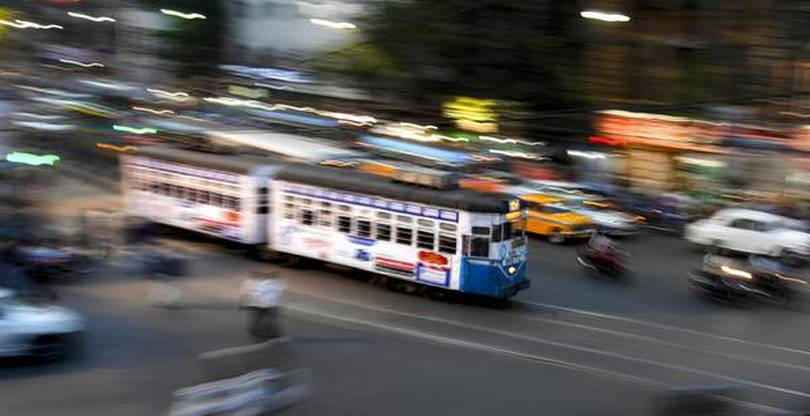
The trams may not have kept pace with the city’s fast life, but they refuse to roll down into the sunset. Making slow progress through busy streets without leaving a smoky trail, the trams offer a ride down history. Running continuously since March 27, 1902, the Kolkata trams make up one of the oldest transport systems in Asia. “Earlier, tram lines used to be separate from the regular traffic. But as the city grew, those lines were merged with the main traffic routes. Hence, tram services run even more slowly now. Youngsters no longer prefer it, and it is only the elderly passengers and women who still use it,” says Uma Shankar Sharma, who has a history with trams. The 59-year-old took up driving trams after his father completed 40 years of service piloting them through the city’s streets.

Bombay, Madras, Delhi and Karachi have no trams now, though the British introduced them in these cities also. Exuding an old-world charm and nostalgia, the slow-moving, eco-friendly transport system is part of Kolkata’s charm. The Calcutta Tramways Company was registered in London in 1880. The British managed it even after Independence. In 1967, the West Bengal government took over the operations. But as time passed, taxis, private buses and India’s first metro simply outpaced the trams. The tram tracks became a casualty of rapid urbanisation. Many tracks were removed. The slow speed, infrequent timings and failure to change network patterns worked against trams. The tramway corporation even introduced bus services to increase its revenues.

Indrajit Singh, a timekeeper at the Esplanade tram depot, says only 10% of the tram lines in existence in 1995, when he joined service, are functioning now. He cites the expansion of the metro and other means of transport as the reason for the decline. The depot, from where the first electric tram car in Asia was run, today houses a tram museum and a cafe, serving history buffs and tourists. A 2011 study by the University of Calcutta said improving Kolkata’s tramways would have greater economic and environmental benefits than replacing it with other means of transport such as buses.

source: http://www.thehindu.com / The Hindu / Home> News> Cities> Kolkata / by K.R. Deepak / April 21st, 2018

Fashion frat step up for fest

Students walk the ramp Picture by Shubham Paul

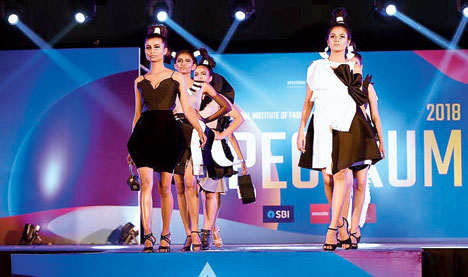
It was the annual fest of the best-dressed campus in town. National Institute of Fashion Technology (NIFT), in Sector III, held Spectrum 2018, with the theme of alternate reality, and colleges came from near and far to join what was one big party.

Off-stage events like “Task it up” had teams rushing to complete a series of fun activities before others. One round had all of them take off their shoes at a spot, run a distance and come back to put them on. Laughter and chaos ensued.

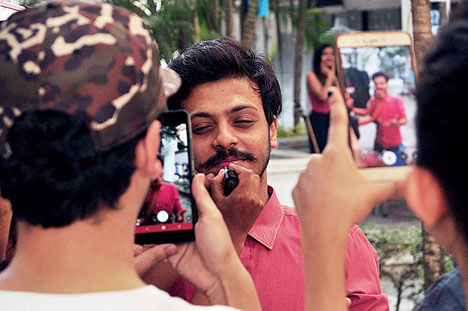
A round of “task it up” asked teams had to apply lipstick on a man

Another round saw all the males on the campus disappear. The task was for teams to apply lipstick and eyeliner on men. “Please, please, please!” a group of girls begged a male student who had set up a chaat counter. “We’ll eat all your phuchkas!” But the boy would have none of it.

Aritra Sarkar, another youth who was helping an NIFT friend put up a stall, was a rare man who allowed himself to be decked up. “I thought I’d help the teams out,” he smiled through scarlet lips as the teams fumbled to click a selfie with him to show the judges.

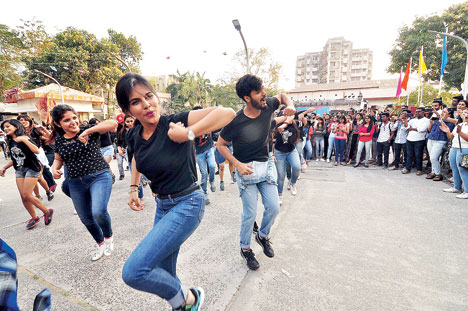
Students break into a flash mob. Picture by Prithwish Karforma

Students broke into flash mobs and came together to watch dance contests. Bhawanipur Education Society College won accolades for their dance to a medley of Bollywood songs with a message. Pratik Khatri played Mogambo, a skirt-chaser who finally gets nabbed by a gay man, played by Rounak Verma. “We wanted to portray gender equality, and show that men, women and LGBT all have equal rights and that no one has the right to harass another,” said Rounak.

Students had put up stalls selling cupcakes, stationery and accessories.

Madhurima Mukherjee, a first year student, had put up a tattoo corner. Some visitors longed for tattoos but were afraid their parents might not like it. Jhanvi Priya, another student, had found a way out. “I really love my dad and wanted my first tattoo to be dedicated to him,” she said, shutting her eyes tight as Madhurima prepared to ink a heart beat sign on her wrist with the word “Dad” on it. “It’s a surprise for my dad but I’m sure he won’t scold me now,” winked Jhanvi.

Style quotient

Piyush Kedia and Venkatesh Jaiswal of IIT Kharagpur nailed the quiz. “Our weakest link was the fashion-related questions but over all, I guess we pulled through,” said Piyush.

They fielded posers such as: Who introduced blue jeans? (Levi Strauss) Which actress, when asked what she wore to bed, had said “Channel No. 5 of course”? (Marilyn Monroe) and What kind of jewellery became popular in the hippy movement of the 1960s? (Bead jewellery).

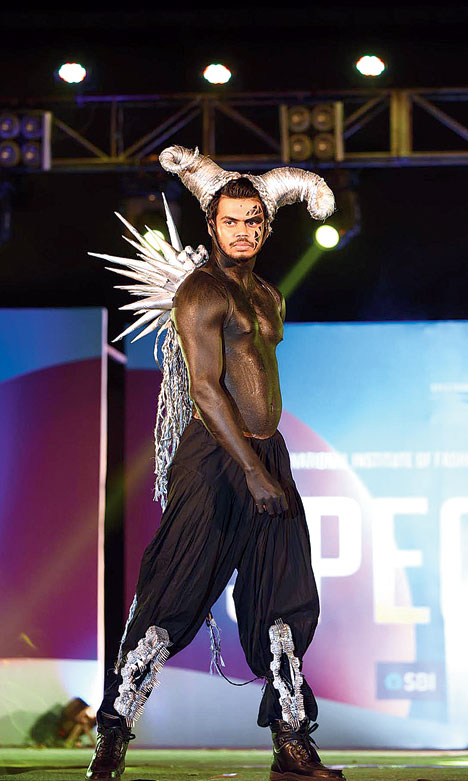
The most awaited act had to be the fashion shows. The Bhawanipur college, for instance, interpreted the “alternate reality” theme by fixing the necktie and breast pocket behind one’s shirt and the Ionic Fashion Academy girls wore long flowy gowns that reminded one of leafy vegetables.

Other students in avant garde costumes

The host college had three entrants. The fashion and lifestyle department showed men with ram horns and girls with snake-like wraparounds with lights blinking on their clothes. The audience gasped collectively as one model took a fall but she recovered and the student emcee, Nandita Banerjee, couldn’t have handled it better. “A round of applause for the team and another one for the model who reminded us that the show must go on!” she smiled.

A student in a fashion show on the theme of “abaya and hijab” .

Another act that was warmly received was the fashion show by women in burkhas and hijabs with layers, sequins, and designs.

“We wanted to show that a woman in hijab can be fashionable too,” said Taqdis Fatma, a student of the clothing production technology department who walked the ramp. “Many of us wear abayas every day but it’s not that we’re forced to do so. It’s a choice and we’re comfortable in it.”

The segment featured seven girls, one boy and even a child. They paraded holding up placards with words like “Peace, love and harmony”.

“There is such camaraderie and brotherhood in the air,” smiled Nift director Col (retd) Subroto Biswas, who had joined the college during Spectrum last year. Harsha Singh, the cultural president of Nift, said the event had been a learning experience for the entire team.

source: http://www.telegraphindia.com / The Telegraph,Calcutta,India / Home> Calcutta / by Brinda Sarkar / April 20th, 2018