The students and teachers at Ekalavya Model Residential School
Jhargram:
All 22 first-generation students at Ramakrishna Mission Vidya Mandir (Ekalavya Model Residential School) in Jhargram have come passed the Higher Secondary examinations with flying colours.
The students, 13 boys and nine girls, belong to tribal families and none of their parents has ever studied till the highersecondary level.
Barring one, who wrote his exam from hospital and secured second division marks, the rest got first division, with eight of them securing star marks. School topper Budhor Mahali scored 84.2%. Three students got letter marks in English, nine in Santhali, two each in philosophy and political science and one in science.
Commending all students and teachers for the results, school secretary Swami Shuvokarananda Maharaj said, “Two years ago, Ramakrishna Mission was given responsibility to run the school. We have 374 students, all of whom are tribals. We have 48 teachers here. Parents of none of the 22 Higher Secondary examinees this year have studied till the plus-II level. The results show how children from the tribal community are making a headway in studies.”
source: http://www.timesofindia.indiatimes.com / The Times of India / News> City News> Kolkata News> Schools & Colleges / by Sujay Khanra / TNN / June 10th, 2018
The Tollygunge Club hosted a golf tournament recently that saw around 90 members and guests, including a few industrialists and corporate honchos, swinging it in style on the club’s lush green course.
Capt Ravi de, Anil Mukerji, Govind Atwal
Dinesh Agarwal, one of the participants, said, “It’s always lovely to play on the beautiful course of the club. We braved this hot weather and put up a healthy competition. It was great fun teaming up and golfing with so many corporate executives.”
Viren Sinha, Rahil Ansari, Brandon Dsouza
Some of the winners of the tournament were Siddharth Bansal, Karan Singh, Sharad Jhawar, Sanjay Goenka and Pratik Lakhotia.
source: http://www.timesofindia.indiatimes.com / The Times of India / Home> News> City News> Kolkata News / by Srishti Dasgupta / TNN / June 01st, 2018
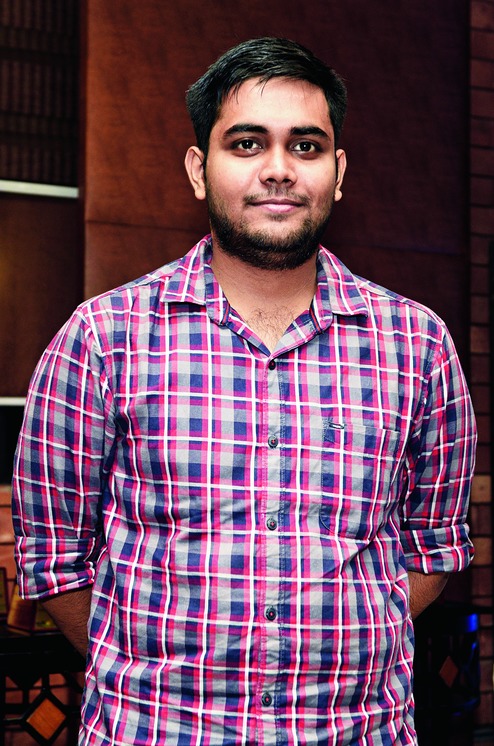
Sobhan Mukherjee of Bansdroni has been breaking many stereotypes.
Since last year, the postgraduate student of geography at Asutosh College been spending over Rs 11,000 a month to stock up sanitary napkins at public toilets to promote menstrual hygiene. Till now, he has stocked up 30 toilets with 100 sanitary pads.
“I buy branded pads for Rs 3 and sell them at CMC’s pay-and-use toilets for Rs 2,” said the student who procures fund for his Bandhan Sanitary Napkin Project by running a little magazine. Some of the areas he has covered include Bansdroni, Golpark, Garia and Sonarpur.
On Monday, he was part of a campaign organised by Unicef to mark Menstrual Hygiene Day. #LetsTalkAboutPeriods saw government officials, activists and enthusiasts joining hands to break the culture of silence and promote menstrual hygiene.
The campaign aims to spread awareness about menstrual hygiene through various media. It also plans to engage all sections of society in discussions to break myths and taboos surrounding the menstrual cycle.
“When I found my friend so uncomfortable and distressed to talk about the issue, I realised I needed to do something to break the stereotype,” said Sobhan, who is also pursuing health studies at Indian Institute For Health Training.
He now wants to build a team of young boys and girls who will reach out to villages where menstrual health is a bigger issue. “Let boys and girls of a particular village fund their own Bandhan Sanitary Napkin project. I need to build a self-sustaining model,” he added.
As of now, around 40 per cent of girls in Bengal are using sanitary pads, said Sonali Datta Ray, joint secretary in the panchayat and rural development department. “There are sanitary napkin incinerator in around 12 per cent schools and vending machines in around eight per cent schools in rural areas,” said Datta Ray, who was part of a panel discussion on breaking myths.
Burdwan, Purulia and Nadia are some of the districts that are forerunners in the effort. “Here the schools, panchayats and the health department are working in tandem to promote safe hygiene among students,” she added.
“We need to focus on sensitising men and encourage them to talk about the issue,” added Dibyendu Sarkar, additional secretary in the panchayat and rural development department and another participant in the panel discussion.
Other participants included Ananya Chakraborti, chairperson of West Bengal Commission for Protection of Child Rights, and Choten Lama, secretary of panchayat and rural development.
“When you pair lack of awareness with cultural barriers, there is a higher risk of girls using unsanitary material, not taking the proper diet, not recognising any irregularity in their menstrual cycle and thus inviting health complications,” added Mohammad Mohiuddin, Unicef chief in Bengal.
source: http://www.telegraphindia.com / The Telegraph,Calcutta,India / Home> Calcutta / by Chandreyee Ghose / May 29th, 2018
St Augustine’s Day School, Ripon Street, has introduced a robotics club to keep students abreast of development in science and technology. The club, an initiative of principal Richard Gasper, organises workshops, where students are encouraged to make models and devices. Buzzer circuits made by the students at robotics workshops have, for instance, been used during a quiz in the school. The children have taken part in many national as well as international competitions and won accolades.
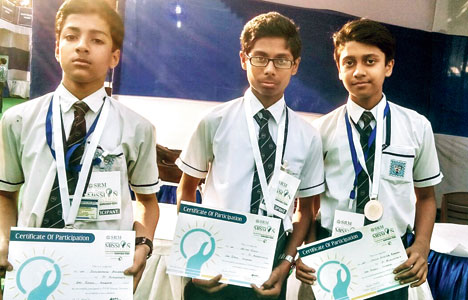
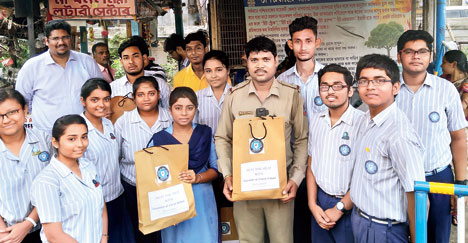
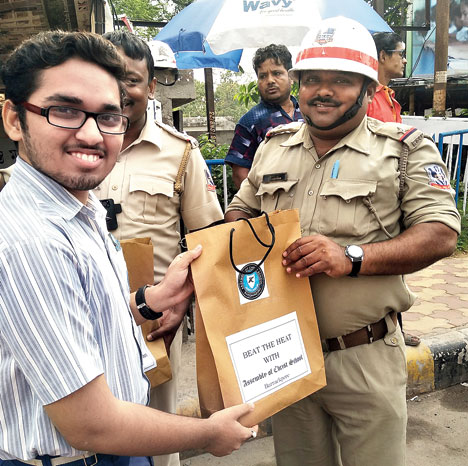
Students of Assembly of Christ School hit the road to express their gratitude to traffic cops who have to be on duty under the scorching sun. The students, along with vice-principal Rev. G. Samuel Davis, visited traffic kiosks between Barrackpore and Sodepur and handed over goody bags to the traffic cops. The campaign started from Lalkuthi in Barrackpore and covered Chiriamore, Titagarh and Khardah before ending at Sodepur. Each bag carried fruit juice, bottles of packaged drinking water, glucose drink and cucumbers.
source: http://www.telegraphindia.com / The Telegraph,Calcutta,India / Home> Calcutta / May 28th, 2018
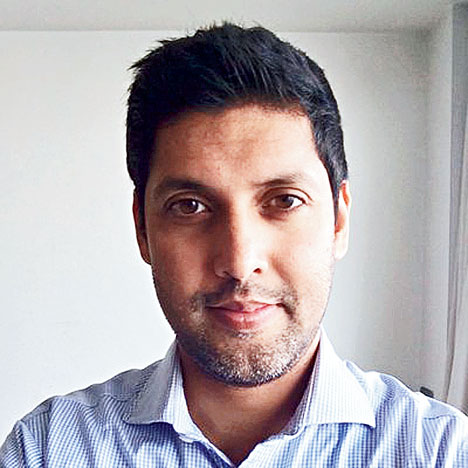
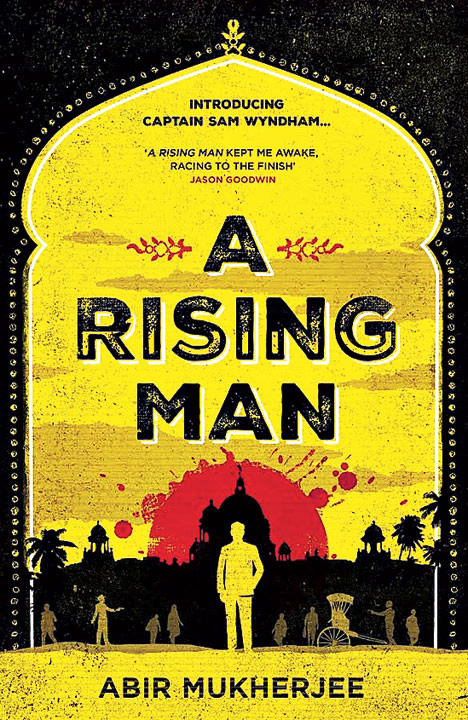
UK-born Abir Mukherjee’s debut thriller set in Calcutta in 1919, A Rising Man, has been shortlisted for a prestigious crime-writing prize.
He is one of six authors selected from a longlist of 18 for the Theakston’s Old Peculier Crime Novel of the Year Award, which is sponsored by T&R Theakston, a brewery in the market town of Masham, North Yorkshire.
It is awarded annually at the Harrogate Crime Writing Festival, held every July. The winner receives £3000 and a small, hand-carved oak beer cask.
This year’s prize, created “to celebrate the very best in crime fiction” and open to UK and Irish authors, is for a novel published in paperback between May 1, 2017, and April 30, 2018.
News of Abir’s nomination comes as he is about to release his third novel, Smoke and Ashes. His second work was A Necessary Evil.
The winner will be decided by the panel of judges, alongside a public vote that opens online on July 1 and closes on July 14. The winner will be announced on July 19.
Abir’s new tale, Smoke and Ashes, is set in 1921 – two years on from when his debut novel opened. He has created an unlikely partnership between Captain Sam Wyndham and his Bengali assistant, Sergeant “Surrender-not” Banerjee. The latter is patrician, Cambridge educated and socially a cut above his boss, who has arrived from the UK to join the Calcutta police. Wyndham is haunted by his memories of the Great War and is now “battling a serious addiction to opium that he must keep secret from his superiors”.
Abir has said his ambition is not simply to tell a detective story but to set it against the background of racist British attitudes when the days of the Raj drew to a close and the fight for Independence became more intense.
source: http://www.telegraphindia.com / The Telegraph,Calcutta,India / Home> Calcutta / by Amit Roy / May 27th, 2018
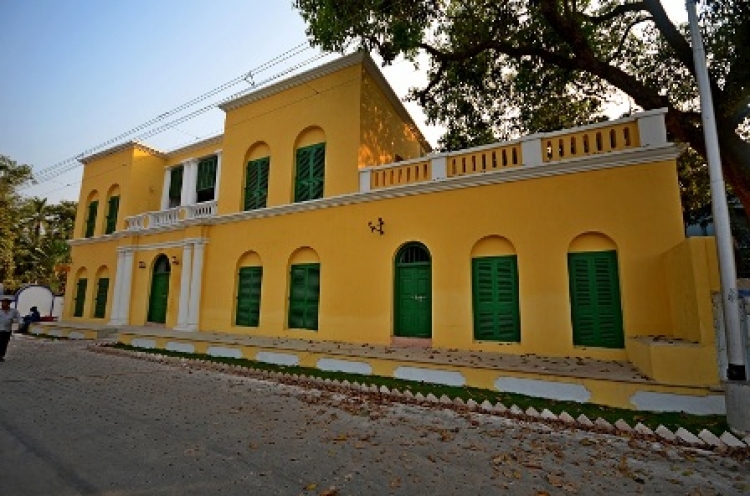
Apeejay Surrendra Park Hotels has entered into an agreement with the Government of West Bengal to manage the historic The Denmark Tavern, the 232-year-oldest hotel in India, in Serampore, Kolkata.
“We are delighted to manage The Denmark Tavern on behalf of the West Bengal Government. THE Park Hotels will build on the rich legacy of the Tavern and bring it and the area back to life. The hotel will soon be buzzing with guests enjoying a quiet break on the banks of Hooghly and the sights and sounds of old-world Serampore and beyond,” Priya Paul, Chairperson, Apeejay Surrendra Park Hotels.
The Tavern was established in 1786 in what was then Fredricksnagore. The two-storeyed structure by the Hooghly is the place where the Danes had kept their flagstaff and cannons. The Tavern was a place to meet and stay for traders, clergy and travellers exploring Bengal.
In 2010 – 11, more than 200 years after the tavern’s heyday, a group of restoration experts studied the building that stood in complete ruins surrounded by debris. It took around two years to restore the Tavern to its former glory as part of the Serampore Initiative, a restoration programme for several Danish heritage structures led by the National Museum of Denmark and funded by Realdania, a private trust in Denmark, in collaboration with West Bengal State Heritage Commission, and Indian National Trust for Art and Cultural Heritage (INTACH).The refurnished building has a cafe, inspired by the double height central atrium of the Indian Coffee House in Kolkata and six high-ceilinged spacious rooms.
The restored Denmark Tavern will fall under THE Park Collection brand of THE Park Hotels. The Park Collection is intimate, personalized, and tailored to transmit inimitable guest experiences. The Denmark Tavern will have THE Park Hotel’s design aesthetics, its impeccable services and will reverberate with Anything But Ordinary experiences. The hotel will open by September 2018.
source: http://www.traveltrendstoday.in / Travel Trends Today / Home> Hot News / by T3 News Network / May 24th, 2018
Vaibhav Sethia hopes to find new audiences through his Amazon Prime stand-up special
Before he became a stand-up comic, Vaibhav Sethia did multiple architecture gigs, toiled on remote oil rigs, wrote episodes of a horror TV show which was never released, and assisted direction for a Bengali movie which did release but, “Was so terrible that most cinema halls stopped screening it in four days”.
Now, after over 1000 private, public and corporate stage shows across many major cities in the country, his Amazon Prime stand-up special, Don’t, was launched yesterday. He hopes to find a new audience base on the internet through this show, because unlike YouTube clips which are free, short and only contain snippets of his comedy, he feels a show will offer insight into his persona. “I talk about being bitten by mosquitoes, my experiences with customer care, how phones have ruined our lives, my reaction to my grandparents, my increasing weight and other such everyday things. I go the extra mile to discuss these things in a way which we wouldn’t in common conversation and give the audience a new perspective,” he says.
Chasing a dream
An architecture graduate from IIT Rourkee, the now 30-year-old got on stage for the first time in December 2012, after moving home to Kolkata to deal with an injury. “This is a legendary story among Kolkata comics: It was the first ever open mic held in the city. The prize was ₹1 lakh, and only four of us were competing. The guy who won never did comedy again. The other three of us are still comics,” he sniggers.
Always the funny guy amongst his friends, getting on stage made Sethia feel like he was friends with the entire audience. He had found exactly what he wanted to do for a living but did not know how to build a career in comedy. “There was no scene in Kolkata; we would do one show every two months. In the weeks in between, I would wake up in the afternoon and sit on my laptop all day. My parents were disappointed because I was giving up great job offers to get on stage once in a while,” he recalls.
Staying on stage
Relentless, he reached out to full-time stand-up artistes to figure out how to make it lucrative. He travelled to Mumbai frequently to get more stage time and worked on building a scene in Kolkata through Comedified, an outfit he started with comic Anirban Dasgupta. “I just wanted to get as much stage time as possible, because, as they say, practice makes a man perfect,” he says. In early 2016, he moved to Mumbai to pursue his dream because, “I realised there was no other place I could grow as much”.
Now, a known name in the comedy circuit, he performs over 20 paid shows a month, and still gets on stage every day to hone his skill set. “I want to talk about subjects like parallel universes and the judicial system, but I haven’t found a way to do it in a funny way yet. There are times when [topics like that] just feel like a TED talk,” he chuckles.
Watch Don’t on Amazon Prime.
source: http://www.thehindu.com / The Hindu / Home> Entertainment / by Raveena Joseph / May 25th, 2018
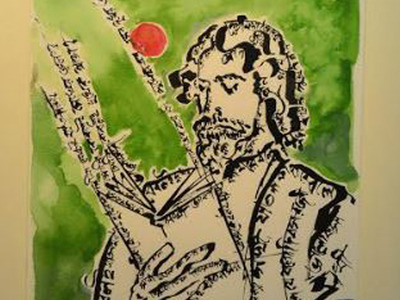
Artist Indrajit Nattoji presented a unique collection of paintings at the ICCR on Saturday. It was called, “Tagore in Shorthand” that delves into Kobi Guru’s literary works through handwriting his poems and songs in his image, using ink and paint on paper.
Each art-work showcases one of Tagore’s literary works written in his image. Portraits range from Tagore as a young man to his later years – an artist’s tribute to Rabindranath Tagore in hand written drawing style. Director and actor Parambrata Chattopadhyay was present at the event with Bickram Ghosh, Wassim Kapoor, Baishali Dalmiya among others on day one.
Talking about his inspiration, Nattoji said, “I have been drawing and painting from the time I recall my earliest childhood memories. It was a natural instinct, as basic as eating and breathing. I always wanted to be an artist since the time I used to travel with my parents during my summer holidays. When I was studying at the National Institute of Design, long before the digital renaissance, we used to take notes, write scripts, stories and with pen, pencil and paper. Computers were a distant concept at that time and nor were we allowed near one.
Recently, I started using handwritten words and sentences to create forms while drawing over words when I made mistakes. As I was drawing while writing, the lines took on a life of their own. I started writing while creating an image and I created images while writing. I then added some paint and colour. Shorthand art anyone?”
A student of NID, Ahmedabad, Nattoji has wonthe Singapore Promax BDA Asia Awards, Razorfish Rocket Award for Rising Talent and Best Station ID. He has worked in Channel [v] Mumbai as Senior Producer, later becoming an ad-filmmaker kick-starting his own company called Blink Pictures. Currently, he is writing his next feature film, while conceptualizing, directing and producing three film installations for India’s first Museum on Indian Music in Bangalore and continuing to make Ad-Films. He loves travelling the world with his family.
When asked why he chose Tagore, the artist said, “The Bengali ‘force’ in me has always been strong. I have been brought up with the mandatory staple of Tagore songs, poems and stories. Recently I was in the middle of an animation project where I had taken on a part of the animation where one had to do hands-on drawings digitally. My mother had organized a small function and get together for Robindro Jayanti and had asked me to draw a portrait of Tagore and add a quote from his works. I was already drawing frames for my animation with my newly acquired Ipad and Apple pencil. I quickly combined the words ‘Pochishe Boishak’ into an image of Tagore. It was spontaneous and intuitive. It turned out quite interesting and was much appreciated by everyone. That’s how this project took birth.”
What are the plans with this journey of painting? “I hope to take this further with interpretations of more of his works in handwritten drawing style with larger formats of drawing, painting, screen prints, woodcuts, digital art and large-scale animation and film installations,” Nattoji signed off.
source: http://www.timesofindia.indiatimes.com / The Times of India / Home> News> Cities> Kolkata / by Ajanta Chakraborty / TNN / May 23rd, 2018
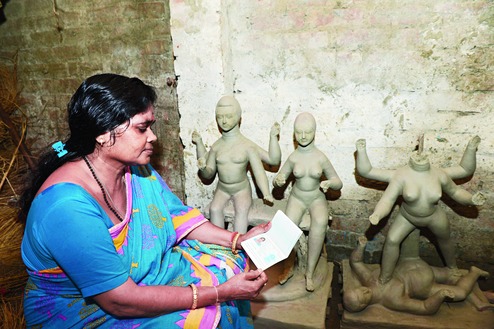
China Pal with her passport that arrived barely hours before the expiry of the deadline for handing documents to the Chinese consulate on Friday. Picture by Bishwarup Dutta
Kumartuli:
On her first trip abroad, Kumartuli’s best-known woman idol-maker China Pal is headed to – where else but China.
She has been selected by the city’s Chinese consulate-general to participate in the China-South Asia & Southeast Asia Arts Week and Lancang Mekong Arts Festival, which will be held as part of the China-South Asia Expo.
“We have heard China Pal is good with idol-making. She will make idols at a folk master craftsmanship show and display the significance of different procedures,” said consul general Ma Zhanwu.
Along with her reputation, her name also carried weight. “We thought she loves China or Chinese tea but when we spoke to her, it turned out that it has to do with her being the fourth child,” smiled Ma.
When Metro spoke to China, the explanation ironically turned out to have to do with her parents’ desire for family planning.
“I am the youngest of six siblings and am the fourth of four daughters. My elder sisters are called Durba, Kalyani and Uma. So my parents named me ‘ Chai na (do not want)’,” China said. “I loved idol-making ever since I was 14 but father was opposed to a girl going to his workshop. We, the women of Kumartuli, help out with small jobs but never do we come to the forefront alongside the men.”
Ironically, when Hemanta Pal fell ill, it was his youngest daughter who took over his trade.
She is unaware how the consulate heard about her but points out that she has crafted the idol at EC Block’s Durga puja in Salt Lake twice. That is where the consulate office is located and the consul general traditionally is a guest at the pandal inauguration.
So far, the 45-year-old’s farthest journey has been to Manali. “I did get a chance to go to Africa or some such place in 2015 but things did not fall in place.”
Even this journey was riddled with uncertainty as China did not have a passport and even when she applied for one on May 4 on learning of her nomination, she mistakenly opted for a normal – and not a tatkal (urgent) – type of application. And there were barely hours left for the consulate’s document submission deadline to expire on Friday when she received her passport from the Beadon Street post office.
Passport in hand, China could finally turn her attention to the requirements of the journey to China in the afternoon. “I am planning to carry two half-finished and detachable mini models of Durga and Kali. I will colour them here but carry the shola pith accessories with me to do the decoration in front of the audience there,” said China.
Terracotta artiste Ashish Kumar Biswas of Thakurnagar, Bongaon, will also be going with her. The winner of the Presidents’ Award for 2014-15 is planning to carry terracotta Buddha figurines, Chinese motifs and fridge magnets.
The trip is for 10 days and the expo in Kunming, the capital of Yunnan, the province of China closest to Bengal, starts on June 13.
source: http://www.telegraphindia.com / The Telegraph,Calcutta,India / Home> Calcutta / by Sudeshna Banerjee / May 19th, 2018
Briton married to Bengali finds new calling after living in village
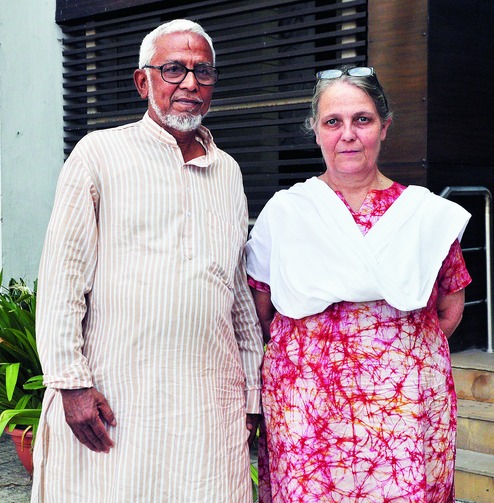
Ranjan Ghosh and Lindsay Barnes. Picture by Anup Bhattacharya
Calcutta:
She is from Lancashire in north-west England, he is from Bally in Howrah. Lindsay Barnes and Ranjan Ghoshhad met in the Eighties as students at Jawaharlal Nehru University and, fired by a shared idealism and sense of adventure, set up home in a village near Bokaro.
Sometime in 1993, Lindsay was forced by circumstance to help a village woman deliver a baby. She had no medical degree, only a book to help her. Since then, Lindsay has played midwife to scores of mothers and set up a 12-bed health centre with her husband Ranjan Ghosh to provide hundreds of others a safe place to give birth.
The couple have also brought together more than 7,000 women from 120 villages under various self-help groups, with Ranjan using his expertise to induct them into microfinance.
Lindsay and Ranjan, who were in Calcutta to attend a Mother’s Day programme organised by an infertility clinic in Kasba, said they planned to train junior doctors and nurses to deliver babies under limiting circumstances in rural areas.
Health care was, of course, not a choice Lindsay had made when she started living in Chambrabad village, 25km from Bokaro. A student of sociology, she was there primarily for research on life in the coal belt when a call for help changed her calling.
“Some neighbours approached me to help a mother-to-be,” she recounted. “I was astounded. I had no clue what to do. I was trying to put them off with excuses. It was my husband who goaded me to go,” 58-year-old Lindsay told Metro.
Armed with a book titled Where there is no doctor: A village healthcare handbook, Lindsay left home to help deliver the baby. “The local women who gathered around me knew I had no knowledge of midwifery, yet they were relieved to see me. They knew I would find a way out. That’s when it hit me that I must do something to help them,” she said.
Lindsay, now a mother of two, soon started receiving similar requests from other villages. “After a few home deliveries, I decided to educate myself in hospitals and nursing homes. I learnt a little and read a lot more to perfect my job,” she said.
After almost 100 home deliveries, Lindsaybegan hiring rooms for deliveries. She set up the 12-bed health centre in 2001. “The village girls now run the health centre with minimal support from qualified doctors. I am still called to handle critical cases. Ninety-five per cent of women have normal delivery. We refer critical cases to nearby hospitals,” she said.
According to gynaecologist and infertility specialist Sudip Basu, what sets Lindsay apart is her “practical knowledge”.
“It will be good if she can train our junior doctors and nurses how to treat patients under limiting circumstances. My team, in turn, can volunteer at her health centre. We plan to replicate the model in other villages.”
source: http://www.telegraphindia.com / The Telegraph,Calcutta,India / Home> Calcutta / by Chandreyee Ghose / May 14th, 2018