Category Archives: Arts, Culture & Entertainment

Every 5th Bengali speaker lives outside Bengal

Kolkata :

Nearly one in five “Bengalis” — or people who have listed Bengali as their mother tongue in the 2011 census — now lives outside Bengal. India has 9.6 crore Bengalis, of whom 1.8 crore (or 19%) stay outside Bengal, data from the 2011 census on mother tongues has revealed.

Maharashtra has the maximum number of Bengalis in India if you discount Bengal and its neighbouring states like Orissa, Bihar and Jharkhand, and states and union territories like Tripura and Andaman and Nicobar Islands, which have always had a large Bengali population.

Maharashtra has 4.4 lakh people who count Bengali as their mother tongue, which is way more than the number of Bengalis in Uttar Pradesh, the National Capital Region of Delhi, Karnataka (which has Bengaluru, home to a large number of Bengalis), erstwhile Andhra Pradesh and Tamil Nadu.

Maharashtra topping the list of these states has come as a surprise to many. Of these states and union territories, Delhi is traditionally supposed to have a high concentration of Bengalis. “But Maharashtra has a high growth rate with a quite a few cities that are very well off,” social theorist Ashis Nandy felt. “Bengal, incidentally, is one of the biggest suppliers of labour to Maharashtra,” he added.

Linguist Pabitra Sarkar attributed the lure of the film industry in Mumbai as a reason for the high Bengali-speaking population there. “The education sector in Pune and the diamond industry based in Maharashtra are big draws among migrants who speak Bengali,” Sarkar said.

Also, Nagpur — the headquarters of erstwhile Bengal Nagpur Railway — has a large Bengali population of settlers who migrated to take up employment in BNR. Besides, Delhi is geographically much smaller than Maharashtra — a huge state — though the concentration of Bengalis there may be more.

Social theorists Ashis Nandy also pointed out that Bengalis were “assertive” about their language. “Even when Bengalis shift to Maharashtra, they continue to speak their language,” Nandy said.

Chhattisgarh is second to Maharashtra among states that do not share a border with Bengal (and states and UTs other than Tripura and Andaman and Nicobar Islands) to have a large Bengali population; it has 2.4 lakh Bengalis. Madhya Pradesh, from which Chhattisgarh was carved out in 2000, has a much lower figure of a little more than 1 lakh.
Andaman and Nicobar Islands has a similar number of people who count Bengali as their mother tongue. Sarkar attributes this to the migrant Bengali population. “They were refugees from erstwhile East Pakistan. Their children and grandchildren speak Bengali as their mother tongue,” Sarkar explained.

Among the five southern states, Karnataka — because of the large Bengali population settled in Bengaluru — tops the chart; it is followed by Andhra Pradesh, Kerala, Tamil Nadu and Goa.

The percentage of people in India who have listed Bengali as their mother tongue has gone up to 8.3% of the total population (from 8.1% in the last census of 2001). Sarkar says he would not want to ignore the influx of the migrant population from Bangladesh to various parts of India.

source: http://www.timesofindia.indiatimes.com / The Times of India / Home> News> City News> Kolkata News / by Priyanka Dasgupta / TNN / June 28th, 2018
Kolkata library that celebrates parallel literature turns 40

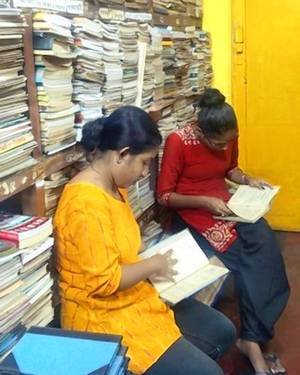
Visitors browse the collection at the library. Photo: Special Arrangement

Little Magazine Library grew from artistic writing.

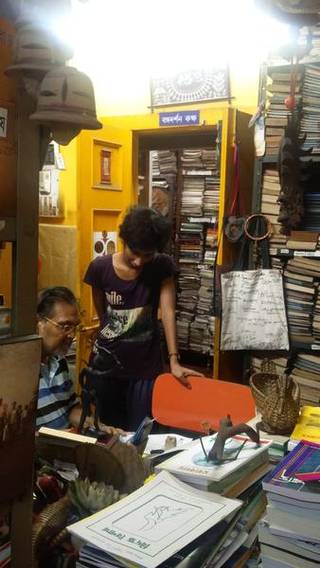
Nestled in Temar Lane, off College Street, Little Magazine Library is a bright yellow building. The small entrance to this home-turned-library in Kolkata opens up to wall after wall of books. Seated in the midst of these mountains is founder Sandip Dutta, the owner of the library that turned 40 on Saturday.

His quest to open a library of this kind, which would eventually host poet Mahasweta Devi and other literary figures, began on one of his many trips to the National Library in 1972, when he was 21.

“When I walked into the National Library, I saw the little magazines thrown on the floor. Dust and worms had wrecked most of them,” he said.

Mr. Dutta launched his archive when the country was taken up by the little magazine movement in the 1970s. It made its way across Maharashtra, Kerala and West Bengal, nurturing marginalised, less-known writers. In Bengal, the movement gathered steam through post-modernist Bengali literature.

Periodicals prosper

The coming of the Hungry Generation writers popularised periodicals like Krittibash (edited by Sunil Gangopadhyay and Dipak Majumdar), Sabuj Patra, Kali Kalam, Kobita Saptahiki (edited by Shakti Chattopadhyay) and Kallol.

Initially, Mr. Dutta organised an exhibition, which showcased about 750 little magazines from his collection. By 1978, he had set it up, and was working to clear the confusion about what the magazines meant: “People often take ‘little’ in this case to mean ‘for children,’ but few realise it is a non-commercial, parallel establishment that celebrates artistic voices.”

Sandip Dutta in his library with a new member. Photo: Special Arrangement.

The venture started off with 1,500 magazines and was known as ‘Library and Laboratory for Bengali Little Magazines.’ It later became the ‘Kolkata Little Magazine Library and Research Center,’ housing about 60,000 periodicals, 1,600 of them digitised. It also houses research material on 60 topics: from film, music, politics and feminist theory to subaltern studies.

Filmmaker Jojo Karlekar, who made a documentary, Little Magazine Voices, says, “I don’t think it is possible to ever be comprehensive about it.”

Mahasweta Devi was a regular patron. When she lost the manuscripts and a few publications, Mr. Dutta was given the task of retrieving them.

source: http://www.thehindu.com / The Hindu / Home> News> Cities> Kolkata / by Bulbul Rajagopal / Kolkata – June 23rd, 2018

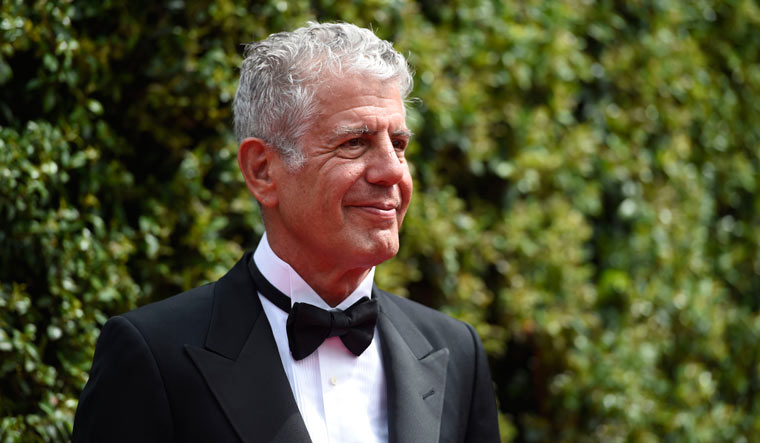
When Bourdain visited Kolkata and indulged in a plate of poori-bhaji

Anthony Bourdain | AP

The news of US celebrity chef Anthony Bourdain’s death has sent shock waves across the food world and beyond. Bourdain, who will be remembered as a renowned chef, author and TV personality, was also an intrepid journalist. He pioneered a kind of a cultural field reporting which offered an unpretentious window into the lives of people who toil and sweat to earn their bread, who are the hidden cogs of a food chain whose most ostentatious and snobbish aspects are held up as aspirational. He travelled the world in search of stories connected to food and eating and living. He patiently listened, and allowed himself to be carried away. When he came to India in 2006 to shoot an episode of his TV series No Reservations, he characteristically observed: “To be in India, anywhere in India, is to risk being endlessly enchanted and repelled, until your senses wanna to shut down.”

A major part of that episode was devoted to his time spent in Kolkata, although the same episode also featured the high-energy Maximum City Mumbai. Bourdain pointed out how these two were the only cities in India, with their tightly-packed interweaving of class and cultures, which reminded him of home, that is New York. Bourdain took a second class train to reach Kolkata and immersed himself in its sounds, smells, shapes and colours, traversing a journey which has charmed countless other dreamers, authors, filmmakers.

After intently watching a cock-fighting match in rural Bengal, digging into a two-rupee plate of poori-aloo bhaji in a flower market under the Howrah Bridge and attending local wrestling matches and temple rituals, you could only trust Bourdain to cleverly remark, “Incidentally if you are going to be reincarnated in India , I highly recommend being a cow. The service is excellent.”

He even waded into the sets of a TV serial shoot, where he dined on a simple, wholesome thali with the cast and crew. Mamata Shankar, Bengali actress and daughter of famous Indian dancer Uday Shankar, was in the middle of a shoot, but happily entertained her curious guest who derived a great sense of reassurance from the fact that soap operas the world over are the same, like good old comfort food. In a Mid-Day article, Mamata fondly reminisced: “He was a happy Frenchman, consumed by food. We ate together that afternoon and he surprised me with his knowledge of Bengali food. He was a khaddo rashik (gourmand). I told him about my father and uncle (Pandit Ravi Shankar). He was familiar with their work. I was surprised how much he knew about my family.”

Accompanied by a popular food columnist Nondon Bagchi, Bourdain played a hectic round of cricket at Kolkata’s Maidan and followed it up with a round of jhaal muri and a similar version of the savoury snack served with crackers from vendors on the fringes of the park. This wasn’t very dissimilar to eating nachos after a game of baseball, the dapper chef thoughtfully pointed out.

When onboard a ferry in the Sundarbans to escape the hectic flurry of the city, Bourdain was your green hero worried about submerged islands and sustaining biodiversity. But every global issue for Bourdain had an entry-point from food. Who would have thought that prawns and bhetki fish in extra virgin diesel oil could be so tasty, Bourdain observed as any real journalist would, always curious, open-minded and unafraid of the unknown.

source: http:theweek.in / The Week / Home> Leisure> Lifestyle / by Sneha Bhura / June 09th, 2018

Rimpa Siva gets Ustad Bismillah Khan Yuva Puraskar

Kolkata :

She has been playing the tabla since the age of three. At 32, Kolkata-based Rimpa Siva has been bestowed the Ustad Bismillah Khan Yuva Puraskar 2017 by the Sangeet Natak Akademi. Needless to say, Rimpa is thrilled with the announcement and is hoping that her recognition will inspire other girls to play the tabla.

Speaking to TOI, Rimpa said she was pleasantly surprised with the announcement. “I didn’t even know that I was nominated for this award. I came to know about my win only after congratulations starting pouring in. I feel privileged to be getting the award on the same year when the Akademi Puraskar will be given to Haimanti Shukla and Parvathy Baul from Bengal,” said Rimpa, who had bagged first class first degrees during both her graduation and master’s from Rabindra Bharati University.

Awards, however, aren’t new to Siva. Known as a child prodigy, she has already won the President’s Award from APJ Abdul Kalam in 2007, Shanmukha Sangeetha Shiromani Award in 2004 and Anunraj Memorial Fund award from Norway in 1996. Rimpa dedicates the credit for her performance to the guidance received from her father, Pt Swapan Siva.

“Whatever I am now is a result of the blessings and teachings of my father,” she said. At 14, she had first accompanied Pt Hari Prasad Chaurasia on a concert tour to the US. Since then she has been playing with stalwarts. In 1999, a 26-minute documentary film titled “Rimpa Siva: Princess of Tabla” was made in France.

There was a time when Rimpa would face questions about why she had picked up an instrument that was traditionally a favourite with men. After performing the world over and now, having won this award, she finds this question irrelevant. “People feel that since women’s fingers are delicate, they might not be suitable for playing the tabla.

But, I have proved them wrong. I’m glad that other women tabla players including Reshma Pandit and Mitali Khargonkar are also coming up now,” said the player from the Farukhabad gharana who is known for playing Ustad Karamatullah Khan’s intricate “kata gheghe tete kata” composition at a very high speed.

The 32-year-old has also come up with an instrumental band called Nari Shakti. “Apart from me on the tabla, we have Pamela Banerjee on pakhawaz, Nibedita Ghosh on sitar and Atri Mazumdar on vocals. However, we are still trying to find good female santoor and sarangi players for our band,” she said. On being asked about her thoughts on World Music Day, she said she is hoping that more and more women instrumentalists come to the forefront. “It’s time for more women to break the glass ceiling,” she signed off.

source: http://www.timesofindia.indiatimes.com / The Times of India / Home> News> City News> Kolkata News / by Priyanka Dasgupta / TNN / June 20th, 2018

Kolkata cyclist to pedal from Ladakh to Sri Lanka

City mountaineer and trekker Samrat Moulik recently cycled 3,000km from Gangotri in Uttarakhand to Kuakata in Bangladesh

Kolkata :

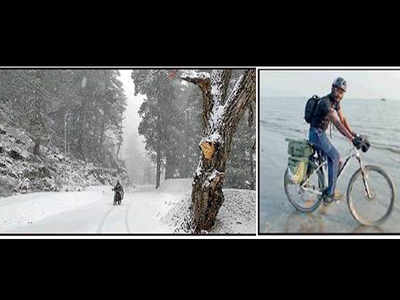
A mountaineer and trekker from Kolkata, who quit a corporate job to pursue his passion, is preparing for a mega cycling expedition of 5,500km – from Nubra Valley near Ladakh to Kanyakumari and onward to Sri Lanka.

Three months ago, he completed a 3,000km solo cycling journey from Gangotri in Uttarakhand to Kuakata in Bangladesh, traversing the entire length of the Ganga as it meandered through five states before entering Bangladesh.

“The condition of the Ganga – that we consider sacred and yet pollute – prompted me to undertake the ‘Save Ganga’ campaign in February-March. I wanted to know what was polluting the river and its impact on the population living along its length,” said Samrat Moulik. He began the journey on February 8 this year and finished on March 21.

While the condition of the river is good in Uttarakhand, its deterioration was visible after Haridwar. “Pollution actually began at Nagina – a town in Uttar Pradesh. In Moradabad, there is cremation ground at the ghat, a picture that one sees all along the river thereafter. From there on, the river water gets murkier as it flows. The effects of Ganga Action Plan, about which I had heard for years, were not visible. The pollution load of the Ganga increases as polluted tributaries flow into it,” said Moulik.

As the river flows downstream, industrial waste becomes the major pollutant. The situation improved in Jharkhand. But when the river bifurcates into the Hooghly and the Padma near Rajmahal, its condition again deteriorates. “The situation is better in Bangladesh because of people’s dependence on the river,” he said.

Moulik plans to start his journey in September. He will cover several rivers in central, west and south India before travelling to Sri Lanka and cycle along the rivers there.

source: http://www.timesofindia.indiatimes.com / The Times of India / Home> News> City News> Kolkata News / TNN / June 14th, 2018

Citizens take inititaive to restore heritage school

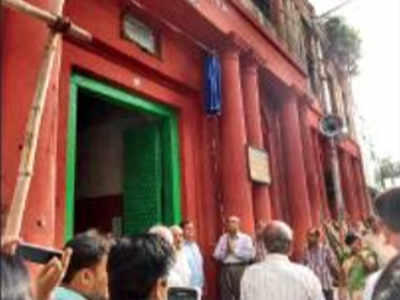
A plaque was unveiled at the school on Saturday

Kolkata :

A dilapidated portion of the Burrabazar branch of Metropolitan Institution, which was pulled down by the KMC on April 7, is getting a new lease of life with a group of residents taking the initiative to restore the heritage structure to its old glory. The initial, rudimentary repairs have been carried out with school funds and the subsequent renovation is likely to depend on government assistance as well as crowdfunding.

Members of ‘Purono Kolkatar Golpo’, a Facebook group that has taken up the project, organized a programme on the premises of the institution on Prasanna Coomar Tagore Street at Pathuriaghata on Saturday, when they unveiled a plaque, with the building’s “heritage status” written on it.

This plaque, they hope, would make Kolkatans and authorities aware of the historical significance of the school, which was founded by Ishwarchandra Vidyasagar.

The unveiling was followed by discussions and a cultural programme, which was attended by current and old students, teachers, neighbours and local councillor, Ellora Saha, who advised to form a development committee that would work towards procuring money from the government. “It is a proud moment that ordinary people have come together to conserve the historical institution. Our aim is to restore the building,” said P N Palit, secretary at Vidyasagar Institute trustee board. He added the initial repair, white-wash and clearing trees and undergrowth from the compound were carried out with school money.

Heritage enthusiast Swarnali Chattopadhyay said, “It’s high time we did something to save such structures of architectural and historical significance. For restoration, we are looking to state help and crowdfunding as and when required.”

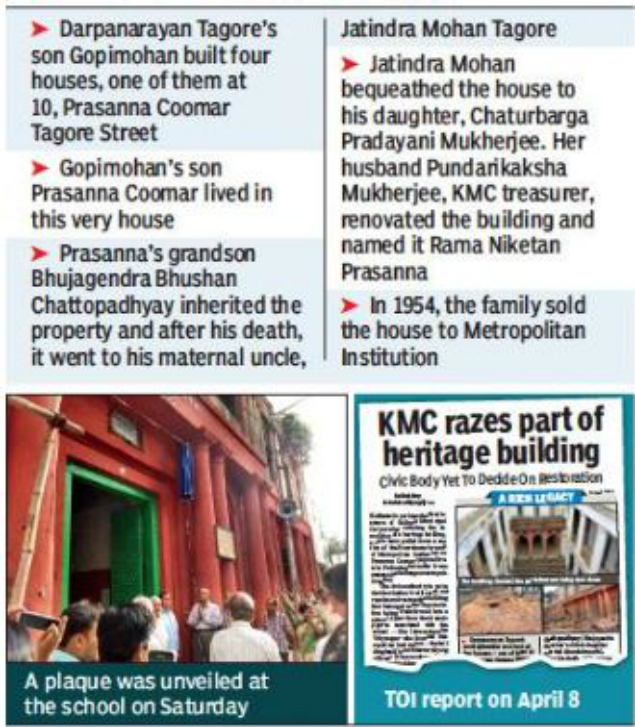
Till 1954, the building belonged to the Tagores and was known as Rama Niketan.

Thereafter, the Burrabazar branch of Metropolitan Institution was set up on the premises, where the school ran out of rooms on the ground and first floors. Now, with only 60 students on the roll, classes are held only on the ground floor. The Pathuriaghata post office shared the same compound. “To save the building, it is important to save the school.

Different activities have to be started there as the institution and the building are interdependent. A proposal has been given that other small schools in the area may use the huge compound, and if need be, they can be merged into one institution,” said Jayanta Sen, heritage activist and another member of Purono Kolkatar Golpo.

Councillor Saha said, “The building still has Vidyasagar’s chair and it is where Madhusudan Dutta composed ‘Sharmistha’. It is my duty to help people conserve the place.”

Conservation architect Kamalika Bose hailed the initiative: “This is a great example of residents doing something at the grassroots level, without expecting the government to take the first step.”

source: http://www.timesofindia.indiatimes.com / The Times of India / Home> City News> Kolkata News> Schools & Colleges / by Dipawali Mitra / TNN / June 17th, 2018

Mathematics prof finds Hemanta’s rare recordings in Bangladesh

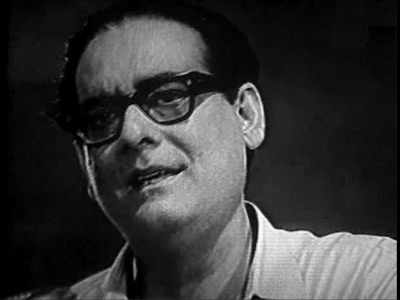
Singer-composer Hemanta Mukherjee

Kolkata :

Ahead of his 98th birth anniversary on Saturday, rare recordings of legendary singer-composer Hemanta Mukherjee from Bangladesh have been unearthed by a mathematics professor in the city. The recordings – one which dates back to 1971 and the other being the last ‘basic song’ recorded before his death in 1989 – have perhaps never been seen or heard in India.

Joydeep Chakraborty, the former guest lecturer at Rabindra Bharati Univerity (RBU) who now teaches in Murshidabad’s Nagar College, had earlier collected Mukherjee’s first recording of a Rabindra Sangeet in Pakistan. “The 45 rpm record of ‘Ami jalbona mor’ was made by the Gramophone Company of Pakistan in 1961. It was recorded in cooperation with the Visva-Bharati Music Board. I collected this from a Muslim family in Murshidabad,” Chakraborty said.

Two months back, he chanced upon the rare 1971 video recording from a friend. “After the liberation war of 1971, Bangabandhu Sheikh Mujibur Rahman had invited Mukherjee over to Dhaka. During that visit, he had performed a Rabindra Sangeet – ‘Tui phele eshechhis kare, mon, monre amar’ – for the state-owned television network in Bangladesh. My friend in Rajshahi sourced the recording for me,” Chakraborty said.

When Chakraborty was teaching at RBU, he came across a student from Bangladesh who wanted his help to covert some recordings in her family’s possession to the digital format. “While doing the work, I chanced upon a cassette that had a recording of a person composing a song. The voice seemed like that of Mukherjee,” Chakraborty said. His guess was confirmed by the student’s grandfather in Dhaka. “The recording was done in 1989 when Mukherjee was in Bangladesh and trying to set to tune the song ‘Lokhi jokhon ashbe ghore’. Nobody apart from that family has ever heard this recording,” he insisted.

During that same time, Chakraborty also chanced upon another rare recording of Mukherjee. “The song was ‘Bhalo kore mele dyakho drishti/Bujhbe Bangladesh bidhatar koto boro srishti’. The song was penned by Abdus Sattar and set to tune by Golam Mustafa. This was the last recorded ‘basic song’ of his,” Chakraborty informed.

However, it isn’t just these recordings from Bangladesh that make his Mukherjee archive interesting. In his kitty are some rare jingles that Mukherjee had recorded for Colgate toothpaste, PC Chandra jewellers and Lipton tea. “I sourced his jingle for Eveready torch from a roadside seller. An old employee helped me get hold of his Bata jingle. I also have a 1958-recorded jingle for Pundinhara that he had sung for Salil Chowdhury. I sourced his 1979-London recording of Ramayana in Hindi from an Anglo-Indian lady from Park Street,” he said.

That apart, Chakraborty also has 200 letters of the legend in his possession, a postcard record of Mukherjee singing for the coronation of the king of Nepal in 1964, recording of a 1973-programme in Rabindra Sadan which had Mukherjee singing live for all the characters in ‘Chandalika’, a harmonium used by Mukherjee during the late 1930s and Mukherjee’s personal collection of books.

Keen to exhibit his collection, Chakraborty will be happy to help if the government plans to host such a show.

source: http://www.timesofindia.indiatimes.com / The Times of India / Home> News> City News> Kolkata / by Priyanka Dasgupta / TNN / June 16th, 2018

The art of cooking, colours & conversation

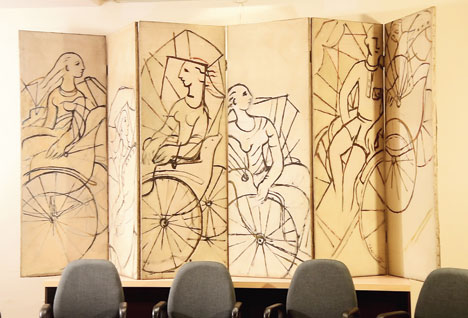
A painting by Shanu Lahiri from a series on rickshaws, a Calcutta phenomenon loved by the artist, formed the backdrop to the discussion

Calcutta:

One of the recipes that she had created was named Chicken Beparwah.

Shanu Lahiri, painter and sculptor, cooked with as much passion as she brought to her art. Wherever she was, laughter and conversation would flow. So would food cooked by her, as unusual and robust as her.

She would often name them with care.

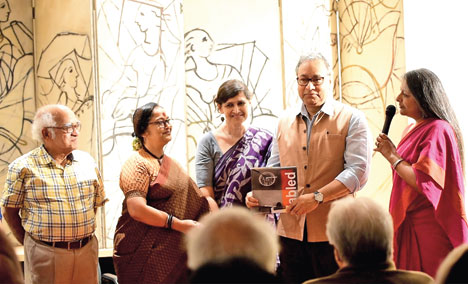
(From left) Samik Bandyopadhyay, Chaitali Dasgupta, Tapati Guha Thakurta,
Jawhar Sircar and Nandita Palchaudhuri at the launch of Tabled

The warmth and generosity of those afternoons and evenings that she presided over at her Lake Town home seemed to flow directly into the auditorium at Jadunath Bhavan in the city last Friday, at the launch of Tabled, a compilation of Shanu Lahiri’s recipes, anecdotes and art.

Shanu Lahiri, a member of The Group, a women’s artists’ collective in the city, was the sculptor of Paroma, a Calcutta landmark that had been installed in 1987 on what came to be known as the Science City island. The city woke up on a November morning in 2014 to find the statue, a woman’s form with children, vanished and replaced by the multi-colour globe of the Bengal government’s Biswa Bangla brand.

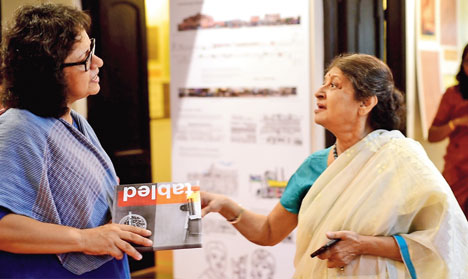
Damayanti Lahiri and (right) Damayanti Basu Singh

The book, launched by Jawhar Sircar, chairperson, Centre for Studies in Social Sciences, is the labour of love of Damayanti Lahiri, Shanu’s daughter. Damayanti, however, pointed at her namesake, Damayanti Basu Singh of Vikalp publishers, as having played a more important role in the project.

Tabled has been designed and structured by artist Chittrovanu Mazumdar, who happens to be Shanu Lahiri’s nephew, and who refused to show up on the stage despite several calls, remaining doggedly in the background.

The black and white cover of Tabled does not quite prepare one for what lies within: an explosion of colours, forms and recipes. But that was Shanu Lahiri. Close friends and loved ones remembered her lovingly.

Historian Tapati Guha Thakurta, who grew up in the south Calcutta house where the artist first lived with her family before moving to Lake Town, chose to speak in Bengali. “The language of “Shanu mashi’s” art was international, but the language she wrote in, or that of her inner self, was Bengali,” said Guha Thakurta. All those conversations that Shanu Lahiri seemed to be always having were conducted in Bengali. Guha Thakurta spoke about Shanu Lahiri’s food-loving husband, without whose large and benign influence the artist would not have grown; neither would the eccentric cook have been born.

TV personality Chaitali Dasgupta, who had interviewed Shanu Lahiri for a cooking programme on Doordarshan, said the sculptor had refused to put on the slightest make-up for the shoot. “Let the sweat show. It will look like garjan tel, garjan tel,” remembered Dasgupta. The Durga idol’s face is painted with this oil.

When social entrepreneur Nandita Palchoudhuri, who was conducting the conversation, asked scholar Samik Bandyopadhyay about the correspondences between cooking and painting, Bandyopadhyay spoke about “Shanudi’s passion for work as activity”. “Her lines move madly,” he said. She painted as if without a desire to control. “There was a kind of continuum in the ways she lived, worked and cooked.”

It is probably not a coincidence that when he received Shanu Lahiri’s book, Bandyopadhyay chanced upon a newspaper article on an exhibition in Barcelona on works by Picasso that are about cooking and utensils.

The evening evoked memories of a time that is difficult to imagine now: a flow of spirit over conversation and food, without the interruption, or aid, of mobile phones, ordering food from outside, and in the Bengali language. The previous city has disappeared, as the missing statue of Paroma proves.

source: http://www.telegraphindia.com / The Telegraph,Calcutta,India / Home> Calcutta / by Chandrima S Bhattacharya / June 15th, 2018

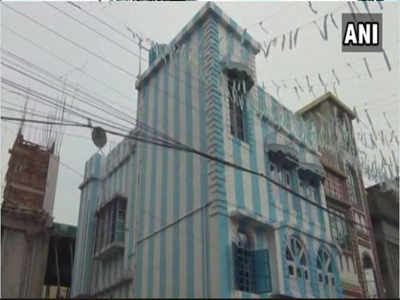
Story of a Messi Fan: Tea stall owner paints entire house in Argentina colours

Shib Shankar Patra’s house (Photo: ANI)

Kolkata :

Shib Shankar Patra is one among thousands of die-hard Argentina fans in Kolkata and there’s nothing unusual about it.

But then die-hard fans at times can be weird too and the 53-year-old Patra has that weird streak in him.

Trying to garner enough savings from his modest earnings through a tea stall, Patra harboured a dream — to watch ‘The Albiceleste’ live from the stands in Russia.

But when a Kolkata-based travel agent informed him that his savings — a princely amount of Rs 60,000 (USD 900) is not enough to fund his World Cup trip (travel agent gave him a budget of Rs 1.5 lakh), he decided the next best thing –paint his entire three-storied building in Argentina colours.

“I don’t smoke or drink. I have only one addiction and that is Lionel Messi and Argentina. I don’t earn much but ensure that bulk of my earnings is kept aside for these indulgences when World Cup comes calling,” Patra, owner of a tea and snack stall in North 24 Parganas’ Nawabganj township, told PTI.

You don’t need a GPS to track Patra’s house once you get down to Ichhapore Railway Station. Ask any cocky teenager or elderly uncle about “Argentina Chaayer Dokan” (Argentina Tea Stall), they will be more than happy to oblige.

The street leading up to his tea stall cum house is dotted with Argentina flags while a giant one flutters high making its presence felt.

Every four years coinciding with the World Cup, Patra, who runs his tea stall from the ground floor of his three-storied building, gives his building a fresh coat of light blue and white shade.

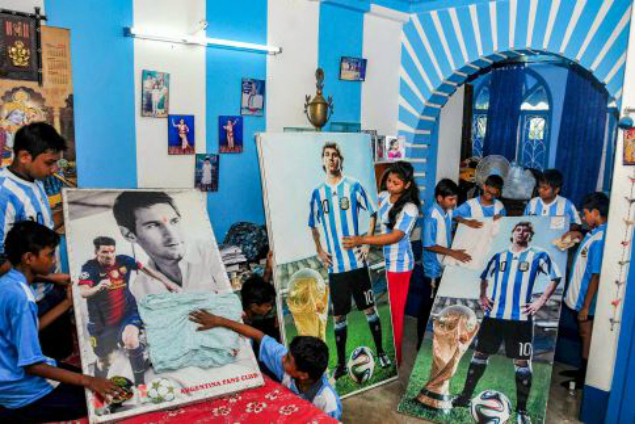
Enter his three-room apartment and the craziness hits you instantly. All the walls are painted in Argentina colour, even the small ‘puja sthal’ (where the idols of Gods and Goddesses are placed). The walls of each room adorns a life-size vinyl flex print poster of Messi.

Addiction can be contagious but if its ‘Messi mania’, Patra doesn’t mind that his wife Swapna along with his children — 20 year-old daughter Neha and 10-year -old son Shubham are equally mad about the fleet footed genius.

“My kids know everything about Messi. The food he likes, the car he drives, everything,” Patra says with a glint of pride in his eyes.

“They don’t miss a single match of Messi. If there’s a late night match during the exams, they will pretend to sleep early but will watch live streaming on their cell phones,” wife Sapna said.

There is one common thread of all Argentina fans in Bengal. The 1986 World Cup, which was aired live on Doordarshan turned Kolkatans into ‘Maradona devotees’. Messi is an extension of Maradona.

“I have watched the Argnetina friendly at the Salt Lake Stadium. I lived a dream that day,” Patra recollected.

It was the first time, he painted his house in Argentina colours, something he repeated in the 2014 edition of the World Cup as well.

Since 2012, the Patra family celebrates every Messi birthday with fanfare like cutting cake to organsing blood donation camp.

And it goes without saying that tea and samosas (staple diet for Bongs during their football adda sessions) is complimentary on all Argentina match days.

With Messi’s birthday coinciding with the World Cup, they have cancelled the blood donation camp, which is held every year.

Instead a 30-pound cake will be cut and 100 Argentina jerseys will be distributed amonmg local kids with Messi’s photograph embossed.

In attendance would be the local MLA and India U-17 World Cupper Rahim Ali.

By his own admission, he has never taken any loans for his personal indulgences.

“I’ve never sought money from anyone but we never fell short, and somehow everything falls in place in time,” Patra said.

“People here also happily come forward. Someone sponsors the food, someone gets the cake and we make it a mini-Argentina here,” Patra says.

Even there will be prayers for Messi with the priest of the local Hanuman temple — his regular client — offering special prayers for the Argentine wizard.

“He gets me the ‘sindoor’ from Hanuman’s left leg (the connection is Messi being a left-footed player) and the vermilion is applied on Messi’s poster during every match. We hope he lift the Cup this time,” Patra signed off.

source: http://www.timesofindia.indiatimes.com / The Times of India / Home> News> City News> Kolkata News / PTI / June 13th, 2018

Kolkata’s first Durga Puja-themed restaurant encapsulates city’s most celebrated event

Dashabhuja, the new restaurant, connects Bengal’s most delightful celebration with its inhabitants’ most delightful indulgence—Durga Puja and the festive Bengali cuisine.

With food stalls lining the streets, devotees queuing up outside eateries and plates full of food passed among families and friends, the whole of Kolkata turns into a giant food court during Durga Puja.

While the five-day festivities get over in the wink of an eye, the city now has its maiden Durga Puja-themed restaurant ready to serve gastronomes round the year.

Dashabhuja, near the city police headquarters at Lalbazar, connects Bengal’s most delightful celebration with its inhabitants’ most delightful indulgence—Durga Puja and the festive Bengali cuisine.

The elegantly-lit eatery, decorated with colourful overhead canopies and various forms of the goddess Durga, simulates the feeling of sitting in a marquee while pampering the taste buds. The sound track of rhythmic dhak beats, an inseparable part of the Puja rituals, and several Puja-themed hangings and artefacts add to the festive ambience.

The menu, comprising authentic Bengali platters, gives prominence to Puja dishes starting from bhog (community feast of food items offered to the Goddess first) of khichdi, bhuni khichdi and labda (mixed vegetables) to the lavish spread of mutton curry, luchis (a type of puri), chanar paturi, rice, and payesh or the Bengali version of kheer.Along with the Puja-specific main course, the mouth watering variety of “Pujor Misti” or the sweets offered to the goddess Durga, such as chandrapuli, narkel naru, balushai, etc., are also served in the eatery round the year.

According to the restaurant owner, an artist associated with designing prominent community puja pandals or marquees for the last three years, the eatery is a perfect amalgamation of his dream and the family business.

“My dream is to design the themes for Durga Pujas while we have been running restaurants as part of our family business.

So in my new project, I thought of connecting the two. This is the first of its kind project that would let you soak in the carnival spirit of the puja in Bengal—throughout the year,” said Sayak Raj, the owner, who also designed three prominent community pujas last year.

Raj also revealed he was in conversation with a number of city artisans and sculptors, who would be making the Durga idols for some of the most popular pujas this year, and plans to install artefacts designed by them in his eatery.

“I wish this restaurant to be an archive of the Durga Puja celebrations in Bengal so that visitors from other states and countries can get a glimpse of our heritage and culture surrounding this festival. We are planning to decorate the interior with the miniatures of Durga idols to be installed in some of the prominent pujas in the city this year,” he said.

The restaurant, inaugurated by veteran Bengali actor Barun Chanda and legendary Indian classical dancer Uday Shankar’s daughter and actress Mamata Shankar barely a month ago, has created a buzz among food enthusiasts in the city and received significant celebrity presence.

“We have also requested some popular committees to provide us with their Puja theme songs so that we can play them in our restaurant all year long — along with our signature theme music,” the owner added.

source:http://www.nationalheraldindia.com / National Herald / Home> Food / IANS / June 12th, 2018