Category Archives: Arts, Culture & Entertainment

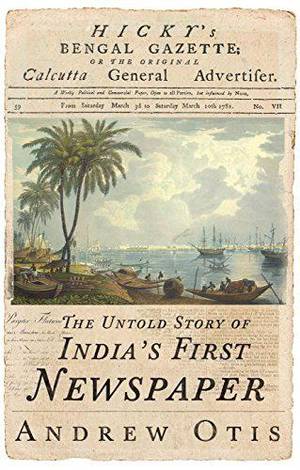
Hicky’s Bengal Gazette: The Untold Story of India’s First Newspaper review: Winds of freedom

In 1780, an Irishman took on the British in Calcutta with a tell-all weekly that covered everything from corruption to politics

It was 1780. Great events were shaping and shaking the world. Four years earlier, in 1776, Britain had lost its first colony; a new nation was born, namely, the United States of America. And nine years, later, in 1789, the French revolution ushered in a new era of freedom and hope in Europe.

At a time when the western world was changing rapidly a new spirit was also taking shape in one of Britain’s eastern colonies. Calcutta, then capital of British India, though the East India Company ruled only a small part of India at that time, was witnessing developments that were new not only in India, but in all of Asia. As free thought and freedom of expression swept across the world, an Irishman called James Augustus Hicky gave Calcutta and India its first printed newspaper in 1780.

Taking on power

Hicky’s Bengal Gazette, according to the young American scholar Andrew Otis, was a four-page weekly newspaper priced at ₹1. And it took on the rich and mighty of British Calcutta. What did Hicky publish in the pages of his newspaper? “He tried to cover everything that might be important to Calcutta, devoting many sections to politics, world news and events in India.” Topics that featured regularly were poor quality of sanitation and lack of road maintenance. Houses of poor Indians had thatched roofs, prone to catching fire. The outbreak of fires was frequently reported in Hicky’s paper. Through the letters he solicited and published, the editor gave voice to Calcutta’s poor.

He attacked corruption in the East India Company and in high echelons of society. The Bengal Gazette reported that the Governor of Madras, Sir Thomas Rumbold, had been recalled to England to answer charges of corruption in front of Parliament. “Hicky sarcastically wrote,” Otis tells us, “Rumbold was a great man for only amassing a fortune of about 600,000 pounds while in India, much of it from bribes and extortion.”

Hicky did not spare any institution. He exposed the problems of low pay for soldiers in the subaltern ranks of the Company’s army. Failed wars of the Company also came under its gaze. The Company’s army suffered a crushing defeat in the Battle of Pollilur at the hands of Hyder Ali, then ruler of Mysore. As the news of the disaster trickled in, Hicky questioned why the British were fighting in India. He accused the Company of squandering the lives of its soldiers. He even praised the noble actions of Hyder Ali in his treatment of the captured soldiers of the Company.

But as Hicky continued his fearless mission against corruption, the powers of the day did not sit idle. A rival newspaper was born in Calcutta. The India Gazette of Messink and Reed differed from Hicky in every possible way. The two papers represented two sides of the political spectrum.

Tough rival

Hicky emphasised independence while the India Gazette made no secret that they had the support of Governor Warren Hastings. So much so that Hastings had given the facility of free postage to India Gazette. There were hardly any opinion columns in it, a clear sign of their obeisance to Hastings’s authority. And they did so for a good cause, that was monetary rewards. India Gazette became the Company’s de facto mouthpiece; the Company’s departments placed advertisements and notices in that paper.

Press freedom

But Hicky took on the might of the establishment. He alleged through his pieces in the paper how one Simeon Droz had sought a bribe from him and wanted to get favours for him from Marian Hastings, wife of Warren Hastings, in lieu of the bribe. Hastings fumed that someone could show such imprudence. He passed an order that the Post Office would no longer extend its facility to the Bengal Gazette.

Hicky fought back. He hired 20 hircirrahs (courier men) to deliver his newspaper, and his newspaper’s popularity soared. He continued his fight against the most powerful man of the day and his entourage.

Hastings hit back and the Chief Justice Elijah Impey decreed that Hicky be imprisoned on charges of libel. A grand jury sat to decide the fate of Hicky.

After a fierce courtroom battle, the jury acquitted him. Hicky won, Hastings lost. As Otis tells us, “He had proven that it was possible to protect the Press against the most powerful people in British India.”

There were still three more trials to come that tried to muffle the voice of Hicky. What happened; did freedom of the press triumph? For that you must turn to Otis’s book, as he sketches a riveting tale of the struggle of India’s first newspaper editor.

Hicky’s Bengal Gazette: The Untold Story of India’s First Newspaper; Andrew Otis, Westland/ Tranquebar, ₹899.

source: http://www.thehindu.com / The Hindu / Home> Books> Reviews / by Sunandan Roy Chowdhury / July 14th, 2018
London Bongs go all out for England

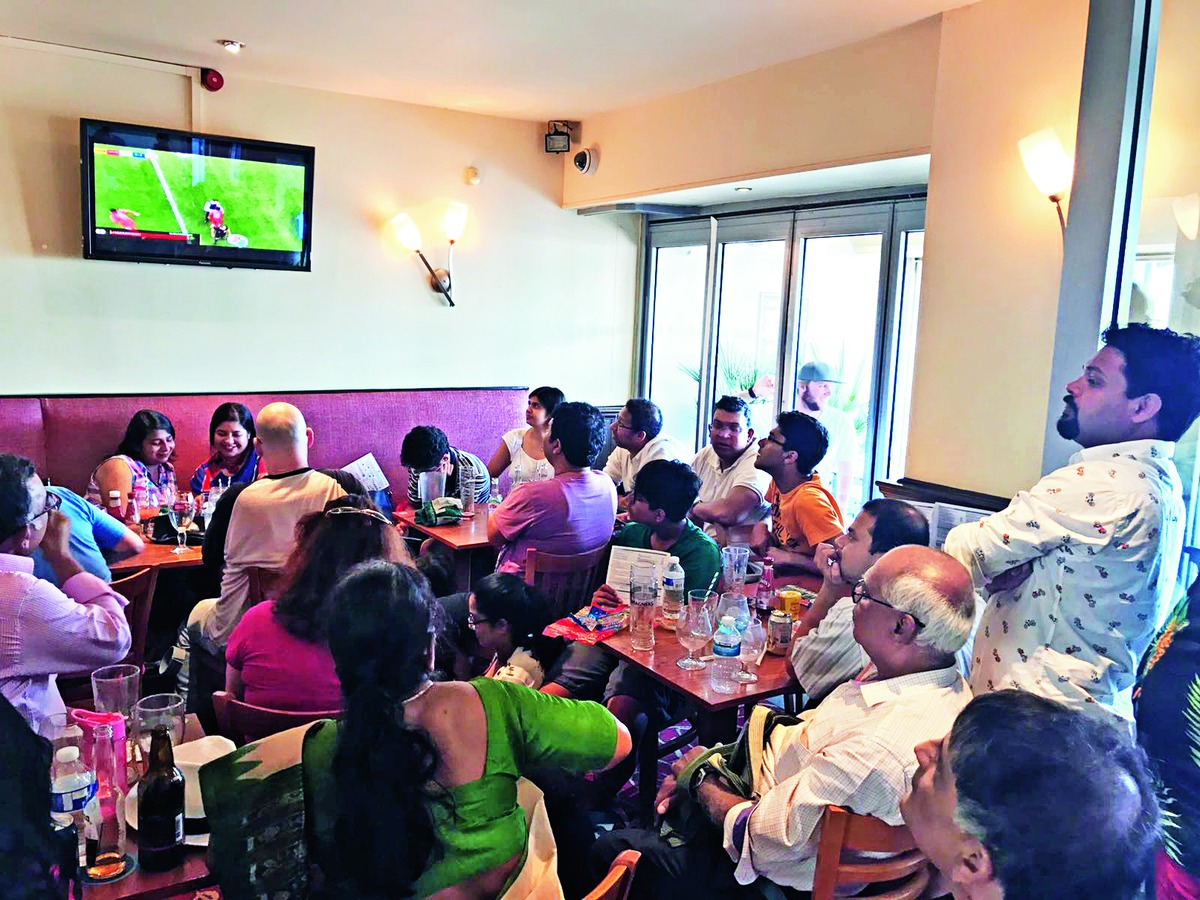
Bengalis from London gather at a Wetherspoons pub to cheer England in the quarter-final against Sweden

Calcutta:

It’s coming home… With old favourites Brazil and Argentina out of the World Cup, Bengalis in England are joining the rest of the country in chanting the choral lyric to the 1996 No. 1 single Three Lions (referring to the English football team’s logo).

“The lyrics are being put up as social media status, memes are getting forwarded on it…” said Sourav Niyogi, a resident of central London.

A video clip he forwarded to Metro had Jaya Bachchan beaming towards the door, silver tray and diya in hand, but instead of the title track of Kabhi Khushi Kabhie Gham there is the Three Lions chorus playing and in place of Shah Rukh Khan, it’s England captain Harry Kane running in with a FIFA World Cup cut-out.

“Streets are getting empty when England is playing. People are hanging flags from houses and cars. Yesterday, I saw a group break into the song at Liverpool Street station,” said Saikat Roy Chowdhury, an IT professional. “Till the other week, our WhatsApp group was divided into supporters of Brazil, Argentina and Germany. Now we are all united under St George’s Cross,” said the 42-year-old.

“Nobody expected England to go this far. This team has no superstar. People have been caught by surprise at how well they have done,” said Tushi Banerjee, a Lionel Messi fan who had “wanted him to go all the way”. Now she buys chart paper for her six-year-old son Ryan to prepare charts with scores of England’s matches.

Saikat and another 60-odd members of the Bengali community group London Sharad Utsav (LSU) had gone for a seaside picnic at Margate on Saturday. “We wrapped up quickly to watch England play at the local Wetherspoons pub.”

Suranjan Som, general secretary of LSU, explains: “Those who come from Calcutta tend to stick to their respective football loyalties – Brazil or Argentina – initially. But as they gradually get sucked into British life and the English Premier League, their loyalty starts shifting towards England. But this time there is no division.”

Prasenjit Bhatacharjee, who has put his sky-blue-and- white jersey away and taken out his England shirt, has started a winner prediction poll on Facebook. “Of course, England has got the most votes,” he laughed. “The average age of this team is only 26. Seventeen members of this squad were not even born when England last reached the semi-final in 1990.”

Indians of other communities are excited about the on-going cricket series. “But for Bengalis, the World Cup is a bigger talking point,” he said.

source: http://www.telegraphindia.com / The Telegraph,Calcutta,India / Home> Calcutta / by Sudeshna Banerjee / July 11th, 2018

Gods, demons and myths

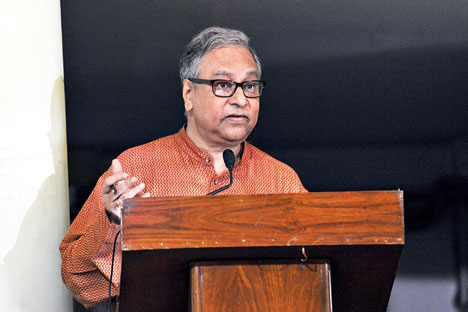
Jawhar Sircar delivers the Dr Biman Behari Memorial Lecture at Asiatic Society.
Picture by Sanat Kumar Sinha

Park Street:

When Jawhar Sircar, the former Prasar Bharati CEO, took the stage at Asiatic Society to deliver the Dr Biman Behari Memorial Lecture on a topic drawn from Indian mythology, it was a deliberate act to lift what he described as the “academic apartheid with gods and demons”.

“The huge area of mythology and folklore is taken as nonsense by academics, thus leaving it to those who are deliberately misusing it to threaten the idea of India,” Sircar said.

Among those who deal in the area, Devdutt Pattanaik, he said, is too text-based in his interpretations. “At times he does refer to context but that pleases rather than disturbs the reader into challenging dangerous fundamentalism.”

Amish Tripathi, he said, builds modern myths on age-old ones that leaves the reader more firmly rooted in the imagined past. “The difference between myth and reality is fast disappearing in India.” Only a few bravehearts like D.D. Kosambi have explained “why colourful tales are needed to sugarcoat religious values”.

Elaborating on his theme ‘ Asuras in Indian tradition’, Sircar said his fascination with asuras was from a desire “to get their side of the story”.

He was using asuras, mentioned in the Mahabharat and the Puranas, as an umbrella under which to put all demonised anti-gods. “They are indigenous forces who stood in opposition to the emerging and dominating Sanskritic narrative.”

“The idea,” he said, “is to try to retrieve bits and pieces of the alternative narrative that was wiped off by priestly officialdom but survived through disjointed tales embedded within the mega narrative.”

Delving into the root of demonology, he pointed out that for ages Man knew certain deities were not benign. “But our binaries do not operate on the same plain (as the God vs Devil construct in the West). We have internalised much of the malevolent pantheon.”

An example of the process, he said, is Shani, who is still treated with suspicion and carries signatures of demonic worship. “You cannot place him indoors. Yet Brahmanism has managed to fit him within the system so that he does not run out of it and become the rallying point of dissonance.”

A difference between gods and demons, he said, is that one has to be worshipped and the other propitiated. Deities were metaphors for ethnic groups. “In pre-legislative times, policy-making depended on whose god one was able to foist upon the others in the pantheon.”

The expulsion or suppression of gods reflects social changes. “Of the ruling three in the Aryan narrative, Brahma was pensioned off to a temple in Pushkar and Indra was banished as a suffix to names. By this time, pastoral economy was on the upswing and Indra was pitted against Krishna.” The Govardhan mountain episode, with Krishna sheltering Vrindavan from the thunder of Indra, is iconic in the Krishna lore.

“Monotheism makes no compromise with the demonic. The devil had to be opposed to God. Christianity and Islam have kept the demon alive on a day-to-day basis as temptation, Sircar said, referring to rituals such as stoning of the devil at Mecca.

But in Hinduism, the asura is already defeated and his memory is celebrated in the burning of Ravan. “Over time, even figures in opposition were deified. Ravan, for example, was shown as a Shiva disciple.

“The story of India lies in this absorption and continuous process of accommodation.”

source: http://www.telegraphindia.com / The Telegraph,Calcutta,India / Home> Calcutta / by Sudeshna Banerjee / July 1oth, 2018

Tour of three hidden gems

Museums that encapsulate magic of Bengal and Calcutta

Michael Feiner, the German consul general, with members of Unique Legacies of Bengal (BAUL) at Gurusaday Museum in Joka on Sunday. Pictures by Gautam Bose

Calcutta:

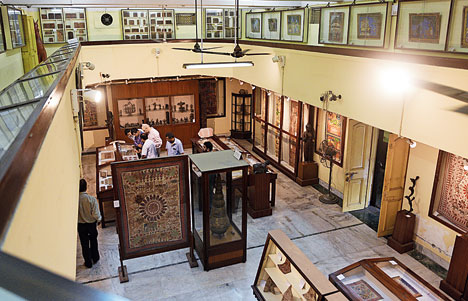
A museum dedicated to the folk arts and crafts of Bengal, another housing a treasure trove of artefacts excavated till 2005 and a third that narrates the story of the ubiquitous tram. Three of Calcutta’s lesser-known attractions, all of them possible to visit in a day, were on Sunday part of a heritage tour taken by the German consul general Michael Feiner.

Metro tagged along to capture highlights of the visit to the Gurusaday Museum in Joka, the State Archaeological Museum in Behala and the tram museum in Esplanade.

Gurusaday Museum, Joka

This museum located near the Joka crossing on Diamond Harbour Road houses paintings, kantha embroidery and musical instruments, among others.

Colourful scroll paintings ( patachitra) that narrate tales like Gourangalila and Manasamangal adorn the walls . There are also square paintings that depict ordinary people living ordinary lives as well as gods and goddesses. One such painting shows a rural market scene with some people dressed in proper clothes while others are clad only in a dhoti, creating an image of social contrast.

Tribal musical instruments like dhamsa, madal, shinga and damru are also on display in the museum.

The majority of the pieces are from the collection of Gurusaday Dutt, an Indian Civil Service officer who gathered those during his stints as collector in various districts of undivided Bengal. Many others have made donations to the museum.

One of the more striking pieces is the Crowned Buddha. “We are used to seeing figures of a bare-headed Buddha. A figure of Buddha with a crown on his head and jewellery around his neck and arms is rare,” said Dipak Barapanda, the assistant curator of the museum.

Smaranika, the tram museum at the Esplanade tram depot

The stone sculpture dates back to the 10th Century.

The museum has been in the news, albeit for the wrong reason, since the Union ministry of textiles informed the authorities that it could not fund maintenance forever. In a letter last November, the ministry asked the museum to find a sustainable revenue model to keep the show going.

About 800 exhibits are currently on display and another 4000 are languishing in the storeroom for paucity of space.

State Archaeological Museum, Behala

Tucked away behind a pavement full of hawkers in Behala is the richness of a heritage often overlooked. Several galleries in this museum are dedicated to paintings and artefacts found during excavation of historical sites.

Very few seem to know that artefacts excavated in 2005 at Jagjivanpur, a site in Malda, are on display here. “This site was excavated between 1996 and 2005,” said Sumita Guha Roy, the assistant curator and an employee of the museum since 1992.

How Jagjivanpur was discovered is an interesting story in itself. “In 1987, a man digging his field found a bronze plate,” Guha Roy recounted. “Archaeologists later deciphered the text on the plate and found that it was a land grant made by King Mahendrapala to his senapati (commander) to build a Buddhist monastery there.”

This was the first clue to the treasure trove hidden underground. A plaque inside the gallery mentions that excavation began in 1992, but had to be stalled for some years to rehabilitate people living there.

In one gallery, a painting from the late 18th Century shows the intermingling of people from different stratas of society. This one came from Nashipur in Murshidabad.

“The painting shows a medieval king and a Vaishnava saint standing in front of Lord Krishna with folded hands,” said Sayak Ghosh, a member of the Bespoken Architectural and Unique Legacies of Bengal (BAUL), the group that had organised the Sunday tour with the German consul general.

Smaranika, the tram museum in Esplanade

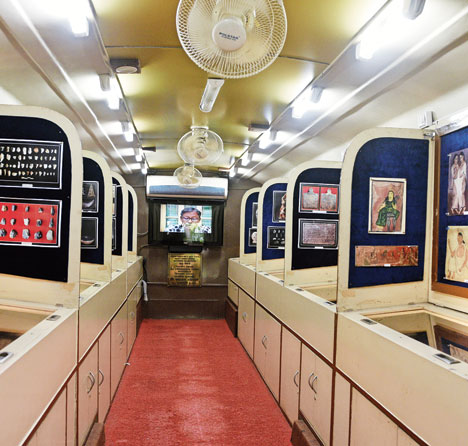
The inside of a van that travels to the districts to make people aware of Bengal’s history, heritage and culture. Schools and individuals can contact that State Archaeological Museum to book a visit to their neighbourhood

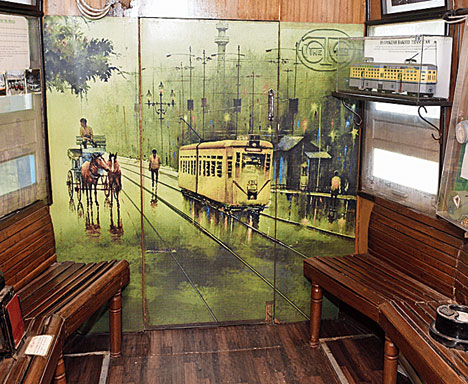
A tram of 1938 vintage at the Esplanade depot has been turned into a museum-cum-cafeteria with 16 seats. The rear bogie of the tram is where the museum is. It contains replicas of a tramcar that was once used to water and clean roads, besides a trolley bus. Tram tickets used during various periods are also on display.

Trolley buses had wheels like buses, but they drew electricity from overhead electric cables meant for trams.

The visit took consul general Feiner back to Germany, where trams still run. “Around 50 cities of Germany like Berlin, Stuttgart and Munich have streetcars. In Germany, streetcars get priority over other traffic,” he said.

At the cafeteria, which is open from 1pm to 8pm, a montage of films shot inside trams between 1931 and 2012 runs on loop on a television screen.

Feiner, who has lived in Calcutta for 10 months, offered a suggestion to promote tourism within Calcutta. “I think there should be a website with comprehensive information on the museums and heritage of Calcutta. There are a lot of ways to promote tourism and this can be a start,” he said.

source: http://www.telegraphindia.com / The Telegraph,Calcutta,India / Home> Calcutta / by Subhajoy Roy / July 09th, 2018

Trees offer multiple benefits — don’t kill them, breed them

In 1979, Dr. T.M. Das of Calcutta University estimated the value of a tree to be $2,00,000 | Photo Credit: S. SIVA SARAVANAN


Hundred trees remove 53 tons of carbon dioxide and 430 pounds of other air pollutants per year. They also catch about 1,40,000 gallons of rainwater per year.

Officials in Delhi wish to fell about 17,000 fully grown trees in some parts of the city to make space for building housing colonies. And to “pacify” people who object to this tree destruction, they say that for every tree that will be felled, they will plant 10 saplings. Interesting — the minister knows it; the National Building Construction Corporation (NBCC) knows it and we all known it — that this is a stupid answer. “What you lose today, I will make up” (20 years from now? and if the saplings survive?) And this is not just in Delhi. Government and city planners in several other states do the same. This attitude shows not just ignorance but arrogance, disregard for trees and their value. It is time planners wake up and understand the value — economic, ecological, health-related and sociological — that trees offer.

Value of a tree

Way back in 1979, Dr. T.M. Das of Calcutta University estimated that the monetary value of a tree, during a life span of 50 years, amounted to about $2,00,000 (at 1979 rates). This was based on the amount of oxygen it produces, the fruit or the biomass and the timber it offers when felled and so on. For every 1 gram that a tree accumulates as it grows, it generates about 2.66 grams of oxygen. Dr Nancy Beckham of Australia, in her paper, “Trees: finding their true value”, points out that “trees and plants silently carry out their daily routine years after years, stabilizing the soil, recycling nutrients, cooling the air, modifying wind turbulence, intercepting the rain, absorbing toxins, reducing fuel costs, neutralizing sewage, increasing property values, promoting tourism, encouraging recreation, reducing stress and improving personal health as well as providing food, medicine and accommodation for other living things”. (Link: ).

The Department of Environmental Conservation of New York State, USA offers numbers in this connection (see ), along with references to scientific papers which estimate these numbers. It points out that (1) healthy trees mean healthy people: 100 trees remove 53 tons of CO2 and 430 pounds of other air pollutants per year; (2) healthy trees mean healthy communities: tree-filled neighbourhoods lower the levels of domestic violence and are safer and move sociable; (3) healthy trees mean healthy environment — 100 mature trees catch about 1,40,000 gallons of rain water per year; (4) healthy trees mean home-owner savings — strategically placed trees save up to 56% of air conditioning costs; evergreens that block winter winds can save 3% on heating; (5) healthy trees means better business — in tree-lined commercial districts, shoppers report more frequent shopping and spend 12% more for goods, and (6) healthy trees means higher property values.

The minister and the NBCC officials are smart people and they surely know all these facts. Yet for them, a mature tree is “dead urban space” and clearing 17,000 trees means real estate for building houses, colonies and shopping malls in a city that is gasping for clean air. (Delhi Greens, an NGO, estimated in 2013 that a healthy tree is worth Rs. 24 lakh a year, just with respect to its oxygen producing capacity). And for them a sapling occupies (today) about a hundredth (or even less) space. But where will they plant the saplings — where the trees were? How will they survive if construction starts already? Clearly the officials’ attitude is: ‘well, we will be gone (transferred/ retired) and do not need to answer’. What Gurgaon was then, and is now, makes the point.

Admire trees, don’t axe them

In stark contrast to their cruel attitude towards trees stand the examples of Sunderlal Bahuguna’s “chipko” movement, Saalumarada Thimmakka of Karnataka who has planted 398 banyan trees — each representing her own child, and Majid Khan and the team of biologists and horticulturists who are offering “intensive care” (injecting insecticide mix in to the phloem of each branch) to a 700 years old “pillalamarri” banyan tree near Mahabubnagar, Telangana, spanning a 4–acre canopy , which is being eaten up by termites, and bringing it back to life. (See: https://www.thehindu.com/news/national/telangana/a-tree-in-intensive-care/article24241462.ece). Should it have been cut and the 4 acre space used as real estate?

Obviously trees offer emotional, even spiritual solace. Indian history is replete with examples — Lord Buddha, Emperor Ashoka, and the Tamil King Pari Vallal who left his chariot near a plant to help it spread its branches.

Should not Delhi then think of building houses and colonies elsewhere in the suburbs, saving these 17,000 trees? Or if at all it has to do it in Delhi, think new thoughts, but without cutting the trees (or at best sacrificing the smallest possible number)? This impossible-sounding scheme offers challenges to architects. Indeed, high rise apartments have been built elsewhere, saving trees and even including them as part of the building. Some examples are seen in Italy, Turkey and Brazil.

India has been blessed with creative architects, both Indian and foreign, who have built houses and campuses, totally in harmony with the surroundings. The Indian Institute of Architects has about 20,000 members, we have about 80 institutions that teach architecture. Why not throw a challenge to them to come up with the best plan, offer a handsome award to the most suited and creative one, and use it to build the colony?

dbala@lvpei.org

source: http://www.thehindu.com / The Hindu / Home> Science / by D. Balasubramanian / July 07th, 2018

Presi alumni top post

Calcutta:

Nabaneeta Dev Sen has become the first woman president of the Presidency Alumni Association since its inception in 1951.

Dev Sen was officially anointed at a meeting at the association’s office on the Presidency campus on Friday.

“We have had 20 presidents before her. She happens to be the first woman,” said secretary Bivas Chaudhuri.

Dev Sen had filed her nomination for membership in the association’s executive council and was inducted as one of the 29 members at the association’s annual general meeting on June 23. “The executive council unanimously named her the next president,” Chaudhuri said.

Presidents have a tenure of one year. The 30th member of the council is the ex-officio chief patron, who is the university’s vice-chancellor.

Asked what role she would like the alumni association to play, Dev Sen replied: ” These are tough times. Let us see what can be done.”

source: http://www.telegraphindia.com / The Telegraph,Calcutta,India / Home> Calcutta / by The Telegraph Special Correspondent / July 07th, 2018

London goes the Kolkata way!

For decades now jhalmuri, spicy puffed rice, has ruled the streets of Kolkata.

Chef Angus Denoon serving jhalmuri in London.

For decades now jhalmuri, spicy puffed rice, has ruled the streets of Kolkata. Having been a part of 10 Foods Around the World to Try Before You Die (published by Huffington in 2012), jhalmuri has now found many new admirers on the streets of London.

Well-known industrialist Harsh Goenka recently put up a video on his Twitter account of an English chef selling jhalmuri in London. “Jhalmuri is my all time favourite snack. Jhalmuriwalas dot the streets and lanes of Kolkata, and each neighbourhood proudly boasts of their ‘guy’ being the best. Funny that a mix of simple ingredients can demand such finesse. Now delighted to see it available in London (sic),” he tweeted. What’s interesting is that many foreigners can be seen enjoying the Indian street food in the video.

The chef, who is seen making jhalmuri in the video, is a British chef Angus Denoon, and has been selling jhalmuri on the streets of London for almost a decade since he first tasted it on the streets of Kolkata.

Jhalmuri makes for a perfect rainy season snack. Try this easy-breezy recipe and enjoy it with a cup of adrak ki chai.

Jhalmuri
Ingredients
(serves 4)
250 gm murmura
1 spicy mixture (farsaan) with peanuts
¼ cup onion, finely chopped
2 green chillies, finely chopped
1 potato, boiled and diced into small pieces
¼ cucumber, finely chopped
1 tomato, finely chopped
Juice of one lemon
2 tsp coriander leaves, finely chopped
½ tsp mustard oil, to drizzle for jhalmuri masala
¼ tsp amchoor powder
½ inch roasted cinnamon
1 roasted green cardomom
2 roasted cloves
½ tsp salt
1 roasted dried red chilli
¼ tsp roasted coriander seeds
¼ tsp roasted jeera
(Grind them together. Quantity needed — 1 tablespoon)

Method
Mix all the ingredients of jhalmuri, except the lemon juice and coriander leaves. Sprinkle the jhalmuri masala and then mix some lemon juice. Garnish with coriander leaves and serve.

Purabi Sarkar, home chef

source: http://www.deccanchronicle.com / Deccan Chronicle / Home> Lifestyle> Food and Recipes / Deccan Chronicle / July 05th, 2018

Calcutta through Chinese eyes

Victoria Memorial:

If there was no Chinese community in Calcutta, there would have been no rickshaw, no Darjeeling tea and no noodles for us.

But the Chinese – missionaries, migrants, journalists and government emissaries – also left their written impressions of the city.

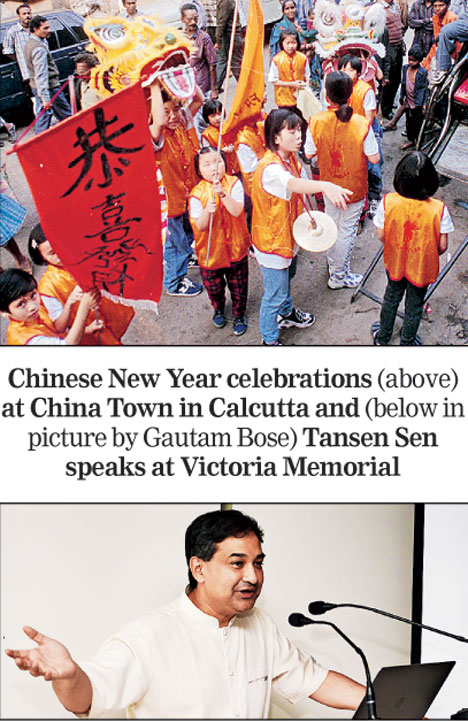
“The Chinese formed the largest migrant group from outside South Asia in the city. There were those who came to look for jobs and those who got smuggled in,” Tansen Sen said.

“It was the site of opium export and of financial transactions in the late 19th and early 20th century. The Mahabodhi Society here was a transit point between Sri Lanka and Thailand, China and Tibet. Many walked from Kalimpong to Lhasa, carrying necessary commodities. All this shows how important Calcutta was to the Chinese.” The professor of history and director, Center for Global Asia of New York University, Shanghai, was speaking on Chinese encounters with colonial and post-colonial Calcutta at Victoria Memorial on Thursday.

Governor General Warren Hastings initiated exchanges with China in the Qing dynasty. He sent a diplomatic mission to Tibet in 1774-75 and granted land near Budge Budge to Tong Atchew, the first Chinese trader to Calcutta, to set up a sugar mill in exchange of tea. British records show how Chinese labourers, especially carpenters, began to grow in popularity.

If Atchew did not document his impressions, Huang Maocai, sent by the governor of Sichuan in 1879, did. “His job was to check if the British planned to attack China and he created maps of the entire region from Sichuan to Bengal. He was fascinated with the railways and the telegraph as well as streetlights and tap water.”

But Kang Youwei, who visited Calcutta twice in the first decade of the 20th centure and stayed at the Grand Hotel, found the streets “filthy like those in Beijing”.

By the time Kang comes, there were three Chinese settlements in Calcutta – Bowbazar, Tangra and Budge Budge. Sen stressed that it would be wrong to lump the community together. “Bowbazar, housing the Cantonese, was a relatively open community. Tangra, housing the Hakkas, was gated. They did not like each other.”

The next major visitor, Tan Yunshan, the founder-director of Cheena Bhavana, Visva-Bharati, described China Town as an unhygienic place of criminal activities, opium dens and “where Chinese women showcase their small feet”, an euphemism for prostitution.

“But those who lived here regarded the place differently, like Kwai-Yun Li. Daughter of Hakka parents who migrated here in the 1920s and owned three shoe stores, she grew up in Chhatawala Gali and then Tangra, and was friendly with Bengali and other communities.”

But the political changes in 1949, when the Kuomintang lost the civil war in China and India recognised the People’s Republic of China (PRC) government, impacted the local Chinese populace.

The rise of communism or the “godless regime” impacted David and Mary Lamb, Chinese Christian missionaries who not only had to quit Shanghai but were also precariously placed in Calcutta as the Bengal government was supportive of PRC. The Lambs founded the Ling Liang Chinese Church and Grace Ling Liang English School in Tangra.

But worse was to come in 1962 with the war. As Kwai-Yun Li, who migrated to Canada and wrote of her Chinatown experience, told this correspondent during her Calcutta visit in 2008: “Fear was in the air…fear of being deported or put into Deoli.”

Deoli, in Rajasthan, is where a British detention camp for World War II Japanese prisoners had been reopened “to lodge Chinese-Indians”. Sen says those who had opted for PRC passports in 1949 were the first to be targeted. Many who were deported to China were settled in villages in Guanxi, Guangdong and Yunnan. “They still maintain Indian traditions like wearing sari and celebrating Diwali.”

The Chinese writings, Sen pointed out, present a perspective different from British writings and deserve to be read to understand the cosmopolitan nature of Calcutta.

source: http://www.telegraphindia.com / The Telegraph,Calcutta,India / Home> Calcutta / by Sudeshna Banerjee / July 01st, 2018

The dead poet’s society

Swachchhasila Basu visits Michael Madhusudan Dutt’s Bengali debut stage on the poet-playwright’s 145th death anniversary

DUTT ADDRESS: Belgachia Rajbari

A two-storey structure off north Calcutta’s Belgachia Road nudges curiosity. The portico cuts though the building like a tunnel. Trees grow on the walls, their aerial roots weaving a veil over it. The pink ground floor walls are peeling like scabs, the upper floor is unpainted. The bricks that seal the arched spaces to the right of the portico talk of secrets buried. The red doors to the left are not welcoming either. And yet, once, the doors of this very house had been thrown open to Bengal’s cultural elite.

The Belgachia Rajbari hosted, among other things, the first performance of Michael Madhusudan Dutt’s Sarmistha, the first original play in Bengali.

According to the Mahabharata, Sarmistha is the second consort of prince Yayati. Says 83-year-old Nityapriya Ghosh, “It was 1859. While translating Ramnarayan Tarakanath’s Sanskrit play Ratnavali into English, Dutt realised there were no original plays in Bengali. Encouraged by friends and patrons, among them the rajas of Paikpara and Jyotindramohan Tagore, he wrote this five-act play.”

This was supposed to be the most productive phase of Dutt’s literary life. In a letter from 1859, written to a friend whom he refers to “as one of the best dogs in creation” he writes, ” Sermista [the English translation by Dutt himself is spelt thus] has turned out to be a most delightful girl… Jyotindra says it is the best drama in the language.”

Ghosh, who used to live in Belgachia Villa – a government housing that came up in a portion of the Rajbari estate – says that around 1836, Prince Dwarkanath, entrepreneur and grandfather of Rabindranath Tagore, bought the estate and a single-storey house and converted it into this palace. In Bonedi Kolkatar Gharbari, Debasish Bandyopadhyay writes that Dwar-kanath had spent over Rs 2 lakh on the estate makeover.

“The who’s who of society would look forward to an invitation to the innumerable parties he threw here,” says 88-year-old Deboprosad Majumdar, who has done much research on the region.

Later, Dwarkanath’s son, Debendranath, auctioned the property. Its new owners, the Singhas of Kandi in Murshidabad, who were the rajas of Paikpara, got it for Rs 54,000.

Paikpara is adjacent to Belgachia.

In Calcutta – The Living City, writer Tapati Guha Thakurta talks about the drawing room of the palace being full of European style furniture, art and sculptures.

Ghosh’s daughter, Sahana, recalls playing with her friends in the palace gardens till the early 1970s, while attending mothers would sit around on marble chairs fixed to the ground, around a marble table, chatting, knitting and soaking up the winter sun.

At that time, the then owners lived in a second house further down, across a large water body known as the Motijheel. Sahana says, “It extended quite a bit across the estate even in the 1970s. An uncle used to take us bird-watching there.” The jheel has vanished in places today and what remains of it are unrelated ponds and garbage dumps.

Theatre artiste Ditipriya Bandopadhyay, who got a chance to enter the palace building recently – she was shooting for a TV serial – says, “I saw some black-and-white photographs. They were captioned but the writing was so blurred that there was no telling what was what.”

Sarmistha opens in the Himalayas. Dutt writes in yet another letter: “Everyone says it is superior to that [Ratnavali] book; as for the Bengali original, the only fault found with it is that the language is a little too high… This I need scarcely tell you, is nothing; for if the book is destined to occupy a permanent place in the literature of the country, it will not be condemned on this head.”

source: http://www.telegraphindia.com / The Telegraph,Calcutta,India / Home> Calcutta / by Swachchhasila Basu / July 01st, 2018

Meet India’s First Santhal RJ, Who Wants Tribal Culture to be Truly Understood

Shikha Mandi, who hosts a show about the coming-of-age of tribals in India in fluent Santhali, also wants more indigenous voices to be heard in the public domain.

Shikha Mandi. Credit: Priyadarshini Sen

Perched on the hot seat, her fingers manoeuvring the keys of a mixer console like an artist wielding her brush, 24-year-old Shikha Mandi cuts an arresting frame. The radio jockey punctuates her chat show, Johar Jhargram – about the coming-of-age of tribals in India in fluent Santhali (the language spoken by over six million indigenous people across South Asia) – with mellifluous strains of village songs.

Her story is even more interesting. The daughter of a small farmer from West Midnapore, Mandi worked her way up from the paddy fields of Jhargram’s Belpahari village where she was born, to the coveted mechanical engineering school at Kolkata’s Industrial Training Institute. And now, as one of India’s first tribal radio jockeys, she’s quite the talk of the town.

RJ Shikha commands the attention of hundreds of listeners through Radio Milan – a small community radio station in West Bengal’s Jhargram district – about 170 km west of Kolkata. The radio waves bearing her unusual Santhal imprint ripple through the Jhargram and Kharagpur districts. More fans across India and abroad tune in to her programme online. Her followers on social media are also growing. Not only does Mandi want tribal culture to be understood across India, she also wants to pioneer its representation through popular media. “There’s almost no knowledge of tribal life and its idiosyncrasies. I want more indigenous voices to be heard in the public domain,” she says.

To forefront tribal culture and ethos, Mandi holds her own at Radio Milan – her “working playground,” as she calls it. Here, she writes her own script, mashes up tunes, readies playlists and rustles up ideas for shows on socially relevant issues. “There’s a lot of independence at work, and I’m encouraged by my colleagues to think out of the box,” she says.

Her colleagues at Radio Milan, which was set up last November by Milan Chakraborty, a Kolkata-based entrepreneur, are supportive of her work. “Shikha impressed us with her determination, diligence and language proficiency,” says Tanmay Dutta, a well-heeled radio jockey from Siliguri, who trains young talent. “There are few people in India who understand the Santhali Ol Chiki script and can translate it. Not too many books or academic resources are available, either. So Shikha works hard on her research.”

But the journey to the hot seat hasn’t been an easy one for Mandi. At the age of three, she was sent to live with her uncle in Kolkata so she could receive a quality education. There were reported incidents of Maoist activity in the Jhargram region, which added to their insecurity. “My parents thought it wasn’t safe for me to live in our village. But in Kolkata, despite having a loving family, I felt a sense of uprootedness,” says Mandi.

At school, the young girl would get taunted for her Santhal leanings and demeanour. But that made her more determined to stay true to her roots. “The older I got, the more connected I felt to my tribal mores,” she says. So, Mandi would tune in to Santhal shows on Doordarshan; sing indigenous songs and recite Santhali poetry at social gatherings. Instead of settling into city life completely, she held on to her tribal identity and nursed the dream of going back to Jhargram.

The move back to Jhargram was in some ways fated. Just as Mandi was preparing to take an apprenticeship test at a Kolkata-based shipbuilding and engineering company, she got an interview call from Radio Milan last November. After scouring several resumes, the hiring team cast its eye on Mandi. “We felt Shikha is deeply embedded in the tribal culture. Her ability to identify issues facing indigenous people, and making them accessible through popular media set her apart from other applicants,” says Chakraborty.

Even though Mandi had no formal training in radio or anchoring, she won the hiring team over with her persuasion skills. Soon after getting selected, the 24-year-old moved back to her beloved hometown.

But the transition wasn’t easy. Years of living in Kolkata had taken the sheen off Mandi’s proficiency in Santhali. She had to make herself acquainted with tribal customs, rituals and devotional songs for her show Johar Jhargram. She also spent nights poring over books given to her by four Midnapore-based professors who knew the Ol Chiki script well, including the bi-monthly magazine Sagen Saota. “Going on air was a nerve-wracking experience, and I would have my script open in front of me every day,” says Mandi.

The content-mastering challenge aside, Mandi also had technical challenges to overcome. The 24-year-old was made to undergo training in script-writing, voice tone and modulation, studio sound and audience engagement. “I had no idea about the technical side of radio production, and was literally thrown into the deep end in order to figure things out,” she says.

But Mandi’s love for all things Santhal made these challenges surmountable. Today, she’s a purist in her approach to showmanship. “There’s not a speck of Hindi or Bengali in my show, and I can rustle up and rehearse a script, three hours prior to my programme,” she says with a wry smile.

The young RJ’s command of Santhali and understanding of tribal culture has also made her more experimental. Nowadays, she goes to different villages in Bengal to identify new trends, and ways to build a support-base in indigenous communities. “Instead of just sitting in my studio and doing my research, I like to be in touch with real people and real issues,” she says.

Mandi’s innovative approach has struck a chord with the Santhal people. Priyanka Hembrom, a 17-year-old ardent fan from the Jaigeria village in Jhargram district, says she too wants to be a radio jockey, and entertain and inform an audience. “Shikha brings important issues such as underage marriages in tribal communities to the fore. She adds a touch of humour to all her shows, which makes her stand apart from others,” says Hembrom.

Mandi’s out-of-the-box thinking also gets reflected in her special shows ahead of tribal festivals. Her programme – the ‘Wonders of Waiting’ was a big success, says one of her colleagues. “The act of waiting is pregnant with hope. Those who work on the borders, wait to be united with their families; children living abroad wait to go back home. Shikha wanted to underline the value of time in the act of waiting. Isn’t that an interesting idea?”

Perhaps for Mandi, too, patient waiting has given her career an impetus, and her life meaning. More advertisers are now buying slots during her show. The Santhali programme has been extended by a couple of hours, and there are plans to bring in more tribal artistes to improve people’s understanding of indigenous communities.

“The fact that I’m doing what I love, for the people I love, in the place I love the most is my biggest success. I’m not looking back,” says Mandi.

Priyadarshini Sen is an independent journalist based in New Delhi. She writes for various India and US-based media outlets.

source: http://www.thewire.in / The Wire / Home> Culture / by Priyadarshini Sen / June 13th, 2018