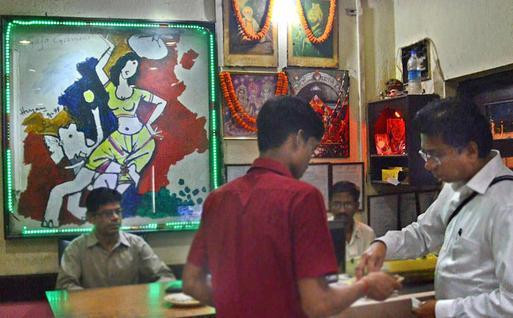
The wall of the Azad Hind Dhaba in Kolkata adorned with M.F. Husain’s Gaja Gamini. Photo: SUSHANTA PATRONOBISH
The now-famous painting, titled Gaja Gamini (one with a walk like an elephant), depicts a dancing woman, in a bright red background, while a white elephant looks on with its trunk held aloft
The memory of seeing M.F. Husain colouring one of his sketches back in 1999 is still fresh in the mind of Madan Sharma, one of the owners of Azad Hind Dhaba, a popular eatery in south Kolkata.
One fine afternoon years back, Mr. Husain walked into the dhaba, which he frequented during his visits here, and all of a sudden started adding colour to the black and white sketch on the wall that he had drawn three years before.
“The experience made me speechless,” Mr. Sharma said, on the eve of the 99th birth anniversary of the iconic painter.
The now-famous painting, titled Gaja Gamini (one with a walk like an elephant), depicts a dancing woman, in a bright red background, while a white elephant looks on with its trunk held aloft. Mr. Husain arranged a private show of his film Gaja Gamini at Azad Hind in 1999.
Sitting at the cash counter with the painting behind him, Mr. Sharma fondly recalled his memories of the famous artist. He remembers Mr. Husain as a “moody and humble person” who would come to the restaurant and sit quietly in one corner sipping his favourite “kadak chai [strong tea].”
“He did not talk much. But sometimes told me what kind of food he wants,” Mr. Sharma said. He was initially apprehensive of talking to an artist of Mr. Husain’s calibre, but eventually they became friends. “Mr. Husain could mingle with adults and children with equal ease. He was totally devoid of arrogance.” Whenever schoolchildren spotted him at the eatery, they flocked to him and asked for autographs. The world-famous painter complied with their demands with a smile and even drew them impromptu sketches.
When asked about the controversy that erupted in 2006 over Mr. Husain’s depiction of Hindu gods and goddesses, Mr. Sharma said the thought of removing the painting never entered his mind. “Nobody asked me to remove the painting even when the controversy erupted.”
Mr. Husain eventually had to leave the country under pressure from Hindu nationalist forces. He passed away in London in August 2011.
Meanwhile, the dancing woman with an elephant walk lives on happily on the central wall of Azad Hind Dhaba, in the company of numerous Hindu gods and goddesses.
source: http://www.thehindu.com / The Hindu / Home> Features> Friday Review> Art / by Soumya Das / Kolkata – September 17th, 2014
The ‘toy train’ chugging up a serpentine track through the Darjeeling hills is almost an image out of a fairy tale. But for Adrian Shooter the first look at the scene triggered a life-long love story that made him buy an entire locomotive to run in his London garden.
The world’s oldest surviving Darjeeling-Himalayan Railway (DHR) locomotive is back on track, thanks to Shooter. Smitten by the magic of a ride on the DHR (now an Unesco world heritage property) a decade and a half ago, Shooter, who retired as chairman of Chiltern Railways, bought the DHR locomotive — model number 778 — built in 1889 by Sharp Stewart and Company, Manchester, to restore it to perfect
condition.
The Indian government had sold the locomotive to Hesston Steam Museum in 1960, not realizing what its worth would be 50 years later when it was declared a world heritage by Unesco.
Shooter has also bought an Ambassador that runs by the train when it chugs through his garden to give it a feel of being in Darjeeling. He shipped the locomotive in a container from US to the steam rail workshop in Tyseley, Birmingham, where he restored it. The tracks laid in his garden over 1.5km is in the form of a loop just like in Darjeeling.
He has also built a station that looks exactly like the original Sukna station, besides laying a pathway that crosses over the tracks, exactly the way it is in Darjeeling.
In an exclusive interview to TOI, Shooter said “I bought the locomotive from the museum in Indiana, US, in 2002. It had been bought by a private individual, Mr Donnelley in 1960. He died in 1975 and it passed on to the museum after that. He was the boss and major shareholder in R R Donnelley Co, which is a very large printer and publisher in Chicago.”
He added, “I have several volunteers who help me operate the loco and we give rides to invited guests. We usually have 100-150 and do this three or four times a year. The loco is fully functional and is in excellent condition. Last winter it had a 10-year overhaul when, by law, the boiler has to be taken off the chassis, carefully examined and repaired as necessary.”
“The loco still has the original 1889 boiler and is, by at least 50 years, the oldest loco boiler in use in the UK. There are a couple of older ones in India. The reason that it has lasted so long is that it is made of wrought iron, which is much more corrosion-resistant than steel. It was obviously very well looked after during its 70-year use in India,” Shooter said.
Shooter will be in Delhi in February at the invitation of Mark Tully to speak at the Indian Steam Conference. He said, “Darjeeling Railway is very special because it climbs so high (over 7000 feet) through fantastic countryside with wonderful people. Many Britons had ancestors who lived, worked or visited Darjeeling. I still regularly come across people who went to school in Kurseong or Darjeeling. The engines themselves are of a sound design that have shown themselves to be more than capable on very steep and curvaceous railway tracks.”
Shooter, however, said he has no plans to return the locomotive to India. Britons will get a chance to ride on the train as it makes a special appearance at the North Pennines on September 26-28.
South Tynedale Railway at Alston is hosting Shooter’s train — Locomotive No. 19 — for an Indian-themed weekend of food, music and films. People will be able to ride on the train, dress like a local from Darjeeling and enjoy eastern Himalayan cuisine.
Locomotive No. 19 was withdrawn from the Darjeeling-Himalayan railway service in 1960 and, privately purchased, made its way to Indiana. In 2003, it was taken across the Atlantic to be restored by Tyseley Locomotive Works, Birmingham, for Shooter. At the same time, two replicas of DHR carriages were constructed at the Boston Lodge Works of the Ffestiniog Railway. These and the locomotive run in Adrian Shooter’s private garden railway.
India at present has 14 original DHR locomotives in working condition and 10 others on display at museums. Shooter’s train is the oldest of all DHR trains. Currently, only five DHR locomotives are privately owned, four of which are in Assam. The 778 is the only model outside India.
Indian railway expert Rajesh Agrawal said, “In the 1960s, India was getting rid of a large number of locomotives as we had more than we required. One such model was the 778. Nobody knew then that the DHR would become such a prized object. People also thought the 778 was not in working condition as it was 71 years old. A locomotive generally retires after 45 years.”
source: http://www.timesofindia.indiatimes.com / The Times of India / Home> City> Kolkata / by Kounteya Sinha, TNN / September 19th, 2014
This new contribution to diaspora studies maps a woman’s tumultuous passage from India to West Indies
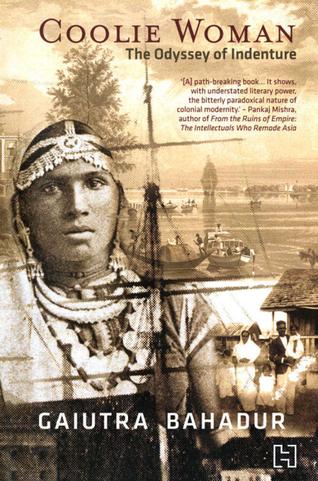
COOLIE WOMAN — The Odyssey of Indenture: Gaiutra Bahadur; Hachette Book Publishing India Pvt. Ltd., 4th & 5th Floors, Corporate Centre, Sector 44, Gurgaon-122003. Rs. 599.
Usha V.T
Gaiutra Bahadur’s Coolie Woman is an attempt to recreate the journey of an indentured woman labourer — a woman from India —who travelled to the West Indies and eventually to the United States. Diaspora studies have often pointed out that a wide array of social and economic deprivations drove villagers from their homes to travel to faraway lands. And as this author reiterates, the practice of imperial capitalism destroyed traditional livelihoods, while at the same time colonialism created new routes for moving across the subcontinent, in several guises.
The author justifies the use of the term coolie , despite its derogatory connotations, at the very outset. In fact, she devotes a whole chapter to a discussion of the term and its use in the current context. “As it turns out, mystery darkened the lives of many women who left India as coolies. The hind of scandal was communal. Some historians have called indenture “ a new form of slavery,”
In many ways it was: once in the sugar colonies, coolies suffered under a repressive legal system that regularly convicted more than a fifth of them as criminals, subject to prison for mere labor violations, which were often the unjust allegations of exploitative overseers.”
What makes the work interesting is the autobiographical nature of the narrative. The protagonist is the author’s great grandmother Sujaria, whose life and adventures are the occasion to map the tumultuous journey of the woman from her home in India to the West Indies. With the help of historical records, legal documents and tales of indenture, Gaiutra Bahadur attempts to recreate her grandmother’s historic journey. She says: “What I found was a revelation. I once thought that my great grandmother must have been an exception .” And a little later we read: “In which category of recruit did my great grandmother fall? Who was she? Displaced peasant, run away wife, kidnap victim, Vaishnavite pilgrim or widow? Was she prostitute…”
The sexuality of the women and her exploitation in terms of her body both during the journey to the new land as well as in her survival in the land of her slavery through sexual negotiation takes prime place in some of the seminal chapters of the book. They were exploited physically and their reputations were then “dismembered”. This was done systematically both by the men who exploited them as well as by the men who had no sexual stake in the women. Though it was seen that gender imbalance caused sexual chaos in the colonies among the indentured labourers and their functionaries, the women were made to suffer not merely physical agony but mental torture through character assassination. Some of the comments and statements that Gaiutra cites are from public figures held usually in high regard: Even men without a sexual stake in the women cut them to pieces. The Reverend C.F Andrews, indenture’s greatest critic, rued the women he met in Fiji. “The Hindu woman in this country” he reported, “is like a rudderless vessel with its masts broken being whirled down the rapids of a great river without any controlling hand. She passes from one man to another and has lost even the sense of shame in doing so ”.
Of course none of the opinionated colonisers bother to talk to the women or ask for their version of the reality they face on an everyday basis for survival. Yet they make their judgements on the character of the women vocal and the woman as always is silenced and humbled for circumstances beyond her control.
In 1906, the author’s great grandmother and her new born arrived at Rose Hall Plantation, on Canje Creek. She did no field work there as the narrator informs us… “Dey send her, and she cyaan make it in the field, because her feet was soft …” Instead Sujaria was assigned to be a child minder. This was the job that Jamni, the woman at the edges of the Nonpareil uprising, either as kept woman or rape victim, reportedly had. And this was the job that my great grandmother was given. Perhaps this was because she had a baby to support alone and her caste background had made her useless in the fields. Or perhaps, she possessed a pretty woman’s advantage. (p 148)
Gaiutra explains how caste class and gender are factors that develop new meaning as the woman moves from her own land through along, perilous journey into a new world where her survival depends on her capacity to negotiate with the multiple forces that are decisive to her existence. Her sex, though her weakness, now becomes a major factor that she can utilise for negotiating her survival. In a way of life, that is exploitative, survival become the centre of the labourer’s existence and the author explains how it is achieved in individual cases.
The narrative is supported with documents such as legal references, captains’ or doctor’s logbooks from the ships, police records, administrative reports, photographs etc.
These neglected narratives are footnotes to colonial history and women’s history in particular. It becomes her middle passage:
middle-passaged
passing
beneath the coloring of
desire
in the enemy’s eye
a scatter of worlds and bro
ken wishes
in shiva’s unending dance
(Arnold Itwaru, “We Have
Survived”)
With an astute eye for detail Gaiutra Bahadur, trained as a journalist, unearths sumptuous information buried in documents and records hitherto less-explored areas pertaining to women in indentured labour amounting to sexual slavery, and the odyssey of indenture is presented in a nonchalant manner. However having said that, the documentary nature of the work makes it a little tedious and uninteresting at times over several pages.
The author’s self-conscious struggle to motivate the reader to share individual experiences — albeit factual, in places slipping into a fictional style — is sometimes a bit laborious and too obvious. Gaiutra Bahadur’s Coolie Woman traces the story of how one woman’s experience represents an entire spectrum of woman’s experience: the book is a veritable source book for further research in diaspora studies.
source: http://www.thehindu.com / The Hindu / Home> Features> Book Review / by Usha V.T / September 16th, 2014
The story of the Jews of Calcutta tends to always be a story about disappearance. There are only about two dozen Jews left in the city where once they were thousands and that makes it a poignant story of loss – of shuttered synagogues without services, a Jewish Girls School without a single Jewish girl, and buildings with names like Ezra Mansion but no Ezras in them. Nahoum’s Bakery and its plum cakes are about the only real memory most Calcuttans have of their city’s Jewish history. It makes for a melancholic nostalgic story both about the vanishing Jews of Calcutta and the city’s fading cosmopolitan charm.
But Jael Silliman says when she started archiving the city’s Jewish history she did not want it to be a lament about how few Jews were left in the city. She wanted to make a different point– “it is that the time we were here was full, was good and both we and the city benefited.”
JewishCalcutta.in is less a stuffy museum of that 230-year old history and more of a digital album that tells the story through snapshots and film clips and even recipes, through marriage contracts found in auction houses and wedding dresses stored away in attics in America. Silliman conceived of the idea, secured a Fulbright-Nehru fellowship and Jadavpur University’s School of Cultural Texts and Records came on board to help create the digital archive.
“My notion of the Jewish community was from my granny and my great-grandma and they were very conservative women, very inward-looking, not politically inclined. Fuddy-duddy kind of people,” she laughs. “I thought their worlds were very limited.”
But she found to her astonishment, her community was anything but limited. She encountered the first person in India to do magic on the radio. Silent movie stars. The first mother and daughter Miss India pair. The first woman to cut a record on disc in India.
Communists and Congressis. A woman asking to be a plaintiff in court long before even Britain had female lawyers. A woman lawyer fighting for the rights of Muslim women in purdah. The “Patton” of the Indian Army. And Jewish patrons of the Bengali Star Theatre in North Kolkata. “They loved what they called ‘gaana bajana’” chuckles Jael.
The Jews of Calcutta were mostly Arab Jews from Iraq, Syria and Yemen who came to India as traders. They prospered under the Raj in that grey area between “whites” and “blacks” and left behind grand edifices recalling that prosperity. But Jael says it’s worth remembering that because so many were new immigrants, over 40 percent of the community was poor and started at the bottom of the ladder.
In a way, she says the story of her community’s success is a story about India as well. “I think only a country like India would enable a community like this, which came for such a short time, to have the kind of impact they did,” she says. And her mother Flower Silliman says even though most of the Jews of Calcutta left in the decades after Independence — unsure of their position in the new country — there’s one thing worth remembering: “At least we didn’t vanish because of anti-Semitism. India can be proud and say that the Jews left because they wanted to leave and no one told them to go.”
The Jews of Calcutta are mostly gone but here are seven of the most intriguing stories they left behind, now saved on JewishCalcutta.in.
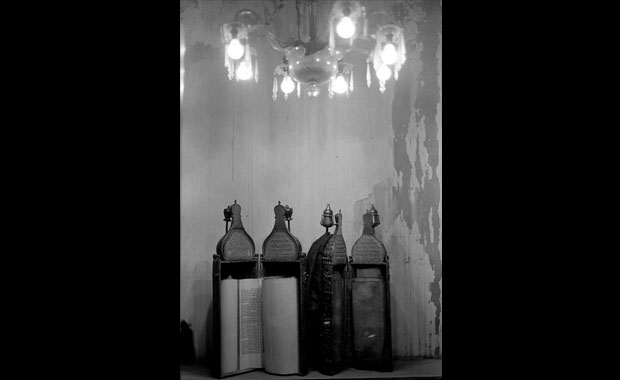
The Sefer Torah. Photo courtesy: www.sanjitchowdhury.com
The Sefer Torah is a handwritten copy of the holiest book of the Jews usually stored in the Holy Ark of a synagogue. “We used to have 80-100 sefer torahs in the synagogue. Now we only have two. At least we have two” says Jael Silliman.
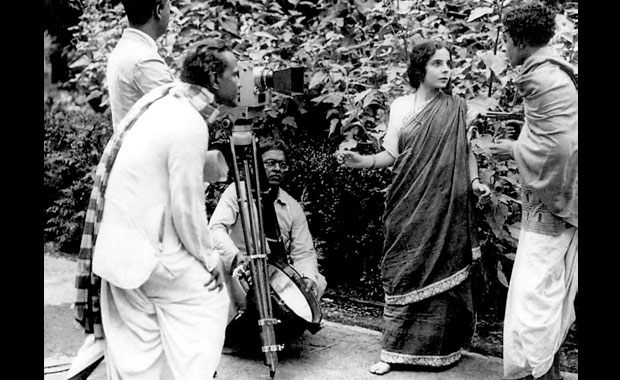
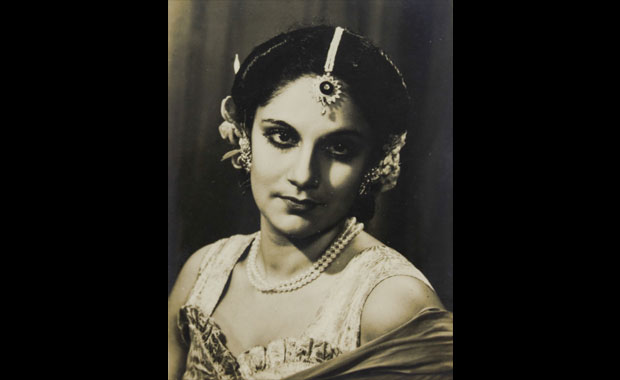
Arati Devi. Photo courtesy: Edmund Jonah
Arati Devi, a star of the silent film era was actually born Rachael Sofaer. She made three films including Punarianma: A Life Divine and A Man Condemned. She died in childbirth at the age of 35. Her cousin Abraham became a Hollywood actor alongside stars like Charlton Heston, Ava Gardner and Elizabeth Taylor.
Pramila. Photo courtesy: JewishCalcutta.in
Esther Victoria Abraham was voted as Miss India in 1947. But she became more famous as Pramila, the westernized vamp with Anglicized Hindi in films like Bhikaran, Ulti Ganga and Bijli. She married the film star Syed Hassan Ali Zaidi, a Shia Muslim and converted to Islam, yet remained Jewish to the end and her children observed Passover. Their daughter Naqui became Miss India in 1967, the first mother-and-daughter pair to do so. Naqui became Hindu. One son became Wahabi. Another son Haider remained Muslim but married a Tamilian Brahmin and wrote the screenplay for Jodhaa Akbar. When Esther died at 90, her sons, Jewish and Muslim, carried her to the Jewish cemetery while prayers from both scriptures were recited.
Aloo makallah has no ingredients except potatos and oil and salt but it’s a taste of Jewish Calcutta oldtimers remember nostalgically. Flower Silliman says the keepers of the kosher rules in Jewish kitchens were often Muslim cooks. “My cook would tell me its shabbat today. You have not made such and such dish. I was not at all religious but he was,” says Flower Silliman.
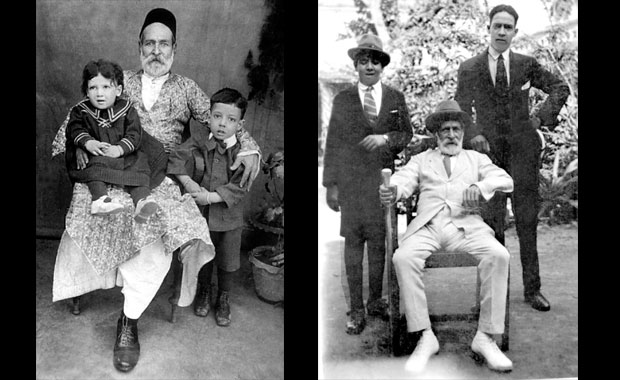
The Jonah family turns sahib. Photo Courtesy: Edmund Jonah
Mr Jonah and his sons show how the Baghdadi Jews quickly picked up British customs as they did business in India. “But he still sits like a Middle Easterner with his legs apart. So I think the transition for some of them was not so smooth,” says Jael Silliman.
Magen David Synagogue. Photo Courtesy: Ashok Sinha
There were three synagogues in Calcutta within walking distance of each other. “We used to roam from one synagogue to another. You told your father I am going to this synagogue this time. Not because you wanted to. But your girlfriend was there. Or you wanted to check out the new girl in town,” says Flower Silliman.
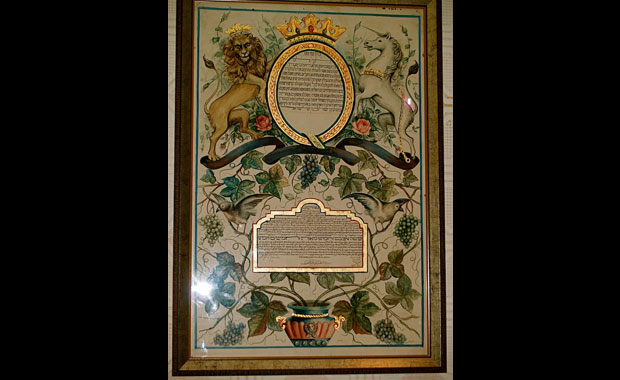
Ketuba or Marriage Contract. Photo Courtesy: JewishCalcutta.in
The elaborate Ketubas are now collector’s items. Jael Silliman was puzzled to be shown a ketuba from Faizabad which was not known to have Jews. But the project put her in touch with the family who owned that ketuba. Their forefather had gone to Faizabad to recruit railway workers for East Africa for the British in 1914. “It was like pieces of a puzzle which came together very neatly,” says Jael Silliman.
source: http://www.firstpost.com / FirstPost.com / Home> F.India> Latest News> India News / by Sandip Roy / September 13th, 2014
Nazrulgeeti exponent Firoza Begum, who was to be honoured with ‘Banga Bibhushan’ by the state government later this month, passed away in Dhaka on Tuesday evening. The 84-year-old was suffering from heart and kidney disease.
“She breathed her last around 8.15pm,” Bangladeshi media reports said. She had been undergoing treatment at the ICU of a private hospital. She was fitted with a pacemaker on Monday.
Mamata Banerjee grieved on social media as the news reached her on Tuesday night. “I am very sad to learn that the legendary Firoza Begum has just breathed her last. Her passing away will certainly create a huge void in the world of music and culture,” she posted.
The CM said her government had planned to confer the state’s highest civilian honour on her. “We had decided to honour her with ‘Banga Bibhusan’. She had also agreed to come to Kolkata to receive the award. But, now it’s all over,” she mourned.
Mamata recounted her last interaction with the legend by saying: “Hardly 10 days ago, we talked to each other. To me, her passing away is indeed a great personal loss. She used to treat me as a member of her family. On the last occasion of our meeting, she told me: ‘Ar ki dekha hobe? (Will we meet again?)’ Today, these words keep ringing in my ears,” the chief minister said.
source: http://www.timesofindia.indiatimes.com / The Times of India / Home> City> Kolkata / TNN / September 10th, 2014
Another feather will shortly be added to the city’s heritage hospitality industry as Astor Hotel opens its doors for guests.
Housed in a building that was a British barracks about a century ago, the hotel has retained the rooms of mismatching size and shape, and ironed out the colonial wrinkles with the precision of 21st Century.
“In its 120-odd years of existence, the interiors of the building never complemented its grand facade. Be it the electrical or plumbing system, it was a completely unplanned structure. A thumb-rule in construction is that a poorly-maintained building must be brought down and built over every 70-80 years,” said the hotel’s proprietor Vikram Puri.
“But with the help of the members of the heritage commission and a team from Delhi that specializes in restoring old havelis of Rajasthan, we managed to preserve the heritage elements of the building.”
Puri said the building used to be a British boarding house where soldiers would come riding on their horses and walk up the stairs to take rest in their rooms.
“What used to be the stable is now a lounge bar called Plush. We restored the same teak staircase the armymen walked up, instead of turning it into an elevator shaft. We retained the rooms with their mismatched dimensions, which gave us perfect material for a boutique hotel. A modern hotel resembles a block diagram, but here every room has a different character,” Puri said.
The guests here will use the same rooms that were once occupied by the army personnel of the imperialists, but the rooms have been fitted with modern facilities such as a big-screen television and air-conditioning.
“The main corridor of the hotel has a distinct Victorian look. But, we will adorn the walls with paintings and photographs of a century-old Kolkata,” Puri added.
To bring down carbon footprint, the hotel has done away with split air-conditioners and geysers and installed central systems. The corridor is not chilled but cool.
“This is not air-conditioned but filled with treated fresh air,” said a member of the hotel’s staff.
High ceiling, a four-poster bed and sepia-tainted lights give the suites the ambience of an era gone by. But water sprinklers, smoke detectors and Wi-Fi devices are a constant reminder of 2014.
source: http://www.timesofindia.indiatimes.com / The Times of India / Home> City> Kolkata / by Shounak Ghosal / September 12th, 2014
Mukherjee was the only Indian-origin author to be longlisted earlier this year.
London:
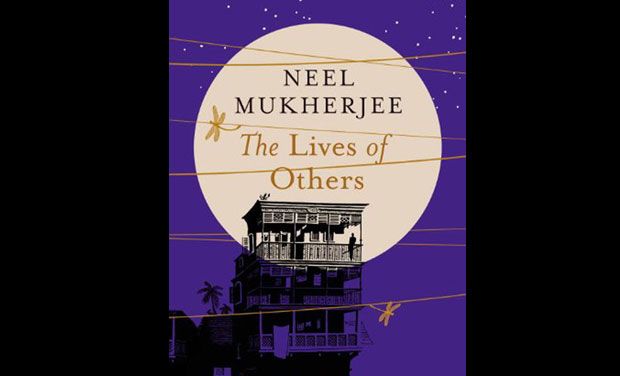
Kolkata-born British author Neel Mukherjee’s latest novel The Lives of Others, set in troubled Bengal of the 1960s and centres around a dysfunctional family, has been shortlisted for the prestigious Booker Prize 2014, in its debut as a global literary award.
Mukherjee, who studied at Oxford and Cambridge, was also the only Indian-origin author to be longlisted earlier this year, the first time the prestigious literary award opened up for anyone writing in English regardless of nationality.
“We are delighted to announce our international shortlist. As the Man Booker Prize expands its borders, these six exceptional books take the reader on journeys around the world, between the UK, New York, Thailand, Italy, Calcutta and times past, present and future,” said A C Grayling, chair of the 2014 judging panel.
“We had a lengthy and intensive debate to whittle the list down to these six. It is a strong, thought-provoking shortlist which we believe demonstrates the wonderful depth and range of contemporary fiction in English,” he added.
Mukherjee, now a British citizen, has been selected for his second novel published in May this year. The book is based in Kolkata and centres around a dysfunctional Ghosh family in the 1960s.
Mukherjee reviews fiction for the Times and the Sunday Telegraph and his first novel, A Life Apart was a joint winner of the Vodafone-Crossword Award in India.
The others on the shortlist include American authors Joshua Ferris for To Rise Again at a Decent Hour and Karen Joy Fowler for We Are All Completely Beside Ourselves; Australian Richard Flanagan for The Narrow Road to the Deep North; and British authors Howard Jacobson for J and Ali Smith for How to be Both.
Previously, the prize was open only to authors from the UK and Commonwealth, Republic of Ireland and Zimbabwe. For the first time in its 46-year history, the 50,000-pound prize has been opened up to writers of any nationality, writing originally in English and published in the UK.
source: http://www.deccanchronicle.com / Deccan Chronicle / Home Lifestyle> Books-Art / PTI / September 09th, 2014
Kunal Banerji at the interactive session. (Anup Bhattacharya)
Kunal Banerji, an associate professor of management at Eastern Michigan University and a St. Xavier’s alumni, addressed students of JD Birla Institute’s management department on quality management.
The management guru dwelled upon the three cornerstones of business excellence — quality, profitability and productivity — at an interactive session organised by the Calcutta Management Association, in association with The Telegraph, on August 29.
He peppered his lecture with topics ranging from compensation and appraisal to use of suggestion systems and continuous improvement efforts to illustrate why it’s important to improve product quality, or how to do it more effectively, in the service sector.
Banerji drew from his Total Quality Management and Business Excellence, a research paper he co-authored with David E. Gundersen and Ravi S. Behara, to answer most of the questions.
He explained how quality is more perceptual than real. “Till a point of time all foreign goods were considered to be of the best quality… that is how our psyche was built. After 1992 (post-liberalisation of the economy), this perception of quality changed.”
On behalf of the CMA, its executive committee member Asok K. Banerjee thanked Banerji for discussing his research extensively with the students. “We had a great audience and a wonderful ambience.”
Banerji said: “It was a mixed crowd and that is always very interesting. Honestly, I didn’t expect such a big crowd. I don’t get such a big crowd in the US, probably because of the population rate.”
J.N. Mukhopadhyaya, the director of the JD Birla Institute’s management department, said he was happy that the seminar turned out well.
source: http://www.telegraphindia.com / The Telegraph, Calcutta / Front Page> Calcutta> Story / by A Staff Reporter / Friday – September 05th, 2014
After being sold at a record price of USD 1,850 (around Rs 1.12 lakh) per kg, Darjeeling’s Makaibari tea estate has become one of the most expensive tea producers in India.
“It is a matter of great pleasure and pride that Indian Tea, Makaibari, has booked orders at a record price of USD 1,850 per kg. That the orders have come from Japan, the UK and the US is also noteworthy,” Tea Board Chairman Siddharth said.
He said at a time when the Tea Board and the tea industry are grappling with the issues of value addition and brand building, this news has come as a shot in the arm.
“Makaibari has been an iconic tea garden and we are very pleased to note that even after its ownership has recently changed hands, the high standard of its quality and recognition has grown further,” Siddharth said.
Darjeeling Tea Association secretary Kaushik Basu said this is the highest ever price he has ever heard of for Indian tea.
“But this is a one off case. We have heard that it was a small sale of around 5 kg. I don’t think it was a commercial sale or auction. It may have been sold on charity,” he said.
Located in Kurseong, Makaibari is the ancestral property of Raja Banerjee who had recently sold off 90 per cent of his stake to Luxmi group.
source: http://www.newindianexpress.com / The New Indian Express / Home> Business> News / by PTI / September 06th, 2014
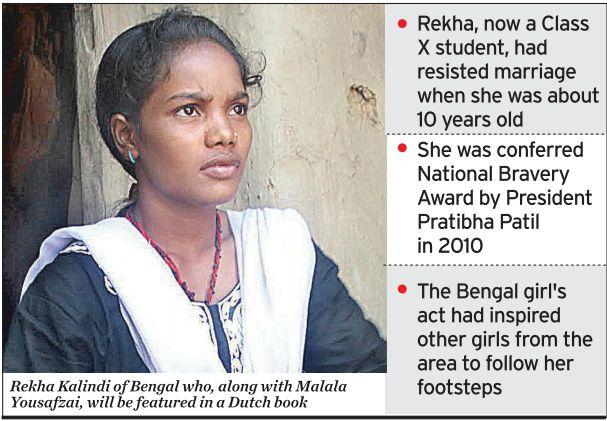
What is common among Malala Yousafzai, Anne Frank, Hellen Keller and 16-year-old Rekha Kalindi from Purulia in West Bengal?
The braveheart from the State will feature along with Malala and Anne Frank in the book Children who changed the world to be released in November in Amsterdam marking the 25th anniversary of the UN Declaration of the Rights of the Child.
Rekha, now a student of Class X, resisted marriage when she was about 10 years old. Her resistance led to other girls in the area following in her footsteps. She, along with two other girls from the district, was conferred the National Bravery Award by then President Pratibha Devisingh Patil in 2010.
The book is written by Dutch Newspaper NRC Handelsblad’scorrespondents who live and work in the countries of the children featured in the book.
It profiles 20 children and the chapter on Rekha is written by journalist Aletta Andre.
Girls inspired
“Rekha’s story fits very well in this theme (the book’s theme), as she resisted a very common but not so great practice in her area, when she was about 10 years old and has with her act inspired other girls to do the same. It shows that very young children, even very young girls in a patriarchal society, have the power to make a difference,” she said in an email response.
Speaking to The Hindu, Rekha said she was very happy that the story about her is being published in other countries. Since the time she and other girls from Purulia had resisted child marriage, many girls came forward to oppose the practice, she said, adding that poverty and lack of education are still resulting in such marriages.
She also pointed out that a Class V textbook of the State Board has a chapter on child marriage where her and another girl’s names feature.
“Such stories (like Rekha’s) encourage adolescents to protest and raise their voice against child marriage,” Asadur Rahaman, chief of field office UNICEF in West Bengal, said. Pointing out that child marriage and trafficking of girls continue to be a concern in States like West Bengal, Mr. Rahaman said that a scheme like Kanyasree providing scholarship to school-going girls is a significant
initiative.
source: http://www.thehindu.com / The Hindu / Home> News> Cities> Kolkata / by Shiv Sahay Singh / Kolkata – August 28th, 2014