Category Archives: World Opinion

Textiles ministry pitches for GI tag for more Bengali sarees

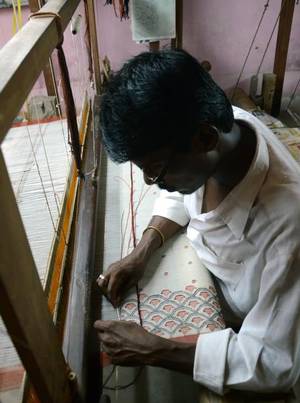
The Bengali Jamdani does not have a GI tag yet. Here, a weaver at the pit loom works on a Jamdani print at a factory in Kana, West Bengal. File photo. | Photo Credit: Sushanta Patronobish

So far, only three types of sarees from West Bengal — Baluchari, Santipur and Dhaniakhali have obtained the GI tags.

The textiles committee of the Union Ministry of Textiles has asked the various weaving communities of West Bengal to apply for the Geographical Indication (GI) tag for Intellectual Property Rights (IPR) protection.

So far, only three types of sarees from West Bengal — Baluchari, Santipur and Dhaniakhali have obtained the GI tags.

“We are asking the different weaving communities of West Bengal to go for GI registration. Some of them are the weavers of Bengali Jamdani, Begumpuri and Bengali Tangail sarees which have huge export markets,” deputy director of the Textiles Committee of the textiles ministry T.K. Rout told PTI.

The weavers of scarves and stoles of Fulia should also apply for GI registration, he said.

Mr. Rout said that once these weaving communities get the GI tag, their IPR would be protected and legal action could be initiated against those who were not bonafide claimaints of these textile products. “Even the export markets of these products would be protected,” he said.

“GI is IPR which provides protection to the products which have origins in a particular geographical location and different from patents and trademarks,” Mr. Rout added

It also gives protection to those weaving communities from counterfeit claims by others, he said adding that the ministry was working to facilitate this process.

As of date, 270 products of the country had been registered under the GI Act, out of which 151 of those belong to the textiles and handicrafts segment.

source: http://www.thehindu.com / The Hindu / Home> News> Cities> Kolkata / by PTI / Kolkata – March 16th, 2018

Shooting silver and a promise to ‘sir’

Coach relives olympic medal miss in ward’s Commonwealth shoot-off

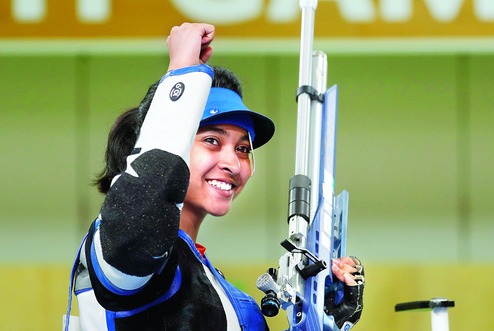
Mehuli Ghosh after shooting a bullseye to tie with the eventual winner, Martina Lindsay Veloso of Singapore. (Reuters)

Calcutta:

The shot at gold in the women’s 10m air rifle event at the Commonwealth Games was down to two competitors. Martina Lindsay Veloso of Singapore had just scored 10.4 in her final shot and nothing less than a bullseye would give her rival a chance. Mehuli Ghosh hit exactly that: a 10.9.

The crowd erupted as Mehuli pumped a fist, kept her rifle down, took off her blinder and stepped back from her position. Thousands of miles away, in New Town, her coach Joydeep Karmakar yelled at the TV: ” Hoyni (It’s not over)!”

Martina and Mehuli were tied at 247.2, a new Games record, and the gold was to be decided by a shoot-off.

Joydeep, who himself missed an Olympic medal at the London Games by a whisker, knew it would be tough for his ward. “It’s not easy to quickly regain position. The body has to be aligned with the target and weight distributed between outstretched legs for perfect balance. This is achieved over several shots,” he told Metro within minutes of Mehuli finishing second.

When she called, the first word Mehuli uttered to her coach was “sorry”.

“She told me, ‘ Jani tumi rege gyachho (I know you are upset)’. I told her I was about to break the TV,” Joydeep said.

Mehuli had been misled by her name overtaking Martina’s on the scoreboard. “She missed the rank ‘1’ against both names and the term ‘s-off’ to the right,” Joydeep said.

Mehuli scored 9.9 to Martina’s 10.3 in the shoot-off. “If only I were there, I would have shouted out to her about the tie,” the disappointed coach said.

But he had regained his composure quickly enough not to make his ward feel any more miserable about missing the gold. “What happened was because of inexperience. She is just 17. Girls her age chat and have fun after school while she is hard at practice,” he said. “Mehuli has promised me she will make up for the loss.”

As the nation woke up to the Baidyabati girl’s feat, mother Mitali spoke of the two-hour journey, with four changes of transport, she makes almost daily to reach Joydeep’s academy at The Newtown School.

“This has been her routine since she was 14,” she said.

To let her focus on shooting, Mitali had even allowed her daughter to skip the board exam this year.

source: http://www.telegraphindia.com / The Telegraph,Calcutta,India / Home> Calcutta / by Sudeshna Banerjee / April 10th, 2018

Leander Paes — Timeless wonder

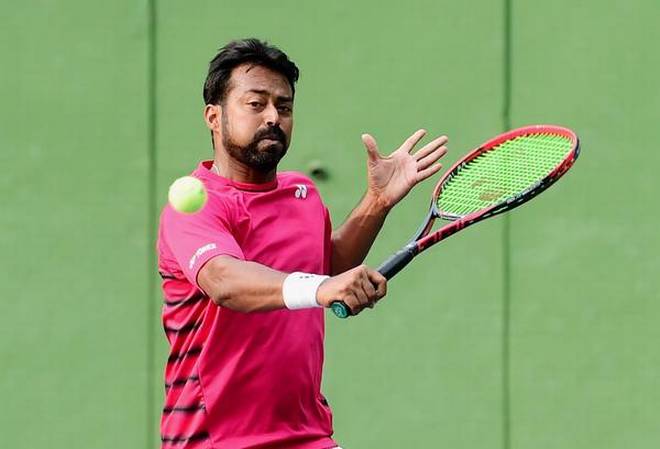
Leander Paes. | Photo Credit: PTI

A look at the career highs of Leander Paes.

1990: Starts his Davis Cup career at the age of 16, with Zeeshan Ali his first doubles partner.

1991: Wins junior titles at the US Open and Wimbledon to become Junior World number 1.

1995: Ranked No. 130, manages to beat World No.7 Goran Ivanisevic in a five-setter on grass in the Davis Cup.

1996: At the Atlanta Olympics, beats Fernando Meligeni to win India’s first individual bronze in 44 years.

1998: Bags the Newport ATP title and beats Pete Sampras at New Haven.

1999: Along with Mahesh Bhupathi reaches the finals of all four Grand Slams, winning Wimbledon and French Open. Reaches the No.1 ranking in doubles.

2000: Given the honour of carrying the Indian flag at the Sydney Olympics.

2003: Wins the mixed doubles events at the Australian Open and Wimbledon partnering the legendary Martina Navratilova.

2006: Leads the Indian tennis contingent at the Doha Asian Games. Bags two golds with Mahesh Bhupathi and Sania Mirza.

2013: Clinches the US Open doubles title with Radek Stepanek to become the oldest male Grand Slam winner at 40. Bestowed the country’s third-highest civilian award, the Padma Bhushan.

2016: Secures his 42nd Davis Cup doubles win (partner Rohan Bopanna) with a victory over South Korea. Ties with Italian Nicola Pietrangeli for the all-time record.

2018: Claims a record-breaking 43rd Davis Cup doubles win in the Asia Oceania Group I tie against China. Paes also has the most number of wins (doubles and singles combined) among active players at 91.

source: http://www.thehindu.com / The Hindu / Home> Sport> Tennis / April 08th, 2018

Chess competition with peace as top prize

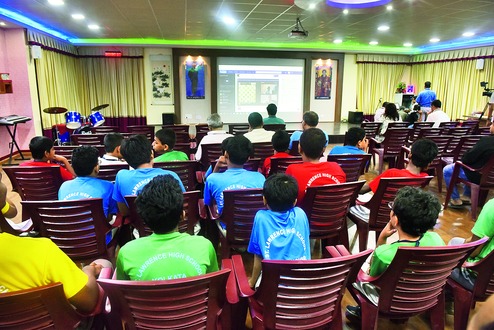
The exhibition match at St Lawrence School on Friday. Picture by Sanjoy Chattopadhyaya

Ballygunge:

An online chess challenge for students of Jesuit schools across four continents was launched at St Lawrence School on Friday with a face-off between two grandmasters and a grand prize to checkmate all prizes: global peace.

Around 20 students from schools in the US, Europe and South America have already registered for the event, scheduled to start in mid-April.

The tournament, called Chess ‘n’ Mate, will be played in a league format with each player guaranteed more than one match. The draw will be such that players from countries that traditionally have had strained relations will be clubbed together so that they get to know each other and become friends.

“What happens after the game is just as important as competing. There will be the usual prizes for the winners of the tournament, of course, but what sets us apart is the concept. Competitors will have to coin slogans after each match and the five best lines on the theme “Peace through sport” will be rewarded,” said Rahul Mukherji of the St Lawrence Old Boys’ Association, which is organising the tournament in collaboration with the school.

Jesuits are members of the Society of Jesus, a Roman Catholic order of priests founded by St Ignatius Loyola, St Francis Xavier and others in 1534. They run schools in 160 countries.

The three exhibition matches on Friday were between Grandmaster and former women’s world champion, Alexandra Kosteniuk, who was in Paris, and Grandmaster Dibyendu Barua, who made his moves sitting inside the Fr Wavreil Hall at St Lawrence School.

Barua won one of the matches and Kosteniuk the other two.

The matches were streamed live and the recording would be used to promote the online tournament.

Speaking on Skype later, Kosteniuk, who is an ambassador for an organisation called Peace and Sport, told the students to spread the word. “Let’s work towards a day when there are no wars… Battles should be fought only on the chessboard,” she said.

Students from Lithuania, Brazil, the US, Albania, Spain and India have registered for the challenge.

source: http://www.telegraphindia.com / The Telegraph,Calcutta,India / Home> Calcutta / by Rith Basu / April 07th, 2018

Kolkata girl nominated for global sci-fi award

Kolkata :

Writer, editor and Jadavpur University alumna Mimi Mondal has been nominated for the 2018 Hugo Awards for co-editing her first science fiction book — the anthology ‘Luminescent Threads’. The 30-year-old, who hails from Kolkata,is the first from the city to be nominated for the top honour in science fiction. Previous Hugo nominees include names like Arthur C Clarke, Isaac Asimov and Neil Gaiman. Her fellow nominee in the Best Related Works category is the late Ursula K Le Guin.

“I am not an outlier genius. I am completely homegrown and following the path of my elders. Growing up in Kolkata, I read very little purely generic science fiction. And honestly, I taught myself English from a dictionary so I didn’t see people like myself in the worlds written by white, male writers. What I did grow up reading, and this is where we Bengalis have an advantage, was a lot of Dakshinaranjan Mitra Majumdar, Satyajit Ray, Premendra Mitra, Rabindranath Tagore, Narayan Gangopadhyay, Lila Majumdar and Sunil Gangopadhyay… I read them all,” says Mondal, who lives in New York now.

The writer in her emerged in her teens when Mondal studied at Nava Nalanda and then at Calcutta International School. Mondal’s inner editor is unforgiving of her earliest poetry, which she says was ‘of a somewhat middling quality’. “Then I discovered Marquez and Rushdie and Kolkata writer Samit Basu. These completely blew open my mind,” she said.

“I come from a background which made every success in life feel like a little ‘whoop’ to me because nobody in my family had done anything like that. I felt like that when I got into the English department of Jadavpur University in 2007. I don’t think I have stopped,” she says.

Mondal was the Octavia Butler Memorial Scholar at science fiction writing workshop Clarion West in 2015. In strange poetic justice, it is Octavia Butler to whom Mondal’s co-edited anthology pays tribute. “Butler was a number of firsts — the first major African American, queer, woman author of the genre. ‘Luminescent Threads’ is a book about celebrating the triumph of diversity,” Mondal says.

Diversity and inclusion of diverse people remain the writer’s chief concern. Mondal finds herself asserting her Dalit identity to a Western readership “which does not even know what Dalit means”. “I didn’t write from a Dalit sensibility until a few months ago. I am still teaching myself the process. I represent my community by declaring I am Dalit in my author bios and everywhere else.”

source: http://www.timesofindia.indiatimes.com / The Times of India / News> City News> Kolkata News / TNN / April 06th, 2018

Architect helps crack conservation code

Calcutta:

A young architect working on heritage structures in Chandernagore busted several myths about conservation of old buildings at a lecture at the Indian Museum on Wednesday afternoon.

“Conservation is no rocket science. It is far from a Nasa code that can’t be cracked,” said Aishwarya Tipnis.

An alumnus of the School of Planning and Architecture in New Delhi, Tipnis won the Chevalier des Artes et des Lettres, France’s top cultural award, this January for her “outstanding commitment” to the preservation of French heritage in Chandernagore, where she has been working for eight years.

The 37-year-old debunked the common perception that conservation is opposed to development, stressing that it is in fact a part of it.

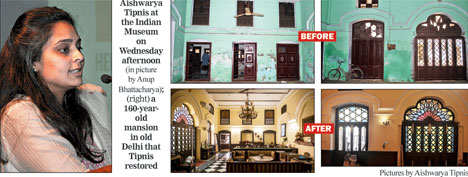
The lecture, titled Why Does Heritage Conservation Even Matter To Anyone, took the audience through a presentation that told the story of Tipnis’s first big project – the restoration of a 160-year-old mansion in old Delhi, which started in 2010.

The current owner of Seth Ram Lal Khemka Haveli at Kashmere Gate in Shahjahanabad, Deoki Nandan Bagla, wanted to spruce up the house before his sons’ marriage. The three-storeyed house had been home to Bagla’s grandparents since 1920. Lack of renovation had created large cracks on floors and walls and several doors and windows were missing.

It was one of the first private conservation projects in the capital and went on to become a torchbearer for conservation of several old mansions. But the journey wasn’t smooth. The first challenge came from the client himself. Bagla wanted to turn it into a contemporary home. “What is restoration? Make the haveli modern,” he told Tipnis.

But Tipnis managed to convince him that compromising on the house’s principle architectural and aesthetic values was not a smart choice. “I told him everybody had a fancy home. But a palatial mansion was rare. He could show it off as a status symbol to the families of prospective brides.”

The finer details of the conservation were not as important to Bagla as his family’s pride. The point Tipnis drove home was that “architects have to get off their high horses” and connect with people.

One of the key aspects of traditional architecture was lime mortar plastering instead of cement. It led to setting up a lime mortar chukki in the courtyard of the mansion. After several failed experiments – with everything from urad dal and gur to methi seeds – a traditional lime plaster was ready to be caked on the walls.

The project also proved that conservation did not need to be an extremely expensive affair and jugaad could go a long way in bringing down the costs. Instead of using imported beams, Tipnis and her team used stainless steel beams made in Bagla’s factory.

The main lesson of the project was that heritage must continue to be relevant for conservation. “The day it loses relevance, no amount of legislation can preserve it,” said Tipnis.

source: http://www.telegraphindia.com / The Telegraph,Calcutta,India / Home> Calcutta / by Debraj Mitra / April 05th, 2018

Former ZSI director passes away at 81

Kolkata :

Former director of Zoological Survey of India (ZSI) Asish Kumar Ghosh passed away on Monday morning at the age of 81. He was battling throat cancer.

The first Environment Monitoring Wing in ZSI (Kolkata and Chennai) was started under his leadership in the early 1980s. Ghosh was also the founder-director of Centre for Environment & Development in Kolkata, which conducted several seminal studies on the city’s environment.

A Fulbright scholar and Rockefeller Foundation grantee, Ghosh studied in University of Calcutta and University of Wisconsin, Madison, USA. He had written extensively on biodiversity conservation, natural resource management, and on environment and development. Between 1992 and 1996, Ghosh led the Indian delegation to Ramsar Convention on international wetlands in Japan, besides representing the country in several other international meets.

Ghosh also served as guest faculty in many reputed institutes. He had mentored many environment scientists and environmentalists.

Environmental activist Bonani Kakkar said, “Ghosh had the courage to submit an affidavit supporting the public in the wetlands case while still in office. His death is a terrible loss to those who care for our environment and the city.”

source: http://www.timesofindia.indiatimes.com / The Times of India / News> City News> Kolkata News / TNN / April 03rd, 2018

There’s Didi. There’s Dada. Between them, there’s a Ditch

Bengal has talented sportswomen aplenty but why is they do not have their deserved place on the sporting map of India? Moumita Chaudhuri goes looking for answers
.
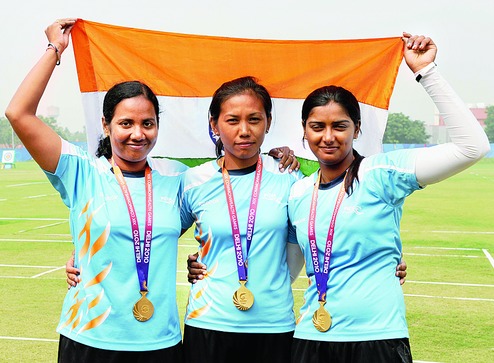
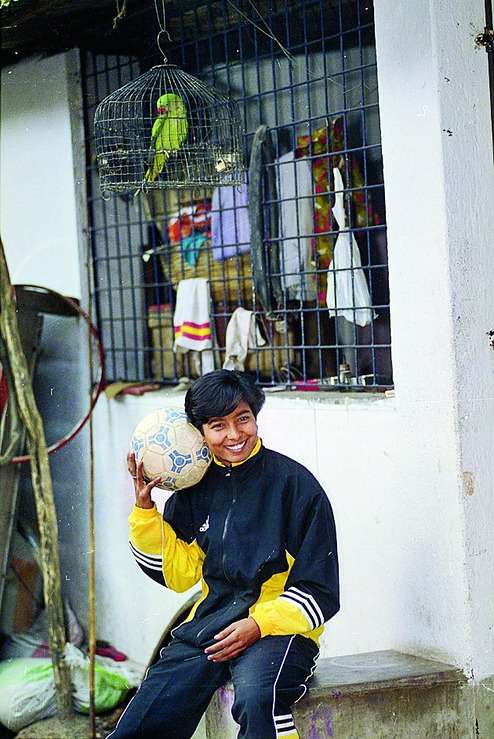
FOULED: (From top) Archer Dola Banerjee (left) with Bombayla Devi Laishram and Deepika Kumari after winning gold in the 2010 Commonwealth Games; a file picture of current football coach Sujata Kar; Kar’s ward Rojina Khatun

A 17-year-old was returning from a neighbourhood function with her mother when they stopped at a grocery shop. The small television set was telecasting a weightlifting competition. Mother and daughter watched a young woman struggling to lift a bar with weights on either side. As other bystanders watched in awe and cheered, the mother wondered what the big deal was. After all, her daughter would routinely lift heavy sacks of grain by way of running errands for their neighbours in Habibpur village of Bengal’s Nadia district. “Some of the elderly people would ask me to lug a sack or two to the storeroom on the second or third floor for a rupee or two. Sometimes they would shoo me away after the work was done,” says Rakhi Halder, weightlifter from Bengal.

Egged on by her mother, Rakhi signed up for formal training at the local club – a single-storey structure with a big hall, some equipment and a tin roof. She says, “They had a couple of weights and the only ones who ever practised were men.” When the trainer asked her to lift a 40-kilo weight, she did so effortlessly. And that is how, within five days of signing up as a weightlifter, when she could barely tell a “clean and jerk” from a “snatch”, Rakhi participated in a state-level competition and won it too. A year later, in 2012, she won the Oceania Commonwealth Junior Championship in Australia.

Since then, Rakhi has gone on to break Karnam Malleswari’s record in the 33rd Women’s Senior National Weightlifting Championships in Mangalore, Karnataka. She had trained to participate in the Commonwealth Games in Gold Coast, Australia, that begin this week, but owing to some procedural issues was not selected. She now has her hopes pinned on the 2018 Asian Games scheduled for September in Jakarta.

But the larger dream she nurtures is to train at least six students before she retires from the sport. As of now, she has one student who has won a gold medal at the 2017 state-level meet. Rakhi and her husband – he is also her coach – Naveen Kumar, are currently employed as Group C staff with the Eastern Railways. They dip into their earnings for Rakhi’s training as well as that of her student. She says impassionedly, “I want weightlifting to stay alive in Bengal.”

Bengal’s sportswomen have always done her proud, be it in swimming, table tennis, football, archery, volleyball or cricket. Bula Chowdhury crossed the English Channel in 1989, Dola Banerjee has a world record in archery, Sujata Kar played in the Indian football team, Poulomi Ghatak is creating new records in table tennis, Mehuli Ghosh just won two bronzes at the ISSF World Cup… But there is a common refrain – the state government has done very little for its sportswomen in terms of infrastructure, funding and support. In fact, they have, most often than not, owed their sporting success to their peculiar life situations and a history of hardship.

But post success, after travelling the country and a fair bit of the world, these women have realised that there is no merit in waiting around for more such happy accidents. To raise generations of sporting talent, there must be a plan and there must be investment – emotional, physical and financial.

We are at Rakhi’s two-room Railways quarters discussing all this. The living room has been converted into her practice area. The bar and weights are kept in neat stacks, the floor mats are spread out evenly and on one side is a single bed. It is her day off and she has been trying her hand at making idlis – her husband, who is from Telangana, has taught her how to.

Rakhi continues her tale. She was strong and sturdy from childhood. “I’d sometimes plough the field with my father, pick up a calf in my arms and cuddle it. I did not find physical labour exhausting,” she says. When her mother took her for formal training to the village club, she went without boots or belt.

“At that time we had no money. My father had been in coma for two years and my mother was working as a domestic help. The trainer at the club was too kind to ask me to pay an admission fee. He told me I could pay Rs 51 as guru dakshina whenever I could afford it,” says Rakhi.

Indeed. That a lot of Bengal’s sporting talent at all makes it to the big arena owes itself to individual goodwill.

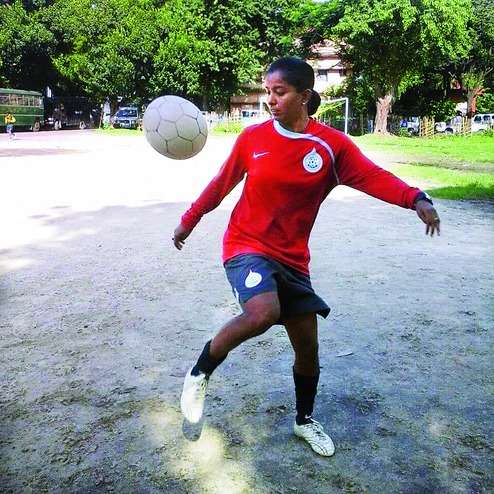
Former captain of the Indian women’s football team, Sujata Kar, has a day job with the West Bengal Police but she is now a full-time coach. When we enter her fourth-floor flat at the police quarters in south Calcutta, she is sitting on the floor applying ice pack on the foot of a young woman in jersey and shorts. Two others of the same age come out from one of the bedrooms. Rojina Khatun, Barnali Tara and Devlina Roy are all Sujata’s students and live with her right through the football season. Most of them are from interior Bengal and come from impoverished families. Rojina’s father used to work in a jute mill before it shut down. Devlina’s father is a farmer. Barnali’s father is a vendor, he sells bananas. Says Sujata, “They cannot do the daily commute and play – it is exhausting. I take care of their diet. My mother cooks for them.”

Sujata herself had to struggle much before she could play. She was 15 when she convinced her father, an odd jobs man, to allow her to play football. She had borrowed a jersey and shorts from her brother who was a footballer himself but had to give it up after he suffered an irreversible injury. “My mother sold our brass gamla, or tub, to buy me a pair of boots,” she says.

Her father gave her a month to prove herself. “I used to walk down from my home in Kalikapur to the Jadavpur University football ground – five kilometres – and at times to the Sirity football ground near Tollygunge – another 10 kilometres – for practice. I could not afford to pay the Rs 2 bus fare every day.” It is this empathy that seems to fuel her deep investment and engagement with these young footballers.

She tells us that football holds little future for women. “East Bengal and Mohun Bagan dissolved their women’s teams in 2008. Right now, all they have is the I-League. Match fee is Rs 5,000 per person, which is neither here nor there. What about the future of these girls?”

Former cricketer with Team India and currently Bengal’s minister of state for sports, Laxmi Ratan Shukla, lists all that has been done to encourage sportswomen in the state. He talks about an archery academy in Jhargram, cricket academies, swimming clubs… He says, “We have given Rs 5 lakh to local associations who prepare players for the Olympics. Another Rs 2 lakh has been given to the sporting clubs for development of infrastructure.”

That brings to mind something Olympic gold medal winner Abhinav Bindra once tweeted. He said, “Each medal costs the UK £5.5 million (Rs 46 crore). That’s the sort of investment needed. Let’s not expect much until we put systems in place at home.” That was in 2016.

Swimmer Bula Chowdhury knows full well there are things closer home that are more difficult to achieve. She has not been able to open a swimming academy to date. ” Kono support nei… There is no support,” she says, then adds, “Maharashtra, Kerala and West Bengal used to dominate swimming competitions, but now it is Bangalore. It has the best infrastructure in the country to train swimmers. But we have not graduated beyond those ponds that existed when we trained in the 1970s.”

What Dola says about archers is not very different from Bula’s account. According to her, while international level recurve sets start at Rs 1.5 lakh, many archers in Bengal practise with bamboo bow and arrows even today. There are about three to four archery clubs but none is in good condition. The then bleeds into the now. It seems to matter less what time or what sport we are talking about. The sense is, if it is Bengal, then someone has pressed the pause button on sports.

Sujata is realistic, hopes her students will at least land a job in the sports quota. But who’s to explain to the young ‘uns that their fledgling passion in all likelihood won’t ever find a bigger playing field?

“I want to play,” says Rojina. “I want to play before the whole world.”

source: http://www.telegraphindia.com / The Telegraph,Calcutta,India / Home> West Bengal / Moumita Chaudhuri / April 01st, 2018
Antarctica scholar was from Purulia

Purulia:

A Purulia youth engaged in researching Antartica’s climate died at the world’s southern tip.

Suvojit Sen (23) was part of the 37th Indian Scientific Expedition to Antartica, a project his family said sees few applicants owing to the risks it involves.

Brother Subhankar was informed of his death on March 27; the family is unaware of when his body will reach them.

Goa-based National Centre for Antarctic and Ocean Research (NCAOR), where Suvojit was employed, said in a release: “He met with an accident during convoy operations at Ice Shelf and suffered major trauma late March 26. He was immediately rushed towards the expedition vessel and doctors joined with medical help. Unfortunately, attempts to revive him went in vain.”

The convoy operation was heading from the Indian Research Base, Maitri, to Ice Shelf, a distance of approximately 80 km.

Subhankar finally told father Dilip Sen and mother Mukta of Suvojit’s death on Thursday. They were shell-shocked and unable to speak when TOI visited their home in Purulia’s Dulmi-Nadhia locality.

Suvojit graduated from JK College in Purulia. His outstanding Geology scores in 2014 helped him get into IIT Bhubaneswar for his Masters.

Suvojit applied for the 37th ISEA project last year and was selected. He left home on October 19, 2017.

Subhankar said: “Suvojit would call us from Antartica regularly and tell us of his experiences amid ice and snow. He was very happy with his work and the opportunity to have a unique experience so early in his career. Suvojit was staying with his colleagues at a base camp named Maitri. He would tell us it felt like being in a completely different world.”

The family said that during his last call on March 24, Suvojit said his project was nearing completion and that he would be returning home before his 24th birthday on April 13 and be around for Subhankar’s wedding on April 26.

source: http://www.timesofindia.indiatimes.com / The Times of India / Home> News> City News> Kolkata News / TNN / March 30th, 2018

Calcutta boy Ramit Tandon is fast climbing up the squash charts

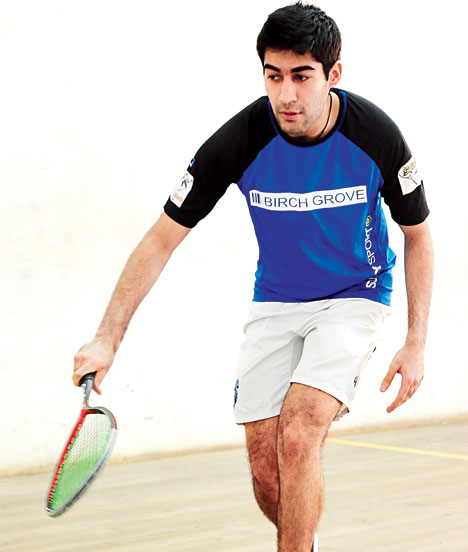
Ramit Tandon at The Saturday Club. Picture: Arnab Mondal

There is something earnest about Ramit Tandon that strikes you instantly. Genial, confident and candid, the 25-year-old started playing squash full-time in September last year and has quickly moved up to become world number 65. Before he left for a training camp to Chennai ahead of the Commonwealth Games next month, t2 caught up with the boy from Lord Sinha Road.

How excited are you about the Commonwealth Games?

I am not feeling the butterflies yet! Once I get to the village and I see the other athletes… maybe then it will hit me. I haven’t processed the thought of being in Australia. I am happy to be home for 10 days with my family. The last week or so, I have been pushing myself hard. Also, squash is such an individual sport, you always enjoy being part of a team. That energy, where you have other people supporting you, means more than being on your own. I am trying not to stress too much. Of course, we will give our best. It is the biggest event for us this year.

When did you start playing squash?

My dad (Raman Tandon, The Saturday Club president) used to play squash. So, I followed him to the club and slowly got interested. By the time I was eight or nine, I started playing.

What’s great about the game?

Well, now my life revolves around squash. The last 10-15 years have been only squash. It’s been a big part of my life. The reason I like it is, it’s fast… in an hour you know the result. It’s a lot of fast thinking. My personality is similar. It’s taught me a lot of life lessons. There are so many different aspects of the game that have to be right to get to the end result.

Take us through your career till now…

I was a top-ranked junior in India from 2010-2012. I moved to the US for my education and graduated from Columbia University, with statistics. I was one of the best college squash players over there. At that point I wasn’t sure if I would play professionally because it is a hard sport to jump into. Cricket and tennis were more out there, more popular. It was a risk and I wanted to hedge myself before taking a risk. I felt I needed to finish my education first.
I worked in finance in New York for two years. Hedge fund job vs professional squash player… pick one… it’s a no-brainer. I mean I really wanted to play squash, but also I wanted to experience the work environment. While I worked there, I kept playing in a few tournaments here and there and got a few good results. The people I met at the hedge fund, like my CEO, were very supportive of my decision to go give it a shot. So, September 2017 I decided that I was going to start playing full-time. I am based in New York and Calcutta and I shuttle. I started off as 400 or something in the world and now I am 65.

Wow!

I have the belief. I am happy about the fact that I moved so quickly. When you start doing something full-time, there is a different sort of pressure to it. It’s hard when you’ve been sitting at the desk for two years crunching numbers.

What was the turning point?

So, Ali Farag, who is the current world number three, I beat him in a tournament in the US while working. I was ranked almost 500 in the world.

I would train quite a bit during the weekends and about three times during the week. Ramy Ashour, who is like the Roger Federer of squash, moved to New York and we became very close and we would train together on a daily basis. When I started working, I would train three-four times a week with him. Training with him gave me a lot of confidence. I think he was a big reason I was able to maintain my game while working.

People started talking after I beat Ali Farag. The buzz around me… people at work would be like… ‘Why don’t you go and play?’ But for me, it was very risky. Also, you are more comfortable on court when you know you have a job and you are not worried about winning or losing… you don’t have to worry about paying rent. I enjoyed that mindset. But then a lot of people around me started telling me… and I started to believe in it as well. I had a few more events which went well.
Then in a game, I lost to this guy who was among the top 20 in the world. I lost to him in five games. That’s when I realised that I was losing out on match experience. I was playing one or two tournaments a year, which wasn’t enough to compete at that level. I was enjoying my job, but I realised that squash gave me more happiness.

How has life changed?

It’s been a change of lifestyle for me. From sitting at my desk for eight to 10 hours a day to hitting the gym in the morning… then squash… then fitness again.

So, a much healthier lifestyle…

I don’t think it’s healthy (smiles). People think an athlete’s life is very healthy, it is not. It’s torture for the body. I can sense it… when I am hating the work I am doing, the tournaments go well after that. If I am enjoying the preparations and not pushing myself hard enough, my tournament doesn’t go well. In six months, I have realised that. We overdo it for sure and you need to because the competition is so high.

A lot of the hard training is based around the physical stuff and that’s the hard part. At night you are sleepless because you’ve been through so much. If you are a professional, there is no day off. At this level, no coach can tell you X amount of work is ideal for you. As a player, you’ve got to figure it out… how hard you can be pushed, when you need to slow down.

In the first phase, I went for a lot of tournaments where I overdid it. I realised I wasn’t as fresh as I should be. Sometimes, I didn’t train that hard. It’s all about finding that balance. In matches too, it is a fine line… when to be aggressive, when to stay calm. I am still learning every day. The first few months was just about finding a routine. Now, I think I have just stabilised into a routine. The challenge has been to get used to all the physical work, the travelling and finding the exact balance… which I am still figuring out.

What is your workout routine like?

I play for about a couple of hours in the morning, followed by a fitness session… could be gym or sprinting for another hour or two hours. Gym is at The Saturday Club… I work with Anwar Wahhab. He has been with me since I was eight or nine. By the time I am out, it is 1pm-2pm. Then it is time for lunch and then I am back training around 4pm. In the evening it is mostly skill and then maybe a relaxation session… swimming. I am back home by 8pm-8.30pm.

You need a strong core to prevent injuries. My sport requires a lot of speed and agility. It is all about developing strength without getting too bulky. For me, it is a lot of leg work and a lot of core work. I do sprinting sessions for the cardio. I do agility and footwork sessions for the quick turnings. I enjoy this the most. I do swimming mostly as recovery and cardio.

Have you picked up anything from Ramy Ashour?

He is very unique. Most of it is the mental side. I want to go into a match feeling how you go to office. On match days, I still wake up feeling it is an event, a festival. And that is never good.

What is your bigger goal?

By this year end, I would like to get into the 30s. I am happy with the progress so far. I feel I can still do better.

So, you are not easily happy?

I am not. I don’t know if it is a good thing or a bad thing. (Smiles)

KNOW RAMIT

Joined PSA World Tour in September 2017
Current world rank: 65
Was the ‘top male player’ of the Indian team that finished 2nd at the U-21 World Cup in 2012
Won 2 PSA world titles in 2017
Won 6 junior national titles
Captain, Indian junior team (2010-2012)
Asian Junior team championship winner and individual championship runner-up
I unwind: By following the markets!
Music fave: Marshmello.
Fave actors: Shah Rukh Khan, Leonardo DiCaprio.
Fave actress: Deepika Padukone, and Alia Bhatt because she watched my match in Bombay.

source: http://www.telegraphindia.com / The Telegraph,Calcutta,India / Home> Lifestyle / by Saionee Chakraborty / March 27th, 2018