Category Archives: Records, All

Films speak a universal language: Bengali director whose Malayalam film made it to Cannes market

After three silent films, Bengali filmmaker Aneek Chaudhuri has helmed a Malayalam film — a first for someone from Bengal. The film is now part of Cannes 2020 and will be screened later this month.
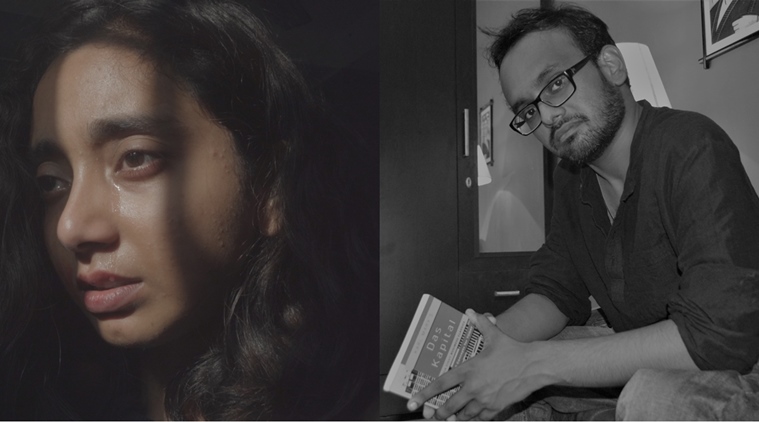
Aneek Choudhuri’s Malayalam film Katti Nrittam is part of the Cannes Film Festival 2020 lineup.

Art transcends barriers. So, it should come as no surprise when a Bengali decides to make a film in Malayalam. However, for Kolkata-based filmmaker Aneek Chaudhuri — whose Malayalam film Katti Nrittam is part of the Marché du Film at the Cannes Film Festival 2020 — it’s the one question he gets asked all the time.

“Films speak a universal language,” said Chaudhuri, 28. It’s a fitting answer from someone who first forayed into cinema with silent films. A film in Malayalam then — a language he doesn’t speak himself — is a natural progression. “I believe that cinema should not have any kind of language barrier,” he said.

Katti Nrittam — a thriller about a failed Kathakali dancer who turns into a psychopathic killer — made a mark earlier too, when its script was included in OSCARS’ Margaret Herrick Library in California— regarded as one of the finest film-related libraries in the world.

In its 73rd edition, the Cannes Film Festival, which is scrapping its physical event for a series of virtual screenings on account of the COVID-19 pandemic, will launch the Marché du Film or the festival’s Film Market online to support industry professionals around the globe. Katti Nrittam is one among the many being screened during the five-day virtual event between June 22 and 26.

Chaudhuri’s previous films — The Wife’s Letter (2016), White (2018), and Cactus (2018) — were also screened at Cannes. However, it is for the first time he won’t be there in Paris to present his film.

First Malayalam film from Bengal

While Katti Nrittam, meaning the Knife Dance, is a modern-day adaptation of ‘The Mahabharata’, the film also draws inspiration from O. Henry’s short story ‘The Cactus’ (1902).

Starring Rahul Sreenivasan, Rukmini Sircar, Sabuj Bardhhan, Anuska Chakraborty and Aritra Sengupta in major roles — it’s the first Malayalam film by someone from Bengal.

“Malayalam Cinema is indeed the best form of Indian Cinema these days,” said Chaudhuri, explaining his choice of language in an email interview. “They have found a way to integrate mainstream and parallel cinema.” However, it was his trip to Kerala’s Kalamandalam in 2018 that further sparked his interest in Malayalam arts and culture.

(Read this story in Malayalam)

The film, which took almost a year to finish as Chaudhuri started to work on the script in early 2019, was primarily shot in Kolkata. The only difficulty was finding locations that resemble Kerala closely. So would it not have been easier to shoot in Kerala itself then? “Yes I could have but that would mean I need to drop out a lot of technicians from Calcutta without whom I cannot work. They wait for me to make a film so that they can work in terms of creative liberty I provide them,” he said.

A modern day Mahabharata

In Katti Nrittam, Chaudhuri uses the graceful Kathakali dance of Kerala to articulate a story of violence. “When I had decided to adapt Mahabharata on-screen, I had to make the killings classy and beautiful and I thought of nothing but this dance form,” he said.

In the film, Arjuna is portrayed through a Kathakali dancer. “After studying the patterns of murderers like Ted Bundy, I believe that for them, killing was a form of art,” said Chaudhuri, “We had to beautify the process of killing.”

In his modern-day interpretation of the epic, Chaudhuri tries to do what otherwise is a taboo: highlight the darker sides of the divine. Answering if the epic — which he dubbed one-dimensional — is still relevant, he said, “Sometimes the interpretation of an epic is directly proportional to the times we are living in.”

‘People expect a change’
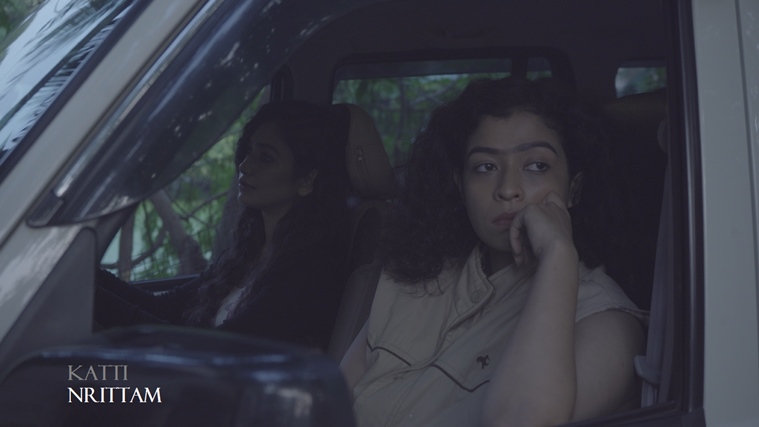
Katti Nrittam is expected to have a commercial release in 2020.

Winning many accolades and awards in the last couple of years, Chaudhuri’s films often put women at the centre. His last directorial work Cactus portrayed Jesus Christ as a woman and White was a poignant silent film about rape.

Katti Nrittam is no different: while the film narrates a complex tale of a quadrilateral love based on Henry’s novel, the gender roles have been reversed.

Talking about his women-centric films, the filmmaker, admitted that he is inspired “a lot” by women. “I would try to look out for feminist dimensions in every character I read or create, because women are so damn interesting,” he said, “They can do everything and that too, successfully. And I strongly believe that the world was created from a woman’s point of view that’s why we are still safe; they are the most able and organised people, I must say.”

Chaudhuri’s film has been received positively in Kerala — “But back home, people think that I am in too much of a hurry,” he said.

“In Bengal, you don’t get the space to film alternative stuff. People might be in the legacy of auteur, but most of them in the current scenario are not original and inclined toward earning rather than creating. Now, that is alarming, isn’t it?” said Chaudhuri.

However, it is in his audiences that he has hope. While Katti Nrittam is expected to have a commercial release in 2020, Chaudhuri has spent the lockdown working on a feature-length film titled The Symphony of Pansies with a Lebanese artist Stephanie Bou Chedid. “And if all goes well, something big in 2021,” he said, without divulging further details. “People expect a change.”

source: http://www.indianexpress.com / The Indian Express / Home> Entertainment> Malayalam / by Shreya Das / June 03rd, 2020
Calcutta University’s digital collection goes online

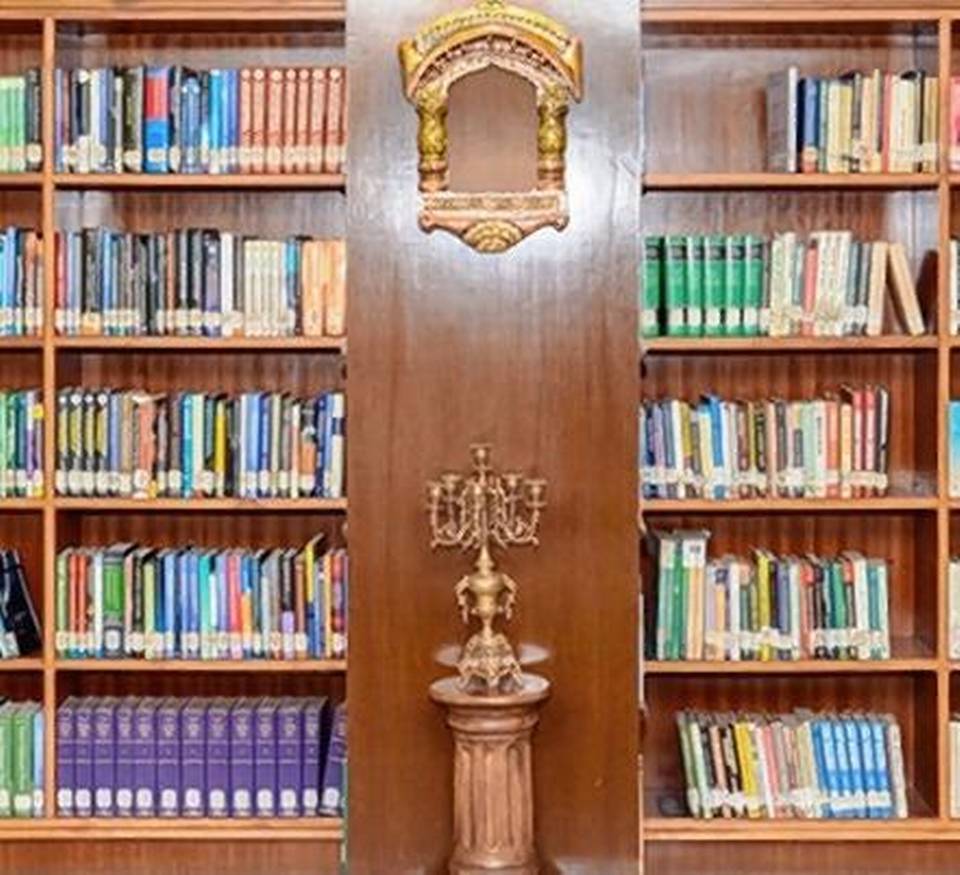
Books at the University of Calcutta library are not accessible at the moment.

Now anybody, anywhere in the world, can access countless articles, journals and dissertations

In what can be seen as a sign of the times to come, when social distancing may just become the new normal, the University of Calcutta has placed the entire digital collection of its library online so that physical visits are no longer necessitated and the world at large benefits from it.

The decision of the University, set up in 1857, has placed in public domain countless articles, journals and dissertations, including issues of The Calcutta Review dating back to 1844 and Tagore Law Lectures dating back to 1870. Now anybody, anywhere in the world, can access them any time.

“We are living through a time of great uncertainty, owing to the global coronavirus pandemic. To cope with regulations of social distancing and lockdown, our teachers have initiated online teaching. They have also been regularly uploading study materials on the university website. In this spirit of online education, the university has also decided to open up free access to its digital collections. These would be accessible through the university website, www.culibrary.ac.in,” Vice-Chancellor Sonali Chakravarti Banerjee said in a circular.

Two major reasons

“There are two major reasons underlying our decision. The first is our responsibility to our students and our faculty, whose education and research have been obstructed by the prohibition on physical access to the library collections.

“The second is our responsibility, as a public institution, to the citizenry as well as the world at large,” Ms. Chakravarti Banerjee said.

“Education is a public good; and the necessity and value of academic research increases, more than ever, if our society is to recover from the crisis.

“As a public university, we feel that it is our responsibility to make our digital collections part of a global academic commons, to facilitate the pursuit of knowledge beyond borders,” she said.

Till now, the library facilities and resources, including digital collections, were primarily accessible to users within the university campus.

Now, the digitised collection of full-text materials has been made accessible for free reading — from any part of the world.

“The University of Calcutta feels honoured to contribute to the communing of cultural-educational resources; and thus to strengthen the global networks of cooperation and solidarity through which alone we shall be able to recover as a planetary community,” the Vice-Chancellor said.

According to a senior university official, this decision to make the library’s digital content public, even though prompted by the pandemic and subsequent lockdown, would, in all probability, continue to hold good even after the lockdown is lifted.

source: http://www.thehindu.com / The Hindu / Home> Life & Style / by Bishwanath Ghosh / Kolkata – May 06th, 2020

Pankaj Mullick’s grandson reveals some legacy gems

Anecdotes and songs punctuating a virtual tribute to commemorate the music legend’s 115th birth anniversary

Pankaj Mullick / Parimal Goswami

In 1922, a 17-year-old set to tune Rabindranath Tagore’s poem Shesh Kheya. He sang it at college functions and other cultural events. When word reached Jorasanko, the Tagore family abode in north Calcutta, the composer was summoned by the poet himself. That day the youth had started to sing and soon enough Tagore slipped into a trance. It was his habit whenever he was writing or composing or when in deep thought. But the young man had no way of knowing any of this. Confused and somewhat awkward at this effect his composition had, he quietly slipped out of the room mid-song.

The young man’s name was Pankaj Kumar Mullick. And these anecdotes and songs punctuated the virtual tribute organised by Intach’s Calcutta chapter and the Pankaj Mullick Music and Art Foundation on May 10 to commemorate the music legend’s 115th birth anniversary.

Mullick’s grandson, Rajib Gupta, did the talking; his wife, Jhinuk, sang a selection of Mullick’s compositions.

Gupta continued, “Dadu met Tagore again 15 years later. By this time he was a music director. He had already worked in films such as Chandidas (1932) and Kapal Kundala (1933) and he needed Gurudev’s permission to use Shesh Kheya in Pramathesh Barua’s film Mukti (1937).” When they met, Tagore inquired softly, “Why did you run away the last time we met?”

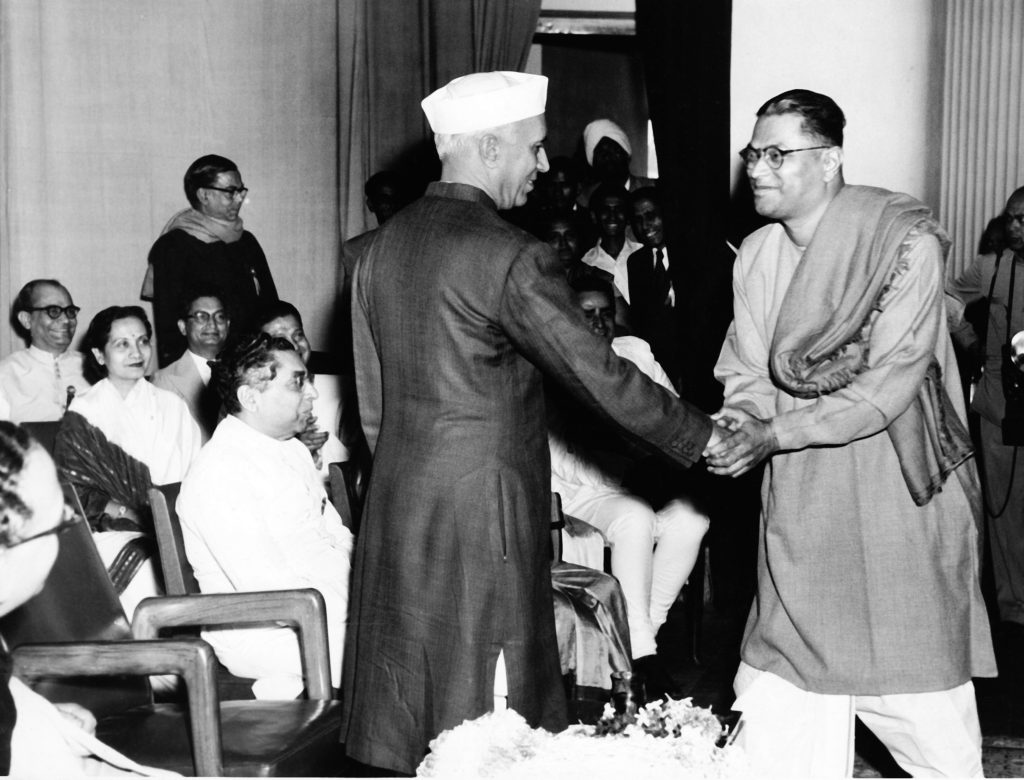
Melody maker: Pankaj Mullick; with Jawaharlal Nehru in 1955 at a seminar / Courtesy, Rajib Gupta

This time, Tagore heard the entire song and was overwhelmed. He granted Mullick permission to use the song. Should you run a YouTube search, the scene will surface on your screen. The silver waters, empty, but for a single vessel. The horizon, obviously flushed even in a black-and-white print, with the coconut palm leaning against it. And the sun dipping low into the river. The song is picturised on Mullick — it was his debut as an actor — but it is his voice more than his screen presence that can hold audiences across generations captive. The lines go — Diner sheshe ghumer deshe ghomta pora oi chaya/Bhulalo re bhulalo mor pran/O parete sonar kule andharmule kon maya/Geye gelo kaj bhangano gaan… At day-end in the land of slumber, a veiled shadow/Casts on me a spell sublime/On the other side, by the golden shore, lives what credo?/It pierces all worldly chores with a melody divine.

Insistent though neither plaintive nor resigned, Mullick’s music and rendition add another dimension to Tagore’s words.

Mukti is a tumultuous relationship saga. In the end, the man dies and the estranged wife survives. When Mullick narrated the script to Tagore, the elder apparently remarked, “It seems the protagonist of your story is in search of mukti… freedom.”

When Barua learnt about this exchange, he promptly christened his production Mukti.

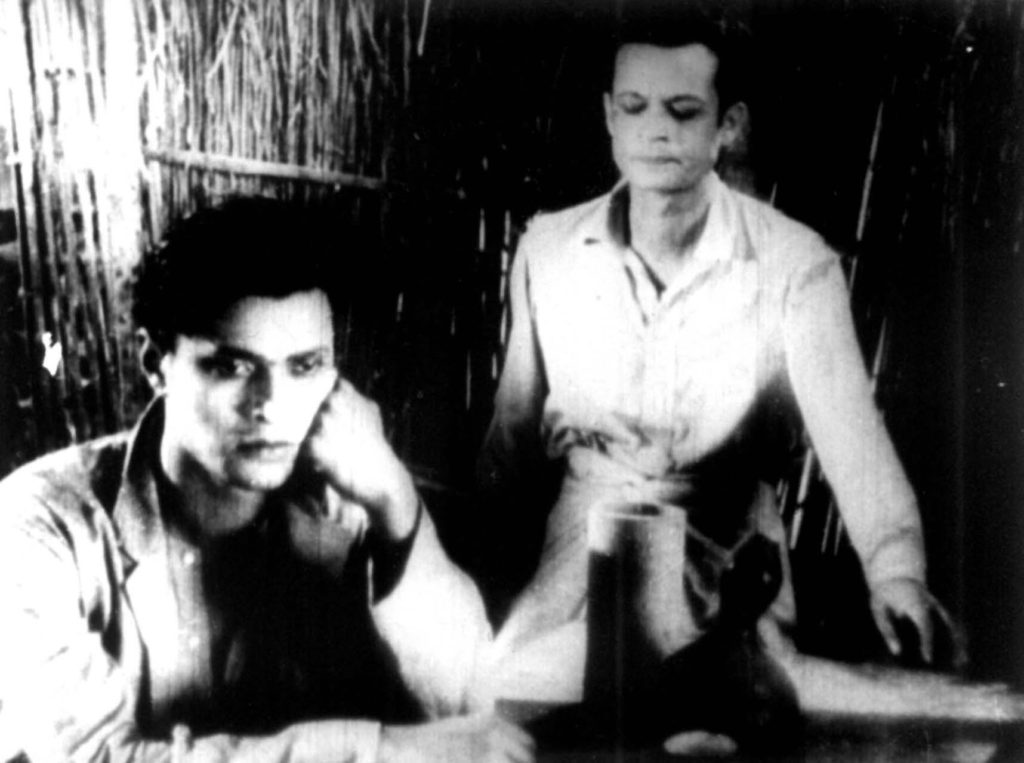
Pankaj Mullick in the 1937 film, Mukti, with Pramathesh Barua / Courtesy, Rajib Gupta

Rajib does not tell a linear tale. He does not need to. His memory drive is teeming with gems and he can pick and choose, polish and cast aside as he pleases. The cast from his anecdotes is delightfully star-studded.

He talks about the camaraderie between Mullick and singer-actor-superstar K.L. Saigal.

Saigal acted in a couple of Bengali films produced by New Theatres. In one such, he was required to sing a Rabindrasangeet — Tomar binay gaan chhilo. But there was a slight problem — Saigal didn’t speak any Bengali. Those days not only was it uncommon to have a “non-Bengali” sing Rabindrasangeet, culture vigilantes too were not entirely encouraging. The way out was to have Saigal copy Mullick “pronunciation by pronunciation, timbre by timbre”. Rajib’s narration trails off and Jhinuk strategically breaks into song.

Next comes the tale of Mullick wanting to have the Calcutta Philharmonic Orchestra play to his rendition of yet another Rabindrasangeet, Pran chay chokkhu na chay, and the keepers of tradition refusing to have any of it. By this time Tagore had passed away. Finally, Mullick did a Hindi translation and thus was born the popular Pran chahe nayan na chahe. Jhinuk breaks into song again.

Sepia-tinted times are not free of complexities. Mullick joined New Theatres around the same time as the famed composer, Raichand Boral, in 1931. The two worked as joint music directors for six years. Despite the collaboration, as Rajib points out, a lot of their films did not have Mullick’s name in the final list of credits. It seems Mullick, who was at that time the breadwinner of a joint family of 60, did not wish to jeopardise his position by picking a quarrel with the studio bosses. But the old wound obviously was never quite forgotten. It merely turned into one of those legacy aches that will roll from generation to generation.

After Mukti, Mullick was set free from a spell of ignominy. He learnt Rabindrasangeet, sang them on the Broadcasting Company Ltd, the colonial predecessor of the All India Radio (AIR), and was the first to use them in films. “Dadu had the songs translated into several Indian languages including Hindi, Gujarati, Tamil and Telugu,” says Rajib, whose narration picks up pace and one can almost sense the busy hum from Mullick’s heyday.

The rundown in no particular order. Helming the popular radio programme, Sangeet Shikkhar Ashar, for 47 years. Being honorary advisor to the folk entertainment section of the government of West Bengal, appointed by chief minister Bidhan Chandra Ray himself. Travelling across India with a variety of productions showcasing Bengal’s folk heritage. Composing Mahishasuramardini.

Member of the Calcutta Municipal Corporation’s mayor-in-council, Debashish Kumar, joins the virtual adda and elaborates on Mahishasuramardini — the programme aired by the Broadcasting Company Ltd at the crack of dawn on Mahalaya.

Mahisasuramardini had more than one creator. There was playwright Bani Kumar, who had scripted it all; Birendra Krishna Bhadra, who did the Chandipath, or invocation of the goddess, and was also the compere; and Pankaj Mullick, who set it all to tune.

Rajib does not forget to mention how one year it was ditched for a programme by Mullick’s protégé Hemanta Mukhopadhyay. He says with restrained pride, “But there was a public uproar and the broadcasters were forced to air the original thereafter, year upon year, beginning with that very year on the day of Mahasashthi.”

Rajib’s narration changes tack when he talks about his grandfather’s work in films. The 1930s spool rolls. Heady years. After a character role in Mukti, the lead role in Aandhi (1940). Thereafter, Doctor the same year. Rajib keeps it real, quotes Tapan Sinha who is believed to have said, “Pankaj Mullick was a decent actor.”

The actual glory, the out-of-the-ordinary stories, have to do with Mullick’s career as composer. How O.P. Nayyar said to Ameen Sayani that as a six-year-old he was inspired by New Theatre’s Pankaj Mullick to take up singing. How Mullick introduced playback singing in Indian films. How he introduced Western musical elements in popular Indian music — fundamentals of harmonisation, interlude music, counter melody. He discovered the horse-beat rhythm, the train rhythm. “You know A.R. Rahman’s Chhaiyaan chhaiyaan? That train rhythm Dadu was the first to use in Doctor.”

And the legacy chugs along…

source: http://www.telegraphindia.com / The Telegraph, online edition / Home> Culture / by Anasuya Basu / May 24th, 2020

Rediscovering the Parsis of Calcutta

New Delhi (IANS) :

It began with author Prochy N. Mehta”s grandchildren being barred from Kolkata”s sole fire temple and culminated in a meticulously researched book on the role of prominent Parsis and the community at large in various aspects of the city”s growth in diverse areas over the years.

“My grandchildren were going to the only fire temple in Kolkata (the Late D.B. Mehta”s Zoroastrian Anjuman Atash Adaran) with us. In 2015, the newly appointed Head Priest phoned and requested us not to bring my daughter Sanaya”s children to the fire temple. On asking why, I was told that the (temple”s) Trust Deed is sacrosanct,” Mehta, author of “Pioneering Parsis Of Calcutta” (Niyogi Books), told IANS in an email interview.

“This started my search into the past. The Trust Deed is dated 1915, but no one today has any recall of us Parsis of that time, of the community in Calcutta, and what they fought for and believed in,” Mehta, one of just 420 Parsis in Kolkata, said. The community has seen zero growth in the last three years as there have been no births.

“Sanaya is married to a non-Parsi. Her children were visiting the fire temple till 2015 We have an Originating Summons in the Calcutta High Court asking for interpretation of the Trust Deed. That is why I studied the Trust Deed and unearthed information. We can now interpret the Deed with this new information. The fire temple trustees are not opposed to it.

“Every family in Calcutta has children who have intermarried. In the last three years, all marriages are intermarriage. They do not want to take a decision in case people point fingers at them saying it”s being done as they are in a similar situation. If the court rules that would decide the issue (but the case is still pending),” Mehta explained.

Mehta elaborates on the issue in the Preface.

“I had no illusions. What I was taking on is what every religion faces at some state: the fear of change. Any change from the norm upsets someone of the other. Sometimes, change comes about because there are enough people to force the change through. Sometimes, the silent majority want the change but do not have the time, means or patience to make it come about. I felt I had all three. More importantly, I wouldn”t allow my daughter”s children to be treated any differently than the children of my son,” Mehta writes.

This initial curiosity turned into a voyage of discovery, which changed her perception of her community and awoke in her an intense pride in the Parsi stalwarts of yesteryear. Mehta”s meticulous research reaped rich dividends as she slowly dusted off the cobwebs of history that revealed the pioneering Parsis” arduous journey to Kolkata, their forward thinking, their broad-minded approach, their willingness to give and to improve the lives of all around them.

These extraordinary Parsi men and women played a prominent role in society by taking upon themselves the responsibility of helping one and all, regardless of class, caste, creed, or colour. Their ability in business and faith in the future was matchless. These early Parsis were not afraid of taking on the establishment and fought publicly to resolve disputes where the orthodox members were unwilling to give the reformists their way.

“I try to trace the history of the Parsis, as there is no recorded history of the Parsis in India, except for a poem the Kissa-e-Sanjan written in 1599 by a priest, Boman Kekobad,” Mehta told IANS.

“An interesting fact is that we had forgotten our religion till Changa Asha (the leader of the Parsis in Navsri) found a group of Parsis in about 1490 living amongst the Hindus as a tribe following Hindu customs and way of life. Till today, the World Zoroastrian Organisation is finding such co-religionists living in poverty in the villages of Gujarat and seeks to rehabilitate them.,” Mehta elaborated.

To turn to the pioneers, the book says Rustumji Banaji may have been the most prominent man in Bengal in the 1800s; owner of Kidderpore and Salkia docks, master ship builder, pioneer in banking, insurance, social service, social reform, and shipping. But alas, forgotten today.

Many of the pioneer Parsis of Bombay had their early roots in Kolkata: Sir Jamshedji Jeejeebhoy; Nusserwanji Cowasji Petit; Dinshaw Petit; Framji Banaji (brother of Rustumji Banaji); the Wadia family of shipbuilders; Meherwanji Mehta, father of Phirozshaw Mehta; Khurshedji Cama; Dadabhoy Navroji; Jamshedji Madan (father of Indian cinema); and Dorab Mehta (Meherwanji”s brother), who had done extensive charitable work for the city of Navsari.

Then there were the nationally famous Parsis who belonged to Calcutta, but were forgotten by us. D.N. Wadia, the world famous geologist; Erach Bhiwandiwala, the artist; A.C. Ardeshir and his famous horse, Ethics; and Dr Irach Taraporewala, who translated the Gathas and wrote the Divine Songs of Zarathusthra.

And then there was the Tata family connected through marriage with the (DB) Mehta family. Jamshedji and Dhunjibhoy Mehta met at Dadabhai Navroji”s home in England, where they purchased machinery for their cotton mills, Empress Mills, Nagpur, and Empress of India Mills at Srirampur. Dhunjibhoy”s grandson, Phiroze Sethna, and Jamshedji”s son, Ratan, married the daughters of Ardesher Sett, Navaz, and Banoo. This must have sealed the bond of friendship among the families, the book says.

(Vishnu Makhijani can be reached at vishnu.makhijani@ians.in)

–IANS

vm/rt

source: http://www.outlookindia.com / Outlook / Home> The News Scroll / by IANS / May13th, 2020

India’s first municipal archive

The digitised municipal archive was launched in 2017 with copies of the Calcutta Municipal Gazette

A 1927 edition of the Calcutta Municipal Gazette / File photo by Subhasish Bhattacharjee

Calcutta’s East-West Metro line, the same that will connect Howrah and Dalhousie Square, was conceived nearly a hundred years ago by the British. “An expert had come down from London in 1924,” informs Deepankar Ganguly, who helms the Calcutta Municipal Corporation archives. He continues, “According to the original plan [which is to be found among the archival gems] too, a portion of the stretch was to run under the Hooghly river.”

The digitised municipal archive was launched in 2017 with copies of the Calcutta Municipal Gazette. The gazette’s founder-editor was Amal Home, who had been handpicked by Subhas Chandra Bose when he was the CEO of the civic body. “The gazette blossomed with all kinds of writings and contributions from within India and abroad,” says Ganguly. So you have Mahatma Gandhi writing on khadi and C.V. Raman on music. But primarily, the gazette carried news of municipalities across the globe.

Amal Home, Editor, Calcutta Municipal Gazette / File photo by Parimal Goswami

One such issue from 1931 is titled “Raman Number”. Among other things it contains the speech the physicist delivered at the Calcutta Town Hall. It reads: “A hot day in June is not an opportune moment to enter upon praise of the physical climate of Calcutta. But from the point of view of research, there is something more important than the physical climate, and that is the intellectual climate… For a hundred years, Calcutta has been the intellectual metropolis not only of Bengal, or of India, but of the whole of Asia.” The same issue has a clip about a Captain T.A. Joyce of the British Museum who had returned to London after an expedition in the British Honduras, where he possibly unearthed the ruins of a Maya civilisation; the third anniversary of Paikpara library; and an advertisement by the health department of the Delhi Municipality seeking tenders for rat traps.

Encouraged by the then mayor of Calcutta and a generous grant, Ganguly and his team of three digitised all gazettes between 1924 and 1975. But as he himself points out, an archive cannot constitute editions of the gazette alone.

In the days and weeks that followed, Ganguly started to digitise the 1,000-plus books, documents and maps that were in possession of the civic body and would have ended in the rubbish bin for sure. Gradually, rare civic body related documentation procured from elsewhere also found place in the archive index.

An archive is not an archive. It is like Sleeping Beauty waiting to come alive at The Heritage Enthusiast’s touch. Even a cursory scroll down the corporation archives’ online index conjures a different time, different places, a variety of issues. Somerset county’s war on T.B.: 1925. Program of Nutrition education in New York city area: 1946. Public health protection in Soviet Russia: 1946. Paris Street accidents: 1925. Municipal election in Rome: 1947. Tokyo municipality gherao by workers’ union demanding higher pay: 1946.

The bare bones of history mean different things to different people. When Gary Stringer and Ayesha Mukherjee of the UK’s Exeter University visited the archives, they were surprised at a detailed handcrafted map of Subeh Bangla from the 18th century that they were shown. Stringer offered to lend expertise to enlarge the map digitally to reveal details the naked eye could neither see nor appreciate.

Ganguly talks about an incident from the 1946 Direct Action Day that is recorded in the municipal archives. It seems when riots broke out in Calcutta, Tagore’s sister found herself in the crosshairs of the unrest. That is when corporation councillor Haji Md Yousuf came to the rescue of her and the entire family. When this archival finding was reported, someone from the councillor’s progeny got in touch with Ganguly and requested that he be allowed to see the report.

The longish room on the top floor of the CMC building in central Calcutta is teeming with nuggets. How way before Independence, the electric train was thought of by the British, but was axed by the coal syndicate. How the corporation commissioned one Bipin Behari Das to make three motor cars by hand. How one of them is to be found at the Banaras Hindu University. A photograph of Das’s workshop at 100 Bondel Road also exists. A six-line advertisement Tagore wrote for Tisco is to be found, as also news of a member of the Birla clan celebrating a marriage in the family by building a block for Calcutta University. And among the collection of advertisements is one of Dunlop selling pneumatic tyres for bullock carts.

Ganguly praises current mayor Firhad Hakim and his predecessor Sovan Chatterjee for supporting the initiative. A flip through the guest book reveals that the archive has got the attention of researchers from Dhaka to Cornell. It is a fact that as the first municipal archive in India, it has built some sort of a reputation. But as to whether the rest of the city is aware of the riches it has in its midst, there is serious doubt.

source: http://www.telegraphindia.com / The Telegraph, online edition / Home> West Bengal / by Upala Sen / March 15th, 2020

Bengal insititute develops robotic device that can collect samples of COVID-19 suspects

The device will help the frontline healthcare workers in delivering services while maintaining social distancing, reducing the chance of them getting infected.

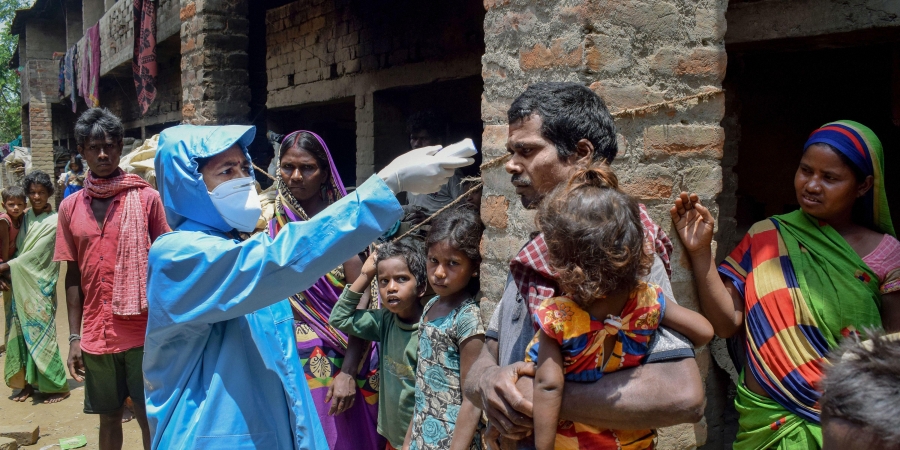
A health worker screens a labourer working at a brick kiln as his family members look on during the nationwide lockdown to curb the spread of corona
rus in Nadia district Tuesday April 28 2020. (Photo | PTI)

Kolkata :

The CSIR-CMERI in Durgapur has developed a low-cost robotic device that can be used for collecting samples of people having symptoms of coronavirus, besides treating COVID-19 patients.

The ”Hospital Care Assistive Robotic Device” will be very helpful for the frontline healthcare workers who are treating COVID-19 patients, said professor Harish Hirani, director of CSIR-CMERI (Central Mechanical Engineering Research Institute).

It will help them in delivering services while maintaining social distancing, reducing the chance of them getting infected, he said.

The cost of the device is less than Rs 5 lakh and the weight is not more than 80 kg, making it easy to use and affordable for healthcare facilities, Hirani said.

The device, which has a video call facility, can also be used in providing food to the patients.

The device can be navigated through automatic and manual modes and needs to be monitored by a nursing booth with a control station.

“It will be able to transport food items, medicines, testing equipment, files, personal protective equipment in a comprehensive sterilised environment,” Hirani said.

A spokesperson of the institute said the device can function in a range of 0.5 km and has a battery life of four hours.

“The clinical trial of the device has been successful. We will be ready if healthcare facilities and governments show interest,” he said.

source : http://www.newindianexpress.com / The New Indian Express / Home> Cities> Kolkat a/ by PTI / April 29th, 2020

British officer with Calcutta ties raises £15m

‘You’ve all got to remember that we will get through it in the end’

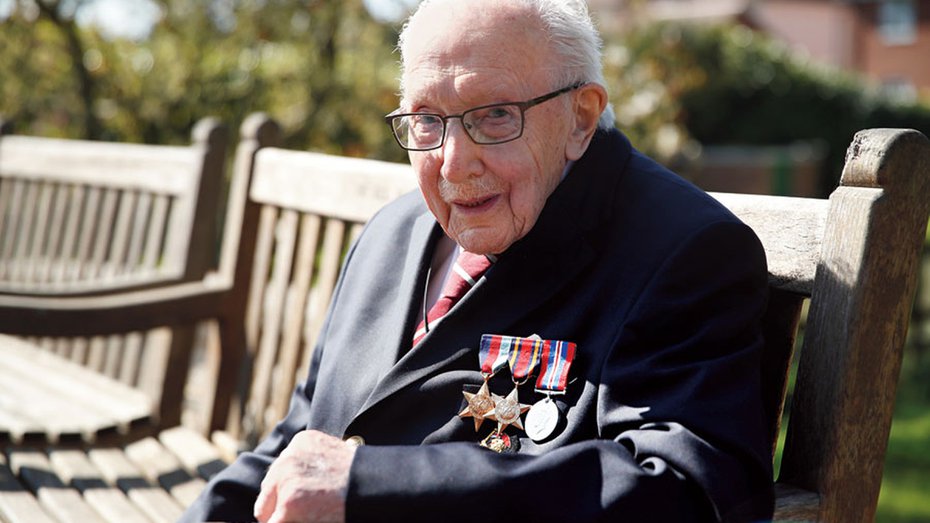
Captain Tom Moore at his home in Marston Moretaine, England, on Thursday after he completed 100 laps of his garden and raised £15 million for the NHS.(AP)

Captain Tom Moore, a former British army officer who served in Calcutta during World War II, had intended to raise £1,000 for the NHS by marking his 100th birthday on April 30 by doing 100 laps of the 25-metre loop in the garden of his home in Marston Moretaine, Bedfordshire, in 10-lap segments.

But by the time Moore, aided by his walking frame, had completed his mission on Thursday morning, donations from 620,000 people in 53 countries had taken the total on his fundraising page to over £15m — a record for a single campaign on “JustGiving”.

It is all a long time since his days in India. Moore was conscripted into the British Army in June 1940 when he was 20, and began his military career in Otley, West Yorkshire, where he joined the 8th Battalion, the Duke of Wellington’s Regiment under Lieutenant Lord George Saville.

This might explain why, when donations hit £10 million late on Wednesday night, Moore tweeted “Virtutis Fortuna Comes” — the Latin motto of the Duke of Wellington which means “fortune is the companion of virtue”.

In October 1941, his unit was posted to Bombay, with the sea voyage, via Cape Town, taking six weeks. He took a train to Poona and joined the 50th Indian Tank Brigade, where he was asked by his commander to start a motorcycling course for the Brigade because of his expertise in the sport.

He was next ordered to move to his base in Calcutta — the journey during the monsoons took three weeks — and later took part in two exercises in the Arakan before moving to Rangoon.

After all in his background, he probably thought his walk in England, even at 99, was a bit of a doddle.

Still, among those who applauded his fundraising achievement was Ben Stokes, Wisden’s cricketer of the year, who said: “The funds you have raised for the real heroes (in the NHS) are just sensational.”

Chancellor Rishi Sunak said Moore’s “extraordinary” efforts “goes to show the British spirit is as strong as it’s ever been”, while the health secretary Matt Hancock remarked, “This is an awful crisis, but there are some little shafts of light…. He’s served his country in the past and he’s serving his country now, both raising that money for the NHS, but also cheering us all up.”

From his home, Michael Ball, a well-known singer, offered a rousing rendition of You’ll Never Walk Alone.

As the sprightly dressed 99-year-old, with his medals gleaming in the spring sunshine, finished his mission, there were TV cameras and journalists to record the occasion plus four soldiers from the Yorkshire Regiment to give him a ceremonial salute.

An emotional Captain Moore, then revealed that he had postponed his 100th birthday party and that after a short rest he would resume his walk.

He added an uplifting message to people in Britain and beyond: “You’ve all got to remember that we will get through it in the end, it will all be right but it might take time. All the people are finding it difficult at the moment, but the sun will shine again and the clouds will go away.”

He said that NHS workers on the frontline “deserve everything we can give them”, and that “I’ve always been one for having a future, I always think things will be good. We’ve fought so many battles and we’ve always won and we’re going to win again.”

www.telegraphindia.com / The Telegraph, online edition / Home> World / by Amit Roy in London / April 17th, 2020

Forgotten hero of a forgotten battle

A 36-year old schoolmaster and his disciples, challenged the tyranny of the British Raj, and for a few glorious days, threw off the yoke of imperial servitude.

Suresh Chandra Dey

Chennai :

A 36-year old schoolmaster and his disciples, challenged the tyranny of the British Raj, and for a few glorious days, threw off the yoke of imperial servitude. They paid a heavy price. But a tinder had been struck, and a group of young Bengali men and women had briefly managed to attack and capture British strongholds. I am referring to the little-known saga of the Chittagong Armoury Raid and the ensuing Battle of Jalalabad Hills, led by ‘Masterda’ Surya Kumar Sen, former president of the Indian National Congress’ Chittagong branch.

My grandfather Suresh Chandra Dey was one of the 65 members of the Chittangong branch of the Indian Republic Army, who raided the local armoury and cut off the communication systems to isolate the important port city. A few days later, a regiment of more than 20,000 British troops struck back. During this fierce battle, my grandfather was shot. He managed to survive the injury and was helped by his comrade Shanti Nag, who carried him down the hill to safety.

Dey was eventually arrested and jailed without a trial, incarcerated as a political prisoner. When his tormentors could not extract information from him through coercion and torture, they tried bribing him, offering to send him to England and fund his higher studies as a barrister.

He did not give in and was eventually released and placed under house arrest. So much so, when my grandfather wed my grandmother Kironmoyee Dey, it was in the presence of British soldiers. He then made his way westward, and eventually founded a the first Sreeleathers store in Jamshedpur in 1952.

My grandfather had chosen to dedicate his life to the idea of an independent India. But the pocket of earth on which he and his comrades bled into was cleaved away at partition, first as East Pakistan and then as Bangladesh.

It falls upon all of us to remember our forebears, and cherish the country that was founded on the blood sacrifice of so many forgotten heroes.

source: http://www.newindianexpress.com / The New Indian Express / Home> Cities> Chennai / by Rijuta Dey Bera / Express News Service / April 23rd, 2020

IIT Kharagpur builds disinfection tunnel for campus visitors in coronavirus time

While passing through the tunnel, a visitor is sprayed with a disinfectant solution coming out of a high-pressure air compressor.

IIT Kharagpur. (Mint file)

The Indian Institute of Technology Kharagpur has set up a disinfection tunnel for sanitizing visitors to the campus during the ongoing lockdown triggered by the coronavirus outbreak, an official said on Saturday.

The tunnel has been installed at the sole entry point of the campus for essential services staff such those involved in cleaning operations and once the lockdown is lifted, it can be of use to screen visitors until the threat of COVID-19 is gone, he said.

While passing through the tunnel, a visitor is sprayed with a disinfectant solution coming out of a high-pressure air compressor.

The system to automate the process of disinfecting visitors was developed by Prof Mihir Sarangi, Associate Professor Mechanical Engineering, along with faculty and staff members from various departments.

“The output material is like mist and highly effective as it covers a larger surface area unlike liquid disinfectant.

Also, it does not need any drainage,” Sarangi said, This mechanism is, however, a supplement for hand washing or the need to wear face masks in public. Hand wash stations have been placed just outside the disinfection tunnel, he said.

The product prototype has been built indigenously at the IIT Kharagpur in less than a week while the campus is under lockdown.

The prototype is now fully operational at IIT Kharagpur and is used for all people entering the campus.

The commercial model for the product has been estimated to be available for Rs 4 Lakh.

IIT KGP Director Prof Virendra K Tewari said such technologies can be quickly built and employed at any location which has a daily influx of essential service providers.

“Our campus is like a mini township which, in the current situation, requires automation of hygiene and safety protocols for essential service providers who are coming out of their homes every day to serve at the campus and also the campus community who are interacting with these visitors,” he said.

Tewari said more such innovations to assist Indias fight against COVID-19 are underway. PTI SUS NN NN

source: http://www.hindustantimes.com / Hindustan Times / Home> Education / by Press Trust of India, Kolkata / April 18th, 2020

Feed the Need: This group of friends in Kolkata has fed over 1000 families amid lockdown

In Kolkata, a group of six friends have come together to feed villagers in the state.

Ration distribution in South 24 paraganas village.

Kolkata :

The unprecedented lockdown in a bid to prevent the spread of coronavirus in India, has given rise to a humanitarian crisis, where thousands are going to sleep every night without a morsel of food in their stomach. Amidst the crisis, several good samaritans have come forward to do their bit to help the starving souls.

In Kolkata, a group of six friends have come together to feed villagers in the state. The group has so far raised more than Rs 4,000,00 through donations from their friends and colleagues and fed 1200 families in West Bengal.

Ritambar Das, Arijit Roy Chowdhury, Preetom Bhattacharya, Abhijit Sarkar, Sukanya Dutta and Rovers Chatterjee with the help of their friends from other cities in India, US and UK have been delivering ration to families in four villages which are completely cut off from the cities amid lockdown.

Three kilograms of rice, one kilogram of potato and some lentils go into a bag that is then distributed among the villagers. So far the group has managed to help people in Mallickpur, Joytola, Piyali and Betberia. From procuring the ration to distribution, these six people have been doing it all on their own with the help of local police.

“We decided to take this initiative after one of Rritambar’s employees asked for financial support for the people of his village. But for him, it was not possible to take the responsibility of the entire village. So he pitched the idea to some of us and we decided pool money and help them,” said one of the members of the team.

This group of young professionals have also started a Facebook page ‘Feed the Need- by willing souls’ to spread the word and collect funds. The members of the group added that it’s a close circuit network but they are deliberating the option of crowdfunding.

“We initially had a target to collect Rs 15,000 so that we could feed at least 150 families.Our friends passed on the information to their friends who started donating. We coordinate everything through a WhatsApp group. We add every donor to the group to keep them updated,” he added.

The group recently held a ‘thanksgiving’ event in South Kolkata for the essential service providers(police, delivery agents, et al) where they were given snacks and energy drinks.

“We have been distributing these rations on our own with the support from the local police. However, we have decided to engage daily wage labourers in distributing work so that we can pay them a fee to sustain themselves,” a member added.

We are not doing any religion-based distribution, the group maintains adding that it is imperative to look beyond such petty issues and help everyone who is less fortunate.

The group is scheduled to distribute more rations among the families of three more villages in South 24 Parganas district.

source: http://www.newindianexpress.com / The New Indian Express / Home> Good News / by Alisha Rahman Sarkar / Online Desk / April 19th, 2020