‘Self-respect often stands in the way of seeking help’
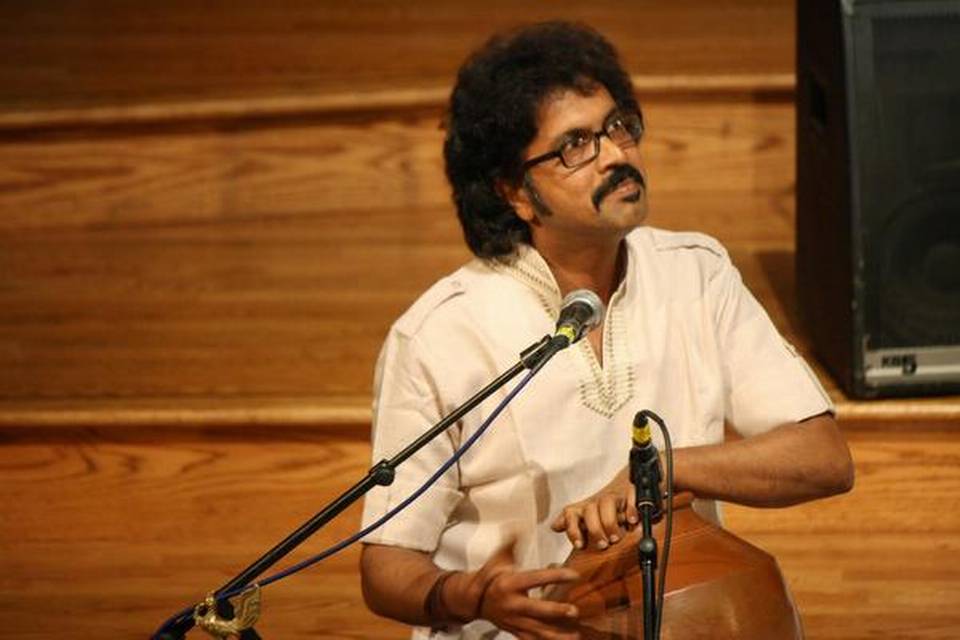
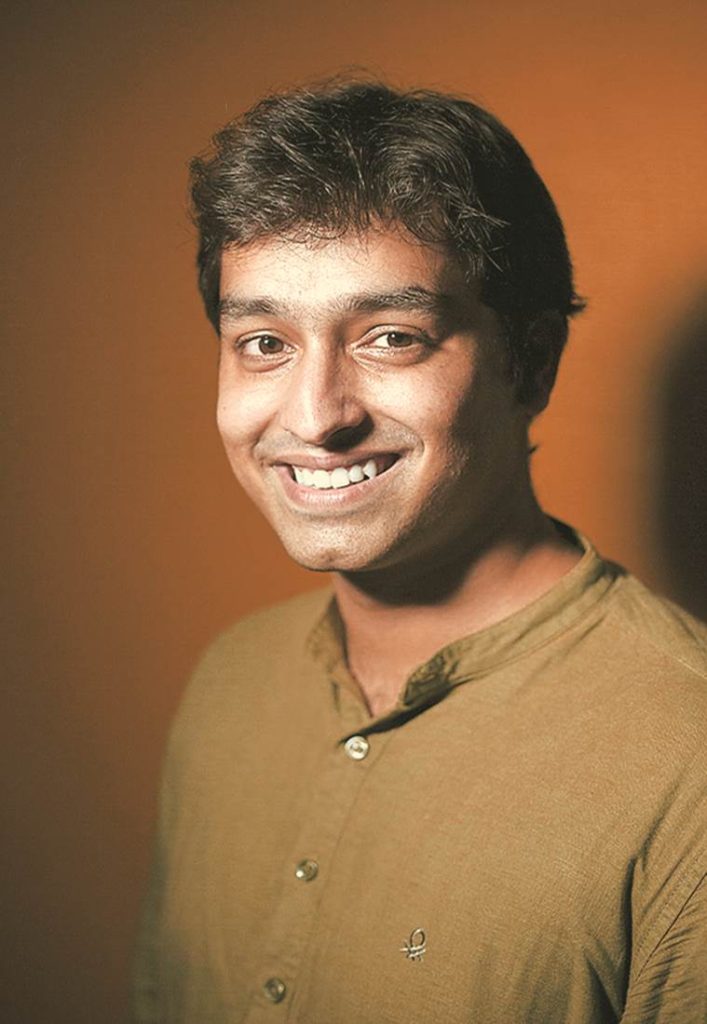
Somnath Roy, 49, is possibly the only Bengali to play the ghatam, an instrument synonymous with the Carnatic tradition. But then, his life has been about making unusual choices. Mr. Roy was a full-fledged sportsperson until the age of 19 — first as a gymnast and then as a coach for West Bengal’s sub-junior kho-kho team — when he discovered his love for classical music. Today, as an established cine musician who designs rhythm for movies, he is helping raise funds for classical musicians who have been without an income due to the prolonged coronavirus-enforced lockdown .
Looking for more
“Classical musicians are in the field out of passion and not because of money because there is hardly any money. With the [enforcing of the] lockdown, whatever income they made from concerts dried up. We — a group of established artistes — have managed to help about half-a-dozen musicians so far. We are looking for more people who need help,” Mr. Roy, a resident of Howrah, told The Hindu.
“The problem is identifying such people, because self-respect often stands in their way of seeking help. It wasn’t easy finding out musicians who were really hard up — they included people whose kitchens had almost stopped functioning. Now we have come to know of a young tabla player from Asansol who is in need of money,” he said.
“Cine musicians like me are part of an association — there will be some kind of help if a musician is in need. But classical musicians belong to the unorganised sector, they are pretty much left to fend for themselves,” he said.
Online classes
With recording studios shut for the past nearly three months, Mr. Roy himself has been making a living from online classes he gives students, teaching them the concept of tala — or beats. Mr. Roy, however, did not begin his musical journey as a percussionist. After he quit sports at the age of 19, he was learning to play the flute from the flute-maker and -player Nepal Sarkar, who discovered that the pupil had a gift for rhythm and sent him to Bablu Biswas, a classical percussionist. Subsequently, he learned Western drums from Amal Roy and began playing for films.
“In 1996-end, I happened to watch a show of Zakir Hussain’s Shakti group, and was mesmerised when I saw Vikku Vinayakram play the ghatam. I approached [the respected Kolkata-based mridangam player] Pandit S. Sekhar, who taught me the mridangam for a while and then referred me to Suresh Vaidyanathan, a well-known ghatam player living in Chennai. I lived in Chennai — in Mandaveli — for over two years, learning from Mr. Suresh,” said Mr. Roy.
“I continue to learn from Mr. Sekhar and Mr. Suresh even today. You can say I have introduced the ghatam as a Hindustani percussion instrument to audiences here. I have accompanied many artistes — Amjad Ali Khan, Vishwa Mohan Bhatt, Ajoy Chakrabarty. I am absolutely fascinated by the ghatam,” he said.
source: http://www.thehindu.com / The Hindu / Home> Cities> Kolkata / by Bishwanath Ghosh / Kolkata – June 16th, 2020
WBBSE Madhyamik Results 2020 Live Updates:West Bengal Board of Secondary Education (WBBSE) has declared the WBBSE class 10th result at wbbse.org. Check latest updates of results, pass percent, direct link, steps to check results and other details he…
WBBSE Madhyamik Results 2020 Live Updates:
West Bengal Board of Secondary Education (WBBSE) has declared the WBBSE class 10th result, at 10 am today. Students can check their results online at wbbse.org and wbresults.nic.in. This year, WBBSE has recorded the highest ever pass percent at 86.34%.
Out of the 10.03 lakh students who took the exam,8.43 lakh passed.
Aritra pal has bagged first rank in state in his class 10th exam. He got 694 out of 700 i.e 99.14%. He is from Memari Vidyasagar Memorial School.
Sayantan Garai and Avik Das scored 693 out of 700 to bag second position while Soumya Pathak, Debosmita Mahapatra and Aritra Maity scored 690/700 to bag 3rd rank.
The WBBSE conducted the class 10th exam from February 18 to 27.
Over 10.15 lakh students have taken the class 10 West Bengal Madhyamik exam this year. Over 5.7 lakh students are girls. Due to the coronavirus outbreak students do not have to come to school and collect their West Bengalu 10th mark-sheets , this year. Instead, their parents would have to come to school with the student’s admit cards and registration certificate to collect the mark-sheets.
Here in the liveblog we will provide you information about the exam, results, pass percent, direct link, steps to check results and other latest updates:
(with inputs from Joydeep Thakur in Kolkata)
source: http://www.hindustantimes.com / Hindustan Times / Home> Live Blog / by Hindustan Times / posted by Nandini / July 15th, 2020
There is a house that oftentimes appears in my dreams. And no, it is not called Manderley. In fact, it is not a house at all, but an apartment building of the old fashioned sort. And most likely it never had a name.
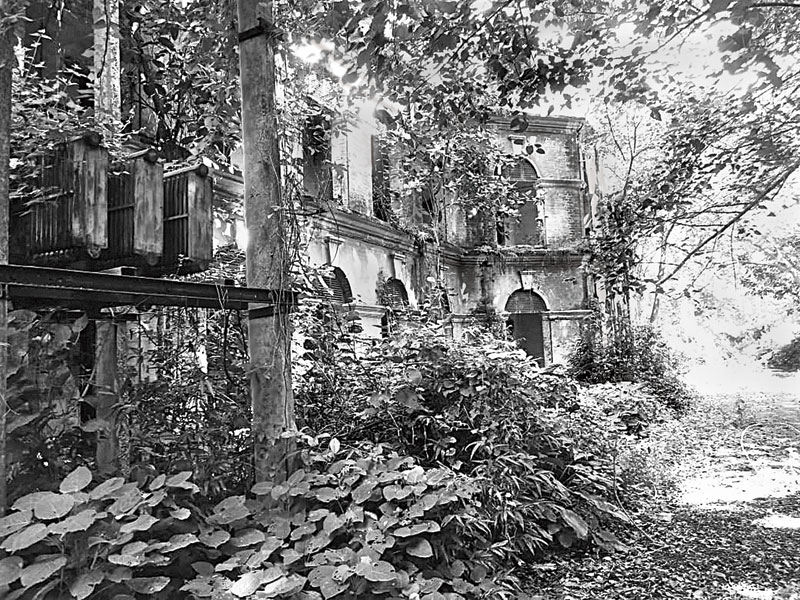
On the banks of the Hooghly river, in the small town of Sahaganj, a subsidiary of the British tyre company of Dunlop had set up workshop in the early 20th century. The residential colony that overlooked the river was referred to as the “Compound” by locals. It had been built in the mid 1800s for the officers of the American Jute Mill. After the mill shut down, Dunlop acquired a large expanse of land in Sahaganj and set up a factory there and what was known as the “Estate” — a gaggle of red brick apartment blocks, a hospital, schools, a club, a swimming pool, a co-operative, a hostel for trainees referred to as the bower, playgrounds and everything possible that the employees and their families might need. It also acquired the Compound and its surrounding land.
The first time I stood before the green gates to the Compound I was no more than five. I remember looking up at the enormous gates with the spikes on top and the pink and purple bougainvilleas wrapped around them and thinking it would hurt real bad if I tried to pluck a flower and somehow landed atop one of those pointy things.
Upon entering the Compound, the first building to the left was the house that now lives in my dreams. We used to call it the Green Flat.
Like I said, it was an old fashioned apartment building. Three apartments on either side. The front of the building had two or three concrete stairs with a stump for a stairhead on either side. Those stairs led to a winding wooden staircase. A red mat affixed with brass clamps covered the wooden stairs. And whenever anyone climbed them, they heaved like a heavy heart.
One evening, before we actually moved into the Green Flat, we went by to see the place. A group of children were just wrapping the evening’s play. They crowded around to inspect me, the new addition. “Which house,” one asked. “Which school,” asked someone else. One boy, who was a head taller than the rest, said out loud to no one in particular, “That house is haunted. Those dark patches on the cement stairs outside, those are ancient blood stains.”
So many years later, there are nights when I am back at that very spot, just under the gulmohar tree, looking up at the faded green house in the purple dusk, and the house staring back at me.
It is never the same dream, though it is the same house. Sometimes I am outside, sometimes I am on the stairs, my hand on the smooth dark wood of the bannister. At other times I am running down the never-ending sun verandah of the second-floor apartment that was our home for 11 months. There have also been times when I have dreamt that I am inside the building next to it, a more modern structure referred to as the “Highrise”. Our apartment in the Highrise was at a level higher than the Green Flat, and in my dream I am looking down at the other house and I can feel it glowering back at me.
Everyone who ever lived in the Green Flat had a story, even some of the grown-ups. The smell of coffee brewing at odd hours. Voices. The bars of an invisible piano. Only one person I knew claimed to have seen something, and though she was one of the adults no one believed her. I remember her telling some of us how she had folded her hands and prayed to the white blur to leave her alone, progress to another world.
I myself don’t remember seeing or hearing anything, but there is a memory of an evening that comes alive in my dreams. It must have been just a couple of weeks since we had moved in. I was in my room playing or reading. When I was done doing whatever it was, I realised I was home alone. The next couple of minutes I moved swiftly from room to room. To this day I remember my mounting anxiety, the sound of my own beating heart and the drone of the cicadas. For some reason that day I couldn’t run out of the house but remained confined to the verandah, pasted to the net of the window, howling for my mother in some unknown fear.
Today, I don’t remember anymore how that evening resolved itself. No big deal I assume or else the parents would have told me. But in my dreams now, revisiting that moment I am sure of a presence dark and sad. An undiscerning presence that wanted to be friends with a scared little girl.
In our 11 years in the Compound we changed houses four times. All the other houses also appear in my dreams. And not just the houses, sometimes I dream of the Club House. The inside of the club, where we watched movies on Sunday afternoons on a TV with shutters and a VCR — Mr India, Moses, Ben-Hur — as we munched on jam sandwiches. This was also where a lot of the parties were hosted throughout the year; there was much dancing and one time Lanadi fell and chipped her tooth. Then there was the billiards-cum-library room. Every Christmas, this is where we put up chartpapers with cottonwool tufts to mimic the North Pole. On the lawn overlooking the club we acted out the nativity play, had fancy dress parades and quiz contests, while the grown-ups used it for lawn bowling and skittles over Abdulda’s freshly baked mince pies and trayloads of Bloody Marys.
I dream of these spaces but the tether always is the Green Flat. In my dreams sometimes I am on a rickshaw winding down the road before the Club. There are chairs and tables on the lawn, but there is not a soul in sight. I look to my right and I cannot see Nirmalda, the bearer, on the club verandah, and the doors are shuttered fast. Only behind me there is something, and I know it is that thing from the Green Flat. And it wants to get into the rickshaw with me.
In every dream I am egged on by the thing into areas of the Compound I never realised I had paid any attention to. Sometimes I am inside the Highrise lift — the one with the green doors. Sometimes I am amidst overgrown grass and I am thinking where is Maalibhai, the same who had a pock-marked face, called a bouquet, “booket” and wore a sky blue fatua and dhoti. Often I am walking down the road that connected the Highrise with the bungalows. The morum tennis court is to my right. The two copper sulphate benches are to my left. And I want to feel happy, because I am finally home. I know the road will rise at an angle soon and the bottlebrush tree will loom into view and if I walk on for another minute or so I will get to smell the magnolia outside Bungalow No. 4. But I can never get to the magnolia tree, and behind me I can feel the thing from the Green Flat, closing in, closing in, closing in.
In other dreams I will be approaching the bungalows from the club side. The narrow road that wound past the vegetable and flower patches. When I get to Bungalow 1, our last address there, I want to just burst in through the netted back door into the pantry and past the broom cupboard and up the stairs into what used to be our room.
One dream, surprise, surprise, I manage to get in. And even in my dream I am thinking, I am finally home, well, almost.
The door swings open but inside there are no lights. I walk into the dining room and I find the table laid out. I peep into the small drawing room and it is empty. I see the telephone table with the stolid black telephone — 3025 is our number. The facing window still has that lace curtain, I note with relief. The door to the other drawing room is half open and I can spy the blue carpet as I start to take the stairs. Even in the dark, even in my hurry I notice the three framed birds on the landing, and then I reach the top. But it is all dark.
On a whim I make a dash for the parents’ room. But where are they? The fans are turning, the ACs are on, the giant bed is made. There is the dresser with the oval mirror and the half mirrors on either side like angel’s wings and a heavy bottle of Oil of Olay. By the time I walk into the dressing room with the full length mirror, I am frantic. I stare into the mirror but I cannot see my reflection. It is so dark I cannot see my hands. And I am thinking I have to turn the latch, if I cannot find my hands how will I turn the latch? And I know the thing from the Green Flat is in there watching me fumble and panic. Waiting to pounce.
***
Last to last winter the Sahai siblings were in town after many years. They wanted to see Sahaganj and the Compound and, thereafter, some of us. “For closure,” all three of them chimed. It is from them that I learnt that the place is in ruins. “It was a dreary sight,” said Shippradi. “So many trees and bushes all growing wild. The club, the pool, I could see nothing. The Green Flat was a khandahar,” she added.
source: http://www.telegraphindia.com / The Telegraph, online edition / Home> Culture> Heritage / by Upala Sen / February 22nd, 2020
Mookerjee was the founder president of Bharatiya Jana Sangh which later became BJP.
Kolkata :
The Union Cabinet has approved the decision of renaming Kolkata port as Syama Prasad Mookerjee Port which was announced by Prime Minister Narendra Modi during his Kolkata visit on the occasion of the 150-year celebration of Kolkata Port Trust in last January. Mookerjee was the founder president of Bharatiya Jana Sangh which later became BJP.
While announcing the new name of Kolkata port in the programme in Kolkata on January 12, Modi had said, “It is a significant day for Bengal and those connected with the Kolkata Port Trust. It is a historic port that saw India’s freedom and has been a witness to India’s progress. It will be called Dr. Syama Prasad Mookerjee Port.”
Mookerjee was independent India’s first minister of Industry and Supply and known to be a harsh critic of the Congress party. Mookerjee, who led the Akhil Bharatiya Hindu Mahasabha from 1943 to 1946 as its president, opposed Article 370 and expressed his displeasure at special status for Jammu and Kashmir. Mookerjee was arrested by Jammu and Kashmir police and died in custody in 1953.
Shortly after Modi announced the renaming of Kolkata port, trade unions at the port protested saying the move will hurt the history of the organisation. A mass signature campaign from the employees of the riverine port against the Centre’s decision had been launched by the National Union of Waterfront Workmen(I), backed by West Bengal’s ruling Trinamool Congress.
source: http://www.newindianexpress.com / The New Indian Express / Home> States> Karnatka / by Express News Service / June 03rd, 2020
Academics specialising in Indo-Bangladesh relations consider the close ties between the border towns quite natural given their shared ethnic identity and Durga Puja’s importance in the Bengali community. SHREYA DUTTA
Taki in West Bengal is a town of green paddies and greener ponds on the banks of the Ichamati river separating India and Bangladesh. Like the rest of the state, it sees enthusiastic Durga Puja celebrations every year. The streets are lit up in canopies of fairy lights, Bengali songs and Bollywood hits blare from loudspeakers, and pandals, or marquees, compete for who carries the tallest, glossiest pratimas—idols—of the goddess Durga.
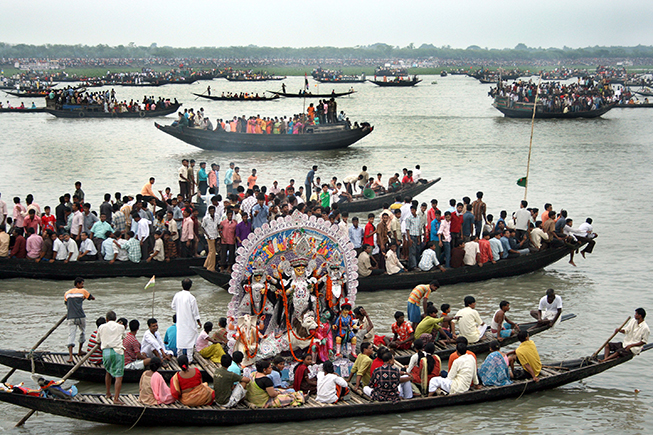
But what distinguishes Taki from other border towns is a particular tradition on the final day of the Puja. As its residents gear up for the immersion of idols, so do its counterparts in Satkhira, a district across the border in Bangladesh. The inhabitants of both towns place the pratimas in their respective boats and sail up to border security boats floating in middle of the river, along the international boundary. With a dozen metres between them, the two groups of neighbours wave at each other, exchange greetings and—with deafening shouts of “Aschche bochor abar hobe!”–Until next year!–immerse the idols together. For a day, citizens of the two countries, divided by geopolitics, come together to celebrate a shared heritage.
The practice of joint celebrations goes back several decades, Sridip Roy Choudhary, a local Communist Party of India (Marxist) worker, told me over tea and rasgullas when we met in late September 2017. Until the early 2000s, residents of both countries would cross the riverine boundary and dock in the neighbouring country to shop and socialise on the eve of visarjan—the day of immersion. “There would be a little mela on both sides,” Choudhary said. “We’d buy coconuts and sugarcane from there, they’d buy oil, soap and Boroline (antiseptic cream) from here.” Some people would even find a wedding match for their sons or daughters. His friend Subhas Pal, a 48-year-old LIC agent, recalled it as a time of fluid movement across the border. “I made a lot of friends in these visits across the border. Hindus or Muslims, they always treated me with the best of hospitality,” he said. “We’d fish in the ponds and have a feast after.” While those from Bangladesh made use of the medical facilities available in India, Indian visitors were keen on the cheap, “king-size” cigarettes of Bangladesh. And Pal added, these would not be bought, only bartered.
At 6 pm, the border guards would announce the end of the meeting-time. The residents would get into their respective boats and trawlers and return to their countries across the river. There were no passport-checks or entry pass for visitors. At its heart lay an implicit trust, according to Taki residents. The practice of an open-border tradition seems extraordinary now, with security concerns about cross-border terrorism, illegal immigration and cattle trade dominating the mainstream discourse. But academics specialising in Indo-Bangladesh relations consider the close ties between the border towns quite natural given their shared ethnic identity, the mutual practice of soft diplomacy and Durga Puja’s importance in the Bengali community.
“The Puja festivities have always been more social than religious affairs,” Somdatta Chakraborty, a research associate at Calcutta Research Group, told me over the phone. “Not only do Muslims participate in large numbers in the celebrations, most pandal-makers belong to the community.” Many villages along the border lie within shouting distance of each other, sometimes separated by a narrow mud path or shallow streams. Given their shared linguistic identity, it was not easy for many residents living in the border-towns to come to terms with the creation of East Pakistan in 1947 and, later, Bangladesh in 1971. Many had friends and relatives across the border—at times, in their backyards—and restrictions on free movement were often too much to bear.
According to Chakraborty, the Ray Chaudharys, an influential zamindar family, first began communal Durga Puja celebrations in Taki in the 1970s. As it grew in scale, visitors came from across the border for visarjan. “After the economic liberalisation of 1991 in India, people started coming in from Bangladesh for work,” she said. “Then in 1992, the Babri masjid demolition happened. In Kolkata, it prompted communal disturbances for the first time after 1947. This began to dilute the homogeneous Bengali identity.”
Beginning in 1989, the Indian side decided to fence its 4,098-kilometre border with Bangladesh. Thirty years later, the work remains half-finished. A 10-foot fence with concertina wires, and two-foot rock stumps for border-pillars, are visible along the border. The Border Security Forces, or BSF, did not fence the perimeter of the Ichamati river, since local livelihoods depended on it, but ramped up security and surveillance. They also erected watchtowers along the riverfront and floating outposts in the river. By the early 2000s, a day-long free pass across the border on visarjan had all but stopped.
In May 2011, the All India Trinamool Congress, led by the now-chief minister of West Bengal, Mamata Banerjee, swept the state assembly elections. The party, known for promoting better relations with Bangladesh, reportedly organised a Milan Mela—a festival to celebrate the immersion—in Taki, and it allowed for the relaxation of border norms on the day of visarjan. According to eyewitnesses and media reports, thousands allegedly trooped into India under the garb of festivities and boarded buses and trains to bigger cities in search of employment. There was a near-complete shutdown of immersion festivities for the next three years.
The BSF South Bengal Frontier, in charge of the security at the Taki border, refused to either confirm or deny that there had been any security lapses in 2011. Instead, a representative speaking for the BSF chief PSR Anjaneyulu told me, “Such an incident hasn’t happened in the past three to four years. Now it is very organised.” His reluctance to speak about the incident had a familiar ring to it: in a report published on Rediff.com in 2014, a security personnel in Taki told a journalist, “It’s an unpleasant memory that is buried. Let’s talk about today and tomorrow.”
When I attended the Taki visarjan in 2017, the diplomatic relations between the countries were at their least combative. Over the previous four years, India had resolved the administrative anomalies of its border enclaves and started a public border-retreat ceremony at the Petrapole-Benapole checkpoint, the highlight of which was the security personnel shaking hands before calling it a day, every day.
At Taki, the border forces of India and Bangladesh were alert but not intrusive, as they patrolled on steamers with guns, cameras and life-jackets. Thousands had turned up to witness the unique Puja celebrations along the leafy riverfront. Nearly a hundred boats chugged along the length of the Ichamati promenade, carrying revellers from both countries who clicked photos, soaked in the September drizzle and waved at their neighbours across the border. At 6 pm, the security forces announced that the celebrations should wind up. Over the next hour, their loudspeakers and flashlights led the boats back to the coast.
Pal was also among the revellers that day. “My only regret is that the next generation will never know of the joy we had experienced,” he said. “For us, visarjan was not about taking the pratima and throwing it into river. It was about making the journey to the other end, of interacting with people. The charm has now diminished. It now seems like a formality.”
I asked him what he missed the most about the border-crossing tradition. With a laugh, he said, “The free cigarettes, of course.”
The print version of this article mistakenly stated that India and Bangladesh had signed a pact for sharing the waters of the Teesta River. The Caravan regrets the error.
OMKAR KHANDEKAR is a journalist from Mumbai, and an alumnus of Cardiff University. His reporting from India, the Maldives and the United Kingdom has appeared in numerous publications, including The Caravan, Open and Scroll.
source: http://www.caravanmagazine.com / The Caravan / Home> The Lede – Community / by OmKar Khandekar / March 01st, 2018
“He wanted to provide the best quality food at the cheapest price,” said daughter Sohini Basu
Arnab Basu, the man who created Mio Amore / sourced by the Telegraph
Arnab Basu, the owner of popular confectionery brands Mio Amore and Winkies, died on July 2 at a city hospital. According to family sources, he was battling liver cancer.
A resident of The Residency in City Centre, Basu was 65 and is survived by his wife, son and daughter.
Basu, who started as a bank employee and then ran a bakery in Saudi Arabia with a friend, founded Switz Foods in 1989. Two years later, he would open his factory in Kasba Industrial Estate.
He arranged with a Mumbai company to bring the brand Monginis to eastern India, taking it in a new direction. The chain, that started with a shop in Dhakuria in 1992, expanded to over 300 outlets in Bengal and Odisha, including 220 in Calcutta.
In 2010, he entered a joint venture with Bauli of Italy to start production of croissants. He launched the brand Winkies to enter the packaged confectionery business in 2012. Soon after, he decided to set up his own brand and thus was born Mio Amore in 2015. Within two years, turnover soared over Rs 500 crore.
“He wanted to provide the best quality food at the cheapest price,” said daughter Sohini Basu, who owns the popular cafe and cake shop Mrs Magpie. “My father was happy that one of his children got into cakes,” she added. Basu’s son is a London-based banker.
source: http://www.telegraphindia.com / The Telegraph, online edition / Home> West Bengal> Calcutta / by The Telegraph, Special Correspondent / July 10th, 2020
In his address to the nation, Prime Minister Narendra Modi reiterated the need to remain safe by adopting physical distancing measures.
A file photo of West Bengal Chief Minister Mamata Banerjee. | PTI
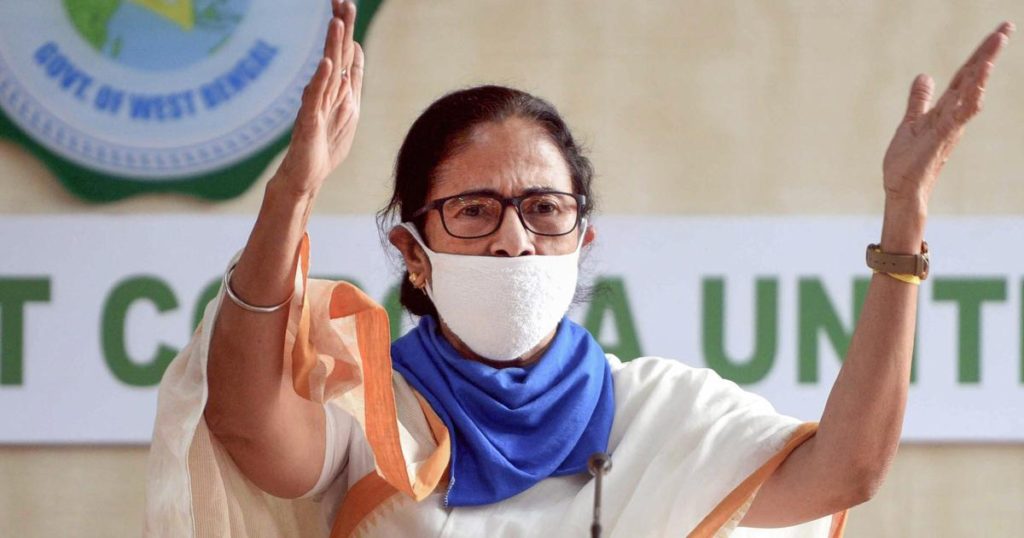
Prime Minister Narendra Modi on Tuesday announced that the free grain distribution scheme under the Pradhan Mantri Garib Kalyan Yojana will be extended by five months till the end of November. Modi made the announcement during his sixth address to the nation since the coronavirus pandemic began. Soon after this, West Bengal Chief Minister Mamata Banerjee extended the free distribution of grains till June 2021 in the state.
Modi observed that even though India’s mortality rate is one of the lowest in the world, people have become negligent in following physical distancing norms and wearing mask since the restrictions were relaxed.
India recorded 18,522 new coronavirus cases on Tuesday, taking the overall count to 5,66,840, according to the figures by the health ministry. The toll from the disease rose by 418 to 16,893. Over 3.3 lakh people have recovered so far.
The global coronavirus tally has crossed the one crore-mark, with 1,02,74,274 cases so far. The toll has risen to 5.04 lakh, according to the John Hopkins University .
source: http://www.scroll.in / Scroll.in / Home> The Latest> Live / by Scroll Staff / June 30th, 2020
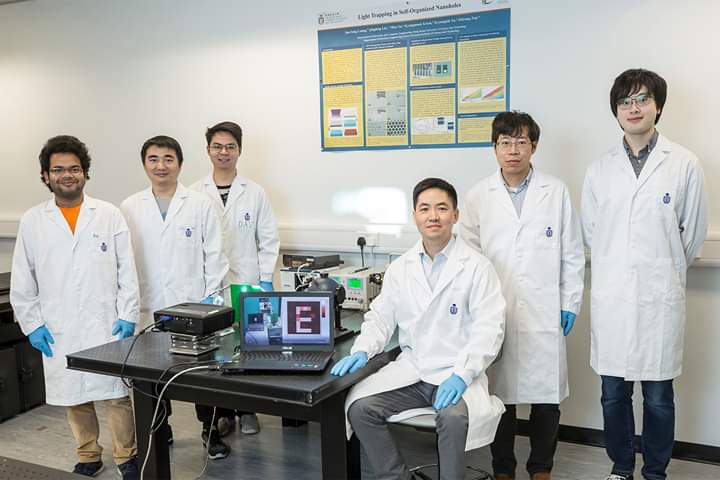
Proud to state that Alumnus of Heritage Institute of Technology, Swapnadeep Poddar had been a part of the great Research team on ‘Super Human Biometrical Eye with a Hemispherical pervoskite nanowire array retina’, at The Hong Kong University of Science and Technology under the leadership of Professor FAN Zhiyong.
Recently the research team and their research was being featured in prestigious science journal ‘Nature’.
Swapnadeep completed his B. tech in Electonics and Communication engineering from Heritage in 2016 and now pursuing his PhD at The Hong Kong University of Science and Technology….
Now this biometric human eye will give a pathbreaking development in science and technology. India shines with Swapnadeep now.
source: http://www.youthkiawaaz.com / Youth Ki Awaaz / Home / by Partha Sarathi Bhowal / June 29th, 2020
A border demarcates. It also seams two Indian WIP projects – Dostojee and The Borderlands – presented as part of ‘Goes to Cannes’ at the prestigious film festival.
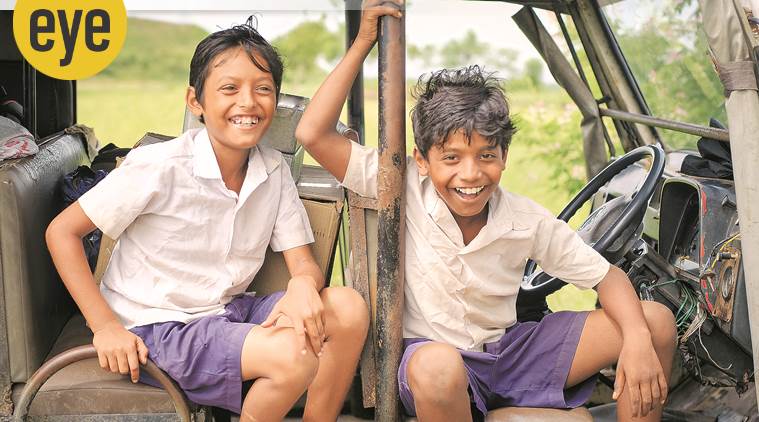
A still from the film ‘Dostojee’
The Bengali landscape is resplendent in the trailer of Prasun Chatterjee’s debut feature Dostojee (Two Friends), and its cinematography “sumptuous”, as the American magazine Variety noted. Vast, rainwashed stretches of paddy fields along river Padma and the glint in the eyes of the two young protagonists, reminiscent of another Bengali village boy, Apu, from Satyajit Ray’s Pather Panchali (1955). First-time cinematographer Tuhin Biswas, a still photographer and primary-school teacher in West Bengal’s Nadia district, was unsure about the video format, until Chatterjee told him, “This is photography too, just think of these as 24 stills per second.”
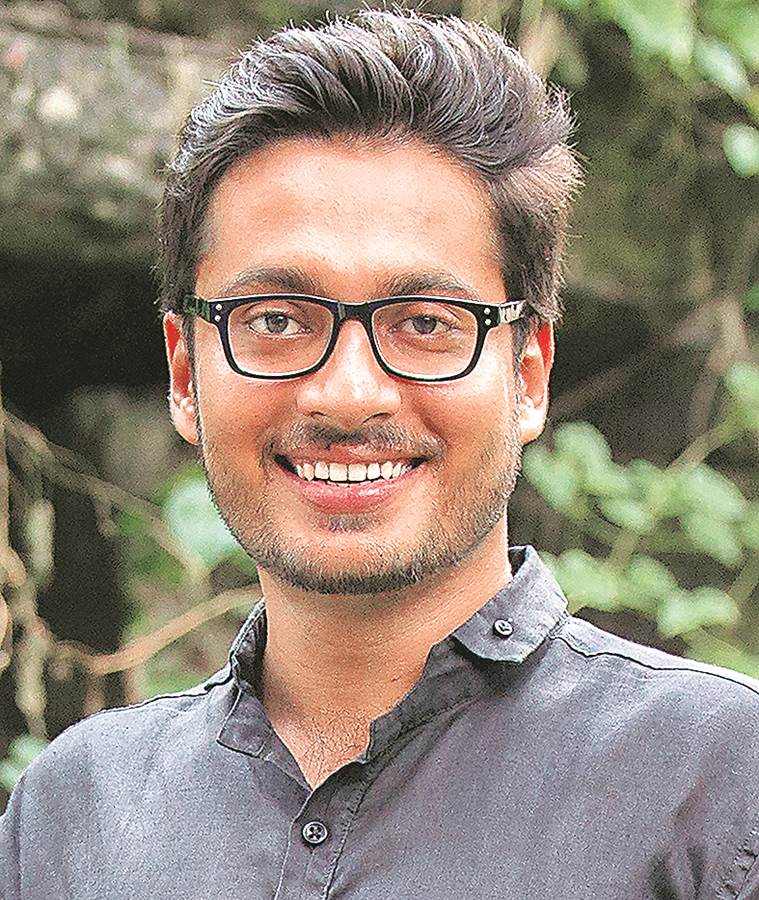
The location is the remote, no-man’s-land near Domkal (in Murshidabad) — the last subdivision on the Indian side. The Padma river separates it from Bangladesh’s Rajshahi. The backdrop is an early-’90s Bengal, touched by the communal violence that followed the Babri Masjid demolition and the ’92 Bombay blasts, but Dostojee speaks of the friendship between two boys from different faiths, living in a border village. In one scene, as their torn kite flies into Bangladesh, and as Palash says he will move with his fearful mother to the Hindu-majority Nadia when he grows up, one wonders if, when the time comes, Safikul will recall his words to his dostojee (best friend): “bhoy ki, aami toh aachhi (have no fears, I’m here with you)”. “I wanted to show anger and love through the eyes of children. What they witness is my subject of inquiry, too,” says Chatterjee, 34, who grew up in Kolkata’s Dum Dum and dropped out of Physics (Hons) at Calcutta University to make films.
For over two years, hestayed with and trained 150 locals as his cast and crew. One afternoon, when he was packing to return to Kolkata, an angry nine-year-old came banging on his door. The boy, Arif Sheikh, whose friend Asik Sheikh was cast as Palash, said, “Ekhane cinema’r jonno baccha leya hoye? Boite lyen amake, Deb er moto koyee debo (Are children being cast in films? Take me, I’ll act like the Bengali hero Deb),” guffaws Chatterjee who, bowled over by his confidence, cast Arif as the other lead, Safikul. Another time, the crew landed up to find one of them with a Neymar hairdo (the 2018 FIFA football world cup was on) and had to wait for “his hair to grow back” to start the shoot.
Prasun Chatterjee
For Chatterjee, who traces his roots to Bangladesh, the pull of these border people has always been great – more than even cinema which he calls “tucchho (trivial)” in front of their lives. “Your work should make the provincial man – the labourer, the farmer –win at the end, or even if he dies, show that there is a flicker of hope for their lot,” says the filmmaker, who is inspired by Ritwik Ghatak’s ideology and Ray’s craft.
From paper to screen, it’s been a seven-year journey since 2013. The film’s working title Dharmik, used while crowdfunding,was changed for a film by that name already existed.Co-producers Prosenjit Ranjan Nath and Soumya Mukhopadhyay came on board in 2017, and Taiwan’s Ivy Yu-Hua Shen after NFDC Film Bazaar selected Dostojee in November in its Recommends section. NFDC sent it, among five films, to ‘Goes to Cannes’: 20 work-in-progress (WIP) films from across the world, whose pitches were made to global buyers and distributors at the Marché du Film from June 22-26 – the only segment of the Cannes Film Festival that took place online this year.
There, Asia’s leading film project market Hong Kong – Asia Film Financing Forum (HAF) picked up the Bengali feature Dostojee (feature) and two Indian documentaries, including Samarth Mahajan’s The Borderlands – the only three from South Asia – among its 22 shortlisted projects for its WIP programme in August. HAF presented The Borderlands – the only Indian documentary in ‘Goes to Cannes’ official selection – at Marché du Film.
The sense of invisibility runs deep in villages and towns along the borders. Mahajan, 29, recounts how, when in 2015 his town Dinanagar, 10 miles from the India-Pakistan border in Punjab, faced a terrorist attack, his mother sounded excited over the phone — Dinanagar had made national news and relatives had woken up to her existence.
Samarth Mahajan
“Most of the stories that we hear about border areas create a specific image of army men and terrorists but no common people. I come from a border area and have lived through experiences which don’t fit these general perceptions of borders,” says Mahajan, who while growing up would often see people visiting Dera Baba Nanak, near his town, to see – through binoculars – Pakistan’s Gurdwara Kartarpur Sahib.
The graduate from Indian Institute of Technology, Kharagpur, gave up his cushy FMCG job in Kolkata to make documentaries. He moved to Mumbai in 2015, where he met his IIT-K batchmate Ashay Gangwar and began collaborating. Gangwar was the cinematographer for Mahajan’s first documentary on fireflies of Maharashtra’s Purushwadi, Kazwa — A Million Lanterns (2016), his company Camera and Shorts produced Mahajan’s The Unreserved (2017), on the India seen on the General coaches of trains, which won the National Award for ‘Best On Location Sound Recordist’, and, with the media company All Things Small, co-produced the crowdfunded Borderlands.
A still from the documentary, ‘The Borderlands’
For his latest, Mahajan, along with cinematographer Omkar Divekar and associate director Nupur Agrawal, took a four-part journey to different borders: Pakistan, Bangladesh, China -Myanmar, Nepal and Bhutan. He learnt that borders have their own ecosystem. How civilians cooperate with the Nepalese army to nab human traffickers. What happens when a tiger, from Arunachal Pradesh’s Dibang Valley wildlife sanctuary, crosses over into China? “The mountainous China-India border, the LAC, doesn’t have border pillars. A shaman told us that if a tiger gets killed (by neighbouring tribes or Tibetans living across the border), his tribe observes penitence for five days: no alcohol, no sex, etc. They mourn the environment,” says Mahajan. How a Pakistani Hindu refugee in Rajasthan “studying to be a doctor, has to unlearn the Arab script and learn Devanagari. Her dream got complicated because of crossing the border.”
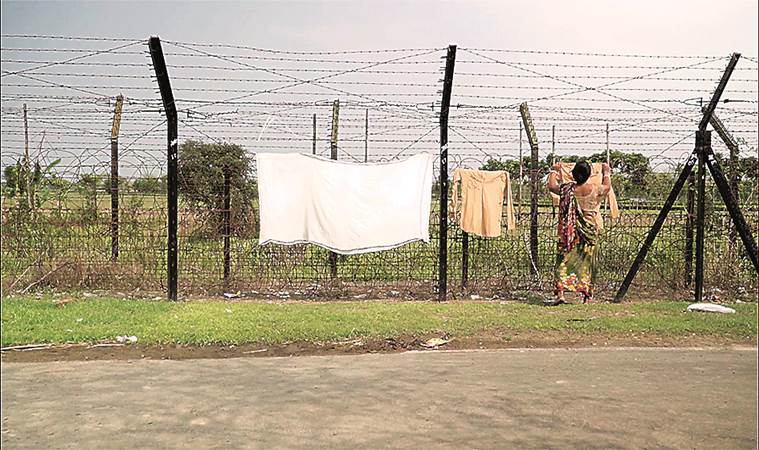
His film will explore these, along with heartwarming tales of common people along the borders. How the Bengalis on either side dry their clothes on the fence, and exchange gifts on Bengali New Year. “There are two Indias. One is upper-class privileged and the other we have stopped engaging with. At this point in India’s history, we need to hear stories of people from the grassroots. To explore life beyond the domain of violence and politics. For military valour stories, there are already films like Border (1997), LOC: Kargil (2003), Lakshya (2004),” he says.
source: http://www.indianexpress.com / The Indian Express / Home> Eye / by Tanushree Ghosh / New Delhi / June 28th, 2020
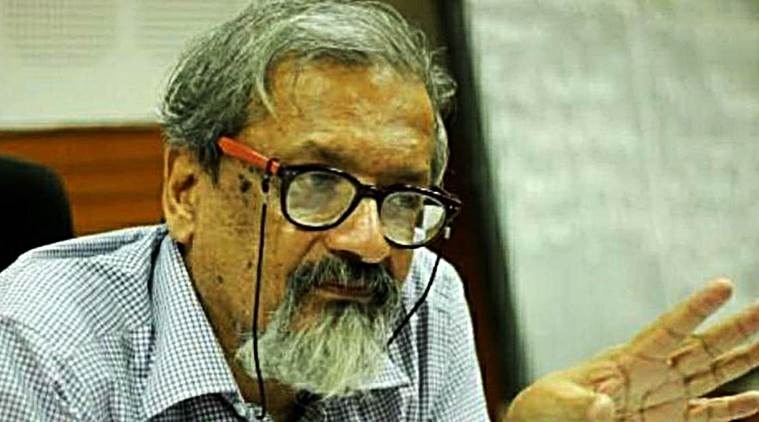
Vasudevan is survived by his wife, historian Tapati Guha Thakurta, and daughter Mrinalini Vasudevan.
Historian Hari Sankar Vasudevan (Photo: Twitter @IFPStudies)
Historian Hari Sankar Vasudevan, who had tested positive for coronavirus , died at a private hospital in Kolkata early Sunday. He was 68.
Vasudevan tested positive two days after being admitted to AMRI Hospital in Salt Lake on May 4. Soon after, he was put on a ventilator after developing respiratory distress. The state government is, however, yet to identify whether he died of Covid-19 or due to comorbid conditions. Vasudevan was an expert on European and Russian history and the India-Russia relationship. A graduate of Cambridge University, where he also completed his post-graduation and PhD, Vasudevan was the director of the China Centre at Calcutta University.
Earlier, he served as director of Maulana Abul Kalam Azad Institute of Asian Studies, Kolkata, of the Ministry of Culture. Between 2003 and 2005, Vasudevan was a professor at Central Asian Studies and acting director at the Academy of Third World Studies, Jamia Millia Islamia, Delhi. Between 2011 and 2014, he was member the Indian Council of Historical Research.
Vasudevan is survived by his wife, historian Tapati Guha Thakurta, and daughter Mrinalini Vasudevan.
Mrinalini told The Indian Express , “My father had tested positive for coronavirus and his condition was critical since Friday. He was on a ventilator. We learnt from the hospital that he died of multi-organ failure. His body is at AMRI, and the cremation will be as per protocol for Covid-related deaths.”
After the historian tested positive, his family members were asked to go into home isolation.
“Only one of my father’s friends will be allowed to see the body. The cremation will be at Dhapa,” Mrinalini added.
Expressing his condolences, West Bengal Governor Jagdeep Dhankhar said in a statement, “A multifaceted person, he made his mark while being involved in a formal consultative capacity with projects/institutions of the Ministry of Culture, MHRD, the Ministry of Commerce and the Ministry of External Affairs of the GoI… His contributions to society will be ever recalled. May his soul rest in peace.”
source: http://www.indianexpress.com / The Indian Express / Home> India / by Express News Service / Kolkata / May 11th, 2020