Category Archives: Records, All

Pritilata Waddedar, the 21-year-old who chose to die than be caught by the British

Women’s Day Special: Inspired by Surya Sen, the 21-year-old led the raid on the Pahartali European Club in Chittagong.
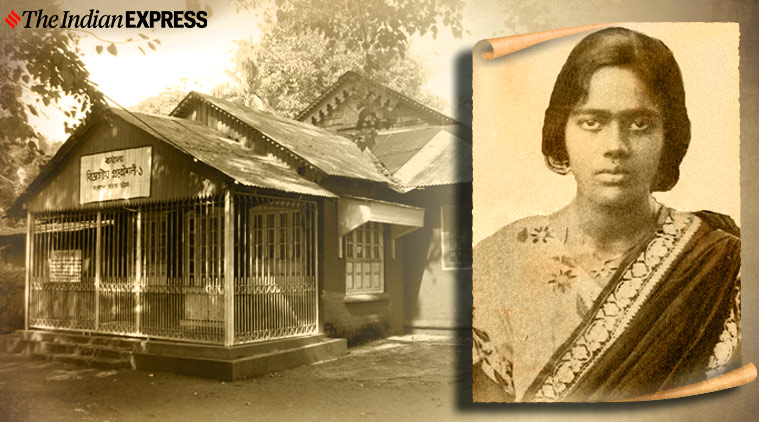
In a re-reading of historical accounts on Waddedar’s life and contributions, it is easy to forget how young she was when she threw herself fully into the cause of liberation of her motherland. (Photos: Wikimedia Commons; Designed by Gargi Singh)

Born in Chittagong, now in Bangladesh, Waddedar was a promising student, having spent her school years in her hometown. While a student at Eden College in Dhaka, Wadderdar’s anti-British sentiments began to take a more form as she slowly developed connections with other women who were spearheading semi-revolutionary groups. One such was with Leela Nag, a student at Dhaka University and an associate of Subhash Chandra Bose, who established the Deepali Sangha, a revolutionary group that provided combat training to women.

Waddedar came to Calcutta for higher education and enrolled as a student of Philosophy at Bethune College under the University of Calcutta. In the city, Waddedar was introduced to revolutionary leader Surya Sen, affectionately called ‘Master da’ by associates. Inspired by Sen, Waddedar soon joined his underground group. According to various accounts from the 1930s, members of Sen’s group initially objected to her membership, but appear to have eventually relented when they discovered her devotion to the cause for the motherland’s freedom, as well as her abilities to carry out assignments undetected by the police.

During the Chittagong Armory Raid of April 1930, 20-year-old Waddedar, along with Surya Sen, Ganesh Ghosh, Lokenath Bal, Ambika Chakrabarty, Anand Prasad Gupta, Tripura Sen, Bidhubhusan Bhattacharya, Kalpana Dutta, Himangshu Sen, Binod Bihari Chowdhury, Subodh Roy, Monoranjan Bhattacharya among a others in a group of at least 65 people, devised plans to raid the armoury of the British forces and destroy telegraph and telephone lines. Although the group did not manage to locate the armory, they succeeded in ruining the telegraph and telephone lines. Many members in the group were very young at that time, Subodh Roy being the youngest at just 14.
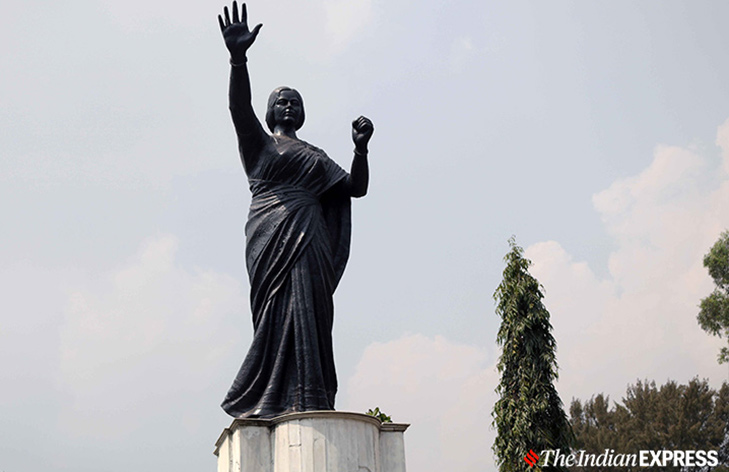
The tall statue depicts Waddedar, clad in a khadi sari, beset with sharp folds, with one arm outstretched and another balled up in a fist, perhaps signalling her determination for the cause of freedom. (Express photo by Shashi Ghosh)

While some members of the group were captured and arrested, Waddedar and a few others managed to escape and regroup over the next few months. In 1932, the group, following Surya Sen’s original plans to attack the Pahartali European Club in Chittagong, assigned Waddedar as the leader for this assignment. The social club for Europeans had been specifically targeted because of its racist and discriminatory practises towards Indians, especially its use of the signboard that read “Dogs and Indians not allowed”.

Under Waddedar’s leadership, a group of 10 was trained in the use of arms and taught how to consume potassium cyanide if the need arose. They attacked the club on the night of September 23, 1932. Several members of the club were injured, while the group was shot at by the police guarding the club. Waddedar sustained a bullet wound that prevented her from escaping with her group. In those circumstances, she consumed potassium cyanide to evade arrest and ended her life. Waddedar was only 21.

Like her contemporary, Bina Das, Waddedar too had been denied her graduation degree by the British authorities of Bethune College under Calcutta University. In March 2012, almost eight decades after her death, the University of Calcutta posthumously awarded Waddedar her pending Bachelor of Arts degree with Distinction for the year 1932. On her graduation certificate, Waddedar’s name is mentioned with a misspelling, ‘Pritilata Waddar’, perhaps an indication of how her name was recorded in university records.
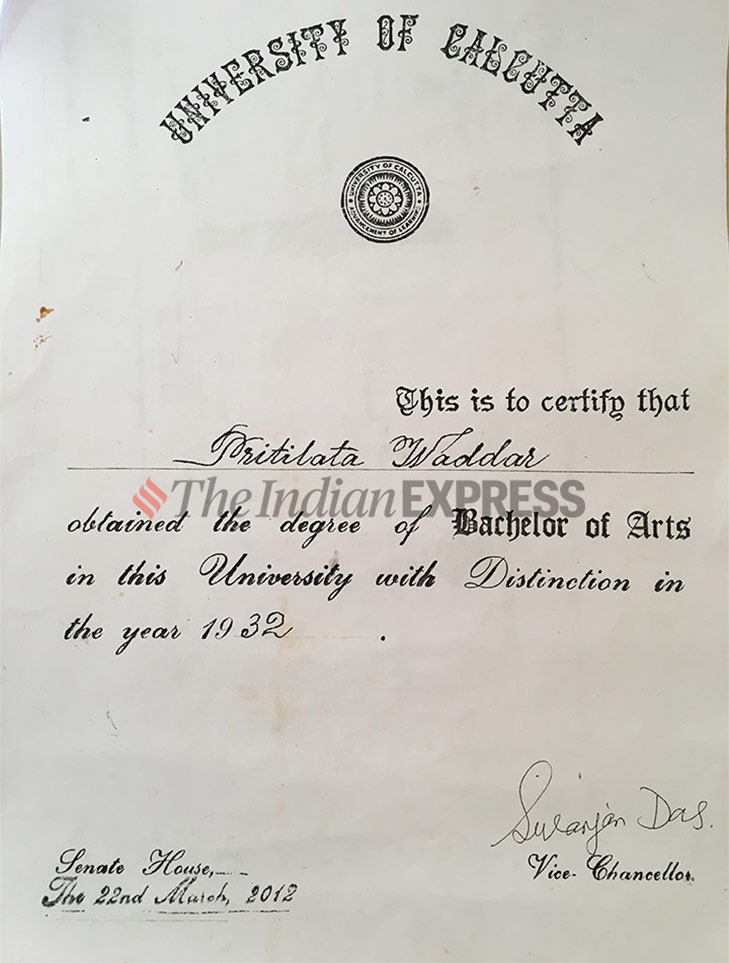
In March 2012, Calcutta University posthumously awarded Pritilata Waddedar her pending Bachelor of Arts degree with distinction for the year 1932, that the British administrative authorities had withheld from her. (Express Photo by Neha Banka)

Dr Soumitra Sarkar, Librarian of Calcutta University, who oversees university archives told indianexpress.com  that he did not have much information concerning why this may have occurred. A copy of Waddedar’s graduation certificate and marksheets were provided to the Birkanya Pritilata Trust in May 2018, based in Waddedar’s native village, Dhalghat, Patiya, Chittagong, established in her memory.
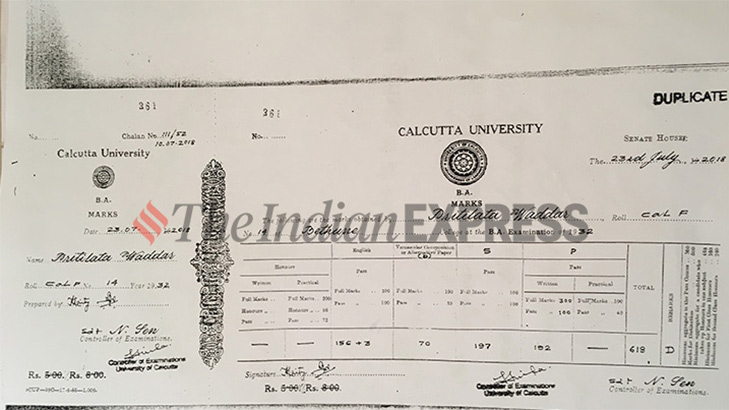
Calcutta University provided indianexpress.com a copy of Pritilata Waddedar’s marksheets for the year 1932, a detailed document that indicates that Waddedar was a student at Bethune College, reproduced by university authorities in 2018 for archival purposes. (Express Photo by Neha Banka)

The large expanse of the Maidan area in the heart of Kolkata, is dotted with statues of individuals associated with the freedom struggle. Between 1947 and 1983, the West Bengal government replaced statues of British officials and East India Company employees with those of revolutionaries, men and women who had devoted their lives to the freedom of the nation.

One such statue is that of Pritilata Waddedar, the only commemorative structure dedicated to her in the country. The monument does not have an address; to find it, one would have to walk down the long stretch of Indira Gandhi Sarani in the Maidan. The tall statue depicts Waddedar, clad in a khadi sari, beset with sharp folds, with one arm outstretched and another balled up in a fist, perhaps signalling her determination for the cause of freedom.

In a re-reading of historical accounts on Waddedar’s life and contributions, it is easy to forget how young she was when she threw herself fully into the cause of liberation of her motherland.

source: http://www.indianexpress.com / Indian Express / Home> Lifestyle> Arts & Culture / by Neha Banka / Kolkata – March 08th, 2020
The man who advised the Tatas to set up Jamshedpur: Pramathanath Bose

Visionary geologist PN Bose pioneered mineral exploration in India

While he could have easily made a life for himself in England, Pramathanath Bose – nationalist to the core – chose to return to India. Sources by The Telegraph

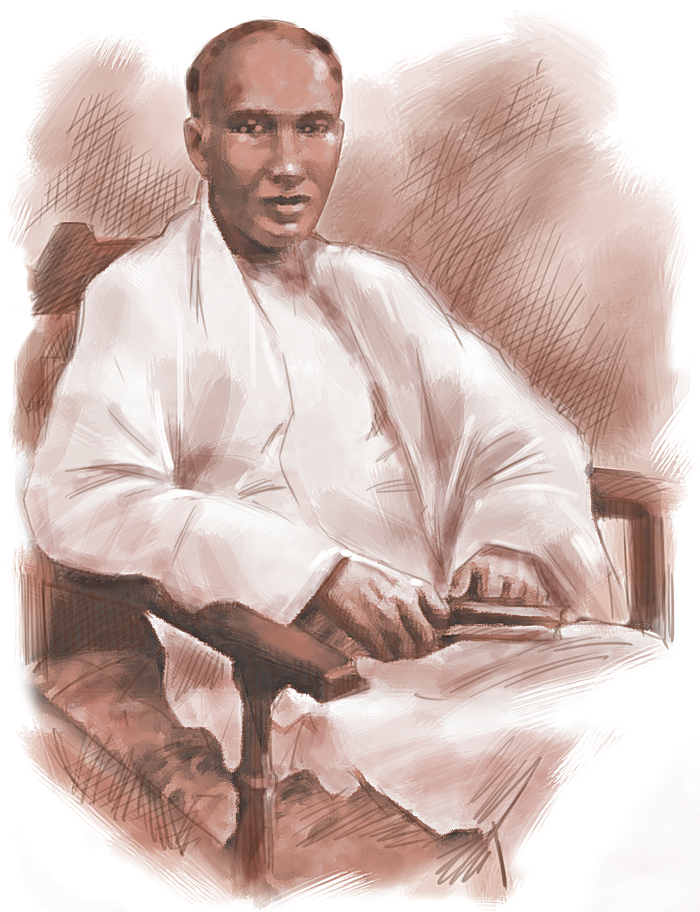
Pramathanath Bose, a scientist and geologist who lived in the 19th century, has many firsts to his name. Marked by an ardent passion for geology, he pioneered mineral exploration in India and was responsible for the Tatas setting up a steel plant in Sakchi, better known as Jamshedpur.

Born in 1855 in Gaipur village in West Bengal, Bose completed his studies from Krishnagar College with flying colours before moving to Calcutta for further studies. In 1874, he graduated from St Xavier’s College. He travelled to England on the Gilchrist Scholarship to earn an undergraduate degree in science. Bose was in fact the first Indian to get a BSc degree from a British university. He went on to get a diploma from the Royal School of Mines. While he could have easily made a life for himself in England, Bose — a nationalist to the core — chose to return to India.

In 1880, he joined the Geological Survey of India (GSI) as assistant superintendent, the first Indian to hold this post. He served with great distinction for 20 years, assiduously attempting to promote industrial expansion by developing geological resources, particularly coal and iron ore. He discovered the Dalli-Rajhara iron ore deposits in what is now Chattisgarh, which became the captive mines for Bhilai Steel Plant, set up exactly a century after Bose’s birth. Mining started in the Ranigunj coalfields in 1774 but it was under Bose that the operations became systematic and structured.

Next, he turned his attention to Sikkim, not a favourable area for mineral extraction because of inaccessibility, rugged terrain, excessive rainfall leading to frequent landslides and a thick mantle of vegetation. Studies revealed that Sikkim was rich in deposits of copper, iron, lead and zinc, with traces of cobalt, gypsum, graphite, limestone, dolemite, gold, silver and tungsten.

Bose’s tireless efforts in Burma, now Myammar, too were rewarded by the discovery of a variety of minerals. Later, geological studies carried in the royal states of Indore and Kashmir too delineated vast areas with mineral deposits.

Bose’s work in the Narmada valley helped understand the rock structure of the Deccan as well as open up new areas of study such as petrology, historical geology, mineralogy and fossils. He could determine the age of fossils by the radio-carbon method. He located the Gondwana layer in the Deccan which connects Indian history with Africa. His theoretical as well as practical knowledge and his writings in the newsletters and bulletins of GSI helped contextualise Indian geology and elevated the study of Indian geological science in the world.

Bose discovered the unique carbonatite rock and means to extract minerals from granite. Due to his perseverance, the GSI was able to extract manganese and iron ore in Durg, Chattisgarh. In spite of this, Bose was superseded by his British junior, T.J. Holland, as director of GSI in 1903. Miffed, he resigned.

After his voluntary retirement, Bose became technical adviser to the Maharaja of Mayurbhanj. This area in Odisha is rich in mineral deposits, and while surveying it, Bose discovered abundant iron deposits at Garumahishani. It had not escaped Bose’s observation that all his previous discoveries were utilised by the British. This time, he arranged for swadeshi industrialist Jamsetji Tata to sign an accord with the king, Sriram Chandra Bhanjadeo, to establish Tisco (Tata Iron and Steel Company). According to Jamsetji’s biographer, Frank Harris, Bose suggested the factory be set up at Sakchi, at the confluence of the Subarnarekha and Kharkai rivers. He also inspired Jamsetji to set up the Indian Institute of Science at Bangalore.

Bose played a pivotal role in the establishment of the Bengal Technical Institute, now called Jadavpur University, where he was the first principal. He also held regular lectures at the Dawn Society and the Indian Association for Cultivation of Science. He understood that without economic development India’s progress would remain a dream.

Bose wrote books on science in Bengali, including Prakritik Itihaas, which explored the natural history of India. He also published three volumes of the History of Hindu Civilisation During British Rule. This great scientist, who died in 1935, was also a humanist greatly interested in the heritage and culture of India.

The writer is a science historian and author of Science and Nationalism in Bengal

source: http://www.telegraphindia.com / The Telegraph, online edition / Home> Science-tech / by Chittabrata Palit / January 19th, 2020

India’s deepest Metro ventilation shaft nears completion

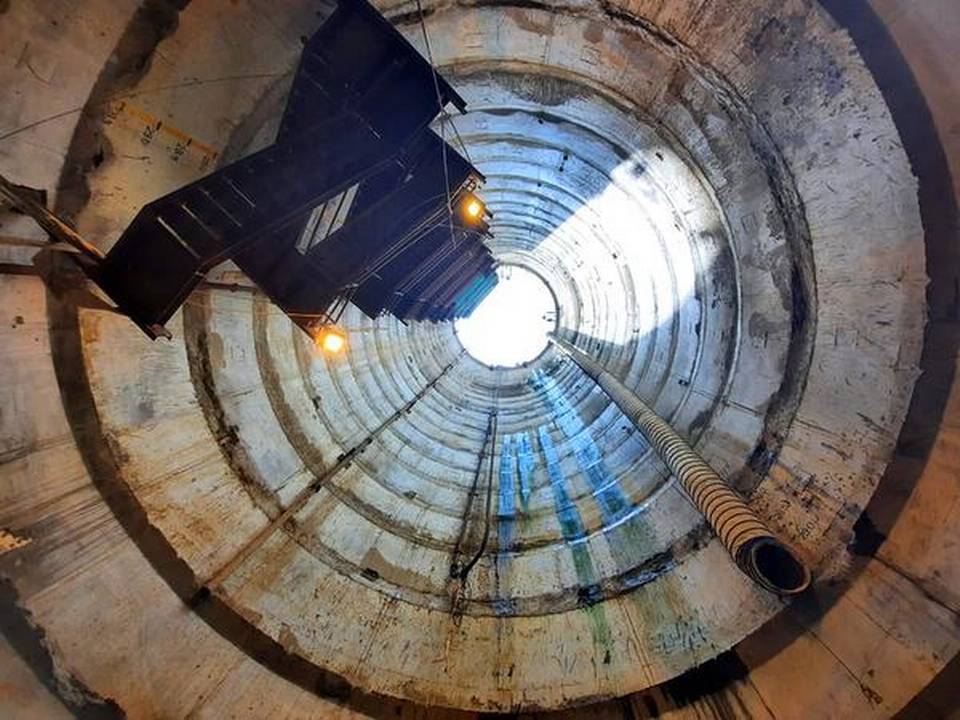
To greater depths: India’s deepest ventilation shaft for East West Metro in Kolkata.

The Metro project connects Kolkata and Howrah through underground tunnels below river Hooghly

Kolkata’s East West Metro Project, a mega infrastructure venture connecting the twin cities of Kolkata and Howrah through underground tunnels below the river Hooghly, will have achieved another engineering feat on Monday when it completes India’s deepest Metro ventilation shaft. The shaft goes 43.5 metres below the ground level, equivalent to a 15-storey building. The shaft will not only provide ventilation to the tunnels, but also an exit for evacuation during an emergency.

The evacuation shaft is located at Strand Road near river Hooghly and is situated between the two tunnels.

“This is a marvellous achievement, to successfully complete the 43.5-metre deep Metro ventilation shaft on the bank of river Hooghly. This is India’s deepest Metro ventilation shaft ever constructed by adopting a unique methodology… ,” said Satya Narayan Kunwar, Project Manager, Afcons.

Afcons had been commissioned by the Kolkata Metro Railway Corporation Ltd ( KMRCL) to execute the underground stretch of the East West Metro Project from Howrah Maidan to New Mahakaran station, which includes the tunnels below the river bed. The projects have already achieved a number of significant milestones which are considered engineering marvels. Two tunnels running parallel to each other about 37 metres below the river bed were completed by mid 2017 followed by the Howrah Metro Station, which, at 30 metres below the earth surface, is the deepest metro station in the country.

Afcons officials said the ventilation shaft was another such milestone. The shaft has a 10.3 metre inner diameter circular lining wall of minimum 500 mm thickness, and of concrete grade minimum M40 (a special construction material) circumscribed by 1 metre thick diaphragm walls all around.

‘Innovative techniques’

“The Metro shaft has been constructed adopting innovative engineering techniques and methodology to navigate geological challenges and overcome any impact on Kolkata’s circular railway track along river Hooghly,” Mr. Kunwar said.

The 16.6 km East West Metro Project will connect Howrah on one side of the river Hooghly to New Town Rajarhat in the north eastern fringes of the city on the other side. About 10.8 km of the metro line is underground and the remaining 9.8 km of the project will be through an elevated corridor.

source: http://www.thehindu.com / The Hindu / Home> News> Cities> Kolkata / by Shiv Sahay Singh / Kolkata – August 10th, 2020

Versatile musical genius – Kamal Dasgupta

With a career of about fourteen years, Dasgupta have approximately 8,000 songs under his belt including 80 Bengali movies – his unique contribution was the invention of a shorthand method for swaralipi.

In the 1940s, he was a star composer. He had many firsts to his name. He was the most educated man across the industry in those days. He came to the rescue of singers who were trying to break into the music world. He gave music in the most successful films of the 40s. The sale of his private records touched an all-time high. Yet the man behind many unforgettable melodies has been forgotten – he was Kamal Dasgupta.

Kamal was born on July 28, 1912, in Kalia village in the district of Jasore, then in British India (now in Bangladesh). He was initiated into music by his father Prashanna Dasgupta. He later learnt it from his brother Bimal Dasgupta. Afterwards, he became a disciple of the legendary Dilip Kumar Roy and Ustad Zamiruddin Khan. He did his matriculation from Calcutta Academy. Later, he completed his B Com from Komila Victoria Collage. He joined Banaras Hindu University (BHU) for his masters. He earned his PhD from BHU for his work on Mirabai’s bhajaans and music.

Kamal Dasgupta was a versatile musical genius. He used to sing modern songs in Bangala, Hindi, Urdu and Tamil.

He was a brilliant composer who composed around 8,000 songs. His first composition was recorded in 1932 in the voice of Satyaboti. His composition was classical based and folk music. Later he tended to lean towards Thumri style and Naats.

In 1935, Kamal Dasgupta joined the Gramophone Company of India in Calcutta as a music director. During this stint, he developed a close and lasting association with the poet Nazrul Islam. They became fond of each other and the relationship lasted for eleven years (1934-45). The culmination of their friendship were 400 songs – inspired by the works of the poet.

Calcutta was the major hub of Indian films produced in the 1930s. New Theatres and Madan Pictures were the main studios along with the other companies. After earning a name with his compositions, Kamal tried his luck in films. His first picture was Pandit Moshai (1936) in Bangla which was followed by Sarbjanin, Vivahotsab and Devyani between 1936-1942.

The legendary actor, director Prathmesh Chandra Barua was impressed by his music and gave him a break in Jawaab in 1942. PC Barua directed both the version in Hindi and Bangla. The film was an instant hit. It had cult numbers like Toofan mail ye duniya toofan mail, Ae chand chhup na jana and Kuchh yaad na rahe.

Kamal Dasgupta’s next film was MP productions social, Hospital, starring Kanan Devi, Ahindra Choudhary and Heeralal. Its hit number was, Ghata chhayi ghanghor. The very same year he did another Barua Production, Ranee. The cast included J Ganguly, Kalawati, PC Barua and Jamuna. Like his earlier films, his music became popular.

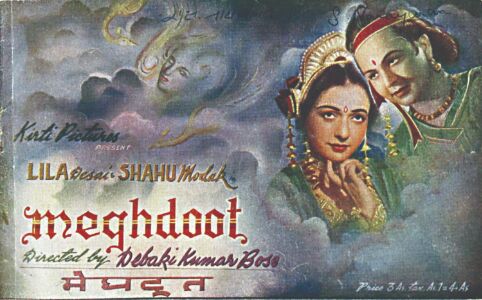
Kamal Dasgupta was as successful in films as he was in his private recording career. In 1944, he moved to Bombay and did the film Meghdoot (1945), based on the Sanskrit poet Kalidas. Leela Desai and Sahu Modak were in the lead. The film was directed by the legendary Debki Kumar Bose.

During his stay in Bombay, he did several films across different genres. His next film was Arabian Nights, directed by Niren Lahari. The cast included Kanan Devi, Nawab and Robin Majumdar. All the numbers of the film became very popular – Suno suno kya ek naya fasana, Hum dil ko, dil hamko samjhaye, Mujhe sapno se kaun jagaye re and Aankhon ki roshni hai dil ki ye ye chandani hai. The same year, he did a social film Bindiya, starring Ragini, Amar, M Shakeer and E Billimoriya. The film was directed by CM Luhar. Kamal Das Gupta used the voices of Anima Dasgupta, Kalyani Das, Hemant Kumar and Amar. Its hit numbers were: Hanso hanso ae kamal kali, Jeevan sargam pe aye jaa geet suhane, Meri aankhon mein ye aanshu nahi dil ki kahani hai and Chand pass hai raat andheri kyun.

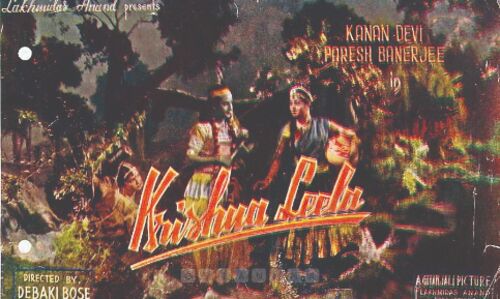
His next film was the mythological Krishna Leela (1946) which was directed by Debki Kumar Bose and had Kanan Devi and Paresh Banerjee in the lead. The popular hits in this film were: Man mein basa le manmohan ko, Prabhu teri maya jo chahaye, Sawan ki rani aaiye, Chanda door gagan mein bulaye, More janam janam ke saathi, Bahein churaye jaat ho nirmal mohe jaan and Tera ghar man mera.

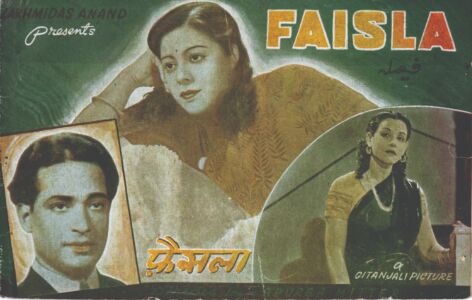
1946 was the busiest year for Kamal Das Gupta. He did Zameen Asmaan for director Dwarka Khosla, starring Ranjana, Jeevan and Kusum Deshpande. Its hit numbers were: Ek raat kabhi aisi aye, Papiha papiha to pee ko pukaar and Ek geet sunana hai hamein. Coming back to Calcutta, he did Faisala (1947) followed by Manmani. The film had Ragini and Jairaj in the lead. The film was directed by Sarvottam Badami. Its hit numbers were: Ishare ishare mein duniya bana li, Baiman tori batiya jadu bhari and Ae chaman bata kyun hansta hai.

His last film with his mentor PC Barua was Iran Ki Ek Raat (1949) – a costume drama, starring Jamuna, Narang, Chandrakant and Chandrawati.

Its melodious number were: Ulfat mein jise banaya tha, Chhalke chhalke sarabein jawani ke palaye, Kaun hai teer andaaj bada, Ae dil kya and Khel hai ye zindagi.

His last release was Phulwari in 1951. He had 40 films to his credit. Following this, the maverick composer got completely disillusioned by the film industry and recording companies. His favourite songs which were sold in the lakhs didn’t carry his name on the jackets.

At the age of 44, he married his favourite singer, Firoza Begum and embraced Islam. Kamal Dasgupta, by now, became Kareemuddin Ahmed. He kept on doing movies whenever an offer came. His last film in Bangla was Bodhu Baran in 1967. He shifted to Dhaka. When Bangladesh became independent, he became a citizen in 1972.

The composer was a man of taste. He owned a Buick, a rare thing in Calcutta in the 1950s. He was a great human being. He fed hundreds of people during the Bengal famine. He was also extremely fond of cricket. He was blessed with three sons – Shafin Ahmed, Hamin Ahmed and Tahsin Ahmed. They followed their father in music and cricket. Two brothers played cricket at the state level and Hamin Ahmed was selected for the national team of Bangladesh.

Kamal Das Gupta with his failing health and lack of proper medical treatment succumbed to his ailments and passed away in Dhaka on July 28, 1974, at the age of 62.

source: http://www.millenniumpost.in / Millennium Post / Home> Sunday Post> Beyond Bygone / by Sharad Dutt / March 07th, 2020

A few good men

To duck the coronavirus or dodge Amphan’s fury was never top of their agenda

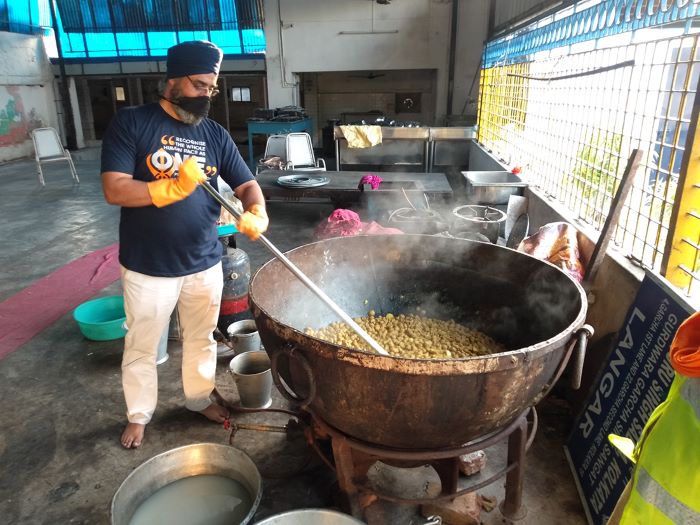
SERVE ALL: Food being prepared in the Khalsa Aid kitchen for those hit by Amphan / Courtesy, Raghbir Singh

During the first few days of the lockdown, Raghbir Singh and some others served 500 meals in and around south Calcutta. Thereafter, they lost count and it was never the point in any case.

The 30-year-old, who works part-time as a real estate dealer and also helps out with the family car rental business, is not new to relief work; he has helped during the Kerala floods of 2018 and the Assam floods of 2019. He says, “When the lockdown was announced, we knew our relief work would have to be ramped up. Since Day 2 we started cooking dal-chawal daily at the Garcha gurdwara and distributed it to people living on pavements and makeshift houses by the roadside.” Volunteers also went around city hospitals such as Chittaranjan Hospital in Park Circus, R.G. Kar Medical College and Hospital in Shyambazar and Calcutta Medical College on College Street with food packets for patients’ kin.

After the first few days, volunteers of Khalsa Aid, a UK-based humanitarian relief organisation, with the help of south Calcutta’s Sri Guru Singh Sabha Gurdwara, started distributing rations — flour, rice, pulses, sugar, salt — to those in need. They had those as well as cooked food home-delivered too. Raghbir has also been on National Highway 6 a couple of times since the lockdown to hand out bottles of drinking water, biscuits, puffed rice and juice to migrants walking home.

It is difficult to get phone time with Raghbir. Their garage has been shut, and he has been immersed in seva round-the-clock. It entails serving cooked food all day and then driving around the city in the evening delivering household staples.

Raghbir says amidst all this frenetic activity, every successive day he has seen a different side to humanity. “I saw first-hand how difficult it was for the daily-wage earners to survive. They wanted to earn money and some refused to accept the food we distributed.” He talks about others, middle-class folks who first fought shy of seeking assistance, but approached him when he was by himself. “I met so many people who feel that because they are poor, they do not exist for the government,” says Raghbir in muted tones.

On the night of Cyclone Amphan, Raghbir and others from Khalsa Aid got their cars out and drove around the city looking for the stranded and those in need of help of any sort. “We came upon more than one ambulance — carrying patients and kin — stuck on the road. There were uprooted trees all around, impeding movement,” he says.

The morning after brought to light the scale of devastation. Keeping in mind the disrupted power supply and lack of running water across the city, the sevaks went about collecting more groceries. On the first day, they distributed food and water among 400 people, the next day that number doubled and the day after that, it tripled.

Funds to continue this outpouring of support continue to come from private organisations and individuals, most of who prefer to remain nameless.

The night of the cyclone, Raghbir and other volunteers had received instructions

to be on Ground Zero and report the situation so they could start relief work immediately. He says, “We were unable to reach places such as Namkhana and Kakdwip in South 24-Parganas as the roads were completely blocked; so we focused on Calcutta until the roads were cleared.”

On May 25, the group set up their base camp in Diamond Harbour, also in the South 24-Parganas. Raghbir says, “Most of the people had kutcha houses and the cyclone had blown them away. We had carried along plastic sheets; we made canopies for temporary shelter.” The kitchen in Diamond Harbour fed the locals and also many in the Sunderbans and Sagar Island.

Did Raghbir ever fear that he would contract the coronavirus? Does it play on his mind even now in the face of continuing relief work? By way of reply, a photograph lands in the chat window. A close-up of a Khalsa Aid T-shirt with a message emblazoned on it. It reads — Recognise the whole human race as one. Raghbir says, “There is magic in the uniform.”

source: http://www.telegraphindia.com / The Telegraph, online edition / Home> Culture / by Manasi Shah / June 06th, 2020

First-ever container cargo from Kolkata via Chattogram port reaches Agartala: MEA

India and Bangladesh have enhanced cooperation in shipping and inland water trade in the recent years.

MEA Spokesperson Anurag Srivastava

New Delhi :

The first-ever container cargo from Kolkata via Bangladesh’s Chattogram port has reached Agartala, the External Affairs Ministry said on Thursday, terming it a “historic milestone” in the Indo-Bangladesh connectivity and economic partnership.

Union minister Mansukh Mandaviya had last week flagged off the first trial container ship from Kolkata carrying cargo meant for Agartala that reached the city via the Chattogram port.

MEA Spokesperson Anurag Srivastava said it will help in further development of the northeastern region.

“Another historic milestone in India-Bangladesh connectivity & economic partnership as the first ever container cargo from Kolkata via Chattogram port reaches Agartala.

This will help in further development of the north eastern region,” he said in a tweet.

India and Bangladesh have enhanced cooperation in shipping and inland water trade in the recent years.

Under the Protocol on Inland Water Transit and Trade, in addition to the six existing Ports of Call, five more in each country have been added recently, the Ministry of Shipping said in a statement last week.

A Port of Call is a place where a ship stops during a voyage to enable the loading and unloading of cargo.

Dredging of inland waterway routes is ongoing under a pact signed by the two countries on development of fairway in selected stretches of Bangladesh waterways, with the Government of India bearing 80 per cent of the project expenditure and the balance being borne by the neighbouring country, it said.

Cruise services have also commenced between the two countries, promoting tourism and people-to-people contacts, it said.

source: http://www.newindianexpress.com / The New Indian Express / Home> Nation / by PTI / July 23rd, 2020

Why the Internment of Chinese Indians Is a Story That Must Be Told

When citizens become enemies, such an episode cannot be cannot be pushed to the recesses of public memory.

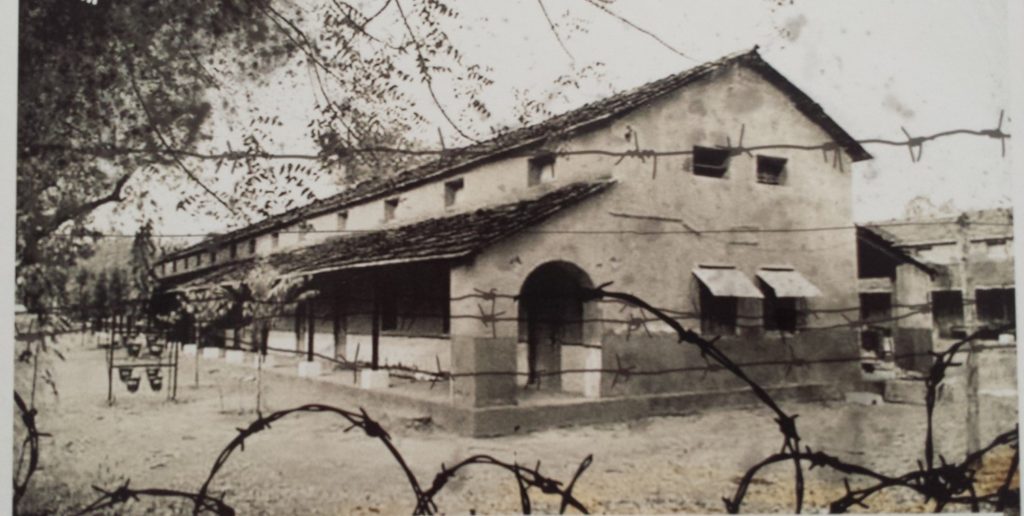
The internment centre at Deoli. Credit: indiadeoli.wordpress.com

It’s in the nature of history that some stories are seldom told, if at all. The story of the Chinese community in this country, summarily packed off to internment camps after India was defeated by China in the 1962 war, is one such episode pushed to the recesses of public memory. There has been little discourse around the subject, and no official acknowledgement of the injustice done to the Chinese Indian community.

Rita Chowdhury rescues that slice of history from oblivion in her historical novel, Chinatown Days. First published in Assamese in 2010 with the title Makam (named after the main Chinese settlement in the region), the book brings those fraught years to light. Overnight, Chinese Indian families were yanked out of their homes, split up, and herded onto trains to spend an unknown number of days, months, or even years in a prison camp in Deoli, a town in Rajasthan. A bewildered and anguished community tried, in vain, to make sense of its sudden degraded status as prisoners.

Chinatown Days reveals how wars scapegoat people who have nothing to do with lighting or stoking the fire. People who simply happen to be on the wrong side of history at a juncture – like that one – when passions are riled up, and governments are locked in war. The stigma of internment, along with the absence of social and political conversation around the injustice, drove survivors of the Deoli camps into silence for nearly five decades.

As a fresh conflict between India and China surfaces with scenes of politicians and ordinary citizens calling for boycotting Chinese goods and trades , we may recall the plight of the Chinese community that suddenly found itself hemmed in from all sides because of a war that was not of their making.

Earlier this year, in their book, The Deoliwallahs: The True Story of the 1962 Chinese-Indian Internment, authors Joy Ma and Dilip D’Souza used interviews to capture the voices of the Chinese community, spanning generations, now dispersed across India and the rest of the world.

Born in Deoli, in her section of the preface, Ma writes : “The Camp is something I lived with from the earliest moment … For us, the survivors of the interment … the stigma and effects have lasted a lifetime, made deeper by the lack of information about the incident. And the experience remains hard to forget no matter how far we have come.” She now lives in the US.

Survivors speak of their experiences in the documentary, Beyond Barbed Wires: A Distant Dawn, saying that even a word of apology from the Indian government would go some way in helping them negotiate the past and heal its wounds. “The total population of Kolkata’s Chinatown was around 30,000, After 1962, there are hardly 2000 Chinese living in India,” Ming-Tung Hsieh, a former detainee, says in the film.

If and when they see the light of day, such narratives show the fragility of existence in a country that you may not have been born in, but one you have embraced as your own, and have been living in for generations.

The genesis of the Chinese community in India dates back to at least the 19th century, when the British East India Company hired workers from China to launch the tea industry in India. Citing Kolkata’s National Library records, Jaideep Mazumdar, in an essay, identifies Yong Atchew as the first Chinese person to settle in Calcutta in 1780. Atchew launched a sugar mill around which grew one of India’s first Chinese communities. By the middle of the 19th century, there was a sizable Chinese population living in India. And at the time of Indian independence, descendants of the early Chinese workers – some of whom were transported to the country as slaves – had become integrated with local cultures, considering themselves citizens of India.

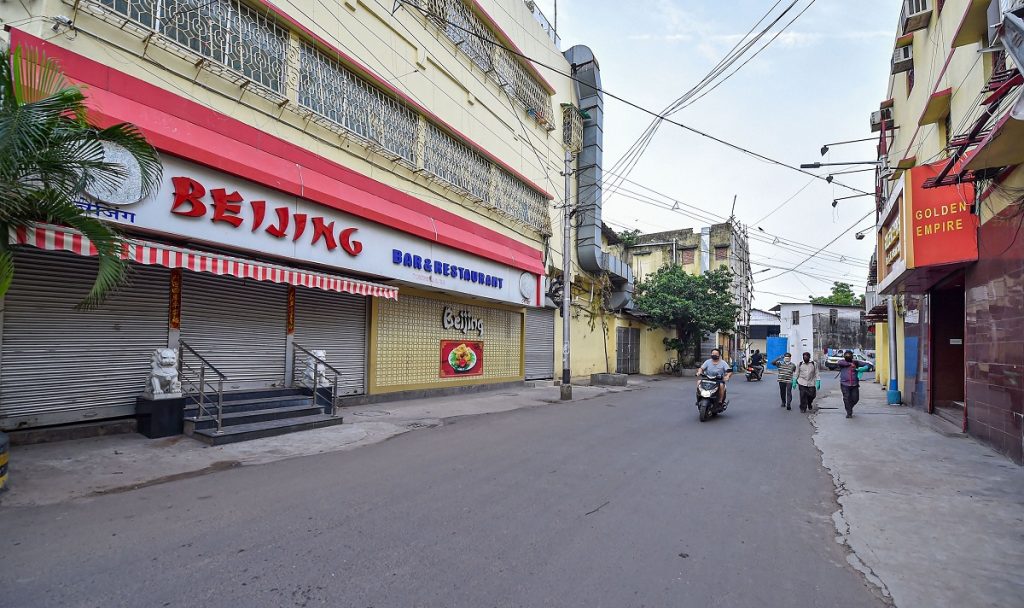
Chinatown in Kolkata wears a deserted look on June 19, 2020. Photo: PTI/Swapan Mahapatra

A group of Chinese workers brought to Assam by the East India Company in the 1830s, many of them indentured or trafficked, form the Chinese community in Chowdhury’s novel. At a time when the ‘outsider’ vs ‘insider’ debate in our public and private conversations has become layered with such corrosiveness, Chowdhury portrays a seamless assimilation of the Chinese community within Assamese society. Assamese and Chinese women and men get married into each other’s communities, the Chinese speak fluent Assamese, while the Assamese eagerly wait for the celebrations of the Chinese New Year. Chowdhury’s novel closely follows the reality of the times. In today’s acidic atmosphere of suspicion, one wonders if this is what utopia looks like.

The India-China war, and particularly India’s humiliating defeat at the hands of the Chinese, in one swoop destroyed that equilibrium. The Indian government, then headed by Jawaharlal Nehru, chose to treat the Chinese community as ‘enemies’ for their association with the enemy country, even though China was not just geographically but culturally distant to the Chinese community in India. Overnight, Chinese Indians across India, particularly in the Northeastern regions and Kolkata, became suspects in the eyes of the government and society. Chowdhury presents a vivid portrayal of the police suddenly appearing on the doorsteps of unsuspecting people, giving them barely ten minutes to leave for an unknown destination, ordering them to leave behind their belongings.

The parallel with Japanese Americans

The story of the wartime incarcerated Chinese prisoners finds a parallel with the internment of over 1000,000 Japanese Americans after the attack on Pearl Harbour during the Second World War in 1942. In reaction, then US president, Franklin Roosevelt, signed an executive order forcing Americans of Japanese ancestry to be removed to concentration camps for five years. Almost two-thirds of the detainees were Japanese Americans, born in the US. They had never visited Japan. In 1988, Ronald Reagan signed the ‘Civil Liberties Act of 1988,’ formally apologising for the internment of American citizens. This happened, in no small measure, because ordinary Americans protested and spoke out against the incarceration of fellow citizens.

“The Chinese Indians did not have any civil liberties group supporting them. Not one group – not one person objected to internment of Chinese Indians. Deoli camp was done like a playbook from Japanese internment … but for the lack of representation in India … there is very little support from groups…” said  Joy Ma in a conversation around the book.

The former Chinese detainees still await an acknowledgement of the injustice done to their community. There are still questions hanging in the air: Who accepts you as a citizen? Who will stand by you in a time of crisis? What happens to a community if the country they believe to be their own enters into war with the country of their ancestors?

I scarcely need to point out that these questions have not gone away, for those who suffered that injustice, or those who suffer injustices that are still ongoing.

source: http://www.thewire.in / The Wire / Home> Analysis> Rights / by Monobina Gupta / June 23rd, 2020

Remembering Uma Bose, who presaged a new era for vocal music

‘The Nightingale of Bengal’ died of tuberculosis on her 21st birthday.

Uma Bose with Dilip Kumar Roy | Overman Foundation

I heard about Uma Bose from my mother when I was a child. She spoke of her with unusual regard, and with sadness and wonder. Uma Bose was born to an eminent, well-to-do family in Calcutta on January 21, 1921, and she died on her 21st birthday of tuberculosis, in 1942. I was told her younger brother had already died of TB and that this had broken her heart.

The wonder and sadness in my mother’s references were mixed up with each other when she dwelled on the symmetry of the life and death, the cruelty that had cut off Uma Bose’s life as a singer and the abundance of fortune that had given her a singular timbre and astonishing mastery well before she died, when she was still half a child.

Uma Bose learned Hindustani classical music for a period from Vishmadev Chatterjee, but her métier became a new kind of modern song that was emerging in Bengal after Tagore, a rival to, and precursor of (in terms of musical and orchestral innovation), the revolution that would change film music in Bombay in the 1950s and ’60s.

To this kind of music she brought a classical proficiency, and a classicist sophistication and calm, whose character was absolutely modern, and I think unheard-of in the 1930s – prefiguring the contained virtuosity and the classicist poise that Lata Mangeshkar would bring to film-music singing in the 1950s.

Her reputation was built on being among the first interpreters of the songs of Himangshu Dutta, one of the great innovators of the popular song in the twentieth century (I’m not qualifying this with “in Bengal” or “in India” for good reason), and on her renditions of the songs in the demanding, eccentric repertoire created by the scholar-poet-singer-mystic Dilip Kumar Roy (1897-1980), son of the poet and songwriter Dwijendralal Ray (1863-1913).

The two songs I’ll first draw attention to here – their tunes are composed, and music arranged, by Himanshu Dutta – are Akasher Chaand (The moon in the sky) and Chaand Kahe Chameli Go (The Moon Says, O Chameli). The first is from 1940, when Uma Bose was 17 years old; the second from 1938, when she was just 17. These are part of a series of songs whose words Dutta got his lyricist friends to write, about the abortive love between the moon and the chameli flower.

Listen first to the curious but arresting mix of instruments – the electric slide guitar; a horn; the sitar; the mix of a three-note orchestral bass line and very light tabla in the 1940 song; the deliberate abstention from tabla in the 1938 arrangement, where rhythm is provided solely by bass lines on strings which don’t, however, interfere harmonically with the song’s ethos but add an unprecedented texture.

I can hear no Indian instrument in Chaand Kahe Chameli Go.

https://www.youtube.com/watch?v=bi-4bi77NlU

Notice the tunes themselves. Akaasher Chaand sounds like it’s based on a raga, but it’s a mix of three – Kamod, Kedar, and Gaud Malhar – that all approximate the major scale and all use both the ma and tivra ma; that is, the natural and sharp fourth. These two notes are revisited to extraordinary effect midway through the song by both Dutta’s composition and by Uma Bose. It’s the kind of subtle but revolutionary modulation on compositional thinking made possible by Tagore, which Dutta extends also to his arrangements.

There is nothing comparable to this testing of demarcations in the Western popular music of the time. In Aakasher Chaand, Bose uses her classical training to play with complex melodic phrases from 1.16 to 1.20 minutes, but brings to the song a deep tonal tranquility and fullness that she takes from her training in, and deep feeling for, the khayal: there is nothing “light” about her approach.

In Chaand Kahe Chameli Go, the melody, which has no counterpart in a raga (the closest is Chhaya Nat), is transformed into an Indian song by the singer and the composer through the use of meend, or North Indian classical music’s glides between notes. You wouldn’t notice that the tune isn’t an actual raga, given the interpretation – but if you sing the opening notes without the meends, you’ll see the melody is very like a Western marching tune or drinking song.

These compositions and renditions aren’t attempts to mix things up; they are a new way of thinking about music.

https://www.youtube.com/watch?v=iOzR0Wj2B5M

Uma Bose’s mentor was Dilip Kumar Roy, the son of a great poet and songwriter, a cosmopolitan who went to Cambridge to do his Tripos but turned more and more to music (he was a gifted and trained singer), experiments in musical composition, and mysticism. To understand figures like Roy – and others before him and contemporary to him – and their particular rebellion, you’d have to imagine what our present-day cultural landscape would be like if some our public intellectuals, social scientists, historians, and commentators began to compose songs, turned out to be deeply tuneful singers with classical training, artists attempting to create a secular vocabulary in poetry and music to express a kind of surrender.

One recalls Nietzsche’s loathing of Socrates for his habit of over-determined theorising, but his warming to the Athenian because the latter set aside philosophy as a condemned man and began to learn music shortly before his death. To understand the revolution that people like Roy (and before him his father Dwijendralal, and his father’s contemporary Tagore) undertook against the colonial self, which could be figured as a kind of Socrates, one must understand the release that the arts, especially modern music, constituted. This release made them extend themselves and their sphere in a way unknown to our intellectuals today. It’s in the midst of this revolution in the educated middle class that we should also place Uma Bose’s singing.

Here are two compositions of Dilip Kumar Roy’s, sung by Uma Bose, both combining devotional elements with Hindustani classical ones, their taans or complex melodic patterns containing echoes of operatic coloratura. They’re like idiosyncratic blueprints of projects that could only have been attempted by an inventor who had access to a multiplicity of cultural languages, techniques, and experiences. They are abstractions, really; it takes Uma Bose’s voice and abilities as an experimental singer, which is what she becomes in these songs, to breathe life into them.

https://www.youtube.com/watch?v=VBEsoAE1lsk

This is Rupe Barne Chhande, loosely based on Khamaj, and Jibane Marane Esho, an invocation of a devotional mood in raga Asavari.

I’m adding a third song here Ke Tomare Jante Pare, Dilip Roy’s father Dwijendralal’s peculiar but compelling riff on the kirtan form.

Uma Bose was conferred with the well-intentioned sobriquet “Nightingale of Bengal” by Gandhi in 1937. She’s little listened to today, in Bengal or outside it. Partly this may have to do with the unclassifiable character of Dilip Kumar Roy’s songs, which are also too difficult to hum to yourself. But mainly it owes to the dominance of an anodyne and sentimental version of the Tagore song that ruled over Bengal from the 1960s, and to a form of tremulous singing that Bengalis began to hold close to their hearts. (If you compare the 1966 version of Chaand Kahe Ghameli Go by Hemanta Mukherjee to Uma Bose’s, you’ll have an idea of this pervasive tremulousness.)

Outside Bengal, our understanding of the history of the popular song in India has been both enriched and curtailed by Hindi film music. It provides a definition that’s full of excitement and variety; but it is, itself, by no means definitive. Uma Bose, like the experimenters whose work she was integral to, was a pioneer. Her emphasis on purity of tone, and a technical accomplishment that goes well beyond precociousness, presaged a new era for vocal music.

Amit Chaudhuri is a writer, a Hindustani classical vocalist, and a composer of crossover music. Listen to his music here.

source: http://www.scroll.in / Scroll.in / Home> Acts of Retrieval / by Amit Chaudhuri / June 23rd, 2020

Plasma bank to come up at Calcutta Medical College and Hospital

Facility to boost Covid therapy trial, but doctors sceptical of donor response

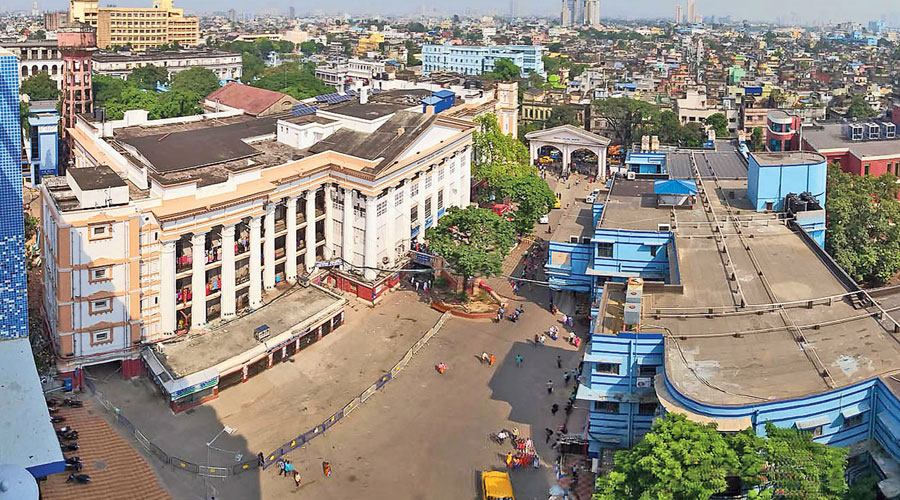
Calcutta Medical College and Hospital.
File picture

The Bengal government will set up a plasma bank at the Calcutta Medical College and Hospital to help conduct trials for plasma therapy for Covid-19.

Doctors and health department officials welcomed the move but wondered how many people would agree to donate plasma after recovering from the disease. Only a few donors have come forward since clinical trials of plasma therapy were launched a few months back.

The bank has been planned to help carry out trials by storing plasma cells — donated by people who have recovered from Covid-19 — before they are infused into patients undergoing treatment for the disease, said officials.

Plasma collected from the blood of a person three to four weeks after he or she has recovered from Covid-19 is expected to contain anti-viral antibodies, said doctors. As part of the therapy, a patient gets 200ml of plasma, stored in -80 degrees Celsius, daily for two days. After a few days, the blood is analysed for immune-response.

“We received Swasthya Bhavan’s nod on Sunday to set up the plasma bank,” said Prasun Bhattacharya, the head of the department of immunohaematology and blood transfusion at the Calcutta Medical College and Hospital, now a dedicated Covid treatment centre.

“The bank will help us continue our clinical trials. We will require some time to create the necessary infrastructure for the bank to be fully functional,” he said.

Over the past few weeks, experts in immunohematology and blood transfusion have been trying plasma therapy on patients with mild to moderate acute respiratory disease symptoms at the Infectious Diseases Hospital in Beleghata.

The trial had begun following a nod from the Council of Scientific and Industrial Research, which had collaborated with the Indian Institute of Chemical Biology, Calcutta, for this initiative by the Bengal government.

The first person to donate plasma for the trial was Monami Biswas. The 23-year-old postgraduate student of business management at the University of Edinburgh had tested positive after she arrived in Calcutta on her way home to Habra in North 24-Parganas in May.

But, like in other parts of India, doctors and scientists in Calcutta are facing reluctance from potential donors.

“Forty patients are supposed to get plasma as part of the trial that started in May. Till date, we have been able to infuse plasma into 10 patients and have managed to get 12 donors,” said one doctor involved in the trial.

According to the health department, 15,235 people have recovered from Covid-19 in Bengal till Monday.

A doctor said they had approached many who have recovered. “But most have turned down our requests. Some are scared they might catch the virus again if they come to donate plasma. A few were discouraged by family members from donating plasma,” the doctor said.

“Stigma and fear of getting infected again are preventing many from donating plasma,” said Abhijit Chowdhury, a public health expert. “Many people who were infected by the coronavirus suffered trauma because they were ostracised by neighbours. Some suffered trauma because of the behaviour of a section of healthcare workers at the hospitals where they were admitted.”

India’s first plasma bank was inaugurated at the Institute of Liver and Biliary Sciences, in Delhi’s Vasant Kunj on July 3.

The same day, a brigadier who had tested positive for Covid-19 died at a Calcutta hospital. Sources said Brigadier Vikas Samyal, who was posted at Fort William, was subjected to plasma therapy at Command Hospital in Alipore at the last moment. The therapy apparently didn’t work.

“Since trials are on, it wouldn’t be proper to comment on the outcome so far. But yes, plasma therapy cannot be tried on any Covid-19 patient anytime,” a doctor said.

source: http://www.telegraphindia.com / The Telegraph, online edition / Home> West Bengal> Calcutta / by Kinsuk Basu / July 07th, 2020

Two friends who wear India’s self-reliance on their wrists

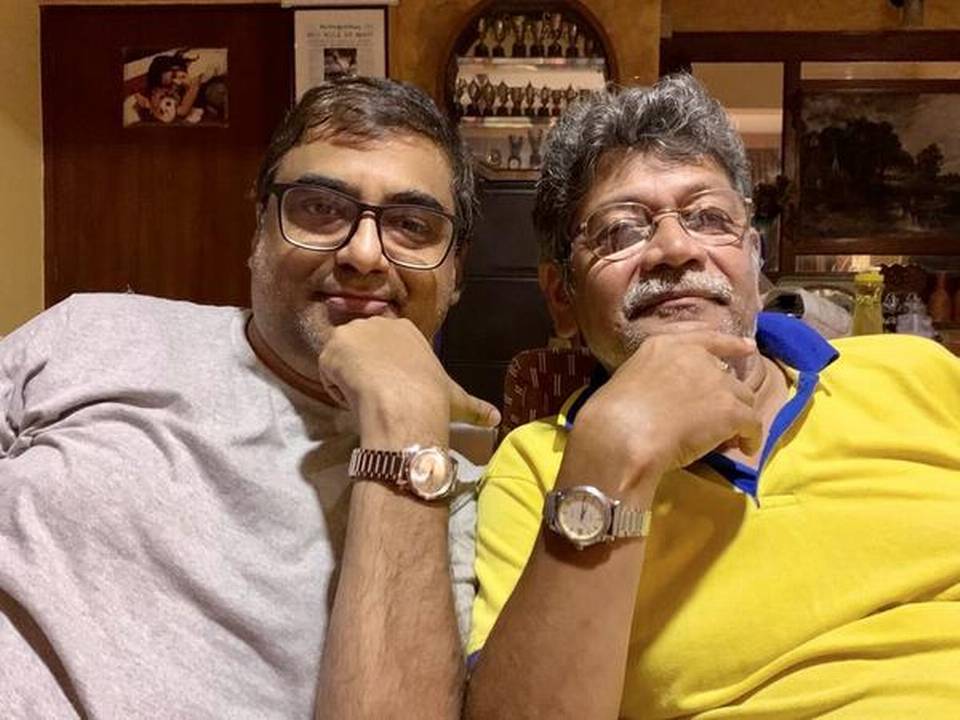
Mr Chakraborty (left) and Mr Singh Roy  

These men from Kolkata sport only HMT watches and boast an impressive collection of the brand.

Madan Mohan Chakraborty begins by making an irrefutable statement: that a watch is a watch; whether it costs a hundred rupees or a million, it shows you the same time.

He should know better. His fascination for watches dates back to his childhood. “A watch is a consummate combination of art and science,” says Mr. Chakraborty, CEO and managing director of a European technology MNC. “I was always attracted by design, art, engineering, accuracy and precision, and in a watch, you get it all.”

But what sets him apart is that a large chunk of his collection consists of HMT watches. Even though he owns many expensive brands as well, it is always an HMT that adorns his wrist. “Here, look at this,” he shows off an HMT Surabhi, “this is better than most Omegas. And this is HMT Priya, look how gorgeous it is!”

HMT — set up as Hindustan Machine Tools in 1953 — began making watches in 1961 and the first batch of its hand-wound watches was released by then Prime Minister Jawaharlal Nehru. For decades, HMT remained synonymous with a wrist watch before, towards the end of the century, Titan took its place, a process that was soon followed by the easy availability of internationally reputed brands in the market.

As an icing on the cake for Mr. Chakraborty, his best friend, Debasish Singh Roy, also happens to be an HMT collector. “I collect coins, cameras, currency notes, but watches are something that I collect as well as use. HMT has been a part of my life, right from the thread ceremony to marriage. I feel good when I think that my watches will go to my daughters and the generation after. Spending time with my collection was one of the most interesting things I did during the lockdown,” said Mr. Singh Roy, a businessman and a sports enthusiast.

Why this fascination for HMT?

Mr. Chakraborty replied on behalf of both: “HMT carries the ability of India. It demonstrates the capability of India, second after second, minute after minute, hour after hour, day after days and generations after generations. We feel extremely proud when we walk in the by-lanes of Switzerland with an HMT Janata or a Pilot on our wrists. People who understand watches can tell whether a watch is mechanical or battery-operated.”

Mr. Singh Roy said: “Many are not even aware that HMT watches are still available on their official site. Many are also not even aware that most HMT factories have closed down and the last one may close down soon. The irony is that HMT was not making money when the watches were available within Rs. 1000. Now when you have to pay between Rs. 1,000 and Rs. 12,000 to get an HMT, there is a queue. HMT failed as there was no effort in its branding. When the world is talking about going green, it’s time for us to stop using battery-operated or even smart watches.”

Mr. Chakraborty, as he fished out more sturdy-looking HMTs from his collection, added: “There are many reasons that HMT should be revived. If properly promoted, the entire globe is your market. You don’t need exclusive showrooms to sell watches. HMT-lovers groups active online will promote the brand. Atmanirbharta  [or self-reliance, readvocated recently by Prime Minister Narendra Modi] must be an action, not just an empty slogan.”

source: http://www.thehindu.com / The Hindu / Home> News> Cities> Kolkata / by Bishwanath Ghosh / Kolkata – July 09th, 2020