Category Archives: Records, All

Kolkatan bags top honour for documentary

Kolkata :

A moving tale of an autistic child has earned independent filmmaker Amrita Dasgupta the `Best Director’ award at the first International Film Festival for Persons with Disabilities, organized by the Union government. She received the trophy from I&B minister of state Rajyavardhan Rathore in Delhi a couple of days ago.

The film, `The New Girl in Class’, was produced by Public Service Broadcasting Trust and Doordarshan. “They take proposals for films every year, and I had sent mine. I made the film after it was selected,” said the Delhi-based Amtrita, who graduated from Calcutta University . “The screening was with special educators and children with disabilities. Every child could relate to it, which I didn’t expect. I never thought of children as the target audience; it is primarily meant for parents and teachers,” Dasgupta said.

The filmmaker credits her stay at her ancestral home on Hindustan Road for helping her develop a passion for art and culture, which later became a profession.

“I’m trying to bring the film to Kolkata. I’m arriving on December 19 and I’ll try to screen it,” she told TOI.

City musician Mainak `Bumpy’ Nag Chowdhury has composed the soundtrack for the film. The film explores the possibility of education for children with autism in regular schools.

It traces a mother’s perseverance over the years to improve her daughter’s condition with autism -her behaviour, communication and learning ability. Her struggle does not end with her daughter’s admission to a regular school, but continues every day with a greater zeal to ensure her learning as she shadows her to school and other remedial classes.

While announcing the dates for the film festival last week, Lov Verma, the secretary at department of empowerment of persons with disabilities, ministry of social justice and empowerment, had said it was organized to recognise the spirit of persons with disabilities.

source: http://www.timesofindia.indiatimes.com / The Times of India / News Home> City> Kolkata / by Shounak Ghosal, TNN / December 07th, 2015
RIP, Sister

SisterKOLKATA07dec2015

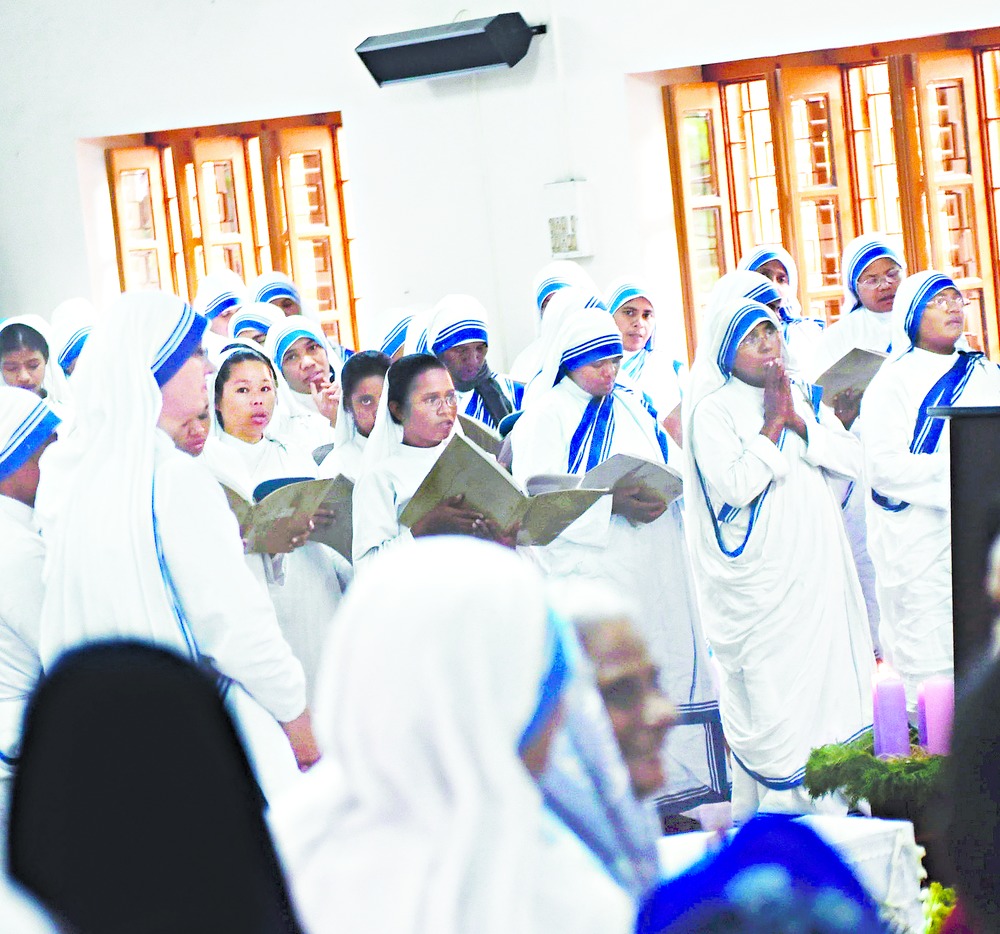
Nuns of Missionaries of Charity at a prayer service for Sr. Gertrude MC at Mother House on Sunday. Sister Gertrude, the second woman to join Mother Teresa in starting the Missionaries of Charity, passed away in the morning.

Born on March 8, 1929, Sr. Gertrude was a doctor. She was Mother Teresa’s student at St. Mary’s High School in Calcutta in the 1940s. Mother Teresa was then the headmistress and in-charge of the boarders at the school.

Inspired by Mother, Sr. Gertrude spent her life serving the poor.

She was by Mother’s side when she passed away at Mother House in September 1997. “We became truly mother and daughter, more than a sister or a doctor,” Sr. Gertrude had written about her relationship with Mother Teresa.

source: http://www.telegraphindia.com / The Telegraph, Calcutta / Front Page> Calcutta> Story / Monday – December 07th, 2015

Kolkata based cardiologist felicitated for path-breaking surgery

Kolkata :

Most patients with heart injuries caused by speeding missiles (bullets, daggers, knives) are deprived of treatment because they bleed to death on the way to hospital, or while being operated. A surgeon has been felicitated for correcting the rarest of accident-related heart injuries by the Central Asia Regional Congress of Medical Women in India.

Prof Sushila Mitra, former head department of cardio-thoracic surgery, SSKM Hospital, presented the cases at the congress in a city hotel on Saturday.

Her first presentation was on Jagadhish Khatua (26), who was hit on his right chest by an arrow during an in-fighting between tribal groups at Birbhadrapur village in Midnapore in 1989. Bleeding profusely, he was admitted to SSKM Hospital and the x-ray showed that the tip of the arrow was inside her heart. “We did purse-string sutures on him, and transfused six units of blood. He went home, cured. Today he is totally symptom free, leading a normal life,” Mitra told TOI.

In another case, 18-year-old Tanmoy Gayen, was hit on his left chest by a stray bullet while he was driving his cycle van. He was admitted under Mitra on 4 April, 1998. “Initially, the bullet was missing in his x-ray reports. His chest was opened and closed. A post-operative CT scan showed that the bullet was deep inside his heart. The bullet was finally removed through an open-heart surgery,” Mitra said. She showed pictures of the man, 17 years later to show his fitness.

The surgeon’s third presentation was about 21-year-old Mahesh Chand diagnosed with a hole in his heart. He was admitted on 18 Match, 1994. “During the corrective surgery, the catheter tip accidentally broke inside the heart and got stuck in the right upper chamber of the patient’s heart. He was immediately shifted to the cardiothoracic surgery department and we did an open heart surgery,” Mishra said, adding “the patient was admitted through the night. We removed the ‘foreign body’ first and then the hole in the heart was mended. Post surgery, the patient was on ventilator for two weeks.” Twenty-one years later, Mishra said, the patients is married with a child.

source: http://www.timesofindia.indiatimes.com / The Times of India / News Home> City> Kolkata / by Ajanta Chakraborty, TNN / December 05th, 2015

German precision for cardiac surgery

Kolkata :

Cardiac surgery and heart ailment detection techniques are set to take a leap ahead with the introduction of advanced systems that will shorten the diagnosis period and make it easier and more precise.

Surgical devices and methods, developed in Germany and launched by Dr Kunal Sarkar at Medica Superspecialty Hospital on Wednesday, will help to detect the extent of blood flow reduction in the arteries, provide cardiac and respiratory support to patients whose heart and lungs are unable to function normally and make surgeries possible through small incisions.

The new methods include Transmit Time Flow Measurement (TTFM) -a diagnostic method that determines the level of blood flow reduction through vessels and helps in identifying vessels that are deeply embedded in the heart muscles. It can be used in transplantation surgery and other vascular procedures other than coronary artery bypass grafting (CABG).

The techniques also include one of the latest and most advanced procedures for conduit harvesting in CABG -endoscopic vessel harvesting (EVH). It requires a very small incision and apart from the cosmetic benefits, the pain is less compared to the open technique.

Extra Corporeal Membrane Oxygenator (ECMO) is another technique that is part of the package. It provides cardiac and respiratory support to patients whose heart and lungs are unable to provide an adequate amount of gas exchange to sustain life. ECMO works by removing blood from the patient’s body and artificially removing the carbon dioxide and oxygenating red blood cells.

Fractional Flow Reserve is the final procedure on offer. It helps in accurate diagnosis of a heart block and significantly reduces unnecessary stenting revascularization and helps in optimizing the therapy for heart patients. It helps the cardiologist in making an informed decision, particularly in case of multi-vessel blocks. The procedure relies not on how severely constricted an artery appears to be, but on how the constriction is affecting the blood flow.

source: http://www.timesofindia.indiatimes.com / The Times of India / News Home> City> Kolkata / TNN / December 03rd, 2015

Urban landscape honour for Eco Park

Kolkata :

The central Housing and Urban Development Corporation (Hudco) has voted Eco Park at New Town as one of the top two projects in the country for innovative planning and design, bringing new accolades for the city in urban landscaping.

The project, developed by West Bengal Housing Infrastructure Development Corporation Limited (Hidco), has won the second position under the `Landscape Planning and Design’ category . The first prize went for the development and revitalisation of Ranmal Lake at Jamnagar in Gujarat.”It is an encouraging recognition for the Hidco planning and engineering team.

The project was inspired by the CM,” said Hidco CMD Debashis Sen. Off the arterial road in New Town, Eco Park is spread over 480 acres, a 104-acre waterbody in its middle.

On July 19, 2011, on her way from airport, Mamata Banerjee reportedly alighted from her car as the waterbody caught her attention. On her instruction, the Hidco converted the area into an ecological garden.

New attractions, such as the Biswa Bangla Haat, a children’s play area, a butterfly garden, a musical fountain, a bamboo garden, a replica of the Ghum station and an adda zone, were added.

source: http://www.timesofindia.indiatimes.com / The Times of India / News Home> City> Kolkata / by Suman Chakraborti, TNN / November 30th, 2015

Freedom fighter scores a century

Kolkata :

He was born the same year America released its first 12-reel film, ‘The Birth of a Nation’ and Ranajit Roychowdhury celebrated his 100th birthday on November 6. The former freedom-fighter is embarrassed that Karolbagh Bangiya Samsad, the club he founded in Delhi in 1958, has planned a grand felicitation to mark his “100 fruitful years” at Tapan Theatre come Sunday.

“I guess my birthday was just another day. By living life, we are only going through the motions. I am happy that I’m still active at 100,” the centenarian said.

Roychowdhury was an engineer with CPWD, which he joined in 1942 and was sacked by his Colonial bosses for his political involvement. “In those days everyone was a Gandhian. Though I spinned the charkha, I had met Bapu only once,” he recalls.

He believed the Partition was but a “temporary affair” and the sub-continent would be one again. “Instead, we had to free East Pakistan,” the lean frame, striding along a Salt Lake road, shrugged.

A look at his life shows how much can happen in a century. If Roychowdhury’s infant years were marked by WWI, his youth went through the tumultuous WWII, when Indian soldiers fought on behalf of the British. He talked of these matter-of-factly, even while treasuring his photograph with Nehru.

The former freedom fighter’s nonchalance about the burning political issues is intriguing. “The same intolerance was there earlie. At least, the society is more stable now and India has moved forward,” he said. said the CPWD chief engineer who retired in 1974 (he had been reappointed in 1946).

His reactions to inflation is no different. “When I was born, 38kg of rice cost Rs 2.50 at Narail (his hometown in Bangladesh). My first pay was Rs 150. So what?”

Roychowdhury credits his longevity to a disciplined lifestyle, frugal meals and good sleep. “The secret to a healthy life is not just good diet but nurturing positive thoug-hts,” Roychowdhury said, adding, “I have never thought ill of anyone.”

He loved playing the flute, but gave it up when he lost his wife, Kamala. “I was 80 then. She had been bed-ridden for 20 years. Thanks to my fitness, I could look after her till the end,” he added. sighed, looking out of the window of his neatly laid out living room on the ground floor of his AC block residence.

The rest of his schedule has remained more or less constant: regular exercise, eating fruits and vegetables and making sure he doesn’t consume plant and animal protein together. His English and Bengali dailies have remained unchanged. He does know about whatsapp, but doesn’t care to use his cell phone. “I am not tuned to mobile sets. For me, the landline works better,” said Roychowdhury, recalling the pre- Sam Pitroda era when the telephone couldn’t be taken for granted. “The life we lead now is better,” he mused, referring to his daily conversations with his eldest (71-year-old) daughter in Mumbai. Three of his five daughters live in the US, and son, Bikramjit, a retired IIT engineer, is on the first floor.

And There is one passion Roychowdhury has stuck to: writing. The best of his published works are his autobiographies on the three stages of his life. “Can’t concentrate enough to wrap up the fourth: ‘Shesh Prahar’ (the last hour)”, I don’t think it’ll be printed,” he laughed.

source: http://www.timesofindia.indiatimes.com / The Times of India / News Home> City> Kolkata / by Ajanta Chakraborty, TNN / November 20th, 2015

Kolkata: Award for the best among equals

Kolkata :

On Panchami, celebrities and who’s who of the corporate world came together to name the winners of Ultra Force Premium presents Times Sharod Srestho 2015 (TSS), a contest to choose the best among the most popular pujas in Kolkata and Salt Lake.

The contest was powered by UCO Bank and jewellery partner Senco Gold & Diamonds; with associate sponsors Smithcucina Infracooka Super Cooktop and National Insurance Company, welfare partner Lions Club and co-sponsors LIC Housing Finance Ltd and CII Surakshit Khadya Abhiyan.

In its ninth edition, the initial two rounds of judging were carried out by Art College professors on the basis of parameters, such as best music, best theme and best surprise element. The final round of judging on Sunday saw celebrity judges —actors Abir Chatterjee, Swastika Mukherjee, Pauli Dam, Sonalee Choudhury, Rajatava Dutta, Anindya Chatterjee, Ritabhori Chakraborty, Priyanka Pal, Roja Paromita Dey designer Debarun Mukherjee, photographer Supratik Chatterjee, make-up artist Annirudh Chaklader, cinematographer Soumik Haldar, art director Koushik Dutta and director Sekhar Das—select the winners from among the shortlisted names, for different categories such as the best puja, best idol and jewellery. Ajeya Sanghati (Haridevpur), Behala Friends and Suruchi Sangha (New Alipore) bagged the Srestho Pujos.

“This is my fourth year with TSS. It’s fun to travel with friends and colleagues as we get to see the pujas in such a comfortable manner,” said Swastika. Director Sekhar Das said, “It was lovely to be associated with Times Sharod Srestho. An overall nice experience.”

For Pauli, it was a unique get-together, replete with adda, snacks and the opportunity to see some of the best pandals. “That is why I make it a point to keep myself free for this event every year,” she said. “I am thankful to The Times of India for giving me this opportunity to visit the best pujas and pandals,” said Abir.

Kuntal Chatterjee, COO, IMFL (Ultra Force Premium), Rajiv Mohan of UCO Bank, Suraj Prakash Gupta of Smithcucina Infracooka, Lion Swapan Bhattacharya, Lion Kishan Podar, Lion Mahendra Jain and Lion Hemant Marda, Ashim Bhuyan of LICHFL, Sarbani Pal of Senco Gold & Diamonds, R K Sahu of National Insurance Company, Indrani Ghosh and Subrata Banerjee of CII were also among the panel of judges.

source: http://www.timesofindia.indiatimes.com / The Times of India / News Home> City> Kolkata / TNN / October 20th, 2015

With a perfect eye

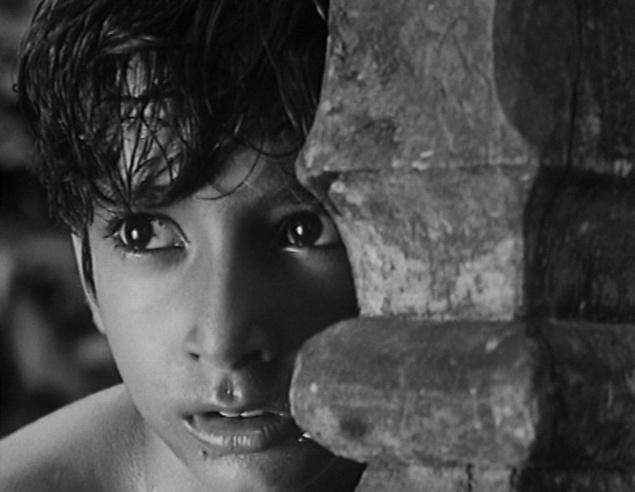
A still from Satyajit Ray's classic Pather Panchali
A still from Satyajit Ray’s classic Pather Panchali

The man responsible for the distinct visual vocabulary of “Pather Panchali”, has unfortunately been forgotten.

Subrata Mitra was an observer of Jean Renoir when he was shooting The River at Kolkata in the late 40s. It was at this juncture he came across Satyajit Ray who was also a keen Renoir observer. Both struck a creative chord and agreed to work together.

No wonder when Satyajit Ray made his debut as a writer-director with Pather Panchali, he had Mitra as his cinematographer. The teaming of Ray, Mitra Ravi Shankar, Dulal Dutta and Banshi Chandra Gupta was perhaps the greatest combination in Indian cinema. With a Michele camera, Mitra created wonders in Pather Panchali. The incomparable use of natural light during the monsoon rains, shots of the kash flowers and a running train in the distance created cinematographic magic. Mitra won a National Award for his camera work in Pather Panchali.

By the time Aparajito went on floors, the Arriflex camera had arrived in the cinematic world. Mitra made superb usage of bounce lighting during the indoor shots in Aparajito. Prior to Aparajito, bounce lighting was unknown to Indian cinema. Even the iconic Ingmar Bergman made use of this technique years later in Through A Glass Darkly.

Mitra can best be described as the perfect cinematic eye of Satyajit Ray. So well did he understand Ray’s thoughts, imagination and visualisation that his camera interpretation of them was sans any flaws. Apur Sansar, Jalshaghar, Devi, Teen Kanya and all Ray films bore the masterly Mitra stamp of cinematography. When Ray decided to shoot Kanchenjungha in colour, it was a challenge for Mitra. Without opting for too many special effects or cinematographic jugglery, he used close-ups to capture the panorama of the Himalayas. The montages were lyrical. The first ever freeze shot in Indian cinema was used to perfection by Subrata Mitra in Charulata.

After Nayak in 1966, Ray and Mitra parted ways. It was mainly due to creative and not egoistic differences. Mitra believed in certain visions which did not gel with Ray’s.

They drifted apart with dignity never criticising each other in public. Ray’s films after Nayak lacked the genius of Mitra’s cinematography. Mitra sans Ray was also not at his altruistic best. One of Indian cinema’s greatest tragedies.

James Ivory and Ismail Merchant worked with Mitra very well in Householder, Shakespearewala, Bombay Talkies and The Guru. In Householder, Mitra used tight close-ups of Shashi Kapoor and Leela Naidu, five in quick successions creating visual poetry. Raj Kapoor made sure Mitra cinematographed Teesri Kasam for Basu Bhattacharya. The shot of the train through a hole in Hiraman’s (Raj Kapoor) cart shot without a tilt still haunts.

The genius took a sabbatical from cinematography in mid 70s. He returned in 1986 to shoot Ramesh Sharma’s New Delhi Times. The shot of Shashi Kapoor running in a dream sequence as his newspaper office burns remains a lesson in cinematography.

Mitra spent his last years teaching cinematography at SRFTII, Kolkata. He was an expert of monochrome and favoured soft colours compared to stark ones. He considered Saath Pake Bandha, Dakhal and Drishti truly well-lit films.

As Pather Panchali is completing 60 years Pather Panchali it is sad that the camera architect of the classic has been forgotten. Mitra still is an idol for any aspiring cinematographers.

source: http://www.thehindu.com / The Hindu / Home> Features> Friday Review / by Ranjan DasGupta / October 22nd, 2015

This is how Calcutta will become London?

bigbenKOLKATA22oct2015

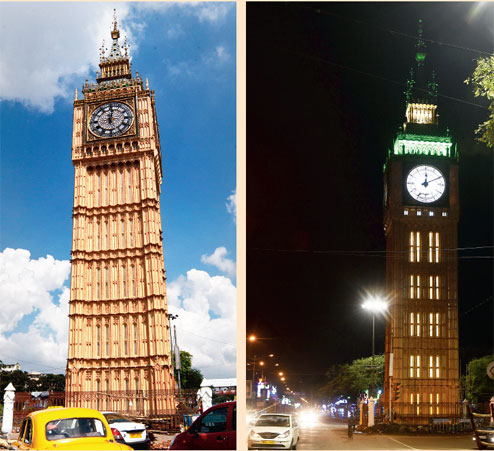
A replica of Big Ben, the famous clock tower of London, has come up at the Lake Town crossing on VIP Road. The 135ft-tall structure, however, falls far short of the original, which towers at 314ft.

The replica, designed by artist Sunil Chandra Pal, is made of concrete and has a fibre casing. Work on the structure had started in December.

Big Ben is the nickname of the Great Bell of the clock at the north end of the Palace of Westminster in London. Like the original, the replica will ring every hour, but the sound will not be produced by a bell like that in the London tower. Instead, a recorded sound will play from a speaker.

South Dum Dum Municipality spent over Rs 1 crore to build the clock tower.

Architect Partha Ranjan Das said the replica looked good but the money should have been spent on building something original.

“If they were so interested in making a tower’s replica, they could have chosen from Gour-Pandua (in Malda). There are many towers there,” he said.

source: http://www.telegraphindia.com / The Telegraph, Calcutta,India / Front Page> Calcutta> Story / picture by Amit Datta / Monday – October 19th, 2015

Nadia royal family bears Puja torch since Akbar era

Krishnanagar :

Illuminated by earthen lamps and torches (mashals), the idol of Ma Raj Rajeshwari looks resplendent in the Akbar-era Natmandir at the Krishnagar Maharaja’s palace.

The serenity is suddenly shattered by the town crier’s shrill call: “Attention! Agnihotri Bajpeyi Raj Rajendro Maharajadhiraj Nabadwipadhipati Mahashaya Krishno Chandro Roy Bahadur is arriving.”

On cue, 108 dhakis beat drums to frenzy.

The Maharaj arrives in an elaborately carved silver palanquin that was gifted to one of his forefathers by Emperor Jahangir. He approaches the pulpit. Shortly thereafter, the palace cannon booms, a signal for the beginning of sandhi puja. A hundred and eight buffaloes are assembled before the Goddess. At shandhikshan, the heads are severed and placed before the Goddess as offering to cleanse the human spirit of its evils. “As a child, I grew up watching these rituals being performed while sitting on my grandmother Maharani Jyotirmoyee Debi’s lap. Growing up, I always held a grudge against Ma Raj Rajeshwari. How could the divine mother, the supreme protector of good and the destroyer of evil, devour so many harmless, helpless lives? I would often bring this up with my father. Being a God-fearing man, he would stick to tradition till the resistance melted away when he saw my infant son Manish crying on witnessing the sacrifice.The practice was stopped in 1987,” said Saumish Chandra Roy , the 39th descendant of Nadia royal family .

Nadia Rajbari’s Durga Puja remains the oldest puja in what was then Anga-Banga-Kalinga or undivided eastern India region. Started in 1603 by Maharaj Rudra Rai, the great grandfather of Krishno Chandro, it has continued uninterrupted till date. “The puja began two years before the death of Emperor Akbar. Since it all happened at the height of the Mughal era, the influence is very strong in the architecture of the natmandir,” said Saumish’s son Manish. However, though the gran deur of celebrations have shrunk over the centuries, the rituals have remained intact.

Ma Raj Rajeshwari has seen Nadia during the most tumultuous of times.In medieval India, persecution and heinous tyranny on the grounds of religion was common.

Blood was spilt for the protection and defense of Nadia’s “honour”, for the protection of the freedom to choose and profess the religion of our choice.”Jato dharma Stato jayo” (Stay in the path of good dharma and victory will be yours) is embedded in the Krishna gar royal family’s coat of arms.

Ma Raj Rajeshwari’s power was tested during Partition. Nadia had initially been ceded to what was then East Pakistan on grounds of religion. “For three nightmarish days, we were Pakistanis. My father Saurish Chandra Roy , the last officially recognized maharaja, had told Sir Cyril Radcliffe (the chairman of the Boundary Commission in British India) that if Nabadwip was lost to Pakistan, then what would remain of the great Hindu faith in the Anga-Banga-Kalinga region?

After three days of rioting, rape and arson, a significant portion of Nadia was returned back to India. The entire population went wild with joy when the news was broadcast over All India Radio. People arrived in trucks from far and wide and assembled in front of the palace gates, shouting ecstatically “Ma Raj Rajeshwari’r Jai!” Though the princely order was abolished by former Prime Minister Indira Gandhi, some royal customs are still followed. The Maharaj was believed to be the protector of his people.Accordingly a clay model of a “shatru”, symbolizing evil, is created which is slain by the Maharaj every year during the Durga Puja. Saumish does the slaying now.

source: http://www.timesofindia.indiatimes.com / The Times of India / News Home> City> Kolkata / by Subhro Niyogi, TNN / October 19th, 2015