Category Archives: Records, All

Part of history for eight centuries, Sen Dighi faces extinction threat

Kolkata:

Its rippling waters tell many a tale and history – dating back to the 12th century. Possibly the oldest waterbody in south Bengal, Sen Dighi in Boral on the southern fringes of Kolkata has survived centuries of negligence, contamination and encroachment. It has seen change of rule, dynasties, eras and witnessed the metamorphosis of the region from a marsh-infested forest land to a thriving habitat. While more than half the waterbodies in the area have vanished and an expanding city has consumed wetlands, Sen Dighi has existed for an incredible 800 years. The 23-bigha pond, a heritage waterbody, now faces a challenge from immersion-induced pollution and its fragile banks are steadily being eaten into by garbage dumps.

A study of its water revealed that the biological oxygen demand of Sen Dighi is high. The water quality has taken a beating ever since the pond was thrown open to immersions and Chhat festivities, according to locals and experts. Even though idols are removed quickly, the residue is enough to affect the water, they say. Perhaps, a bigger threat to the pond is posed by the eroding banks, made unsteady by devotees who have been clearing vegetation along the edges during Chhat. It has led to the uprooting of two trees and another has been left unsteady. These trees are crucial to the survival of Sen Dighi since they have been holding the banks together.

“Over the years, much of Sen Dighi has been lost through encroachment. It is important to protect the pond from pollution and infringement since it is part of our history. We must ensure that Sen Dighi retains its size and its water remains unpolluted,” said Dipayan Dey, chairman of SAFE, a green NGO that is now studying the pond’s water quality.

Around 20 km from Kolkata, Sen Dighi was dug by Ballal Sen, the second ruler of Bengal’s Sen dynasty, in the late 12th century. It must have measured close to a hundred bighas then and was the principal source of water for a large swathe of area to the south of Kolkata, according to Madhu Basu, who has chronicled the history of Sen Dighi. “The city didn’t exist then and it was a practice to dig huge waterbodies that would be taken care of by locals. Almost every house had a tank attached to it. But Sen Dighi stood out due to its size and the fact that it was maintained by the local Tripura Sundari temple that still survives. It is one of the last symbols of the region’s past prosperity,” said Basu, who runs an NGO called Economic Rural Development Society (ERDS).

Over the years, numerous archaeological relics of the Gupta, Maurya, Pala and Sen dynasties have been excavated from Sen Dighi and the areas around it. In the mid-Eighties, Sen Dighi was dried up and cleansed by ERDS. A local body of businessmen took the pond on lease for pisciculture. A part of the money earned from the lease goes to the Tripura Sundari trust. “We dug up numerous relics from the pond. They are now conserved at the Tripura Sundari temple, Ashutosh Museum and a few other places. That was the last time the pond was cleaned,” said Basu, who has penned a book on the history of Boral titled ‘Itihasher Darpane: Boral’.

Locals, on the other hand, pointed out that Sen Dighi is diminishing in size, bit by bit. Documents held by the Tripura Sundari trust mentions the size of the pond as 45 bighas. Less than half of it remains. “Immersions have led to the felling of trees and litter has filled up a portion along the northern bank. If this continues, the pond will get further reduced in size,” said a member of the local Boral Parliament Club that helps the temple trust in maintaining the pond. Basu, who is a resident of Boral, agreed. “Encroachments have always been a threat. With real estate activity being brisk in the area, the future is uncertain for Sen Dighi,” he said.

Till a hundred years ago, the pond would be surrounded by brick kilns. Legend has it that a trader named Maheshwar Shau from Odisha had introduced fish cultivation at Sen Dighi. “Locals got jealous of him and he was killed and thrown into the pond. For many years, people would keep away from Sen Dighi and believed it was haunted,” said Basu.

Green actvists believe immersions should be stopped and Sen Dighi should be cleaned to save it. “If it has to survive, Sen Dighi shouldn’t be used for bathing or washing. Once the water has been cleaned, a pump could be used to pull out water, which can then be used by locals. It would be a shame if Sen Dighi degenerates into a stinking pool like so many around it already have,” said environmentalist AK Ghosh.

source: http://www.timesofindia.indiatimes.com / The Times of India / News Home> City> Kolkata / by Prithvijit Mitra / TNN / February 10th, 2016
In Calcutta, from trick to truth

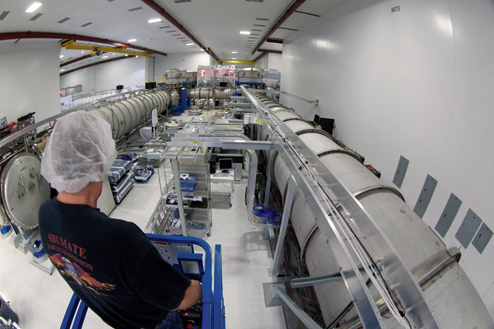
A bird’s eye view of a Ligo laboratory’s laser and vacuum equipment area near Hanford, Washington. (Reuters)

New Delhi :

Anuradha Samajdar, a research scholar in Calcutta, initially thought the first email alert she received about a possible gravitational wave signal was a “blind injection”, the community jargon for a simulation, a trick to test the integrity of the data analysis process.

The email was from Marco Drago, a scientist at the Max Planck Institute for Gravitational Physics, Hannover, Germany, telling a global consortium of physicists that two giant instruments on Earth had sensed (for just a fleeting one-fifth of a second) a signal.

The arrays of lasers, mirrors and control electronics that make up the detectors of the Laser Interferometer Gravitational Wave Observatory (Ligo), located 3,000km apart in the US, had recorded what appeared to be ripples in space-time – possibly the first direct observation of gravitational waves.

It would be up to the data analysis groups scattered across the world, including in Bangalore, Calcutta, Gandhinagar, Pune and Thiruvananthapuram, to determine that they were genuine effects of gravitational waves – and not just noise from the cosmos masquerading as gravitational waves.

“I had heard about blind injections – where a very select few senior scientists release signals and data analysis teams work on them only to be told later that this was a test,” said Samajdar, a scholar working towards her PhD at the Indian Institute of Science Education and Research, Calcutta.

Drago, an Italian and a member of the Ligo consortium, was among the first scientists to be alerted that something interesting had been turned up by an automatic “pipeline” that scans and filters the signals picked up by the detectors.

Shortly before noon on September 14, Drago received the automated pipeline alert. “The signal was so nice, so perfect, it looked like it was coming from a binary (a pair of objects),” Drago told The Telegraph .

After telephone consultations with colleagues, he sent out the alert to the 900-odd consortium members.

Samajdar and physicist Rajesh Nayak at IISER were among scientists in India analysing the signals, trying to determine whether the patterns of ripples observed indeed matched theoretical predictions of what patterns would look like, depending on the source of the gravitational waves.

Nayak, a faculty member at the IISER department of physical sciences, said: “We first match the detected signal pattern with the theoretical predicted pattern, if there is a match, we try and use the signal to estimate various parameters of the source event.”

Supervised by Nayak, Samajdar, who graduated in physics from the Lady Brabourne College, Calcutta, before joining IISER’s integrated PhD programme, while still a bit sceptical about the nature of the signal, began the process of extracting information about the source.

“We began to calculate the masses of the (merging) black holes, their distance – and our estimates were similar to what others in the consortium were reporting,” Samajdar said. “We told ourselves noise wouldn’t give us such nice outputs – that’s when I wondered ‘is this really the big thing’?”

Scientists at the Inter-University Centre for Astronomy and Astrophysics, Pune, the Indian Institute of Technology, Gandhinagar, IISER, Thiruvananthapuram, and the International Centre for Theoretical Sciences, Bangalore, also played key roles in the data analysis.

The multiple efforts across the consortium converged on the same results – the signal had emerged from (the merger of two black holes) a distant part of the universe, perhaps a galaxy.

Physicists are celebrating the discovery for multiple reasons.

“This is an example of big science supported by big engineering,” said Dibyendu Nandi, a physicist at IISER, Calcutta, and head of the Centre for Excellence in Space Sciences, India, a facility supported by the Union human resources development ministry.

The Ligo detectors are marvels of engineering precision, designed to detect ripples or displacements in space billionths of the width of an atom using laser beams that are bounced off mirrors after travelling along two arms of the instrument, each 4km long.

“Gravitational waves was the one prediction of Einstein’s general relativity theory that had not been directly detected – until now,” said Nayak. “This discovery is important for another reason – it will open a new branch of astronomy, we can observe and study things we have never seen or observed before.”

Some physicists also point out that the signal represents the first direct evidence of black holes merging.

“There is no other way we could have detected such exotic events,” said Nandi, who is not associated with the search for gravitational waves. “This observation tells us that such events are not just theorists’ dreams, that the universe is as exotic as we have imagined it to be.”

source: http://www.telegraphindia.com / The Telegraph,Calcutta,India / Front Page> Story / by G.S. Mudur / Friday – February 12th, 2016

India’s first soccer league with sex workers’ children

Kolkata :

Shah Rukh Khan, Sourav Ganguly and Abhishek Bachchan may have set the ball rolling by becoming owners of professional sporting teams in India. But they surely didn’t know that they would kickstart a whole new trend of owning professional football teams comprising children of Bengal’s sex workers. Citizens of Kolkata have come forward to sponsor 16 such football teams that are part of the Padatik Football League. Each of the teams has been sold for Rs 7,000. The prize money is a modest and encouraging Rs 10,000 for the winning team and 7,000 and 5,000 for the runners-up.

Twelve teams have been named after the respective red light areas in Basirhat, Sonagachhi, Rambagan-Sethbagan, Jorabagan, Dum Dum, Domjur, Khidirpur, Kalighat, Boubazar, Titagarh, Seoraphuli, Baruipur and Durgapur. Three teams have mixed membership. While tribal children belonging Amlasole have one team, kids of prisoners, street children and druggies have been grouped together to form the Dosti 1 and Dosti 2 teams. Then, there is a team that belongs to Durbar Sports Academy. “It’s been five years since we organized such football tournaments. But this is the first time we introduced the concept of owning teams. Of course, SRK buying an IPL team has been an inspiration,” said Bharati Dey, secretary of Durbar Mahila Sammanwaya Committee that has organised the tournament.

But what prompted people to become team owners? Retired banker Ashoke Dutta, who owns the Dum Dum team, said paying Rs 7,000 is a ‘social responsibility’. “These are marginalised sections of society. It feels good to be able to do something that brings them to the mainstream,” Dutta said, adding that he has named his team after his deceased wife. “Since it is a seven a side team, I call it Suchitra 7 after my wife,” the widower said.

Artist Subrata Gangopadhyay is the proud owner of the Sonagachhi team. Being involved with NGOs working in red light districts, Gangopadhyay has always supported the cause of such children by donating his paintings. “If my contribution helps these talented children go forward, it will make me happy,” he said. Since Gangopadhyay has recently undergone an angioplasty, he hasn’t been able to personally make it to the stadium. “But I am keeping a tab on my boys. Before every match, I send out messages to boost their spirit and say ‘Fight Sonagachhi Fight’,” he said.

When TOI met with some players of the Rambagan-Sethbagan football team on a lazy Thursday afternoon, they were busy decorating the pandal for their para Saraswati Puja in between their practice session. Twenty one-year Subhas Kumar Shaw, a die-hard Maradona fan, said this effort makes him feel inclusive. “Citizens buying the teams is an index of our acceptance into mainstream society,” he said. Shaw’s Jorabagan team had played against the Sonagachhi team at a stadium in Basirhat. “Unfortunately, our team lost to Sonagachhi,” Shaw said.

But Rabi Das was luckier. His 56-year-old mother has retired as a sex worker but Das has no qualms about introducing himself as a sex worker’s son. “My mother, who now lives in a village in Burdwan, is extremely happy. We have already played four games and looking at lifting the cup,” smiled the player of the Rambagan-Sethbagan team who dreams of a day when news of this tournament will reach the ears of his idol Messi.

The audience turnout hasn’t been bad either. At the inaugural match between Amlasole and Dosti II at Shyambazar’s Deshbandhu Park, some 250 people turned up. “Already 17 matches have been played. Teams have been divided into three zones – Basirhat, Domjur and Baruipur. Eight teams will qualify in the quarter finals. The semi finals will have four teams. We are hoping to host the finals at Ladies’ Park on March 3,” said coach Biswajit Mazumdar.

Sex worker Dulu Sarkar (name changed), whose brother Milan is playing in the Rambagan team is happy. “After my mother expired, I looked after my brother. I’m happy that he is playing,” she said, before preparing herself for her clients. Her only regret is that she herself hasn’t yet been able to make it to the stadium. If her brother’s team reaches the finals, she is hoping to excuse herself from her babu to play cheerleader for her sibling.

source: http://www.timesofindia.indiatimes.com / The Times of India / News Home> City> Kolkata / by Priyanka Dasgupta / TNN / February 13th, 2016

Web home for Chandernagore

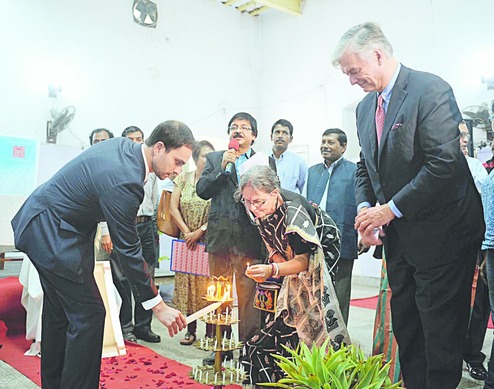
French consul-general Damien Syed lights a lamp to start the foundation celebrations at the Institut de Chandernagor as Vieilles Maisons Francaises president Philippe Toussaint (right) looks on. (Sanjoy Chattopadhyaya)

Five years ago, a project that took off as an inventory of the heritage buildings of Chandernagore has blossomed into an interactive website that acts as a repository of memories, a tool for heritage consciousness and a global platform for the former French colony.

The website www.heritagechandernagore.com will be unveiled on Wednesday at Alliance Francaise du Bengale. “The website enables people to see the magnificent built heritage of Chandernagore. Once one knows what is there to protect, there is no excuse not to do it,” Philippe Toussaint, president of Vieilles Maisons Francaises, the NGO which has provided most of the funds for the website, told Metro.

“The inventory was necessary to protect the buildings which would otherwise disappear,” said French consul general Damien Syed.

Syed and Toussaint had travelled to Chandernagore to be a part of the foundation day celebrations at the Institut de Chandernagor (IdC), marking the signing of the treaty of cession of Chandernagore in 1951.

“The website will evolve as it is not static like the one we built for Chinsurah,” said architect and conservation planner Aishwarya Tipnis, who led the project and has also built www.dutchinchinsurah.com on the history of neighbouring Chinsurah. “A blog will be part of the website where people will continue to contribute. There will be a continual crowd-sourcing of history.”

While the inventory of 99 buildings was ready by 2012, a host of community engagement activities was held in May 2015. “Contests were organised for schoolchildren alongside various workshops and a citizens’ forum. Local youths went door to door collecting memories which form a part of the website. They are now trained to take tourists on guided walks,” Tipnis said.

Toussaint is ready with another gift for Chandernagore. “We want to fund the digitisation of the important documents at IdC.” IdC curator Arup Ganguly has drawn up the list of documents. “Some, like our single copy of Le Petit Bengali, need immediate attention before crumbling to dust,” he says. The project awaits government approval.

source: http://www.telegraphindia.com / The Telegraph,Calcutta,India / Front Page> Calcutta> Story / by Sudeshna Banerjee / Wednesday – February 03rd, 2016

Kolkata girl creates underwater drone

Sampriti Bhattacharya

Kolkata :

At 28, she has created an underwater drone that can map ocean floors and explore the deep sea, where even GPS doesn’t work. Kolkata girl Sampriti Bhattacharya’s invention — the Hydroswarm — has been patented and is quite a rage with the defence sector and oil giants.

What’s more, Forbes has featured her among the top 30 most powerful young change agents of the world. Sampriti, who left the city about seven years back for her masters, is now a PhD scholar at Massachusetts Institute of Technology (MIT).

Hydroswarm was created as part of her research thesis. “Underwater navigation has been a reality for many years but for advanced searches you need maps that are as refined as, say, the Google map. This is where my drone comes in. It can map the ocean, sitting on its bed, and you can zero in on the minutest objects, living or non-living.

You can even map underwater pollution with the help of this drone,” said Sampriti, who was in Kolkata for a short while and returned to the US on Thursday. A South Point alumnus, she studied engineering at St Thomas College and did her masters in aerospace engineering at Ohio State University before switching to robotics at MIT.

She told TOI that she always wanted to create an underwater robot because there was no easy way to study the ocean floor. The only option was the very expensive remotely operated underwater vehicles generally used to track warships.

source: http://www.timesofindia.indiatimes.com / The Times of India / News Home> City> Kolkata / TNN / January 29th, 2016

40 Buddhist relics unearthed at Moghalmari in a single day

Kolkata / Midnapur:

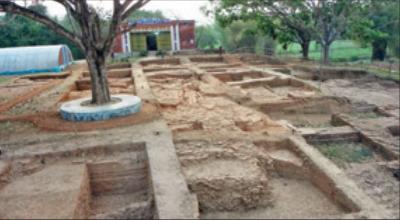
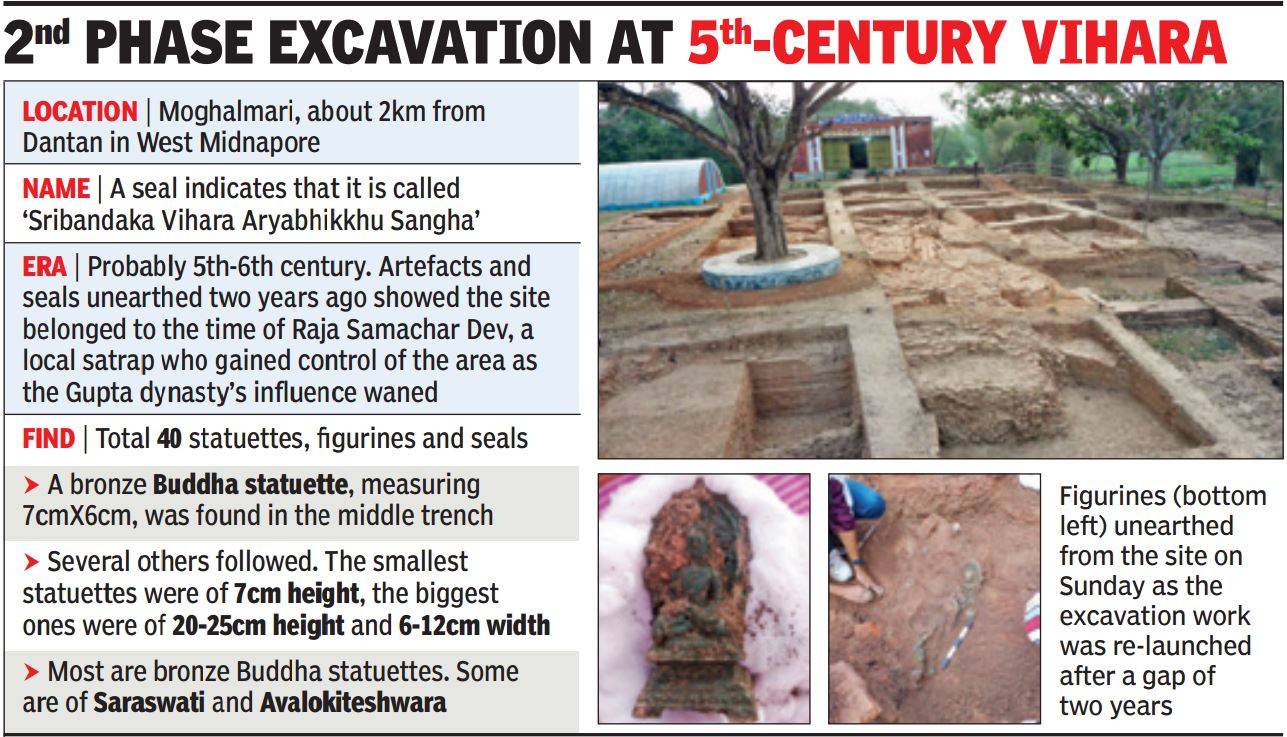
The ancient site at Moghalmari witnessed much excitement on Sunday morning when around 40 bronze artifacts, dating back to fifth and sixth centuries, tumbled out of the earth, as the state archaeology department re-launched excavation of the Buddhist vihara after a gap of two years. The digging work coincided with a two-day Moghalmari Festival inaugurated on Sunday.

BuddhistRelicsKOLKATA25jan2016

About two kilometres away from Dantan in West Midnapur as bronze artefacts dating back to fifth and sixth centuries started tumbling out of the ground, one after the other. The state archaeology department has re-started the excavations at the site after a gap of two years.

Around 11am, a bronze Buddha statuette, measuring 7cmX6cm, first surfaced in the middle trench of the site, which is about 2km from Dantan in West Midnapur. After this, several more statues of varying sizes started showing up to loud cheers from archaeologists as well as residents of the area. Monks from across the country, who have converged on Moghalmari for special prayers and seminars at the festival being organized by Kolkata-based Bauddha Dharmankur Sabha, were equally enthralled by the discoveries at the vihara, believed to be one of the oldest Buddhist sites in the country.

Of the area who gathered to watch the digging. A two-day Moghalmari Festival also started there on Sunday organised by the city based Bauddha Dharmankur Sabha. Invited by the Sabha, monks from across the country are camping at the site for special prayers and seminars. Naturally, the discovery of the bronze statuettes generated all around veneration for the site has already been established as one of the oldest Buddhist viharas of the country and definitely of Bengal.

While the smallest statuettes were around 7cm high, the biggest ones stood tall at 20-25cm, with widths varying from six to 12cm. While most were bronze Buddhas, statuettes of Saraswati and Avalokiteshwaras were also found. “We are going very slow with the digging work as relics are strwen across the entire zone. Finding over 40 antique figurines in a single day is definitely rare and prized. We are thrilled beyond explanation,” said Prakash Maity, who is in charge of the Moghalmari excavation. “Earlier, we found stucco figurines, gold, silver and mixed metal coins, pendants, votifs and seals.” The site dates back to the post-Gupta period when the dynasty’s influence waned and local satraps-here, Raja Samachar Dev, gained control. The pre-Pala phase of Bengal history was shrouded in mystery, experts said.

In fact, the state archaeology directorate halted the digging work as experts needed to analyse the coins and seals to verify the site’s dates. After research, historians were confirmed that they had found the key seal that revealed the vihara’s name as ‘Sribandaka Vihara Aryabhikkhu Sangha’ and the inscriptions on it established that the institute was founded and functioned in the 5th-6th centuries, if not earlier. The state government has decided to release funds for the new phase of excavation. Already, more than Rs 3 crore has been spent.

BuddhistRelics02KOLKATA25jan2016

Atanu Pradhan, a local enthusiast and secretary of Tarun Seva Sangha, who was instrumental in drawing the Calcutta University’s attention to the mound under which the vihara lay buried for centuries is elated. “I am sure that with time, archaeologists will stumble upon artifacts of greater value and the site will be officially announced a fifth-century vihara,” Pradhan said.

source: http://www.timesofindia.indiatimes.com / The Times of India / News Home> City> Kolkata / by Sujay Khanra & Jhimli Mukherjee Pandey, TNN / January 24th, 2016

Women-only chauffeur service ready to hit road

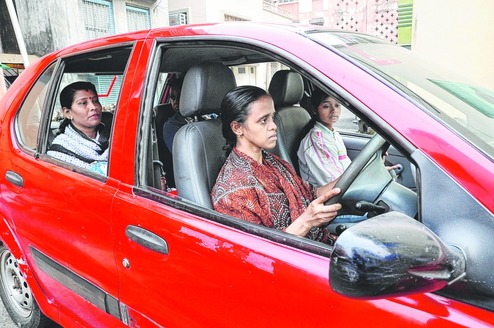
A woman aspiring to become a chauffeur-on-call at the wheel with a trainer watching over her. Picture by Sanat Kumar Sinha

A woman returning home alone in a cab at night need no longer make her family and friends anxious. Come February, she will have the option of choosing a woman to steer her home safe.

Calcutta’s first women-only chauffeur-on-call service is apparently the launch pad for a regular taxi fleet with women drivers in less than a year.

The Azad Foundation, a non-profit-organisation that had launched the service first in Delhi in 2008 and recently in Jaipur and Indore, has trained around 500 women as drivers and is looking to fill a gap in Calcutta that has become pronounced in recent years.

“We keep getting mails and phone calls asking when women drivers would be available here (in Calcutta). For now, only the chauffeur-on-call service would be available. This will be just like hiring a private car for a few hours,” said Dolon Ganguly, programme director at the Azad Foundation.

Nine women aged between 20 and 35 have trained for six months to become as adept at changing a flat tyre as they are at changing gear. Another nine are being readied to become chauffeurs-on-call by May. Sometime next year, the first batch would be eligible for commercial driving licences to work as cabbies.

In a city where taxi drivers often refuse passengers on a whim, the advent of app-cab services like Ola and Uber changed the way people could hire transport even in the dead of night. But from the perspective of women on the move, the women-only chauffeur-on-call service has the potential to be a game changer.

A large section of women in Calcutta who work till late in the evening are exposed to the possibility of harassment the moment they hire a cab with a male at the wheel. Women returning from a night out face the same plight and are often left with no choice but to call family members or male friends to escort them.

“There is always the fear that the driver will take a wrong turn and take me to an unknown location. Screaming on a deserted road wouldn’t help; so I remain extra alert whenever I am in a cab at night. If I have a woman at the wheel, I wouldn’t need to keep a finger ready to dial a helpline,” said a young fashion designer who works in a New Alipore studio and often needs to take a cab at night.

The nine chauffeurs ready to hit the road next month in crisp green uniform with red collars feel just as empowered. “I had never thought about learning to drive a car until someone told me about this job opportunity. My first day at the wheel was scary. But as time went by, driving a car came naturally,” said Khurshida Begun, a mother-of-one from Rajabazar.

Each of the women has received training in first-aid, basic English, gender sensitisation and Wenlido, a self-defence module popular in many parts of the world.

The last round of evaluation that each candidate needs to clear to start working as a professional is conducted by the Azad Foundation’s revenue-earning unit Sakha, which also takes care of placements.

Programme director Ganguly said the training programme had been designed to give each of the trainees at least two-and-a-half months at the wheel under supervision.

The period is sometimes increased, depending on individual need.

Shehnaz Khatoon, 18, is one of the aspiring chauffeurs in the second batch. “I had always dreamt of flying a plane, although that didn’t become a reality. But I get the same thrill out of driving that flying a plane would have given me,” she said.

Shehnaz plans to surprise her father in her uniform once she completes the training, which she was encouraged to join by her mother.

Would you hire a woman chauffeur? Tell ttmetro@abpmail.com

source: http://www.telegraphindia.com / The Telegraph, Calcutta,India / by Monalisa Chaudhuri / Front Page> Calcutta> Story / January 08th, 2015

‘An Indian singer with an international tone’

Kolkata :

When the news of the demise of singer Subir Sen broke out on Tuesday morning, many echoed that it was the end of an era, an era where an Indian musician mastered an international tonal quality and impressed not just with his singing and compositional skill but also his large-hearted nature.

Sen was 82 when he succumbed to cancer on Tuesday at a private nursing home in the city . He is survived by his daughter.

Known for his work in Chhoti Bahen’ and ‘Katputli’ in Bollywood, Sen is popular for his songs like `Dheere chalao zara’ with Lata Mangeshkar and `Humein un rahon par’, besides his hits in Bengali like `Oi ujjawalo dwip’ and Eto sur aar eto gaan’.

Chief minister Mamata Banerjee condoled his death.In her tweet, she wrote: “Saddened at the passing away of legendary singer Subir Sen. He is our Banga Bibhushan. He will always be in our hearts.”

Music director Abhijit Banerjee, who had composed Monalisa tumi ki bolona’ for Sen, described the singer as a king with a big heart and a wide perspective’. While the initial stage of his career saw him singing Hemant Kumar’s songs, Sen had soon graduated to carve a niche for himself. “From Jim Reeves, he picked up the tonal quality .From Nat King Cole, it was the drama that appealed to him.He punched the two style to create an international tone.He even learnt ghazal during his stint in Mumbai,” Banerjee said. Going back in time, he recalled how Sen had made him listen to Jim Reeves’ `I hear the sound of distant drums’ and `Snow Flakes’.”The first song inspired me to compose `Saradin tomae bhebe’. The first line of `Snow Flakes’ song inspired me to compose `E jeno shei chokh’. Nat King Cole’s `Mona Lisa’ helped us to create our own `Monalisa’ in a different form,” he recalled.

Few know that Sen was a good composer too. Sen had composed for an international film called `Midnight’ that had Geeta Dutta, Mohammad Rafi and himself singing in the soundtrack. It was an endearing relationship that Nirmala Mishra shared with him.”One day , I was speaking to him in a certain tone and he told me: `You are talking like a pishima!’ That’s how I got my name `pishima’. In return, I said that I should have the liberty of calling him `pishemoshai’,” Mishra said.

Sabita Chowdhury , wife of music director Salil Chowdhury , said, “Subir-da was very close to our family . My husband used to like his style of singing. He specially composed `Dhoronir pothe pothe’ and `Pagol hawa’ for him.” On being asked the similarity between Sen and Hemant Kumar, Chowdhury said, “His voice has a softness to it and a texture that was different from that of Hemanta-da.”

Singer Banasree Sengupta was impressed with Sen’s acting skills too. “I remember going to watch him film `Momer Putul’ where he had acted opposite Sabitri Chatterjee,” she pointed out, adding, “Composer Sudhin Dasgupta and he were friends. I was a favourite student of Sudhin Dasgupta.When Subir Sen came over to discuss Puja songs with my guru. I would also tag along to be a part of those musical sessions. I regret my luck that I could never sing a duet with him,” she said.

While in Bollywood, Shankar Jaikishan seemed to have kar Jaikishan seemed to have a special liking for Sen. The composer duo account for Sen most well-known songs. “Who can forget his `Manzil wohi hai’ from `Kathputli’?” Sengupta wondered aloud. No one is sure why Sen returned to Kolkata despite a successful stint in Mumbai. Mishra claimed that it was because of “internal politics that prevented his rise in Mumbai”.

But Sen never cribbed publicly and was happy to be singing in Bengali. “He deserved much more recognition than what he got. While remakes are common at reality shows these days, nobody dares to sing his songs,” Sengupta said. The reason, Banerjee pointed out, is his “international sound”. In unison, music industry believe that there will never be another Subir Sen who has so much of `sur’ and `gaan’ in him.

source: http://www.timesofindia.indiatimes.com / The Times of India / News Home> City> Kolkata / Priyanka Dasgupta, TNN / December 30th, 2015

Conservation architect Rohit Jigyasu speaks on sustainable recovery at Indian Museum

Kolkata :

The Indian Museum recently organized a special lecture on ‘First Aid to Cultural Heritage in Nepal For Sustainable Recovery and Risk Reduction’ by Rohit Jigyasu.

Rohit Jigyasu is a conservation architect and risk management professional from India, currently working as UNESCO Chair holswe professor at the Institute for Disaster Mitigation of Urban Cultural Heritage at Ritsumeikan University, Kyoto, Japan and Senior Advisor at the Indian Institute for Human Settlements (IIHS).

He is the elected president of ICOMOS-India since 2014 and ICOMOS International Scientific Committee on Risk Preparedness (ICORP) since 2010. Rohit is also currently serving as the elected member of the executive committee of ICOMOS since 2011.

After taking his post-graduate degree in architectural conservation from School of Planning and Architecture in New Delhi, Rohit obtained his doctoral degree from Norwegian University of Science and Technology, Trondheim, Norway. His multidisciplinary research was focused on the role of traditional knowledge in disaster mitigation in the context of South Asian region.

Rohit has been working with several national and international organizations such as Archaeological Survey of India, Indian National Institute of Disaster Management, UNESCO, ICCROM and Getty Conservation Institute for consultancy, research and training on Disaster Risk Management of Cultural Heritage.

Rohit has been teaching as the visiting faculty at several national and international academic institutions in India and abroad. He is on editorial board of some well reputed journals such as Journal of Cultural Heritage Management and Sustainable Development, and Disaster Prevention and Management. He has contributed to several international publications.

source: http://www.timesofindia.indiatimes.com / The Times of India / News Home> City> Kolkata / by Ajanta Chakraborty, TNN / December 16th, 2015

India’s sepia-tinted U.S. connections

USKolkata09dec2015

A unique photograph of the elephant (1797), archived by the New York Historical Society, is now exhibited in the city.

“It will be a great thing to carry the first elephant to America,” wrote Jacob Crowninshield, the captain of the ship America. The first living elephant, which was ferried all the way from Kolkata to the US, was later exhibited in Boston, New York and Philadelphia.

A unique photograph of the elephant (1797), archived by the New York Historical Society, is now exhibited in the city. Alongside The Elephant, 41 rare photos, collected over the last 150 years, form part of the exhibition titled ‘Kindred Nations: The United States and India: 1783-1947’at The Indian Museum here that opened during this weekend.

The exhibition tells the story of association between the two countries long before the latest thrust to step up diplomatic and trade ties were initiated.

One compelling example is the photograph of the Indian immigrant workforce in the US. It is perhaps a less-known fact that a significant share of the workforce involved in building modern America migrated from northern India.

At least two of the photographs taken around World War II underscore the role of Sikh immigrants in the construction of rail roads or them joining various other trades. The exhibits also narrate how Americans engaged in building ties with Indians.

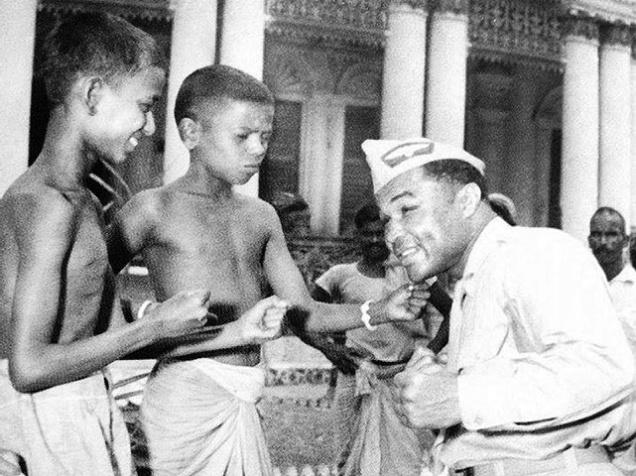
Henry Armstrong, one of the greatest American boxers of all times, visited India during World War II and graced an amateur boxing tournament in Kolkata. A candid picture of the pugilist giving spontaneous boxing lessons to local youth (1945) also forms a part of this exclusive exhibit.

Photographs of celebrated Anglo-Indian actor Merle Oberon, who shot in West Bengal for a film, and Charlotte Wiser, an American anthropologist, teaching childcare techniques to local villagers at Allenganj (1919), provide the viewers with an insight about the ever-evolving ties between the two countries.

It all started with bilateral trade relations. From education, cultural and religious values, cinema, jazz music, Kashmiri shawls, books on navigation — India and the U.S have shared them all. There was also a rare shot of Anandibhai Joshi (1880), the first Indian woman to earn a medical degree in the U.S.

Shots of Singer Manufacturing Company’s office (1897), the famous Atkinson house (1860), Swami Vivekananda with his American counterparts at Green Acre School (1894) and Rabindranath Tagore holding the delicate hands of the blind and deaf American activist and author Helen Keller are the other notable ones.

However, some these exhibits are widely circulated on the Internet.

Curated by the Meridian International Center in Washington D.C. and supported by the U.S. Department of State, the photographs and letters speak of what is described as ‘shared prosperity and peace’. Dr. Jayanta Sengupta, Director of Indian Museum, said it was “an honour” to host the exhibition.

“As a museum, we always explore the interstices of cultures and the connections between them, and what better way to do this than by celebrating the two centuries of historical connections between the world’s two largest democracies?” he asked.

Acting U.S. Consul General Cory Wilcox, on his part, complemented Dr Sengupta. “Through the medium of art, we begin a dialogue about our perspectives and values. We hope this exhibit of the past engagement sparks our imagination for the future, seeing how we can take steps to improve the lives of the next generations in both our countries,” Mr Wilcox told The Hindu.

The exhibit was earlier on display in New Delhi, Chennai, Hyderabad, Mumbai with Kolkata being the last stop, where it will continue till the last day of the year.

source: http://www.thehindu.com / The Hindu / Home> National / by Ayshika Mitra / Kolkata – December 07th, 2015