Category Archives: Records, All

WRITER’S BLOCK – Inside India’s oldest hotel

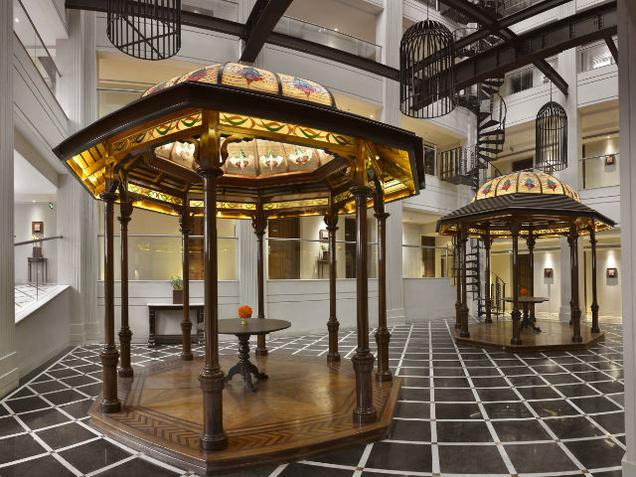
Past meets present: The atrium of the Lalit Great Eastern. /  by Special Arrangement
Past meets present: The atrium of the Lalit Great Eastern.
/ by Special Arrangement

In 1836 — when Bahadur Shah Zafar was yet to ascend the throne in Delhi to become the last Mughal — a man called David Wilson opened a bakery in Calcutta, which was fast growing into a second London. The bakery, a great source of comfort for homesick sahibs, did so well that Wilson soon acquired adjoining properties and in 1840 opened a hotel, cleverly naming it after Lord Auckland, the Governor-General of India who lived right across the road.

Until then, Calcutta boasted of only one hotel, Spence’s, also located a stone’s throw from Wilson’s bakery. Spence’s, which opened in 1830, had its share of admirers, who included Jules Verne. While scanning the archives of The New York Times, which I subscribe to online, I found only one mention of Spence’s, in an 1888 dispatch that was datelined ‘Spence’s Hotel, Calcutta’. Thereafter, for nearly a century, no Calcutta hotel merited mention in the paper other than Wilson’s, by then rechristened the Great Eastern Hotel. If you came to Calcutta, you had to stay at the Great Eastern, whether you were Mark Twain or Rudyard Kipling or Queen Elizabeth.

While no one seems to be sure when exactly Spence’s Hotel shut down, one knows for certain when exactly the Great Eastern was rescued from closure — in 2005, when the property, by now dilapidated and rat-infested, was bought over from the West Bengal Government by The Lalit group. Reopened to the public in 2013 as The Lalit Great Eastern, it is today the oldest existing hotel in India — a 176-year-old brassware restored and polished, its lifespan extended by another century or two.
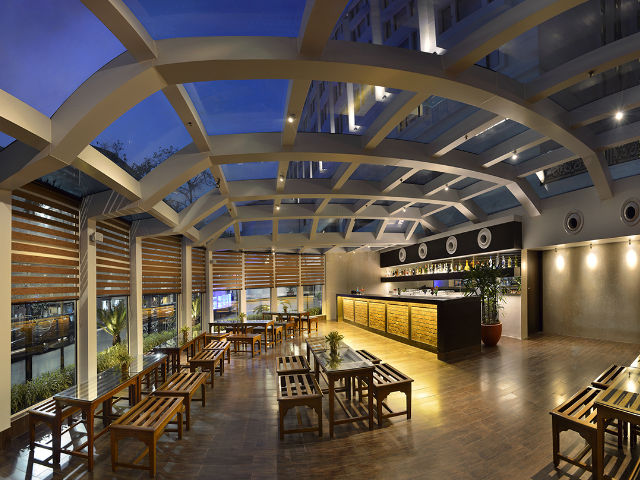
Resurrecting history: The Wilson, which serves as the pub and backery.

At the hotel, where I checked in last weekend, it is hard to miss the advertisement placed in the October 1840 issue of The Englishman and Military Chronicle: “D. Wilson and Co. beg respectfully to announce having taken those splendid and spacious Four-storied Premises, No. 1, Old Court House Street, formerly occupied by Messrs. Thacker and Co. and the Sans Souci Theatre, opposite Government House, and are sparing no expense in the alterations, and fitting it up in a manner that will render it one of the most comfortable family hotels in India.”

Nearly two centuries later, the new owners are doing precisely the same thing — sparing no expense in the alterations — as they blend the Victorian, Edwardian and modern eras to give something unique to Kolkata, which has been notorious for neglecting its handsome colonial-era buildings. The Victorian block, comprising 49 suites, is still under renovation, and will open in February next year.

The three nights I stayed there, I skipped dinner, simply because I overate during lunch, gorging on Bengali food that was prepared in its sanitised kitchens, but tasted very home-cooked. On the third day, lunch was actually home-cooked: I had happened to mention to the resident manager that I had never had litti-chokha, the quintessential Bihari dish, during my decade-long association with Kolkata, and so he had got me litti-chokha from home.

To burn calories, I walked — outside the hotel and inside. I walked around Dalhousie Square, Kolkata’s Westminster, where the hotel is located; I walked the streets of Kumartuli, watching Durga idols being made; I took a ferry across the Hooghly and walked on the Howrah Bridge. Walking in the corridors of the hotel was also as good as walking back in time. From time to time, one came across glass wine decanters, silver napkin-holders, silver water jugs, ancient teapots — all belonging to the time when the Great Eastern was known as the Jewel of the East.

It is one thing to recreate the past with the help of imagination, quite another to recreate it with actual pieces from the past — The Lalit Great Eastern has achieved the latter. When you hold an old wine decanter, you are forced to wonder whether it bears the fingerprints of Rudyard Kipling. It just might — who knows?

source: http://www.thehindu.com / The Hindu / Home> Features> Metroplus> Society / by Bishwanath Ghosh / Chennai – July 01st, 2016
Quiz doyen Neil O’Brien passes away

Neil O'Brien (center)
Neil O’Brien (center)

Kolkata :

Neil Aloysius O’Brien, who pioneered quizzing in India and led the Anglo-Indian community for nearly two decades, passed away in Kolkata on Friday. He was 82.

A former member of Lok Sabha, O’Brien was a three-time nominated Anglo Indian MLA in West Bengal and an educationist. He was chairman of the Council for Indian School Certificate Examinations (CISCE) and chairman and managing director of Oxford University Press.

But it was O’Brien the quizmaster that was the most popular. He hosted the prestigious Dalhousie Institute Invitational Quiz for more than four decades. “Extremely saddened to hear about the passing away of the very talented Neil O’Brien. He will be missed by lakhs of quiz fans across India,” CM Mamata Banerjee tweeted on hearing the news.

O’Brien is survived by his wife Joyce and sons Derek, Andy and Barry.

source: http://www.timesofindia.indiatimes.com / The Times of India / News Home> India / TNN / June 25th, 2016

Restored cult films set for second take

Kolkata:

Way before Shyam Benegal directed ‘Netaji Subhas Chandra Bose: The Forgotten Hero’, another Hindi film was made on the freedom fighter. The Piyush Basu-directed film titled ‘Subhas Chandra’ had got the National Award for National Integration in 1966. A DVD of the Bengali version, which had Lata Mangeshkar’s cult ‘Ekbar biday de maa’ in the soundtrack, was released but the Hindi version never saw the light of day. Fifty years later, the film’s print will be restored, along with a number of Bengali classics.

In 1968, Sachin Adhikari had released ‘Pathe Holo Dyakha’, starring Bhanu Bandopadhyay, Jwahar Roy and Nripati Chattopadhyay. However, the prints of the movie weren’t good enough for a DVD release. If all goes well, the print will be restored soon. Another such Bhanu Bandopadhyay film that has never been released on DVD but might soon release is ‘Ogo Shuncho’.

Not just fresh releases of old movies, this year will see the re-release of DVDs of many Bengali films that have attained cult status. YouTube uploads, VCDs and DVDs of the original prints are available but most of these films have problems regarding fungus deposition, stabilisation, white droplet issues, stains, patches and vertical line formation. Poor audio quality is also a major headache. Dialogues are often inaudible and there is a lot of noise in the background. However, things are looking up what with copyright holders now understanding the importance of preservation.

One such important film that is being restored is KS Saigal’s Bengali film ‘Jeevan Maran’. “Gopalkrishna Gandhi, the former governor of West Bengal, had released a DVD of this movie. But we had used the original print. Hence, the quality had suffered. Now, we have decided to restore this film and re-release it,” said Abhay Tantia, the founder of Angel Video that owns the rights of the film.

In the pipeline is restoration work of Mrinal Sen’s ‘Chorus’, ‘Ek Din Pratidin’, Soumitra Chatter-starrer ‘Baghini’ and ‘Monihar’, Robi Ghosh-starrer ‘Aashite Ashiona’, Tarun Mazumdar-directed ‘Palatak and ‘Sreeman Prithviraj’. The 1964-Rajen Tarafdar film titled ‘Jiban Kahini’ is also expected to get restored soon. Work is currently on progress for Soumitra Chatterjee-starrer ‘Ajona Sapath’.

However, restoration work of such films is a pain-staking job. One minute of a shot has at least 1500 frames. “Each frame has to be restored individually. On an average, restoring of a film requires Rs 4 lakh. We have 20 technicians working on three shifts. Yet, it takes more than a month to complete one film,” said Sushanta Das, who is overseeing the project.

However, restoration of classics doesn’t ensure huge dividends. “It’s not financially very rewarding. But monetary rewards is not always the concern when we are dealing with cult films,” said Akshay Tantia, who considers it his responsibility to preserve Bengal’s culture.

source: http://www.timesofindia.indiatimes.com / The Times of India / News Home> City> Kolkata / by Priyanka Dasgupta / TNN / June 23rd, 2016

JU offers rare live recordings for free listening

JadavpurKOLK22jun2016

Kolkata :

Imagine being present at a mehfil where Begum Akhtar is presenting a ghazal. Imagine listening to a house concert of Annapurna Devi. Imagine listening to Ustad Amir Khan singing a bandish in Persian. All these can be a part of reality if one goes to Jadavpur University’s School of Cultural Text and Records (SCTR). On World Music Day today, any connoisseur can walk into the kiosks set up in the school and listen to the treasure trove of archived music. The best part is that all that comes free of cost!

Director of the School, professor Amlan Das Gupta said, “Collectors from across India have generously donated to this archive that was set up in 2003. The work done here helps in cultural preservation.” In a country where rare records and tapes are lost at regular intervals, such an endeavour has been welcomed by all.

Barring weekends, the archive storing more than 10,000 hours of music is open to any listener between 11 am and 5 pm. Musicologist Anindya Banerjee donated rare live recordings of courtesans like Malkajaan, Bade Moti Bai, Rasoolan Bai and Siddheswari Devi to this archive. “I’ve donated rare live recordings of my guru, Ustad Ali Akbar Khan’s rendition of ‘Lankadahan Sarang’ too,” Banerjee said.

Some years back, Delhi-based collector James Stevenson had sent an aluminium trunkload of cassettes by train. Many still talk about the excitement of receiving that trunk at the Howrah station and then transporting a slice of history to the School. Resoom Pal, an intern at SCTR, said, “I was floored to stumble upon Vidushi Annapurna Devi’s surbahar recital in raag ‘Kaushiki’ and ‘Manjh Khamaj’ from this collection.” All recordings are of superior quality than what is available at any online portal, insists Shantanu Majee, project fellow of SCTR. “We try to preserve these tracks in audio files of superior quality that are uncompressed and preserved in large ‘WAV’ format. This is possibly sound at its best quality,” Majee said.

Some years back, collector Ghulam Naeem donated his collection of spool recordings from house concerts at his residence. In the 70s, Naeem used to import spools to record the programmes! After digitization, the clarity and sound precision of these recordings are of international standards.

One such recording is from a mehfil of Begum Akhtar where she sang a rare ‘ghato’ song – ‘Jal jaumuna bharan ke jaun sajni’ – that was usually sung when women went to fetch water. This ‘ghato’ song leads on to another song – ‘Chha rahi kari ghata’ – in the same recital. Arnab Ghosh, PhD scholar at the JU’s Bengali department, was pleasantly surprised when he discovered a live recording of Ustad Amir Khan’s recital of raga ‘Yaman’ in this collection.

“It was a revelation to hear Khan sahab sing ‘Shah Ze Karam Bar Man-E-Darvesh Negar’ by Amir Khusrau. Listening to such superior quality of music is as good as reliving the live performance,” Ghosh said.

So, what are you waiting for? Just pick up the headphones and let the music play!

Rare recordings:

The Hemanga Biswas archive includes the legendary folk singer’s world music collection of English contralto singer Kathleen Ferrier and German actress and singer Gisela May.

Apart from his created ragas like ‘Chandranandan’, ‘Alamgiri’ and ‘Gaurimanjuri’, this archive also has rare recordings of Ustad Ali Akbar Khan playing raag ‘Gour Sarang’, ‘Barhans Sarag’ and ‘Maligaura’.

One house concert has Ustad Vilayat Khan exploring various kinds of raag ‘Kannada’. This leisurely performance is almost like a lecture demonstration.

There is a recording of Ustad Allauddin Khan playing raag ‘Nat’ and ‘Darbari Kanada’ in sursringar. A rare interview of the maestro with Bhopal radio has him singing raag ‘Komal Bhimpalasri’ and raag ‘Sugadh’.

Pt Ravi Shankar’s early 1950s rendition of raag ‘Mian ki Todi’ and ‘Aalahiya Bilawal’ at the Dixon Lane residence of guru Gyan Prakash Ghosh.

A pre-independence duet of Vidushi Annapurna Devi and Pt Ravi Shankar playing raag ‘Yaman Kalyan’ at Delhi’s Constitution Hall.

source: http://www.timesofindia.indiatimes.com / The Times of India / News Home> City> Kolkata / by Priyanka Dasgupta / TNN / June 21st, 2016

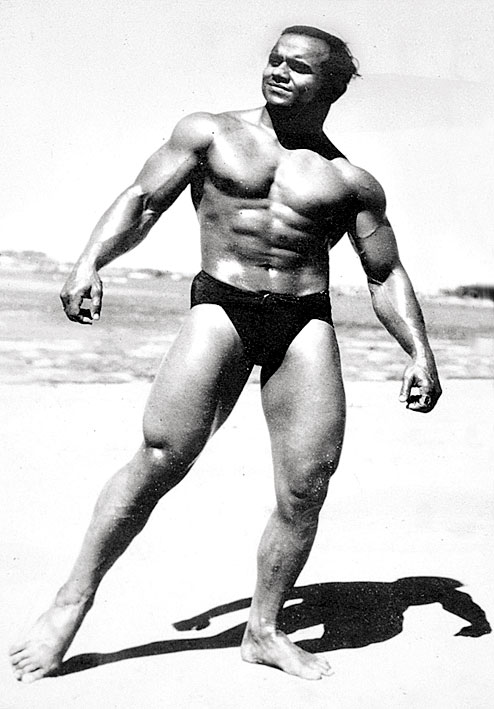
The world of Mr Universe

Manohar Aich (1912-2016)
Manohar Aich
(1912-2016)

♦ Born March 17, 1912 in Putia village of Comilla district in present-day Bangladesh.

♦ At 12, he survived a near-fatal attack of leishmaniasis, a disease caused by the bite of a sandflies but it left him fragile and sickly.

♦ The teenaged Aich got into bodybuilding. His father had ill health and so to support his family he started performing at fairs and other public events in his native village as well as those in the neighbourhood.

♦ Aich met magician P.C. Sorcar at Jubilee School in Dhaka. Sorcar instantly recognised Aich’s capabilities and asked him to join him. While the magician’s feats drew applause from the crowd Aich silenced them by bending steel rods, balancing on his stomach on the tip of a sword, tearing 1,500-page books and doing squats with very heavy loads. But a trick with a spear went wrong and resulted in a life-long scar on his neck.

♦ In the 1940s, Aich joined the Royal Air Force (RAF) as airman and met an officer, Reub Martin, who introduced him to proper weight training equipment.

♦ In 1942, at the peak of the Quit India movement, Aich slapped a British officer for making an offensive comment about India. He was court martialled and jailed.

♦ In jail, he would practise bending the steel rods in his cell. He would also practise daily for up to 12 hours with the little equipment he could find in jail. Aich was released from jail in 1947 after India gained Independence.

♦ In 1950, at the age of 38, Aich won the Mr Hercules contest. In 1951 he stood second in the Mr Universe contest in London. The first position went to fellow Bengali bodybuilder Monotosh Roy, who became the first Asian to be crowned Mr Universe.

♦ Aich trained in London for a year, funding his stay by working with British Railways and bagged the Mr Universe title on March 17, 1952, which was coincidentally his 40th birthday. At that time, his measurements were— biceps 46cm, chest 1.2m, forearm 36cm and wrist 16.5cm. His height was 4ft 11” and he won in the Pro-Short division.

♦ He got a hero’s welcome upon his return to India with both Prime Minister Jawaharlal Nehru and President Rajendra Prasad congratulating him personally.

♦ Aich tried to repeat his feat thereafter but could only secure the third position in 1955 and the fourth position in 1960. He also won gold medals for body building in the Asian Games of 1951 (New Delhi), 1954 (Manila) and 1958 (Tokyo).

♦ Aich performed in a circus, entertaining the spectators with his amazing muscle dancing in the 1960s.

♦ Aich time and again said that the secret for his strength was that he was a teetotaller. He never smoked, ate a simple diet of fish, fruit, lentils, milk, rice and vegetables.

♦ He was a fan of Hollywood actor and multiple Mr Universe title-winner Arnold Schwarzenegger and had watched all his films. He regretted having never met him in person.

♦ Aich passed away on June 5, 2016 at the age of 104 years.

Had you met Manohar Aich? Write to The Telegraph Salt Lake, 6, Prafulla Sarkar Street, Calcutta – 700001 or e-mail to saltlake@abpmail.com

source: http://www.telegraphindia.com / The Telegraph,Calcutta,India / Front Page> Salt Lake> Story / Friday – June 17th, 2016

Halmari CTC tea pips own feat, breaks Rs 500 barrier

Kolkata:

Halmari, the first among Assam varieties to find a place at the Harrods Top Tier Tea Gift Box, may soon be called the Sergey Bubka of CTC tea. The former Ukrainian pole-vault icon broke his own world record 16 times. The CTC (crush, tear and curl) tea produced on the plush plains of this Upper Assam estate has already surpassed its own feat four times in just two years. Late on Tuesday, it created history by vaulting past the Rs 500/kg barrier.

Nine sacks of Broken Pekoe (BP) CTC tea belonging to Halmari Tea Estate fetched a price of Rs 501/kg at an auction brokered by J Thomas & Co. The buyer was Prasad Tea , a tea-buying house in Siliguri. Last July, another Broken Pekoe variety of Halmari estate had fetched a record price of Rs 441/kg. The buyer then was Kolkata’s Sealdah Tea House . Only eight days before that, Halmari, owned by Kolkata-based Amarawati Tea Company , had grabbed eyeballs when another batch of its Broken Pekoe went for Rs 426 a kg.

“Of the nine or 10 CTC varieties that have gone for over Rs 400 a kg so far, seven are from Halmari,” owner Amit Daga told TOI.

Dissecting the character of the record-breaking tea, Krishan Katiyal, CMD of city-based J Thomas & Co, the world’s largest tea auctioneer, said: “This tea is of surprisingly excellent quality for an early second flush variety. The liquor is smooth, full, sweet, malty and mellow.”

Katiyal added that he expects more such good quality tea from Halmari as “the garden’s quality is on an upward curve”.

Daga feels he is lucky to be the owner of one of the “best-placed gardens on earth”. Located 28km from Dibrugarh town, the 374-hectare estate boasts a rich loamy soil suited to produce high quality tea from pedigree clones.

“I also congratulate my whole team for the feat. The courage of the buyer is also commendable to say the least. Preparing such a clientele is not an easy job. It seems the Indian consumers are graduating to the next level for quality tea,” he said.

Stressing on the need to maintain quality, the Halmari owner said: “We are 100% EU-compliant as we export to European clients. But I have no idea why the brand is getting so much value for the past 20-25 years.”
Over 1,000 people work at the Halmari estate to produce around 9.5 lakh kg tea a year.

Bharat Arya , director & CEO of J V Gokal & Co, one of the largest exporters of tea in India, lauded the efforts put in by Halmari, saying the owner must be treating his tea leaves like his baby. “They handle it very well. Thus the tea forms a nice thick cup. It is brisk, strong with a gutty liquor. Basically the garden’s raw material is good.”

Speaking from Siliguri, Raju Prasad, owner of Prasad Tea, said the CTC tea that he bought was better than most Darjeeling varieties although one should not compare between the two. “I paid a good price for an excellent batch of tea. This particular tea is mild and bright bodied. It strikes the taste buds as and when one sips it,” he said.

Prasad has already found buyers for his latest batch. “It will be divided into two parts. One will travel to a Maharashtra seller. The other lot will be sold in the Siliguri market. It is all set to fetch Rs 650-700 a kg in the market,” he said

If you think this is not a big price to pay, think again. Unlike Darjeeling, which goes for thousands per kg and has a select clientele, the CTC caters to the mass market and India is the world’s largest consumer in the category, running through 1,080 million kg of CTC tea in 2015-16. Of the country’s total tea production of around 1,200 million kg last year, CTC accounts for almost 90%.

Asked whether Indian consumers are prepared to pay good price for quality tea, Prasad said, “Today’s tea aficionados are confident about quality. So, they don’t mind paying for it.”

source: http://www.timesofindia.indiatimes.com / The Times of India / News Home> City> Kolkota / by Sovon Manna / June 09th, 2016

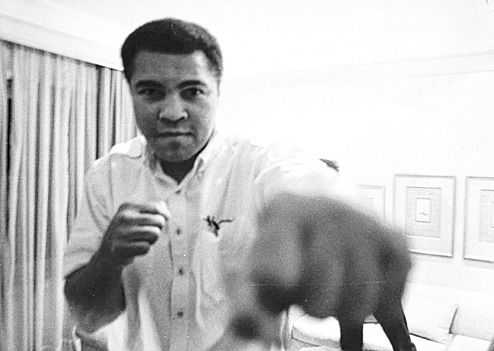
When my right fist was on Ali’s jaw – CLOSE ENCOUNTER WITH TRULY THE GREATEST

Muhammad Ali in his Taj Bengal room in December, 1990

I chased 100m drug cheat Ben Johnson from the 1988 Seoul Olympics and caught him… for an interview at his home in Toronto. I bit my nails during the football World Cup final in Rome in 1990 when Germany’s Andreas Brehme scored against Maradona’s Argentina in a penalty shootout to win the trophy. I joined Carnivale-style Brazilian fans in downtown Los Angeles after they won the World Cup of football in 1994. I was with Sunil Gavaskar when he presented Kapil Dev with a bottle of champagne at the WACA in Perth in 1992 after the Indian all-round legend got his 300th wicket. I saw Kapil dance on the bed of his Ahmedabad hotel room after becoming the highest wicket taker in the world in 1994. I had goosebumps when the Indian national anthem played to announce P.T. Usha as the sprint queen of Asia in South Korea in 1986. I’ve seen Boris Becker ‘boom boom’ his way to a Wimbledon title.

You could say that I’ve been there and done numerous international sporting events as a sports journalist in the 1980s and 1990s. But whenever I am asked about the highlight of my life, my answer is always the same: my encounter with Muhammad Ali at Taj Bengal, Calcutta, in 1990.

It went down like this. Word got around that The Greatest was visiting Calcutta for a community event, unrelated to sport. We at Sportsworld magazine (from the ABP Group of publications) were desperate to get an interview, and needed to identify the organisers of the community event. Having done so, we sought to find a ‘connection’ to the organisers. The link was a man named Dada Osman, a leading figure in Calcutta’s rugby scene and an old family friend of my parents.

Osman organised for me to meet Ali in his hotel room for 15 minutes! The arrangements included permission for us to take a photographer and one other person. This made for plenty of problems because everyone I knew wanted to be my chaperone. You would expect enthusiasm from a bunch of young journalist colleagues. But the demand to accompany me to meet Ali went far beyond my colleagues and friends. My father, Neil O’Brien, known to be an avid boxing fan, put in a request as well. How could I turn him down, when it was part of folklore that the quiz legend Neil O’Brien could rattle off every world heavyweight boxing champion in chronological order since the titles began!

So off we went, father, son and another legend, Calcutta’s best-know sports photographer, Nikhil Bhattacharya, to see the ultimate Legend. To set the scene, it must be pointed out that by this time Ali’s Parkinson’s was well publicised, and we were warned that it would not be a smooth-sailing question-and-answer session.

I knocked on the hotel room door a couple of times and after a little while, it opened. I stood there looking at this big white bath robe right in front of my face. My eyes travelled upwards, and there IT was: the Louisville Lip. From the photographs I had seen, Ali didn’t seem as big a man in comparison to some other boxers of his generation. But I was astounded to see this large frame standing in front of me. It was later that I realised it was not only his physical stature; it was also his awesome presence and aura which made him look bigger than he actually was. There is only one word which comes to mind every time I tell this story.

MAJESTIC! That’s what he was. And mind you this was way past his glory days. He still floated gently like the butterfly he claimed to be. The raving and ranting had been replaced by slow and soft speech. But there was no denying that there was something special about this man. He radiated greatness by his mere presence. I honestly don’t remember what questions I asked, but I recall he wasn’t able to provide long answers. Just a simple ‘yes’ or ‘no’. As an interview it wasn’t very informative.

All I remember is that he sat back on the large sofa, white bathrobe wrapped around as if he had just come out of the boxing ring. I sat at the other end of the sofa… on the edge of it really. My dad sat on the single sofa at the side. Nikhil da went about his business, click, click, click.

There are two other things which are etched in my memory. At the end of our 15 minutes, my dad, unannounced to me, pulled out an enlarged black-and-white print of a photograph of Ali in the famous pose after he had knocked out Sonny Liston to win his first of three world titles. I recall feeling a bit embarrassed, because as a journalist I always refrained from asking sportspersons for autographs, and posing for photos with them. I remember thinking; I had never witnessed my father pay such reverence to any other person. Such was dad’s passion for this legend that he stooped to break my unwritten rule of no autograph/photograph.

Dad’s request gave me courage to ask my last question; and I couldn’t help but ask it. “Ali sir, may I take a photo with you?”

He stood up very slowly, I jumped to my feet. Nikhil da set himself up to take the shot. Just when Nikhilda said “ready?” something got into me. I raised my right fist and placed it on Ali’s jaw to pose for the photo. Perhaps at the back of my mind I was aware that his Parkinson’s would not allow him to ‘sting like a bee’ in reaction to this bold step of mine. I was right. He merely looked at me, leaned forward and the man, known for his classic one-liners, whispered in my ear, “BE COOL, FOOL!”

The champion, his body ravaged by something beyond his control, had not lost his wit, his class and his dignity.

Over many years, when I came across media reports that he was ill, I always told myself that one day I would write again about our meeting to relive the Legend of Ali to the current generation. Sadly, that day has arrived today, when my teenage son, born 20 years after Ali retired, burst into the room to announce, “Dad, sad news: Muhammad Ali has died.” My son knew it would be sad news for his dad, because he has heard on numerous occasions his dad tell the story of the encounter with Muhammad Ali. The time had come for me to write the story, as a eulogy and tribute to the great man. I’m glad I passed on the Ali legacy to my children. I had to, because I have never been so in awe of a person ever in my life as I was with Muhammad Ali that day in the hotel room in Calcutta.

Truly the Greatest! RIP.

Andy O’Brien, always a sports fan and always a Calcuttan, worked for 13 years with Sportsworld magazine. He migrated to Australia in 1996.

source: http://www.telegraphindia.com / The Telegraph,Calcutta,India / Front Page> Caclutta> Story / by Andy O’Brien / Sunday – June 05th, 2016

A window on history – Remains of Portuguese days

WindowKOLKATA04jun2016

Memory can be extraordinarily flexible. As the Portuguese coast recedes and our ship edges into Spanish waters, Évora’s reticence about the communist upsurge in the surrounding region called Alentejo reminds me of the stonewall I encountered in Hyderabad trying to talk of the Telangana revolt. Most people assumed I meant the agitation for a separate state. Few even remembered the earlier armed rising linked to the 1948 Calcutta Conference which also resulted in Malaya’s prolonged and bloody Emergency.

“In the Alentejo, you travel naturally with and to History,” writes a local chronicler. It didn’t know a revolution that never was like West Bengal where revolution means speeches, and revolutionaries fatten in office for decade after decade. Alentejo’s was a revolution that failed like Telangana’s. But without the violence. It also suffered from a confusion of aims. Both mixed the local with the global. The immediate impetus in Telangana was opposition to the Nizam of Hyderabad’s regime. However, the Calcutta Conference spoke of a wider ideological purpose. In fact, many believe the insurrection petered out because Moscow’s rapprochement with New Delhi prompted the Comintern to abandon the conference’s ostensible hosts, the World Federation of Democratic Youth and the International Union of Students.

The peasantry around Évora where we spent several delightful days also felt betrayed. Évora is a charming medieval walled town whose university students in black medallion-studded cloaks over their frock coats sing and dance in the cobbled central square, the Praça do Giraldo, chasing away horrible memories of the burnings that took place there during the Inquisition. Founded in 1559, the university closed down in 1759, when the authoritarian prime minister of the day turned out the Jesuits. It didn’t reopen until 1973. Évora was under Muslim rule for 400 years. They came to help a local contender for power and stayed to consolidate their own rule.

The real contradiction was between radical young officers of the Movimento das Forças Armadas and peasant and student protesters clamouring for reform in 1974. The officers overthrew Portugal’s long dictatorship in a last-ditch attempt to pre-empt more drastic change. The protesters in the streets who gave them carnations which they put into the barrels of their guns – hence the name Carnation Revolution – hoped for a drastic social and political transformation. The organizations of workers and young people that sprouted all over the Alentejo resembled the proletarian councils (soviets) associated with Russia’s October Revolution.

Ordinary soldiers weary of war also set up their own committees to demand democratic rights and an end to Lisbon’s imperialist wars. If national liberation movements could rock the foundations of colonial rule in the so-called “overseas provinces” of Angola, Cape Verde, Guinea-Bissau, Mozambique, and São Tomé, they asked, why should the metropole remain under the corporatist yoke? Landless labourers who toiled on the great estates called latifundio seized the fields they farmed. According to government estimates, about 2,200,000 acres were occupied. Some 1,000 estates were collectivized.

Something like the Spanish Civil War seems to have been fought out in miniature but with roles reversed. Claiming that fascism had to be defeated, Portugal’s reformist Socialist Party and Stalinist Communist Party sprang to support the MFA and the junta it had installed. Social historians believe they destroyed the chance of a socialist revolution. Lisbon promulgated the Land Reform Review Law in 1977. The collectives were dissolved. The original owners repossessed the latifundio. Portugal’s aristocracy has retained its wealth through centuries of upheavals. Some of the mansions and manor houses have been in the same family for generations. Hoardings in the vineyards along the road from Évora to Lisbon proudly proclaim the ownership of families like the Fonsecas. No lingering memory of the 1974 uprising disturbs Évora’s tranquillity.

The official justification is that the Alentejo collective farms could not be modernized. In the mid-1980s, agricultural productivity was half that of the levels in Greece and Spain and a quarter of the European average. Land holdings were polarized between small and fragmented family farms in the north and inefficiently large collectives in the south. Even Bangladeshi immigrants who had managed to acquire Portuguese work permits fled to more prosperous economies. Decollectivization was said to be the only hope.

I learnt more about Évora and its unexpected links with Bengal from Trilokesh Mukherjee, my graphic artist friend who lived in the Dordogne in France for many years. Now he seems to spend more time in Oxford and South Wales but remains a storehouse of the minutiae of Indo-European culture. Trilokesh told me Évora was the birthplace of Manuel da Assumpção, an Augustinian monk who spent many years near Dhaka and is credited with writing and printing the first dictionary and grammar of the Bengali language, Vocabulario em idioma bengalla e portugueza. “The Portuguese even cast some Tamil and Malayalam types. But they never could cast Bengali types.” It’s a matter of everlasting regret to Trilokesh that this final triumph eluded the Portuguese. “The first book to be printed in Bengali was printed in Lisbon though the writer, translator and the compiler came from Évora,” he wrote. Alas, it was set in Latin type.

Évora’s state library treasures another historic document, the manuscript of Brahman-Roman-Kyathalik-Samvada: an argument on Law between a Roman Catholic and a Brahmin by the Bengali Dom Antonio de Rozario. Dom Antonio’s life is shrouded in mystery. No one knows his Bengali name. He was apparently a princeling of Bhusana, which some place near Dhaka and others near Jessore. According to one version, Mug pirates took him to Arakan as their prisoner. Another has it he was sold into slavery in Goa. Both agree that another Portuguese Augustinian priest was his saviour and that he converted to Christianity.

The reinvented Dom Antonio is believed to have converted 30,000 Hindus in and around his estate, thereby arousing the wrath of the Jesuits in Goa who sent a senior priest to investigate. He confirmed Dom Antonio’s proselytizing success but added the converts had little knowledge of Christianity and had been paid to be baptized. It must be added before ghar wapsi fanatics reach for their purifying water that this was the competing camp’s verdict. No rivalry is more relentlessly bitter than that between the pious who are convinced of their monopoly of the truth.

Religion and language are the two main links. Vasco da Gama wasn’t quite the pirate in priest’s clothing that Bharatiya Janata Party loyalists made out on the 400th anniversary of his landing at Calicut, but he did have a strong religious motivation. Another Portuguese sailor, Luís de Camões, called Portugal’s Shakespeare, immortalized his achievement in the epic poem, The Lusiads. If Calcutta had Anthony Feringhee (Hensman Anthony), Dhaka’s Christians revere Sadhu Antoni (St Anthony of Padua). Some credit the Portuguese with creating Bengal’s first modern city in Hooghly. Others hold their imports of tobacco, potato and guava changed Bengali taste for all time.

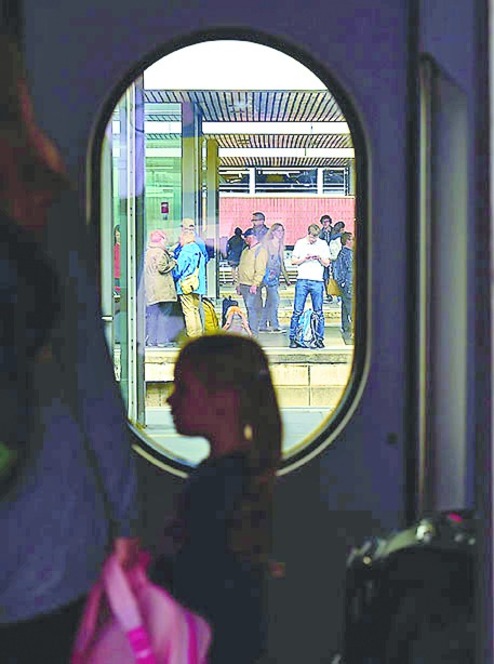
With so many connections, it was exciting to stumble upon a Bengali gift to Portuguese (or so I imagined) when my wife was allotted the janela seat on the train to Sintra. I emailed a friend in Calcutta who passed it on to Aditi Roy Ghatak who messaged me from Macau, where she was holidaying, to say the former Portuguese colony had given her a janela on Portugal. I now learn that far from being Bengali, janla is an import like potato, guavas or tobacco. Derived from the vulgar Latin januella, the Portuguese janela travelled east with those first Europeans to inspire the Sinhalese janelaya and Tamil cannal. Our own janla is like almirah or kameez. Borrowing within reason is all right providing it doesn’t prompt Mamata Banerjee to follow the late P.N. Oak and claim that Big Ben and the Eiffel Tower are really Bengali creations.

source: http://www.telegraphindia.com / The Telegraph,Calcutta,India / Front Page> Opinion> Story / by Sunanda K. Datta-Ray / Saturday – June 04th, 2016

Hill royal relic now rubble – GTA pulls down Bangla king’s centuries-old palace to set up hotel management school

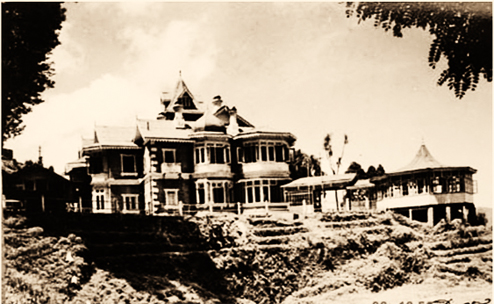
An undated photo of Sailabash: Courtesy Das Studio in Darjeeling

Darjeeling :

Darjeeling’s rare connection with present-day Bangladesh and a part of the hill town’s rich history has been reduced to rubble.

The GTA has pulled down Sailabash, the over-a-century-old summer retreat of the raja of Digapatia, to set up a modern hotel management institute and guesthouse in one of the last few available green spaces in Darjeeling.

Digapatia is now in Rajshahi, Bangladesh.

The palace under the tourism department of the GTA near Jalapahar and was brought down about two weeks ago. “The building was in a dilapidated state and recent earthquakes too had caused some damage,” said Kishore Ghimire, an executive engineer of the GTA.

In his book, A Concise History of The Darjeeling District Since 1835, which was published in 1922, E.C. Dozey, a writer and historian, said the building had been set up on land that was once owned by Capt J. Masson, the superintendent of Tukvar tea estate, by the “Digapatia Rajah”. The retreat was earlier called Girivilash and the name was changed to Sailabash after Independence.

The Late Nayan Subba’s soon-to-be-published book, Heritage buildings of Darjeeling, Kalimpong and Kurseong, says Raja Pramatha Nath Rai Bahadur had founded Girivilash whose garden was laid out by a German floriculturist and horticulturist, Morgenstern, and was looked after by 12 gardeners.

Nobody could say exactly in which year the building had been constructed. But its believed it was built in the last decade of the 19th century.

“Girivilash was a favourite place for the British governors of Bengal….The British army took over the palace in 1942. Later on, it was acquired by the government. It also served as a Tibetan school for a while. The palace has lost the historical grandeur of Girivilash,” writes Subba.

According to Subba, the colonial building had an attic with miniature gables and a small dome, and an all-weather glazed rotunda with small square windows in classical style. There was a tennis court as well.

“Raja Pramadanath Roy occupied the front suite on the ground floor, which included the library, with its precious screens of velvet and ornate wooden pelmets,” writes Subba.

The front suite of the upper storey with the snow view rooms was “for the rani”,

Subba writes. It was “beautifully furnished with a curtained brass cot and a chandelier. There was a huge grandfather clock, which indicated the days of the month and the full moon day (Ekadashi). On the ground floor were the drawing room, dinning room, tash khana (card room) and the billiards room,” Subba adds.

Despite being in a dilapidated state, Sailabash was still a landmark in Darjeeling and used to house a guesthouse after Independence. Once the building was taken over by the Darjeeling Gorkha Hill Council, the office of the hill body’s vice-chairman was housed there. For the past 20 years, the building had been lying vacant.

Bharat Prakash Rai, convener of the Indian National Trust for Art and Cultural Heritage (Darjeeling chapter), said: “How foolish can we be to dismantle such structures in the name of development. Could it not have been repaired? We have lost a piece of history and that is very sad.”

Dawa Lepcha, the GTA Sabha member in charge of tourism, said: “A big-scale hotel management institution will be coming up and the requirements were such that the building had to come down.”

GTA executive engineer Ghimire said the project cost had been pegged at Rs 55 crore. “Apart from the institution, there will also be a guesthouse with 24 rooms for in-house training. The infrastructure is being set up as per the parameters laid down by AICTE (All India Council for Technical Education)”

The five-acre plot in which the Sailabash was located has Annapurna and Kafal guesthouses, along with a pond built by the DGHC. “The Annapurna guesthouse will be used as an administrative building for the institution, while a part of Kafal will have to be dismantled. The pond will be smaller in size and we will have facilities for rainwater harvesting,” said Ghimire.

The engineer said restoration of the building would have cost much more.

source: http://www.telegraphindia.com / The Telegraph, Calcutta,India / Front Page> North Bengal> Story / by Vivek Chhetri / Wednesday – June 01st, 2016

Bengal policeman scales Mt. Everest

A West Bengal police wireless operator scaled the Mount Everest, bringing cheers to the mountaineering enthusiasts who were distraught by the news of recent deaths while attempting to reach the world’s highest summit.

According to a statement released by the West Bengal Police Directorate, Rudra Prasad Haldar (39) reached the summit last Saturday at around 5.24 am. Halder had set out on his mission “Mount Everest” on April 7. He reached the top on May 21 and returned to the base camp two days later, the statement said.- PTI

source: http://www.thehindu.com / The Hindu / Home> News> Cities> Kolkata / PTI / Kolkata – May 27th, 2016