Category Archives: Records, All

Where history is set to fade into oblivion

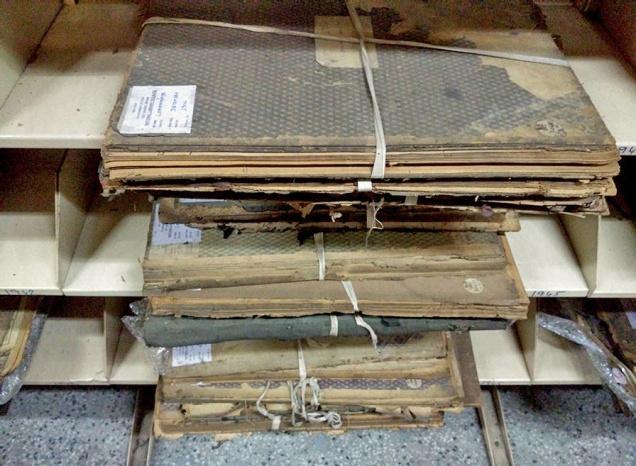
Historic documents lie in neglect in National Library. / Special Arrangement

Newspapers announcing Independence and other events lie in ruins at Kolkata library

“India Independent Today,” announced the August 15, 1947 edition of Amrita Bazar Patrika, one of the highest selling newspapers of India in 1947. The headline is placed above the masthead. But, 69 years later, the August 15 edition is so brittle that it is impossible to open it. It is not only the August 15 edition of Amrita Bazar Patrika that is frangible — 20,000 newspapers stacked up in the reading room are either soiled or so fragile that they will all turn to dust soon.

The rare editions are stored in a dusty and dark section on the second floor of Bhasha Bhavan, located in the western part of the 30-acre campus of the National Library at Alipore. The dark room resembles a mortuary where some of the papers are kept in plastic sheets coated with a thick layer of dust. Water leaks out of the air-condition ducts and during monsoon, buckets are placed to catch the droplets.

“About two weeks ago, the room was filled with ankle-deep water,” an employee of the library said. Some of the volumes were “partially drenched.” “Look at this,” a staff member said, “the August 9, 1942 edition of The Statesman with the news of the All India Congress Committee’s endorsement of Mahatma Gandhi’s call for Quit India Movement… The pages crumble even as you try to remove the dust.” The Statesman’s October 17, 1905 edition with a graphic description of Banga Bhanga, or the first Partition of Bengal, was lying next to The Statesman or Amrita Bazar Patrika. Both announced on Page One that Rabindranath Tagore returned his Knighthood on May 30, 1919, in protest against the Jalianwalla Bagh massacre. Both have nearly disappeared.

The employees said the volumes dating back to 1889 were brought to the Alipore campus in south Kolkata three years ago, for microfilming, from the original building of the Library in central Kolkata. Secretary of the National Library Employee’s Association, Santanu Bhowmick, said there had been “no progress” in the microfilming work.

The Director-General (Additional Charge) of the National Library, Arun Kumar Chakraborty, denied the allegations.

“Perhaps, it [the project] is held up because of the complications in the tendering process,” he said.

source: http://www.thehindu.com / The Hindu / Home> News> Cities> Kolkata / by Soumya Das / Kolkata – August 14th, 2016
Afghan tribe star of Museum show

Kolkata :

On International Day of World Indigenous People, observed on August 9, Indian Museum brought to the fore an anthropological treasure it has had in its store since 1929. Physical anthropologist Biraja Shankar Guha, former director of Anthropological Survey of India, had brought in a model of the Khalash community of Afghanistan after his study on them. Khalash community. It’s accession no is 11813.

In Afghanistan, at the extremities of Hindukush are some isolated mountain valleys of Khyber-Pakhtunkhwa, known to rest of Afghanistan and Pakistan as Kafiristan.

The word ‘Kafiristan’ underlines that the Khalash community follows its own religion. They have liberal customs, rituals and beliefs – for instance, elopement is as common as married women choosing their new husbands, said Indian Museum education officer Sayan Bhattacharyya.

The Khalash religion is similar to the religion that was practised by Rigvedic Aryans and the community has retained most of the Indo-Iranian traits as well.

A wooden statue put on display shows the pagan origin of the community. Some of the Khalash people claimed to be descendants of Alexander the Great and a recent genetic analysis has substantiated this belief.

During the 1970s, local Muslims and militants tormented the Khalash because of the difference in their religions and multiple Taliban attacks on the tribe lead to its numbers shrinking to just 2,000.

However, protection from the government has ensured decrease in violence by locals and Taliban. It has also brought about a great reduction in the child mortality rate. The last two decades has seen a rise in their numbers.

source: http://www.timesofindia.indiatimes.com / The Times of India / News Home> City> Kolkata / TNN / August 11th, 2016

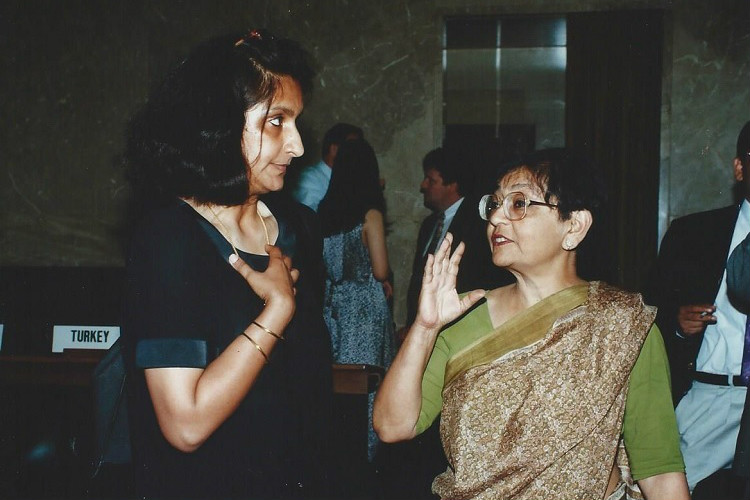
There will never be another Indian soldier-diplomat like you, Ms. Ghose

C’est n’est qu’un au revoir

ArundhatiGhoseKOLKATA28jul2016

Journalist: “Ambassador, Madam Ambassador, is India walking out of the talks?”

Ambassador: “India is going to the loo.”

The journalist was a correspondent for a Japanese news agency. The Ambassador was Arundhati Ghose who passed away this week (1940-2016). She was the Indian Ambassador to United Nations (UN) in Geneva. The year was 1996 – she was negotiating the Comprehensive Test Ban Treaty (CTBT) on behalf of 900 million Indians. The diminutive lady with a cigarette in one hand, papers in the other and India in her heart single-handedly wreaked havoc on the Conference on Disarmament (CD). She did this for India.

Leading from the front and all guns blazing, she defended India’s decision to oppose the treaty. The talks hinged on India’s decision and pressure on New Delhi to sign the skewed and dishonest CTBT was multi-pronged and fierce. She didn’t blink – diplomats will tell you what blinking in such negotiations can mean. No she didn’t blink and ensured no one in India did either. That is an even more difficult task for an Indian diplomat to achieve.

I covered the talks. Staking out with hundreds of journalists at the UN became normal life if not at GATT-WTO, then at the UN. Has Ms. Ghose spoken to India, has Washington spoken to India, will India sign, do you know anything, what is she going to do next went the drift. I felt good – this was a great story.

More importantly, in all my years of reporting from abroad including from the UN, I had never seen an Indian diplomat defending India’s interests with such force, grit, grace and determination. At the GATT-WTO, down the road from the UN, India was conceding paragraph by clause on trade and market access to the demands of the very same P5 who were being dismantled by Ms. Ghose for their double-speak and hypocrisy at the CD.

Didn’t national interest include protecting trade interests? For a journalist, the contrast was stark and which each passing day, I admired Ms. Ghose. If she could do it, why not the other guys down the road? The answer was and continues to be simple – she was a committed Indian, India’s defence interests were not just a treaty, it was her soul and her substance. She walked and talked national security, especially South Asian security.

Picture this. Press conferences during the negotiations were held throughout the day with all of us chasing the P5 (United States, United Kingdom, France, China and Russia), sharing notes, placing each others’ tape recorders in strategic places – laptops and mobile telephones had just debuted. The more important CTBT press conferences were held in a large room, always jam-packed. What will India do or what do you think India will do was almost always the first question.

One such presser was called as the endgame neared. Sitting on the stage with the P5 manel, Ms. Ghose was unperturbed, taking notes, as Ambassador after Ambassador said New Delhi would be held responsible for the CTBT’s collapse. At one point a western P5 Ambassador said “…the people of the world want this treaty.” Ms. Ghose jumped in. Hello, she said. “Which people…I represent 900 million people and you will not ignore the wishes of my people. We are not signing the CTBT text on the table.” In a spontaneous gesture journalists were on their feet applauding Ms. Ghose. The logic was on India’s side – the world had failed its CTBT mandate. The air was electric.

In 1993 the UN gave the then 38-nation Geneva-based CD its first comprehensive mandate to negotiate a test ban treaty at the earliest. The scope of the proposed treaty quickly emerged as the most important and contentious aspect of the negotiations. Linked to the scope were verification and compliance protocols which obviously meant on-site inspections. An international monitoring system would check cheaters but fears grew that this was a fishing expedition in disguise.

Just ahead of the CTBT, India said that the indefinite extension of the nuclear non-proliferation treaty (NPT) – a gift the then nuclear weapons states had given to each other to blow the world apart – was an act of bad faith. Given that reality, New Delhi said any meaningful CTBT could not be a standalone piece and must be part of a time-bound global disarmament process. That set the cat among the pigeons, then.

How did Ms. Ghose handle it? How many phone calls did the Indian Prime Minister take? It was a long way from Arkansas to Haradhanahalli – maybe the Indian Prime Minister was resting when the phone rang, maybe the two men just didn’t understand each other. All we knew was that Ms. Ghose had a mandate and she was going to work it for her people. Ambassadors are supposed to do just that. Serve their countries.

Ms. Ghose did all the heavy lifting and then there were moments that tugged at your heartstrings. She told me about a visit to a bank during one of her trips to New Delhi. The clerk looked at her name, jumped up, told her the entire nation was behind her as she negotiated the ‘NTPC’ in Geneva – such was the groundswell of support for her. There were other anecdotes, of people stopping her on the streets of India, Ms. Ghose and the journalists hanging out in Geneva over peels of laughter even as she scolded us for following her to the loo or not allowing her a peaceful moment for a puff at 3 a.m.

As I write this, I wonder if Ms. Ghose is not telling god what she thinks of the man with the yellow hair trying to make his way to the White House. There will never be another like you Ms. Ghose. This is but a goodbye.

source: http://www.thenewsminute.com / The News Minute / Home / by Chitra Subramanian / Wednesday – July 27th, 2016

East India’s first cadaver liver transplant in Kolkata

Kolkata (IANS) :

Bolstering efforts to carry out cadaver organ transplants in West Bengal, a team of doctors at a private hospital here on Tuesday night performed what is possibly eastern India’s first such liver transplant in the city, the hospital said in a statement.

Family members of a 53-year-old male patient – Samar Chakraborty – who was declared brain dead on Monday assented to the procedure to transplant the liver that is expected to bequeath a new lease of life to a 46-year-old female recipient with liver damage.

The liver, the most important solid organ in the body, was transplanted to 46-year-old Madhuri Saha, a patient with a known case of autoimmune hepatitis, decompensated cirrhosis, ascites, hepatic encephalopathy and hypersplenism by a team of doctors at the Apollo Gleneagles Hospitals.

Following the necessary tests to validate an adequate match, gastroenterologist Mahesh Goenka and his team undertook a successful harvest and transplant of this vital organ.

Chakraborty had a history of diabetes and hypertension, and was suffering from chronic kidney disease. Admitted only recently at a hospital in north Kolkata with Intra Cerebral Haemorrhage, he had gone into a deep coma, suffering irreversible brain damage.

He was shifted to Apollo, where a panel comprising leading doctors from the hospital and the health department of the West Bengal government evaluated his condition and declared him brain dead.

The family consented to multi-organ retrieval, and following the completion of necessary formalities regarding blood type and stability of the organs, the process was undertaken.

Last month, a 70-year-old brain dead woman here bequeathed a new lease of life to four persons, with her kidneys and cornea successfully transplanted in the city’s first multi-organ cadaver donation operation.
–IANS / ssp/pgh/

source: http://www.timesofindia.indiatimes.com / The Times of India / News Home> City> Kolkata / IANS / July 27th, 2016

Eco-friendly transport in Kolkata’s Fort William

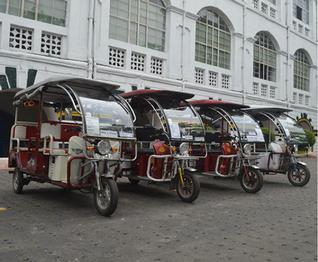
Battery-powered rickshaws wait for passengers in the Fort William campus in Kolkata.— Photo: Special Arrangement

Battery-operated rickshaws, locally called ‘totos,’ are now allowed to ply in Fort William, the headquarters of Eastern Command, for civilians to commute in the 177-acre campus. The initiative has benefited those who work in the Eastern Command — both former and current employees — as they routinely visit Fort William, located on the eastern banks of the river Hooghly.

“Electronic rickshaws are immensely helpful. We had to walk a kilometre or two to reach the canteen from one of the main gates,” said Shibnath Ganguly, a retired Air Force staff and added: “It was an arduous walk, especially in the summer.” The e-rickshaws charge a subsidised rate of two rupees from each passenger for each trip.

235th anniversary

The rickshaws ply from 8 am to 8 pm inside Fort William, which completes its 235th year in 2016.

Opened in 1781, the fort, with a formidable arsenal and personnel presence, was named after William III of England. Many civilians, a few thousands in number, stay inside, while scores of employees daily report to their offices offices.“This is primarily a welfare service, not only for the benefit of the public but also for the boys who operate the rickshaws,” explains Col. Richard Fernandes, the Commanding Officer of 12 Garhwal Rifles, who ensures smooth operation of the rickshaw service. The drivers are civilians, selected by the Army, to run four such rickshaws.

“The Army has provided the e-rickshaws. The drivers are not only paid Rs.3,000 every month [by the Army] but also make additional money by providing the service to people,” said Col. Fernandes. The rickshaws are not allowed to go outside the Fort’s campus. However, that is “not a major concern” for Mritunjay Kumar, one of the drivers who covers 50-60 km every day. “I am earning about Rs. 100-150 per day and making about Rs. 8000 each month,” said 19-year-old Mr. Kumar, whose father is a civilian employee of the Army.

The officials believe that the earning of the drivers from the e-rickshaw project, promoted as “an eco-friendly” venture, will go up from localised tourism, as the Vijay Smarak [War Memorial] at Fort William was recently opened to the public.

The e-rickshaws charge a subsidised rate of two rupees per passenger per trip

source: http://www.thehindu.com / The Hindu / Home> National / by Special Correspondent / Kolkata – July 14th, 2016

IIT-Kharagpur to confer Distinguished Alumnus Award at the 62nd convocation

Kolkata:

Indian Institute of Technology Kharagpur will confer the Distinguished Alumnus Award on the occasion of the 62nd convocation of the Institute which will be organized on July 30 and 31.

Seven eminent alumni have been selected for the award for their exceptional professional achievements in the industry, in the academia or as entrepreneur. The awardees are – Dr Anurag Acharya, Ajit Jain, Asoke Deyasarkar, professor Gautam Biswas, professor Indranil Manna, professor Supriyo Bandopadhyay and Professor Venkatesan Thirumalai.

Dr. Anurag Acharya (IIT KGP B.Tech./Computer Science and Engineering/1987 batch), Distinguished Engineer at Google USA. Dr. Acharya is key founder of Google Scholar which since its inception has become an indispensable service for the global academic and research community.

Ajit Jain (IIT KGP B.Tech./Mechanical Engineering/1972 batch), President of Reinsurance Division, Berkshire Hathaway Insurance Group, USA. Shri Jain is a visionary in the global investment sector, having led Berkshire Hathaway to great heights. He is a well-known philanthropist as well funding the Jain Foundation with the mission is to cure muscular dystrophies.

Dr. Asoke Deysarkar (IIT KGP B.Tech./Chemical Engineering/1971 batch), CEO and Chairman, PfP Industries, USA. Dr. Deysarkar has blended his research with entrepreneurship in Chemical Engineering forming a billion dollar conglomerate of companies. The Deysarkar Family has helped establish the Trans-disciplinary Program in Petroleum Engineering at IIT KGP. Dr. Deysarkar is also known for his philanthropy activities.

Professor Gautam Biswas (IIT KGP Ph.D./Mechanical Engineering / 1985 batch), Director, Indian Institute of Technology Guwahati. Prof. Biswas has an illustrious academic career of 25 years having taught at IIT Kharagpur, IIT Kanpur and in various international universities and known for his leadership at IIT Kanpur, Central Mechanical Engineering Research Institute, Durgapur and IIT Guwahati. His fundamental research on heat transfer phenomena is well recognised in the international academic community. He was the Founder Director of Academy of Scientific and Innovative Research (AcSIR), New Delhi.

Professor Indranil Manna (IIT KGP Ph.D./Metallurgical and Materials Engineering/ 1990 batch), Director, Indian Institute of Technology Kanpur. He has been an exceptional academician and researcher having a long-standing association with IIT Kharagpur as faculty and thereafter leading the Central Glass and Ceramic Research Institute, Kolkata and IIT Kanpur. His significant contributions in advanced material science and engineering have been well recognised by national and international bodies.

Professor Supriyo Bandopadhyay (IIT KGP B.Tech./Electronics and Electrical Communications Engineering/1980 batch), Commonwealth Professor, Department of Electrical and Computer Engineering, Virginia Commonwealth University, USA. Recently he was named Virginia’s Outstanding Scientist and is known globally for his interdisciplinary research. He directs the Quantum Device Laboratory in the Department of Electrical and Computer Engineering which has been frequently featured in national and international media for exemplary research in nanotechnology.

Professor Venkatesan Thirumalai (B.Sc./Physics /1969 batch), Director, NUSNNI-NanoCore, National University of Singapore. He is known for his pioneering research in laser technology. Prof. Venkatesan was Founder of the PhD/MBA program in NUS and the Surface Center at Rutgers University.

The Distinguished Alumnus Award is one of the highest recognition given of accomplishment and contribution of an alumnus/alumna from the Institute.

The awardees will be given a gold medal and a certificate.

source: http://www.timesofindia.indiatimes.com / The Times of India / News Home> City> Kolkata / Somdatta Basu / TNN / July 12tj, 2016

The brothers bose

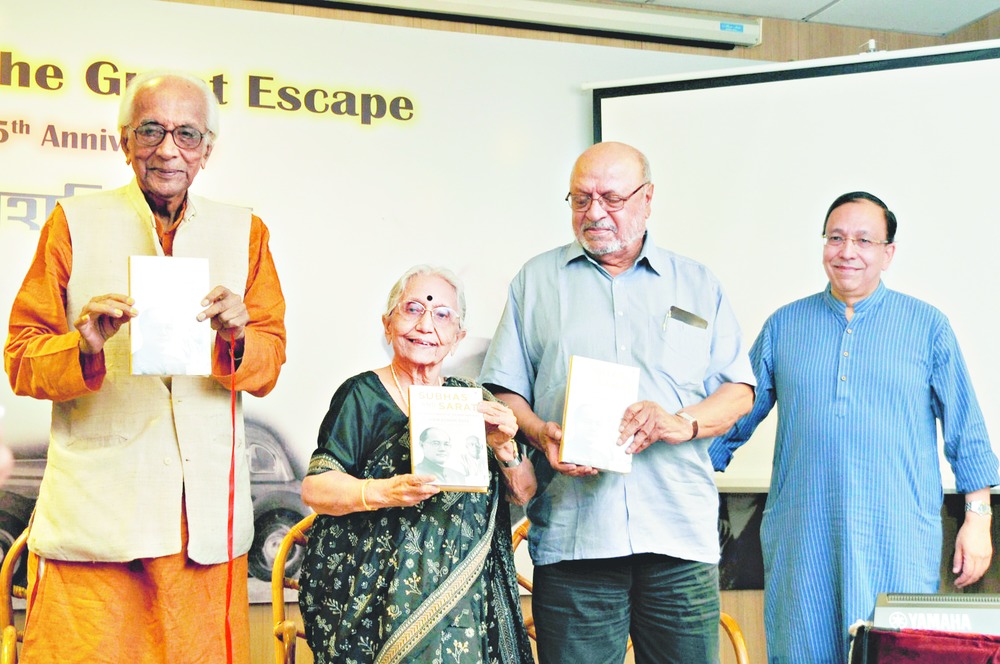
(From left) Poet Nirendranath Chakraborty, former MP Krishna Bose, film-maker Shyam Benegal and historian-MP Sugata Bose at the launch of SUBHAS AND SARAT: An intimate memoir of the Bose Brothers at Netaji Bhavan on Sunday evening. /  Picture by Sanat Kr. Sinha
(From left) Poet Nirendranath Chakraborty, former MP Krishna Bose, film-maker Shyam Benegal and historian-MP Sugata Bose at the launch of SUBHAS AND SARAT: An intimate memoir of the Bose Brothers at Netaji Bhavan on Sunday evening. /
Picture by Sanat Kr. Sinha

The book has been edited by Sumantra Bose, a professor of international and comparative politics at the London School of Economics and son of Sisir Kumar Bose.

Sisir Kumar Bose, Netaji’s nephew and son of Sarat Chandra Bose, had in the 1980s authored the Bengali version of the memoir: Basu Bari.

The book, which used to be serially published in Anandamela, a children’s magazine published by the ABP Group, focuses on the period from the mid-1920s to the 1940s, when the freedom movement was at its peak.

Sisir Kumar Bose, who died in 2000, had written a version of the memoir in English, said Harvard professor Sugata Bose, the elder son of Sisir Kumar Bose.

Chakraborty recounted how as editor of Anandamela he had convinced Sisir Kumar Bose to pen Basu Bari.

source: http://www.telegraphindia.com / The Telegraph,Calcutta,India / Front Page> Calcutta> Story / Monday- July 11th, 2016

Women-only team to make city’s costliest Durga idol

WomenOnlyKOLKATA11jul2016

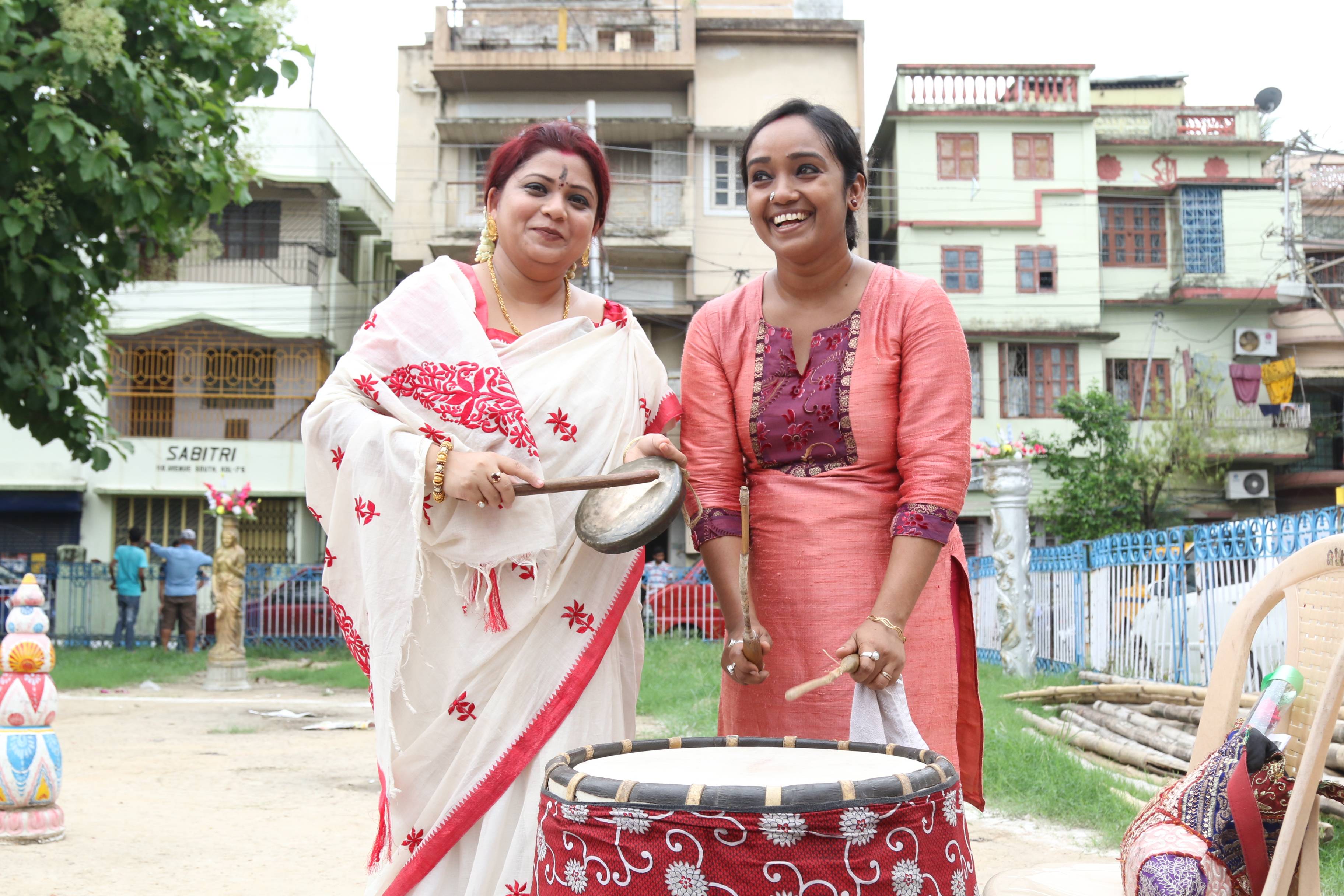
Aditi Chakraborty is a known name in the Durga Puja circuit, as one of the most sought-after idol makers of Kolkata.Subhamita Dinda, on the other hand, is a debutante, though her husband Sanatan Dinda commands huge respect in the same circuit. In a first, these two women are putting together one of the costliest Durga puja idols and pandals this year. They claim to be the first women-only team in this male dominated profession. Now that’s a reason why Santoshpur Lake Palli Pujo must feature in your must-visits list this year.

Aditi, who is in charge of decorating the pandal, said, “We are trying to present tradi tion in a never-seen-before manner. Our theme is `puja’ itself. We will be making use of many traditional items such as tambul dani and stitch-art that used to adorn the walls of homes in our childhood.”

We went to see the two ladies at work on the day of the khunti pujo, where we met Somnath Das, executive member of Santoshpur Lake Palli pujo. On being asked about the USP of their puja, Das said, “For most pujas these days, the theme is planned first and the idol and the pandal are then crafted around the theme.However, we have decided to keep the idol in focus. There will be many rare materials used in the making of the idol which have never been used for this purpose before. The pandal will feature detailed wood-carvings too.”

Aditi and Subhamita have already started work a couple of months back. On being asked how it is to try to make a footprint in this primarily male-dominated industry, Aditi shrugged it off. “I am an artist.It does not matter whether I am a male or a female. What matters is that the work is done well. My bonding with Subhamita is strong and I am enjoying working with her,” she said.

Subhamita, on her part, promises surprise for the visitors. “All I can say is that people will find it in their heart to fold their hands and pray to the idol, once they see it. But for that, one needs to wait a little bit more,” she signed off.

Reporting done by Pratik Banerjee

source: http://www.timesofindia.indiatimes.com / The Times of India / News Home> City> Kolkata / July 11th, 2016

Only military establishment to be named after Bengal icon

Kolkata :

One of his primary responsibilities is to encourage youngsters from West Bengal to join the Indian Navy and what better way to do this from the INS Netaji Subhas, the only military establishment in the country to be named after the Bengal icon. In a way, it was fateful that Commodore Suprobho K De took over as naval officer-in-charge (NOIC), West Bengal, on Monday. A day later, INS Netaji Subhas that De now commands celebrated its 42nd birthday.

“We shall continue to visit schools and colleges to encourage students to take up the Navy as a career. We would like more youth from West Bengal to join the Navy. A Naval Selection Board is also coming up at Diamond Harbour. This will be very crucial for youth in the eastern part of the country who now have to travel to Bhopal to get selected. The selection board will also provide employment and business opportunities for people of the area,” Cmde De said before attending a cake cutting ceremony and barakhana with officers and other ranks of INS Netaji Subhas.

The naval base in Kolkata is also in charge of warships that berth at the ports of Kolkata and Haldia. The NOIC also liasons with the civil administration on several issues including humanitarian aid and disaster relief. The Navy office in Kolkata also keeps a watch on shipping activities in the Bay of Bengal and security aspects. The Navy has also been eyeing a Forward Operating Base (FOB) at Sagar for better monitoring of the region. Sagar will also have a missile battery once the island is connected to the mainland by a road-cum-rail bridge.

The naval base in Kolkata was first set up at Marine House prior to World War II. The strategic importance of the Kolkata port during the war made it necessary for the Allied presence in India to bring up this naval presence to safeguard and strengthen its maritime assets in the east of the country which would also augment the capability to provide logistic support to Allied units and later Indian naval ships operating in the Bay of Bengal. Later the HMIS Hoogly was renamed INS Hoogly. On July 5, 1974, it was rechristened INS Netaji Subhas.

Cmde De, who was commissioned in 1985, is an alumnus of National Defence Academy, the Defence Services Staff College and Naval War College. A gunnery specialist, his previous appointment was as station commander of INS Angre, Mumbai. An alumnus of Sainik School, Purulia, he is married to Bandana De and they have a son who is an IPS Probationer.

source: http://www.timesofindia.indiatimes.com / The Times of India / News Home> City> Kolkata / Jayanta Gupta / July 05th, 2016

City wins teen chef crown – Calcutta Girls student tops it

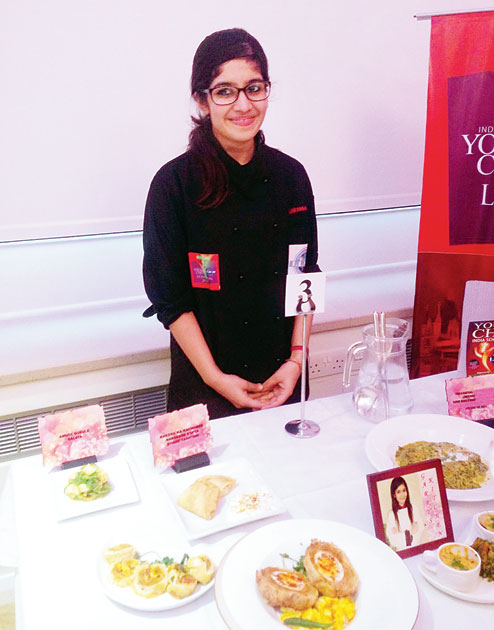
Garima Poddar plates her dishes at IIHM Young Chef India Schools 2014 at the University of West London

Garima Poddar likes her friends calling her Garry after Gary Mehigan, her favourite judge on Masterchef Australia.

And true to the Masterchef nickname, the Calcutta Girls High School Class XII student won the IIHM Young Chef India Schools 2014 contest at the University of West London on Saturday and retained the crown that Simran Kapur had won for Calcutta last year.

The finals of the inter-school cooking competition — held by the International Institute of Hotel Management (IIHM), in association with t2 — saw six finalists from six Indian cities (Calcutta, Delhi, Hyderabad, Bangalore, Pune and Ahmedabad) battle it out with their plates and pans to serve up meals to some of the best-known Indian chefs in London.

Wearing the judges’ hat at the London finale were Andy Verma, who owns restaurants Vama and Chakra in the UK, Dipna Anand whose family owns and runs Brilliant restaurant in London’s Southall area largely inhabited by Indians, Romy Gill of Romy’s Kitchen in South Gloucestershire, and closer home t2 columnist Shaun Kenworthy and Sector V IIHM’s chef Sanjay Kak.

How apt it was for the IIHM Young Chef India Schools contest to culminate in London was underlined by Virendra Sharma, MP, Ealing Southall, the chief guest at the evening prize distribution, who pegged the number of Indian restaurants in the UK at 60,000.

10dishesKOLKATA05jul2016

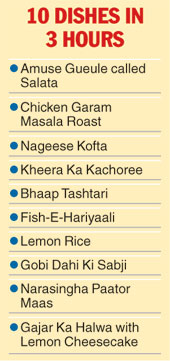
But what did Calcutta girl Garima do that the others didn’t? For one, she churned out 10 dishes in a three-hour-long cookout, a number unmatched by any other contestant. “Her biggest challenge was getting all her dishes right because she made so many,” agreed the judges, all of who gave Garima the highest score.

The Southern Avenue resident pinned her win down to two factors — confidence and practice. “I know it sounds cliched but practice does make perfect. I strived to make at least three dishes a day to prepare for the finals. One day, I did a 100 roti challenge just to get that perfect roti shape and all the rotis were given to the needy,” said Garima.

Like Garima, her other five competitors made it past 8,000 students who participated in the Young Chef competition over six months. Two got their visas in the nick of time and reached two hours before the contest kicked off while the Jaipur girl had to give it a miss, cutting down the number of finalists to six from seven.

In the two days they all spent in London before the finals, food was the only thing on Garima’s mind. Ask the Lebanese hairdresser at Eli’s Hair & Beauty on Kew Bridge Road who was unexpectedly pulled into a casual conversation on tahini, babaganoush and shawarma as she settled down for a wash-and-blow dry! Or the Kadai Chicken that was sampled at a local restaurant down the road from the hotel.

“In fact, it was for this competition that I started having non-veg,” said the spunky Marwari girl. “Non-veg is not cooked at home but we eat it outside. Initially, I would nibble on chicken; now I can eat a whole chicken meal!”

Which is why chicken featured on what the judges called her “buffet”. There was Chicken Garam Masala Roast, Nageese Kofta (egg wrapped in chicken keema) “learnt from my mom’s friend”, Kheera Ka Kachoree “learnt from dadi”, Bhaap Tashtari, Fish-E-Hariyaali, Lemon Rice, Gobi Dahi Ki Sabji and a fusion dessert Gajar Ka Halwa with Lemon Cheesecake. She also made an Amuse Gueule called Salata (frozen salad) and an Assamese dish called Narasingha Paator Maas “inspired by a YouTube video of Gordon Ramsay cooking Assamese food in Assam”.

The commerce student who loves economics also made all the right calculations and moves. Like when she used micro-greens to garnish her dishes, an idea picked up from Shaun’s cooking demonstration the previous day. Or when “I decided not to make rotis because they would have to be made last and would eat into my plating time”, she said.

Her future plans? “It’s either economics or cooking and after this contest, the scales are tilting more in favour of the latter,” she signed off, clutching in her hands the winning trophy, a cheque for Rs 5 lakh and a placard that read ‘Garry’s Kitchen’, which she had proudly displayed on her table.

What is your message for Garima? Tell ttmetro@abpmail.com

source: http://www.telegraphindia.com / The Telegraph,Calcutta,India / Front Page> Calcutta> Story / by Karo Christine Kumar in London / Monday – October 20th, 2014