Category Archives: Records, All

Newly-discovered maps from 1887 tell Kolkata’s municipal story

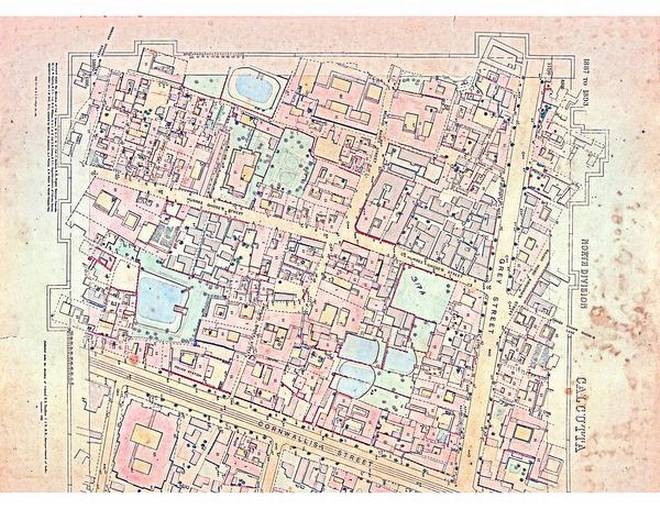
Painstaking effort: In this British-era map of Kolkata, water bodies are shown in blue and concrete structures are marked in pink.

The newly-discovered Kolkata maps, created over a seven-year period, plot buildings, trees, lakes and even dustbins

Almost a hundred years before satellite-based mapping made information available to people at their fingertips, a municipal survey done in Kolkata by British surveyors documented not only streets, houses, landmarks and water bodies but also trees, telegraph and telephone posts, urinals, wells, hackney carriage stands, and dustbins, among others.

The maps of the first major municipal survey of the city carried out over a span of seven years from 1887 are so precise that they follow a scale of 50 feet to an inch. The survey was conducted by Lt. Colonel W.H. Wilkins, who had surveyed Bassein in British Burma. The exercise involved ₹2.38 lakh.

The West Bengal State Archives is now ready with a publication comprising 38 such maps detailing the city’s north division, from Mahratta Ditch in the north, the Hooghly river in the west, the Circular Road, Panchanna Gram in the east and Jorasanko and Kasaripara area in the South.

Titled ‘Calcutta Municipal Maps 1887-1893,’ the publication provides a rare glimpse into the urban history and landscape of Kolkata with the minutest details.

Simonti Sen, the director of State Archives said the painstaking detail in the maps was impressive.

“These maps will not only serve as a milestone to those interested in urban history of the city but can be of immense use to environmentalists who can look up information on water bodies and clusters of trees that existed between 1887 and 1893,” Ms. Sen told The Hindu.

The maps were discovered rolled up in a corner of the State Archives when the renovation of its premises was taken up in 2015. Archivists came across 20 inch x 18 inch sheets with alphanumeric markings that did not make much sense in the beginning.

After a thorough search, scores of such maps were found and it was ascertained that the alphanumeric markings were the order of the maps. The maps were marked on the basis of street names and names of landmarks. Consultations with experts showed that they were part of the survey done by W.H. Wilkins. Each map sheet bears the names of nine or ten surveyors, mostly British, including that of Col. Wilkins.

First effort

“The Calcutta Municipal Corporation was set up in 1876, and this may be the first major survey after that. We believe that the aim of the survey was to increase the tax base of the corporation. One can see the pucca houses and katcha houses being marked differently. Moreover they take into account all municipal infrastructure from sewage lines and drains to telegraph and telephone posts,” Sarmistha De, archivist who has worked extensively on the publication said.

Both Ms. Sen and Ms. De are convinced that the maps, which are being brought to the public domain for the first time, served as the basis of the survey conducted by Major R.B. Smart between 1903 and 1914, which historians call the most “noteworthy of all surveys made on the city till date”.

A changed city

One important thing that the maps point to is the significant change in Kolkata’s green cover and water bodies. They have distinct symbols for different kind of trees, while water bodies are shown as blue spaces, concrete structures are marked pink, and katcha houses, grey.

Almost all 38 maps indicate large open spaces and green. These areas have turned into the most congested parts now.

The maps highlight important educational and cultural institutions of 19th century Kolkata. For instance Bethun College and School, one of the first educational institutions exclusively for girls has been marked as Bethune Female School.

The historic Scottish Church College set up by Alexander Duff in the beginning of 19th century is described as The General Assembly’s Institution in map sheet no. S9. More landmarks such as Duff’s Hindu Girl’s School (sheet no. Q7) and Free Church Institution (sheet no. O3, O4) are also mentioned.

The Star Theatre which conducted its first show on 21 July, 1883 can also be seen at the crossing of Cornwallis Street and Grey Street. (map sheet no S7).

Historians can also find details about the Bengal Music School founded by Rabindranath Tagore, in 1881, referred to in map sheet numbers P4 and P5.

These map sheets also provide a glimpse of the transformation of urban geography.

The name change of some old city streets becomes immediately evident: European names have yielded to Indian ones.

For instance Cornwallis Street changed to Bidhan Sarani, Schalch’s Street to Durgacharan Banerjee Street and Grey Street is now Shree Aurobindo Sarani.

After the current publication, the State Archives plans to reveal 68 other maps.

source: http://www.thehindu.com / The Hindu / Home> News> Cities> Kolkata / by Shiv Sahay Singh / Kolkata – September 30th, 2017

Monali Thakur realised ‘actual gravity’ of National award through others’ reaction

Singer Monali Thakur was named as the Best Female Playback Singer at the National Film Awards 2016.

Monali Thakur shared that she feels amazing and overwhelmed at bagging the award.

Singer Monali Thakur, who has been named as the Best Female Playback Singer for the song “Moh moh ke dhaage” from “Dum Laga Ke Haisha” at 63rd National Film Awards, says it was through other people’s reaction that she understood the “actual gravity” of the award.

The singer also shared that she feels amazing and overwhelmed at bagging the award.

“It feels amazing at first, overwhelming actually and feels really great,” Thakur told IANS.

Asked how important the honour was as compared to other awards, Thakur said: “Of course, this gives a lot of happiness when you know that you have won an award or for that matter that you have been nominated for your work. I realised the actual gravity of this award (63rd National Award) when I saw the reactions….”

The “Sawaar loon” crooner said that the award became more important to her after she saw the “reaction and excitement” of her family and friends.

The 30-year-old singer says that the composition of the song makes it special for her.

“This song is extremely special for me because you hardly get any more compositions like this in our industry. In the era of EDM, I am really happy and feel lucky that I got a chance to sing such a song.” she said.

Directed by Sharat Katariya “Dum Laga Ke Haisha”, a romantic comedy film, stars Ayushmann Khurana and Bhumi Pednekar.

source: http://www.indianexpress.com / The Indian Express / Home> Entertainment / Pop-Bollywood Music / by IANS, New Delhi / May 02nd, 2016

Checkmate nerves in championship endgame – Calcutta teenager conquers enemy within on way to breakthrough international title

Arpita Mukherjee, who won gold in the under-20 Commonwealth Chess Championships in Delhi this month. Picture by Mayukh Sengupta
@Byline: Debraj Mitra

A 16-year-old Dum Dum girl has made a career gambit out of a “distraction” once employed by her parents to get her to swallow her medicine.

Arpita Mukherjee won gold in the under-20 Commonwealth Chess Championships in Delhi this month, an achievement pieced together after several years of dominating performances in state and national championships across age groups. A Class X student at Shahid Rameshwar Balika Vidyamandir in Dum Dum, she sees her first international victory as the turning point in her career.

“I had been losing crucial matches from favourable positions. Not being able to hold my nerves is a failing that I seem to have finally overcome,” said Arpita, whose father Partha gives chess lessons to children for a living.

The teenager looks up to chess stalwarts Magnus Carlsen and Judit Polgar for inspiration and trains at the Dibyendu Barua Chess Academy. Her top goal is to become a Grandmaster.

“There was never any doubt about Arpita’s talent. But she had a confidence problem. Winning the Commonwealth gold will settle her nerves,” Barua told Metro.

For Arpita, this competition had been all about not crumbling under the weight of expectations. A few months before the Commonwealth Games, she had started meditating to get into the right frame of mind. She finished the tournament undefeated, winning five games and drawing two.

“I won at least a couple of close matches that could have gone either way. My concentration did not slip,” Arpita recounted.

Arpita’s first big year in chess was 2008, when she was just seven years old but skilled enough to defeat several higher-seeded players at the Telegraph School Chess competition. The same year, she won the state championship in the under-8 category.

In 2009, Arpita won silver at the Asian Youth Championships in Delhi. A bronze in the under-9 section of the national championships in Chennai followed. Since then, she has consistently earned medals in successive state and national tournaments, including bronze in both the under-17 and under-19 categories of the 2016 nationals.

Arpita, much more confident after her Commonwealth success, aims to become a Women International Master (WIM) soon. “I have one WIM norm. I need two more to get the rank,” she said.

Arpita attributes her success to her father, with whom she plays “mind chess” after dinner every day. Having Grandmaster Barua as a mentor has also been a big advantage. But getting sponsors is proving to be difficult.

The teenager had been selected to represent India in the under-20 Asian Championships in Tehran in May but could not go. “I needed to arrange more than Rs 1 lakh, which I could not do. Arpita had to cancel her trip,” Partha said.

A relative gifted her a laptop last year. “It has helped me a lot – playing with the computer regularly,” she said.

What message do you have for Arpita? Tell ttmetro@abpmail.com

source: http://www.telegraphindia.com / The Telegraph, Calcutta,India / Front Page> Calcutta> Story / Friday – July 28th, 2017

Kolkata’s last surviving Chinese school set for 2nd innings

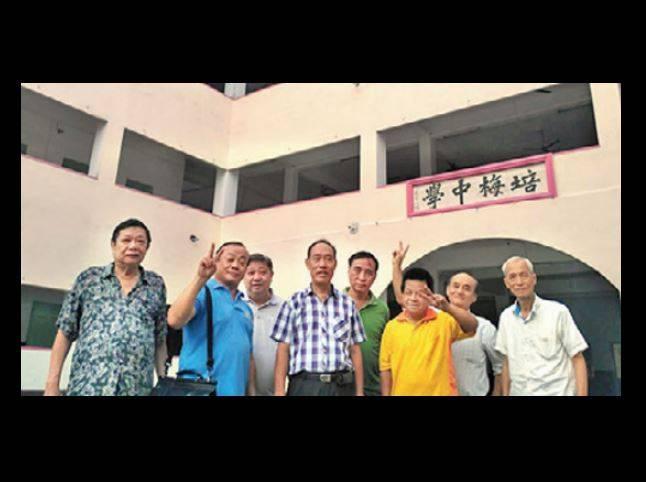
Members of the new managing committee most of whom studied in Pei May

Kolkata:

One of the city’s last Chinese schools that had closed down seven years ago has got a new lease of life. Members of the community in Tangra’s Chinatown are drawing up plans to reopen the institute that has taught Mandarin to at least two generations of Indian Chinese before the classrooms were padlocked in 2010 after the management committee was taken over by a Chinese businessman. The Chinese Tannery Owners’ Association has won the legal tussle and regained control.

“The sweat and blood of our grandparents and parents went into establishing the school so that we could learn the Chinese language and culture. When it was set up nine decades ago, the Indian Chinese community wasn’t prosperous. In fact, most were impoverished and earned a living from sale of leather waste. In our generation, we have not been able to create any infrastructure. It is our moral responsibility to look after the school so that future generations are not deprived of education,” said Chu Ying Wah, vice-president of the school’s new managing committee.

The three-storied U-shaped school building with a football field and basketball court sits on 3 bigha, 13 cottah of prime land in Tangra that developers have been eyeing for a while. With a cottah now selling for Rs 25 lakh in the area, it is a virtual gold mine waiting to be grabbed. Aware of the threat, the committee wants to restart the school from the next academic session, initially from KG to Class V, then till VIII before approaching the CISCE board for affiliation. “Students who get admitted next year should be able to sit for ICSE and ISC exams,” said Yeh Chi Yan, the president of the managing committee.

While restarting the school will be relatively easy, the committee is aware that convincing parents to admit their children in Pei May instead of an established English medium school will be a challenge. “Times have changed. It has to be an English-medium school that will be open to all. Chinese will be available as a second or third language but English will be the first language,” said Chan Yung Sheng, treasurer of the committee. Also, instead of Chinese and world history and geography that was taught earlier, students will now learn about Indian history and geography.

The school’s fortunes had begun to decline from the 1970s when the Indian Chinese community, embittered after being interned during the Sino-Indian border conflict in 1964, began to migrate. The population declined from 10,000 in the 1960s to 5,000. Another wave of migration in the late 1990s after the government decided to shift tanneries out of Tangra saw the population decline to 2,500. This apart, the school also lost out when another school — Grace Ling Liang — was set up and offered English along with Mandarin.

“At present, there are only 2,000-odd Chinese in Tangra. In the 1960s, the school had over 1,000 Chinese students. Now, there will be only a few. Most of the students will be non-Chinese,” said Chen Khoi Kui, secretary of the association as well as Tangra Chinese Youth Club. Such is the situation now, the committee may well have to appoint a non-Chinese to teach Mandarin.

source: http://www.timesofindia.indiatimes.com / The Times of India / News> City News> Kolkata News> Schools & Colleges / TNN / July 09th, 2017

3 Kolkata directors to be part of Oscar panel

Kolkata:

The Academy of Motion Picture, Arts and Sciences has invited 14 popular personalities associated with Indian cinema to be a part of its Oscar committee. Three eminent directors from Kolkata — Mrinal Sen, Buddhadeb Dasgupta and Goutam Ghose — are also in this list.

Incidentally, all three directors have never been in awe of the Oscars. Their names have been often associated with awards at Berlin, Venice and Cannes film festivals. Though highly respected in the art-house circuit of international cinema, none of them have ever won an Oscar or sent their films for consideration at the awards.

Dasgupta has never been known to have rated Oscars as the highest film event. “I have never been inspired by Hollywood. For me, Oscars has never been a benchmark for great cinema. I don’t remember aspiring for an Oscar either. Having said that, I must also mention that being invited to be a part of the committee is definitely a kind of honour for me. I have accepted the offer,” the director said.

Ghose shared that he was once the chairperson of the board that decided on which Indian film must be sent as the Oscar entry. “India produces a lot of films. Thus, we had sent a request asking if more than one film can be sent from here,” he said. Though Ghose insists that he has never been crazy for Oscars, he doesn’t have any conflict with this award ceremony. “Why just Oscars? I haven’t even craved for a Palme d’Or at Cannes. Oscar is basically an award for English language films released in the US. It is also true that some masterpieces have never got an Oscar. Even Alfred Hitchcock didn’t get an Oscar. Yet it is important to see that the academy is expanding and constituting a large committee,” Ghose said.

At 94, Sen is just a year younger than the oldest invitee (American actress Betty White). When TOI asked the director’s son Kunal about his father’s reaction to the invitation, he said, “I have mentioned it to him. He didn’t show any interest or curiosity. It makes little difference as he doesn’t watch films any more. Even when he was active, he showed no interest in the Oscars or the type of the films that compete for it. He didn’t even watch a lot of Hollywood productions. Therefore, I doubt he would have been too involved even if it happened years ago.”

Incidentally, Sen has once famously said, “Oscars didn’t make ‘Slumdog Millionaire’ a great film.”

“He preferred more serious films, not the crowd-pleasing ones that Oscars generally lean towards,” Kunal said. On being asked if Sen’s films were ever sent to the Oscars, Kunal said, “He preferred the European festivals. So, I don’t think he would have considered it, and I am not aware of any of his producers who did it either.”

source: http://www.timesofindia.indiatimes.com / The Times of India / News> City News> Kolkata News / by Priyanka Dasgupta / TNN / July 12th, 2017

Kolkata boy No.3 on AIIMS list, state trio in top 50

Kolkata :

When Tollygunge boy Tamaghna Ghosh quit IITDelhi to return home after only one semester in computer science and engineering, he faced a lot of criticism from family and friends. On Friday though, the same people were heaping praise on him after he stood third in the All India Institute of Medical Sciences (AIIMS) entrance exam. This is the highest rank secured by any student from Bengal in the past five years. Two other state students feature on the top-50 list.

“In 2016, I had 93 rank in IITJEE (Advanced) and took admission in IIT-Delhi. But when I chose to return, everyone apart from my parents criticised me,” said Ghosh. His interest in medical research prompted him to take the decision.

“The course at IIT would have given me a good career with a luxurious life. But that is not what I wanted to do. In 2016, my rank in NEET was not good and that motivated me to prepare well,” said the top-3 rank holder.

The 21st position was secured by Aranya Dutta, a student of Ramakrishna Mission Vidyalaya, Narendrapur. Dutta, an Arijit Singh fan, wants to become a cardiologist. “I was confident of doing well. But being 21st was beyond my expectations,” he said. Dutta, who stood seventh in the HS, said he dedicated eight hours every day for his preparation. ” Accuracy and speed are important,” he added.

On No.28 is Shivam Singh of Birla High School for Boys. “Consistency, revision of lessons and taking mock tests are my success mantra. I would suggest medical aspirants to study the NCERT books,” said the Belur resident. Singh wants to study neurosurgery and likes to play chess, watch comedy shows on TV and devoted five hours every day to prepare for medical entrance tests.

Apart from the three, two more names from Bengal are in the top 100. “For the first time, three students from the state will be joining AIIMS Delhi to pursue MBBS course. In the past, barely one student was able to crack the exam every three or four years,” said Sunil Agarwal, centre director of Aakash Institute in Bengal.

source: http://www.timesofindia.indiatimes.com / The Times of India / News> City News> Kolkata News / by Somdatta Basu / TNN / June 16th, 2017

Karate golds for township academy kids

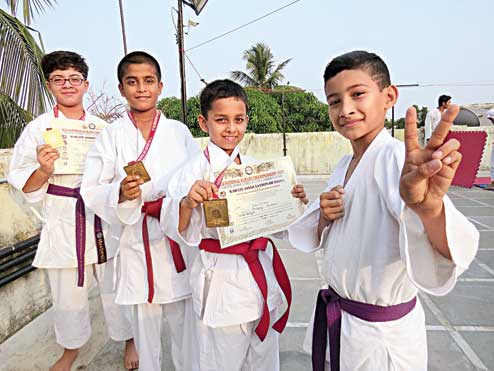
(From left) Rishika Patra, Subhadip Srimani, Pratyay Sarkar and Ayushman Ray pose with their medals on the terrace of Premjit Sen’s academy in BD Block. Subhadip trains elsewhere, in Patipukur

Bengal has returned from the just-concluded Junior National Karate Championship 2017 with eight golds. The tournament, organised by Karate Association of India (KAI), was held at Talkatora Indoor Stadium in New Delhi from May 11 to 13. And of the eight gold medallists, half are products of Premjit Sen’s BD Block training academy.

Another gold might have got added to the tally if Aritri Dey did not commit an elementary mistake. “She forgot to bow at the start of the bout. That got her disqualified,” laments Sen, who was also the competition manager at the tournament. Since Aritri has got a bronze medal at the Senior National Championship, expectations were high from her.

Return to practice pad

The gold medallists, not even in their teens yet, were back for practice within 10 days on the rooftop of BD 340.

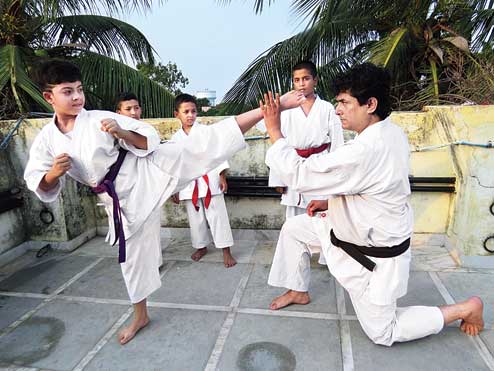
Rishika throws a kick at Premjit Sen in course of training as others watch. Pictures by Sudeshna Banerjee

Bespectacled Rishika Patra takes off her glasses before a fight. The CJ Block girl has been training at the academy since the age of three. Now she is 11. “My father used to be Shihan (Japanese term for master instructor)’s student. He had to give up karate due to spondylitis,” says the girl, whose cherubic face belies the grit of a purple stripe belt. That’s three grades below a black belt.

She studies in Ashok Hall Girls’ Higher Secondary School. The little time she can devote to studies at home after daily practice so far has fetched satisfactory grades. “Though official karate classes are twice a week, Shihan makes them practise separately every day after school,” says Rishika’s mother Sanjukta.

The results have been there to show. Her three earlier national championship appearances have fetched a gold, a bronze and a silver. Add to that a bronze in the Commmonwealth Karate Championship in 2015. “But I prize that first national gold beyond all other achievements. It was my first major competition. Shihan fell ill and had to leave before my fight. So I was alone,” says the girl who idolises boxing legend Mary Kom.

This time, Rishika travelled to Delhi with her parents, fellow student Pratyay Sarkar and his mother. “I was tense about how I would do. Didi (Rishika) was sure to get a medal,” says Pratyay, an eight-year-old from AD Block.

He need not have worried. “Pratyay has never returned without a gold medal from any competition,” says mother Chhanda. This may have been his first national event, but the boy has already played and won in internationals championships. “We try hard to save and send him abroad. Last year, he went to Cape Town, South Africa and the year before to Sydney, Australia. He won in both in his category,” says Chhanda, who runs a tailoring outfit supplying school uniforms to the state government.

This time was no different. “I won all five rounds. Ma was more excited than me,” Pratyay grins. The win earned him a big box of chocolates.

Such is the support he gets from home that his school was changed within a year of joining. “The pressure of studies was too much in Garden High,” she says. Pratyay now studies in Apeejay School in the neighbourhood.

Such is the pull of Sen’s coaching that people travel considerable distances. The other two gold medallists — Ayushman Ray and Amiyo Sundar Biswas — come from Madhyamgram and Konnagar respectively. “I used to train locally before. I am coming to Shihan’s academy for one year now,” smiles Ayushman, 9. Amiyo may be just 12 but he is already a three-time national gold medallist.

Karate’s inclusion in the 2020 Olympic Games in Tokyo has added a spring to their steps. “We used to be a sidelined sport. Now we will be taken seriously. I hope our state government takes notice of these young champions like our neighbouring states have,” says Sen. “My focus is on five students. From the age of 14, they will be eligible to complete in Asian Karate Championship. I am training them to face competition from the traditional powerhouses — Japan, Iran and Malaysia.”
________________________________________________________________________

Can an Asiad/ Olympic karate medal come from the Salt Lake academies?
Write to The Telegraph Salt Lake, 6 Prafulla Sarkar Street, Calcutta 700001 or email to saltlake@abpmail.com
_________________________________________________________________________

source: http://www.telegraphindia.com / The Telegraph, Calcutta,India / Front Page> Salt Lake> Story / by Sudeshna Banerjee / Friday – May 26th, 2017

Meet Shakespeare, Tagore and Ray, across the Hooghly

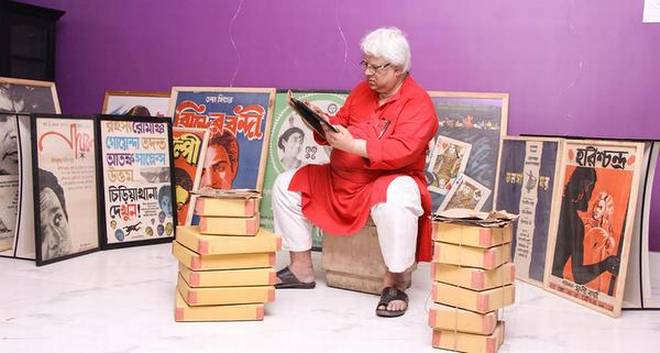
Different strokes: Devajit Bandyopadhyay shows off some items from his collection. | Photo Credit: Special Arrangement

Kolkata collector with a passion for art of the world ready to turn three decades of memorabilia into public archive

Once famed as Sheffield of the east, Howrah, across the Hooghly from Kolkata does not normally attract attention, except from the spiritually-inclined who go to Belur Math. That is set to change, as a museum of the arts is taking shape in one of its small streets, with a trove of collections on literature and the performing arts.

The curated pieces include an old music record made of pitch board, a mid-18th century Bengali manuscript copy from Bibliotheque national de France, and an old ivory-inlay veena.

There are rare books of Shakespeare from London, letters of Rabindranath Tagore, a bioscope and original film posters of Ray and others. Many of these artefacts are from a three-decade-old private collection now going up for public viewing at the Academy Theatre Archive.

Devajit Bandyopadhyay is the passionate force behind the effort. He almost chose to be a chartered accountant, for which he qualified like others in his family, but found more value in theatre and its music. His journey began when he left home, almost penniless, realising that “justice cannot be done simultaneously to two fields that are poles apart.” Sitting in his South Kolkata apartment crammed with books on the performing arts, he recalls his early days of picking up skills in music, painting, theatre and puppetry. “I sang, I held painting exhibitions and gave lecture-demonstrations even as I pursued my passion for music-in-theatre.”

Gina Lolobrigida book

Researching this topic (he has a Ph. D from Jadavpur University on Bengali theatre music), he scoured sources worldwide.

Piece by small piece, he built a small assortment of things, sometimes finding treasures like a signed book by film star Gina Lolobrigida and a Bengali LP record in Oxford Street, UK. He knocked at every door that held promise.

Today, there are 500 pieces of memorabilia, 40 musical instruments, 20,000 books, periodicals and manuscripts and about 24,000 records of Indian and western music and operas. Most are backed by accession reports and authentication certificates, says Mr. Bandyopadhyay.

“My passion binds me to each acquisition, but my 12-year chase to acquire the 18th century Bengali manuscript in Paris and the time I had to persuade octogenarian Istiauq to sell his bioscope from remain etched in my mind”, he says.

Kidderpore chase

A hunt to get a book from a Kidderpore bookseller initially ended in failure, since the man was hospitalised suddenly.

He had lost all hope of getting the book when he heard that the store-owner had sold the entire cart to another book-dealer in central Kolkata.

“I located him. He was not in a very cooperative mood but I went with him to his godown and persuaded him to part with the book”, Mr. Bandyopadhyay recalls.

His passion for collecting and bringing artefacts from far and wide to an art-loving audience is undiminished.

He is now keen to set up the public archive and the digital venture was inaugurated by actor Madhabi Mukherjee, whose posters from Ray films are among the prominent exhibits.

Going public with art

Professor Jayanta Sengupta, Director, Indian Museum, lauds the effort.

He said at a workshop held recently to impart knowledge on restoration, that such private collections as they were a valuable source of conservation.

source: http://www.thehindu.com / The Hindu / Home> News> Cities> Kolkata / by Indrani Dutta / Kolkata – April 23rd, 2017

Assam to convert Bhupen Hazarika’s Kolkata house into archive

Assam Government wants to convert music legend Dr Bhupen Hazarika’s Kolkata residence into an archive, Chief Minister Sarbnanda Sonowal said today.

Director of Assam Bhawan in Kolkata was instructed to pursue the matter in obtaining the ownership of the house from its current owner, an official release said here today.

Hazarika, who died in 2011, lived in a house in Tollygunge area of south Kolkata for decades starting from the middle of 1950s.

At a meeting with the officials of Assam Bhawan in Kolkata, Sonowal also said that steps would be taken to erect a statue of Assam’s literary icon Lakshminath Bezbaruah in the Assam Bhawan premises in the metropolis.

Taking stock of the construction works of Kolkata Assam Bhawan, the Chief Minister said that the house must reflect Assamese culture and tradition through its architecture.

An auditorium inside the Assam Bhawan would be used commercially to generate revenue, he said.

The Chief Minister also directed the Chief Engineer of PWD department to construct a ‘namghar’ (prayer hall) in the Bhawan premises.

Sonowal also directed the officials to start a helpline and website for the benefit of the students and patients from Assam to Kolkata coming for higher studies medical treatment respectively, the release added.

(This article has not been edited by DNA’s editorial team and is auto-generated from an agency feed.)

source: http://www.dnaindia.com / DNA – Daily News & Analysis / Home> News> India / PTI / Thursday – May 04th, 2017

Tracing the last of Raj-era silversmiths

Kolkata :

A quiet revolution is unfolding in Mamata Banerjee’s backyard, courtesy her own MSME department.

The department’s retail body, Biswa Bangla Marketing Corporation, has started reviving a vanishing craft that is delightfully British, tracing the last of the Raj-era silversmiths — Maheswar Dutta — at Kansaripara.

TOI found Bengal’s only surviving “Sheffield craftsman” inside a crumbling edifice, down a backstreet of the CM’s Kalighat residence. These days, Kansaripara Lane — the cradle of Bengal’s traditional silversmithy — is no more than a place with decrepit houses that once belonged to Hindu sub-caste Kangshabaniks or Kansaris (bell metal workers) who settled here in the mid-18th century.

Squeezed between Sambhunath Pandit Street and Russa Road, this place is home to artisans who are still visited by leading jewellers for their outstanding craftsmanship. Dutta (63) is the last heir of a tradition extending back to Charnock’s Calcutta. His forefathers spearheaded a resurgence in heritage silver craft of the 8th century Pala dynasty.

“We were displaced from the nearby Gobindopur village, that constituted Calcutta 250 years ago when Robert Clive cleared the swamps to build Fort William,” said Dutta.

Some of the exquisite pieces Dutta and his apprentices, Alok Patra (38) and Biswanath Bodak (28), have forged will shortly travel to London for a Biswa-Bangla exhibition. The idea is to bring these intricate inlay work in dainty velvety boxes back to shoppers’ lists and eventually apply for the GI tag for the “nakshakari” work.

Only the other day, until Biswa Bangla’s chief consultant Partho P Kar tracked the roots of Bengal’s silversmithy, Dutta was a worried man. Now, they are the busiest stakeholders of the heritage craft revival project.

source: http://www.timesofindia.indiatimes.com / The Times of India / News> City News> Kolkata News / by Ajanta Chakraborty / TNN / May 01st, 2017