Category Archives: Records, All

Indigo researcher digs out nuggets from past

Jenny Balfour-Paul at The Bengal Club. Picture by Sanat Kr Sinha

• A famous tea company in Calcutta traded in indigo in British India. That’s how its office on RN Mukherjee Road, Nilhat House, got its name.

•Opium and indigo growers were locked in constant rivalry before 1859

• Evidence of indigo dye has been even found in the remains of the Indus Valley civilisation

Calcutta:

Such nuggets from history made up writer Jenny Balfour-Paul’s hour-long Bengal Club Library Talk, organised in association with The Telegraph, on November 8.

Balfour-Paul, who has researched indigo for decades, traced its history right from the early evidence to the exploitation faced by farmers in pre-Independence Bengal.

The session was peppered with anecdotes, humour and photographs of travel that she undertook since 2000 to bring together the indigo story.

The highlight of the evening was shots of a handwritten journal by 19th century British explorer Thomas Machell, who got the author inspired in the first place.

Machell had lived in Calcutta and worked in several indigo plantations in the 19th century. His journal traced his experience and the culture of the time, in the form of correspondence to his father in England.

Balfour-Paul shared with the audience how she found Machell’s journals by accident. “I was in the British Library surfing through old books and records when I found this valuable piece of history. It was the word indigo that made me reach out for it,” she said.

One line in the handwritten diary had particularly caught her eye. “I wonder if anybody will find these journals in the 20th century in a dirty library…” Machell had written. “I thought I was meant to find it,” added Balfour-Paul.

The author decided to travel to all those places where Machell had visited more than 100 years ago. She juxtaposed snaps taken during her visits to Calcutta, Bangladesh and also the Marquesas Island in French Polynesia with the British explorer’s illustrations.

Visits to Calcutta brought out some lesser-known facts. “Tea company J Thomas & Co would auction indigo. No wonder their office was called Nilhat House,” Balfour Paul said.

Another story was about her hunt for Machell’s grave. “Two of his journals are missing and I am still putting together the last six years of his life. I was not sure where he had spent his final years,” Balfour-Paul added.

India made Machell ill. He had left its shores for his native Yorkshire only to come back again. “My daughter and I went places in search of his grave, till we realised he had died near Jabalpur. One rainy day in Jabalpur we almost got ourselves arrested as we went grave hunting,” laughed the author.

She has documented many of her tales in her book, Deeper than Indigo: Tracing Thomas Machell, Forgotten Explorer.

source: http://www.telegraphindia.com / The Telegraph, Calcutta,India / A Staff Reporter / Saturday – November 11th, 2017

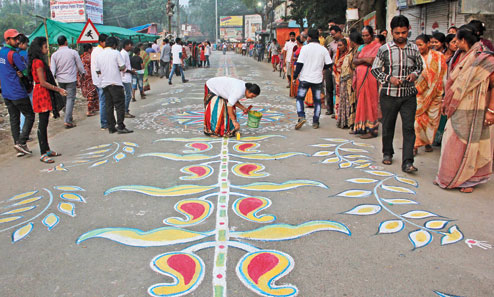
Phulia creates 3km-long alpana in 10 hours

– Hundreds wield brush and paint to draw on road with four colours

Anit Thapa addresses the meeting in Kurseong on Sunday. Picture by Passang Yolmo

Phulia:

Over 800 people wielded brushes and paints of four hues and drew for around 10 hours to create a 3km-long alpana, which the organisers claim is the longest in the world.

The residents of Nadia’s Phulia woke up on Sunday morning to a splendid view of the alpana, which is a traditional motif drawn on the floor in Bengal and elsewhere in the country.

From 9pm on Saturday, 25 groups with 35 members each started drawing the alpana from Phulia bus stand and completed the entire 3km stretch of a road at Sabujpally around 7am on Sunday. To draw the alpana, 2,800 litres of acrylic paints of four different hues were used.

The artists were responding to a request by Junior 100 Foundation, a social organisation.

“Phulia’s 3km alpana is the longest in the world so far and we are planning to approach the Guinness Book of World Record for its inclusion on the list of extraordinary achievements,” said Abhinaba Basak, the cultural secretary of Junior 100 Foundation.

Debabrata Pal, 28, a graduate in fine arts from a government art college, who took part in the alpana drawing, said: “With such an initiative, people will experience the pleasant look of traditional motifs synonymous with our culture”.

In September, Before Durga Puja, Samaj Sebi Sangha Sarbojanin Durgotsav Committee in south Calcutta drew a 1.2km alpana. Over 320 government art college students took less than 24 hours to draw it.

Basak said: “Our aim is not to go for any competition rather to revive a passion to learn Bengal’s traditional art among the young generation. With this objective, we tried to make it as long as possible, which eventually became the longest one.”

Enthusiasts like Mousumi Biswas, 22, an MA second-year student and Arijit Debnath, 11, of Class V also took up the brush to draw the alpana. The initiative received cooperation from police who diverted traffic to facilitate the drawing.

source: http://www.telegraphindia.com / The Telegraph, Calcutta,India / Home> West Bengal / by Subhasish Chaudhuri / October 29th, 2017

Kolkata to Chandannagar: The French life

In Chandannagar, time flows as languorously as the Ganga beside it

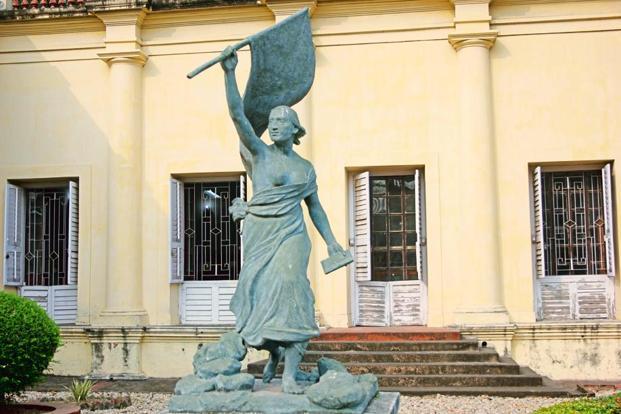
The statue of Marianne, a national symbol of France, outside the Dupleix mansion. Photos: Ganesh Vancheeswaran

The rains had left the fields lush green, a vivid contrast to the dark brown soil at the base. This dual-colour canvas kept a tight grip on the sides of the road through most of the trip. Bustling villages and near skirmishes with traffic ensured there was never a dull moment on the drive from Kolkata to Chandannagar.

My decision to go to Chandannagar for the weekend had been an impromptu one, taken the night before. The fact that it was the only French colony in Bengal in the 17th century, at a time when the British were making determined inroads into the region, made me curious. And so, late one Saturday morning, I hopped into a taxi for the 53km ride. It was a swift and mildly disorienting transition from the crush of humanity in Kolkata. As we entered Chandannagar, my driver pointed to two pillars topped with urns. He said these were all that remained of the grand gate built by the French in 1937.

I asked him to take me to the Dupleix Museum, located in a large yellow mansion. It is one of the few in India that houses a collection of artefacts from French rule, which lasted more than 250 years. Chandannagar was a major trading and military hub for the French during the 18th and 19th centuries. And this mansion used to be the official residence of French governor generals. Apart from French memorabilia, the museum houses rare collections of statues, letters exchanged between freedom fighters, and news clips on the freedom movement in Bengal. With its colonnaded courtyard, broad slatted windows and high ceilings, it is a throwback to period architecture. Even today, French is taught at an institute that operates from the same premises.

Leaving the museum, I headed to a stall nearby for a leisurely mutka (earthen cup) of tea. I was in no mood to rush from place to place. Already, I could feel my heartbeat settling into a slower rhythm. Chandannagar has that effect on you.

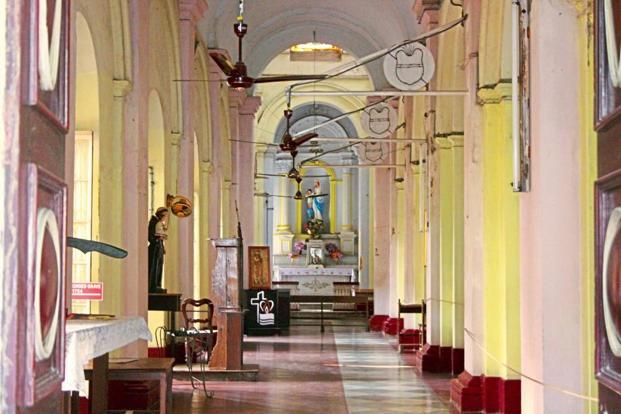
The interior of the Sacred Heart Church.

Continuing my journey into the past, I walked up to the lovely Sacred Heart Church, close to the Dupleix Museum. This church, designed by French architect Jacques Duchatz, was inaugurated in 1884. Stepping into its cool portals, I was transported back to the 19th century. The stained glass, old furniture and colourful murals along the nave are largely intact. Later, I walked through the restored graves and tombstones in the cemetery adjoining the church. Buried here along with other nobles is the long-forgotten French commander Duplessis, one of the town’s founding fathers.

Exploring the streets that evening, I saw a number of rambling bungalows from the French period. The structures, still intact, exuded an air of genteel neglect. There was an abundance of greenery. Traffic was sparse and slow-moving. Passing through the local market, I was struck by the absence of the hoarse cries one normally finds in Indian markets. Even the haggling was absent. It seemed as if the entire town loathed anything loud or frenetic.

Wending my way to the strand, I sat on a bench. A few others had colonized benches to read the newspaper or chat. In front of me, the Ganga, known in these parts as the Hooghly, flowed gently, with barely a murmur. Boats ferrying locals were the only traffic. And quiet descended as soon as the day’s activity wound up with the setting sun.

Fortified by some luchi-aloo dum the next morning, I sallied forth again. This time, to the stunning Nanda Dulal temple with its cream-and-vermillion exterior. This temple is built in the do chala (double sloping roof) style native to Bengal, but is, surprisingly, devoid of the terracotta work that is typical of buildings in this district. I learnt from the priest that this temple, which houses a deity of Lord Krishna as a child, was first built in 1740, destroyed and then rebuilt.

I was tempted to join the boys playing volleyball in front of the temple. In keeping with the mood, however, I decided to return to my room to curl up and read.

Weekend Vacations offers suggestions on getaways that allow for short breaks from metros. The author tweets from @theholehog.

source: http://www.livemint.com / Live Mint / Home> Leisure / Ganesh Vancheeswaran / November 09th, 2017

At 233, Asiatic Society archive starts new innings, goes digital

Kolkata :

The journey started way back in 1784 and on Monday, the oldest archive of the country, located inside Asiatic Society, started a new journey as it shifted to the digital mode.

For long, the Centre had been prodding the Society to get its valuable archive digitized but the authorities were unable to comply because of the unionized staff that often put spanners into the process. In 2006, when Pranab Mukherjee was the Union finance minister and chairman of the planning board of the Society, he urged the authorities to fast-track digitization so that the wealth could be made available in the digital domain. At the moment, only members of the Society have access to the archive.

The process could start much later and even on Monday, when the public announcement was made, only the first phase of the digitization was over. The rest will follow in phases.

In the first phase, all publications of the Society, right from 1788, when the first edition of an Asiatic Society publication came out, have been digitally reproduced and linked to the Society’s website. The formal inauguration was done by Jawhar Sircar, former Union culture secretary, who had prodded the Society in his previous capacity, to enter the digital platform.

“This place is steeped in history and is of singular importance but it doesn’t have a complete inventory yet. I am happy that the first step in digitization has happened here but in the 21st century, this is not enough. I urge the Society to accelerate the process, which can also become an income generator when non-members try to access the archive,” Sircar said.

The archive has 50,000 manuscripts in 26 languages, made in varied mediums like palm, palmyra leaves, barks of trees and paper (often handmade, not chemically treated). There are original paintings of Hodges, Daniells, Baille, D’Oyly, Solvins, Rubens and Reynolds, and are among the most valuable in the world of paintings. “In the next phase, we will digitize the paintings. There are some extremely rare views. There are 90 paintings of European masters and 125 masters of the Bengal School in our archives,” said Satyabrata Chakraborty, general secretary of the Asiatic Society. This will be followed by digitization of manuscripts.

source: http://www.timesofindia.indiatimes.com / The Times of India / Home> News> City News> Kolkata News / by Jhimli Mukherjee Pandey / TNN / November 07th, 2017

IIT Kharagpur led NDL India and UNESCO join hands through Globalization of Digital Library Design

Kolkata :

In the recently concluded international workshop jointly held by UNESCO and the National Digital Library of India (NDLI) under the leadership of IIT Kharagpur, NDLI announced to go global through international collaborations with the world’s top digital libraries keeping up to its motto of ‘Open and Inclusive’.

The Workshop deliberated on the state-of- the-art technology, practices, and policies as internationally accepted and available for digital library design. About 200 domain experts from India and abroad participated in the Workshop including representatives from Microsoft Research, Google and Taylor & Francis.

UNESCO, the event co-organizer collaborated with NDLI to promote the digital libraries as a very effective avenue to realize universal open access of the learning contents. It has promised to co-ordinate digital library development, resource sharing activities of the SAARC countries. Integration of UNESCO South Asia publications has been taken up as the first step towards that.

“While getting international content is one aspect of NDLI, the other focus for NDLI is being inclusive and open. Inclusive will be in terms of education, languages and disciplines. It is open in every respect whether data, technology or content,” said P P Das who is the in-charge of NDLI.

NDLI is mulling over possibilities of collaborations with Trove and DigitalNZ in terms of sharing of resources and software components. NDLI is already collaborating with Europeana Foundation. Individual experts in user data analytics, knowledge graph mining, linked data have shown keen interest in imbing best research practices into NDLI development. Some of the other digital libraries which expressed interest in collaboration with NDLI are Tainacan Project (Brazil), National Library of The Netherlands, National Library of South Africa, and National Library of Nepal.

Under the NDLI project, IIT Kharagpur has also initiated discussion with Microsoft Academic on sharing scholarly publishing knowledge graph.

“NDLI research and development team will soon focus on implementing technical outcomes of the workshop in terms of data aggregation framework, indexing infrastructure and service based models for data sharing. The developments in academic search engines like Google Scholar and Microsoft Academic also provide cues to efficiently organize scholarly publication in NDLI,” said Plaban Kumar Bhowmick, Program Co-Chair of the workshop.

K K Sharma, secretary, MHRD and R. Subrahmanyam, additional secretary, MHRD who were present on the occasion opined that by 2030 the union ministry is targeting to increase the Gross Enrolment Ratio (GER) in higher education to 30 per cent from the present 24 per cent. To achieve this goal, a combination of digital technology with the educational resources is the ideal pathway to ensure that all of India can learn, share and grow.

source: http://www.timesofindia.indiatimes.com / The Times of India / News> City News> Kolkata News> Schools & Colleges / by Somdatta Bose / TNN / November 07th, 2017

FIFA President Infantino Thanks West Bengal CM Mamata Banerjee

FIFA president Gianni Infantino has thanked West Bengal Chief Minister Mamata Banerjee for successfully organising the matches at various stages and the final of the Under-17 World Cup last month.

FIFA President Gianni Infantino. (Getty Images)

Kolkata:

FIFA president Gianni Infantino has thanked West Bengal Chief Minister Mamata Banerjee for successfully organising the matches at various stages and the final of the Under-17 World Cup last month.

In a letter from FIFA headquarters in Zurich, Infantino also praised Banerjee for the way the tournament was hosted at the Salt Lake Stadium including the final.

“I would like to congratulate your government on its role in your country’s successful hosting of the FIFA Under-17 World Cup. I would also like to thank you on behalf of the entire FIFA delegation for affording us such a cordial welcome and warm hospitality,” he wrote to Banerjee.

The FIFA president also praised Banerjee’s vision about the game in breaking down the cultural and social barriers and making the game accessible to all.

He also thanked the West Bengal government for the development of football and promoting the values of the game in India.

Promising all assistance from FIFA in developing the game in the region, Infantino lauded Banerjee for deciding on providing 15-acre of land to the AIFF for the National Centre of Excellence for Football near here.

The Salt Lake Stadium here had hosted 11 matches of the FIFA U-17 World Cup, including the final. Kolkata co-hosted the mega event along with New Delhi, Guwahati, Navi Mumbai, Kochi and Margao.

source: http://www.news18.com / News18.com / Home> Football / PTI / November 04th, 2017

Oldest Birla school celebrates rich legacy

Kolkata:

Eight schools, 20,000 students and a rich history of 70 years.

It all started in 1946, when industrialist and philanthropist Basant Kumar Birla and his wife Late Sarala Birla forayed into the field of education with Mahadevi Birla Shishu Vihar. It is now a part of the Ashok Hall Group of Schools.

From its inception, the school has transcended many barriers and now, it has arrived at the threshold of yet another celebration – a time to commemorate the legacy and carry forward the good work.

On Thursday, the celebrations began with the staging of ‘Jubilant Memoirs’ — a 90-minute production by students, ex-students, teachers and staff of the school. It presented a blend of music, drama, dance and visuals. The journey of the school was shared through the eyes of generations who have been part of the legacy.

Damien Syed, consul general of France, was the chief guest on the first day of the event.

“The thought of setting up of the school came when they were looking for a play school for their son Late Aditya Vikram Birla. They wanted to form a play school where the child would learn to adjust to the environment and be sensitive to others. Their three-year old son had been the first student of the school along five others,” said principal Sonali Sarkar. From Aditya Vikram Birla to Kumar Mangalam Birla – the school had been a destination for several other stalwarts from the family.

Sulekha Pal, who was a teacher between 1965 and 1979, remembers how she went to the Birla Park to teach ‘Kumar’. “He was very well-behaved. I remember him as a toddler who was fond of games,” she said.

Julia Bailey, the director of education in the Ashok Hall Group of Schools, added, “Manjushree Khaitan, the chairperson of the school, wants to make sure that the administration is up-to-date with all new technologies. Our main aim is to keep the quality of teaching high”

As part of the celebrations, two walks will be organised where students, alumni, teachers, ex-teachers and staff, totaling about 700, will take part to raise awareness on women empowerment and issues related to the environment and education.

source: http://www.timesofindia.indiatimes.com / The Times of India / News> City News> Kolkata News / TNN / November 03rd, 2017

Meet Miss Japan who is also half-Bengali!

For the world she is Priyanka Yoshikawa -Miss World Japan 2016.

But those close to her know her as Priyanka Yoshikawa Ghosh.

Born to a Bengali father and Japanese mother, she is the first woman from a multi-racial background to have won the pageant in Japan. But Priyanka’s journey was far from easy .

When she broke the glass ceiling, there were some who questioned why the title was not bestowed upon a `pure’ Japanese, but Priyanka found support in her nation and also in India, where she has her roots.

On a whirlwind tour to Kolkata where she attended a dinner hosted in her honour by Masayuki Taga, Consul General of Japan in Kolkata, Priyanka spoke to us about the backlash and support, tracing back her roots and why her family doesn’t discuss Prafulla Chandra Ghosh, her greatgrandfather and Bengal’s first chief minister, over dinner.

Excerpts:

Is this your first trip to Kolkata since you won Miss World Japan in 2016?

Yes. But I have been to the city quite a few times before that. I lived here when I was nine years old. That was for a year. I also studied in a school here. Even before that, I have been to the city when I was two or three, but I don’t have memories of those visits. Another long visit was five years ago, when I was 18. That time, I stayed here for a month. My father is Bengali and our extended family lives here. My connection with Bengal was established with my birth though I was not born here.During the one year I was here, I explored my father’s country and got to understand my roots.

On this visit for a day, did you get to meet your relatives living in Kolkata?

My father comes from a big family and he has many siblings. My uncle and aunt live in Kolkata.Some of my cousins are still here, but many got married and live abroad. Whenever I am in Kolkata, I visit them. I came on Sunday midnight and on Monday , I visited Mother House and later, went to a doctors’ meet. Though I was not in Kolkata on work, I am the brand ambassador of a charitable foundation, and ended up doing some meaningful work. I wanted to visit Kolkata ever since my win, but it was hard to get a vacation. Then, I got a few days off and came here on my way to Guwahati.

After you became Miss World Japan 2016, the first contestant from a multi-racial background to do so, you spoke about drawing inspiration from Ariana Miyamoto, born to a Japanese mother and African-American father, who won the Miss Universe Japan 2015. She had to endure racial backlash for being a hafu (a person with a non-Japanese parent), but since she set a precedent just the previous year, was it easier for you?

To be honest, Ariana was not exactly my inspiration. We participated in different pageants. I followed my own dreams, but I have tremendous respect for her.I didn’t know her before I won, but we became good friends after winning the title. I didn’t hear stories about her trials and tribulations, but she made it big as the first hafu to win a pageant in Japan. She had to face racial backlash as she was the first and people were not used to it. For me, I was the first for Miss World in the nation. Nothing has been easy even though Ariana won the previous year. I got good media coverage and though some people questioned my win, it never affected me. I was confident and was concen trating on the international pag eant where I made a mark after 60 years. During the pageant, there was no social media back lash, but after the win, some questioned why the title was not awarded to a `pure’ Japanese. I got a lot of support too. Messages came trickling in from hafus living in Japan, and also from Indian citizens. When you get such strong support, it gives you more confidence. I am proud to have an Indian in me, but that doesn’t mean I am not Japanese.

What were the celebrations like in India?

My relatives messaged me. My first cousins are very close to me. I call them didi. One of my didis lives in the US and she was a great support during the inter national pageant. She is eight nine years older than me and she and everyone else was happy about the win.

What was the homecoming like this time around?

I was excited as I was meeting everybody after five years.Visiting home and meeting my aunt, uncle, nephews was quite something. Though they are all in touch with me, talking to them on social media is different from meeting them. I got to eat Bengali food. I was looking forward to tasting some homecooked Indian food. I often crave for white chicken, which is perhaps called doi chicken. And I love phuchkas though I missed it this time. I was in Mumbai and had panipuris there, but it’s different from having phuchkas in Kolkata.

How did you learn to speak so fluently in Bangla?

I studied Bengali in school, but I picked it up naturally as everyone speaks Bengali around me in my family .

Your great-grandfather Prafulla Chandra Ghosh was the first chief minister of Bengal. You must have heard many stories about him from your father?

He was my great-grandfather, but I didn’t meet him. My father did tell me stories about him but only at times. I never really asked questions about him.Everybody in our family knows about him, but we don’t discuss him over dinner.

An elephant trainer, are you visiting Guwahati for a purpose?

My Guwahati trip is all about wild elephant conservation and nature conservation.

You have keen interest in Bengali movies…

I remember having seen The Japanese Wife and some others that I watched on flights. I can’t read or write in Bengali though I can speak the language. It’s sad that not many Bengali films can be found in Japan, though Bollywood movies -sometimes three years old -travel to the country . I love to watch them. I have grown up watching Shah Rukh Khan, Hrithik Roshan and Kajol. Kajol is one of my favourite actresses.

Should you foray into Bengali films if an offer comes your way?

Yes, why not! I would also love to do something with films in India, maybe bring them to Japan… There are many takers for Indian films in Japan and I am sure a lot of people here are waiting to watching Japanese films. If I can bridge the gap, I will be the happiest.

source: http://www.timesofindia.indiatimes.com / The Times of India / Home> News> City News> Kolkata News / by Zinia Sen / TN / November 02nd, 2017

Centuries-old temples unearthed in West Bengal A parish anticipating relic tourism

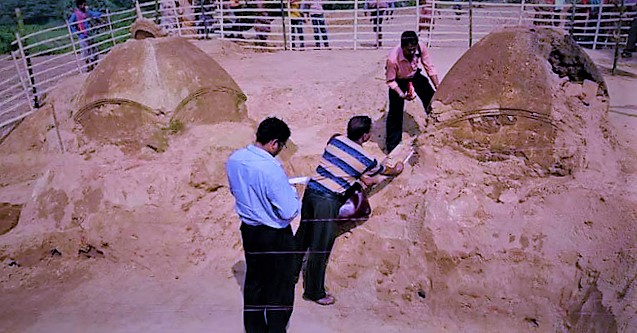
ASI members inspecting the temples in Bhuri, a village near Burdwan

Less than 130 kilometres from Kolkata, in an area at East Burdwan’s Bhuri village, two temples emerged while local workers were digging. The initial inspection and predictions tell that the temples could be centuries old.

Unprecedented and to the dismay of the local workers were digging a section of the land as a part of the Village Panchayat’s cleaning programme aiming to set up a park, two masts of 1.4 metres each came out. The masts resemble the architecture of temples and the primary observation reveals that the temples could be centuries old. Some of the locals also believe that these are Lord Shiva temples that were built during the early British empire.

The land lies beside a canal that connects the River Damodar that was dug years ago to divert water from the village and prevent flood during the monsoons. Whether it was flood or earthquake that led to the demolition and the extinction of these two temples is still a mystery.

Growing anticipation
A team of three from the Archaeological Survey of India (ASI) visited the site where the temples were discovered. According to one of the members of the team who requested a privacy of identity said, “We can’t say anything as of now, it’s very strange that this part of the country had temples like these. We have to dig another 20 odd feet to unearth the reality and the exact identity of these temples. I would my team to prepare the report as soon as possible.”

The ASI team met the local authorities and explained their expectations regarding the security of the place how to neutralise the local excitement. The village head and local police station were instructed to cover the area and stop any kind of further digging. The temples have already got few dents due to the unprofessional digging and the ASI officials stressed on putting a barricade to stop further damage.

While it was just a park that was on the cards, the local authorities are now expecting a tourism spot revolving on the historical aspects of these two temples. For the time being, they are keeping a close watch on the area and have also managed to set up lights during the night to make sure that there is no unnecessary loss of information.

Relic tourism
The eastern region of India especially West Bengal, Bihar, Odisha, and Jharkhand have seen a plethora of religious as well as ethnic diversity since centuries. From the Buddhist settlement in Bodh Gaya and their gradual spread in and around eastern India to the likes of Vaishnavas and various sects of Hinduism practised their culture here. The likes of Moghalmari in West Midnapore district of West Bengal where almost three decades of excavation revealed a Buddhist settlement also adds another hue to this mysterious finding.

History lovers and story seekers have always found their way to dig the reality out of these unique discoveries. While the eastern state is aiming to promote itself as a one-stop destination for all kind of tourists, the unearthing of these two temples near Burdwan definitely has a positive prospect for West Bengal’s tourism industry.
Keep an eye on this space to follow the updates from the unique hamlet nearby the railway station Galsi that recently witnessed the emergence of these two shaman relics.

source: http://www.mediaindia.eu / Media India Group / Home> Tourism / by Sudipto Roy / Kolkata / October 27th, 2017

Where an iconic press struggles for survival

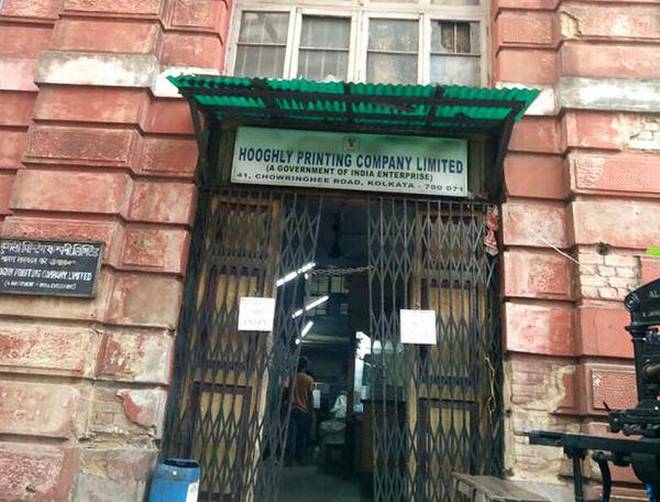
Tucked inside one of the many old red mansions that still dot the city skyline is a 15,000 sq. ft. space, which houses a press that had printed the Indian Constitution. But five years away from its centenary, the iconic printer is gasping for breath.

How old is it?

Hooghly Printing is a subsidiary of Andrew Yule, a Central Public Sector Enterprise. It came into being in 1922. This was at a time when the printing industry was in its infancy in these parts. Once running to full capacity, now it is knocking on the doors of the Central and State governments to get printing orders to survive. Hooghly Printing is part of the Andrew Yule Group of companies, which started operations in 1863 when a young entrepreneur from Scotland arrived in erstwhile Calcutta, then the Imperial capital. By 1875, the company had grown to mark its footprints in jute, tea, coal and insurance. Andrew Yule’s control passed from one sibling to another, and Sir David Yule assumed full control of the company after the death of his brother George, who had run it since 1875.

By 1902, Andrew Yule had expanded its business throughout the country with over 30 businesses which included jute and cotton mills, tea and coal companies, a railway company, a paper-making company and a printing press. It even had under its control a zamindari in Midnapore district of West Bengal, where it virtually ran an administration with agriculture, forestry, fisheries, roads, schools, hospitals and dispensaries, the company’s website says.

What did it print?

Hooghly Printing not only printed the Constitution but was also responsible for supplying the parchment paper on which it was printed. The first few copies were printed at the Dehradun printing facility of the Indian government as these were to be the best copies. The rest were printed at HPC.

Why is it in trouble?

In recent times, however, Hooghly Printing’s journey has been a rough one. As printing facilities have proliferated, Hooghly Printing’s need to play by the rules of a government-owned organisation has shackled its growth, admits Andrew Yule chairman Debashis Jana. It has been printing books, brochures and the like, but it needs bulk orders to survive.

What is the way ahead?

It needs to modernise to put in machinery that will help it get customers. It also needs space. Andrew Yule has put in place a strategy of upgrading the unit while relocating it to an unused space in another of its units on the western precincts of the city. Alongside, it is appealing to the Central and State governments to give it orders for printing textbooks.

The Hooghly Printing’s turnover was ₹17 crore in 2016-17 with a post-tax profit of ₹3 lakh. This thin margin is getting steadily eroded. Its parent, Andrew Yule, which celebrated its centenary year in 1963, too fell into bad days with the nationalisation of the coal and insurance business. In 1969, the government stepped in to acquire a 49% stake, making it a public sector enterprise. Its journey continued to be a rocky one thereafter and it moved to the sick bay. It has since made a remarkable turnaround. Today, it is in profit, and there is no reason that Hooghly Printing should not be a contributor to its parent’s strength. No one knows if a plaque would mark the space in Kanak Building on the arterial Jawaharlal Nehru Road, where the Constitution was printed, but it will be pity if a heritage institution like Hooghly Printing is allowed to fall by the wayside, say historians.

source: http://www.thehindu.com / The Hindu / Home> News> City> Kolkata / by Indrani Dutta / October 14th, 2017