Category Archives: Records, All

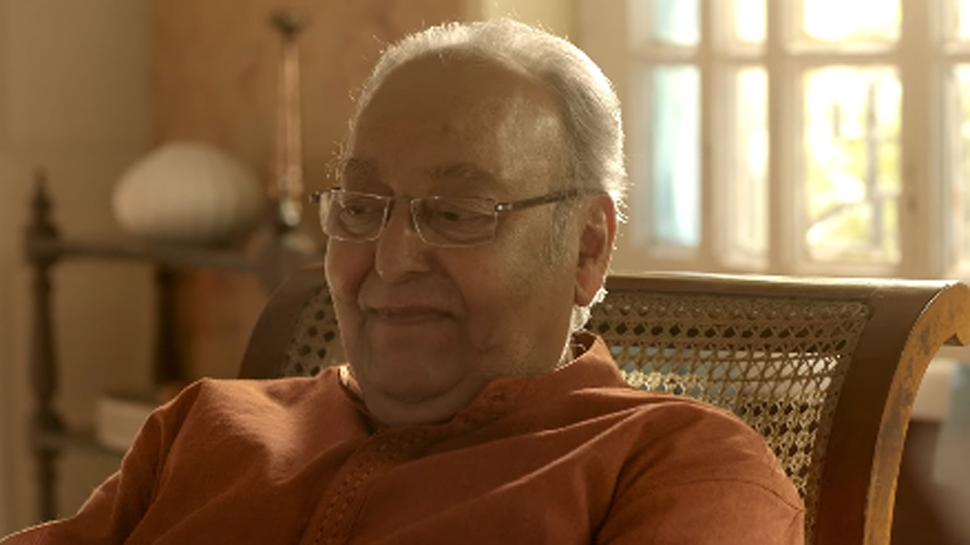
Soumitra Chatterjee to get French honour during Kolkata book fair

Image Courtesy: YouTube Grab

Kolkata (IANS)

Legendary Bengali actor Soumitra Chatterjee would be handed over France’s highest civilian award Legion of Honour during the 42nd edition of the International Kolkata Book Fair in January next year.

France, which would also be the focal theme of this edition of the world’s most attended book fair, is planning to present the award to the octogenarian actor on the inaugural day of the event in the presence of its Minister of Culture Francoise Nyssen, a senior French official said on Tuesday.

“Soumitra Chatterjee is not just an actor, he is a legend. The award was announced in June. But we waited for the perfect occasion to hand him the award. The book fair seems to be a perfect backdrop as our Minister of Culture would also be present in the city at that time,” Damien Syed, Consul General of France in Kolkata, said during the announcement and logo unveiling event of the book fair here.

“It is a befitting occasion to hand him the award as a French minister would be visiting the city after seven years. We felt it would be more prestigious and impactful if he is handed over the award by the minister, who herself is a writer and a noted publisher in France,” he pointed out.

The upcoming edition of the book fair would be inaugurated by West Bengal Chief Minister Mamata Banerjee at a new venue in Central Park Mela Grounds in Salt Lake and would be held from January 31 to February 11.

Talking about the French connection to the Kolkata book fair, Syed said the French pavilion in this edition, entitled ‘Experience: The Digital Journey of France’, would focus on highlighting various aspects of Indo-French relations.

“It is wonderful to see France as the main focus country in the Kolkata book fair. The French pavilion in the fair would be uniquely designed to portray different aspects of Indo-French relationships in the past, present and future,” the consul general said.

The ongoing ‘Bonjour India Festival’, organised by the cultural wing of the French Embassy in different Indian cities on the occasion of the 70th year of Indo-France diplomatic relationship, would observe its closing ceremony at the Kolkata book fair.

source: http://www.zeenews.com / Zee News / Home> News> Lifestyle> People / IANS / November 28th, 2017

An exhibition traces the origins of indigo, born in India and loved the world over

The dye that brings the world together

The Greeks called it indikon and the Romans, indicum, eventually indigo in English, all implying the same — from India. True indigo, Indigofera tinctoria, a flowering plant with 750 sub-species is found in the tropics. It produces this distinctive natural dye from its leaves, and is the only organic source of the colour blue in nature. And the Indian subcontinent being the prime supplier of true indigo, the dye was named thus by the Greeks.

Then, Arab merchants took the dye to the Mediterranean and Europe and its rarity gave it a regal aura. Jenny Balfour-Paul, dye specialist and an authority on indigo, says the term ‘royal blue’ came from here.

Balfour-Paul was at Kolkata’s Indian Council for Cultural Relations to speak at Indigo Sutra, a fascinating symposium held there in early November.

As Gasali Adeyemo from Nigeria demonstrated the unique adire tie-dye technique from his country, Sufiyan Ismail Khatri from Kutch demonstrated ajrakh, the block printing that’s done on both sides of the fabric. Adeyemo spoke of how the patterns in adire are tribe identifiers, also working as messages that convey specific ideas and thoughts, easily recognisable to compatriots.
Amrita Mukerji, the woman behind Sutra Textile Studies, the non-profit society that organised the event, was in Malaysia in the late 80s-early 90s and decided she wanted to showcase India as something more than just the country that provided wealthy Malays with plantation workers. So she began to exhibit, using personal and other collections, Indian textiles, jewellery, art, literature and music.

It was in Nigeria that Mukerji had fallen in love with indigo, finding the local shops stacked with bolts in vibrant indigo hues in adire patterns. It was there she discovered checked cloth called George that looked just like Indian lungi patterns. And later learnt that the name came from Fort St. George in Chennai; the same cloth was known as Bleeding Madras in other places.

And the twain met

In 2000, Mukerji met Balfour-Paul. At the time, Balfour-Paul had just come across the journals of a Victorian adventurer and fellow indigo-lover, Thomas Machell.

Inspired by Machell’s writing, which she published as Deeper than Indigo, Balfour-Paul set out to trace his footsteps; and Mukerji travelled with her to the places in Bengal where Machell had lived as an indigo planter.
Monoleena Banerjee, an independent textile designer and consultant, also accompanied them.

Superimposing a map made by Machell on to a contemporary road map, they found four of Machell’s nil kuthis or indigo houses in Nadia district. Three of them were in ruins, while the fourth had been taken over by the local Hare Krishna society.

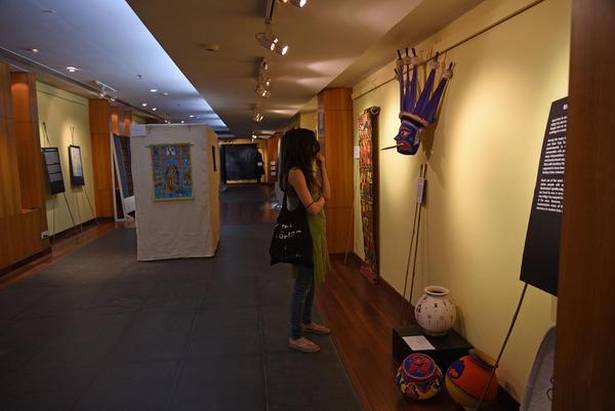
All these threads came together at the symposium, held most appropriately in the centennial year of the Champaran Satyagraha. Wonderfully curated by Londoner Simon Marks, textile designer and natural dyer, who spends a lot of time in Jaipur and Kutch, there were seminars, workshops, discussions, film shows, a bazaar, and excursions to weaving and dyeing centres.

Participants came from across India, Africa, Japan, Thailand, Jordan, Salvador, Great Britain and Bangladesh to exhibit their skills and share knowledge, playing their part in promoting and reviving indigo, the oldest natural dye known to man.

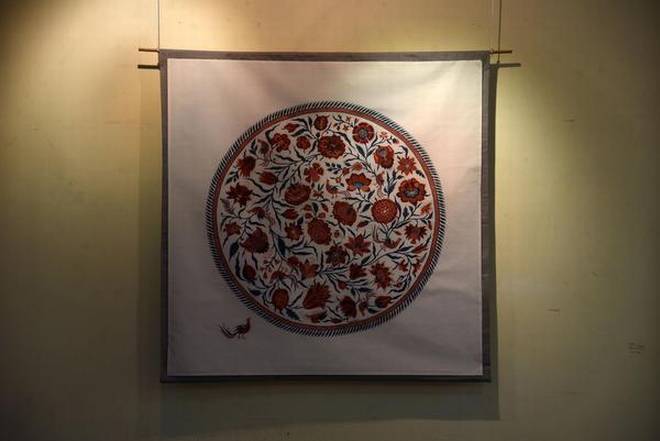
A scale model of an indigo dye manufacturing unit, a replica of the one in London’s Kew Gardens, made for a fascinating study. There were collections of indigo-hued and inspired works of art, to be worn or displayed, as well as indigo fabric installations, including a maze-like room separator by Kolkata designer Santanu Das. Natural dye artist Ajit Das’s exhibits emphatically announced the range of this dye between hues of blue, purple and black.
We are reliably informed there are more blue jeans on this planet than there are people, and Jesus Ciriza Larraona, a Spaniard, is currently working with dye manufacturers in Tamil Nadu and elsewhere to develop organic dye for Levi’s jeans. He also manufactures organic indigo clothing for Auroville.

Ruby Ghuznavi, a reputed crafts researcher who has done much to revive organic dyes in Bangladesh, was a keynote speaker here. Living Blue, a unit of CARE, Bangladesh, works to empower weavers, indigo farmers and dye-makers in Rangpur in the northern part of the country. It specialises in exports of kantha and indigo-dyed fabrics, using the Japanese Shibori technique, for personal wear and home furnishings.

Clearly, the increasing use of organic products in a polluted world has led to the current revival of interest in sustainable indigo. And, as it did centuries before, the dye is bringing the world together.

The author, who lives in Kolkata, keeps rediscovering it, often with wonder.

source: http://www.thehindu.com / The Hindu / Home> Entertainment> Art / by Patrick Sanjiv Lal Ghose / November 04th, 2017
Suriname envoy at Kolkata ghat from where ancestors set sail

Kolkata :

On February 26, 1873, sailship Lalla Rookh set off from what is now known as Suriname Ghat with 410 passengers on board. Nearly all of them were from places that are now in Uttar Pradesh and Bihar. The men and women had been recruited as ‘coolies’ or indentured labourers by the Dutch who owned sugarcane plantations in Suriname. The ship docked at Paramaribo on June 5 with 279 men, 70 women and 50 children. Eleven did not survive the voyage. In the years that followed, 63 more ships left Kolkata port for Suriname.

Nearly 145 years later, a descendant of one of the 34,304 Indian labourers who were transported to a distant land in the northern tip of South America returned to the very ghat from where her ancestor had set sail and survived the arduous journey. It was a poignant moment for Aashna Kanhai, the Surinamese ambassador to India, as she stood at ‘Mai Baap’ Memorial on Suriname Ghat and looked at the shimmering waters of the Hooghly.

“Today, there are 170,000 people of Indian origin in Suriname (the total population is 558,368). There are also 200,000 of them in Holland who decided to leave Suriname when the country became independent 42 years ago,” said Kanhai as she folded her palms in a namaskaar in front of the Mai Baap Memorial.

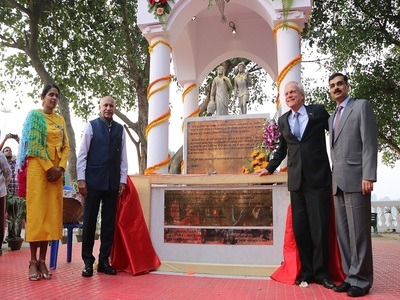
Surinam ambassador in India Aashna Kanhai, Union minister of state for external affairs M J Akbar, Netherlands ambassador in India Alphonsus Stoelinga and Kolkata Port Trust chairman Vinit Kumar at the unveiling of the plaque at Mai Baap Memorial in Surinam Ghat, Garden Reach on Saturday. photo by – Avik Purkait

The occasion that had brought Kanhai to Kolkata was Suriname Day. “My ancestors must have stood here for the last time before leaving India forever. The men carried two dhotis and two kurtas each. The women carried two saris each. Apart from this, some carried religious books like the Ramayana, Mahabharata or Quran,” Kanhai said, her voice choked with emotion.

Aashna Kanhai, the Surinamese ambassador to India, celebrated Suriname Day on the banks of Hooghly on Saturday, accompanied by minister of state for external affairs MJ Akbar, who unveiled a plaque at the Mai Baap Memorial on Suriname Ghat.

The memorial comprises a sculpture of a man and a woman, each carrying a potli, to commemorate the landing of Indian labourers at Paramaribo. The original sculpture is in Paramaribo and its replica was inaugurated in Kolkata in 2015.

Her great grandmother’s father was among the indentured labourers who landed in Suriname. During an earlier visit to Kolkata, she had heard the name Bhawanipore and it rang a bell. “I recalled that my ancestors were kept at the Bhawanipore Depot before they boarded the ship,” Kanhai added.

Initially, the transport and living conditions of Indian labourers in Suriname was worse than it had been prior to the abolition of the Dutch slave trade. Many died during the journey.

But why did the Dutch planters require Indian labourers? “In 1863, slavery was abolished by the Dutch and they entered into an agreement with the East India Company to recruit labourers from India to work in the sugarcane plantations in Suriname. Men, known as Arkatias were sent out to recruit people from Uttar Pradesh and Bihar. They entered into a five-year contract and came to be known as the Contrakees or Agreemanees. They were to receive 25-pence a week for their labour but payment was often delayed. Of the 34,000-odd Indians who reached Suriname, 65% stayed back. Indentured labour was finally abolished 100 years ago in 1917,” the Surinamese ambassador said.

During the event, videos of renditions by Surinamese singer Raj Mohan were screened. In a Bhojpuri song, the singer brought out the feelings of a ‘coolie’ after he realized that he had been cheated. The second song by Mohan was Tagore’s Ami Chini Go Chini Tomarey, Ogo Bideshini. Kanhai, who speaks fluent Bhojpuri, said that the only Bengali she knows is the Rabindrasangeet which is extremely popular in Suriname.”That one stanza of the Bhojpuri song says it all. It reveals how the labourers from India had gone to Suriname with plans to return after five years with small fortunes. Once there, they realized that they were cheated. They were taken there as replacement slaves. Such was colonialism. They just played with words to make things sound better. The Hooghly wasn’t a river of hope. It was a river of no return. The peasants left their lands in the first place because of the huge taxation imposed by the colonial government in India. They had no surplus during lean seasons. Through such programmes, we celebrate the resilience of human spirit,” Akbar said.

While Dutch ambassador Alphonsus Stoelinga recounted how his country shared a piece of history with India and Suriname, Kolkata Port Trust chairman Vinit Kumar said there are plans to improve the surroundings of the memorial. “The first labour ship to leave Kolkata for the Mauritius was in 1834. Later, ships left for several countries. We have plans to organize heritage tours to the Suriname Ghat and create a larger indenture memorial. We shall also upgrade the surroundings,” Kumar said.

source: http://www.timesofindia.indiatimes.com / The Times of India / News> City News> Kolkata News / by Jayanta Gupta / TNN / November 26th, 2017

Kolkata Chinese makes it big with Tangra-style food in London

Kolkata :

Kolkata-born Chinese who took Tangra-style cuisine to London is planning to leverage the popularity of the Indo-Chinese food that he serves at his restaurant in Harrow to start a chain across UK.

Steven Lee, whose father had migrated to India in the 1940s from Guangdong province in China, was born in Kolkata in 1971 and grew up in Tangra, the Chinatown that once housed tanneries that have now been converted to restaurants.

Like most Chinese living in Kolkata, Lee had bland Chinese food at home. But it was the spicy Indian-Chinese served in Chinese restaurants that he loved.

“Indo-Chinese food is a Tangra creation that is now a worldwide sensation. This fusion is unique on its own and loved by foodies all over. It is different because this fusion is prepared by using Indian ingredients while still accepting the Chinese cooking technique,” explained Lee, who started Indo-Chinese kitchen bar Hakkaland named after the Tangra’s Hakka community.

While Lee left Kolkata to work in at China Garden — a popular Chinese restaurant by Nelson Wang in Mumbai — nearly 20 years ago, he still visits his relatives in Kolkata annually during the Chinese New Year.

Around 17 years ago, celebrity chef Udit Sakhel invited him to London to work at his restaurant Dalchini. There, Lee used his experience and knowledge of Tangra-type Chinese to introduced Indo-Chinese food. “I infused many new dishes to this fusion and Asian taste which was widely accepted in the UK and the restaurant was a huge success in early 2000s. “Keeping the multi-cultural diversity of UK in mind, I introduced Hakka Chicken, Ginger Chicken, Fish Pepper Salt, Tai Pai Paneer, Soya Chilli and a lot more,” Lee recounted.

After working for Dalchini at Wimbledon, Spice n Ice at Croydon and Bombay Wok at Hounslow, Lee teamed up with partners to launch Hakkaland a year ago. During Durga Puja, Lee’s restaurant served to Bengali patrons at the Ealing Town Hall.

Encouraged by the customer response, Lee now plans to make Hakkaland UK’s first Indo-Chinese restaurant chain with joints in Manchester, East London, Leeds, Lecister and Birmingham. Lee isn’t sure yet but if things go his way, he even has eyes on bringing his brand home to where it all started, Tangra.

source: http://www.timesofindia.indiatimes.com / The Times of India / News> City News> Kolkata News / by Subhro Niyogi / TNN / November 20th, 2017

Danish tavern decked up to start second innings in Serampore

Kolkata :

The double-storey Denmark Tavern, which was in a shambles till a couple of years ago, will soon turn into a lifestyle stay. The edifice on the banks of the Hooghly in Serampore will be Bengal’s second government-backed live-and-conserve endeavour after the St Olav’s Church project, which was restored last year and is in back in use for prayers and religious ceremonies.

Come February and CM Mamata Banerjee will open the doors of Denmark Tavern that has risen out of debris after being painstakingly restored by the National Museum of Denmark (NMD) in tandem with the West Bengal Heritage Commission. The NMD has funded the Rs 3.5-crore restoration and the state tourism department is paying another Rs 1.2 crore for the finishing. It will be running the cafe-by-the-river, which will have six overnight-stay rooms.

The Serampore riverfront, which looked picture perfect during the Danish rule, fell on bad times and the majestic structures were left to rot for decades. In 2012, things started changing with Serampore Initiative, the grand revival of the former Danish colony. The Denmark Tavern restoration is part of the big plans to bring back the old glory of the former Danish colony.

“We are extremely excited about the completion of the Denmark Tavern, which was the most challenging of the restoration work we have done in Serampore,” Bente Wolff, curator, National Museum of Denmark, told TOI from Copenhagen. Over last several months, Wolff has been flying in and out of Serampore to supervise the restoration work.

“This is the first public-private partnership in the heritage sector at this scale. This will give a fillip to the CM’s pet project of river cruise linking all the heritage towns along the Hooghly,” said Manish Chakraborti, the project’s conservation architect
Clearing the morass and rescuing the tavern was the most formidable task ever, said Suvaprasanna, chairman of the commission. “The challenge was in connecting history with architecture. For instance, the exact location of the tavern was not known. Finally, we found documents showing it was next to the SDO’s residence. It took one-and-a-half months to clear the debris,” he said.

“Denmark’s interest in reviving the remnants of the buildings first started in 2008 at the ethnographic department of the National Museum of Denmark,” added commission member Partha Ranjan Das. Archival and field studies were carried out between November 2008 and April 2009 by restoration architect Flemming Aalund and historian Simon Ranten, who produced an elaborate, report.

source: http://www.timesofindia.indiatimes.com / The Times of India / News> City News> Kolkata News / by Ajanta Chakraborty / TNN / November 21st, 2017

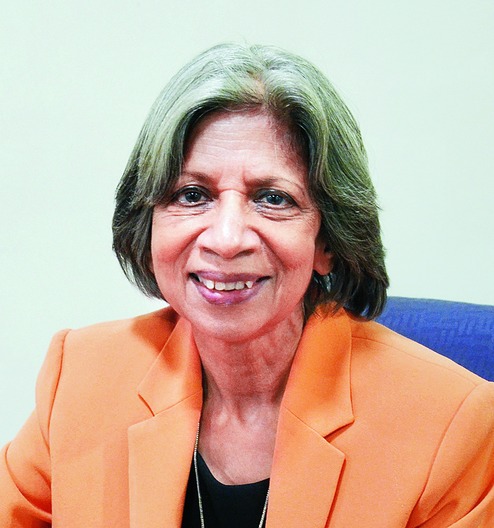
Policing feather in city girl cap

Millie Banerjee

London:

Calcutta-born Millie Banerjee has been appointed the new chairman of the UK’s College of Policing.

Actually, she has been interim chairman since November last year so her appointment was today made permanent by the home secretary, Amber Rudd.

“Working with Millie over the last year I have been impressed by the insight she brings from her time leading other public and commercial organisations, including the British Transport Police,” Rudd said on Thursday.

Millie’s responsibilities are highly sensitive – keep an eye on “standards in policing” across the 43 police forces in England and Wales; developing knowledge and “what works”; and assisting with education and career development.

It is possible she will want to exchange notes on policing in Calcutta.

“Millie” is really her nickname but it has come to stay as she has become part of the great and good in Britain. She was born Urmila Ray-Chaudhuri in Calcutta on June 30, 1946, and is friendly with a number of prominent figures in the city, among them the physicist Bikash Sinha.

Millie, who was honoured with a CBE on the Queen’s Birthday Honours list in 2002 and was High Sheriff of Greater London in 2012-13, was chairman of the British Transport Police Authority for seven years and spent 30 years in the telecommunications and satellite industries. This included 25 years with BT in senior positions.

She is currently the chairman of NHS Blood and Transplant and a board member of East London NHS Foundation Trust.

Reacting to her confirmation, Millie said: “I have spent many years in policing and it has been a privilege to witness the dedication and compassion of officers and staff to protect the public. This is evident when I see that public approval for police has remained high despite officers and staff being faced with ever more complex crime, a reduced workforce and greater demand.

“We are dedicated to providing access to the best knowledge and skills which sits behind the bravery, dedication and compassion shown by police on a daily basis. We have ambitious plans ahead and I intend on working with people across policing to continue building a professional body that supports all officers and staff.”

source: http://www.telegraphindia.com / The Telegraph, Calcutta,India / Home> Calcuttu / by Amit Roy / November 17th, 2017

Sweet victory: Bengal wins bitter battle over rasogolla

Kolkata :

It was a bitter battle but, in the end, victory was sweet. Bengal has won the Geographical Indication (GI) tag for Banglar Rasogolla, a sweet the state has almost been synonymous with, beating Odisha in a hard-fought war. The win came on Tuesday which was, ironically, World Diabetes Day.

The verdict comes after a two-year-two-month-old battle that the two states fought in the intellectual property wing of the ministry of commerce, which confers the tag. The war over the ubiquitous sweet was, by no means, simple: each state submitted reams of theses supporting their respective claims, drafted by historians, food technologists and even bure-aucrats. In the end, the first use of chhana (curdled milk) in making Bengal’s best-known sweet clinched victory.

The GI website mentions Banglar Rasogolla as “registered” for the coveted GI tag. The item was applicant number 533, and was registered as the 308th item to win the tag.

Chief minister Mamata Banerjee, who is in the UK now, expressed her joy in a tweet. “Sweet news for us all. We are very happy and proud that #Bengal has been granted GI ( Geographical Indication) status for Rosogolla,” she wrote. State higher education minister Partha Chatterjee, too, was ecstatic.

“We had applied for the GI tag in 2015,” said food processing secretary Nandini Chakraborty. “Rasogolla — under the name Banglar Rasogolla — will be registered under the Food Processing and Horticulture Development Corporation Ltd.”

Bengal perhaps never imagined that it would one day have to stake a claim on the rasogolla, but a claim made by the Odisha government, on the day of Ulta Ratha, 2015, saying the day should be declared as Odisha’s Rasogolla Day, made it sit up and take note.

Soon, Odisha applied for a GI tag on the rasogolla and Bengal’s science and technology department, prodded by thousands of rasogolla fans, lodged a counter-claim. In September 2015, the state prepared a dossier containing all sorts of proof — documents, historical texts and analogies — in support of its claim that the rasogolla was native to Bengal, and had been invented in two stages in two completely different historical time zones. The claim was registered by the GI registrations office and separate investigations were launched to authenticate the respective claims.

The Bengal government consulted sweets researcher Haripada Bhowmick for the historicity of the rasogolla, while the Odisha government got Jagannath cult researcher Asit Mohanty to look into its claim. Bhowmick’s book ‘Rasogolla — Banglar Jagat Matano Abishkar’, has been used as part of the material that was submitted to the GI office. Odisha evoked its gods and temples while staking its claim, replete with references of how Lord Jagannath used the kheermohan, the precursor of the rasogolla, to appease his consort goddess Lakshmi. And why mythology alone, even ancient history — from the time of the Dandi Ramayana, an adaptation of the epic by Balaram Das of the 16th century — has been used as reference. Bengal, too, has argued that it can trace the roots of the rasogolla to the times of the Bhakti movement of the 15th century and how Mahaprabhu Sri Chaitanya might have taken the sweet, in its formative stage, from Bengal to Odisha, when he started residing in Puri. Food writers who have been watching this space said the two states agreed on the antiquity of the sweet, if not its place of origin.

“We stand vindicated today,” said Mohua Hom Chowdhury, representative of the state science and technology department, who had coordinated the process with the GI registration office. “There should not have been any debate in the first place. We were rooting for our Banglar Rasogolla, which should not be confused with their kheermohan or their pahala rasogolla, which might be later variations, but are completely different sweets.”

Bengal has explained that the art of rasogolla-making lies in the use of chhana (Bengal-style cottage cheese). “Bengal is the only state that uses chhana, which is curdled milk, to make sweets. The process of curdling is considered ‘unholy’ by most communities including Odiyas, who never offered any sweet to Lord Jagannath made of chhana. The temple records that contain details of the food that can be served to the Jagannath does not mention rasagolla anywhere. To prove its point, the Bengal dossier quotes liberally from historical texts, records and literature like ‘Nadia Kahini’ by Kumudnath Mullick, proceedings of the Bangiya Sahitya Parishad, translations from the ‘Chaitanya Charitamrita’, ‘Chandimangal’ by Kabikankan Mukunda, etc. Kheermohan is made of kheer or concentrated milk and pahala rossogolla, a variant of Bengal’s original sweet, is yellowish in colour, less soft and much more sweet.

“Odisha should apply for kheermohan and pahala rasogolla separately,” Hom Chowdhury added.BoxGI tag : What does it mean?It is a name or sign used on certain products which corresponds to a specific geographical location or origin (town, region, or country)

Use of GI may act as certification that the product has certain qualities, is made according to traditional methods, or enjoys a certain reputation, due to its geographical originWhat will happen now?Any sweet maker can apply to the state science and technology department for the Banglar Rasogolla GI tag. There will be an investigation as to whether he is using the right ingredients, in the right quantity and following the specified manufacting process to be worthy of the tag.What are the advantages ?The tag is a proof of authenticity and someone who has been awarded the tag is definitely superior to one who is still selling rasogolla but doesn’t have the tag.Other Bengal items with GI tagThere are 15 items from Bengal with the GI tag now, some of them are :

Darjeeling tea (drink), Lakshman bhog, fazli, himsagar, baluchari sarees, dhaniakhali sarees, Joynagar moya, Bardhaman Sitabhog, Bardhaman Mihidana, Gobindobhog rice, Tulaipanji rice, Banglar RasogollaGI tag awaited Sarpuria and Sarbhaja.

source: http://www.timesofindia.indiatimes.com / The Times of India / News> City News> Kolkata News / by Jhimli Mukherjee Pandey / November 15th, 2017

How World War II cramped Kolkata airport runway

HIGHLIGHTS

Kolkata airport currently has a runway capacity of only 30 flights per hour

Airports Authority of India is considering a second airport for Kolkata.
________________________________________________________________________

Kolkata :

A decision taken during World War II has now come to haunt Kolkata airport’s growth prospects. The airport which currently has a runway capacity of only 30 flights per hour, could have handled twice the number of flights had there been a proper second runway at its disposal. But the plan to create a second cross runway in the east-west direction was junked and instead a parallel runway was built that cannot be used for simultaneous operations now because they do not meet safety parameters.

It is this runway constraint, coupled with lack of space for additional parking bays that is forcing Airports Authority of India to consider a second airport for Kolkata.

It was the Allied Forces’ fear of the airport at Dum Dum being bombed by Axis powers during World War II that led to the British opting for parallel runways instead of ones that cross each other. With Japanese bombers a constant threat, the Allied Forces felt that if a bomb was dropped at the point where the runways intersect, it would take out both runways. Instead, having them parallel would give them an opportunity to use the alternative runway if one was destroyed.

“Kolkata airport’s first landing strip dates back to the 1920s. It was later strengthened for use as taxiway and is still in use to taxi aircraft. Around 1932-33, a proper runway was constructed in the north-south direction. This is now the secondary runway at Kolkata airport. To cater to the increased requirement during WW II, it was decided to construct another runway around 1942-43. That is when the cross runway proposal was mooted and then dropped in favour of the parallel runway,” the source said.

While airports around the world have parallel runways in which flights take off and land simultaneously, it is not possible at Kolkata airport because the two runways are too close to each other. “When they were built, there were Dakota and Fokker planes with small wing span. The separation between the two runways at Kolkata airport at 213 metres was sufficient then. But as aircraft dimension changed, the minimum distance criteria was revised. Today’s Boeing and Airbus with large wing spans require a minimum distance of 760 metre between parallel runways. There is no space at Kolkata airport to create that separation as the terminal building is located to the west and boundary wall to the east,” an official said.

At present, the primary runway is used for flight operations with the secondary runway coming into play when the primary runway is shut down for maintenance or other exigencies.

source: http://www.timesofindia.indiatimes.com / The Times of India / News> City News> Kolkata News / by Subhro Niyogi / TNN / November 14th, 2017

‘Longest’ sari in making

– Art work with colours of national flag

Krishnagar:

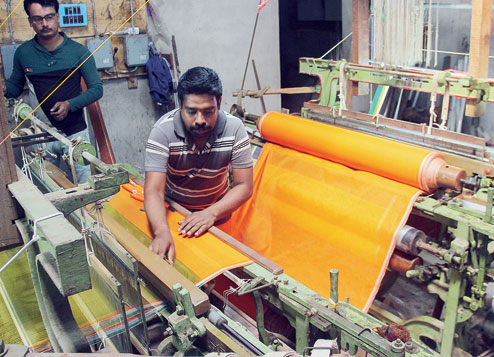
An award-winning weaver from Nadia’s Phulia is leading a team to make a 3.85km long sari, which he claims is the longest in the country.

The sari will be displayed at a Phulia school ground on January 1. The sari, being built at a cost of Rs 2.9 lakh, will have colours of the national flag – saffron, white and green.

Biren Kumar Basak, 72, who took the Sant Kabir award from Prime Minister Narendra Modi last year, said he would dedicate the sari to the nation on New Year’s Day as a tribute to his country.

Basak, who designed the sari and is financing the weaving, said: “This work of art will be longer than the 3.05km long sari made at Bharuch in Gujarat in March this year. I will dedicate the sari to the nation. I will then cut the polyester sari into 700 normal saris and distribute the same among the poor women of Phulia.”

Weavers busy making the sari at Phulia. Picture by Abhi Ghosh

The sari made in Gujarat earned a Guinness book entry.

Basak and five other weavers have been working almost round-the-clock at a power loom in Krishnagar using 316kg of yarn of saffron, green and white color brought from Surat to meet the target of January 1.

“My dream was to make the longest national flag. I then changed my mind and decided to make the longest sari using the colours of the Tricolour. My workers also supported the idea and I started working on it from September,” Basak said.

Raju Basak, a weaver who is monitoring the progress of the sari, said: “We have already completed around 3.2km and hope the target will be met.”

source: http://www.telegraphindia.com / The Telegraph,Calcutta,India / Home> West Bengal / by Subhasish Chaudhuri / November 13th, 2017

KIFF goes behind the lens of Ray and Ghatak

Kolkata :

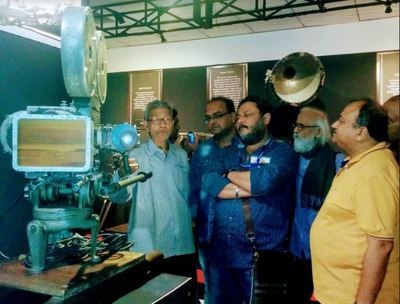
The camera which Subrata Mitra used for shooting ‘Pather Panchali’ triggered many memories for cinematographers – both veteran and young – when they dropped by at the ‘Looking Thru’ exhibition organised on the sidelines of the 23rd Kolkata International Film Festival. Inaugurated by director Prakash Jha, the exhibition is a priceless archive for global cinema.

“The exhibits include camera equipment used by directors like Lumiere Brothers, Satyajit Ray and Ritwik Ghatak and film students and the enthusiasts can learn a lot about our glorious history and how cinema evolved through its medium in the past century,” said principal secretary, Information and Cultural Affairs department Vivek Kumar.

Paying rich compliments to KIFF organisers for hosting such an exhibition, Jha said, “Truly, there was great passion in collecting all these and putting up such an exhibition. All film lovers of the city will be looking with eagerness at this. This adds a new chapter and will go a long way in understanding cinema,” Jha said.

One of the first exhibits on display – that was given by Anjan Bose of Aurora Film Corporation Pvt. Ltd – is a Bell & Howell 35 mm motion picture camera that was used in the silent era. US based Bell & Howell was founded in 1907 and was a manufacturer of motion picture machinery. Since 1909, this company used to make 35 mm motion-picture cameras. However, they stopped making motion-picture cameras from 1970s.

The next exhibit was the immensely popular camera in Europe. Called Super Parve, this camera was extensively used by Sergei Eisenstein and could record both sound and picture simultaneously in sound negative and picture negative formats. Director Abhijit Guha, who had come to watch this exhibition, mentioned that this camera was used for shooting Sukumar Dasgupta’s ‘Ora Thake Odhare’ and ‘Sadanander Mela’. “Both films had featured Uttam Kumar and Suchitra Sen,” Guha said.

The 35 mm Arriflex Blimp, which was capable of enclosing a 1000 ft magazine, also drew many visitors. The camera on display was used to shoot ‘Bhagini Nivedita’ and ‘Raja Rammohan’. Next on display was a Bell & Howells 1925 era Eyemo. Manufactured by the Bell & Howell Company of Chicago in 1925, it was the most popular, compact 35 mm camera that had a 100 ft capacity. Its small size made it a popular camera while filming during World War II and the Vietnam War. “During those days, it was difficult to film with heavy cameras. Hence, this camera became popular.

The 35 mm film size also was brought down to 16 mm and subsequently to 8 mm because of the needs during wartime filming. The 16 mm Maurer is another priceless camera in this collection. It was used for optical effects like dissolve, fade-in and fade-out. The Panavision is a later version of this camera,” said cinematographer Premendra Bikash Chaki.

Incidentally, this camera was so popular that the Appolo 11 spacecraft was equipped with a Maurer. History has it that the crew used this kind of camera to record lunar features from the lunar surfaces.

The Arriflex camera also had a special place in the exhibition. Based in Germany, the Arri group was founded in 1917. In 1937, Arri introduced the world’s first reflex mirror shutter in the Arriflex 35 camera. It has the ability to focus the image by eye through the viewfinder. Pointing at this camera, Chaki said, “This was used to shoot films like ‘Jalsaghar’ and ‘Jukti Tokko Aar Goppo’.”

The Bolex camera made by a Switzerland-based company also drew a lot of attention. Their 16 mm spring-wound is a popular introductory camera in film schools. In 1950s during the golden era of 3D film, Bolex offered a 3D stereo kit for their H-16 camera. Bolex 16 Pro and H-16 was technically very advanced. “This camera was used by Goutam Ghose. He had shot his award-winning documentary titled ‘Hungry Autumn’ with this,” Chaki said.

In 1952, Arri introduced the first professional 16 mm camera with a reflex-viewing system. In 1965, a self-blimped 16 mm camera was marketed: The Arriflex 16BL. “This camera was used by Goutam Ghose to shoot ‘Silk Route’,” Chaki added.

Even a Red digital camera donated by Swarup Biswas has also been on display. However, it was the Mitchell 35 mm camera that drew the maximum attention. That was not surprising since along with this camera was on display two working stills of Ray and Subrata Mitra shooting ‘Pather Panchali’. Gaur Karmakar, who had worked as an assistant cameraman in some of Ghatak’s films, explained: “We have shot ‘Komol Gandhar’ and ‘Subarnarekha’ with this very camera too.”

With many more stories unfolding behind the lens, it’s needless to say that viewers of KIFF will have a lot beyond movies as their takeaway from the cine-fest.

source: http://www.timesofindia.indiatimes.com / The Times of India / News> City News> Kolkata News / by Priyanka Dasgupta / TNN / November 11th, 2017