Category Archives: Records, All

River heritage walk

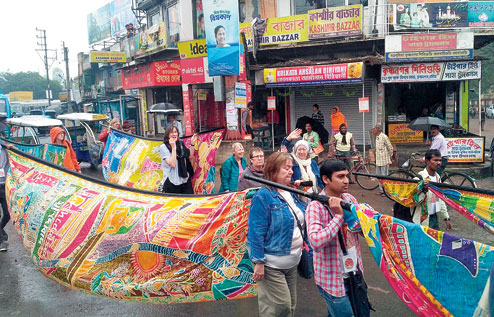
The heritage walk on Saturday. ( Pranab Debnath)

Krishnagar:

In a bid to rediscover and rebuild the cultural relationship between Bengal and the UK that developed over centuries along the banks of the Hooghly and the Thames, a group of contemporary artistes, authors and historians from Calcutta and London on Saturday participated in a walk in Nadia’s Krishnagar.

The walk, a part of the 10-day initiative titled “Silver River India Walk”, began from Azimganj in Murshidabad on Thursday. It will conclude at Calcutta’s Victoria Memorial Hall on December 16, with stops at 10 important heritage sites like Barrackpore, Chandernagore and Batanagar – all located along the banks of the Hooghly.

The walk has been organised by the British Council in India in association with UK-based art organisation Kinetika and India-based Think Arts, with the support of the Union ministry of culture, the state tourism department and several other organisations to mark the 70th year of India’s Independence.

On Saturday, around 40 artistes from Bengal and the UK paid a visit to the clay model hub in Krishnagar’s Ghurni and learnt about the craftsmanship of the artisans.

“It is a great experience to see the artisans working with delicate artefacts with such fineness. Stories of these artisans need to be known by people that live on the banks of the Thames too,” said Kevin Rushby, a travel journalist with The Guardian.

source: http://www.telegraphindia.com / The Telegraph, Calcutta,India / Home> West Bengal / by Subhasish Chaudhuri / December 10th, 2017
Bose Institute, 100, to house museum on history of Indian science

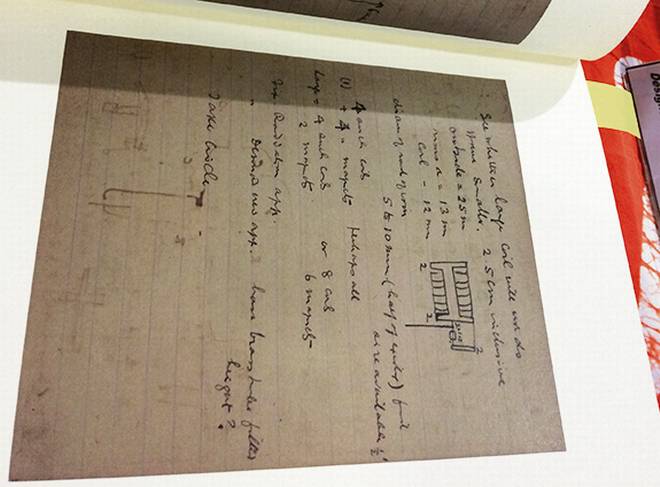
One of the pages of J.C. Bose’s notes. Photo: Special Arrangement

Bose Institute, one of India’s oldest research institutes, will house a museum highlighting the history of Indian science. The decision was taken during the recently-concluded centenary celebrations of the institution, set up by Jagadish Chandra Bose in 1917.

“The History of Science Museum will be located in the campus of Bose Institute on Acharya Prafulla Chandra Road in Kolkata. We are in touch with the National Council of Science Museums for its construction. There will be 50- 60 panels in the first phase which will be completed by 2019,” Siddhartha Roy, director of Bose Institute, told The Hindu.

According to Prof. Roy, the museum will cover four disciplines — physics, astronomy, mathematics and medical sciences — and trace the journey of Indian science from the ancient times.

“Depending on the themes we can have the gallery tracing the development from the Harappan times,” he said.

Professor P.P. Divakaran, who was present at the centenary celebrations of Bose Institute last month and gave a lecture on The Mathematics of India : From Counting to Calculus, welcomed the idea of the museum and said he was “pleasantly surprised “to find a section dedicated to mathematics.

“For most of the time till 1600 AD, India had one of the most advanced mathematical cultures among the world,” Prof. Divakaran said.

Prof. Roy pointed out that modern Indian science may have started with J.C. Bose but there were many who did pioneering work but people were not aware of their contribution.

“In terms of advancements in medical science, the museum will highlight the likes of U.N. Brahmachari, who discovered the treatment for kala azar, and Sambhu Nath De, who discovered the cholera toxin,” Prof. Roy said.

Renovated museum at Bose Institute

Interestingly, as part of its centenary celebrations, the Bose Institute recently upgraded the existing museum on J.C. Bose by displaying 12 digitised volumes of the scientist’s handwritten notes and dairies.

These diaries include the notes he took while attending classes by Francis Darwin (son of Charles Darwin) at Christ’s College in Cambridge. The museum, which also has on display the microwave apparatus developed by J.C. Bose in 1894, has also brought to light the scientist’s communications with personalities such as Mahatma Gandhi and Sister Nivedita.

source: http://www.thehindu.com / The Hindu / Home> News> Cities> Kolkata / by Shiv Sahay Singh / Kolkata – December 02nd, 2017

Canny captain who mothered teammates

Neighbours and friends still cannot get over the sudden death of veteran cricketer Srirupa Bose. She was found lying in a pool of blood after collapsing in her GC Block house on November 30.

According to sources, a journalist had come to take her interview and she asked her to wait downstairs as she went up to her first floor bathroom. When a long time passed, the journalist got anxious and asked the domestic help to look for her.

“We were alerted by cries for help of the domestic help. Boys from a nearby chemist shop as well as a local doctor rushed. We took her to AMRI,” recalls Saktidhara Saha, a former volleyball player who lives just a house away and knew her since 1972.

She was 66, and is survived by husband Pareshnath Mukherjee, a former Bengal Olympic Association president, and daughter, Amrita Mukherjee, a tennis player.

“Her life revolved around her daughter for the last 15 years. She travelled with her all around the country and abroad,” recalled Sujoy Kumar Ghosh, chief operating officer of neighbouring Bengal Tennis Association where Amrita plays her tennis. “In fact, they had just come back from Indore and were supposed to travel to Sholapur for a tournament that evening.”

Ghosh, who knew Bose since 2003 when BTA came into being and Amrita enrolled there, also recalled the wide contacts she had in the sporting world. “She brought (1987 Wimbledon champion) Pat Cash to hold a four-day workshop here at BTA. Even this year, mother and daughter went to Wimbledon to watch the tournament.”

She was full of life. “Once we held a carnival at BTA and two of us were supposed to sing Jamaica farewell on stage. She joined us.”

Srirupa had told The Telegraph Salt Lake in an interview in 2005 how she had started with hockey and basketball at Calcutta Rangers Club in 1971 and then shifted to cricket.

“She was the first captain of the Bengal women’s cricket team,” says Gargi Banerji who played under her from 1976 to 1984. “Bengal was the national champion for seven years during that time,” she says.

Banerji recalled Bose being a shrewd captain who always knew how to bring out the best from the players without being demanding. “She was very disciplined and like a mother to us.” Bose later became India captain, the chairperson of the national selection commitee and team manager— all when women’s cricket was run by Women’s Cricket Association of India. She took charge as assistant director at Sports Authority of India after she quit railways.

Her sradh ceremony will be held on Sunday and a memorial service on Monday.

source: http://www.telegraphindia.com / The Telegraph, Calcutta,India / Home> Calcutta / December 08th, 2017

Royal Bengal water – 68-year-old letter makes a splash

Kumar Supriya Narayan. Picture by Main Uddin Chisti

Cooch Behar:

Time was when the blue-blooded could say “I am monarch of all I survey/My right there is none to dispute”.

Now, a descendant of the Cooch Behar royal family has written to the Trinamul-run municipality staking claim to right to free water.

Kumar Supriya Narayan, 26, is not seeking charity but asserting what he says is a right granted to his family through a letter written 68 years ago by V.P. Menon, the bureaucrat who helped Sardar Vallabhbhai Patel fulfil his mission to integrate India.

Supriya Narayan introduces himself as the grandson of Kumar Dwijendra Narayan, whose cousin Jagaddipendra Narayan was the king of the Cooch Behar princely state when it merged with India on August 28, 1949. Jagaddipendra Narayan, the brother of the exquisite princess Gayatri Devi, was effectively the last king of Cooch Behar.

Two days later, on August 30, Menon sent the letter to King Jagaddipendra Narayan. The seventh point of the purported letter says: “…. water supply will be provided free of charge to the main palace of Your Highness and family within the state.” Nearly seven decades later, the water promise has come into play because the municipality has decided to start drinking water supply to the households of the town.

Each person in a household is entitled to 90 litres a day. Meters will be installed and plans are afoot to levy a charge if the quota is exceeded.

Supriya Narayan, who works as a clerk in the state labour department here, said: “I have written to the chairman, mentioning that we, being descendants of the royal family, are supposed to get water free of cost.”

His grandfather, Kumar Dwijendra Narayan, whose name also figures on the list of royals in the letter sent by Menon, was a cousin of Gayatri Devi.

“King Jitendra Narayan – the father of Gayatri Devi and King Jagaddipendra Narayan – was my grandfather’s uncle,” Supriya Narayan said.

Supriya Narayan, who is also the secretary of the Consortium of Koch Royal Families, has said around five families are entitled to free water supply.

“It is not a question of money but it is a matter of promise. After the accord was signed, a number of issues were decided, ranging from allowances to the family members to ownership of land and other properties. Among these, there is a clause that mentions water supply. That is why I have mentioned it to the civic body before it implements the levy,” he said.

Asked about the letter, Bhusan Singh, the civic chairman, said: “We do not have any proper evidence to identify the descendants of the royal family. Moreover, we are yet to start the water supply and introduce the metering system and the levy. Once it is operational, we will look into the issue and, if required, will consult the state government.”

source: http://www.telegraphindia.com / The Telegraph, Calcutta,India / Home> India / by Main Uddin Chisti / December 07th, 2017

The Great Escape car story

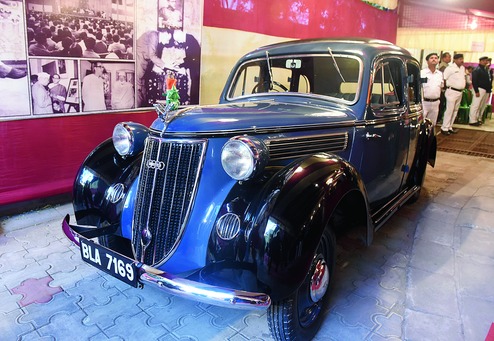
Netaji Subhas Chandra Bose’s Great Escape car, the 1937 Wanderer, was taken apart – on slides – and its restoration story told at the Calcutta Club on Saturday.

Restorer Pallab Ray (right in picture by Sanat Kr Sinha) gave an audiovisual presentation on how he was picked to restore the vintage car that was part of “such a thrilling history”.

In fact, the Bose family had two cars – a Studebaker President and the Wanderer. Apparently, Netaji wanted to escape in the Studebaker. But the Wanderer was chosen as everyone thought people would easily recognise the Studebaker.

Netaji’s nephew Sisir Bose ran an endurance test with the Wanderer till Burdwan.

On the night of the Escape, the Wanderer made a noisy start as it moved out of the Elgin Road house, turned right and then again right to get on to Allenby Road. Netaji held on to his door tightly without closing it so that anyone who was awake would hear only one door being shut. He shut the door after the car had crossed Allenby Road.

On the 75th anniversary of the Great Escape, the restored Wanderer (top in picture by Pradip Sanyal) was unveiled by then President Pranab Mukherjee.

The car had been on display at the Netaji Research Bureau (NRB) since 1970.

The NRB director appointed Audi Calcutta for its restoration. As Wanderer was built by Auto Union, which Audi bought later, they had been contracted to do the job. The Audi Calcutta CEO zeroed in on Ray who had restored his family’s Studebaker President.

Ray said he found the car in a shambles. He was asked to do just a visual restoration, but he decided to make it run again. And he did that with the help of his team. From overhauling the engine to working on the transmission and unique Wanderer suspensions, rebuilding the dashboard and stitching the upholstery, Ray restored the vehicle completely.

Reporting by Anasuya Basu
source: http://www.telegraphindia.com / The Telegraph, Calcutta,India / Home> Calcutta / by Anasuya Basu / December 06th, 2017

Darbeshi singer dies

Jalpaiguri:

Kalachand Darbesh, who is presumed to be the last Darbeshi singer of Bengal, passed away at his home in Gobindapally of Dhupguri on Sunday morning.

The 84-year-old singer, who has earned several national and international accolades for his songs, was suffering from breathing problems and renal complications.

Family members said he had fallen ill on Saturday and was taken to the North Bengal Medical College and Hospital in Siliguri.

Later, doctors advised that he could be taken back home but around 6.45am on Sunday, he breathed his last. He is survived by his wife, son, daughter-in-law and a granddaughter.

“He was the last Darbeshi singer in Bengal,” Rup Das, his son, said.

In his lifetime, Kalachand had worked with maestros like Pandit Ravishankar.

In 1990, at London Bharat Mela, he had performed with Zakir Hussain and sung Darbeshi songs in Scotland, France and Africa.

In 2013, he was awarded the Nazrul Puraskar by the state government. Chief minister Mamata Banerjee had handed over the award to him.

The same year, he was conferred the Sahajiya Samman by Sahajiya Foundation. The foundation had also made a documentary on his music and life named In Search of Darbeshi Songs.

“He was one of the few persons who had kept the Darbeshi style of singing alive and had worked on it in a consistent manner for decades. His demise is a loss for the state and all Darbeshi song lovers,” north Bengal development minister Rabindranath Ghosh said.

Ghosh, who visited Dhupguri to attend some government functions, said they would mull over a proposal of setting up a statue of Kalachand.

“His contribution and works on music should be remembered,” the minister said.

source: http://www.telegraphindia.com / The Telegraph, Calcutta,India/ Home> West Bengal / by The Telegraph Correspondent / December 04th, 2017

Calcuttans share city memories

Calcutta:

More than 200 Calcuttans strung together their impression of the city through keepsakes and stories at a crowdsourced event in GD Birla Sabhagar on Friday.

A month-long campaign on Facebook and Instagram prompted artistes, professionals and students to join Kolkata 100/100. Centre Stage Creations presented the art installation project as part of the Sabhagar Theatre Festival.

Various shades of city life were brought alive through stories of love, struggle and fight for justice. “I was the outsider who would come here to visit grandparents during vacations,” Rajashree Bose, a professional, said.

Her story traced her metamorphosis from an outsider watching Chuti chuti and loving mithai during vacations to a true blue Calcuttan who complains about the lack of job opportunities yet enjoys its comfortable lifestyle.

The signboard, a birthday gift to a student, was one of the 100 objects on display. (Shuvo Roychaudhury)

Many stories focused on optimism. Rupkotha Mukherjee spoke about her fight with depression and her love for writing poetry. “I look at depression in a positive light. It has helped me write better,” the student said.

Some traced the city’s dark side. Activist Ekaboli Ghosh spoke of the abuse that she and her mother faced at home and the daily crime against women in the city. “I am very disillusioned with the city,” she said.

The storytelling session – I Am #NOTA FACEINTHECROWD – was peppered with nostalgia, confessions, political views and humour.

Shahidul Islam’s account of how he fought against taking dowry and managed to convert his village won plenty of applause.

Stories also came out through objects. Every object came with a note about its importance in the owner’s life.

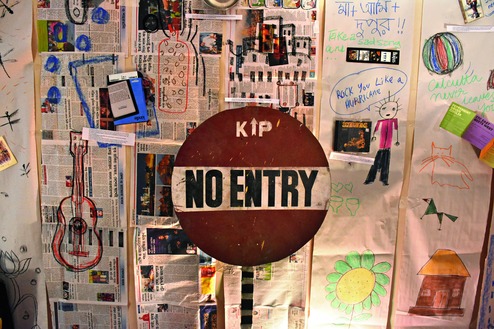
A red letter box, a prop used in a play Priyo Bandhu by Mad About Drama, was one of the first objects to grab eyeballs. Perched on top of it was an Old Monk bottle, a remnant of Alokananda Mandal’s college days. Student Priyadarshini Mukherjee had contributed a No Entry signboard, a 21st birthday gift from a bestie who had stolen it on his 21st birthday.

source: http://www.telegraphindia.com / The Telegraph, Calcutta,India / Home> Calcutt / by Chandreyee Ghose / December 03rd, 2017

National bronze for Bengal rowing teens

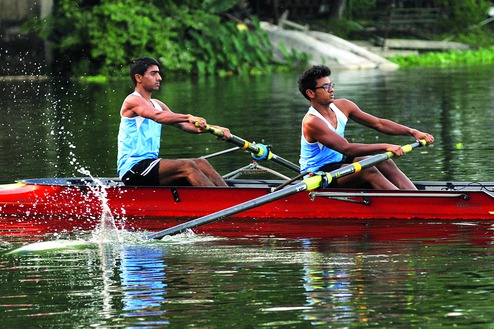
(From left) Md Rahmat Ali and Sanglap Bose practise in Rabindra Sarobar. (Sanat Kr Sinha)

Rabindra Sarobar:

Two teenage rowers from Calcutta have ended a seven-year wait for Bengal by winning bronze in the junior national championships.

Sanglap Bose, 16, and Md Rahmat Ali, 15, finished third, missing out on silver by two seconds and gold by six.

The 38th edition of the event was held in Odisha’s Jagatpur between November 14 and 19.

The last time any male rower from Bengal made it to the podium in the junior nationals was in 2010 when Kapil Pincha won bronze in single sculls in Hyderabad in 2010.

“We finished first in the heats but couldn’t hold on to our nerves in the finals,” Bose, a Class XI student of Julien Day School, Bhowanipore, said.

The team completed the race in 3 minutes and 40 seconds. Telangana came first, followed by Madhya Pradesh.

Bose and Ali , a Class X student of Kendriya Vidyalaya, Ballygunge, practise at the Bengal Rowing Club.

“Junior nationals are more competitive than the sub-juniors. The 1km watercourse is a big challenge for our rowers because all watercourses in Calcutta are smaller,” Rajesh Agarwal, rowing captain, Bengal Rowing Club, said.

The teens had been preparing for the tournament since July. They practised early morning and in the evening.

In the pairs, two rowers have an oar each, compared to double sculls where each rower has two oars. “You need a certain level of physical strength to do well in pairs. The hours at the gym are as important as the practice sessions on water,” Agarwal said.

A low carbohydrate protein rich diet and a complete bar on junk food was also part of the preparations.

Ali stands at 5 feet 7 inches and weighs 52kg. Bose is 5’5″ and weighs 63kg.

“The immediate reaction after the race was that of disappointment. But we badly wanted a medal. We had aerated drinks after six months to celebrate the podium finish,” Ali said. His rowing career started at the club in 2014, a year after Bose had joined the club.

The two rowed together for the first time in 2016 and won gold in the state championships held at the club in January. They followed it up with gold in double sculls in the national sub-juniors in Chennai in June. “They keep pulling each other’s leg but on a boat they complement each other perfectly,” Agarwal said.

source: http://www.telegraphindia.com / The Telegraph, Calcutta,India / Home> Calcutta / by Debraj Mirta / December 02nd, 2017

CM bats for e-archive of rare documents

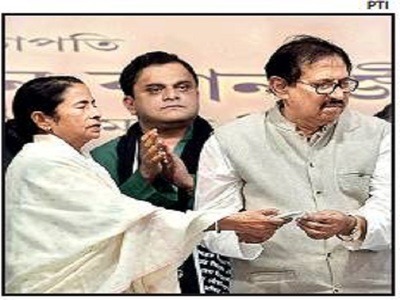
Chief Minister Mamata Banerjee lays the foundation stone of the West Bengal Legislative Assembly Platinum Jubilee Memorial Building

Kolkata :

The Platinum Jubilee Memorial Building coming up on the West Bengal Legislative Assembly premises will be a treasure trove of rare documents, books and historic files. The documents will be accessible to general public.

Chief minister Mamata Banerjee, while laying the foundation of the building, requested assembly speaker Biman Banerjee to keep a separate entrance for common people, students and scholars to access the documents. “We were the first to make public the Netaji files, which were in possession of the Bengal government. We believe in transparency and accountability. There are several rare files from the pre-Independence and post-Independence era in possession of Kolkata Police, state police and the assembly,” said the CM.

She urged the Kolkata Police and the state police to digitize all these rare documents and make them available online. The CM also said that an e-library can be made. “If the MPs want to do some research for preparing a note before addressing Parliament, they get adequate information within a very short time. There should be similar mechanism in the assembly as well,” she said.

The chief minister also asked if the documents and archive material can be translated into English with the help of British Council. “You should also look into possibilities of exchange of documents and other materials with the Parliament of Bangladesh,” she said. The proposal was made since Bangladesh holds a huge number of documents before and after the Partition. “Bengali is the fifth widely spoken language in the world and second in Asia. The e-library will benefit a huge number of students,” she said.

source: http://www.timesofindia.indiatimes.com / The Times of India / News> City News> Kolkata News> Politics / TNN / November 30th, 2017

Bengal in Bollywood: tracing a cross-country romance

Exhibition at KIFF chronicles contributions to mainstream cinema over 80 years

Over the past few years, while delivering the inaugural lecture at Kolkata International Film Festival (KIFF), superstar Amitabh Bachchan has emphasized the contribution of Bengal’s film makers and artistes to Bollywood. And this year was no different.

Speaking at the inauguration of the 23rd edition of KIFF earlier this week on this year’s focus on music and songs in Indian cinema, Mr. Bachchan said, ““The biggest revolution in journey of film song happened in Bengal when in 1935 director Nitin Bose and his brother Mukul Bose… introduced pre-recorded song in the Bengali film Bhagya Chakra and its Hindi remake Dhoop Chhaon.”

And ‘Bengal in Bollywood’ is the theme of an exhibition organised by the State Information and Cultural Affairs Department at Nandan during the ongoing festival.

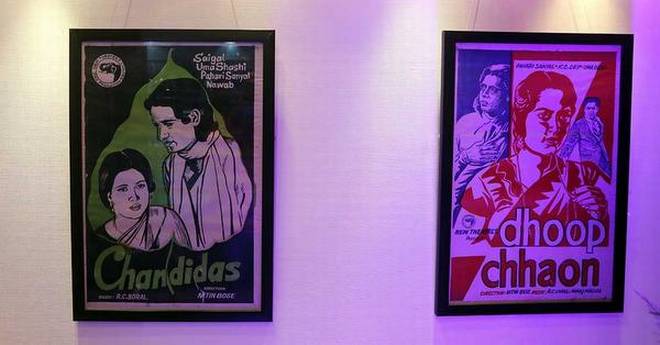
The exhibition chronicles the contribution not only of Bengali directors and actors but also technicians and singers through 30 unique and rare original posters, 22 lobby cards and 10 informative posters over 60 years from the 1930s to the early 1990s.

Rare glimpses

The earliest posters are of director Nitin Bose’s Chandidas and Dhoop Chhaon from 1934 and 1935 respectively while the latest is from the Mithun Chakraborty starrer Ghar Ek Mandir from 1984.

The posters are largely from the personal collection of statistician-turned-film buff Somnath Ray who has curated the exhibition.

“Most of the posters are 40 x 30 inches or 30×20 inches but there is one poster of the 1958 comedy Chalti Ka Naam Gaadi which is one-third of the size of original. These are called ‘one-third’ and were kept in the office of the producers,” Mr Ray said.

The posters reveal little known links between Bengal and Bollywood. Among the posters is one of Bollywood’s iconic director Raj Kapoor’s Awara. Mr. Roy explains that the film was shot by a Bengali cinematographer, Radhu Karmakar.

Iconic faces

Other than the posters, there are about 22 lobby cards, which were printed by film studios to promote their films till 1960 and are now part of film memorabilia.

Lobby cards of Basu Chaterjee’s Shaukeen starring Ashok Kumar and Utpal Dutt, Shakti Samanta’s Anand Ashram and Hrishikesh Mukherjee’s Mem Didi are on display.

The 40×30 inch poster of another Hrishikesh Mukherjee’s film Anupama starring Dharmendra and Sharmila stands out given its unique style of painting.

Along with the film memorabilia, there are at 10 large black-and-white photographs of Bengali directors, actors and singers featuring Ashok Kumar, Utpal Dutta, Devika Rani, and Hrisikesh Mukherjee among others.

source: http://www.thehindu.com / The Hindu / Home> Entertainment> Movies / by Shiv Sahay Singh / Kolkata – November 12th, 2017