Category Archives: Records, All

Focus French connection

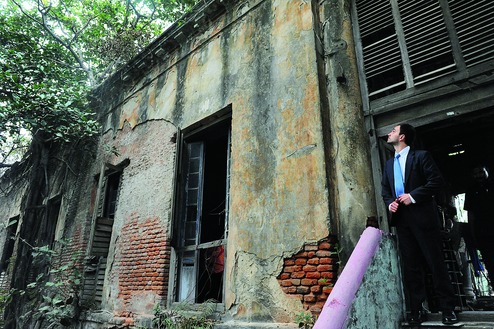
French consul general Damien Syed during an earlier visit to the Registry Building in Chandernagore, accompanied by Metro

Calcutta:

Registry Building, a derelict colonnaded structure with louvered screens, caught in the clasp of myriad tree roots at the corner of the Strand, declared as condemned by the civic body, is the focal point of an initiative in Chandernagore for the former French colony to reconnect with its built architectural heritage.

Friday will see the launch of Know Your Indo-French Heritage, a week-long multidisciplinary workshop that is taking place within the ambit of Bonjour India, a celebration of Indo-French partnership in innovation and creativity across the country, organised by the French Embassy and Institut Francais.

“It is a collaborative workshop designed for the restoration of French-built heritage which will not survive unless people are proud of the town’s assets and realise that this can be a source of economic growth,” said French consul general Damien Syed, who reiterated his distress at the state of dereliction of the French heritage structures.

Students from Jadavpur University, Chandernagore College and The Confluence Institute for Innovation and Creative Strategies in Architecture, Lyon, will meet at Chandernagore College on Friday. “They are expected to come up with innovative design solutions as to how public spaces in the town can be better utilised. One of the outcomes of the workshop would be a sustainable business model for the reuse of the Registry Building. IIM Nagpur will collaborate on that,” said Aishwariya Tipnis, a conservation architect who has worked to identify the heritage buildings in Chandernagore. Seven buildings from her list, including the Registry Building, have recently been selected for notification as heritage structures by the state heritage commission.

All ideas from the workshop will be exhibited on the Strand as part of the closing ceremony on January 12 for the public as well as French ambassador Alexandre Ziegler to see. “We will also launch a crowd-funding initiative which will possibly be a first in India for restoration of a building,” she said.

Four heritage adda sessions will take place involving eminent residents like lighting wizard Sridhar Das and representatives of heritage businesses like confectioner Surya Kumar Modak.

Beyond Chandernagore

France will be the partner country this year at the state government’s Bengal Global Business Summit. “For the first time, we will have a delegation of nine or 10 companies,” said Syed. This is a significant development after the pullout of a French joint venture from the Haldia port which was blamed on strong-arm tactics by an entrenched lobby close to the ruling establishment. The then ambassador Francois Richier had raised the matter with the state government during his city visit in 2014.

source: http://www.telegraphindia.com / The Telegraph, Calcutta,India / Home> Calcutta / by Special Correspondent / January 05th, 2018
It’s Bach to the cemetery for a musical feast in Kolkata

One of the city’s oldest Christian cemeteries will host an evening of Baroque music to celebrate its 250th birth anniversary
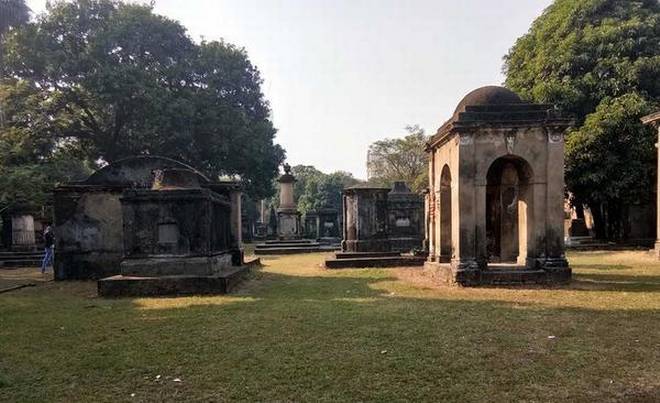
Come Saturday, Kolkatans, both the living and the dead, can look forward to a grand musical feast as the South Park Street Cemetery, one of the city’s oldest cemeteries, will celebrate its 250th birthday by holding a concert on its premises.

In a clearing amid small and giant sepulchres, ageing plaques, and 300 varieties of trees, its sprawling, leafy compound will host a performance by a string quartet and a pianist on January 6.

The performances, according to the programme booklet, will mainly be of “17th and early 18th century Baroque composers” such as Antonio Lucio Vivaldi, Johann Sebastian Bach and George Frederick Handel. Some of the finest musicians of the city, including some who are based abroad, such as the violinist Prosanto Dutt, will perform. “He will also talk about the music,” said Ranajoy Bose, the architect of the two-hour show and a managing member of the Christian Burial Board, which manages the cemetery. The tickets are priced at a modest ₹20.

On being asked about the low price of the tickets, Mr. Bose said, “This is a strange cemetery. For instance, there are no crosses here. Instead, the tomb designs carry the architectural imprint of many civilisations, including Greek, Roman, Turkish and Mughal influences, and some are even shaped liked Hindu temples. We would like school children to know something about these eclectic designs created by Indian masons, besides some Western classical music.”

source: http://www.thehindu.com / The Hindu / Home> News> States> Other States / by Suvojit Bagchi / Kolkata – January 03rd, 2017

Gratitude to genius behind Boson

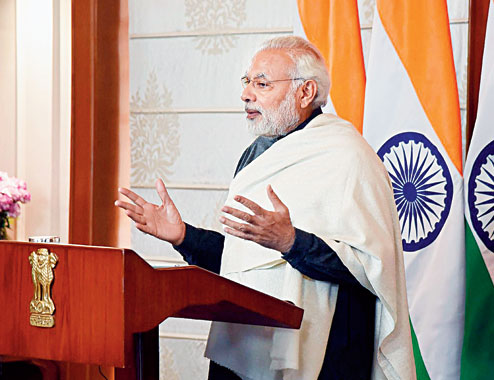
Prime Minister Narendra Modi pays tribute to S.N. Bose (below) on his 125th birth anniversary
via video-conferencing from New Delhi on Monday. (PTI)

Calcutta:

Physics was his calling but he could play a complex classical raga on the esraj with as much dexterity as he could read out a French novel in impromptu English translation.

Stories highlighting the multifaceted genius of Satyendra Nath Bose, after whom the Boson particle is named, on Monday filled the curtain-raiser to a yearlong commemoration of his 125th birth anniversary.

Prime Minister Narendra Modi inaugurated the event from Delhi through video-conferencing, reminding the audience at the SN Bose National Centre for Basic Sciences in Salt Lake that “just as a quantum particle does not exist in isolation, we should also get out of isolation”.

Modi said the scientific ecosystem needed to connect with innovators, entrepreneurs and technocrats to work on artificial intelligence, big data analytics, machine learning, genomics and electrical vehicles. “These are some of the rising technologies on which we need to get ahead,” he pointed out, holding up Bose as the inspiration to test new frontiers.

Born on January 1, 1894, Bose had collaborated with Albert Einstein to create what came to be called the “Bose-Einstein Condensation”. Physicist and author Partha Ghose, who did his PhD under Bose, recounted one among many instances of how humble he could be despite his brilliance.

“He was in a reflective mood one day and spoke about the ‘photon spin’ aspect in his derivation of Planck’s law. But then, with a mischievous smile, he said, “But the old man (Einstein) struck it off”.

Ghose said the anecdote left him flabbergasted because Nobel laureate C.V. Raman’s research later vindicated Bose’s derivation.

“When I asked him why he didn’t claim credit for his discovery, he said, ” Ki ba eshe gelo? Ke baar korechhilo tatey ki eshe jaye? Baar to hoyechhilo (How does it matter? Who discovered it is not the main thing, is it? At least it was discovered)’,” he reminisced.

Planck’s law is the basis of quantum theory.

In his speech, the Prime Minister said many Nobel prizes had been won for work based on Bose’s research.

Union science and technology minister Harsh Vardhan also paid tribute to Bose.

source: http://www.telegraphindia.com / The Telegraph, Calcutta,India / Home> Calcutta / by Anasuya Basu / January 02nd, 2018

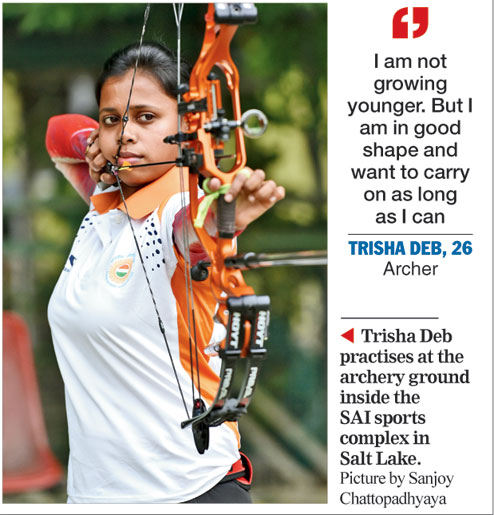
Girl who refused to bow before ordeals – Archer from Bengal shines

Salt Lake:

An archer once hailed as a child prodigy but forced to move out of Bengal for want of opportunities was part of the Indian women’s trio that struck gold in last month’s Asian Championship in Dhaka.

Trisha Deb, 26, has seen several ups and downs in her 17-year-old career. Daughter of an errand runner and a tuition teacher, Trina’s first sophisticated bow came in 2004 as part of a scheme for budding players.

Her journey began at the Baranagar Archery Club, the cradle of such archers as Banerjee siblings Dola and Rahul. “The club is right next to my maternal grandparents’ home, where my mother would leave me when she went to give private tuitions,” Trisha told Metro.

The first laurel came in 2004 when Trisha won gold in the sub-junior national championships in Delhi. An encore followed in Ajmer the next year. It was her bronze in the senior nationals at age 14 that turned heads.

But Trisha’s performance graph took a sudden plunge thereon. “Archery is an expensive sport. A standard bow needs refurbishment every couple of years. My parents tried their best but it was too much for them,” she said.

Trisha had applied for admission to the famed Tata Archery Academy, Jamshedpur, in 2006 but was rejected because of her height.

The next few years were the worst in Trisha’s career. “I was not even selected for the nationals from the state. I was shattered mentally,” she said.

Fortune smiled on Trisha in the form of a residential programme for archers at Punjabi University, Patiala, in 2011. Her mother was jittery about letting her shift base but Trisha was determined not to give up sports.

In Patiala, Trisha met Jiwanjot Singh Teja, a coach at Punjabi University. Teja advised her to shift to compound archery from recurve because of her short height.

A recurve bow gets its name from reverse curves at the end. Compound bows, on the other hand, use a pulley system that takes strain off of the bow, making it easier to shoot.

A year later, Trisha won the All-India Inter-University Archery Championship and in 2013 she made it to the Indian team for compound archery.

Trisha was part of the Indian team that won bronze at the World Cup in 2013 in Shanghai. Her best came the year after with a bronze in the compound women’s individual event at the Asian Games in Incheon, South Korea. It also bagged her a railway job.

Now the sole earning member of her family after her father’s death last year, Trisha refuses to give up her passion.

Her reward came when she, along with Parveena and Jyothi Surekha, won gold in Dhaka by beating the team from Korea. She was on the verge of tears when she heard the national anthem playing as she took the podium.

“I am not growing younger. But I am in good shape and want to carry on as long as I can,” said Trisha, who has set her sights on the Asian Games 2018, to be held in Jakarta.

source: http://www.telegraphindia.com / The Telegraph, Calcutta,India / by Debraj Mitra / December 30th, 2017

CSIR develops ‘solar tree’ that can light 5 houses

A CSIR laboratory in West Bengal has designed a ‘solar power tree’ that takes up only four square feet of space and produces about three kilowatts (kW) of power, enough to power about five households.

“The challenge was to come up with a design so as to generate more solar power in less land space,” Sibnath Maity, chief scientist at the Central Mechanical Engineering Research Institute (CMERI) in Durgapur, which developed the “tree”, told IANS.

“For one mW of power, one needs five acres of land. To generate 10,000 mW we would need 50,000 acres. Now this poses a dilemma in states like West Bengal and Bihar,” Mr. Maity said.

The “solar tree” was inaugurated on Tuesday by Union Science and Technology Minister Harsh Vardhan during his maiden visit to the CMERI, which is a constituent of the Council of Scientific and Industrial Research (CSIR).

Mr. Maity said one conventional solar photovoltaic system of five kW requires 400 square feet of area.

The three kW solar power tree resembles a tree with branches at different tiers and could be squeezed on rooftops and highways with a space requirement of around four square feet.

“The branches hold up the 30 photovoltaic panels and the system costs around Rs.3 lakh with battery back-up,” Mr. Maity said.

Two solar power trees would be installed at the office at Harsh Vardhan’s bungalow according to the Minister’s request, said Mr. Maity.

Harsh Vardhan also inaugurated the ‘Control Container’ developed by the CMERI for lake and sea trial of ‘Remotely Operated Vehicle (ROV)’.

“I happily took part in live demonstration of the tractors developed by CSIR-CMERI by being literally in the driver’s seat and actually driving one vehicle,” the Minister posted on his official facebook page.

“I lauded the contribution of the institute in Green Revolution with its immensely successful technological achievements — the ‘Swaraj Tractor’ followed by the ‘Sonalika’ and the ‘Krishi Shakti’ I also drove the ‘e-rickshaw’ developed by the institute with great enthusiasm,” Harsh Vardhan added. – IANS


“Challenge was to come up with a design to generate more solar power in less land space”

source: http://www.thehindu.com / The Hindu / Home> News> Cities> Kolkata / IANS / Kolkata – May 21st, 2016

Kolkata artist’s paintings stamp their authority in Germany

Kolkata :

German postal service Deutsche Post AG has issued two postage stamps featuring paintings by an artist from Kolkata.

Sudip Chatterjee, who passed out of the Indian College of Art & Draftsmanship in 1986 after graduating in science from University of Calcutta, was pleasantly surprised when he received a mail from the Deutsche Post headquarters in Bonn, seeking his approval to use two of his paintings in postal stamps. Each stamp is priced 1.45 euro.

Awarded senior fellowship by HRD ministry for 2016-18, Chatterjee was in Germany for an exhibition at Galerie Sabine Neubuhr from May 30 to June 19. He is again due to visit Germany next year for an exhibition at Gallerie Stauferland at Goppingen near Stuttgart from May 31 to June 17.

Chatterjee association with Germany goes back two decades. In 1998-99, he was an artist in residence at the Kuntseminar Freie Hochschule in Metzingen, Germany, and has done several shows in Stuttgart and Berlin, apart from Paris, Mumbai, Delhi and Kolkata.

His Paintings are part of the collection at the National Gallery of Modern Art, Roopankar Museum, Bharat Bhawan and other private and public collections in India, Germany, France, UK, Finland, Austria, Canada and the US.

source: http://www.timesofindia.indiatimes.com / The Times of India / News> City News> Kolkata News / TNN / December 28th, 2017

City girl under Gopi’s wing

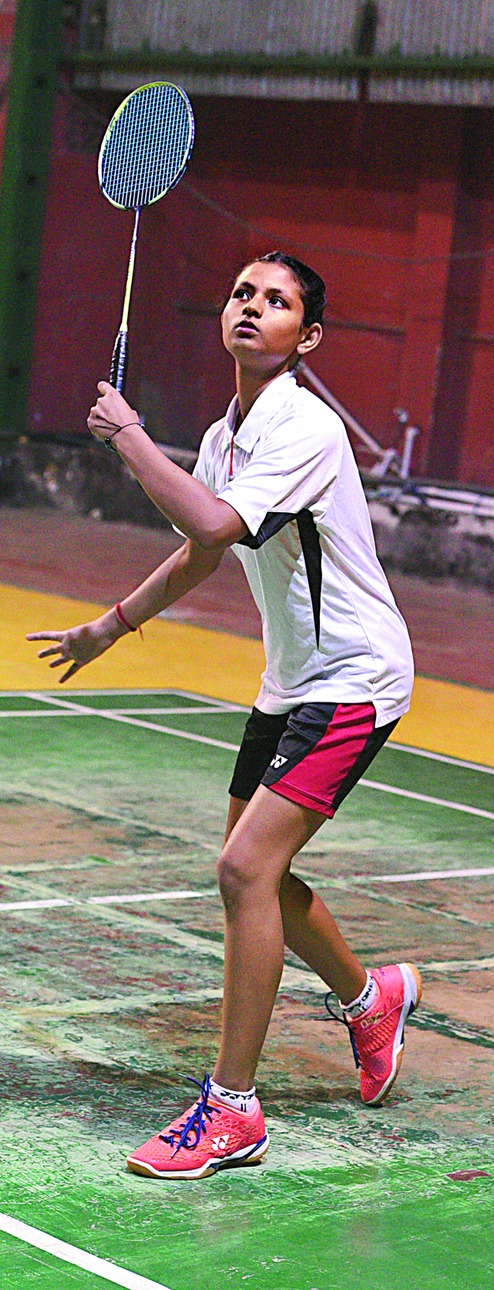
Shreya Tiwari at a practice session at Park Circus Byam Samiti. (Rashbehari Das)

Calcutta:

She is just 13 and has reached some milestones that teens at her age can hardly imagine.

Meet Shreya Tiwari, a Class VIII student of Indira Academy, who recently won an under-15 state badminton championship in Raiganj and reached semis of another under-15 state-level tournament in Durgapur. She has been training under Pullela Gopichand, the Dronacharya of Indian badminton for the past one and half years.

Shreya started playing the game six years ago as her father felt she must engage in a sport to stay fit. “Just a few days after she started training under coach Tapas Biswas at Park Circus Byam Samiti, the coach called me up and told me ‘she has a great potential, she will surely play for India’. Shreya also fell in love with the game soon after joining the coaching centre,” said Sanjay Tiwari, the father, who is the founder-principal of Indira Academy.

Shreya, a big fan of Srikanth Kidambi, started playing district-level tournaments in 2012 and just after a couple of years of playing at district level, she started playing at state and national level. “Shreya is very sincere and passionate about her game. She is a fast learner. She started winning state-level tournaments at the age of nine, which is really commendable,” said coach Biswas.

source: http://www.telegraphindia.com / The Telegraph, Calcutta,India / Home> Calcutta / by Ayan Paul / December 27th, 2017

Besties bring gold for Bengal Rowing duo may move out for better facilities

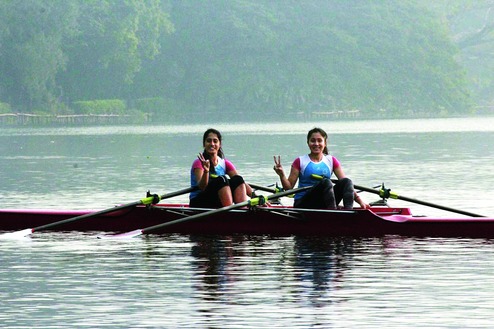
Shreya Iyer and (right) Aishwarya Krishnan

Rabindra Sarobar:

A pair of childhood best friends whose special bond extends to competitive rowing have just fulfilled their dream of becoming national champions.

Aishwarya Krishnan, 19, and Shreya Iyer, 20, together won Bengal’s only gold medal in the Senior National Championships in Pune from December 6 to 11. The duo defeated Chandigarh and Odisha in the 500m women’s double sculls with a timing of 1:43.5.

Metro had highlighted the girls’ journey through friendship and rowing on February 6 after they won a silver medal in the same event of the previous national championships.

“The Odisha team had Asian medallists. Beating them to win gold this time was extra special,” said Aishwarya, who is studying in St. Xavier’s College.

Since becoming partners in double sculls in 2015, the two of them have won several tournaments but losing to Odisha in the Bhopal championships had hurt.

The night before the rematch, Shreya lost count of the number of times she woke up. “I was super pumped up, all adrenaline!” Shreya, who is in Loreto College, recounted.

Aishwarya said her mind was blank. “I just wanted to give 100 per cent.”

On December 10, the Bengal duo led from start to finish. The celebrations were briefly halted by Aishwarya throwing up – she blames it on one egg too many for breakfast – but the pair later took the Bengal contingent out for a pizza lunch.

What clicks for the pair is their chemistry. “I can go all out for her and she for me. What you need in a team game comes to us naturally,” said Shreya, who also loves to play the violin.

Their next target? Doing well in 2000m events.

They are considering moving out of Bengal because it lacks a water strip for 2,000m practice.

source: http://www.telegraphindia.com / The Telegraph, Calcutta,India / Home> Calcutta / by Debraj Mitra / December 27th, 2017

IIM reunion kicks off

Joka:

The IIM Calcutta’s 1992 alumni returned to the campus on Saturday to relive their student days with batchmates Sonya Dutta Chowdhury and Swati Kaushal who chucked corporate careers to turn authors.

Each year, winter marks the homecoming of the batch that graduated from Joka 25 years ago. And the occasion is called “Reminiscence”.

The reunion started with a two-day carnival that would include a guided tour of the campus, a discussion with the director and dean, interaction with former professors and current students among others.

“I cannot imagine being a writer without my stint in the management school,” Kaushal told her batchmates. “Because I went to management school, worked with Nestle, interacted with advertising agencies, I was subjected to a lot of communication… that’s what brand management is about.”

Dutta Chowdhury said: “MBA teaches you a lot of communication, writing, analysis and storytelling.”

Instances of IIM graduates shunning corporate careers to turn authors is not new, though. Amish Tripathi, who was at IIM Calcutta to collect the distinguished alumnus award on November 14, is perhaps the most successful example with his Shiva trilogy.

source: http://www.telegraphindia.com / The Telegraph, Calcutta,India / Home> Calcutta / by Special Correspondent / December 24th, 2017

Diagnosing early-stage cervical cancer using artificial intelligence

New approach: “The change in tissue morphology as the disease progresses can be picked up by light scattering,” say Prof. Prasanta K. Panigrahi (right) and Sabyasachi Mukhopadhyay

The AI identifies precancerous tissue, and also the stage of progression in minutes

The morphology of healthy and precancerous cervical tissue sites are quite different, and light that gets scattered from these tissues varies accordingly. Yet, it is difficult to discern with naked eyes the subtle differences in the scattered light characteristics of normal and precancerous tissue. Now, an artificial intelligence-based algorithm developed by a team of researchers from Indian Institute of Science Education and Research (IISER) Kolkata and Indian Institute of Technology Kanpur makes this possible.

The algorithm developed by the team not only differentiates normal and precancerous tissue but also makes it possible to tell different stages of progression of the disease within a few minutes and with accuracy exceeding 95%. This becomes possible as the refractive index of the tissue is different in the case of healthy and precancerous cells, and this keeps varying as the disease progresses.

“The microstructure of normal tissue is uniform but as disease progresses the tissue microstructure becomes complex and different. Based on this correlation, we created a novel light scattering-based method to identify these unique microstructures for detecting cancer progression,” says Sabyasachi Mukhopadhyay from IISER Kolkata and first author of a paper published in the Journal of Biomedical Optics.

Elaborating on this further, Prof. Prasanta K. Panigrahi from IISER Kolkata and corresponding author of the paper says: “The collagen network is more ordered in normal tissues but breaks down progressively as cancer progresses. This kind of change in tissue morphology can be picked up by light scattering.” White light spectroscopy (340-800nm) was used for the study.

Statistical biomarker

The change in scattered light as disease progresses is marked by a change in tissue refractive index. The team has quantified the changes in tissue refractive index using a statistical biomarker — multifractal detrended fluctuation analysis (MFDFA). The statistical biomarker has two parameters (Hurst exponent and width of singularity spectrum) that help in quantifying the spectroscopy dataset.

While MFDFA provides quantification of light scattered from the tissues, artificial intelligence-based algorithms such as hidden Markov model (HMM) and support vector machine (SVM) help in discriminating the data and classifying healthy and different grades of cancer tissues.

“The classification of healthy and precancerous cells becomes robust by converting the information obtained from the scattered light into characteristic tissue-specific signature. The signature captures the variations in tissue morphology,” says Prof. Panigrahi.

“The MFDFA-HMM integrated algorithm performed better than the MFDFA-SVM algorithm for detection of early-stage cancer,” says Mukhopadhyay. “The algorithms were tested on in vitro cancer samples.”

In vivo samples

The team is expanding the investigations to study in vivo samples for precancer detection. While the accuracy achieved using in vitro samples was over 95%, based on a study of a few in vivo samples the accuracy is over 90%.

“In the case of in vitro samples we were able to discriminate between grade 1 and grade 2 cancer,” says Prof. Nirmalya Ghosh from IISER Kolkata and one of the authors of the paper. “More testing is needed using in vivo samples.”

“Superficial cancers such as oral and cervical cancers can be studied using this technique. And by integrating it with an endoscopic probe that uses optical fibre to deliver white light and surrounding fibres to collect the scattered light we can study cancers inside the body,” says Prof. Ghosh.

source: http://www.thehindu.com / The Hindu / Home> Sci-Tech> Science / by R. Prasad / December 23rd, 2017