Category Archives: Records, All

Nasscom to host first SME conclave in Kolkata

Kolkata :

The National Association of Software and Services Companies (Nasscom) on Thursday said it will host its first international SME conclave here on January 10-11, 2019, to provide entities an opportunity to establish a business connect.

The two-day conclave will be attended by over 2,500 delegates, 100 chief information officers, while over 200 companies will showcase their products and solutions, the association’s SME Council Chairman Kamal Agarwala said.

Small and medium enterprises constitute about 80 per cent of the association’s membership and they contribute about 20 per cent of the total software exports of the country, according to industry sources.

source: http://www.outlookindia.com / Outlook / Home> The News Scroll / September 27th, 2018

Winners of Shanti Swarup Bhatnagar Prize for Science and Technology 2018 announced

Dr Aditi Sen De is the only female winner this year
On the occasion of its foundation day, the Council of Scientific and Industrial Research (CSIR) has put out the list of recipients of the Shanti Swarup Bhatnagar Prize for Science and Technology for 2018.

Every year, several scientists below the age of 45 are selected from various institutions across the country and awarded for their outstanding scientific work in the last five years.

Here is the full list of winners this year in various categories

Category Winner Affiliation

Biological Sciences
Dr Ganesh Nagaraju IISc Bengaluru
Dr Thomas Pucadyil IISER Pune

Chemical Sciences
Dr Rahul Banerjee IISER Kolkata
Dr Swadhin Kumar Mandal IISER Kolkata

Earth, Atmosphere, Ocean and Planetary Sciences
Dr Madineni Venkat Ratnam National Atmospheric Research Laboratory, Tirupati

Dr Parthasarathi Chakraborty CSIR-NIO, Goa

Engineering Sciences
Dr Amit Agrawal IIT Bombay
Dr Ashwin Anil Gumaste IIT Bombay

Mathematical Sciences

Dr Amit Kumar IIT Delhi
Dr Nitin Saxena IIT Kanpur

Medical Sciences
Dr Ganesan Venkatasubramanian NIMHANS, Bengaluru

Physical Sciences
Dr Aditi Sen De Harish-Chandra Research Institute, Allahabad
Dr Ambarish Ghosh IISc Bengaluru

source: http://www.thehindu.com / The Hindu / Home> Sci-Tech / by The Hindu Net Desk / September 26th, 2018

Paintings that pioneered modern art in India to get a permanent gallery in Kolkata

Victoria Memorial Hall is all set to unlock a set of 5,000 paintings from the Bengal School that paved the path of modernism in Indian art.

Victoria Memorial Hall (VMH), one of the museums with the highest footfalls in the country, is all set to unlock a a set of 5,000 paintings from the Bengal School that paved the path of modernism in Indian art.

“This winter we will open a permanent gallery dedicated to this collection. It includes the largest and most important collections of the works of Abanindranath Tagore and Gaganendranath Tagore, two of the pioneering figures of modern Indian art,” said Jayanta Sengupta, curator and secretary of VMH.

Notable among this collection are the works by cousins Abanindranath and Gaganendranath, as well as Nandalal Bose. The three are among India’s nine artists of national importance whose works cannot be taken outside the country.

“This collection is one of the most important in the context of Indian modern art because modern art movement in India centred on Kolkata, and this collection comprises works of the formative days,” said Sushobhan Adhikary, art critique and former curator of the museum at Kala Bhavana of Visva Bharati.

The Bengal School art movement that started in the late 19th century led to the development of modern Indian art during the early 20th century.

The 300-odd works of Abanindranath is the most exhaustive collection of his works and include the iconic series on Arabian Nights, Mughal Empire, Mangalkabya and the mask series. Among most famous paintings are ‘Bharat Mata’ (1905) and ‘Passing of Shah Jahan’ (1902), Krishna Lila series and the 12 original illustrations for Omar Khayyam’s Rubaiyat (1909-1911).

Gaganendranath’s 200-odd works include those of cubist style and his signature-style of satiric works and caricature.

Besides, there are pencil sketches of Jyotirindranath Tagore, Rabindranath’s elder brother whose art influenced the poet’s drawings in his early days.

“The permanent gallery will be a treat for art lovers,” Adhikary added.

“Jyotirindranath had the unique habit of sketching people sitting in front of him and then to get the sketch signed by the person. The collection comprises several dozen of such signed portraits,” said Subhashis Mukherjee, treasurer, Rabindra Bharati Society (RBS).

The collection of about 5,100 paintings, sketches and doodles was in the strong-room of RBS from 1945 to 2011, when it was handed over to VMH on enduring loan.

The authentication and cataloguing was going on over the past six years and is now complete. The framing and mounting has been done afresh in most cases.

The gallery, which is almost ready, will be able to display about 250-300 paintings. The works from the collection will be put on display in turns.

“We already had an exhaustive collection of the Company school of art. Now, we have a great collection of modern Indian art. At present we are equipped to provide one of the best visual documentations in India of late-medieval and modern South Asian history from the late 17th century to the middle of the 20th century,” Sengupta said.

Among other important artists in this treasure trove are Mukul Dey, Radha Charan Bagchi and Sunayani Devi, Asit Haldar, Sudhir Khastagir and Sarada Ukil – all important personalities of Bengal art.

There is also a set of about 100 paintings of ‘unknown artists’, belonging to the Bengal school and the Rajput school.

source: http://www.hindustantimes.com / Hindustan Times / Home> Kolkata / by Snigdhendu Bhattacharya, Hindustan Times / September 19th, 2018
Platform for chip designing

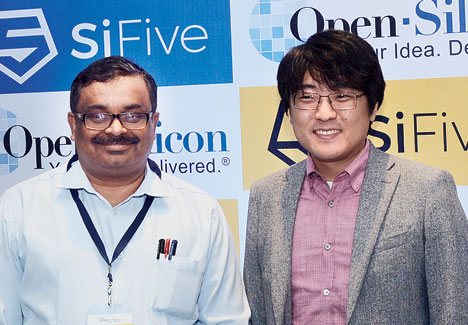
IIT Kharagpur director Partha Pratim Chakrabarti with Yunsup Lee, co-founder and chief technology officer, SiFive. Picture by Bishwarup Dutta

Calcutta:

IIT Kharagpur is exploring the possibility of using a platform developed by a group of researchers at the University of California, Berkeley, that can be freely used for designing semiconductor chips.

In the foreseeable future, Digital India will need application-specific chips in every conceivable domain but today only a handful of companies have the ability to design integrated circuits (IC).

Inspired by the success of open source software, SiFive, a US-based company, aims to change the ecosystem of chip design by promoting OpenSilicon – a platform where pre-designed open source components can be stitched together to design customised ICs.

The OpenSilicon platform already provides the open source RISC-V processor developed by the researchers at UC Berkeley.

Recently, SiFive hosted an academic symposium at a city hotel, where cost-effective ways to design and fabricate semiconductor chips were discussed threadbare. The symposium was attended by professors from IIT Kharagpur.

Later, the academics explained the significance of the conclave.
Designing semiconductor chips require sophisticated and expensive software tools or CAD tools and years of experience. Chip fabrication costs are astronomical. For any start-up that wants to get into custom chip designing, the costs and skill requirements are difficult to overcome.

“It is a promising initiative. Offering open source pre-designed components through a cloud-based design framework has the potential to bring down the design cost. Also, bundling multiple custom ICs in a single fabrication cycle can help in sharing the fabrication costs among the partners,” said Pallab Dasgupta, dean, Sponsored Research and Industrial Consultancy, IIT Khargpur.

Dasgupta is also a professor in the department of computer science and engineering with years of experience in electronic design automation.

The IIT has an advanced chip design laboratory since 2000, which has successfully designed and tested more than 100 chips with its fabrication partners. It carries out research for top global semiconductor and EDA companies.

SiFive is aiming to let more start-ups use its platform to minimise the cost of developing semiconductor chips and rid the chip design industry of the proprietary regime of a handful of wealthy companies, said Yunsup Lee, co-founder and chief technology officer (CTO) of SiFive.

“India is home to some of best research and educational institutions in the world. We are honoured to host presentations from the academic luminaries who are on the frontlines of innovation and research in the areas of machine learning, hardware verification, circuit design and more,” said Yunsup, who delivered a lecture at the symposium.

When Metro asked him to explain what prompted the company to hit upon the concept of looking beyond the proprietary regime, Yunsup, who has done his PhD from UC Berkeley, where he co-designed the RISC-V ISA and the first RISC-V microprocessors with Andrew Waterman, said: “At the University of California, Berkeley, we believe in taking the technology to a larger pool of users so the technology can do greater good. This was developed during our student days. With this motto in mind, we are touring 20 cities across the globe to popularise the concept.”

IIT Kharagpur director Partha Pratim Chakrabarti, who attended the session, said: “The concept they have floated is innovative. We are holding talks about a tie-up that the company has proposed.”

source: http://www.telegraphindia.com / The Telegraph,Calcutta,India / Home> Calcutta / by Subhankar Chowdhury / September 14th, 2018

Squash wins back its star, India gets medal

Calcutta boy’s sport-or-job battle

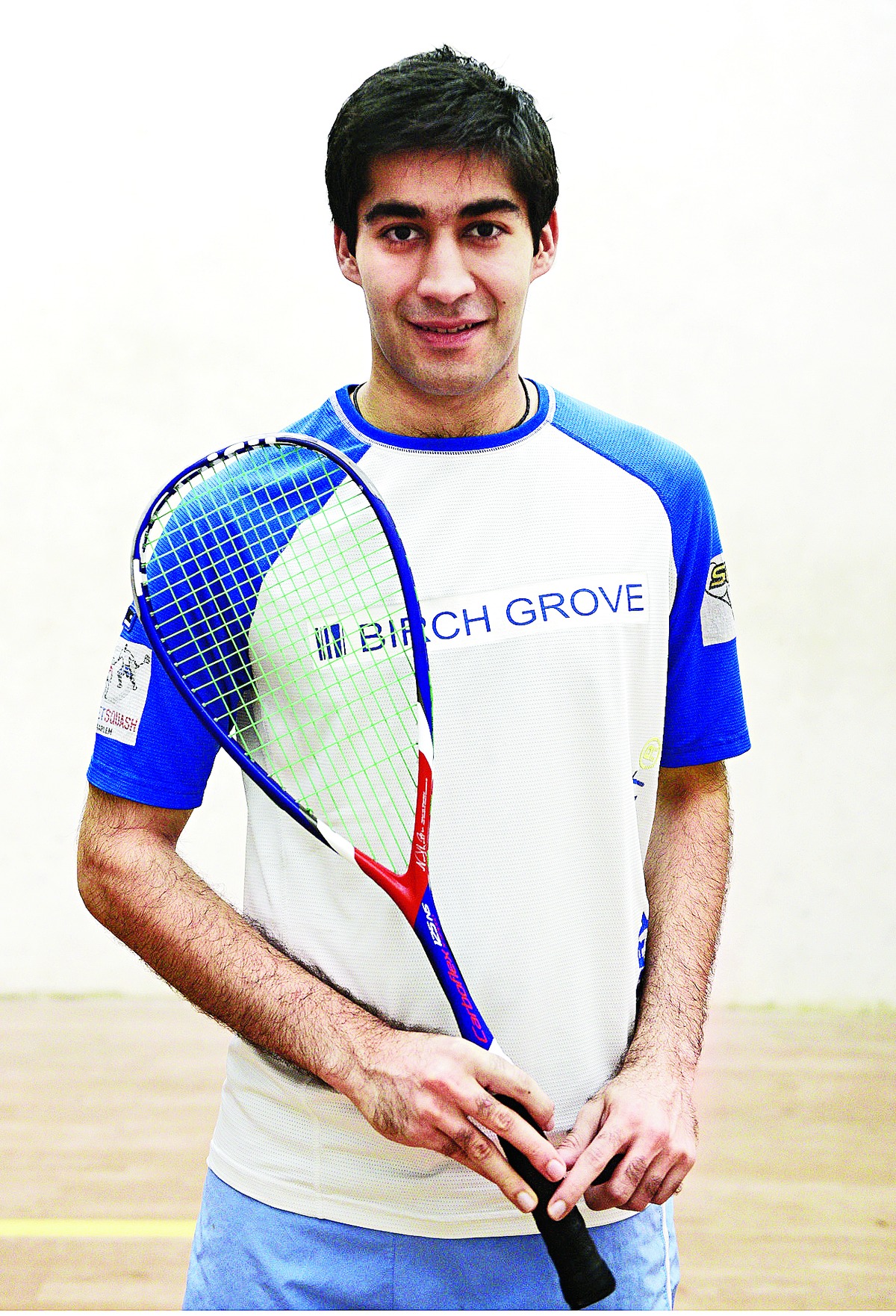
Ramit Tandon at Saturday Club on Monday.
Picture by Gautam Bose

Calcutta:

Ramit Tandon’s journey from La Martiniere for Boys in Calcutta to the winners’ podium at the 2018 Asian Games hasn’t followed the usual curve of sporting success achieved through sweat and the sacrifice of myriad other ambitions.

The 26-year-old, who also studied at Columbia University, was till a year ago analysing equity and debt markets sitting in the New York office of a hedge fund. Squash remained his passion, but primarily as a leisure activity.

Last Friday, Ramit won an Asian Games bronze in Jakarta along with teammates Saurav Ghosal, Harinder Pal Singh Sandhu and Mahesh Mangaonkar, all three of them regulars in the competition circuit.

Ramit had quit his job in New York to turn pro only last November. His Professional Squash Association (PSA) ranking then was above 600. Over the next few months, he won two PSA titles to break into the top 60, good enough to earn him a spot in the Indian team for the Asian Games.

“I used to badly miss being in competitive squash. The travelling, the pressure (to perform), the adrenaline rush and, of course, the honour of representing the country,” Ramit told Metro at the Saturday Club, where he hits a ball or two whenever he is in town.

At the Asian Games, Ramit won all but one of his matches. He counts his performance against Qatar in a crunch match in the group stage as his personal favourite. He did not play a match in the semifinal against Hong Kong because the two players before him had lost theirs, making the rest of the contest inconsequential.

While the gold medal eluded India, Ramit sees the bronze as a vindication of his decision to become a squash pro.

So, what made him finally choose squash over a shirt-and-tie career? “Hedge funds require balancing risk and return. I thought it was time I did it for myself instead of clients,” he said. “I was earning well. I had to factor in so many things, including the possibility of a comeback to my earlier career if I failed in squash.”

As a student, Ramit had been regarded as a promising player in the junior circuit. Between 2001 and 2011, Ramit had won a string of national championships in successive age groups. He was the captain of the India Under-19 team that won a gold medal in the Asian Junior Championships in Sri Lanka in 2011.

But studies won the competition when it came to choosing a career. “I had had a decent schooling. When I got a chance to study at Columbia University, I did not want to let go of it. After my graduation in statistics, I got an analyst’s job with Birch Grove,” he recalled.

Now that squash has won back what it lost, Ramit intends to be loyal to the sport. And nobody’s complaining.

source: http://www.telegraphindia.com / The Telegraph,Calcutta,India / Home> Calcutta / by Debraj Mitra / September 04th, 2018

Kolkata revives the romance of the Raj

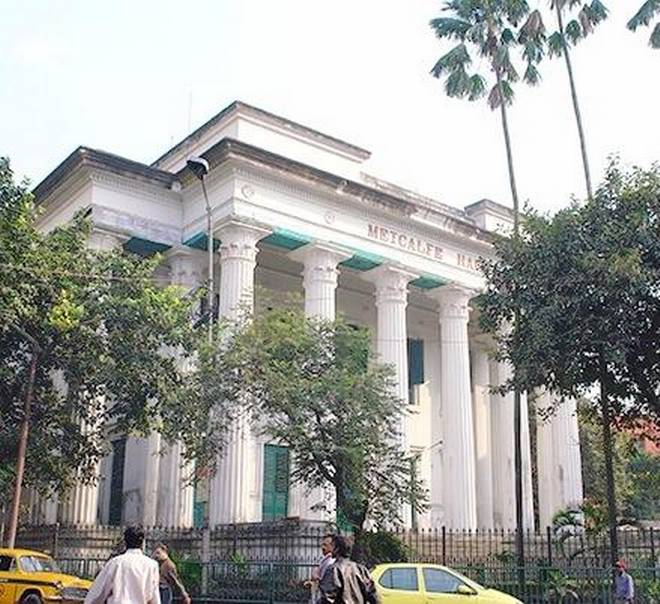
From another time: Metcalfe Hall, at left, and Currency Building are set to host exhibitions. | Photo Credit: The Hindu

Two colonial-era buildings to get a new lease of life as hubs of art and culture

Two of Kolkata’s oldest colonial buildings, Currency Building and Metcalfe Hall, both built in the 19th century, will soon become museums and galleries showcasing art and urban history.

The three-storied Currency Building in Dalhousie Square was built in 1833. Designed in the Italian style with Venetian windows and cast iron gates, its vaults and strong room once housed some of India’s oldest banks, including Agra Bank and the Reserve Bank of India.

But now the western wing is all set to become the office of the National Gallery of Modern Art (NGMA). Once the NGMA moves in, the Currency Building will host an exhibition of sketches and sculptures by Ramkinkar Baij, a pioneer of modern Indian sculpture.

“We are expecting that a portion of the Currency Building will be handed over to us by September. There are plans to have a large exhibition on Ramkinkar Baij,” said Adwaita Gadanayak, director general of NGMA.

Archaeologists say the Currency Building was not a mint but a place where currency was kept. Till 1937, it was occupied by the RBI, after which it fell into neglect. Its central dome collapsed later. The Archaeological Survey of India (ASI) took over its upkeep in 2005.

Barely 200 m away is Metcalfe Hall, with 30 Corinthian pillars built between 1840-1844. Located at the junction of Strand Road and Hare Street, it draws its name from Lord Metcalfe, the Governor General of India in 1835-36. It is in this structure that the city’s history will come alive as the ‘Calcutta to Kolkata’ exhibition.

Renovation dilemma

The ASI grappled with the question whether to rebuild the Currency Building’s dome, but decided to keep the existing structure.

In Metcalfe Hall, it shifted one lakh books for repair work. “The exhibitions will bring them back to life,” said G. Maheswari, Superintend- ing Archaeologist, ASI, Kolkata circle.

source: http://www.thehindu.com / The Hindu / Home> News> States> Other States / by Shiv Sahay Singh / Kolkata – September 02nd, 2018

Telugus rejoice 1000 full moons in city

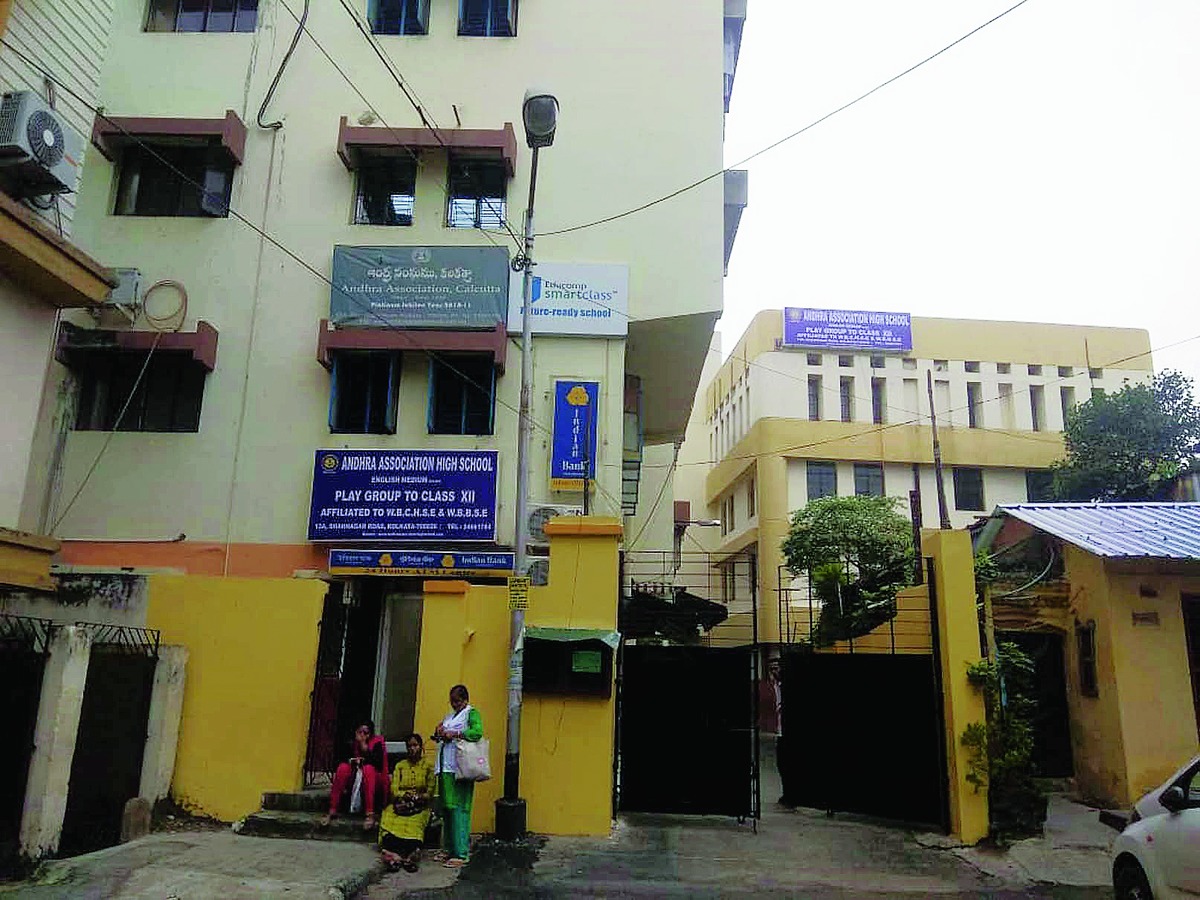
The Andhra Association Calcutta, which houses the Andhra Association High School

Calcutta:

An association for Telugus in Calcutta, formed in 1936, is celebrating its existence for 1,000 full moons according to the Telugu calendar, an occasion known as Sahasra Purna Chandrodaya.

The Andhra Association Calcutta was set up to give Telugus a feeling of home away from home.

Sahasra Purna Chandrodaya is an occasion Telugus celebrate if they see 1,000 moons in a lifetime, an association official said.

“Our association has completed 1,000 full moons and we will celebrate the occasion. For us Telugus, seeing 1,000 full moons is an auspicious occasion,” Srinivas Vedula, president of the association, said.

“In Telugu families anyone living for 1,000 full moons thinks it to be a new life. If one’s spouse is alive, partners exchange garlands like a second wedding.”

Established in September 1936, the Andhra Association Calcutta is now 81 years old. The difference in food, culture and language prompted Telugus in the city to form the association.

Vadlamani Venkatesham Pantulu, an engineer working in Port Trust, had set up the association.

President Vedula said several Telugus approached Pantulu after which the engineer took a place on rent in Bhowanipore and turned it into a hostel for Telugus. “Here, people used to get food cooked the way they would get at home. Besides, interacting with fellow Telugus gave them a feeling of home.”

Even now the association directs people who approach them to places where they can get Telugu food or people. Yet at the same time, members mingle with people from other states so that they don’t remain exclusive without any contact with people from other cultures, Vedula said.

“During cultural programmes, we have Rabindrasangeet as well,” an association member said.

There are about 100,000 Telugus in Calcutta and a large number of them working in the IT sector in Salt Lake and New Town.

Andhra Pradesh has been split into two states but people from both Telangana and Andhra Pradesh are members of the association. “It’s an association of Telugu people and not of people from a state,” Vedula said.

The current building that houses the association’s office on Pratapaditya Road has the Andhra Association High School, where Telugus are a minority. “We have about 1,000 students and about a dozen of them are Telugus,” a member said.

source: http://www.telegraphindia.com / The Telegraph,Calcutta,India / Home> Calcutta / by Subhajoy Roy / September 03rd, 2018

Taste a cuppa of tea tales

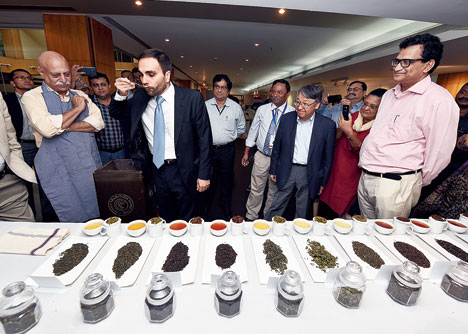
French consul general Damien Syed has a go at the tea tasting session. Pictures by Sanjoy Chattopadhyaya

A beverage made from the first harvest of a garden is light and delicate. A few months later, the second harvest from the same garden lends a rich musky character to the drink. The two are like youth and wisdom.

Calcutta:

Tea tales brewed at a tasting session for the champagne of Darjeeling on Friday.

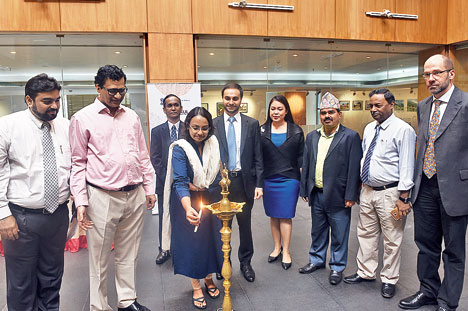
Kajari Biswas, director of the Indian external affairs ministry’s branch secretariat in the city, lights the inaugural lamp at ICCR on Friday

Foreign envoys were shown how to make the “right slurp” – and forget manners for a moment – to realise all the flavours, each independent of the other, at the same time.

India’s favourite drink has a centuries-old heritage. The tea industry creates maximum sustainable livelihood in Darjeeling and is steeped in the local history of the hills.

“Since the time the British first planted tea saplings in the Darjeeling area way back in the early 1800s, tea has become synonymous with the art, culture, lifestyle and economic ecosystem of the people around the tea gardens,” said Samrat Chowdhury, the chief mentor of BAUL (Bespoken Architectural and Unique Legacies of Bengal), which hosted the Chiabari Festival at ICCR, with the external affairs ministry and Chamong Chiabari Tea Resorts.

There are more than 80 tea gardens in the hills of north Bengal. The Darjeeling tea industry employs 55,000-odd workers and some five lakh people are dependent on the industry.

Arijit Raha, the secretary general of the Indian Tea Association, gave an overview of the Indian tea industry. The stagnation in auction price over the past few years and climate change were some of the challenges before the industry, he said. “There is an urgent need to check unfettered expansion as well.”

Krishan Katyal, chairman and MD of auctioneer J Thomas, at the event

Krishan Katyal, the chairman and managing director of auctioneer J Thomas, said the beauty of Darjeeling tea was in the distinct difference in flavours of the drink made from the leaves of the same garden in two different seasons.

“During the first flush in spring, the leaves are fresh and green like new shoots. The liquor is a beautiful, clear, light and delicate. The leaves of the same garden during the second flush in summer are of a completely different texture – thicker, heavier and more succulent. The tea is richer, with a ruby red colour and a depth and mellowness,” said Katyal. “It is hard to choose one. The two flavours are like youth and wisdom.”

The consuls general of France and Japan were among those at the event along with Kajari Biswas, the head of the Indian external affairs ministry’s branch secretariat in the city.

During a tea tasting session, Ajay Kichlu, the director of the Chamong Group, invited Damien Syed, the French consul general, to the table.

When Syed kept sipping the tea, Kichlu and Katyal asked him to slurp in a spoonful and let it roll in his tongue. The reason – a sip allows just one composite taste, while a slurp allows a jet of the liquor to enter the mouth, activating all the taste buds simultaneously. “The composite taste is dissected into specific compartments and each one of them is felt independently,” Kichlu said. Syed got it right the next time.

The programme included discussions on the prospect of tea tourism and the way forward for attracting foreign visitors. “We are trying to make India a 365-days-a-year destination. Niche offerings like tea tourism would play a key role in that,” said J.P. Shaw, the regional director of India Tourism in Calcutta.

P.K. Bhattacharya, the secretary general of the Tea Association of India, said 11 new tea estate proposals are pending with the government. “A couple would be approved soon.”

source: http://www.telegraphindia.com / The Telegraph,Calcutta,India / Home> Calcutta / by Debraj Mitra / August 04th, 2018

Trophy for hill Cup colours

A decorated street at Bara Kak Jhora in the Darjeeling hills that bagged the award

Darjeeling:

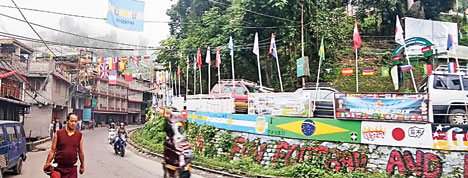
In the “World Cup Town” of Darjeeling, BKJ (Bara Kak Jhora) United Club on Sunday lifted the “trophy” hours before the biggest football tournament’s grand finale kicked off.

BKJ United Club bagged the prize for the most beautifully decorated Darjeeling area during the month-long Fifa carnival.

The Darjeeling North Point School Alumni Association (DNPSAA) handed over a replica of the Fifa World Cup to BKJ United Club.

“On June 2, we had organised an outreach programme to raise funds for a Father Van Memorial Clinic on Wheels. Thousands participated in the football parade where we had christened our hometown.

‘The World Cup Town’. BKJ United Club has bagged the award,” association chief Deven Gurung said. Father Van was a former rector of North Point.

During the event, which featured various entertainment shows, it had also been decided that the best decorated area with the World Cup theme in Darjeeling town would be awarded hours before the final begins in Moscow.

The team inspected several places like Aloobari, J.P. Sharma Path, Employment Exchange area, Nimki Dara, but found Bara Kak Jhora different.

“The place (Bara Kak Jhora) was not only beautifully decorated but was also unique in the sense that it was informative,” Gurung said.

Apart from detailing the history of the World Cup and putting up theme works on “Pele to Platini, Zico to Ruud Gullit”, the club had made a special display of Sunil Chhetri for being among the highest scores of international goals.

“We appreciate the fact that they had a corner for the ’60’s legendary players of Darjeeling’ and put up photographs of famous footballers from the region like Chandan Singh Raut, who was part of the India’s football team, Benu Subba, Avay Gurung, KrishDewan, Raju Rai, Kapil Thapa and Shyam Thapa. All of them have made us proud,” said Gurung.

The St. Joseph’s School alumni association announced that the ambulance, for the clinic on wheels, has been booked and will arrive soon. The vehicle, fitted with a slew of equipment, will be sent to remote areas for free medical check-ups.

source: http://www.telegraphindia.com / The Telegraph,Calcutta,India / Home> West Bengal / by Vivek Chhetri / July 16th, 2018

Practice, chance and peace

From left) Filmmaker Suman Mukhopadhyay; BN Ramesh, additional director general and inspector general of police, West Bengal Human Rights Commission; Vishesh Gupta, the chairperson of Bharat Soka Gakkai; former Prasar Bharati CEO Jawhar Sircar; dancer Alokananda Roy and Rashi Ahuja, director and head of external relations, Bharat Soka Gakkai at the conference at Science City on Saturday. Picture by Bishwarup Dutta

Science City:

For 36 years, a Japanese man has been writing and sending a peace proposal to the United Nations. Even at 90, Daisaku Ikeda stays committed to his life-long effort to steer the world away from conflicts and build a humanistic society. He has managed to spread his belief across 192 countries, including India, through the Buddhist society of Soka Gakkai that he leads.

The Soka education system, rooted in the society’s values, encompasses kindergartens in six countries, elementary to graduate level schools in Japan and a liberal arts university in California. Born to a family of seaweed farmers, the Buddhist philosopher and peacemaker has also founded an art museum, a music concert association and institutes for peace and policy research in Japan and the US.

The organisation’s India arm Bharat SokaGakkai held a conference on Ikeda’s 36th peace proposal at Science City on Saturday. “Soka means value creation. There is a lot of synergy between our values and the UN’s agenda,” said Vishesh Gupta, the chairperson of Bharat Soka Gakkai.

The guests were welcomed by volunteers clapping in rhythmic unison.

“Art can’t teach anyone anything. It only makes the human soul receptive to the good. Neither does artistic vision fall from the sky. It is the result of practice,” said filmmaker Suman Mukhopadhyay. He went on to talk of the issues he has addressed through his work on the stage and in films. He is planning a film on Kashmir, titled Paradise in Flames.

Dancer Alokananda Roy shared her experience of working with prisoners. “When I walked into a prison, I did not expect to meet people with heart. But if you treat them as human, they also feel human. I have worked with juvenile offenders, too, who are traumatised by society’s finger-pointing.They made a mistake. It’s fair to give them a second chance,” she argued. Her new students, however, have not made any mistake. They are transgenders. “They do not deserve to be cast aside.”

B.N. Ramesh, additional director general and inspector general of police, West Bengal Human Rights Commission, spoke of his experience of tackling insurgency-hit states across the country and people he met along the way, like an 11-year-old stone pelter in Kashmir.

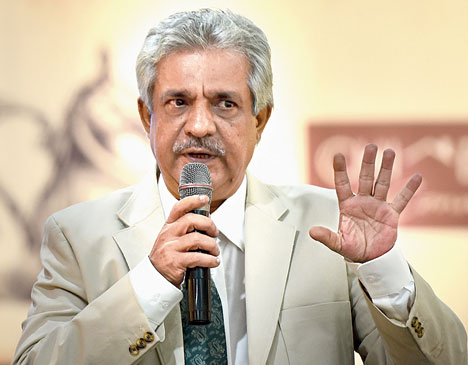
Former Prasar Bharati CEO Jawhar Sircar shared his experience of attending three Unesco conventions. On the agenda was restitution of cultural property, i.e. the question of returning cultural artefacts plundered from another nation. “Management of peace at the kitchen level calls for patience,” he said.

Using the acronym VUCA coined by the US army, which stands for volatility, uncertainty, complexity and ambiguity, he said: “That’s the world we face. Is peace worth discussing in such a world? But man’s capacity to destroy is equalled only by his capacity to save.”

He cited the genesis of a cross-cultural signal – the salutation. “When strangers met in the medieval times, it was customary to delink the right hand from the body to indicate that no weapon would be used. Warriors would also raise their visors to reveal their identity. The gesture was stylised over time.”

Sircar also mentioned the phenomenon of Mexican wave in sports stadiums. “It proves that there is dormant in man a capacity to act in unison, rising above identity and ideology thrust upon him,” he said.

source: http://www.telegraphindia.com / The Telegraph,Calcutta,India / Home> Calcutta / by Sudeshna Banerjee / July 16th, 2018