Category Archives: Records, All

Railway heritage by Hooghly

The highlight of a railway heritage walk was the residence of the GM of South Eastern Railway that was once occupied by Wajid Ali Shah, the last ruler of Awadh
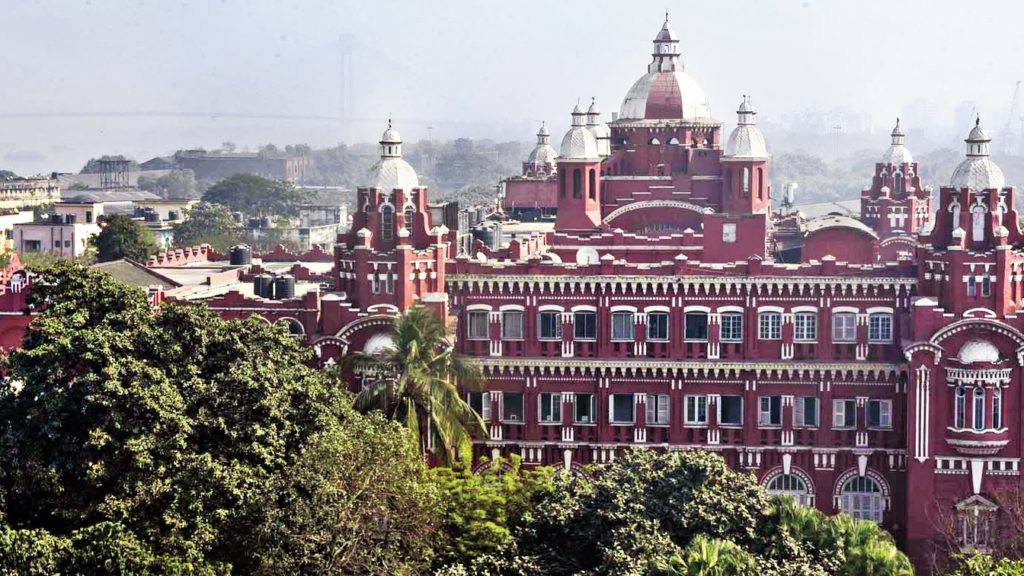

The headquarters of South Eastern Railway.

A white edifice overlooking the Hooghly in Garden Reach was built by the British in 1846, the architecture inspired by the Tower of the Winds in Athens.

The building, the highlight of a heritage walk on Saturday morning, was for a few years the home of Wajid Ali Shah, the last ruler of Awadh who was exiled to Calcutta.

But the first occupant of the home was Lawrence Peel, the chief justice of British India. He was the cousin of Robert Peel, two-time Prime Minister of England and one of the founding fathers of the Conservative Party.

The walk began at the South Eastern Railway headquarters in Garden Reach and culminated at the BNR (Bengal Nagpur Railway) House, the official name of the white bungalow that now serves as the residence of the general manager of South Eastern Railway.

“Fascinating titbits of colonial history is nested in every corner of the buildings in this area,” said Samrat Chowdhury, chief mentor of BAUL (Bespoken Architectural and Unique Legacies of Bengal), which organised the walk in association with the external affairs ministry and the railways.
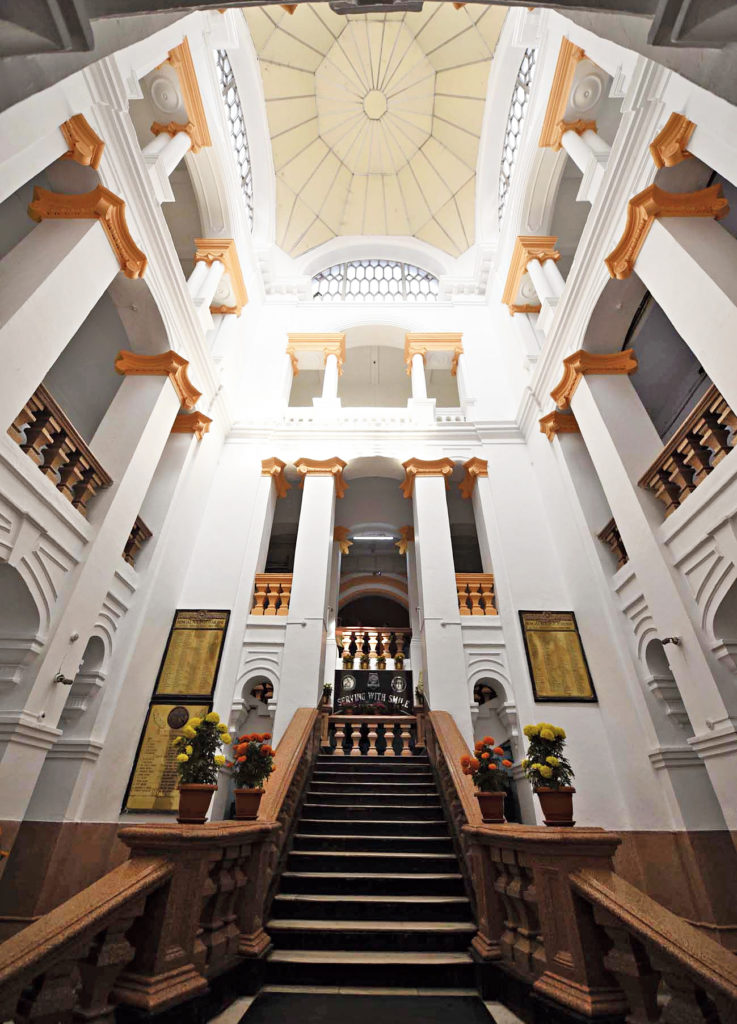

The inside of the building. The dome on top conceals water tanks
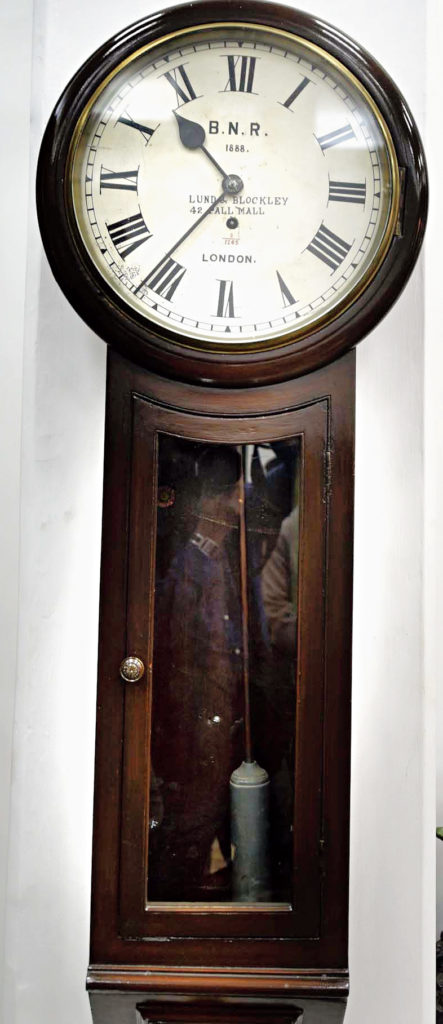
A clock made in London in 1888 inside the general manager’s office

The headquarters of South Eastern Railway (erstwhile Bengal Nagpur Railway) is a majestic red brick building with domes.

“The architecture is Indo Saracenic, also found in Madras High Court and Lucknow railway station. The red brick structure is occasionally relieved by stone terracotta. The western design is embedded with Indian features such as domes,” said J.K. Saha, chief heritage officer of South Eastern Railway, who guided the participants in the walk.

The construction of the building — spanning over 53,000sq ft — started in April 1906 and was completed in May 1907, a pointer to British engineering efficiency.

Several things have been left unchanged for over a 100 years, including the cast iron-Burma teak staircase to the glass door that leads to the general manager’s cabin. “The building has not needed any structural alterations,” said Saha.

Apart from railway officials and heritage enthusiasts, people from various walks of life took part in the walk on Saturday. Janavi Sanon, a 24-year-old architect, was one of them.

“This is my second railway heritage walk. As a student of design, this is an exciting journey. The history behind all these buildings makes it doubly interesting,” she said.

The deputy high commissioner of Bangladesh, Toufique Hasan, was a participant.

One of the main attractions was a newly opened heritage gallery at the railway office. A 119-year-old Schiedmayer piano was a key draw in the gallery.

Made in Stuttgart, the instrument was shipped to India in 1900. “It is difficult to say who brought it and who played it in Calcutta but it is vintage stuff and would fetch at least a crore in the antique market,” said Saibal Bose, senior railway engineer who has done extensive research on railway history.
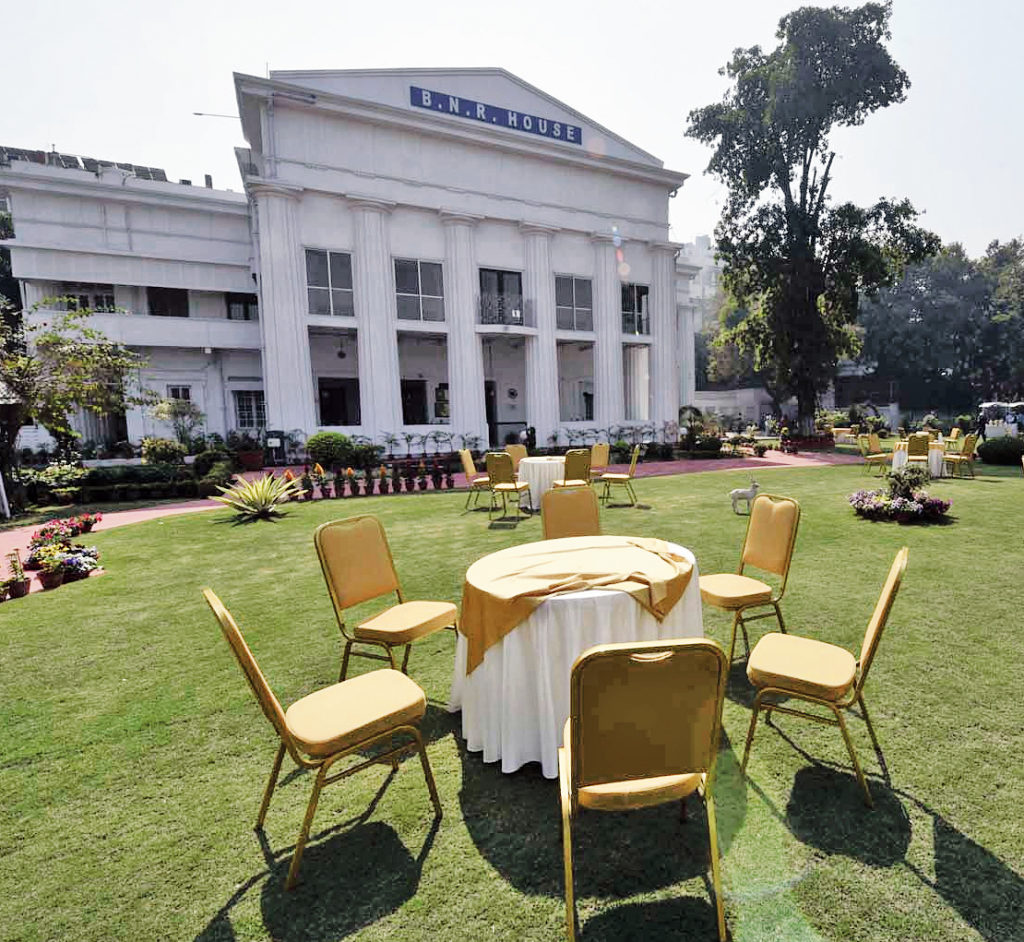

The BNR House that was home to Wajid Ali Shah for a few years / Pictures by Sanjoy Chattopadhyaya

A feedback from Netaji Subhas Chandra Bose in a complaint book of a railway refreshment stall at Muri station, now in Jharkhand, is there on one of the shelves.

A cabinet is dedicated to shells made by the Kharagpur railway workshop of BNR during World War I and II. Resting beside the shells is a large splinter that was inside a bomb dropped by the Japanese in Garden Reach during World War II.

“People of the country need to know about this heritage. I want more and more schoolchildren and youngsters visiting these areas,” said Kajari Biswas, head of the external affairs ministry’s branch secretariat in the city.

Saha also explained why the area was called Garden Reach.

A reach is a length of a stream or river, usually suggesting a level, uninterrupted stretch. There is one such reach in the backyard of the headquarters. The botanical garden sits on the opposite bank.

“The reach and the garden gave this name,” Saha said.

In December, BAUL had organised a similar heritage walk around Howrah station. “We want to bring the railway heritage sites within the ambit of tourism. Ideally, there should be a single-window system that takes care of a guided tour of all these places. There is tremendous tourism potential here,” said Chowdhury.

source: http://www.telegraphindia.com / The Telegraph, Online edition / Home> Heritage / by Debraj Mitra in Calcutta / February 03rd, 2019
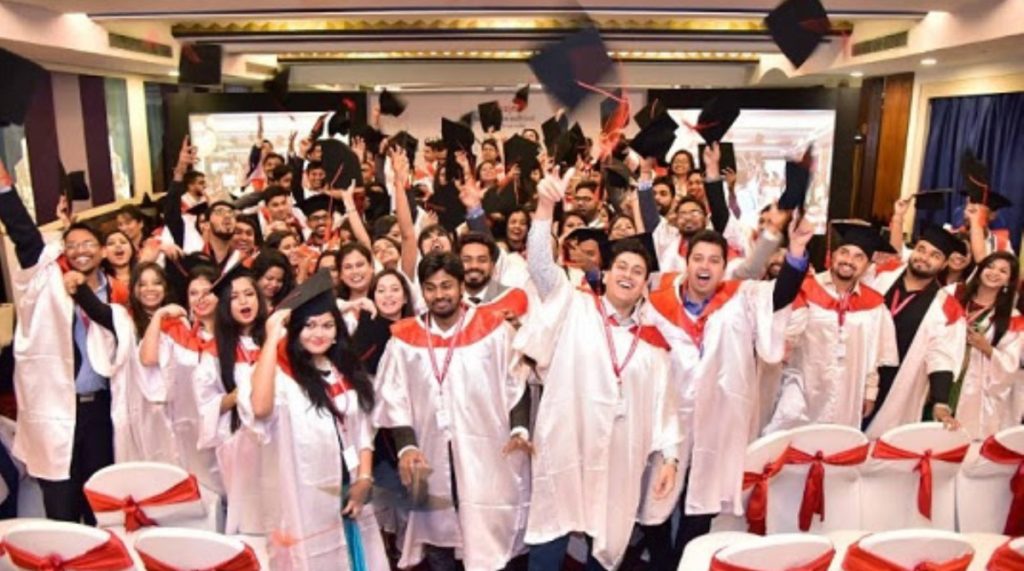
Globsyn Business School conducted its 15th Annual Convocation at The Park, Kolkata

The 15th Annual Convocation of Globsyn Business School was conducted on February 17 at The Park, Kolkata. Over 120 students from Globsyn Business School’s postgraduate management programmes were felicitated at the event. The Convocation included the parents of the students graduating from GBS and the alumni.

Shri (Dr.) M.V. Rao, I.A.S., Addl. Chief Secretary, Panchayat and Rural Development, Govt. of West Bengal addressed the gathering and was the Chief Guest of the event. Shri Arun K. Chandra, Managing Director, PC Chandra Group also graced the occasion and addressed the Convocation as the Guest-in-Chief.

Shri Bikram Dasgupta, Founder & Executive Chairman, Globsyn Group, conferred diplomas to the students. While addressing the gathering, he said, “With a journey of over 20 years encompassing education, technology, skill development and infrastructure, Globsyn Group is now focused at evolving GBS into a global B-School with an education edifice that promotes Innovation, Research and Technology. Exciting times are awaiting the students, alumni, corporates and other stakeholders of GBS with the Group now focusing on emerging technologies as a way of life. I congratulate the students graduating today and wish them all the best for their ambitious career.”

Globsyn Business School recognised the contributions of several of their student-volunteers who are a part of the Kalyani Youth Leadership Forum. Their members undertake the B-School’s ‘care for society’ initiatives implemented under the aegis of Kalyani – a Bikram Dasgupta Foundation.

The 15th Annual Convocation also marked Globsyn Business School as the first AICTE approved B-School in India to use Blockchain technology to issue diplomas. The rollout of the diplomas on Blockchain will allow the students and their prospective employers to access the diploma credentials from any geographical location, without any need to send or present physical certificates.

Enhancing on the technology-connect of the B-School, Rahul Dasgupta, Director, Globsyn Business School said, “Globsyn Business School was started in 2002 with a vision to create industry-ready managers for the technology-driven knowledge economy. Having been promoted by Globsyn with deep roots in IT hardware, training and fulfilment, GBS uses technology-enabled platforms and systems in all its operations and processes. With Globsyn now looking at Blockchain, Artificial Intelligence, Machine Learning, Data Analytics and Internet of Things as an area of focus, the students of our B-School can only expect greater dependence on these emerging technologies to further improve the academic delivery process.”

source: http://www.thestatesman.com / The Statesman / Home> Books & Education / by SNS Website / New Delhi / February 18th, 2019

In Version 2.0, Kolkata’s iconic Metro cinema is a ‘filmi store’


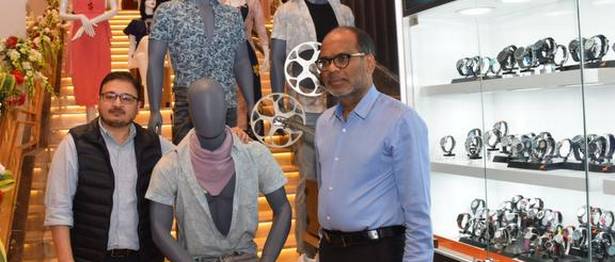
Future Lifestyle Fashions CEO Vishnu Prasad (right) and Future Retail CEO-East Zone Manish Agarwal   –  Debasish Bhaduri

It was in 1934 that American film production company Metro-Goldwyn-Mayer decided to set up a cinema hall in Calcutta to promote its films. The hall was inaugurated in 1935. Famous as an elite British city, the then Calcutta was a large market for Hollywood films.

Eighty-five years later, the iconic cinema hall on Chowringhee Road has made way for Future Group’s first ever movie themed ‘Central’ store.

The fashion and lifestyle retail store will play old Hollywood, Hindi and Bengali hits. These classics were big draws at the ‘Metro cinema’. The screenings are likely to start in April.

According to Vishnu Prasad, CEO, Future Lifestyle Fashions (which owns Central), the company is preparing a list of classics that have been screened. Plans are afoot to bring in the yesteryear stars who featured in these films. Over each week, a film will be played.

First thematic store

“This will be our first thematic store. In fact, Metro Central will be a filmi store. Going forward we may look to host theme-based movie screenings at the store. The idea is to bring alive a lost heritage of the city,” Prasad told BusinessLine.

Metro Central, as it is called, is expected to rake in ₹100 crore by FY20 with apparel sales accounting for nearly 70 per cent of it.

Down memory lane

Metro Cinema’s distinctive art deco structure has, over the years, defined the culture of the city. Initially, it screened only films produced by MGM. Gradually, Hollywood films made way for Hindi cinema and an occasional Bengali film.

The two-storied structure was designed by Thomas Lamb, a Scottish architect settled in the US who built several movie theatres around the world. MGM commissioned him to build two theatres in India. Metro Calcutta’s famous cousin in Mumbai was built in 1938.

Prasad points out that “special care” was taken at the time of renovation so that the art-deco façade, waterfall-style columns and grand staircase within were retained. The company has spent ₹22-25 crore on renovating the heritage structure that will have 55,000 sq ft of space.

Sources say the group had held talks for the renovation and reuse of Grace cinema, too, but issues such as structural stability of the building put things on the backburner.

source: http://www.thehindubusinessline.com / Business Line / Home> Variety / by Abhishek Law / Kolkata / February 15th, 2019

Minto stops at ancestor’s home

A flesh-and-blood Minto and his wife were in Calcutta on Saturday, retracing the steps of his ancestors who lived here over a century ago


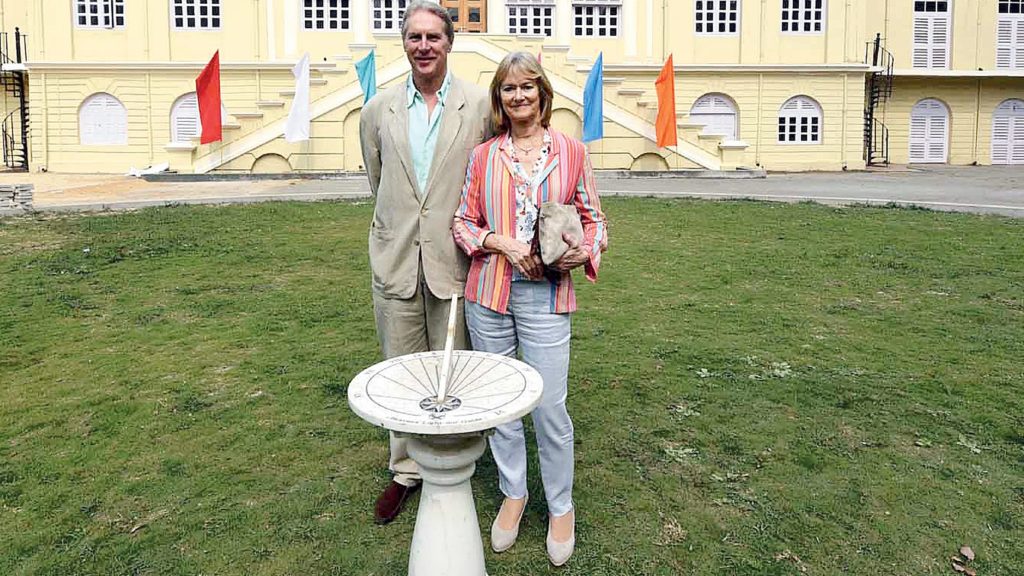
Gilbert Timothy George Lariston Elliot-Murray-Kynynmound, the seventh Earl of Minto, with his wife Diana Barbara Trafford in front of the Old Government House in Barrackpore on Saturday. / Pradip Sanyal

Minto, to most Calcuttans, is a bus stop scrawled in black on an yellow band across the sides of ramshackle minibuses. For some, it is the patch of green in front of Belle Vue Clinic named after the governor general of India.

But a flesh-and-blood Minto and his wife were in Calcutta on Saturday, retracing the steps of his ancestors who lived here over a century ago.

Gilbert Timothy George Lariston Elliot-Murray-Kynynmound, the seventh Earl of Minto, visited the summer residence of the governors general of India where the first Earl of Minto (governor general of India, 1807-1813) and the fourth Earl of Minto (governor general and viceroy of India, 1905-1910) are said to have spent many a happy weekend, “arriving on Fridays and leaving only on Monday mornings”.

“I can absolutely see why they built the summer residence right next to the river. It gives a real atmosphere of India, and I just spent a magical time there,” Minto told Metro after touring the Old Government House in Barrackpore.

“The entire purpose of this time was to visit Calcutta,” said Minto, on his second visit to India but “the very first to Calcutta”. He is scheduled to travel to Goa and Hyderabad before leaving for London.

Minto’s earlier stops in the city included Victoria Memorial Hall and the Raj Bhavan, where he saw a photograph of Lord Minto’s appointment as governor general in 1807.

“There was a lot of talk about India at home and the country was remembered with much affection,” said the current Lord Minto, pausing before his ancestor’s statue on horseback at Latbagan. “My great grandparents made many good friends in India and were in touch with them all their lives.”

With Minto on this trip are his wife Diana Barbara Trafford and author and family friend Anabel Loyd.

“The Government House designed by Captain Thomas Anbury in 1813 was used as a country residence for the British Governor-Generals,” according to the British Library online gallery.


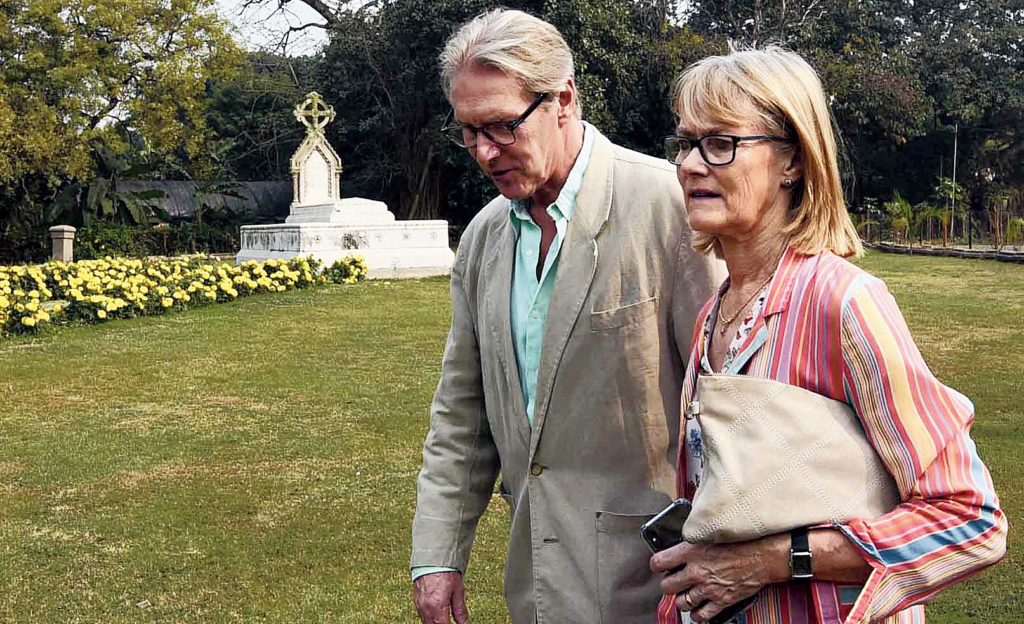
Lord and Lady Minto at (in the background) Lady Canning’s tomb. / Pradip Sanyal


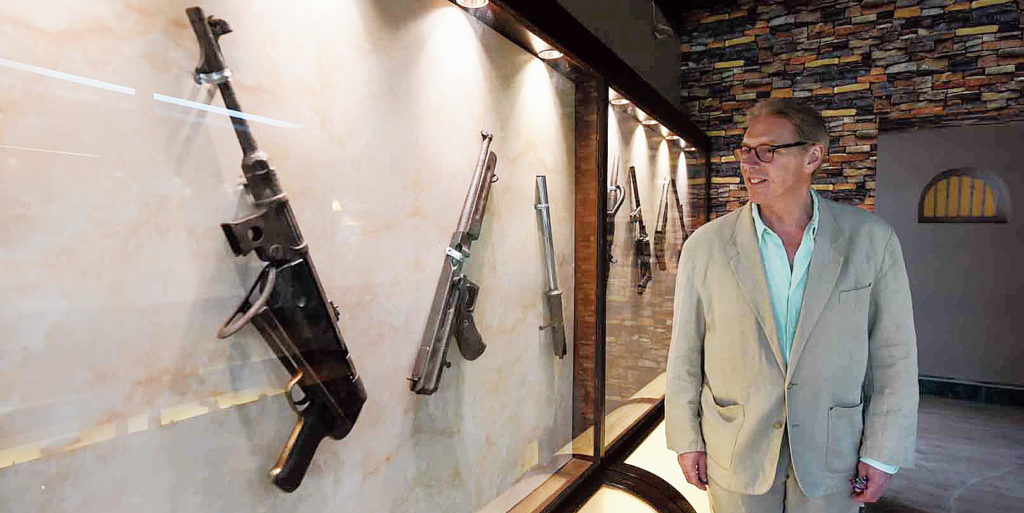
The present Lord Minto in the Westside Gallery where seized arms from the pre-and post-Independence era are displayed. / Pradip Sanyal

Lord Wellesley, who took over the commander-in-chief’s residence in 1801 in Barrackpore, commenced the building of a summer residence for the future governors general of India. He got the gardens landscaped in “English style” and added an aviary and a menagerie, both of which are in a shambles. However, only the first storey was built before Wellesley was recalled to England.

Wellesley’s dream house was added to and expanded in bits and parts by the governors general who lived there. Sir George Barlow, acting governor general, converted each corner of the verandah into a small room. In 1814-15, the building was expanded by the Marquis of Hastings who added a new storey, side wings, a portico and the Upper Entrance Hall. Lord Auckland (1835-1842) added the balcony on the western side, Lord Lytton (1876-1880) replaced the unseemly iron staircase on the southern front, Lord Ripon (1886-1884) installed a wooden porch in front while Lord Minto (1905-1910) electrified the building, laid the floor in the drawing room and redecorated the house.

The house was taken over by the Bengal government and turned into a police academy and police hospital in 1948. The hospital was later shifted out.

The current renovation and conservation of Old Government House, now Swami Vivekananda State Police Academy, has been undertaken at the initiative of Soumen Mitra, the additional director-general of police (training). “Work is on, it will take a long time to finish,” said Mitra, as he took the Mintos around.

Strolling through the lofty rooms, both the Lord and the Lady marvelled at the architecture and the ventilators that naturally cooled the rooms with the river breeze passing through the shafts and lofty windows. They were accompanied by G.M. Kapur of Intach.

Barrackpore, a cantonment area, was built at the bend of the Hooghly river, 20km north of Calcutta, and offered a splendid vista, making it the perfect “weekend retreat”.

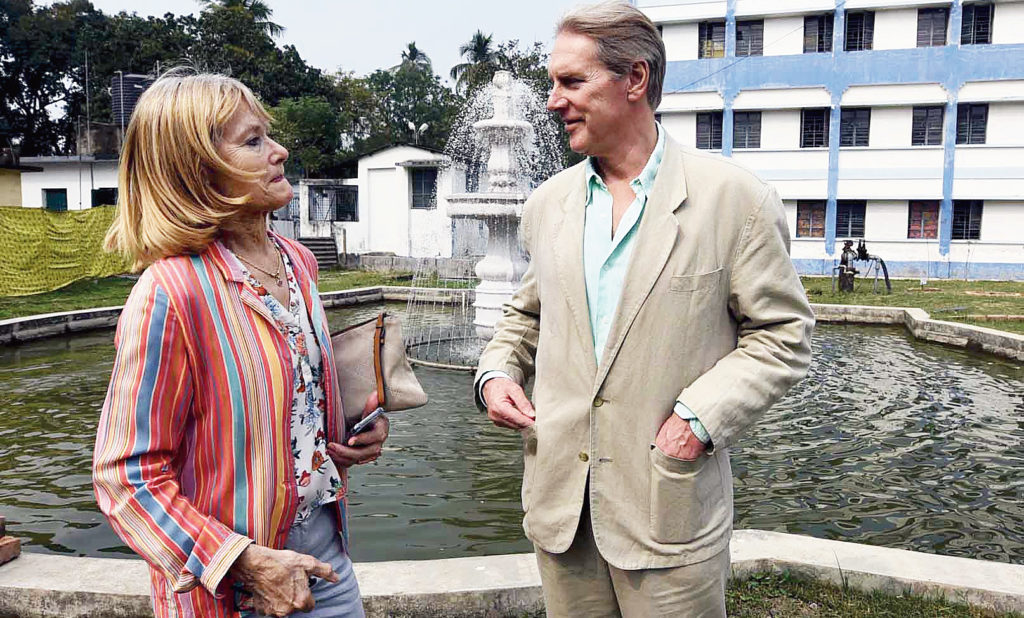
The couple from Minto, Roxburghshire, also stopped by the Minto Fountain, a marble fountain added to the sprawling acres by Lord Minto. “The fountain was designed by Lady Minto who inaugurated it before leaving for England in 1910,” said Mitra, who found it dysfunctional and buried under a pile of rubbish.

The Mintos were taken to Flagstaff House, the current residence of the Governor. They strolled around the garden, peered at the old lighthouse, stood before Fourth Earl of Minto’s statue, inspected a series of Raj statues shifted from Calcutta to the statuary and stopped at the restored cenotaph built by the First Earl of Minto in commemoration of officers who fell in the battles of Java and Mauritius and Gwalior.


In front of Minto fountain, which was designed by Lady Minto and inaugurated by her before she left for England. / Pradip Sanyal

source: http://www.telegraphindia.com / The Telegraph, Online edition / Home> People / by Anasuya Basu in Calcutta / February 10th, 2019

The Calcutta story

This book offers insights into a chapter of Calcutta’s history that is frightening and inspiring at the same time. David Lockwood takes readers back to 1942 when the city was bombed by the Japanese air force. An excerpt:

December 20, 1942, was a Sunday. On that day, Calcutta’s ‘Oldest Nationalist Daily’ (according to the masthead), the Amrita Bazar Patrika, reported that in Burma there was a possibility of ‘the end of defensive warfare on this frontier [by the Allies] and the beginning of a war of attack.’ Meanwhile, in the Don-Volga area, ‘the Soviet ring is drawing tighter around the enemy.’ Despite this optimistic note, the paper reflected evidence of wartime stringencies. The Imperial Tobacco Company appealed to its customers to accept cigarettes without packets in order to alleviate the paper shortage. The Government denied a shortage of rice. Women were told that they were ‘the Inner Wall of Defence’ and as such they should join the Women’s Auxiliary Corps (India). Indian political problems were also evident in the shape of the continuing Quit India campaign. An attack on a police station, bombs in Baroda and acid attacks on the police were reported.

The Calcutta races, however, went ahead as normal and were graced by the presence of the Marchioness of Linlithgow, His Excellency the Governor of Bengal, and Lady Mary Herbert. There was cricket on Saturday and Sunday and a tennis carnival to look forward to on Thursday. Cinemas catering to English speakers were featuring Chaplin in Goldrush, Robert Taylor in Her Cardboard Lover, and Abbott and Costello in Pardon My Sarong. The paper reported an increase in the production of Indian films for ‘the surging crowds during yuletide hungry for entertainment.’

That night Calcutta was bombed by the Japanese air force. The structural damage was minimal, but the panic that ensued was widespread. Large numbers of Calcutta residents fled. Fear was exacerbated by indications that neither the Government of India nor the Government of Bengal nor the Calcutta municipality were prepared for the defence of the city.

The air raid took place in a context of overwhelming Japanese military success and territorial expansion. The British — the assumed defenders of India — had been pushed out of Malaya, Singapore, Hong Kong and Burma. In late 1942, it was widely expected, in India and beyond, that a Japanese move into northern India was inevitable, imminent—and perhaps unstoppable.

Calcutta served as an industrial centre, a port and a transit point for troops moving up to fight the Japanese in Malaya and then in Burma. It was a city of considerable strategic importance to the Allies. Once Burma fell, Calcutta was the mainstay of the Allies’ Asian front. Consequently, it was a Japanese target. As Prasad points out, ‘Their air force was also well poised…to inflict continuous and heavy raids on Calcutta and the industrial area in the eastern regions. The official reaction to these first raids on the city was very much along the ‘we can take it’ and ‘business as usual’ line, modelled no doubt on the (officially) stoic British reaction to the Blitz. The Governor of Bengal, Sir John Herbert, telegrammed the Viceroy after the first raid that despite two deaths and fourteen injuries, there had been ‘No noticeable effect on morale.’ Later the Chief Secretary related that ‘ARP Services are in general reported to have done excellent work,’ demonstrated by the fact that ‘defections were very few.’ The Viceroy was moved to tell Calcutta’s citizens:

Yours is the first capital city in India to suffer in this war a baptism of fire and her citizens have provided an admirable example of steadiness and fortitude. Well done Calcutta.

The English press was, if anything, even more relaxed. The European-owned Statesman declared that the first raid was ‘a small affair and, if the city has to be raided, it can be described as a very suitable introduction.’ Even the Amrita Bazar Patrika reported that ‘Little damage was done and no nervousness was shown by the townspeople.’

Down amongst the townspeople, however, things were not quite so sanguine. After the first raid, ‘nervousness’ broke out on a wide scale. According to Joydeep Sircar, the raid was a ‘devastating blow to the morale of the inhabitants.’ Sircar suggests that ‘one and-a-half million people’ fled, causing a breakdown in ‘the civil services.’  There was a widespread feeling that ‘The Government had not prepared for the eventuality and seemed overwhelmed by developments in Southeast Asia.’

In the ensuing days and weeks, some signs of defence began to appear: A number of Hurricane aircraft were moved to Calcutta; emergency airfields were constructed, including one in the centre of the city between Chowringhee and the Maidan; slit trenches were dug in the same area. But following the December 1942 raids, many of Calcutta’s citizens were not concerned with defence. They were more interested in flight.

On December 23, Governor Herbert reported to the Viceroy that there had been a ‘considerable exodus of people from Calcutta though not yet amounting to a panic rush.’ Workers had ‘wholly disappeared from the dock area’ and morale was deteriorating — though ‘nothing like a landslide’. The post-bombing exodus took up the full capacity of the railways. Special trains were laid on to cope with the numbers attempting to leave the city. On December 27, ‘measures were taken to clear crowds of refugees collected at railway stations along the evacuation routes.’ The British authorities estimated that some 2,50,000 people left the city by road and another 1,00,000 by rail. Katyun Randhawa, a Calcutta schoolgirl, remembered the exodus and the railway stations ‘packed with people trying to get out’—some permanently. ‘Some of our street hawkers also disappeared,’ she relates, ‘—we never saw our bread delivery man again.’

Not unnaturally, those who felt the most vulnerable —from working-class suburbs, industrial establishments and around the docks — were those most inclined to leave. The Bengal Government Labour Commissioner put a brave face on the situation on the Monday morning after the first raid: ‘There was full attendance this morning in mills and in engineering firms. In fact, some engineering firms reported better attendance than on normal Monday mornings.’ The docks presented a different picture. The Chief Secretary reported that boatmen, port employees and contract labour (including coal coolies) all evacuated. Workers from outside Calcutta ‘left in large numbers on foot both by way of the Grand Trunk Road and the Orissa Trunk Road.’ He estimated their number at 2–3,00,000. Severe labour shortages ensued. The workers that remained took the opportunity of pressing their demands on the employers. There was an increase in strikes in Calcutta after the raids. The Australian war correspondent, Wilfred Burchett, was present in the Calcutta Port Commissioner’s office after one of the December raids, when the latter was confronted by a deputation of wharf labourers. They told him:

We don’t mind staying and working, even if they do bomb us, but we want food in our bellies and decent shelters. At present we’ve got neither.

The Scavengers’ Union demanded wage increases and free accommodation as ‘a large number of sweepers had already left the city and many would go away in the near future.’ The wharf labourers’ demand for shelters reflected, again, the feeling in the city and in the province—and perhaps across India as a whole—that the Government had not prepared well enough for the possibility of war and was not doing enough about it now that it had arrived. In the aftermath of the raids, Sudata Debchaudhury argues, ‘[t]he Government had practically collapsed.’ This may be overstating the case, but at the time the Amrita Bazar Patrika was complaining that the Government of Bengal had done nothing to organise an orderly evacuation, or to provide the evacuees with alternative means of livelihood, shelter and conveyance. Confidence in the authorities could not have been strengthened by the fact that during the December raids about 10 per cent of ‘the lower ranks of the Calcutta Police’ themselves abandoned their posts and fled.

Widespread fear of air raids and even invasion had taken hold in India well before December 1942, and this laid the basis for the civilian exodus from Calcutta. In the early part of the year, the example of Burma was there for all to contemplate. The Government should have known what to expect. On the basis of Burma’s experience of attack from the air, the Government of India’s Civil Defence Department sent out a circular, Lessons learned during air raids, to all Provincial Governments in August 1942.

Excerpted with permission from David Lockwood’s Calcutta Under Fire, Rupa Publications India, Rs 295

source: http://www.dailypioneer.com / Daily Pioneer / Home> Sunday Edition> Agenda> Backbone > Excerpt / February 10th, 2019

French heritage seal on Chandernagore buildings

The Registry Office, Chandernagore College and Sacred Heart Church are declared as heritage structures


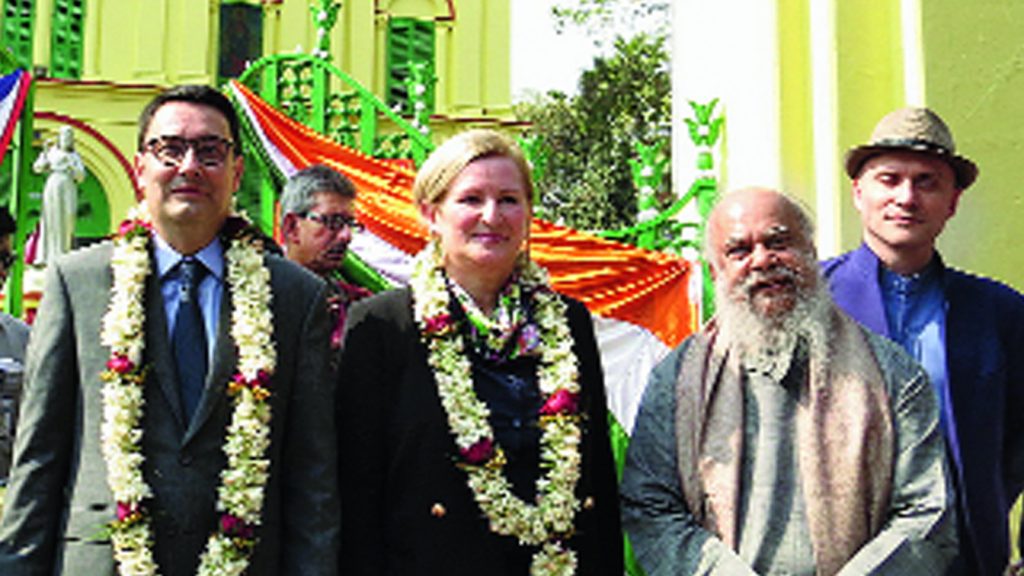
(From left) French ambassador Alexandre Ziegler; consul general Virginie Corteval; Shuvaprasanna, chairman, West Bengal Heritage Commission; and Fabrice Plancon, director, Alliance Francaise du Bengale at Sacred Heart Church on WednesdayPicture by Sudeshna Banerjee

French ambassador Alexandre Ziegler unveiled plaques declaring three buildings in Chandernagore heritage structures on Wednesday.

He was accompanied by members of the West Bengal Heritage Commission.

“The French consulate in Calcutta had sent a proposal for enlistment of 14 buildings in Chandernagore as heritage structures in 2017. Acting on it, the commission has made the declaration for eight buildings. Plaques will be laid today on three of them,” commission chairman Shuvaprasanna said at a programme at the start of the tour at Institut de Chandernagore.

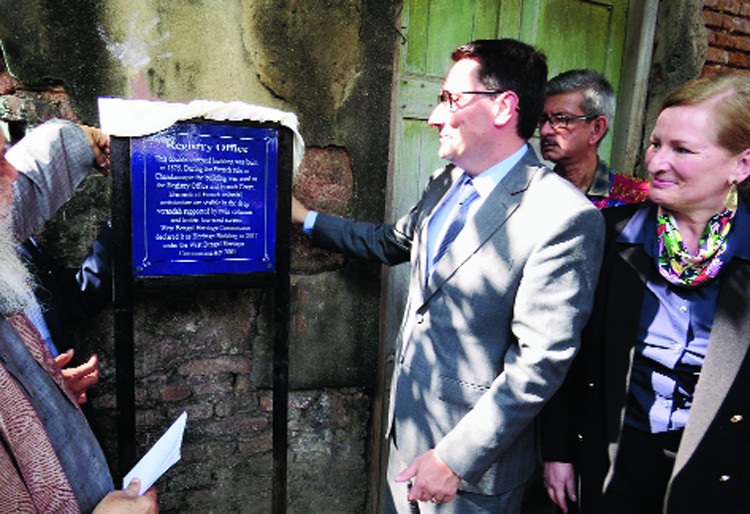
The blue enamel plaques reminded the ambassador of the street name signage in France. “They are very French,” he smiled, unveiling one at the first stop on the tour — the Registry Office and French Court.

The derelict structure rich in history at the starting point on the Strand, facing the river, has been saved from demolition after the petition from the French.

It was also the focal point of a workshop called House of the Moon during Bonjour India, the French festival in India, in 2017, for which students of design from India and France co-created and collaborated to develop an intervention in Chandernagore.

Once restored, Ziegler envisions it as a focal point of tourist interest, with a coffee house and an information centre.


Ziegler unveils the plaque declaring the Registry Office a heritage structure.

But he insisted that the day’s exercise was not just about restoring history. “It’s about what you can do with heritage while looking at the future. It is much more than architecture, for our vision involves economic revitalisation of the town. We will be working on giving ownership to the whole community by working with students and children, and making Chandernagore the focal point of our common history and bilateral relations.”


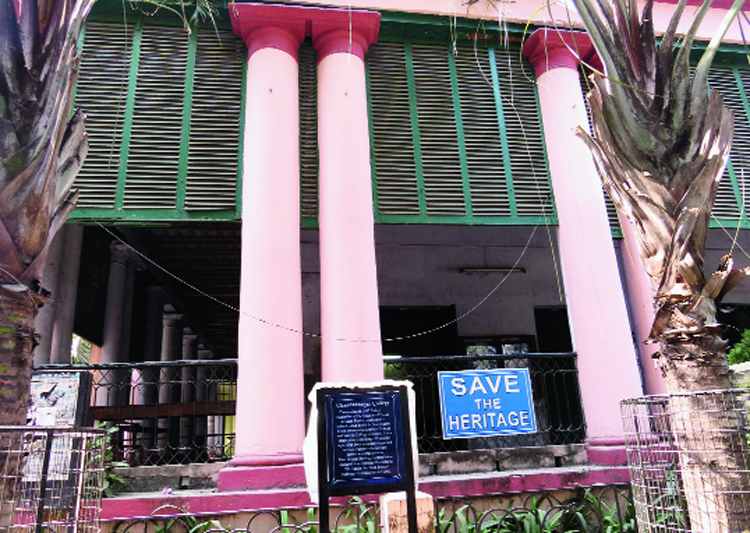
The heritage structure plaque at Chandernagore College.Pictures by Sudeshna Banerjee

The other two buildings where plaques were unveiled are Chandernagore College and Sacred Heart Church.

The college, originally established as St Mary’s Institution by the French Catholic Missionary, Rev. Magloire Barthet in 1862, had received an affiliation to Calcutta University as a First Arts Level College in 1891.

The principal, Debasish Sarkar, had a piece of good news to share with the ambassador — the college had just been granted Rs 1.68 crore for the upkeep of the building by the higher education department.

“This is a memorable day for Chandernagore. The laying of the plaques invests the buildings with importance and insures their future. It also gives the young generation something to take pride in,” said Basabi Pal, the head of the college’s French department, which is the oldest in Bengal. The department now grants even postgraduate degrees.

Father Orson Welles received the ambassador at Sacred Heart Church, which dates back to 1875.

The consul general of France in Calcutta, Virginie Corteval, and district magistrate J.P. Meena were present at the programme.

A team of technical experts will visit Chandernagore “by the summer” to help with the restoration, the ambassador said.

source: http://www.telegraphindia.com / The Telegraph, Online Edition / Home> Heritage / by The Telegraph – Special Correspondent in Chandernagore / February 07th, 2019

Sabyasachi Bhattacharya, one of the country’s leading historians, passes away in Kolkata

A prolific writer, Bhattacharya stepped out from the strict confines of his specialisation in economic history and provided an all-encompassing view of modern India, placing it in the context of world history.

Sabyasachi Bhattacharya (1938-2019), one of the foremost historians of modern India, died in Kolkata on Monday. He was 81 and suffering from cancer of the spinal cord for well over a year.

A prolific writer, he enjoyed a stature similar to historians Romila Thapar, K N Panicker and Sumit Sarkar. He made lasting contribution for his study of the working of the colonial regime and various economic aspects in colonial and post-colonial India.

On Monday historians recalled how, Bhattacharya, suffering from cancer, did not spare himself the rigour of editing a three volume Comprehensive History of Modern Bengal (1700-1950), to be published by Asiatic Society. As many as 65 scholars from India and abroad contributed to this book that has been sent to the press.

Despite illness, he remained intellectually active throughout 2017 and 2018 and his last book, ‘Archiving the British Raj: History of the Archival Policy of the Government of India, with Selected Documents, 1858–1947’, was published in November 2018.

The disciplined approach marked Bhattacharya’s academic journey down the years.

His monumental work, ‘Financial Foundations Of the British Raj: Ideas And Interests In The Reconstruction Of Indian Public Finance (1858-1872)’, which was first published in 1971 and has run into its seventh edition, is considered a classic. ‘The Colonial State: Theory and Practice’ is another of his esteemed books.

Bhattacharya initially earned his repute as a historian with his seminal works on economic history of India under the colonial rule, based on archival research, and later also worked on political and cultural-intellectual history of Independent India.

Historians also valued his journey from the strict confines of the area of specialisation — economic history — to providing an all-encompassing view of India, placing it in the context of world history for colonial and post-colonial periods.

Bhattacharya was also reputed as a teacher and administrator. He had served as the vice-chancellor of Visva-Bharati University (1991-1995) and Chairman of the Indian Council of Historical Research (2007-2011), besides teaching history at Jawaharlal Nehru University (1976-2003) (JNU).

He played a pivotal role behind the foundation of Centre for Historical Studies at JNU.

Bhattacharya also held teaching and research positions at St. Antony’s College (University of Oxford), University of Chicago and El Colegio de Mexico.

Besides having written more than three dozen books, he was the chief editor of Indian Historical Review and the general editor of Towards Freedom, a series on the movement for Independence in India published by Oxford University Press in collaboration with ICHR.

‘Essays in Modern Indian Economic History’ (2015) and ‘Towards a New History of Work’ (2017), two books he edited during the last phase of his life, continued with the same mission of chronicling the country’s economic history.

He also co-edited ‘Workers in the Informal Sector: studies in labour history, 1800-2000’ (2005), ‘The Vernacularization of Labour Politics’ (2016) and ‘The Past of the Outcast: Reading in Dalit History’ (2017).

Among his works on India’s cultural and intellectual history are ‘The Mahatma and the Poet’ (2011), ‘Vande Mataram: A Biography of a Song’ (2013), ‘The Idea of Civilization in the Indian Nationalist Discourse (2011)’, ‘Cultural unity of India’ (2013), and ‘Rabindranath Tagore: An Interpretation’ (2016).

He is survived by his wife, Malabika and daughter, Ashidhara Das. His last rites will be performed on Wednesday.

source: http://www.hindustantimes.com / Hindustan Times / Home> Kolkata / by HT Correspondent, Kolkata / January 08th, 2019

The only Greek of Calcutta

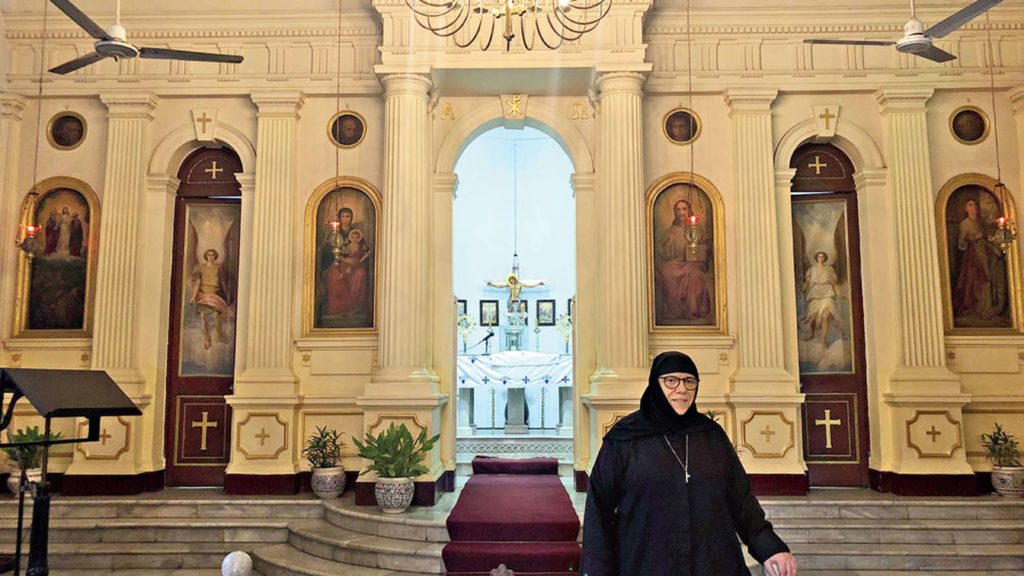
Sister Nectaria Paridisi of the Greek Orthodox Church is the only Greek left in the city


Ground reality: Sister Nectaria at the Greek Orthodox ChurchManasi Shah

Sister Nectaria Paridisi sips on her Darjeeling tea. She is sitting in the lounge on the ground floor of the Greek Orthodox Church in Kalighat in south Calcutta and talking animatedly about a whole lot of things — the church, the state government’s lack of interest in the heritage property and its history, the uncaring locals. The room is full of antique furniture, framed photographs of bishops and Greek inscriptions. Flags of Greece, India and the bygone Byzantine Empire stand in different corners of the room. Our host is Father Raphael, a priest at the church. And the nun, Sister Nectaria, is the only Greek resident left in Calcutta.

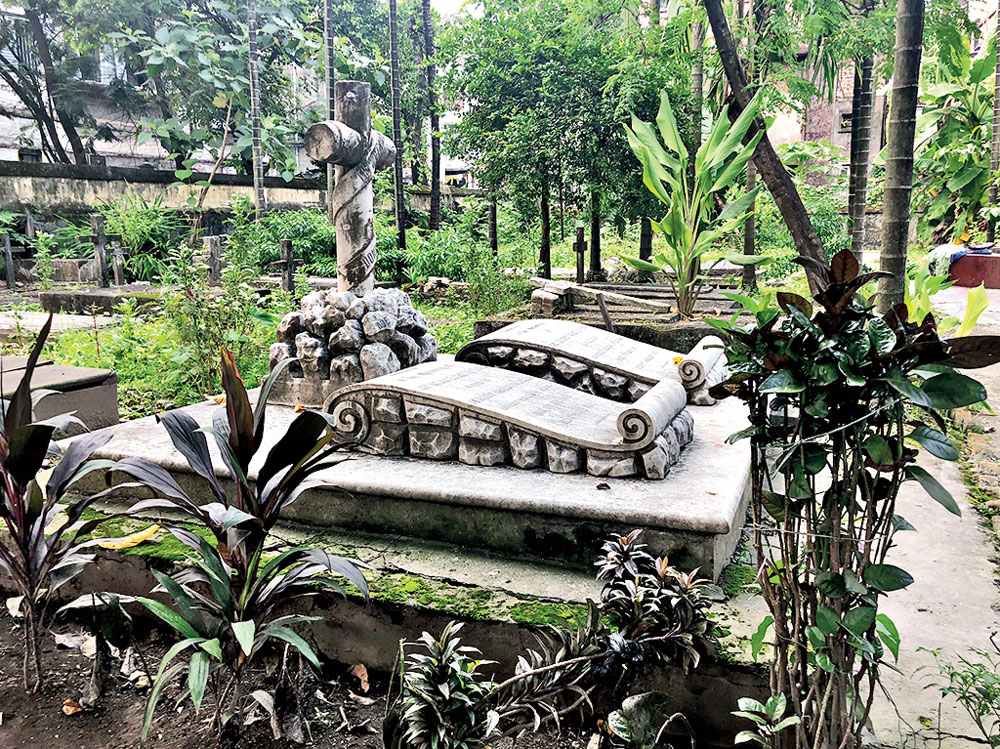
To trace the beginning of Calcutta’s Greek association, however, we have to trek to Phoolbagan in the eastern part of the city. It is not difficult to miss the plaque at the entrance to the Greek cemetery. For one, the compound itself is surrounded by a gaggle of residential buildings and then there is the flurry of activity from the ongoing expansion work of the Kolkata Metro. Unlike some of the other cemeteries of the city, such as South Park Cemetery or the Scottish Cemetery, this one is smaller and way less verdant.

The caretaker, Basanta Das, says there are more than 200 graves here. Das, whose father and grandfather have also been caretakers here, says, “Not all the graves have bodies. Some of them are just epitaphs and tombstones.” Most of the graves have inscriptions in Greek. One such reads: “In the memory of Mavrody Athanass Mitchoo who died on December 9, 1855.” But the oldest grave is of Alexander Argeery, who died on August 5, 1777.

“From the 17th century, Calcutta was home to a Greek community,” says Sister Nectaria. In his book, Calcutta Old And New, H.E.A. Cotton writes: “The Greeks, like the Armenians, owe their association with Calcutta to the allurements of commerce.” According to Cotton, the first Greek settler of note in Calcutta was Hadjee Alexias Argyree, a native of Philippopolis, who came to Bengal in 1750 and earned his living as an interpreter.

In fact, it was Argyree who founded the first Orthodox Church of Calcutta. The story goes that in 1770, he set sail from Calcutta for Mocha and Jeddah. But his vessel was hit by a severe storm and was close to sinking. A devout, Argyree promised the gods that if he survived the peril he would found a church in Calcutta for its Greek inhabitants. True to his word, upon return to the city, he obtained relevant permissions and started to move on the purchase of a property. But then, he died in 1777.

Three years later the church came up. Writes Cotton, “…his family contributed a considerable sum, the remainder being made up by voluntary contributions, Warren Hastings heading the subscription list with 2,000 rupees.” Sister Nectaria confirms that the first Greek church to be built in Calcutta was indeed at Amratollah Street (in central Calcutta) and it had a cemetery adjoining it.

The first minister of the church was Father Parthenio, a native of Corfu, who settled in Bengal in 1775 and who is said to have sat for the figure of Jesus in German neoclassical artist Johann Zoffany’s painting, Last Supper.

The Greeks of Calcutta were a wealthy and powerful community. This is borne out by some of the epitaphs. One of them reads: “In the memory of Sir Gregory Charles Paul, Advocate General of Bengal, died on January 1, 1900.” Another grave belongs to Mavrodi Athanass Mitchoo, a planter.

According to Sister Nectaria, in 1922 another wave of Greeks fled their homeland. “A major reason was the genocide that happened at that time. Calcutta was an important port those days and so many came to Calcutta,” she says. The long and short of it, the Greek community continued to flourish till 1947 and, thereafter, began its denouement. Says Sister Nectaria, “Greeks started to leave India and move to London, Johannesburg, some moved back to Greece even.”

In 1924, the Amratollah property on which the Greek church stood was sold. Says Sister Nectaria, “The church authorities bought the Kalighat property and decided to move the cemetery out of town.” [At that time, Phoolbagan was not part of the city.]

The entrance to the Kalighat church building has two plaques on either side. The inscriptions are in Greek. Sister Nectaria translates it: “It is in memory of the Greeks who donated generously to build the first church in Amratollah… Their bodies are buried but their names will remain alive for generations.”


A tombstone in the cemetery at Phoolbagan / Manasi Shah

With the Greeks moving out, the church became non-functional and was finally locked down in 1972. And then, in 1991, it was reopened on the initiative of the Greek embassy. At the time, Sister Nectaria, who was posted in South Korea, was asked to come and take care of the church. Father Ignatios was in charge of the church. He also established the Philanthropic Society of the Orthodox Church.

According to the nun, the years of neglect had literally eaten into the church building. The whole place had been taken over by termites. She says, “It was just black. And I started cleaning through the layers of dirt. The termites had eaten all the ornaments of the Lord, the clothes, the books and even the wall clock.”

Sitting in the church that afternoon, it was difficult to imagine that scene. The wooden altar is now beautifully polished and has intricate panels and paintings related to the life of Christ, Virgin Mary, archangels Gabriel and Michael with their swords drawn out.

Calcutta is now emptied of its Greek populace. The church is frequented by local Christians and Sunday services are held regularly in Bengali. “Many Hindus also just come to pray. Sometimes I see Krishna monks, who come, sit, pray and leave silently,” says Sister Nectaria.

If she resents anything it is the attitude of the people in the neighbourhood. Breaking his silence for a change, Father Raphael says, “This is a Grade 1 heritage building [as declared by the Kolkata Municipal Corporation] and still we have to struggle for its maintenance.”

Sister Nectaria elaborates, “The local people force the guard to open the gates and act like this is their property. During Durga Puja, they put lights around the church. It is not as if we are against Durga Puja, but it is about the whole attitude. Whenever there is a festival, they block the church entrance and dump chairs, lights and sound equipment in the church premises as if it were a store room. And when I oppose, they call me an outsider.”

These days, Sister Nectaria visits the church only every other week. She remains busy in Bakeswar on the southern reaches of the city, where she is in charge of two orphanages under the Greek Church. Then there is the St. Ignatius High School, which is also under her supervision. And does she feel like an outsider?

She smiles, “Now? I am now half Indian.”

source: http://www.telegraphindia.com / The Telegraph, Online edition / Calcutta / Home> Heritage / by Manasi Shah / February 02nd, 2019

Life and times of an Indian civil servant

Writer Ashok Basu served the bureaucracy for over 40 years, through Naxalism, the Emergency and liberalisation


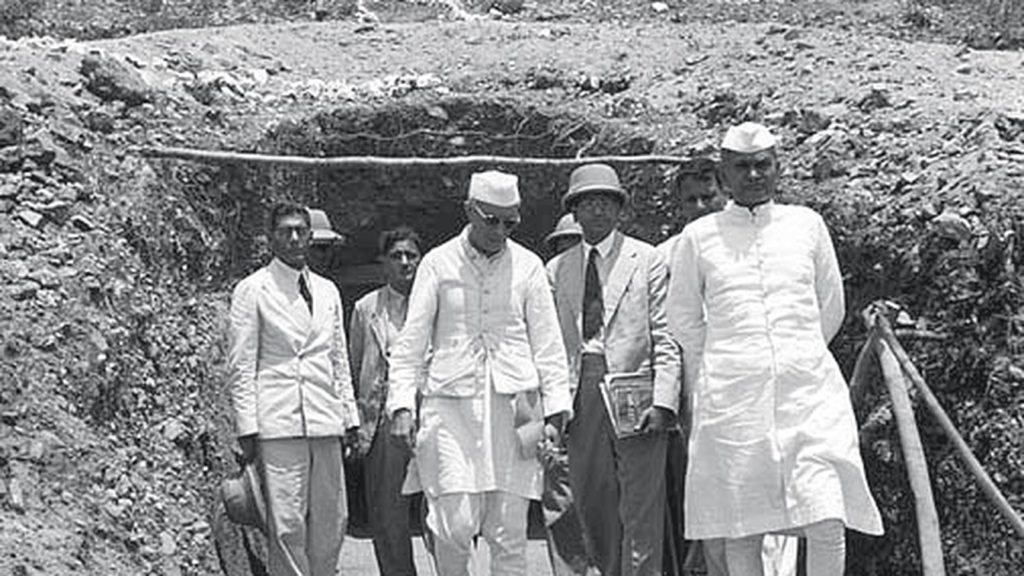
Jawaharlal Nehru visits workshops and laboratories at the Campsite Hirakud DamImage: Wikimedia Commons

Told by a sycophantic colleague that crime had gone down significantly since he became West Bengal’s chief minister and that there were “fewer robbers and dacoits” about, Bidhan Chandra Roy replied, “No wonder. Some of them are in my government.” Many such anecdotes enliven what might otherwise have been a somewhat solemn account of Ashok Basu’s 42 years as a civil servant in the state and Central governments.

Not many bureaucrats have such varied experiences in so many vital ministries, shape crucial developments like deregulation and decontrol in the iron and steel industry, or ensure transparency and accountability in electricity regulation. The reader shares his pleasure in these achievements and in his and his family’s academic brilliance and his father’s professional reputation as a policeman. Basu emerges as a thoroughly nice family man who bears no grudges and casts no stones. One wonders how his colleagues — not always one happy family — responded to this panglossian (“all is for the best in this best of all possible worlds”) benignity. Calcutta Corporation’s unions did not take kindly in 1983 to his plan as commissioner to engage Thames Water to restore the city’s sewage system which it had helped to lay a century earlier. They might have sung a different tune if China Investment Corporation had already bought 9 per cent of Thames equity which it didn’t do until about 20 years later.

While he avoids being judgmental, opinions are not altogether absent. But they are either attributed to someone else (like the wry comment about the “Rig Veda” explaining successive Left Front election victories) or so nuanced as almost to be overlooked. When Kishan Chand, Delhi’s former lieutenant-governor, an Indian Civil Service officer whom the Shah Commission gave a rough time, was found dead in an abandoned well two kilometres from his South Delhi home, leaving two suicide notes, the police had no doubt he had killed himself. But Basu’s “allegedly committed suicide” recalls India Today’s report that “a host of prominent politicians seem equally convinced” he “was murdered to stop him from giving evidence against Mrs Gandhi and her Emergency cohorts”. He is more forthright about the Left Front’s stand on English. “An extreme view started gaining ground that the Left Front wanted the masses to remain uneducated so that they could be manipulated and prevented from questioning the system.”

Detailed case histories make this a valuable addition to the literature on a bureaucracy considered one of the world’s most powerful. But it would have benefited from professional editing, some fact-checking (How can a Paris city tour include the Vatican, or Bulgaria have been “a constituent of the USSR”?) and an Index. A more detailed analysis of the IAS’s role in contemporary India, possibly compared to those whom Philip Woodruff — Philip Mason of the ICS — immortalized as the Founders and Guardians, might also have added value to the volume. Basu’s definition of the IAS being “about sharing space with colleagues and the highest in the land, and knowing them better” echoes Lee Kuan Yew’s belief that only “an elite administration” can effectively “run a vast country like India”.

This now unfashionable view was ridiculed in a History Today writer’s mockery, “Much nonsense has been written about the romantic, glamorous notion of a single ICS officer riding around his district, dispensing even-handed justice to a grateful and submissive peasantry. Settling law cases before breakfast, such a paragon apparently corrected land records before lunch, shot a tiger or two before dinner and wrote some Latin verse before taking a cold bath and retiring to a camp bed.” Basu’s indulgence is Hindi film songs. References to the “steel frame”, Lloyd George’s term for the ICS, perpetuate that heaven-born mystique. Dipak Rudra, two years Basu’s senior in the IAS, more realistically called it the “bamboo frame” in several newspaper articles. That suggested a cadre that is more vulnerable to pressure, persuasion and all the weaknesses from which Indian institutions suffer.

Basu rightly says Nehru “had a clear perception of the India he wished to create” but may err in claiming that “the senior officialdom advised him (Nehru) impartially to enable him fulfil his dream”. Nehru himself did not feel his dream was fulfilled. Asked three years before he died to identify his greatest failure, he replied after a long reflection, “I failed to change this administration. It is still a colonial administration.” Tarzie Vittachi, his Sri Lankan interlocutor, felt that for Nehru, the IAS was too much like the ICS.

Power, Duty and the Game Changer: Reflections of a Civil Servant By Ashok Basu, Mitra & Ghosh, Rs 400

source: http://www.telegraphindia.com / The Telegraph – online editon / Home / by Sunanda K Datta-Ray / January 11th, 2019

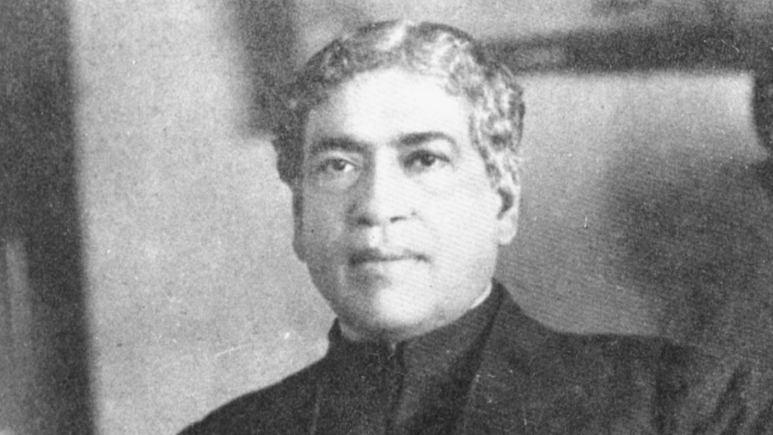
A tribute to Jagadish Bose, who proved plants have life

Group of scientists recreates Bose’s experiment, which was not received well 100 years ago

Bose’s peers in the West may not have got the same results as him because of the water used /
Image: The Telegraph

More than 100 years after Jagadish Chandra Bose conducted the experiment that established plants have life, a group of scientists in Calcutta came together this year to repeat it.

Supriyo Kumar Das, an assistant professor of Geology at Presidency University, led the initiative. The others on the team were also from Presidency — Debashis Datta and Rabindranath Gayen, both assistant professors of Physics, Snigddha Pal Chowdhury, a research associate in the Geology department, Abhijit Dey, an assistant professor of Botany, and Saranya Naskar, an MSc student of Physics.

Bose, who had joined Presidency College in 1885 as a professor in the Physics department, had conducted the experiment in a laboratory on these very precincts. No matter how much he is hailed today for his scientific genius, in his time Bose’s experiment had not been received well.

It all began when Peter V. Minorsky, a botanist and professor at Mercy College in the US, got in touch with Das earlier this year. Minorsky wanted to know about the groundwater composition in the College Street area, where Presidency University stands.

Says Das, “It is from him that I heard about the prejudices against Bose. In the course of our exchanges, I got interested and emotionally involved with Bose’s work.”

He had been savagely criticised by George James Peirce, professor of Plant Physiology at Stanford University. Peirce wrote in the journal, Science, in 1927: “The trouble with Bose… is that while his curiosity is directed to biological phenomena, his mind is inadequately equipped with the information and habits necessary for accurate study, and his reflections are addressed to philosophical problems.”

In 1929, the Indian Review reported that G.A. Perrson, who was from the US, was unable to find pulse in plants. And years later, in the mid-1960s, in the Handbuch der Pflanzenphysiologie (Encyclopaedia of Plant Physiology), it was said, “Unfortunately Bose’s theoretical views and his emotional style of reporting have generated what may be an excessive skepticism concerning the validity of his observations.”

This is what Bose had observed. By devising a wire electrode — an invention three decades ahead of its time — he identified a pulsating layer of cells abutting the vascular tissue in plants. In an email to The Telegraph, Minorsky says, “In the last few years, plant biologists have come to recognise this layer is the site of propagating waves of calcium release that are involved in communicating stress from local points of occurrence to the rest of the plant. The discovery of this calcium wave is one of the more exciting discoveries of the 21st century, and Bose’s ‘plant heart’ predates this discovery by a century.”

Bose has left notes aplenty about every aspect of his historic experiment. One of the lone omissions is the kind of water used. Says Das, “Being a geochemist and scientist, I understand the composition of groundwater and the effect of chemical stress of sodium on plants. I also know that the composition of water varies from place to place.” He adds, “It occurred to us that Bose’s peers in the West might not have got the same results as him because of the water used.”

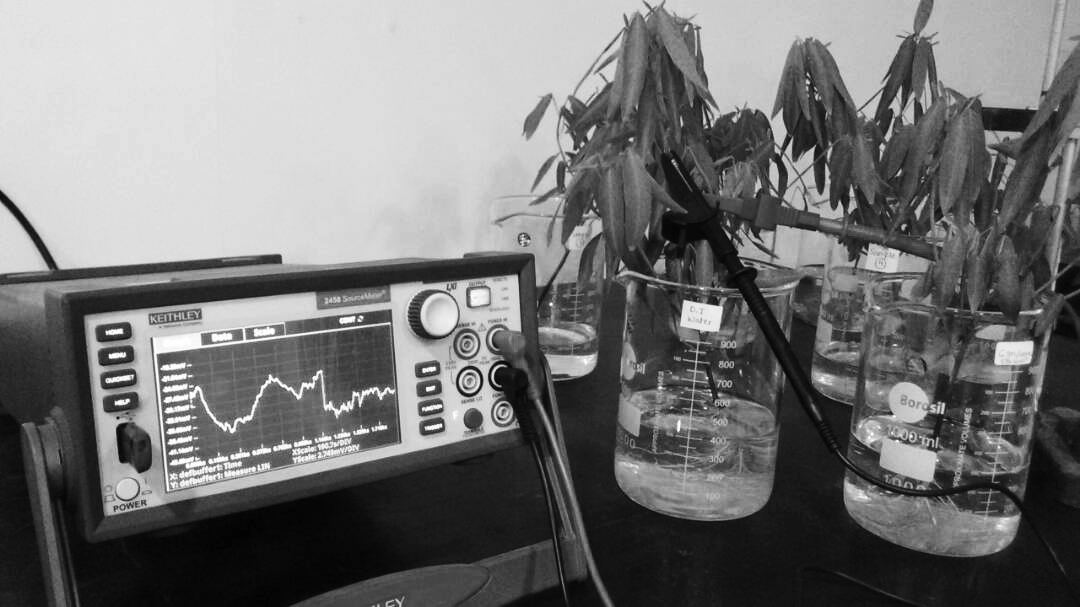
PULSE TEST: A repeat of the experiment at Presidency University that Jagadish Chandra Bose conducted in the 1900s /
Image: The Telegraph

In Bose’s time, water was supplied to the Presidency campus from Palta in the Barrackpore area. Das points to a spot occupied by an elevator on the ground floor of Baker Building that houses the Physics department and says, “This is where the old pipeline ran.” Currently, the municipality takes care of the water supply. It comes from the Tala tank in north Calcutta.

When Das and and others repeated the experiment, they decided to use water from every possible source Bose might have accessed. “He could have also used water from the Ganges or from the pond in College Square,” says Das.

Datta explains, “We wanted to check the potassium and sodium concentration. Electricity flows through water only when there are some ions present in it. Possibly, the scientists from the West had not used ionised water.”

The “repeaters” used for the experiment the plant Bose had used — the Desmodium motorium, locally known as bon charal. Minorsky explains, “The lateral leaflets of Desmodium are unique in the plant kingdom for their pronounced and unprovoked oscillatory movements. If conditions are optimal, one can watch these lateral leaflets move at a pace slightly slower than the second hand of a watch.”

According to Minorsky, Bose enjoyed certain enormous advantages over his Western peers. First, Desmodium motorium is a native of Bengal, so he had access to an ample supply of healthy, thriving specimens. In contrast, in the West its cultivation was restricted to glasshouses. Those days, glasshouses were often heated by wheelbarrows of burning coal. These released a gas called ethylene, which in turn affected many plant processes, including a decrease in overall excitability. Second, he points out Calcutta’s temperatures and how they lend themselves to plant study. “Temperatures of 30-35° Celsius, which occur commonly, are optimal for studying plant movements and excitability. The temperatures at which scientists in the West studied plants would have been much lower,” he says. Finally, there was the salty water advantage.

Dey arranged for 21 Desmodium plants. Each was kept in a beaker full of a distinct water sample. Thereafter, they were all kept in a controlled atmosphere. Says Gayen, “We placed them in glass beakers and left them in the laboratory, where all the lights would be kept on so that all of them were exposed to the same amount of light. The air conditioner would be set at a particular temperature to control the humidity. We would connect the probes to two different parts of the stem. The source meter was used to read the fluctuating signals.”

The brainstorming went on for months and the experiment lasted a fortnight. Das says, “The apprehension of failure was there. But the moment when we got the first response was exquisite. The horizontal line that appeared on the screen formed a peak and then fell only to rise again. Though our graph did not have peaks and troughs as tall as Bose’s, we definitely had got a graph that roughly replicated the ECG graph of humans.”

source: http://www.telegraphindia.com / The Telegraph,Online edition / Home> Culture / by Moumita Chaudhuri / November 25th, 2018