The state government has decided to set up a museum inside the Assembly.
The museum will be the first-of-its-kind where sculptures of various eminent persons of the state who have contributed immensely for the welfare of the nation will be displayed.
A space of around 2,000 sq feet has been identified inside the Assembly where the proposed museum will be set up. It will have an art gallery, too, where works of famous painters, including Jamini Roy, will be displayed.
Sculptures of famous personalities in the Assembly will also be displayed.
The Speaker has already sent a list of names of eminent persons whose sculptures will be displayed inside the museum.
According to the proposed plan, initially 10 to 12 statues of eminent persons will be displayed inside the museum. Replicas made of fibre glass representing various art forms of different states as well as foreign countries will be put up for display inside the museum.
The PWD is in the process of inviting sculptors and artists to discuss which statutes should be placed first.
It may be mentioned that the Housing Infrastructure Development Corporation (Hidco) has come up with a plan to set up the first ever wax museum at New Town in Rajarhat .
The museum, being planned on the lines of London’s Madame Tussauds wax museum, will be set up at Rajarhat New Town and a 5,000 sq ft area has been earmarked for the project.
source: http://www.thestatesman.net / The Statesman / Home> Bengal / Statesman News Service / Kolkata – July 25th, 2014
Three Keralite Civil Service officers would soon add a new chapter in palliative care in rural West Bengal, inspired by similar initiative in their home state.
‘Sanjeevani’, an end-of-life care project to be launched in September in the Nadia district of WB, is the brain child of IAS officers P B Salim and Bijin Krishna and Amarnath, an IPS officer. The project has been conceptualised by the Kozhikode based Institute of Palliative Medicine (IPM), the training, research and outreach arm of Pain and Palliative Care Society, which pioneered community volunteering in end-of-life care.
Salim, hailing from Muvattupuzha, is currently working as the District Magistrate of Nadia while Amarnath, a native of Moozhikkal in Kozhikode, is the ASP of South 24 Parganas. Bijin from Meppayur in Kozhikode is the Assistant Collector of Murshidabad district. “Both Amarnath and Salim had associated with IPM years ago. Salim suggested starting a palliative care programme in West Bengal. He along with Amarnath then approached me. Later, Bijin also extended support to the initiative,” said Dr Suresh, director of IPM, which provides technical support for the project.
According to Salim, Sanjeevani is aimed at improving the quality of life of the terminally ill in Nadia.
“The project intends to introduce a new culture of providing care for the bed-ridden patients utilising a network of physicians, nurses and volunteers,” he said.
source: http://www.newindianexpress.com / The New Indian Express / Home> States> Kerala / by Shafeeq Alingal / July 25th, 2014
Some 40 actors and film technicians won awards named after Uttam Kumar on Thursday at Nazrul Mancha. “There must be many… who are waiting for an award… . That’s why we started the Bangabhushan… (another award instituted by the government),” Mamata Banerjee told the gathering. Metro presents an abridged list of who got what & why we think they deserve it
source: http://www.telegraphindia.com / The Telegraph, Calcutta / Front Page> Calcutta> Story / by The Telegraph, Calcutta Bureau / Friday – July 25th, 2014
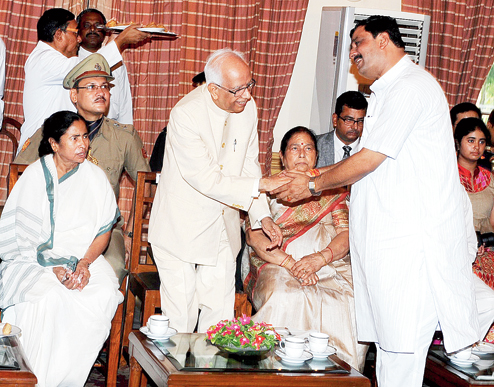
Governor Keshari Nath Tripathi (centre) is greeted by Bengal BJP president Rahul Sinha (right) on Thursday as chief minister Mamata Banerjee looks on. Picture by Pradip Sanyal
Calcutta :
Keshari Nath Tripathi, who was sworn in today as governor of Bengal, has started his tenure by saying he “talks less”.
However, in a 10-minute interaction with the media, he proved that he knows “when to speak” and “what to speak”.
The former Speaker of the Uttar Pradesh Assembly took over in the presence of chief minister Mamata Banerjee and her senior cabinet colleagues.
The two main Opposition parties — the Congress and the CPM — did not attend the event. Three senior leaders of the BJP — Rahul Sinha, president of the Bengal unit; Siddharth Nath Singh, minder for Bengal; and Amalendu Chattopadhyay, organisational secretary — were present.
In a departure from tradition, the new governor fielded some questions from the media. “I talk less. As a lawyer I had learnt when to speak and when not to speak and what to speak and what not to speak,” Tripathi said in his opening remarks.
Over the next 10 minutes, the 82-year-old governor spoke on a range of issues. Excerpts follow. The italicised sentences are background information included by this newspaper.
Q: What is your assessment of the chief minister?
Tripathi: What can I say about her? (Smiles)
Whether in power or in Opposition, unless they (political parties) develop the habit of respecting constitutional provisions and framework, it will ultimately result in chaos. Everyone has to work within the Constitution’s provisions. That is expected of the authorities.
Relevance: Since the change of guard in Bengal, the Mamata-led government has had several run-ins with constitutional bodies like the State Election Commission and the West Bengal Human Rights Commission. The government had a bitter legal battle with the state poll panel over the schedule and security arrangements for panchayat elections. At present, the two sides are locked in another battle over holding polls in 17 civic bodies and corporations. Mamata developed an icy relationship with the state human rights panel, too, after it recommended action on rights violation cases. Ahead of the Lok Sabha polls, the chief minister had a public outburst at the Election Commission of India over the transfer of some officials, only to climb down later.
Q: What do you have to say about political violence in the state?
Tripathi: Violence of any kind is to be condemned. One of the chief functions of a political party should be to preach and practise tolerance of the views of the other side. If you tolerate others’ views, you can develop a system to find solutions. Violence is not the solution.
Relevance: The ruling establishment in Bengal has been time and again accused of inflicting violence on supporters of Opposition parties. Sources in Raj Bhavan said that over the past three years, Opposition parties had met M.K. Narayanan, the former governor, at least twice a month to complain about atrocities. Besides, some Trinamul MPs and MLAs have been accused of making outrageous statements.
Q: What will be your role as governor?
Tripathi: The governor’s job is not to invite any confrontation with anybody. Let me understand Bengal, let me know the problems and whether I can solve them within the constitutional limits.
Relevance: This is more or less the textbook definition of what a governor is expected to do — steer clear of activism and remain a neutral entity that keeps an ear to the ground and an unwavering eye on the Constitution. The Bengal Opposition has been saying that some pieces of legislation have been pushed through without running them through a constitutional sieve.
Q: Do you know that two Opposition parties did not attend the swearing-in?
Tripathi: If they have boycotted, I don’t know why. They don’t know me and I don’t know them. What was the reason for boycott? Let them be happy.
Relevance: The Congress and the Left have reservations about the appointment of a BJP leader as governor at a time the party is eating into their support base and growing in Bengal. The Left and the Congress had supported a Trinamul-led motion against the appointment of a governor without consulting the state government.
source: http://www.telegraphindia.com / The Telegraph, Calcutta / Front Page> Story / by The Telegraph, Calcutta Bureau / Friday – July 25th, 2014
In a first of its kind surgery in the city, a woman recently underwent a successful complex heart surgery while her heart was still beating.
According to a release, the 51-year-old woman was suffering from a severely stenotic rheumatic mitral valve disease, which required her mitral valve to be replaced. The mitral valve consists of two flaps and is responsible for controlling the flow of blood into the heart.
A team of two doctors at the Eastern Railway’s B.R. Singh Hospital conducted the surgery with the help of a heart-lung machine. The heart was continuously supplied with oxygenated blood and it remained in a state of slow beating to enable the mitral valve to be replaced with metallic valves. The surgery on heart valves is commonly performed on a motionless heart by using a special solution called cardioplegia . As the heart is stopped for surgery, the surgeon must restart it and reintroduce blood into the heart muscles.
This is known as reperfusion. Reperfusion can cause impairment of heart function known as reperfusion injury with complications such as irregular heart rhythms and pump dysfunction. Reperfusion injury is especially a concern in high risk patients, such as elderly, people who had previous heart operations, and those with complex health problems. Therefore, the beating heart surgery leads to better preservation of heart and better survival rate, especially among high-risk patients.
source: http://www.thehindu.com / The Hindu / Home> News> Cities> Kolkata / by Staff Reporter / Kolkata – July 23rd, 2014
Set in Sonagachi, ‘Sold’ — that follows the tale of a child trafficked from Nepal to the city, is directed and produced by Oscar winners and features ‘X-Files’ star Gillian Anderson, David Arquette, Tillotama Shome and Parambrata Chatterjee among others, has won the audience award at a London film festival recently.
This is the first feature film of Jeffrey Dean Brown, whose first short with dialogue, adapted from the book ‘Molly’s Pilgrim’, won the Oscar in 1986. This film is adapted from a book by Patricia McCormick that has been translated into 32 languages. The executive producer of ‘Sold’, Emma Thompson, is a two-time Academy Award winner. Joint Overdose, the film firm headed by Kolkata filmmaker Qaushiq aka Q, was the line producer. “We had met and the producers were well-versed with our earlier works. Our job was to ensure everything went smoothly during the production and shoot. The film will definitely hit the screens in India by next year,” said Q.
In the film, lead character Lakshmi’s stepfather accepts an advance for her to work as a domestic servant in Kolkata, and she becomes obliged to work off the debt. Lakshmi goes willingly, believing she will work and earn enough money to buy her mother a tin roof. But when Lakshmi arrives in Kolkata, she is handed over to Mumtaz, a ‘madam’ who presides over a brothel called Happiness House. Brown pointed out that ‘Shawshank Redemption’ is structurally similar to ‘Sold’. “Mumtaz exploits her prisoners like the warden did in ‘Shawshank’. In both the films, you know the hero is planning an escape, but you’re not sure how and this keeps you watching,” he said.
Asked about if he had any reservations about the content and depiction of Kolkata’s dark underbelly, Q said: “It’s not a negative set-up at all. It’s time for us to face the facts. And we were anyway interested in the film for the social message and its outreach.” His colleague in Overdose, Tanaji Dasgupta, not only has a role in the film but is also credited as a line producer.
“I remember visiting Sonagachi for the first time, seeing hundreds of young girls and women selling themselves on the streets. It was overwhelming. When I saw a girl who had just been rescued from a brothel, I truly understood the suffering these kids go through. She couldn’t look anyone in the eye; she looked shell-shocked, like someone taken from a battlefield who had lost her entire family. Girls like her are put on suicide watch for three months after being rescued. They don’t trust anyone; they’re like frightened animals. They try to escape, they cut themselves and have been known to hang themselves if not watched. The other survivors gradually make them feel at home and teach them to trust again. It was seeing these things with our own eyes that motivated us to make the film even more, so we could show the world what is happening,” said Brown.
source: http://www.timesofindia.indiatimes.com / The Times of India / Home> City> Kolkata / TNN / by Shounak Ghosal / July 19th, 2014
Doctors at the B R Singh Hospital in Kolkata have successfully replaced Mitral valves of two patients without stopping their hearts. Cardiologists at the hospital under Eastern Railway, have claimed that such surgeries have been performed in the eastern part of the country for the first time. According to them, keeping the heart beating during such a surgery reduces chances of post-operative complications.
“The first surgery was conducted a few days ago on a 51-year-old female patient suffering from severe Stenotic Rheumatic Mitral Heart Disease. After that a similar surgery was conducted on a 52-year-old male patient. Such surgeries are normally performed after the heart is stopped by using a special solution called Cardioplegia. After the surgery, the surgeon has to restart the heart and reintroduce blood into the heart muscles. This is known as Reperfusion and can cause impairment of heart function,” said cardiac specialist Alok Mazumdar who along with Himanshu K Dasmahapatra of the Advanced Cardiac Care Centre was part of the team that performed the surgery.
The Mitral valve is located in the left or more important half of the heart. This valve separates the upper and lower chambers on the left side and is very critical for proper functioning of the organ. “Reperfusion injury can cause complications such as irregular heart rhythms (Arrhythmias) and pump dysfunction. Reperfusion injury is especially a concern in high risk patients, such as elderly people who had previous heart operations and those with complex health problems. Reperfusion can be avoided if the heart is kept beating during surgery. Beating heart surgery leads to better preservation of heart function, better survival rate, especially in high risk patients. There is less chance for developing any heart rhythm, kidney or liver complications and most importantly, reduce the risk of neurological complications including stroke and memory problems. Hospital stay is also reduced due to quicker postoperative recovery,” Mazumdar added.
The surgeries at B R Singh Hospital were performed with the aid of Heart-Lung Machines. The hearts of the two patients were continuously perfused with Oxygenated blood and they remained in a state of slow and empty beating to allow the Mitral valves to be removed and replaced by metallic ones.
“No Cardioplegia was used and the risk of developing any major complications after valve surgery in this unique way is significantly lower than performing surgery in a stopped heart. There are no records of such a surgery being performed before this in the eastern part of the country. A handful of such surgeries may have been performed elsewhere in the country,” the doctor said.
According to noted heart surgeon Kunal Sarkar, this was a commendable effort. “Such surgeries are rare as a lot of precision and expertise is required. Doctors normally go in for such surgeries only if the patients suffer from certain complications. Normally, the heart is stopped during valve replacement as the risks involved during the surgery itself are less,” he said.
source: http://www.timesofindia.indiatimes.com / The Times of India / Home> City> Kolkata / by Jayanta Gupta, TNN / July 21st, 2014
Who said classical music was boring? It could be cool, too. Say hello to supergroup ‘Classicool’, a conglomeration of second- or third-generation musical talents including sitarist Purbayan Chatterjee, drummer Gino Banks, son of Louiz Banks, tabla player Anubrata Chatterjee, son of Pt Anindo Chatterjee, flautist Rakesh Chaurasia, nephew of Hariprasad Chaurasia, and Amaan Ali Khan, son of Ustad Amjad Ali Khan, among others. Their mantra: Classical is cool.
It is to be noted that all of these collaborators have direct or indirect links with Kolkata. Louiz was ‘discovered’ by R D Burman during a concert at Park Street, Hariprasad Chaurasia speaks Bengali as fluently as anyone in the city. The supergroup, debuting in Mumbai on July 31, is aching to put up a show in Kolkata, the ‘Mecca of music’.
The musicians, though, loathe to call it a ‘band’ and prefer to call it a “movement”. The supergroup also has vocalist Suchismita Das, who has collaborated with A R Rahman, and city guitarist Sanjay Das. The idea to push classical music to GenY came to life with Purbayan tying up with music portal Qyuki.com, which is headed by A R Rahman, filmmaker Shekhar Kapoor and Samir Bangara, who is the co-founder and MD of the portal.
“The movement aims to make classical music more relevant to the youth. It’s only appropriate that so many musicians with a Bengal connect are on board. We are waiting eagerly to be able to stage a show in the city,” said Bangara.
“In an initiative like this, it’s only natural that everyone would have a Bengal connection. This project is distinctly Kolkata-driven, as you can’t avoid the city when it comes to classical music,” said Anubrata. “Classical music must be regenerated for the youth and they must be mobilized. Classicool retains original ragas and presents them in a modern soundscape using the bass and drums as accompaniment. In 3- to 5-minute capsules, we have presented original content in a new context. People, especially youngsters, have a lower attention span these days. Therefore, classical music needs to be fed in shorter doses of a few minutes in a song-like format. Also, these youngsters are used to a certain kind of bass-drum soundscape which they think is cool. They can also identify with certain visuals. Classicool presents classical music in a user-friendly format so that the sanctity of the raga is preserved without distancing or intimidating the listener,” said Purbayan.
With all the musicians established in their classical worlds and Gino being the only ‘non-classical’ player, does it make him feel the odd one out? “Not at all. Just because I play the drums doesn’t mean the character of the music has changed. The sound, a little. I have knowledge about classical music and that helps me, definitely,” said Gino.
“I’m very happy with the Classicool project. In my time, I was classic as well as cool,” Louiz laughed out loud. “But this movement is a welcome boost to the evolution of music. The purist may not agree. But I realized it 30 years ago when I ventured into classical and merged it with jazz,” said the veteran pianist.
“This is the best of both worlds. This is the future of music. And during my Kolkata days, I never found a more knowledgeable, appreciative audience. I’m very happy that Gino has teamed up with a bunch of extremely talented musicians with distinct Kolkata connections,” he added.
source: http://www.timesofindia.indiatimes.com / The Times of India / Home> City> Kolkata / TNN / July 22nd, 2014
The photographer and artist couple Alan Teller and Jerri Zbiral have unearthed a wealth of stories while chasing clues to identify the places in photographs of Bengal taken by an unknown American in 1945.
“Astonishing” was how the American couple described their weeklong sleuthing across Kharagpur, Salua and Pingla in West Midnapore, helped by two IIT Kharagpur students, Subhajyoti Ghosh and Siddharth Agarwal.
Metro had on February 26 reported on Alan and Jerri’s research — funded by Alan’s 2013 Fulbright-Nehru senior scholarship — into the background of a bunch of black-and-white photographs found in a box they had picked up for $20 at an estate sale in Chicago.
In the box were photographs of six temples, three of which the couple have located in Kharagpur — Balaji, Kali and Nandeswar. One they had traced three years ago. “The Nandeswar temple has a new portico which destroys the façade’s splendour,” said Jerri.
The couple have identified the man standing beside the Balaji temple in one of the photographs. “He was A. Narayan Swamy Naidu, the priest of the Balaji temple. He had founded the temple in 1935. We met his great-grandson Raju Naidu and daughter-in-law Padmavati, who is over 80 now. She became emotional when presented with a copy of our 1945 photograph,” said Jerri.
A movie theatre in one of the photographs has been identified as Bombay cinema in the railway town. Residents who were shown two photographs of markets suggested that one is the sprawling Golbazar in the heart of the town and other is located in Salboni, around 50km from Kharagpur.
Alan and Jerri have learned that the photographer was attached to a regiment of American soldiers stationed in Salua — around 5km from Kharagpur — which functioned as an airbase during World War II. Since 1949, Salua has been the headquarters of the Eastern Frontier Rifles (EFR). Gorkha personnel of the EFR helped the couple identify a laundry, a wall and a pond seen in some of the pictures.
“We have come to know that at the Salua base African-American soldiers were housed outside the main camp, segregated from the whites. That is not surprising as the US army wasn’t integrated till the 1950s. What is surprising was that the black soldiers were housed next to the munition storage areas. So if the Japanese bombed the area, wouldn’t they be the first to suffer a direct hit?” asked Alan.
“The whole issue of American presence in Kharagpur is shrouded in mystery,” he said. The couple have come across brief mention of their presence in documents at the Nehru Museum of Science and Technology, housed in a sprawling Raj-era building where the country’s oldest Indian Institute of Technology was inaugurated in 1951.
Under the British rule, the building had served as a jail for political prisoners — Hijli Detention Camp — and later as the command post of the American airbases in the region.
“We know that the Americans were doing reconnaissance work anticipating a Japanese land invasion but are uncertain about some details relevant to our search, such as why our photographer left his base and wandered around clicking all those photos of village life and temples and people with what was then a cumbersome camera. India’s role in World War II is still foggy and our search will perhaps clear up some areas. We’re seeking permission to gain access to the interior of the Salua base,” said Alan.
The couple will submit an application to the American authorities under the Freedom of Information Act for the release of documents related to the Hijli Detention Camp/Command Post and the Salua base, so they could draw a clearer picture of the photographer.
The couple’s last stop in their search was Naya village in Pingla (50km from Kharagpur), where they commissioned two jorano pats (narrative story scrolls unfurled to the accompaniment of songs) by patua Swarna Chitrakar, based on the 1945 pictures. “She has constructed a personal narrative based on a dozen or so photographs,”said Jerri.
The couple will deliver a lecture on the photographs and their search for the locations at the Victoria Memorial Hall at 5.30pm on Monday.
source: http://www.telegraphindia.com / The Telegraph, Calcutta / Front Page> Calcutta> Story / by Sebanti Sarkar / Monday – March 03rd, 2014
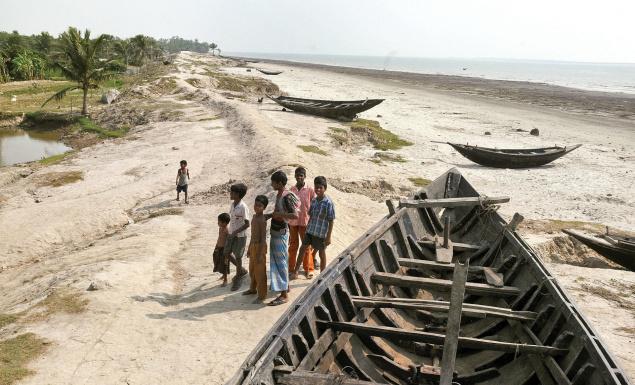
Mousuni, one of the 52 inhabited islands of the archipelago, and a vulnerable climate change hotspot, is sinking at a rapid pace. File photo. / The Hindu
Over 2,000 families affected, acres of farm land submerged
Large parts of Mousuni, a sinking island in the Sunderbans archipelago, have been submerged with tides rising because of the spring equinox.
“More than 2,000 families have been affected and hundreds of acres of agricultural land and several fisheries have been destroyed by the high tides,” Sheikh Ilias, panchayat pradhan of Mousuni told The Hindu on Tuesday.
Ilias said that he himself was standing in knee-deep water. Mousuni, one of the 52 inhabited islands of the archipelago, and a vulnerable climate change hotspot, is sinking at a rapid pace.
The island with a population of over 20,000 lies in the estuarine system and is open to the sea, said Tuhin Ghosh of the School of Oceanographic Studies, Jadavpur University. “As the sea level continues to rise, flooding will become a regular phenomenon,” Dr Ghosh said.
The 24-sq km island is the second most vulnerable island of the Sunderbans, next to Ghoramara island, whose population is about 5,000.
The panchayat pradhan claimed that damage to the island and the impact on the people is far more than it was during super cyclone Aila, which hit the Sunderbans in May 2009. “The embankments here have not been repaired since they were breached by Aila. About nine km of embankments has to repaired to prevent seawater flooding. The western part of the island is vulnerable to tides and regular flooding occurs, but this time the situation is grave,” said Ilias. He said the State government had provided foodgrains, but supply is not proportionate to the number of people affected. A UNDP report published in 2010 said that 15 per cent of the delta will be submerged by 2020.
source: http://www.thehindu.com / The Hindu / Home> News> Cities> Kolkata / by Shiv Sahay Singh / Kolkata – July 16th, 2014