The Lede – Big Wigs

The unsung wig makers of Bollywood

S Kabir created hairpieces for many major stars, including Amitabh Bachchan in the 1988 action film Shahenshah  /  S Kabir - Siraj Sheikh
S Kabir created hairpieces for many major stars, including Amitabh Bachchan in the 1988 action film Shahenshah / S Kabir – Siraj Sheikh

SURENDRA’S NATURAL HAIR STUDIO isn’t easy to find. But for the wigged wooden heads marking the entrance, this workshop in a grimy alley off Mumbai’s SV Road looks just like any other. Inside, however, it becomes clear that the studio belongs to one of Hindi cinema’s most sought-after wig makers, Surendra Salvi. The foyer walls are lined with photos of Salvi with actors—everyone from Salman Khan to Prem Chopra—sporting his toupees, beards and moustaches.

Salvi ushered me into a workshop where five uniformed employees created mesh bases for new wigs, and wove hairpieces and hair extensions. Almost all of Salvi’s wigs are made of natural hair, but he uses various amounts of synthetic material for those on tight budgets. “Natural hair is expensive,” he explained. Even-length, pre-sorted hair can cost up to Rs 70,000 per kilogram.

Salvi, a Mumbai native, told me he always wanted to be part of the film industry, though it took some time to break into the business. “First I did clerical work,” he said, “then I fitted car lamps for an auto company. Then I worked in a talcum powder factory. Then I had enough.” In the early 1980s, he started assisting the makeup duo of brothers Anil and Pradeep Pemgirikar by making wigs and beards for extras and body doubles. Over the following decades, he made it big on his own. His hairpieces have been used by Boman Irani in 3 Idiots, Shahrukh Khan in Ra.One, Akshay Kumar in Action Replayy, and many other superstars. When I visited two months ago, Salvi was fashioning wigs for director Anurag Kashyap’s upcoming Bombay Velvet. He also does work for regional films, television commercials, and individual clients.

Pradeep Pemgirikar, Salvi’s mentor, oversaw makeup, wigs and prosthetics for the films of director Manmohan Desai in the 1980s. He now runs Mod Wig Centre from his humble three-room house in Dadar, taking whatever work he gets from the Marathi and south Indian film industries. Pemgirikar, who said his best work was on the 1992 film Khuda Gawah, rued changing trends in the movie business. “Everyone wants a natural look now,” he said, “but in those days, every third character in a Manmohan Desai film had a wig.”

If the 1980s and 1990s had the Pemgirikars, the 1960s and 1970s—when bouffants, pompadours and beehives were all the rage—had S Kabir and Victor Pereira. Kabir came to Mumbai from Kolkata in the 1950s to assist his older brother S Amin, who was then already a makeup man and wig maker of repute. Kabir worked with almost all the leading men of the time, his son Siraj told me, and made wigs for such classics as China Town, Mirza Ghalib, Aandhi, Padosan, Sholay, Shahenshah and Kalicharan. But his most illustrious client was Pran, whose memorable get-ups from Upkar and Zanjeer to Amar Akbar Anthony and Don cemented his reputation as one of Hindi cinema’s greatest character actors.

Kabir passed away in 1994. Siraj is keen to keep his father’s legacy alive, and, with his brother Farooque, now runs the wig studio S Kabir & Sons, established by Kabir in the late 1950s, in Andheri East. “Wig making is an art, but it never gets the respect it deserves,” he said. “Even personal drivers and spot boys who serve chai to actors get mentioned in film credits. We often don’t.” An online search showed S Kabir credited for his work on only three movies, though Siraj claimed he actually worked on between seven and eight hundred films. Siraj also lamented the end of the era when prevailing fashions meant greater demand and profits, and more time to craft great wigs. He remembered being called on to make a hairpiece for Amitabh Bachchan several years ago. “They wanted it in three days,” he scoffed. “Is three days enough time to make a wig?” Sorting hair bought from wholesalers is a gruelling process, and the average wig requires at least five to seven days of work.

Victor Pereira, S Kabir’s contemporary, now lives in Mangalore, near his home town of Moodabidri. Although no longer associated with the film industry, he was happy to talk about his glory days over the phone. Having learned his trade in Mumbai from S Amin, Kabir’s brother, Pereira got his break on the 1969 film The Killers, starring Dara Singh and Helen. Although the film was a dud, he went on to craft all of Helen’s wigs from then on, putting his stamp on her looks in song videos such as ‘Piya tu ab toh aaja’ and ‘Mehbooba mehbooba,’ and films such as The Train and Don. Victor also worked, among others, with Hema Malini, Vyjayanthimala, Sharmila Tagore, Mala Sinha and Rekha. His most challenging project, he said, was director Kamal Amrohi’s 1983 release Razia Sultan. “Kamal Amrohi was such a stickler. Woh ek ek baal dekhte the (He used to check each strand of hair). He told me, ‘Hema Malini rani hai (Hema Malini is a queen). I want the best. Nothing else will do.’”

source: http://www.caravanmagazine.in / The Caravan / Home> Reporting & Essays / The Lede / by Roshini Nair / July 01st, 2014
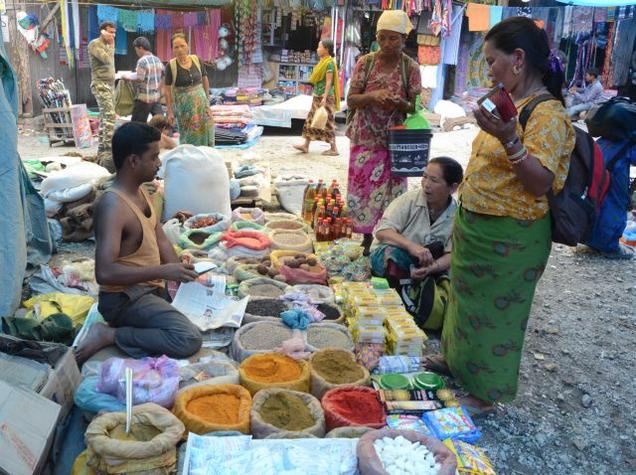
Toto language more endangered than tribe

Researchers and even the members of Toto community admit that the language is under threat and influence of others languages. File photo: Sushanta Patronobish / The Hindu

Language of primitive tribe has no script and is under influence of Nepali and Bengali: researchers

When scientists of the Anthropological Survey of India (AnSI) set out to conduct a study on language of the primitive Toto tribe, whose population has dwindled to 1,536, they did not realise that the language is more endangered than the tribe itself.

During their study they recorded the vocabulary, folklore, and even some songs in Toto language, and realised that the language has no script.

For centuries, the language that belongs to the Tibeto-Burman group of Indian languages, has survived in the small community completely orally without much research, Asok Kumar Mukhopadhyay, research associate, Linguistics (AnSI), one of the prominent members of the research team, who visited the hamlet of Toto tribe, told The Hindu.

“Being a small community, we found that the Totos communicate among themselves in their own language, but the moment they leave their hamlet of Totopara in Madarihaat block of Alipurduar district, they prefer to not communicate in the language even among themselves,” Mr. Mukhopadhyay said.

Under threat
Researchers and even the members of Toto community admit that the language is under threat and influence of others languages, particularly Nepali and Bengali, is increasing day by day.

Interestingly, despite the language lacking a script, members of the community, whose literacy rate as per a sample survey carried out in 2003 was just 33.64 per cent, have penned books and poems in their language albeit in the Bengali script.

Dhaniram Toto, one of the members of the community, has written two books in Toto language over the past two years.

Mr. Toto claims his book, Lokeswar, is about the folk culture of Totos and his other book Uttar Banga Lokpath is about folk tales of the community.

“Since our language does not have a script, I have to take help of the Bengali script,” he says, adding that there is an urgent need to develop a script for the language.

Mr. Toto, who is employed in West Bengal’s Backward Class Welfare Department, says there are others in the community such as Satyajit Toto, who write in the language taking the help of scripts of other languages.

Keep it alive
Their aim is just to keep the language alive. “We carried out this study to keep record of the language. It may happen in a few decades that the language may get extinct. The study of the Toto language is essential to understand the overall cultural ambit of the primitive tribe,” said Kakali Chakraborty, head of office, Eastern Regional Centre of (AnSI).

Day labourers
Totos, one of the primitive Himalayan tribes in the country, usually work as day labourers and porters carrying oranges from Bhutan to the local market in north Bengal.

Despite the geographical isolation of Totopara, the members have started laying emphasis on education, resulting in about half a dozen of graduates, which includes girls. But the elders point out that despite a number of schools being present in the locality, there is no one to teach the children in their own language, and as a result, the children are losing touch with their culture.

source: http://www.thehindu.com / The Hindu / Home> News> Cities> Kolkata / by Shiv Sahay Singh / Kolkata – August 01st, 2014

The Lede – Shoshimukhi’s Song : In search of the first voice recorded in India

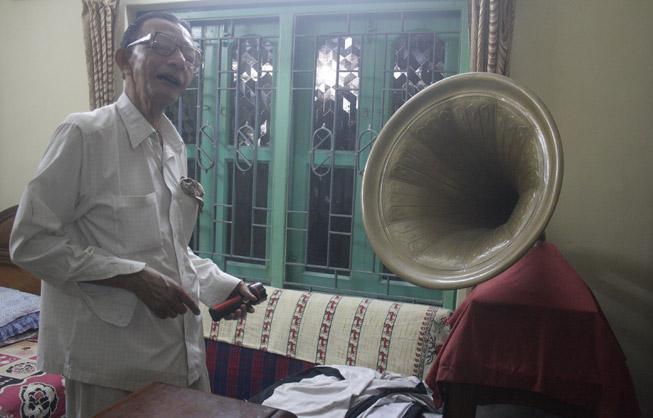
Panchu Gopal Biswas’s gramophone collection includes the first voice recorded in India, that of theatre actress Shoshimukhi - / Photo : SUDHITI NASKAR FOR THE CARAVAN
Panchu Gopal Biswas’s gramophone collection includes the first voice recorded in India, that of theatre actress Shoshimukhi – / Photo : SUDHITI NASKAR FOR THE CARAVAN

WHEN FREDERICK WILLIAM GAISBERG ARRIVED in India in 1902, he had a daunting task ahead of him. In a country that had never before encountered sound recording technology, Gaisberg, a recording engineer with the Gramophone and Typewriter Company had been assigned the job of recording promising voices for commercial distribution. On 11 November that year, in a hotel room in Kolkata, Gaisberg recorded the voice of Gauhar Jaan, a singer of Armenian descent.

Gauhar Jaan went on to become the first commercial recording artist in India, and her career and work are now legendary. But hers was not the first voice that Gaisberg recorded.

“It was Shoshimukhi,” said Indrani Majumdar, a Kolkata-based researcher and collector of old Bengali gramophone records. Shoshimukhi, Majumdar told me when I met her in her east Kolkata studio in March, was an actor in the city’s thriving theatre scene at the turn of the 20th century. “The first recorded content was a Bengali song, ‘Ami ki shojoni kusumeri’ (Is my beloved a flower),” Majumdar said. Gaisberg hadn’t been impressed with the voices of Shoshimukhi or Fani Bala, the other singer he recorded in his first session on 8 November. In his diary, he described them as “two little nautch girls … with miserable voices”.

Majumdar has been immersed in the early history of recording in India as part of a project to collect, digitise and archive 78 rpm gramophone recordings of Bengali theatre performed between 1900 and 1930. Her research, now funded by the India Foundation for Arts and the Berlin Phonogramm Archive, began seven years ago, after she chanced upon a collection of 400 records that belonged to her late grandfather. “Some had labels of drama companies on them,” Majumdar said. “Not much was known about the plays of this period. I thought it would be great if I could do something to restore that part of history.” In the course of her work, she has consulted a number of sources, among them Gaisberg’s own published diaries and researcher Michael Kinnear’s detailed book The Gramophone Company’s First Recordings, which identifies the matrix number of Shoshimukhi’s recording, India’s first, as 13024.

Majumdar’s research has given her a sense of how the theatre community in Kolkata reacted to the advent of recording technology. The fact that no recordings have been found of some theatre legends, like the actor, writer and director Girish Ghosh, suggests that not everyone took to the idea. “Probably because the 78 rpm records were considered a fluke”, said Majumdar. “These [records] typically played for two-and-a-half minutes to a minute more. How to cut down an hours-long play, or an elaborate thumri into that tiny time frame was the question.”

But others from the theatre community were enthusiastic, like Amarendra Nath Dutta, who introduced Gaisberg to Shoshimukhi, a performer with his company Classic Theatre. The theatre recordings went on to be successful, with listeners lapping up encore pieces of Bengali plays, theatre songs like Shoshimukhi’s, full plays recorded over multiple discs, and comic skits. “It’s not easy to know all the relevant information for lack of documentation. I have yet to find the song of Shoshimukhi. But the search is on.”

Having left Majumdar’s studio seized with curiosity about Shoshimukhi’s recording, I made some phone calls to friends in the Kolkata recording industry. Two days later, I sat in the Dum Dum house of Panchu Gopal Biswas, a retired employee of the Kolkata Municipal Corporation. “This is my collection,” Biswas said, pointing to the piles of records neatly stashed in cupboards all over the room. Fishing out a brown envelope from one pile, he carefully extracted a disc from it and laid it on the bed. A worn purple label had fading words on it—‘Shoshimukhi’, and in Bengali, the name of the song, ‘Ami ki shojonee kusumeri’. Stamped on the record was the matrix number—13024.

As the record began to spin on the player, the shrill voice of a young girl filled the room. I thought to myself: Gaisberg may not have been too harsh when he described the voice as miserable. The singer sounded nervous and out of breath. Then, midway through the song, she appeared to gain confidence. The breathing grew more controlled, the words clearer. The refrain was a passionate declaration of love—valo bashi, valo bashi.

“Don’t tell too many people about this,” Biswas said after the song was over, smiling apologetically as he put the record back in its pile. I asked if he would be willing to help a researcher like Majumdar. “Of course I will,” he said. “I’m in if it’s for non-commercial use.” As I made my way out of Dum Dum, my mind was filled with thoughts of Shoshimukhi, sitting in a hotel room all those years ago, surrounded by foreigners, singing into a machine.
_________________________________________________________________________

Sudhiti Naskar is a freelance journalist based in Kolkata. She likes to document people’s lives in moments of flux. She is regularly published in international magazines. She is currently represented by Agency Genesis.
_________________________________________________________________________

source: http://www.caravanmagazine.in / The Caravan / Home> Reporting & Essays> The Lede / by Sudhiti Naskar / June 01st, 2013

The Lede – Test of Metal : The Indian origins of a famous rugby trophy

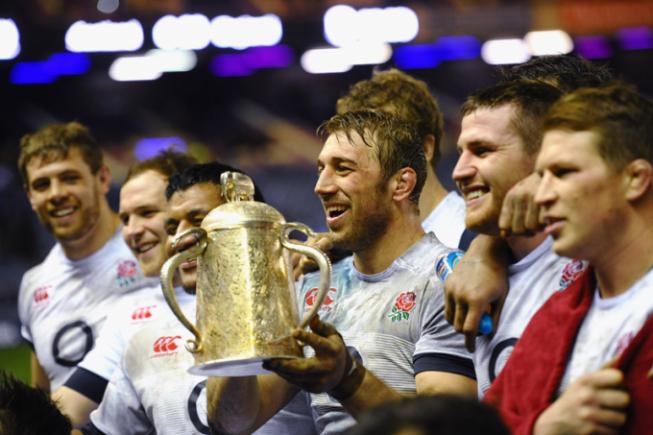
Chris Robshaw, the captain of the English rugby union team, holds the Calcutta Cup, which England retained in February - / Photo : Laurence Griffiths / Getty Images
Chris Robshaw, the captain of the English rugby union team, holds the Calcutta Cup, which England retained in February – /
Photo : Laurence Griffiths / Getty Images

On 8 FEBRUARY, before a crowd of 67,144 people, Scotland faced England at Murrayfield Stadium in Edinburgh as part of the 2014 Six Nations rugby championship. After 80 minutes of play on a muddy pitch, England secured an authoritative victory, with a score of 20–0. As disappointed home supporters filed out, up in the main stand Chris Robshaw, the jubilant English captain, held aloft an intricately engraved silver trophy, with three handles shaped like cobras and an elephant figure crowning its dome-shaped lid: the Calcutta Cup, the oldest trophy in international rugby.

The trophy Robshaw received was, in fact, a replica of the original cup, which is stored in the World Rugby Museum in Twickenham, near London. The museum’s curator, Michael Rowe, told me over the phone that although the cup’s significance has decreased in recent years, it was incredibly prestigious in its heyday, when it was “the Ashes in the sport of rugby.” What is most remarkable, Rowe said, was that the trophy’s origins can be traced back to the largely forgotten history of rugby in colonial India.

In the winter of 1872, a group of British émigrés having a hard time adjusting to life in Calcutta published letters in the Englishman, a prominent newspaper, asking that the administration organise rugby matches. A game was played on Christmas Day that year, with English players on one side and those representing Scotland, Ireland and Wales on the other. There is no record of who won, but the event was a success, and was repeated the following week. Those two matches led to the formation of the Calcutta Football Club in January 1873 (at the time, rugby was one of several related games called “football”). The club thrived—137 members joined in the first year alone—and it joined the Rugby Football Union, the sport’s governing body for all British territories, in 1874.

After a successful start, however, the club fell on hard times. A regiment of the British army left the city for a new posting, and new British arrivals were more interested in polo and tennis. According to Rowe, funds soon started running out, forcing the closure of the club’s free bar, which caused the membership to drop substantially. GA James Rothney, the club’s treasurer, secretary and team captain, considered several fundraising suggestions, but concluded that none of them would keep the club going.

Then, Rowe told me, in 1877, Rothney had an “ambitious” idea. He wrote to the Rugby Football Union suggesting that, to preserve the memory of the club, its remaining funds be used to make what he described as a trophy of “ornate Indian workmanship,” to be “devoted to the purpose of a Challenge Cup and presented to the Rugby Union to be competed for annually” in any way deemed “best for the encouragement of Rugby Football.” Both the Union and the club’s members agreed. Rothney withdrew the club’s remaining £60, a substantial sum at the time, in the form of 270 silver rupee coins. These were melted down in September 1878 by WE Jellicoe, a British silversmith and watchmaker on Calcutta’s Esplanade Row, to create the Calcutta Cup.

The cup was taken to Britain, and in March 1879 the Union organised the first Calcutta Cup match—a game in Edinburgh between England and Scotland, which ended in a draw. The contest was repeated in every following year, and the cup, Rowe said, quickly “became eponymous with the England–Scotland rugby game.” In 1883 it was incorporated into the Home Nations Championship, which eventually became the Six Nations—an annual rugby union competition involving France, Italy, Scotland, Wales, England and Ireland that is effectively the sport’s European championship. The cup has been contested every year since, except during the World Wars. England has won 68 of the 121 matches to date, with Scotland winning 39 and 14 matches ending drawn. England has retained the trophy since 2009.

Today, the original trophy is treated with special care. In 1988, on the night after England retained the cup, two drunk players, one English and the other Scottish, took it out onto the streets of Edinburgh, where they passed it between themselves and dropped it several times. The cobra handles were crushed, and the body and base badly dented. The Edinburgh jewellers Hamilton & Inches restored the cup to its original form, but, as Rowe told me, “silver is a soft metal,” and the restoration left the cup “in a fragile state.” The incident led to a decision to give both nations replica trophies, and store the original at the World Rugby Museum to avoid any further damage.

Rowe said that with the rise of other rugby-playing nations, the England–Scotland rivalry has mellowed in recent years, and so reduced the significance of the Calcutta Cup. But, he added, Rotheny’s idea to entwine the memory of the Calcutta Football Club into the history of rugby was a success. “It is quite remarkable that a short-lived club has such a place in the history of the sport,” he said.
_________________________________________________________________________

Atul Dev is a correspondent with The Sunday Guardian.
_________________________________________________________________________
source: http://www.caravanmagazine.in / The Caravan / Home> Reporting & Essays> The Lede / by Atul Dev / 2014

Prince Dwarakanath lies forgotten in a corner of London

On August 1, 1846, a treacherous thunderstorm raged through London. ‘Vivid flashes of lightning’ struck, the wind howled, and in a hotel room, very close to Bond Street, a ‘Prince’ died. Dwarakanath Tagore was only 52 when he died in the company of just two members of his vast family — a son and a nephew.

Four days later, they buried him, without ceremony in Kensal Green Cemetery. Among the mourners were his youngest son Narendranath, nephew Nabin Chandra Mukherji, four medical students who had accompanied him on his trip to England and his former partners Major Henderson and William Prinsep. Queen Victoria and Prince Albert — who had welcomed him to their court like ‘an old friend’ just over a year ago — sent four carriages. It was a princely send off.

Whatever may have been his reputation back home, in London Dwarakanath was the darling of fashionable society. He gave lavish parties, dined with royalty in England and France, showered his friends and hosts with expensive gifts and gave generously to charities. He was immensely popular with European ladies and made no attempt to conceal his many ‘friendships’. He even kept a boat on the Thames with a certain Mrs Caroline Norton — a divorced, small-time Victorian poet of some ‘beauty and wit’ — where he hosted the literati of the day from Charles Dickens to WM Thackeray.

It is all a very different picture today. Although, the city that he so loved continues to remain popular with most of his fellow countrymen, not many people come to see him. We took the Bakerloo Line on the Underground, got off at Kensal Green Station, and turned left. It was late September and the trees had started changing colour. Kensal Green is huge — 72 acres in fact — and is one of London’s oldest and most distinguished public burial grounds. It has many celebrated residents from scientists, botanists, actors and royalty — Ingrid Bergman and Freddie Mercury among them.

But just as we walked though the very impressive archway of the main gate, we realised we were quite lost. In the absence of any map or directions it was near impossible to find Dwarakanath. Although I knew what his grave looked like, I had no idea where it was. And there was not a soul in sight. A little later, a group of Americans ambled in for a guided walk with a ‘Friend’ of Kensal Green. And this ‘Friend’ – locals who volunteer their time – showed us the way.

Just yards from the main gate, where we had been rummaging the last half hour, lay Dwarakanath. The ground was a little sunken. The grave, simple and grey, simply said ‘Dwarkanath Tagore of Calcutta’. Obit 1st.

The ‘Friend’ who knew a bit about the man seemed curious in our interest. “Nobody visits him these days. Not even on his anniversary. You would think someone from the Indian High Commission or his fellow Bengalis would come to lay flowers. But, I have seen no one.”

Standing there — a little overgrown and overlooked by numerous other graves of different ages — it is difficult to imagine the life and times of Dwarkanath Tagore, once the ‘most prominent citizen’ of Calcutta and the leading force behind the first joint-stock commercial bank in India, Union Bank. Pioneer, philanthropist and partner in Carr, Tagore and Co, Dwarkanath dabbled in everything from customs, salt, tea, coal and steam navigation to indigo and sugar plantations and opium. A great friend of Rammohun Roy, he was a strong voice behind the anti-Sati movement, freedom of Press in India and women’s education. Never shy of controversy, he was almost the self-styled mayor of Calcutta at one point.

The hotel where he died still stands, although under a different name. Brown’s Hotel on 33, Albermarle Street is now a luxury five-star hotel in Mayfair. A room for a night costs anything between £460 and £3,000 and a Sunday three-course lunch for two will set you back by £100. A stay fit for a ‘Prince’ indeed.

— The author is a former journalist who has worked for British and Indian newspapers. She now works at Bath Spa University

source: http://www.timesofindia.indiatimes.com / The Times of India / Home> India / TNN / August 01st, 2014

Feast of Jesuit founder today

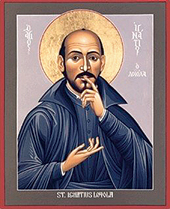
The 20,000 Jesuits and their institutions all over the world celebrate the feast of their founder, St. Ignatius of Loyola, on July 31.

FatherIgnatiusKOLKATA31jul2014

Ignatius was an unusual character of the 16th century, a brave knight and soldier under King Ferdinand of Spain. In 1521, he was wounded in the battle between France and Spain. His life was transformed during his long convalescence and he founded the Jesuit Order, the Society of Jesus, along with Francis Xavier at the University of Paris in 1537, which was approved by the Pope in 1540.

Perhaps Jesuits impart the best-known education in India and elsewhere. They have come to be known in the public mind for their educational work and have acquired the reputation of being among the world’s best educators and educationists.The Jesuit educational network is the largest in the world today.

The Jesuits conduct no less than 50 university colleges, 17 institutes of business administration and 210 high schools across the country; almost all of them are among the most reputable ones. More than 500,000 students belonging to every religious, linguistic and socio-economic group, receive their education at these institutions.

The situation is the same wherever the Society of Jesus has established itself for the greater glory of God. There are 28 Jesuit universities in the US.

As Malachi Martin has said in his book, The Jesuits, “Jesuits always aimed to be the best. And they were. They had a part to play in every major political alliance in Europe and America, in Asia and Africa. They became shapers not only of religious history, but also of world history. Even Nazi generals (incl. Hitler) dreamed of such a cadre of men; and even Lenin envied them.”

Historian Romila Thapar has stated that if India has a written history; the credit goes to the Jesuits.

St. Xavier’s college and school will remain closed on July 31 in honour of their founder. Here’s wishing all Xaverians, present and past, a very happy feast of St. Ignatius of Loyola.

The writer is the principal of St. Xavier’s College, Calcuta
source: http://www.telegraphindia.com / The Telegraph, Calcutta / Front Page> Calcutta> Story / by Fr. Felix Raj / Thursday, July 31st, 2014

Unique memorial service to honour brave airmen

Kolkata :

On Saturday, a unique memorial service was organized at the Rasgovindpur Airstrip (also known as the Amarda Road Airfield) in Odisha to honour 14 airmen of the Royal Air Force (RAF) who were killed in a mid-air collision between two B-24 Liberator bombers on July 26, 1945. It was Bhubaneswar-based war historian Anil Dhir who dug up this historical fact. He along with Aditya Patnaik of the Gandhi Eye Hospital and school children were among those who laid wreaths in memory of the dead airmen.

“Very few people are aware that 69 years ago two Liberators (EW225 and EW247) collided at low altitude during a practice flight. They were part of a six-aircraft contingent from the Air Fighting Training Unit engaged in a formation flying exercise. The Rasgovindpur Airstrip had the longest runway in Asia (more than 3.5 km). The total length of the runway, taxiways and aprons was more than 60 km. Part of the runway (nearly 11,000 feet) still remains but there is no activity save for the grazing of cattle. This airfield played a very crucial role in the defence of India during World War II. It was a forward airbase against the Japanese and was used for ‘Over the Hump’ operations as well as training pilots for special bombing raids. Unfortunately, there aren’t any details available of the activities that took place here between 1943 and 1945, even in military archives,” Dhir says.

It was during a visit to the Madras military cemetery that Dhir came across the graves of 14 airmen who were killed at the Amarda Road Airstrip crash. It took a lot of doing on his part to find out that the 900 acre airstrip was built at a cost of Rs 3 crore in the 1940’s. During his research, Dhir received assistance from Matthew J Poole from the USA who has studied the crash and prepared a report. With Poole’s assistance, Dhir was able to locate the relatives of none of those killed in the air crash. One of them is 101 years old now.

“The two aircrafts took off from the airfield in Odisha but the crash took place over West Bengal. The debris was strewn across flooded paddy fields in Bengal. I have requested both the Odisha and Bengal governments to erect small memorials at the airfield and the crash site to honour the brave souls who gave up their lives for the defence of our motherland,” Dhir added.

source: http://www.timesofindia.indiatimes.com / The Times of India / Home> City> Kolkata / by Jayanta Gupta, TNN / July 29th, 2014

Mohun Bagan kicks off quasquicentennial celebrations

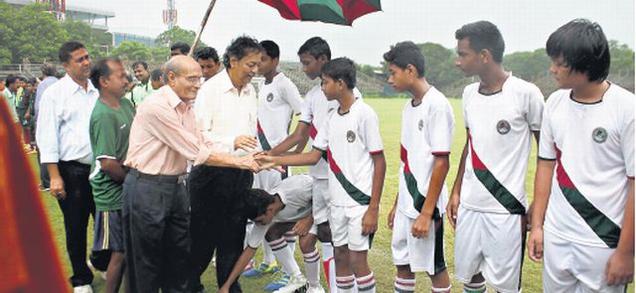
Samar (Badru) Banerjee, the Indian captain of the 1956 Melbourne Olympics football team and one of the oldest surviving football stars, meeting the Mohun Bagan junior players accompanied by the Mohun Bagan secretary Anjan Mitra. Photo: Special arrangement. / The Hindu

A group of senior members sitting on the redecorated galleries in the Mohun Bagan ground trained their gaze on the dark clouds gathering yonder signalling imminent rain.

A group of senior members sitting on the redecorated galleries in the Mohun Bagan ground trained their gaze on the dark clouds gathering yonder signalling imminent rain. Their faces lit up at the prospect, as rains have become synonymous with the successful celebration of one of the most notable victory in the annals of Indian sport – the IFA Shield triumph in 1911.

Mohun Bagan loves to associate itself with that epochal win against the British East York Regiment and celebrates the day (July 29) as its foundation day.

In keeping with that tradition, the club this year sought to begin its quasquicentennial celebrations from Tuesday as the exact date of its foundation remains uncertain.

“It was established in 1889 and in August, but it is not known exactly on which the date it was founded,” says Subhransu Roy, a noted sports researcher from the city. The day saw a big gathering of former players, members and the media, and the club sought to commemorate the occasion befittingly by organising a host of ‘friendlies’ on its ground.

The club management used the opportunity to announce a bigger function at an unannounced date to make the 125 years celebrations more memorable. “We are the oldest and one of the most popular football clubs in Asia. Mohun Bagan symbolises a way of life in Bengal and that has sustained our popularity for all these many years,” says Mohun Bagan general secretary Anjan Mitra. “We have planned big celebrations and hope to bring them around by September,” he added.

Mohun Bagan successfully completed the club licensing criterion this year and entered the threshold of professionalism. “The club ran on the patronage of Kings and Zamindars in the early years, but continued to receive popular support for its notable performances on field. What is remarkable here is the transcendence from an amateur set-up to a more corporatised arrangement,” says Mr. Roy.

Much like its later cousin and traditional rival, East Bengal Club (established 1920), Mohun Bagan has a big community support which is ever growing. “Mohun Bagan has been able to retain its identity as the champion club of India despite not always performing. In recent years, it has not done well in the national tournaments, but its popularity remains intact,” says Mr. Roy.

“We have thousands of people waiting to become members of the club. This is the image of the club, and the older it grows the more popular it will become,” says Mr. Mitra, the secretary of the club since 1995.

source: http://www.thehindu.com / The Hindu / Home> News> Cities> Kolkata / by Amitabha Das Sharma / Kolkata – July 30th, 2014

Kolkata couple’s ‘Labour of Love’ on way to Venice Film Festival

Kolkata :

A film made by a couple from Salt Lake is on its way to the prestigious Venice Film Festival in the next couple of months.

The film, ‘Asha Jaoar Majhe’ (Labour of Love), is devoid of dialogues, though thoughts are communicated through expressions and music. “It’s a positive, simple, easy-going film on love. We’ve shown communication without words. I want people to come to see how love can be expressed by two people without having to speak at all,” said director Aditya Vikram Sengupta.

“In the film, the love is expressed through the most mundane things. In life, I have received love in several forms, from my mother, family members… It wasn’t like they pointed out and exhibited every day how much they loved me. But little actions showed me how much thought and care went behind each,” said Sengupta.

The film features actors Ritwick Chakraborty and Basabdutta Chatterjee. It’s in the race for not one but three awards at Venice – Luigi De Laurentiis Award (Lion of the Future (best debut)), Venice Days Jury Award and Venice Days Public Award.

“We haven’t been able to run it in Kolkata yet as films can’t be screened before the festival in order to be eligible. It’s a non- dialogue film as we felt there was no reason for dialogue just to fill up a silent moment,” said his wife Jonaki, who is executive producer and art director.

The couple, currently settled in Mumbai, produce and make ad-films for a living. “Half of the film was shot by Mahindra J Shetty, who was the cinematographer for ‘Udaan’ and ‘Lootera’. The other half was shot by me. The movie was made with a very small production crew of around 10, and on a very low budget,” added Sengupta.

On the cast, he said: “I took many auditions, but couldn’t find the right face for the role. Basabdatta fit in perfectly. She has a very classic look. Ritwik didn’t complain even if I kept calling for retakes. Some shots were taken 20-30 times. I’m grateful to the actors for their patience. Just because it’s a non-dialogue film doesn’t mean it’s a silent film or an art-house film. I think even 15-year-olds, who have some concept of love, will appreciate and enjoy it.”

The film, primarily set in the city, was extensively shot in north Kolkata. “That’s because my characters live in north Kolkata,” Sengupta explained.

source: http://www.timesofindia.indiatimes.com / The Times of India / Home> City> Kolkata / TNN / July 28th, 2014

Portraits of a city in motion

Caleidoscope

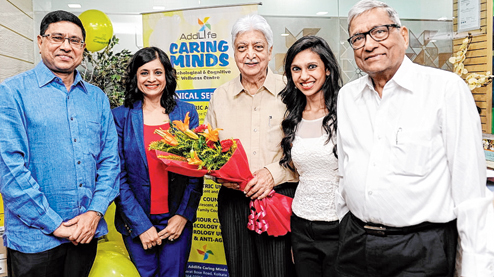
(From left) Sanjay, Minu, Preeyam and HP Budhia with (centre) Azim Premji, the chairman of Wipro, at Addlife Caring Minds on Friday. Premji found the centre impressive. “It is an integrated centre that can address multi-faceted issues,” he said. “The team is young, talented and experienced.” He also cut a cake to celebrate his birthday, which falls on July 24. Picture by Rashbehari Das

A walk through former photojournalist Tanmay Chowdhury’s exhibition reminds visitors of the maxim — a picture is worth a thousand words.

Chowdhury’s photographs, which were on display at Weavers Studio, are manifestations of his perception of Calcutta, a city with “endless scope”.

“I have been to the same riverside, the same ghat a number of times. Yet, every visit has given me a new form, composition and a picture,” Chowdhury said.

His favourite haunts are the ghats and underpasses near Howrah bridge and station, places that see the birth of new stories everyday. “Every person in the picture has a character, a reason for him/her being there and a story. I like to bring out and display their stories,” said the business graduate from Illinois.

Photographs at the exhibition, titled Mise en Scene, were not restricted to Calcutta alone. There were pictures from Mumbai as well. One that caught the eye was of pigeons taking flight in front of The Taj Mahal Palace.

A projector also played a short film by Chowhdury on a screen. “My work attempts to throw light on the underlying relationship between photography and film by composing local street drama in a cinematic way,” said the artist. “Hence, I’ve arranged to exhibit my photographs along with this film. Photography is basically capturing a moment from the motion of life. And if you notice, you will find a figure in motion in each of my pictures here. I wanted a balance between the two.”

Play for kids, by kids

About 40 children participated in three plays staged by Eso Natak Shikhi at Star theatre recently.

All the plays were scripted and directed by the founder-director of Eso Natak Shikhi, Tapas Das. “The kids worked really hard and rehearsed every Sunday evening under my guidance. My idea is to give them a break from lessons. It’s more about enthusiastic participation than outstanding performances,” he said.

Ayantika Biswas, a first- year political science student at Jaipuria college, has been training with Das for five years. “It has become an addiction I can’t let go of. Rehearsing for plays is a great stress-buster and gives me a lot of confidence,” said the girl who played the protagonist’s mother in Moner Katha.

The other plays staged were Maronastro and Khwaish.

Compiled by Trina Chaudhuri and Showli Chakraborty

source: http://www.telegraphindia.com / The Telegraph, Calcutta / Front Page> Calcutta> Story / Caleidoscope / Sunday – July 27th, 2014