The hub in south Kolkata’s Ballygunge will encourage aspirants to showcase their mastery with words as well as their elocutionary prowess through sessions conducted by leading litterateurs, artists, filmmakers and anybody who is associated with writing and reading.
“The club will have four sessions a month, that is, one session per week every Thursday starting August 7. Guests will have to pay Rs 500 for the four sessions. It is open for all,” Ritika Choudhury, owner of Circle Art 360, one of the organisers, said.
A collaborative effort by AHAVA Communications, Circle Art 360 and Creative Studio, the club will be a haven for book lovers as well with discussions and book launches.Choudhury said the organisers are also mulling international partnerships.
source: http://www.post.jagran.com / Post Jagran / Home> States News> East India News / Jagran Post News Desk – Jagran Post Editorial / August 02nd, 2014
Ratan Lal Hangloo has shown that things can be done in Bengal. That real change is possible. Kalyani University is undergoing a remarkable transformation under him – a revolution of sorts that can be a role model for not just academic institutions in Bengal but every sector to pull the state out of this morass.
Hangloo, a respected historian with roots in Kashmir, has been at the helm of Kalyani University for just nine months but it has been like a rebirth for the varsity that had sunk into a cesspool of indiscipline, employees’ agitations, corruption, nepotism and neglect. He has survived Bengal’s political minefield so far with a blend of toughness and pragmatism (plus skills with a camera) and shown great skill in handling explosive controversies like the Bhaktabala BEd seat scam.
At first sight, Hangloo hardly comes across as a disciplinarian. With a quick smile and ready wit, he looks every bit the charming professor he is. But beneath the exterior lurks an administrator with a mission.
He recalls that he joined on a Friday (November 8, 2013) and instead of spending a relaxing weekend, he picked up his camera and went scouting, clicking every part of the campus – from laboratories to lavatories and classrooms to hostels. He has all the images stored in his office computer as evidence of what the campus and its buildings looked like nine months ago.
He ordered an immediate clean-up drive, along with a bold bid to “secure the campus”. He first got the breaches in the university’s boundary wall sealed to stop trespassing, which was common. Locals living on the periphery of the 300-acre campus fiercely opposed it but he wouldn’t budge. There is now a sense of order and security on campus, which looks clean and green.
But more important than these cosmetic changes are the systemic transformations he has brought about. He has introduced rules where none existed. When he took over, the university did not have a leave register for employees and faculty and not even something basic as an academic calendar. There were no records of equipment worth crores of rupees. “I got leave registers made, had a teacher audit all equipment. This university has received a lot of funds since its inception in 1960, but most of it was not spent properly. All the construction has been very shoddy and I have asked engineers to carry out structural evaluations and undertake repairs. In six months, the campus will look much different and all buildings will sport a new look,” Hangloo told TOI.
Hangloo has displayed rare courage in taking on troublemakers. For instance, his predecessors used to live in fear of a casual employee, who used to bully and dictate terms to senior officers. “This man was the leader of a politically-backed employees’ union and had even ransacked varsity offices, including the VC’s chamber. A few months ago, I got to know he was inciting security guards. I sacked him summarily,” said Hangloo, who also evicted the unions from their rooms in the administrative building.
He has asked every officer to prepare a ‘PSO (problems, solutions, outcome) Report’ every month and introduced a docketing system to keep track of files. For the first time in its history, KU now has a prospectus and an academic calendar. Regulations governing PhD admissions were framed and a half-yearly newsletter (another first) is being published.
The new VC has constituted 22 committees comprising teachers and non-teaching staff to deal with various activities. There are, for instance, committees on purchases, security, and upkeep of vacant land. This has brought in a lot of transparency and efficiency and no one can now bully officers into doing anything wrong, say officials.
The go-getter sets a personal example through hard work and diligence. He’s at his wood-paneled office at 9am sharp and continues working till 9.30pm. The varsity is on the cusp of other physical changes also: construction of a new administrative building, auditorium, staff and faculty quarters will commence soon. Three new centres for women’s studies, cultural studies and for studies on the Bengali Diaspora have started functioning at KU. Hangloo’s immediate plans include upgrading of courses, two new smart classrooms for every department, upgrading technology in the campus and enabling cutting-edge research in every field.
Hangloo, who relaxes with a burst of badminton and a dose of music (he has Pannalal Bhattacharjee’s ‘Shyamasangeet’ loaded on his phone) every evening, deals with problems and opposition with equanimity. He recalls a quote from Vivekananda: “You’ll be ridiculed, opposed and then accepted at any new place”. Hangloo is keenly aware of the legacy of Kashmiri Pandits’ contribution to Bengal: “Pandit Sambhu Nath Bhatt, JN Sapru and Jolly Mohan Kaul had rich associations with Bengal. I, too, would like to be remembered for doing my bit for the cause of higher education in Bengal”. Going by the work he has done in Kalyani over the last nine months, Hangloo seems all set to live up to that legacy.
source: http://www.timesofindia.indiatimes.com / The Times of India / Home> City> Kolkata / TNN / August 07th, 2014
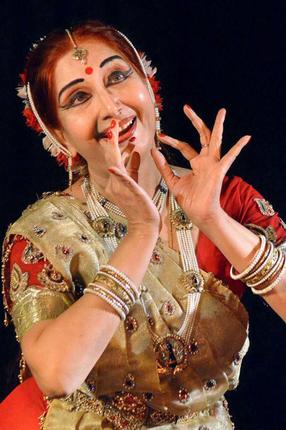
Amita Dutta in performance. Photo: Prashant Arora / The Hindu
Kathak dancer Amita Dutta, recently conferred the first Uday Shankar Award for Lifetime Achievement, talks about pursuing the art form and her endeavour to formalise a Bengal gharana. NITA VIDYARTHI
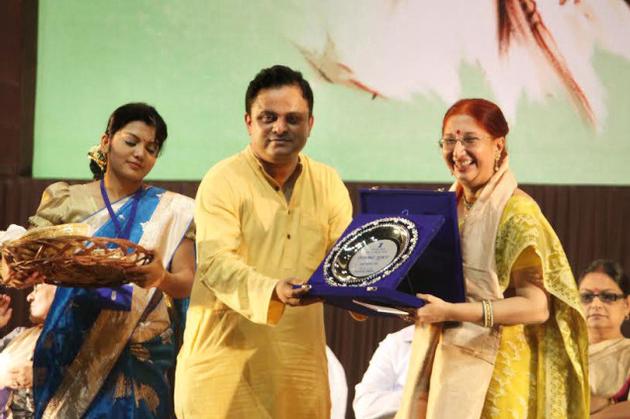
Acclaimed dancer, choreographer, scholar and professor Amita Dutt has recently been conferred the fist Uday Shankar Award for Lifetime Achievement in Dance by the West Bengal Government. Trained in Kathak under stalwarts like Pandit Birju Maharaj, Pandit Vijay Shankar and Bela Arnab, Dutt, the erstwhile Dean of Kolkata’s Rabindra Bharati University, has also been conferred the prestigious Uday Shankar Chair at the University after a gap of 17 years. Dutt, also Director of Performing Arts at the University, has performed and taught extensively at home and abroad and is striving to establish a Bengal gharana of Kathak. Excerpts from an interview:
You have been conferred the prestigious Uday Shankar Chair at Rabindra Bharti University after years. What edge do you think you have over others?
It is not for me ‘to reason why’. One external expert did ask me, how Uday Shankar was important to me as a classical dancer. I had answered that he taught us how to present our dance before a modern audience, on a proscenium stage. Earlier, dancers were engrossed with technicalities and grammar of dance. They did not view the presentation from the angle of the audience. The use of the stage space, lighting, costumes, patterns formed by various dancers and the attention span of the audience were all very important for Uday Shankar. And he was constantly seeking new avenues of expression through dance, never being satisfied with simply copying something that was learnt. In fact, Tagore had also advised Uday Shankar not to be confined within one geographical area or one historical period, but to thirst for new creative expressiveness. I have constantly endeavoured to adhere to these tenets and make my performances attractive and acceptable to a modern-day audience spread across the continents.
Recieving the Uday Shankar Award from the West Bengal Education Minister in Kolkata. Photo: Amrita Dutta / The Hindu
Do you feel any emotional identification with this position?
Yes, I do. My relationship with the great artist is not through blood but through thoughts and ideas. I always consciously carry with me his legacy. Incidentally, there have been many occasions when his name was associated with me. I am the professor in the Uday Shankar Chair, I performed in the first Uday Shankar Festival of the State Government and received the Lifetime Achievement Award in Dance from the Government this year.
How have you justified Uday Shankar’s creativity in your choreography?
I have choreographed many dances using different dance styles. In them, I have gone beyond Kathak. I have used my knowledge and with the inspiration coming from god, Tagore and Uday Shankar, I created many new presentations under the banner of my University. These have been presented in many important festivals across the country.
Your Kathak boundaries have not stretched beyond use of formations…
Yes. I have brought in many creative formations in my choreography. In my presentation on Ganga, I have tried to emulate the movement of the river — sometimes torrential, sometimes meandering, and also the ideas and images associated with the river: both natural and religious. I have also blended our traditional Kathak movements and rhythmic formations within my new creations. The sound of falling rain is shown through footwork and onomatopoeic rhythmic compositions.
How else would you suggest one should expand the boundaries of Kathak? At times, dancers have stretched the boundaries so far that the audience failed to identify the dance numbers as Kathak.
You began to choreograph with works of Tagore, Atul Prasad and Nazrul and then D.L. Roy. How was the creative (setting to music) process different from the classical form?
The creative process is similar. I have always worked on songs and music that have appealed to me, whether traditional or modern, classical or light, eastern or western. Actually, when you are creating a dance piece, you don’t calculate or think with your left brain. Ideas, images, rhythmic compositions and movements dawn on you. Of course, they usually emanate from your storehouse of knowledge, what you have learnt or seen or imbibed. But at times, ideas and images have come to me through my reverie or even my dreams.
Is the use of the celebrated literature a precursor to your establishing the Bengal gharana?
Yes, while working on the various literary works, the idea of an independent Bengal gharana dawned on me. Initially, I had started choreographing on these songs because I loved them. The fact that the audience responded with equal enthusiasm gave me an impetus. And one leading to the other, now the concept of our Bengal gharana has gradually started taking shape. The majority of my performances are for the Bengali audience who enjoy hearing well known Bengali songs. And songs of the last century are still very much alive in the popular Bengali consciousness. In fact, members of my audience participate in D.L. Roy’s patriotic and romantic thoughts more than in Awadhi thumris, chaitis and kaajris. The difference between the Lucknow and Jaipur gharanas was tangible at one time. Today, they are blending into each other as the repertoire is being borrowed or copied and the styles influencing each other. The present-day Benaras gharana artists have learnt from stalwarts of the Lucknow and Jaipur gharanas and there is more of an influence of these gharanas on their dance than an adherence to the precepts of their founder Janki Prasad. I, too, have learnt from stalwarts of the Lucknow and Jaipur gharanas. But what I perform today is not a mere copy of what I have learnt. I have evolved a style of my own which is more melodic than rhythmic, more interpretative than abstract, more lilting than staccato. And I have a large body of choreographic creations on Bengali songs: Tagore, Nazrul, D.L. Roy, Sachin Dev Barman, Salil Choudhury, as well as the traditional Baul songs and kirtans.
Will you be choreographing other poets’ work of that era?
Yes, I wish to. I am working on the lyrics of Vivekananda and Rajani Kanto.
source: http://www.thehindu.com / The Hindu / Home> Features> Friday Review> Dance / by Nita Vidyarthi / August 07th, 2014
British Baptist Missionary William Carey, who was the driving spirit behind the spread of modern English education in Kolkata, will once again be remembered on his 253rd birthday on August 17. The Bible Society has organised for a Carey Lecture to be delivered by Jawhar Sircar, the CEO of Prasar Bharati.
Sircar has been researching on old Kolkata for a long time and will focus his lecture on the Bengal Renaissance and the role of Carey behind it.
This will be followed by a dance drama, Dhrubojyoti Tumi directed by danseuse Alaknanda Roy. The performers are inmates of correctional homes.
source: http://www.timesofindia.indiatimes.com / The Times of India / Home> City> Kolkata / by Jhimli Mukherjee Pandey, TNN / August 07th, 2014
Justice Manjula Chellur. Photo: Thulasi Kakkat / The Hindu
After being administered the oath, Justice Chellur referred to her personal fondness for the rich heritage of the State.
Justice Manjula Chellur was sworn in as the first woman Chief Justice of Calcutta High Court here on Tuesday.
Governor Keshari Nath Tripathi administered the oath of office at Raj Bhavan during the day and Chief Minister Mamata Banerjee was present on the occasion.
37th Chief Justice
Justice Chellur is the 37th Chief Justice of Calcutta High Court replacing Justice Arun Mishra who was elevated as a Supreme Court Judge.
After being administered the oath, Justice Chellur referred to her personal fondness for the rich heritage of the State.
Gratitude
She expressed her gratitude to the Chief Justice of the Supreme Court of India for appointing her to the high office of the Chief Justice of Calcutta High Court.
Along with the Governor and Chief Minister, Law Minister Chandrima Bhattacharya and Speaker of the Assembly Biman Banerjee were present.
The event also witnessed participation of a large number of lawyers of Calcutta High Court.
Born on December 5, 1955, Justice Chellur started her career as an advocate in Bellary and became the first Judge of Karanataka High Court in 2000.
She was appointed Acting Chief Justice of Kerala High Court in November 2011 and had been functioning as the Chief Justice of the High Court since September, 2012.
source: http://www.thehindu.com / The Hindu / Home> Cities> Kolkata / Special Correspondent / Kolkata – August 06th, 2014
West Bengal has now secured first position in the field of micro, small and medium enterprises (MSME) sector, posted Bengal chief minister Mamata Banerjee on her Facebook page. “Our Micro, Small and Medium Enterprises (MSME) Sector is now No. 1 in the country with more than 35,000 new units having been set up with employment of nearly 3.20 lakh people and highest credit disbursement worth Rs.35,000 Crores over the last three years in the state,” the CM posted.
“We have been organizing SYNERGY since September, 2013 to provide more customized solutions to the MSME entrepreneurs t hrough hand holding support and personalized guidance. Nearly 40,000 entrepreneurs visited the clinics, help desks and technology pavilions and bank loan worth hundreds of crores were sanctioned to nearly 1800 enterprises in this first-ever state level conclave,” the CM posted.
“In 2014 we adopted the strategy of taking Synergy closer to the field level and accordingly we organized the first regional Synergy at Siliguri in February this year. The second regional Synergy was held at Howrah on 1-2 August, 2014. Loans worth Rs 1000 Crore were sanctioned and investment proposals close to Rs 5000 Crore were received in the Synergy at Howrah,” the chief minister further posted on her facebook page.
The state government is working on developing more and more MSME clusters in the state so that entrepreneurs, specially women and self help groups can come up with their handicrafts items.
Our Micro, Small and Medium Enterprises (MSME) Sector is now No. 1 in the country with more than 35,000 new units having been set up with employment of nearly 3 lakh 20 thousand people and highest credit disbursement worth Rs.35,000 Crores over the last three years in the state.
We have been organizing SYNERGY since September, 2013 to provide more customized solutions to the MSME entrepreneurs t hrough hand holding support and personalized guidance. Nearly 40,000 entrepreneurs visited the clinics, help desks and technology pavilions and bank loan worth hundreds of crores were sanctioned to nearly 1800 enterprises in this first-ever state level conclave.
In 2014 we adopted the strategy of taking Synergy closer to the field level and accordingly we organized the first regional Synergy at Siliguri in February this year. The second regional Synergy was held at Howrah on 1-2 August, 2014. Loans worth Rs 1000 Crore were sanctioned and investment proposals close to Rs 5000 Crore were received in the Synergy at Howrah.
source: http://www.timesofindia.indiatimes.com / The Times of India / Home> City> Kolkota / Suman Chakraborti, TNN / August 05th, 2014
Jang Kun Lee (left) and Seong Ryeol Kim. / Photo: Special arrangement / The Hindu
In a cluster of doughty Indian kabaddi players the presence of a South Korean creates an outlandish effect, true to his name, the Korean has been noted for his speed and agility.
In a cluster of doughty Indian kabaddi players the presence of a South Korean creates an outlandish effect.
Jang Kun Lee seems to have leapt out of a martial art move and landed straight on the kabaddi mat to salvage his Indian hosts from crisis. This is how the plot seems to be unfolding for the Bengal Warriors in the Pro Kabaddi League, where the 21-year-old South Korean, who calls himself a student of the sport, has already become a hero for the team.
Jang Kun Lee, who shares a part of his name with the celebrated martial art exponent Bruce Lee, has raised the expectations of his Indian teammates, something akin to the exploits of the celluloid hero. Lee is the raider (attacker) every defence dreads and the South Korean showed he is a quick learner as he picked up successive ‘Best Raider’ awards in the back-to-back matches his team Bengal Warriors won when the second round of the recently-launched STAR Sports Pro Kabaddi tournament hit the city this weekend.
His speed and agility are already a talk of the tournament. The player says it comes from his experience of playing the martial art sports like judo and taekwondo. “The tournament is a big learning experience for me and it really feels nice to be apart of it,” Lee said, after picking up his second best raider award.
The Korean interest in Kabaddi does not stop with Lee. The secretary general of Korea Kabaddi Association Yoon Young-hak is closely monitoring the education process of his boys. The other Korean player with Bengal Warriors, Seong Ryeol Kim, is a defender and had already made his debut with the Warriors. Young-hak insists that Kim is also a player of great merit. There are two more Koreans – Dong Ju Hong and Tae Deok Eom who play for Dabang Delhi and Patna Pirates – but it is Lee who is currently hogging the limelight.
Lee went on to reveal the secret of his instant success. “We have a different training procedure in Korea where we focus more on weight training and other strength-building measures. That probably makes us quick and agile. Indians are the best in the world in technique, but I am not sure about the time they devote to weight training,” he said.
The South Korean player says the newly designed professional tournament like Pro Kabaddi will help the sport gain the attention of the world.
“Kabaddi is yet to pick up in our country. The good performance of players like Lee or Kim will definitely help the sport grow in our country,” said Young-hak appreciating the way Bengal Warriors is using his compatriots. “We are preparing for international tournaments like Asian Games and our experience here will form an important part of our training and understanding of the game,” Yoon Young-hak said, adding that his country also is taking the help of coaches from Sports Authority of India to train their players.
Sakina khatun with the bronze medal she won at the Commonwealth Games in Glasgow. / The Hindu
Her success is all down to her hard work: coach
Life has not been kind to Sakina Khatun, who won a bronze medal at the Commonwealth Games on Saturday.
In Glasgow’s Clyde Auditorium, the 25-year-old Bangalore-based para-athlete lifted a weight of 88.2 kg to finish third in the women’s powerlifting event (Lightweight Group A). It was a success that came after prolonged hardship.
“My parents cried when I broke the news to them on the phone,” she told The Hindu from Glasgow.
Her coach and mentor Farman Basha, who also competed at the Games, faltered in his event on account of an injury, but his delight was enormous. “She has been through a lot. So I’m very happy for her,” he said.
Sakina hails from Basirhat in West Bengal’s North 24 Parganas district. Her mother is a farm labourer while her father, ailing with a serious back condition, is unable to work. “He can’t even walk,” Sakina said. “We don’t have the money for his treatment.”
Afflicted with polio at a young age, she took up swimming on her doctor’s suggestion, learning in ponds in her village before a teacher in school noticed she had an aptitude for it. “Despite steady success at the national level, I was ignored for the 2010 Commonwealth Games team. It left me disheartened and I quit the sport,” she said.
Sakina switched over to powerlifting on the advice of one of her swimming coaches, and in 2010 was directed to Basha. “She wanted to come over to Bangalore to be trained by me,” he said. “She had no money and I couldn’t afford to spend a rupee on her.”
But Sakina found a benefactor in Dilip Majumdar, a businessman who volunteered to support her training. “I’m a girl and my parents were against my leaving home,” she recalled. “But my sponsor managed to convince them.”
“At first, she could only lift around 25 kg,” recalled Basha. “But gradually she improved. Her success is all down to her hard work.”
source: http://www.thehindu.com / The Hindu / Home> News> Citis> Bangalore / by Shreedutta Chidananda / Bangalore – August 04th, 2014
Originally based on the Morris Oxford, the Ambassador has been manufactured by Hindustan Motors in India since 1948.
The car manufactuer has announced that it will suspend production at its plant in West Bengal. Few see it returning to Indian roads, as more efficient, modern cars have taken over the market.
This car ruled Indian roads for the first 40 years, becoming a symbol of power and influence. By the end of the 1970s, it had a market share of 75 percent.
The entry of Suzuki though a local joint venture with Maruti, changed all that and by 1992, Ambassador’s share dropped to 20 percent.
Lack of investment, a militant workforce, an ageing plant and lack of interest and vision by the owners are cited as resons for the demise of this car.
In teh 1990s, Hindustan Modors enterd into a joint venture withGeneral Motors to manufacture and sell Opel vehicles. There was also a collaboration with Mitsubishi Motors to manufacture the Lancer. But none of these ventures took hold.
In a statement, Hindustan Motors blamed the shutdown on “worsening conditions at its Uttarpara plant which include very low productivity, growing indiscipline, critical shortage of funds, lack of demand for its core product the Ambassador and large accumulation of liabilities”.
Only 2,200 Ambassadors were sold in 2013-14; a small fraction of the 1.8 million passenger cars sold in India.
In a show, which was aired on the BBC last year, Top Gear organized a world taxi shootout in which Ambassador emerged a winner, beating competitors from all over the globe.
The Top Gear team’s verdict? “If performance is getting to your destination at some point of time, yeah, this is quite a performer.”
As reported in The Economic Times, Nida Najar notes: “Drivers complain that pedals break off after a few thousand miles, that the air-conditioners malfunction. Some use turmeric to stop up holes in the radiator; anything to avoid servicing with expensive and increasingly rare parts. Many carry water bottles to cool off radiators that frequently overheat.”
source: http://www.ferret.com.au / Ferret / Home / by Kevin Gomez / July 03rd, 2014