Tea garden woman gives karate classes

Subrati Baraik performs karate with a student in Jaigaon. (Anirban Choudhury)

Alipurduar :

A 23-year-old woman is providing training in karate to youths, particularly females so that they could protect themselves from teasing and stalkers.

Subrati Baraik, a resident of Madhu Tea Estate, is running a karate camp in Jaigaon and training youths for their own safety.

Baraik told Metro that she had decided to learn karate after being repeatedly teased by youths at different places.

“Eight years ago, I was teased by some youths while travelling on a train. I was returning home from Siliguri. When I tried to resist them, they passed lewd comments. After few months, a similar incident occurred again at a fair. I felt insulted after both these incidents and decided to learn karate for my safety,” she said.

In 2010, Baraik came to Alipurduar town and met Apra Bora, a karate coach.

“I requested him to teach karate and he started training me. In December 2015, I participated in a National Karate Championship in Hoogly and came first in ‘Kiyukishan Full Body Contact’ category,” she added.

In Jaigaon, located on India-Bhutan boarder and 15km from here, Baraik teaches karate to 20 students, of whom 15 are females.

“I started a camp around three years ago in Jaigaon. I came here with my coach and the urge to learn karate among students made me start the camp. I charge Rs 200 per month for a student,”she said.

Classes are conducted from 8am to 9.30am on Sundays.

Baraik said after learning karate, she had once beaten up a group of youths who were teasing her and also wanted her friends residing in the estate to learn the same.

“I could study till Class X because of financial crisis in the family. I have decided to teach karate to the youth in the garden but it will take time to convince them as they are very shy,” she said.

Baraik holds brown belt in karate.

Apra Bora, Baraik’s coach, said: “She is really talented. If she does training with a lot of sincerity, she will be able to win more championships.”

The garden is 36km from Alipurduar town.

source: http://www.telegraphindia.com / The Telegraph,Calcutta,India / Front Page> North Bengal> Story / by Our Correspondent / Friday – February 17th, 2017

Blind steer cars in rally

The Agarwals of Phoolbagan and Laxman Mondal, the navigator, with their amateur category trophies

On February 5, it was the sightless in the navigator’s seat as participants in a car rally made their way from Acropolis Mall to the Harley Davidson showroom in New Town.

The Exide Rotary Car Rally for the Blind was organised by the Rotary Club of Calcutta MidTown in partnership with Just Sportz & Turnstone Global in the TSD (time, speed and distance) format.

The TSD format requires each car to pass through several manned time control points in a specified time, failing in which one is penalised. The team with the least penalty points is declared the winner.

The blind persons guided the driver with the help of the route chart printed in Braille. The rally had about 300 participants with each team being paired with a visually impaired navigator. The route map in Braille was handed over to the teams just before the flag-off and could be deciphered only by the navigator.

There were trophies for professional rallyists, amateurs and all-women teams. Director general, fire services, Jag Mohan was present for the prize distribution ceremony.

The winner in the expert category was Avik Saha with Debargha Mukherjee as the navigator.

In the amateur category, the husband-wife duo of Sandeep and Mukti Agarwal won with Laxman Mondol as the navigator. “We were debutants but Laxman had won a rally before. He was so quick with the instructions that we won easily,” said Sandeep, a Phoolbagan resident.

source: http://www.telegraphindia.com / The Telegraph,Calcutta,India / Front Page> Salt Lake> Story / by A Staff Reporter / Friday – February 17th, 2017

Eveready to hive off packet business business into new entity

Kolkata :

Eveready Industries, the largest dry cell battery manufacturer in India, is planning to hive off its packet tea business into a separate entity. The B M Khaitan Group firm has convened a board meeting on February 20 to restructure the packet tea business. The packet tea with Rs 75 crore turnover now constitutes a little over 5% of the topline of Eveready, once the generic name in battery and flashlights in the country.

A source close to the company told TOI that the management of EIL is contemplating with 2-3 options, including demerger of the packet tea business and making it a wholly owned subsidiary of the battery maker which has diversified into lighting and consumer appliances in the last few years. The demerger of tea business will help Eveready to concentrate on lighting, appliances and bettery businesses which directly leverage the Eveready brand.
“The new company in packet tea will concentrate on tea business. This would be a win-win situation for both the companies. Eveready will concentrate on its core strength while the new company would concentrate on packet tea,” added the source.

The packet tea volume of Eveready is now around 4.5 million kg making it one among many players. But sources pointed out that after the renewed focus on packet tea business, the number could easily go up to 10-15 million kg making it a new company in the top-3 in packet tea after Unilever and Tata Global Beverages. “The new entity may also look for acquisition of packet tea brands and can induct private equity investors as well if needed,” said another source close to the development. B M Khaitan group is already the largest producer in bulk tea globally with 110 million kg output. The bulk tea business of the group comes under McLeod Russel.

Eveready had a turnover of close to Rs 1,400 crore in the last fiscal. The EBITA margin of the company is now at healthy 11%. A source close to Eveready said that after gaining reasonable success in LED lamps, the company is now addressing a growth path in LED Luminaires. “Growth should also come from the newly launched product segment of Appliances, once the distribution network for the same is fully established on ground. The demerger will help these businesses grow faster,” added the source. Eveready sells over 1.2 billion batteries and 25 million flashlights every year.

source: http://www.timesofindia.indiatimes.com / The Times of India / News> City News> Kolkata News / by Udit Mukherji / TNN / February 17th, 2017

Film on messiah of pavements to hit Kolkata screen tomorrow

Kolkata :

At 87, this doctor bends over to listen to heartbeats. He bends slightly more these days, but there is otherwise no sign of fatigue on his weather-beaten face. You may have not been lucky to come across Jack Preger — the healer on Kolkata pavements as, he is popularly called — at work, but here’s a film that captures the journey of the British farmer-turned-doctor who has been serving destitutes on Kolkata streets since the 70s.

The film, ‘Doctor Jack’, directed by French filmmaker Benoit Lange, is an 83-minute film that has already won a coveted international award and is likely to enter some more competitions this year.

It will be screened by Alliance Francaise for a select audience on Thursday and will open for public screening at a popular south Kolkata movie hall the next day.

The French/Swiss film released in those two countries in 2016 and won in the documentary section of the prestigious Solothurn Film Festival, Switzerland. Camerawork by renowned European cinematographer Camille Cottagnoud has received critical acclaim worldwide. The filmmaker has donated the entire amount of 20,000 Swiss Franc to Preger’s organization, Calcutta Rescue.

Born in 1930 in Manchester, Preger’s life has been extraordinary. After graduating from Oxford University with economics and political science, he took up a career in hill farming. It was during this time that he realised that he had a different call in life and that he should spend the rest of his life trying to take medical benefit to the poor who cannot afford structured treatment.

After training as a surgeon at the Royal College of Surgeons in Dublin, Preger decided to leave the first world for good and go to Bangladesh to treat war refugees.

Thereafter, he reached Kolkata and started his clinic on the pavements of Middleton Row. For years, he ran this clinic before Calcutta Rescue spread its wings crisscrossing pavements of the city.

“It took me four years to make the film, such is the mystery of the man. Where does he get so much strength from? I call him the Don Quixote of modern times — a farmer metamorphosing into a messiah. What an exceptional destiny,” said Lange.

Preger, however, in his characteristic humour explained, “Sometimes you don’t choose life…life chooses you.”

source: http://www.timesofindia.indiatimes.com / The Times of India / News> City News> Kolkata News / by Jhimli Mukherjee Pandey / TNN / February 16th, 2017

Pilgrimage to Calcutta with mother and grandmother’s memories as guide – Woman retraces family’s footsteps to home away from home

A yearning for Calcutta handed down three generations like a family heirloom has culminated in a fascinating journey by one of them back to where it all began.

The story starts with Myrtle Natal Borland, who in 1918 gave up a promising career in music in her hometown Durban to accompany her husband to India and become the first woman to sing on radio in Calcutta. Then came Marjorie, born to Myrtle at Calcutta’s Eden Hospital in 1922.

Mother and daughter returned to their native country in 1942, but continued to live with their India memories. Neither was able to make another trip, a regret that Marjorie’s daughter Olivia erased last Sunday when she landed in Calcutta for what she described to Metro as “a pilgrimage of sorts”.

Recently retired from a long career in teaching and journalism at Pietermaritzburg in KwaZulu-Natal, Olivia Schaffer had always wanted to retrace the steps of her grandmother Myrtle and mother Marjorie to Calcutta.

Myrtle had come to Calcutta by boat in 1918, when a lot of this expanding city did not exist. This Sunday, as Olivia embarked on her journey to the past from her hotel in New Town, rows of towering apartment buildings, zippy flyovers, a new Metro link under construction and the sight of “so many trees” appeared to impress her very much. But Olivia was soon enquiring about how long it would take to reach the “old city”.

Her blue eyes sparkling like a child’s, she said: “I am so excited about seeing the house where my mother and grandmother lived, and where my grandfather started Calcutta’s first radio station.”

John Rouse Stapleton was among those who had been present at the inception of Calcutta’s first radio transmitter and studio in a house rarely remembered for it. That was long before Akashvani Bhavan and Garstin Place became landmarks.

Stapleton had met Myrtle, then 18, aboard a ship to England in 1917. She was headed for London on invitation to sing in the opera houses there. “She had spent months performing across South Africa to raise funds for the trip. Yet she gave it all up when she fell in love with the ship’s British wireless operator,” said Olivia.

Talk turned to her present home in Durban and the Pride of India ( jarul) tree under which her mother’s ashes were scattered. In 2014, then suffering from her final bout of illness, Marjorie Getaz (nee Stapleton) was dictating her memoirs to daughters Olivia, Marianne and Suzanne. More than 70 years after leaving India, Marjorie had not got over her yearning for the city of her birth.

Olivia wrote to AIR on behalf of her mother, seeking to know what the Akashvani motto ” Bahujana Sukhaya Bahujana Hitaya” meant. Nudged by the then Prasar Bharati CEO Jawhar Sircar, AIR Calcutta supplied a translation of the motto “For the happiness of many, for the welfare of many”.

Being able to correctly remember what the motto meant thrilled Marjorie, according to Olivia. She recalled her mother saying: “I have no grumbles because I have enjoyed a very rich, varied and fulfilling life; I still appreciate the aromatic flavours in a good Indian curry.”

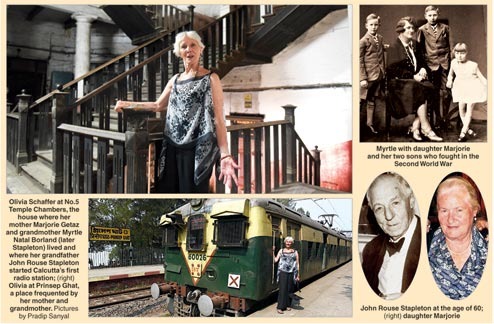
When Myrtle and her husband had arrived in Calcutta in 1918, the Marconi Company was starting test broadcasts from various locations after shifting base from Hastings Street to No. 5 Temple Chambers, beside Calcutta High Court. The first concert was heard at a distance of three miles, followed by a discourse 72 miles away. Stapleton and J. Briggs launched the Calcutta Radio Club in 1923 and soon another broadcasting transmitter called 5AF was installed at Temple Chambers. In 1926, a transmission studio for radio broadcasting started on the top floor of Temple Chambers. Stapleton became the station director and his wife the first woman to sing there.
The private Indian Broadcasting Company Ltd took over in 1927 and Stapleton was still the director at its new and more spacious Garstin Place address when the Indian State Broadcasting Service became All India Radio in 1936. For his efforts, Stapleton was awarded the Order of the British Empire.

Marjorie’s memoirs include vivid descriptions of her childhood at 5 Temple Chambers. “We lived upstairs and Dad had his Marconi office downstairs. My first memory was at about the age of three years, when my father’s canary got out of its cage; all the servants were trying to catch it and it landed on my head. I can’t remember whether I was afraid or not but I do remember that my father loved that bird. It used to sing from morning to night. When it died, Dad took a brick out of the sitting-room wall and into that space he placed a coffin in which he had laid the bird.”

So, somewhere in the walls of 5 Temple Chambers, where Calcutta’s first radio came alive, are the remains of a singing bird. The idea comforted Marjorie.

A ride through Park Street past Flurys on Sunday took Olivia to Temple Chambers, which is now a lawyer’s den. It was built in 1910 on the corner of Esplanade Row West and Old Post Office Street, according to a design by Vincent J. Esch, assistant designer of the Victoria Memorial. A worn nameplate, trees growing out of crack, dark damp stains, thick electric cables snaking across the walls and dusty window slats made for a sorry sight. The interiors were dark and there were few people around. As Olivia scanned each floor lined by offices, her mother’s memories seemed unreal.

Past the seemingly immovable antique lift with grills, she climbed the wooden staircase, undaunted. “Unbelievable that these are the stairs my mother and grandmother used! Even the marble tiled floor is the same,” she said.

An open door on the second floor gave her a peek into what would have been her family home.

Marjorie’s narrative about India remains that of a teenager self-occupied and sensitive by turn. She and her mother Myrtle would often go shopping. Was it to the posh departmental store Whiteway Laidlaw & Co (Metropolitan Building), the Army & Navy Stores or the Sir Stuart Hogg Market (now New Market)? Olivia wouldn’t know. She visited the New Market flower shops and remembered what her mother had said of her grandmother. “She was always in search of books and little ornaments – and I was just looking! The chauffeur would take us, wait for us, and when we got home he would help carry the parcels upstairs and Dad would always say; ‘Oh, more junk!’ One day, in all innocence, Dad’s bearer, Nozier, said, ‘Oh, more junk!’ This had us all laughing for days. When I think back, we brought a lot of that junk to South Africa!”

At Akashvani Bhavan, the offices were closed. But Olivia was thrilled when chief announcer Barun Das recalled hearing that her grandfather had been appointed the first director in 1927. Some old musical instruments kept in a showcase reminded Olivia of her grandmother. “I can’t sing, I am an outdoor person,” smiled Olivia.

From The Town Hall to Prinsep Ghat, Olivia followed the trail her grandparents and mother might have taken. “Perhaps they danced in the Town Hall ballroom. Mother used to say she went for walks along the Hooghly, maybe she was here,” she said.

And then Olivia saw the Vidyasagar Setu. “Gosh! What a bridge!” she said, creating a little memory to take back with her.

source: http://www.telegraphindia.com / The Telegraph, Calcutta,India / Front Page> Calcutta> Story / by Sebanti Sarkar / February 15th, 2017


The accidental zamindar – The East India Company did not learn its lessons well

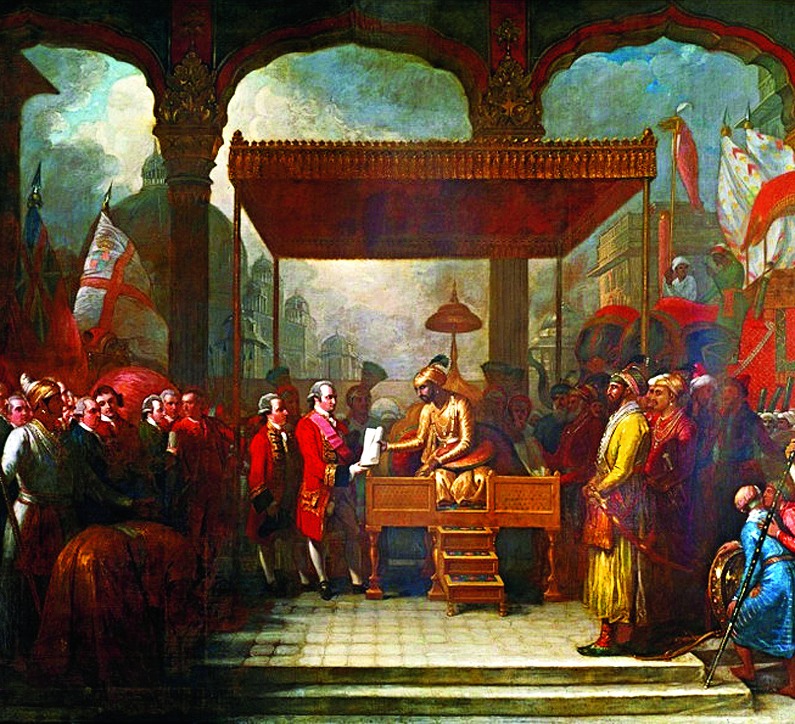
A painting by Benjamin West, 1765, of the Mughal emperor, Shah Alam, transferring the right of tax collection to Lord Clive

East India Company was basically a commercial enterprise; till the end it continued to make good money by exporting Indian goods. In the 19th century, its monopoly was corroded by the entry of other British traders; but trade continued to be a major activity till its demise in 1858.

But it was an odd bird from its birth. The Spanish and Portuguese adventurers who preceded it were an explicit extension of their home governments; the British crown, on the contrary, kept out of the Company’s affairs abroad. Charles II gave the Company power to judge and punish people in its territory abroad according to the laws of his kingdom in 1661; the power to make locally applicable laws followed.

The injunction assumed that the Company would occupy and own territory. But its territory in India was not virgin territory; it had its own administrative structure, of which the Company became one pillar. So it had two masters; and in so far as the two never talked to each other, it had considerable freedom of manoeuvre. But legislation and administration were not its main business; it tried to minimize the effort it put into them. One way it did so was to use local law where it existed, and import British law where there was no local law.

The two differed greatly in respect of landed property. In 1660, King Charles II abolished personal service due from noblemen and converted it into a monetary obligation; that is how land revenue became the dominant tax in Britain. In India, too, land revenue was the major tax; it was reckoned as a third of agricultural produce under Akbar. But it was not always in cash. And it did not necessarily go to the king; the nobleman delivered his dues in cash or in military service. The feudal structure applied to the Mogul empire, but not necessarily to other, smaller kingdoms. So when Lord Clive defeated the Mogul army in 1765 and took the Diwani of Bengal, the Company had to learn the ins and outs of zamindari.

The lessons it learnt are the main part of Law and the Economy in Colonial India, a new book by Tirthankar Roy and Anand V. Swamy. They are an odd pair. Tirthankar is a first-class economic historian. But he is not a leftist; so he faced discrimination from the academic powers-that-be in India. Finally he got fed up and left India; now he teaches in the London School of Economics. Anand Swamy teaches economics in Williams College. They have been running into each other in conferences, and working together on books once in a while.

Their conclusion is that the Company did not learn the lessons well. Its laws led to thousands of cases in Bengal relating to property, tenancy and rent; the system remained overloaded throughout British rule, and cases took decades. As if property law was not obscure enough, legal proceedings were complicated by succession law, which differed according to religion. They do not say so, but the mess was sorted out after Independence, first by legislation abolishing zamindari, and more slowly by population growth, which reduced the size of holdings.

It is difficult to imagine today that Indians could own slaves till 1843; and once slavery was abolished by law, all they had to do was to give a loan to the slave and turn him into a bonded labourer. That is not surprising, since Britain itself outlawed slavery only in 1811. But slavery served a purpose under conditions of labour shortage, which was commonly faced by plantations in the north-east. There were not enough workers in the area; they had to be brought from far away, most often tribals from Chhota Nagpur, which is now Jharkhand. Loading them into bullock carts and transporting them hundreds of miles cost money; a planter could not afford to bring them and then let them walk over to a neighbouring planter for a higher wage. So planters asked for and got laws which empowered them to jail their workers for not repaying a loan. But maltreating workers also earned a planter a bad reputation that he would rather avoid; so planters who could get and retain workers more easily avoided using penalties. Roy and Swamy deal with these labour market adjustments in some detail.

I found their discussion of contract law fascinating. Before the statification of the Company, Indian governments did not legislate or enforce laws. But commerce had existed for millennia; and where there was trade, there was always scope for cheating and breach of promise. Traders used social networks to deal with these risks; loss of reputation and standing was the punishment for breach of contract. But this could work only with those who had reputation to lose; it could not work with Santhal labourers or indigo farmers. When it came to workers, the Company gave penal powers to their employers. That could not be done with indigo farmers; they were not housed by indigo buyers, and could not be jailed or beaten up. So indigo buyers collected chits documenting debt against various farmers, and when an opportunity arose, sold them off to someone who had greater influence on the debtors. Partly under their influence, a contract act was passed in the 1860s; but few cases were filed under it.

Such are the narratives collected by Roy and Swamy. Their book is neither a treatise on law nor a history book: it does not systematically align legislation and case law, and it does not tell a story. The topics it has chosen are broad; a systematic treatment would take more space. Making a history out of it would require a larger role for the personalities involved; a legal treatise would require links with both legislative and case law. So there is a case for expanding the book.

Roy and Swamy should also try their hand at pathology of Indian law. The Indian judicial system is hugely overloaded, and extremely slow; the two aspects are connected, but slowness is not just due to overload. It is a good deal due to antiquated procedure; for instance, judges let lawyers drone on and on, briefs cite piles of cases unnecessary to make the point, and courts give postponements and adjournments for the asking. There are too many briefless lawyers, and too few judges. High courts reverse a high proportion of lower court judgments, generally on the ground of poor police investigation. Other systems have faced these problems and overcome them.

No one in India has looked critically at the judicial system except Arun Shourie; anyone who thinks of doing so is bound to consider the possibility that he may face judicial bias if he is hauled to court. Roy and Swamy do not have to worry about that. At worst, a book of theirs would be banned in India. But that would not be much of a loss; hardly any book sells more than a thousand or two copies in India, and the publicity would increase the book’s sales outside. If the judicial system is to be repaired, someone has to start somewhere, and no one is better placed to do so than Roy and Swamy.

source: http://www.telegraphindia.com / The Telegraph,Calcutta,India / Front Page> Opinion> Story / Writing On The Wall: Ashok V. Desai / Tuesday – February 14th, 2017

Kolkata girl bridges Bengal-Costa Rica gap

Kolkata :

This saree-clad, Spanish-speaking woman had stood out in the Costa Rica pavilion of the Kolkata Book Fair. Nothing about her looks and demeanour was Central American and yet she seemed so much at home, spreading native Costa Rican cheer. But speaking to a visitor at the pavilion, her Spanish changed into pure Bengali within seconds. Kolkata girl Baishakhi Saha has made it big in Costa Rica to gain permanent residency from the government there.

Saha used to live in Salt Lake and studied at Bharatiya Vidya Bhavan before settling down with her parents in Chennai. Her ties to the city, however, remained strong as the family often returned to visit relatives. Always a brilliant student, Saha bagged a scholarship from the Singapore department of education to major in computer science and minor in German from University of Singapore. It was during her stay there that she realised being part of university exchange programmes would help her see the world.

However, she soon realised that with a partial scholarship, it was quite an expensive proposition for an Indian girl with a middle-class background. Around this time, she participated in a global essay-writing competition hosted by the government of Switzerland, on how Europe still inspires imaginations. This won her a limited period stay in Switzerland, which was a turning point in her life. “I yearned see the whole of Europe.

There were many like me and I soon found that by becoming a member of Aiesec, a global students’ body, I could get placed in jobs and get internships that could help me with that. Luckily, I managed to clear the necessary tests and was called for an interview to Malayasia, after which I was awarded a management internship with Model United Nations in Nigeria. It was a two-month job and I made $200 a month — quite a hand-to-mouth situation, but I enjoyed every moment of it,” Baisakhi recalls.

For the next one-and-a-half years she travelled the length and breadth of the west coast of Africa for the TV show Goge Africa. Aiesec acknowledged her work and her next assignment was that of an English teacher in Venezuela, after which she got a similar assignment in Costa Rica. By then, she had started writing her book, ‘magicNine’. The book was a success and Baisakhi was soon giving inspirational talks and teaching business communications at institutes. Her popularity made the Costa Rican government acknowledge her contribution and offer her permanent residency.

“Life has been a dream since then. Costa Rica is more or less like Kerala or Goa if you want to compare Indian situations. I come to Kolkata once in a while, but I have plans to take slices of Bengali culture there now,” Baisakhi said. She is a dancer too and has performed Indian dances in Costa Rica, which have been instant hits. As one of the few Bengalis in a distant land, she has much to do to bridge the two cultures, she explained.

source: http://www.timesofindia.indiatimes.com / The Times of India / News> City News> Kolkata News / by Jhimli Mukherjee Pandey / TNN / February 13th, 2017

Singur movement ‘historic win’, to be part of school syllabus: West Bengal minister

The minister also said that by March 15 the government would complete the entire process of employing 72,000 teachers in primary, upper-primary, Madhyamik and Higher Secondary schools.

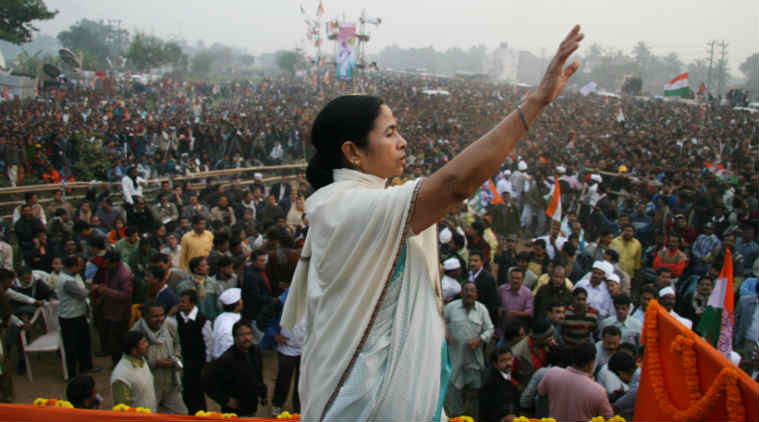
West Bengal CM Mamata Banerjee addressing a rally at Singur in 2011. (Express archive)

The iconic Singur movement would be introduced in the history syllabus of schools run by the West Bengal government from this year, West Bengal education minister Partha Chatterjee today said.

The minister, who described the Singur movement as a “historic win” for the farmers, told a question-answer session in the Assembly that a chapter detailing the agitation would be included in the history syllabus of class eight.
Later, speaking to reporters, Chatterjee said, “It’s a historic win for the farmers. Along with the Singur movement, the Tebhaga movement and Krishak Andolan will also feature in the syllabus and students must know that this movement is one of the milestones in the country’s history.”

Chatterjee said that distribution of the books had already been started. After the Supreme Court verdict allowing redistribution of Singur land among farmers, the state education department had sent the proposal to the syllabus committee for approval of the inclusion of Singur movement in the Madhyamik school syllabus.

The minister also said that by March 15 the government would complete the entire process of employing 72,000 teachers in primary, upper-primary, Madhyamik and Higher Secondary schools.

He requested ‘opponents’ not to move court creating hurdles in the process of employment of teachers and said that his department was going through a verification process at present.

source: http://www.indianexpress.com / The Indian Express / Home> Education / by PTI / Kolkata – February 13th, 2017

Air to water device produces purer drinking water

Kolkata :

The technical report of the functioning of the air to drinking water converting machine have been submitted by state Public Health Engineering department engineers.

Results from the Central Testing Laboratory have shown that the quality of water that is produced by the machine is many times purer and better than the typical water purifier devices.

The Housing Infrastructure Development Corporation (Hidco) authorities are now planning to install a few such machines in different parts of New Town.

“A sample of water produced from the device was sent to the Central testing Laboratory through PHE engineers to find out how pure the water is. The water has been found to have purer quality than the normal water purifying devices. We are planning to install some such devices in Eco Park and other commercial spots,” said a Hidco official, adding that plans are on to install the device at the Mother’s Wax Museum canteen on a trial basis and a few other places like gate No.3 of Eco Park, police outposts, traffic signal kiosks and places inside Eco Park in phases.

source: http://www.timesofindia.indiatimes.com / The Times of India / News> City News> Kolkata News / by Suman Chakraborti / TNN / February 13th, 2017

Federation of Film Societies of India to felicitate Madhabi Mukherjee on her 75th birthday

Kolkata :

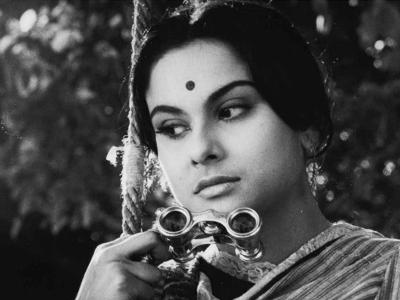
To mark the 75th birthday of veteran actress Madhabi Mukherjee, a special programme will be held on Saturday at Nandan. The Federation of Film Societies of India (FFSI) is hosting this programme along with Shilpi Sangsad and Nandan that will see a host of dignitaries speaking about the actress followed by a screening of “Baishey Srabon”.

While her remarkable prowess in acting has often been spoken about, what has hardly been highlighted is Mukherjee’s philanthropic nature.

Said her daughter Mimi Bhattacharya, “Maa would buy umpteen bottles of pickles sold by an ageing actress only to help her tide through crisis. There were times when we wouldn’t even need that much. Yet, she bought them because that was her way of helping the veteran actress.”

She was among the few who had extended financial help to Ray actor lying on his deathbed in a government hospital. During that time, she was invited to Sonagachhi to attend a programme organised to launch the Babu Samity.

Premendra Mazumdar, who is the former general secretary of the Federation of Film Societies of India, was also one of the speakers. Addressing the sex-workers, Mukherjee had given a fiery speech that day. “‘Both you and I work with our bodies. We use our bodies in a certain way when we perform as actors. You use your bodies differently in your profession. But never be ashamed of what you are doing,’ she had said,” recalled Mazumder.

During her speech, she had referred to how this actor was once in relationship with a lady from that area. “Suddenly, we saw a lady in the crowd weeping profusely. She was the one with whom he had had this relationship. Spontaneously, the girls collected money for his treatment. This lady then accompanied Madhabi-di back to the hospital and stayed there till he died,” recounted Mazumder.

Even her decision to join politics was driven by her urge to help the workers who had lost their job when the Star Theatre was gutted down by a fire. “Maa was crest-fallen. Along with Soumitra kaku (Soumitra Chatterjee), Maa had approached Buddhadeb Bhattacharya to see if something could be done. There were some litigation issues. But Buddhababu never informed her that he wouldn’t be able to do much. That hurt Maa a lot. Later on, when Subrata Mukherjee and Mamata Banerjee had approached maa to join politics, she had first asked if they would do anything for Star theatre. When they had said yes, she had counted 1,2,3 under her breath and said yes,” Mimi said. Losing the polls wasn’t an issue for her. “Maa had to contest against him and was ready to face the consequences,” Mimi said.

However, Mukherjee herself has never liked to highlight the way she has helped others. “It is not about only reaching out to people from the industry. I connect with human beings and try to do my bit to help them,” she said, happy that she has been able to make a difference in people’s lives.

source: http://www.timesofindia.indiatimes.com / The Times of India / News> City News> Kolkata News / TNN / February 10th, 2017