Kolkata sculptor moulds President’s statue

Kolkata :

Last time sculptor Niranjan Pradhan worked with a model offering live sitting was 50 years ago in 1966-67, when he was a student at art college and professional models posed for students to sketch and sculpt human figures.

The sessions helped the artist create some of his best bronze figures, including that of Raja Rammohan Roy in Bristol, Vivekananda, Tagore and Jagadish Chandra Bose at Burdwan University , Satyajit Ray at Roop Kala Kendra and Uttam Kumar at Tollygunge. “One gets to sculpt only famous personalities or gods and goddesses. Artists usually don’t get to sculpt a live person,” said Pradhan. Little did he know he would get the rare opportunity , and the model would be none other than President Pranab Mukherjee.

Over five sessions last year, Mukherjee sat without as much as twitching a facial muscle as Pradhan gave the finishing touches to his statue, now at Rashtrapati Bhavan. “Rashtrapati Bhavan wanted to commission a work for the collection of President’s busts. I readily agreed,” Pradhan said.

Mukherjee had to first go in for a shoot, in which he was photographed from various angles.Based on the photos, Pradhan did the initial clay modelling and then a fibre glass mould, which he carried to Delhi for a live session with Mukherjee for finishing touches. “I was excited about checking out how my sculpture had fared compared to the person,” the artist said.But Pradhan was in for disappointment as Mukherjee got busy with meetings and then left for China.

The next time Pradhan visited Rasthrapati Bhavan was a couple of months later.But this time, he was pleasantly surprise. Not only did Mukherjee give him a day’s sitting, he also sat through for an hour, daily for five days in a row. “He was the perfect model.He was very cooperative and even spent time after the sitting to see how the work progressed,” Pradhan said.

The artist created a plaster cast of the final sculpture and returned to his Salt Lake studio for a bronze casting.

The bust was delivered to Rashtrapati Bhavan in time to be installed next to APJ Abdul Kalam’s bust on December 11, Mukherjee’s birthday .

source: http://www.timesofindia.indiatimes.com / The Times of India / Home> News> City News> Kolkata News / by Subhro Niyogi / TNN / February 27th, 2017
Feted for gift of 30 years of music

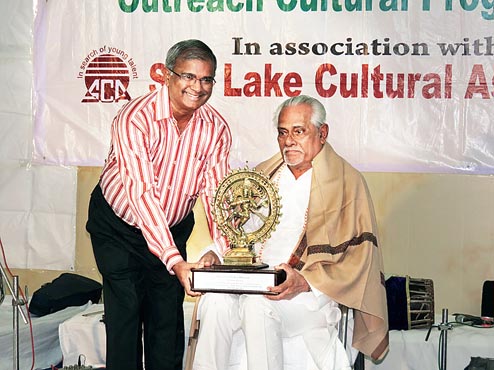
G.V. Subramanian, secretary and joint director of Bharatiya Vidya Bhavan, felicitates Sujit Bhattacharyya at the school auditorium on Saturday. Picture by Sudeshna Banerjee

The man who gave classical music a regular stage in Salt Lake was felicitated last Saturday by Bharatiya Vidya Bhavan. Sujit Bhattacharyya was handed the Parvathi and K.V. Gopalakrishnan endowment at a programme held at the school auditorium for giving young talent a platform over three decades through his organisation Salt Lake Cultural Association.

“Proficiency in classical music is tough to acquire but I would give more credit to the organisers of classical music programmes, especially if young talent is showcased. It is not easy to judge what a musician would be like in 10 years. It is even tougher to carry on doing this for so long. I hope the younger generation takes up the baton from him and carries on under his mentorship,” said Bikram Sarkar, retired IAS and a two-time MLA who stays in AD Block.

The president of the association Asit Kumar Chatterjee recalled the first annual concert 30 years back. “Now we have some resources. Then he was alone. But he was fired by this passion to make this happen. People are ready to loosen their purse strings for Durga puja or Kali puja but tell them you want to organise a classical music concert and you will get neither help nor audience.”

Acclaimed tabla player Suven Chatterjee recalled being scolded on multiple occasions by “Sujitda”. “I called him Sujitda instead of kaku since he was so handsome and I was worried that he might scold me if I called him uncle,” he smiled, adding how he got a chance to play with doyens like Girija Devi and Vishwa Mohan Bhatt at the conference’s programmes down the years.

Sitarist Mita Nag, daughter of Pandit Manilal Nag, recalled how Bhattacharyya had offered her the foyer of Gyan Manch where the annual concert was being held to put up her exhibition on Bishnupur gharana when she met him seeking space.

source: http://www.telegraphindia.com / The Telegraph,Calcutta,India / Front Page> Salt Lake> Story / by A Staff Reporter / Friday – February 24th, 2017

Software for tiger watch in Buxa

Alipurduar :

The Union ministry of environment and forests has launched a software to ensure better monitoring of tigers that will be introduced in the Buxa Tiger Reserve by April.

The software has been made in collaboration with the National Tiger Conservation Authority (NTCA) and Wildlife Institute of India (WII) for all tiger reserves in the country.

“MSTrIPES”, a hi-tech monitoring system, would be introduced in Buxa Tiger Reserve by April and each beat officer will get an Android phone with the software inbuilt that will help to monitor tigers in the habitat, Ujjal Ghosh, the field director of the BTR, said.

There are 42 beat offices in Buxa with one officer each.

MSTrIPES is a GPS-based software that will provide patrolling protocols and record wildlife crimes.

The software will also handle ecological monitoring and store data related to tiger monitoring.

Ghosh said: “The forest guards will have to fill in information about the area they patrolled and number of tigers spotted daily in the Android phones. This information will be passed by the beat officer to the forest range officer who will forward the same to the division officer, followed by the state government. The state will then pass on the information to the Tiger Control Cell of WII in Dehradun. Through this system, there will be a statistical analysis of data regarding protection and monitoring of the tigers.”

According to a forest officer, the BTR is important to the NTCA because ‘Tiger Augmentation Programme’ would be held here this year.

source: http://www.telegraphindia.com / The Telegraph,Calcutta,India / Front Page> North Bengal> Story / by Our Correspondent / Thursday – February 23rd, 2017

Kolkata-based oil & gas co set to buy LSE-listed firm

Kolkata :

City-based PFH Oil and Gas, promoted by Harsh V Poddar of Poddar group, is in talks with London Stock Exchange (LSE)-listed companies for acquisition to expand its energy business. The Poddar-led firm has won three gas blocks from ministry of petroleum and natural gas last week. It is one of the youngest firms in India and the only firm from east to be allotted these oil and gas blocks by the Cabinet Committee on Economic Affairs (CCEA) in this round of auction held on February 16.

Out of these three fields, two are in KG basin (Andhra Pradesh) and one in Cambay basin in Gujarat. During the latest auction round, CCEA awarded contracts for 44 fields, mostly smaller fields of ONGC and OIL India. A total of 47 companies submitted their bids for these blocks, out of which four were foreign companies.

Poddar, a 29 year MBA from Yale and a graduate of Duke University who came back to Kolkata after over an eight-year stint in the US, told TOI that his plan is to acquire the LSE-listed company and merge it with PFH through which its hydrocarbon firm, too, would be listed on LSE. “We are in advance talks with two-three firms. I am going to the UK later this week to finalize a deal,” he added.

However, Poddar didn’t disclose the names of the UK firms citing LSE restrictions

According to Poddar, the three gas fields awarded to PFH have adequate reserve. “There are four drilled wells, and the company plans to drill at least 11 additional wells in the near future. Our portfolio currently consists of three fields in India, which we expect to bring into production by the end of the year. By 2020, we aim to have a portfolio of at least 10 producing blocks in India,” he added. Over the next 20 years, PFH has set a target to become one of the largest global exploration and production companies with a focus on gas.

A young serial entrepreneur, Poddar has acquired or started companies in IT, semiconductors, shipping and environment engineering across India, the US, China and Israel over the last eight years. According to him, Yogeshwar Sharma, based in France, has recently been appointed as a director on the board of PFH. He is the co-founder of Hardy Oil and Gas plc, a London-listed company and served as its CEO until May 2012. PFH Oil and Gas is advised by Manuel Pinho, who had served as economy minister of Portugal from 2005-2009.

Apart from upstream business of exploration and production (E&P), it is also planning to focus on building mid-stream business like infrastructure such as pipelines in the KG basin to make it easier for independent and smaller E&P companies to enter the industry in the future. “Since transportation infrastructure in India is predominantly government-owned, often capacity constraints and lack of competition make it difficult for smaller private companies to negotiate a deal and efficiently transport and market their production. We aim to contribute towards building the necessary ecosystem to make India a vibrant domestic oil and gas market,” he added.

source: http://www.timesofindia.indiatimes.com / The Times of India / News> City News> Kolkata News / by Udit Prasanna Mukherji / February 22nd, 2017

At last, Chandraketugarh gets a museum

Kolkata :

Historians have often linked the archaeological site at Chandraketugarh with Alexandar and the Greco-Roman maritime trade. But on ground zero, nothing much has been done till date to preserve the site with a 250-year-old history. Prodded by Barasat’s Trinamool MP Kakoli Ghosh Dastidar, things have finally started moving in the right direction. Fianlly, Chandraketugarh has started getting its due.

A museum has been readied to preserve artefacts that have found at Chandraketugarh. Though the Archaeological Survey of India (ASI) protects the site officially, there is no sign of “protection” anywhere apart from two signboards that stand at two ends of the mound. The half-excavated matrix lies exposed to daily loot and other ravages.

In 2009, after she became an MP, Dastidar was approached by local school and college teachers who had been trying to raise awareness over the site on their own. “They requested me to visit the site and see how soon everything will get lost. I was aghast at what I saw. ASI had done some piecemeal job and had left the site open and unattended. Since then, I have raised the issue in Parliament and approached the culture ministry to which the ASI reports. When nothing happened, I approached the West Bengal Heritage Commission, but unfortunately I was unable to stir up the imagination of the chairperson,” Dastidar said.

Finally, in August 2016, Dastidar wrote to chief minister Mamata Banerjee, seeking her intervention. “I told her clearly that unless we are able to set up a site office and a museum, the state will lose its most ancient archaeological site,” Dastidar added. Within days, the CM sent an investigation team — comprising the DM, bureaucrats and historians — that assessed the site, interacted with local activist groups and submitted a report that confirmed its antiquity.

Two TOI reports, one dealing with the deplorable state of things and another of a new research by IIT-Kharagpur experts trying to establish the antiquity of Chandraketugarh to Sandrocottus mentioned by Megasthenes, were also cited.

“Finally, at the CM’s insistence, we have been able to set up the museum and the site office, which will start functioning within a month. Local people who have been zealously guarding the excavated artefacts have agreed to donate them to the museum,” Dastidar said, adding that she has been able to recover artefacts worth a few hundred crores.

source: http://www.timesofindia.indiatimes.com / The Times of India / News> City News> Kolkata News / TNN / February 21st, 2017

Doctor far-off, care close by – Satellite health unit set up at remote Rimbick

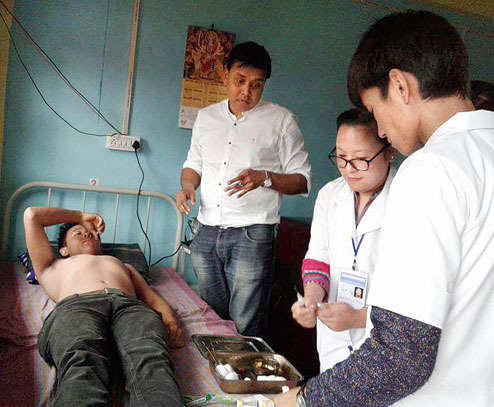
A patient being treated at the medical unit at Rimbick. Telegraph picture

Darjeeling :

An idea that bagged an award from the Acadèmia de Ciències Mèdiques, a forum of healthcare professionals in Barcelona, Spain, has blossomed into a fruitful project that is saving human lives in one of the farthest corners of Darjeeling district in Rimbick.

Plaban Das, a medical director of Planter’s Hospital in Darjeeling, during his advanced medical studies at La Santpau hospital in Barcelona, had through his Spanish friends proposed an idea in 2009 to create a satellite healthcare unit in remote areas.

The idea we bagged the Beques de Cooperacio Academia del Mon award that carried a prize money of 200 Euros in 2009.

“Anna Goma, a Spanish doctor, has presented the idea to the academy and it bagged the first prize. It was just an idea then and wanted to replicate the same in Rimbick, where I had conducted a medical camp in 2007,” said Das.

He mulled over the idea for long and once social media, more particularly WhatsApp, became common among people, he started working on the project.

“The basic idea was to ensure the people of Rimbick and its surrounding areas quick medical intervention during emergencies so that lives could be saved,” said Das.

Rimbick is about 90km from Darjeeling and one has to trek 6-7km further to reach the villages of Srikhola and Daragoan.

“With the help of local people, we formed a 12-member committee and set up the Rimbick Singalila Health Care Centre, a no-loss-no-profit venture which was inaugurated on September 13, 2015,” said Das.

Das made a personal contribution of Rs 2.5 lakh, along with the prize money of 100 Euros (the remaining 100 Euros was used in a project in Nigeria), while local people contributed around Rs 1 lakh. “Dr Hem Gosai, who practices in London but is from Darjeeling, later contributed Rs 1 lakh when he heard about the project,” said Das.

Two nurses, one para-medic and two technicians run the two-bedded centre at Rimbick with ECG, X-ray machine, nebuliser, oxygen cylinder and lab equipment.

“Whenever there is an emergency, the nurses contact me through WhatsApp. Primary tests are done there and they send the report on Whatsapp to me. Then I prescribe preliminary treatment right away, which is important in cases like brain stroke and heart attacks,” said Das.

Prakash Gurung, GTA Sabha member of the area, has also donated an ambulance to the centre.

In fact, this year, the centre observed a Stroke Survival Day, where five patient who had become paralytic and fully recovered because of immediate medical intervention were felicitated.

Shiva Rai, a hotelier, said: “I would not have been speaking to you had the centre not been there. I had gone to bed normally but in the morning, I found that my hands were paralytic and my face slanted. I could recover fully because of immediate medical intervention.

Binod Kumar Rai, a teacher of Rimbick Higher Secondary School, said: “I had a bee sting followed by fever and diarrhea. I recovered immediately. Importantly, my relative who had a stroke also recovered well.”

The centre needs Rs 30,000 on an average a month to function. “They charge a minimum amount. If we were to go and meet Dr Das in Darjeeling we need to spend anything between Rs 2000 to Rs 3000. But treatment is much cheaper and efficient at the Rimbick centre,” said Binod.

Das, along with other doctors visit the centre, once a month. A group of doctors from Zion Hospital in Nagaland held a free medical camp on February 15 there.

“People from Nepal also visit the centre now,” said Das.

Apart from the Spanish doctor, Anna, Martha Gallego, a nurse, Pau Casan Bonet, a pianist, and Begonya Crespo Bosque held a musical event in Barcelona to support the centre.

A similar project is being worked out for Badamtam tea garden, about 20km from Darjeeling.

source: http://www.telegraphindia.com / The Telegraph,Calcutta,India / Front Page> North Bengal> Story / by Vivek Chhetri / Monday- February 20th, 2017