Kolkata: A peek into Parsi tradition and culture at 4-day expo

Kolkata :

If you’ve always wondered what lies beyond the closely guarded boundary walls of a Parsi fire temple, especially because tradition has it that a non-Parsi is not allowed inside, your curiosity is going to be satisfied. A Parsi agyari (fire temple), as it is called by the community, will be re-created as part of a special four-day exhibition that the community in the city is organising to explain its history, traditions, lore and culture.

The exhibition, Threads of Continuity, is being organized between October 26 and 29 by The Calcutta Zoroastrian Community’s Religious and Charity Fund (a trust) – as part of its 150 years celebrations – in association with Parzor, a Delhi-based foundation that has been working with the support of the Unesco for the revival of Parsi culture and heritage. It’s being held at Olpadvala Memorial Hall.

There are about 650 Parsis in the city, a number that has dwindled from 2500 three decades ago. While on one hand the community rues that there has been a steady brain drain of Parsis from the city – thanks to the lack of business and career opportunities here – on the other, both the Parsi Club and the trust have tried to keep the community bonding strong by organizing cultural activities throughout the year. “But, we need to know more about our history that goes back to ancient Persia and the time when we as Zorastrians came under attack from the Muslim invaders/rulers of Persia. Facing persecution, we fled and reached the shores of Diu from where we entered Gujarat and chose to settle there after we were given shelter by the king…” said Cyrus Madan, a trustee.

“Most people do not know why non-Parsis are not allowed inside the fire temple, for that matter, many don’t know that we are not worshippers of fire. It’s just a medium through which we reach the God. We just want to de-mystify everything,” said Trista Madan, who is co-ordinating with Parzor.

source: http://www.timesofindia.indiatimes.com / The Times of India / News> City News> Kolkata News / by Jhimli Mukherjee Pandey / TNN / October 23rd, 2017

Two girls who’ve brought cosplay to Kolkata

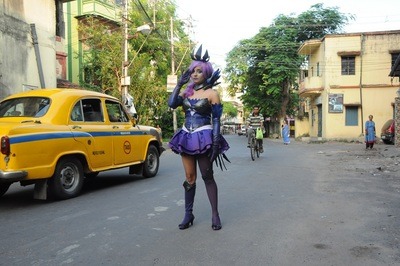
We all have our hidden heroes somewhere inside. It may be someone with superpowers — like Superman or Batman — or someone from the dark side — like Loki or Harley Quinn. While most of us go through life with these fantasies locked up, there are some lucky ones who get to express their innermost desires, dressing up as characters of their choice. These are the cosplayers — people who role-play as fictional characters for an audience — and Kolkata finally has a couple of them to boast of.

What is Cosplay?

Cosplay or Costume Play is a hobby where the participants bring a fictional character to life with the right makeup and costumes. The idea behind cosplaying is to bring two dimensional art forms into 3D space. The characters mostly revolve around anime, video games, manga comics and are sometimes taken from storybooks and TV/web series.

Meet Rhea Chowdhury and Romi Mondol, two girls who’ve taken up this exciting, adventurous hobby in a city that’s a cosplaying backwater in every sense of the term. Cosplaying is an accepted sub-culture abroad, especially in countries with a huge fan following for comic books, like the US and Japan. In India, it’s become popular in cities that have regular Comic Cons, like Bangalore and Mumbai. But that’s not a hindrance for our two city girls. Rhea, aka Rheality Lapse, is a social media executive who’s been cosplaying since 2015, while Romi Mondol, an MBBS interning at SSKM hospital, just started a year back. Their stories will tell you more about them, us and the world of cosplaying.

Early days of Cosplaying

Romi, for instance, faced some resistance at home when she started dressing up as fictional characters. Her parents found her behaviour eccentric and couldn’t understand what the budding doctor was up to. “My dad is still dead against cosplaying as he thinks doctors are not supposed to do such things. My mom was also against it, but since she loves tailoring, she has started sewing my cosplay clothes,” says Romi. Cosplaying also allowed her to cross-dress. “From childhood, I liked to dress up as a boy. I was often taunted for this, but cosplaying helped me get rid of the inhibitions,” Romi adds.

Romi Mondol
Cosplay name: Romtz Wonder World
Profession: Doctor
Cosplaying since: 2016
Major characters covered: Usui Takumi, Misty (Pokemon), Erza Scarlet, Rei Ayanami, Harley Quinn, Lucy Heartfilia
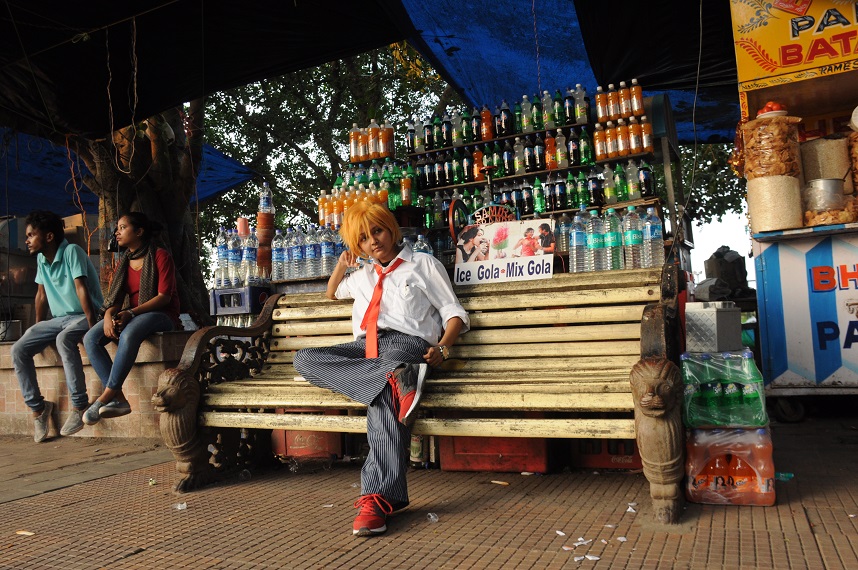
Romi also thinks gender consciousness is dependent on how people address the issue. “I am a cross-cosplayer. I like to dress up as both male and female characters, though I prefer men. Cosplay allows me that, which is one of the major reasons why I fell in love with this activity.”

Rhea on the other hand has a supportive family. “I was always into Japanese anime and gaming. My parents knew that my hobbies and likings were offbeat. They have accepted me the way I am, but they get worried when I wear skimpy clothes. That’s mostly because of the horrifying news we see and read every day,” she says. Rhea started following cosplay in 2010 and before she knew it, she was regarded as a cosplayer. “I’ve been following the scene since 2010. But I started dressing up much later. I used to do that for fun. But when people started calling me a cosplayer, I thought, why not?”

The Kolkata scene

Rhea feels Kolkata can become one of the leading Indian cities for cosplaying, but can’t understand the reasons behind the ignorance. “Kolkata has a niche audience for gaming and cosplaying. But somehow big events like Comic Con India don’t come to our city,” she adds. She also points to the availability of cheap dress material, which is crucial to cosplaying. “The city offers you the best quality dress material at a much cheaper price compared to other Indian cities. This should interest cosplayers but I don’t know why people don’t participate.”

Rhea Chowdhury
Cosplay name: Rheality Lapse
Profession: Social Media Manager
Cosplaying since: 2015
Major characters covered: Lara Croft, Weiss Schnee, Harley Quinn, Juuzou Suzuya (Crossplay), Dark Lux, Diva (blood+)
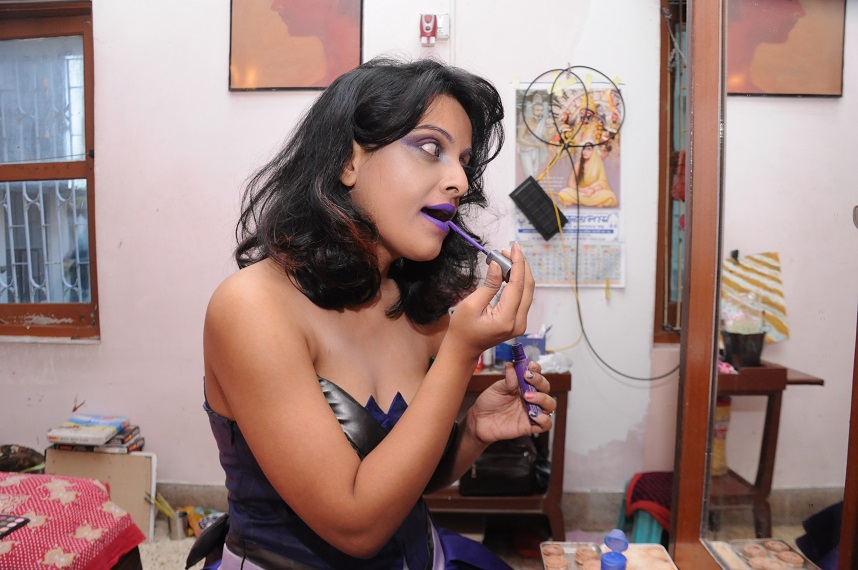
Romi echoes Rhea in that the major cosplay events ignore Kolkata, which is why cosplaying is not growing here. “If events like Comic Con had come to our city, people would have got the opportunity to think about it. Now, most people don’t know what cosplay is. Many people I know have cosplayed once or twice but they didn’t continue because of the lack of events.”

Rhea has won many competitions held elsewhere in India. “I didn’t go for winning; I just went for cosplaying. The opportunities here are so few that participating itself is great fun for me. However, I won quite a few times and it’s always nice.” Romi is visiting Mumbai for a cosplay event later this year. “My profession doesn’t allow me enough time for cosplaying and since Kolkata doesn’t have much events, travelling to another city takes a lot of time. So I miss out on many big opportunities,” she adds.

Both agreed that since Kolkata is not exposed to the idea of public role-playing, people often behave in objectionable ways when they’re out in their costumes. Rhea speaks about a harrowing experience on Park Street, which is seen as the city’s party street. “I did a cosplay walk dressed as Harley Quinn (Suicide Squad) along with my friend who was dressed as the Joker. Stares are common and we cosplayers are prepared for that. But we had to stop the shoot as people crossed the line of decency and came too close. This is not the first time though; such behaviour is common in Kolkata,” she remembers.

Even Romi has faced similar problems. “Even if I ignore the innumerable stares and comments, sometimes people cross the limit. I have faced situations like that but I got out of them very confidently,” she says with a smile.

source: http://www.timesofindia.indiatimes.com / The Times of India / News> City News> Kolkata News / by Shrutanwita Chakraborty / TNN / October 22nd, 2017
On & off field: girls tackle challenges

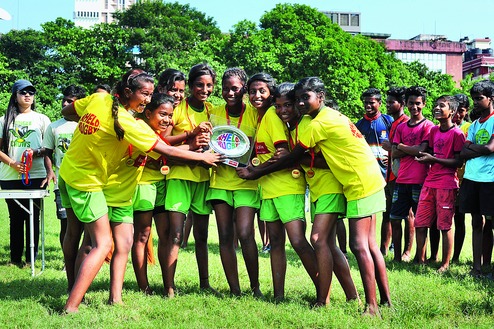
Team Chingrihata I with the winner’s trophy on Sunday. Picture by Arnab Mondal

At 23, Kripa Oraon is a trailblazer. A rugby player herself, she has helped reach the sport to more and more girls in and around Saraswatipur, a small village in New Jalpaiguri.

Maidan: Kripa is one of the 30 girl community young leaders of Jungle Crows Foundation who eat, drink and sleep rugby and defy all odds to rewrite their own life stories and others’.

On Sunday morning, the girl gang proved they are not only good players but also good organisers as they held an under-14 Tag Rugby Festival to celebrate the UN’s International Day of the Girl Child (October 11) at Crow Field on the Maidan.

“From planning to execution, the girls did it all. This is the first time the tournament has been organised entirely by them,” said Nidhi Ghelani, project manager, Khelo Rugby – a sports-for-development project by Jungle Crows.

“We have proved that given the opportunity girls can do everything. I have organised tournaments in Saraswatipur before. So I was confident that I would be able to do it,” said Kripa, who has been playing rugby since 2013 when Khelo Rugby first reached her village. She was responsible for officiating all big matches, including the final.

Twenty teams comprising 280 girls from locations where Khelo Rugby has a presence took part in the competition. Two teams from Chingrihata – Chingrihata I and Chingrihata II – reached the final and Chingrihata I won 6-4 after a tough clash.

“I joined Khelo Rugby just eight months ago and I never imagined I would be a part of the champion side in such a short time. It was great fun,” said Ruma Mondal, a Class VI student of Sukantanagar Vidyaniketan, who dreams of playing rugby professionally and making her father, a rickshaw puller, proud.

Bikash Paswan, the Jungle Crows coach who trains the Chingrihata girls, sees “great potential” in Ruma. “She is a fast learner,” he said.

Paul Walsh, the founder of Jungle Crows, was excited to see “so many girls playing rugby and having fun”. “The Chingrihata girls were absolutely fantastic. It shows how much hard work they have put in,” he said.

source: http://www.telegraphindia.com / The Telegraph, Calcutta,India / Home> Calcutta / by Ayan Paul / Monday – October 23rd, 2017

This video by a Cuban filmmaker turns Kolkata into a dizzying roller coaster ride

‘During my trip to Kolkata, I could only think of one word.’

https://www.youtube.com/watch?v=hYg2dmJO4Lg

Ever since City of Joy, Kolkata has been a foreign filmmaker’s joy, its dizzying roll of sights, faces, sounds, and activities offering exciting possibilities to documentary-makers in particular.

Cuban-born, Netherlands-based filmmaker Yuribert Capetillo Hardy aptly summed up the feel of Kolkata in the title of his short film – Roller Coaster. “During my trip to Kolkata, India, I could only think of one word: rollercoaster,” he wrote in the film description. “This film rollercoaster is the visualisation of my feelings, fears and emotions.”

Hardy’s film moves just like a rollercoaster, swooping low and soaring high to create an exhilarating collage of scenes from the city. He shot his film in just one week, while on assignment for a Dutch non-profit organisation, 1000Children. “The one thing that stays on my mind was a little baby sleeping alone in the streets, which made me think of my own daughter who grows up protected and loved,” Hardy noted.

We welcome your comments at letters@scroll.in.

source: http://www.video.scroll.in / Scroll.in / Home> Around The Web / by Scroll Staff / October 14th, 2017

Project to revive lost glory of Kolkata-Puri pilgrim route

Kolkata :

A team of researchers has taken up a project to revive the lost glory of Jagannath Sadak — the ancient trail from Kolkata to Puri used by travellers and pilgrims before the railways came. The project was launched by the Indian National Trust for Art and Cultural Heritage (Intach), Bengal chapter on November 19, 2015.

Titled, “Listing and Documenting the Monuments of the Jagannath Sadak in West Bengal”, the compiling of heritage sites dotting this coastal route between Odisha and Bengal is now an elaborate three-volume document that informs about the precious structures lost in oblivion and also those which can still be protected. It will be released at the Indian Museum on Sunday. Anil Dhir, chief coordinator of the project, told TOI, “We have traced 200 remnants in Odisha, but only 100 in Bengal.

Many of the monuments don’t exist any more, but some structures, such as a Gurudwara at Chandrakona, a Jagannath temple at Dantan, a Kali temple at Bagnan and the Nandagopal temple at Mellock near Panskura, are still there.”

Travellers would cover the 516 km stretch in bullock carts, palanquins, horses, camels and elephants. Many walked.

Three years ago, Dhir took a bullock cart to traverse the entire stretch. “For the documentation, three different routes were taken in Bengal. They culminated at Dantan on the Odisha border,” explained Dhir. The route taken by Chaitanya Mahaprabhu was through Tamluk, Mahisadal, Kanthi and Mohanpur while Guru Nanak took the route through Chandrakona, Midnapur and Narayangarh.

The popular and shorter route through Uluberia, Panskura, Debra and Belda. G M Kapur, convener, Intach’s Bengal chapter, said, “We will approach the Bengal and Odisha governments and the ASI to notify these 315 structures as protected monuments and help in their conservation.” With the advent of the railways, Jagannath Sadak was abandoned.

source: http://www.timesofindia.indiatimes.com / The Times of India / News> City News> Kolkata News / by Ajanta Chakraborty / TNN / October 21st, 2017

City teen’s chess feat

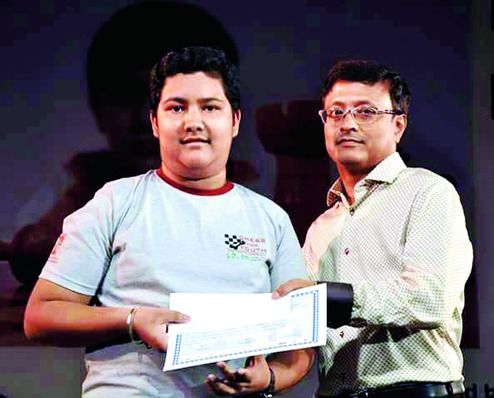
Koustav Chatterjee with Dibyendu Barua. (Debraj Mitra)

Tollygunge:

A 14-year-old boy from Regent Estate, who loves watching superhero films, has won silver in the National Sub-Junior Chess Championship.

Koustav Chatterjee, a student of Garden High School, was leading the table for most of the U-15 tournament, held between October 1 and 9 at Ahmedabad. His score was tied with Sankalp Gupta of Maharashtra, who went on to win the championship because of a better tie-break score.

This is the second consecutive year that Koustav missed out on gold in the sub-junior nationals. “Last year he lost by a narrow margin, too,” his father Kalyan Chatterjee said.

Kalyan, 52, introduced Koustav to chess in 2010. “He had a great memory. He could remember all 52 cards in a pack at the age of 5,” the private tutor said. Koustav’s mother Babita is a state government employee posted at Bikash Bhavan.

The boy started training at a Dhakuria institute at the age of seven and joined Dibyendu Barua Chess Academy in 2015. The same year he won gold at the 2015 Commonwealth championships in Delhi in the U-12 category.

“Koustav has a great temperament. He is one of the best young players in the state,” said Atanu Lahiri, the general secretary of the Bengal Chess Association, who has seen Koustav from close quarters over the years.

“He tends to get overconfident at times. Otherwise, he is grandmaster material.”

Koustav’s favourite player is Anatoly Karpov, the Russian grandmaster and former world champion. “From the current lot, I like Magnus Carlsen, who practises three to four hours a day. I love studying openings of Karpov and Carlsen on my computer,” said the teenager whose favourite subjects are math and chemistry.

When Koustav is not playing chess, he loves watching superhero films and TV series. From the Star Wars to Marvel’s The Defenders, his list is quite exhaustive. Luke Skywalker and Wolverine are his favourite characters.

Koustav also loves collecting coins. The most valuable item in his collection is the Uruguayan Peso, which he collected in Montevideo when he went there to participate in the World Youth Chess Championship in September. “I could not win a medal but playing against international players was a great learning experience,” he told Metro.

By virtue of finishing second in the sub-junior nationals, Kosutav has secured a berth in two international tournaments in 2018, the World Youth Chess Championship in Georgia and the Asian Youth Chess Championship in Thailand. “I don’t want to lose focus in the big stage,” said Koustav.

source: http://www.telegraphindia.com / The Telegraph,Calcutta,India / Home> Calcutta / by Debraj Mitra / Thursday – October 19th, 2017

Malaria App

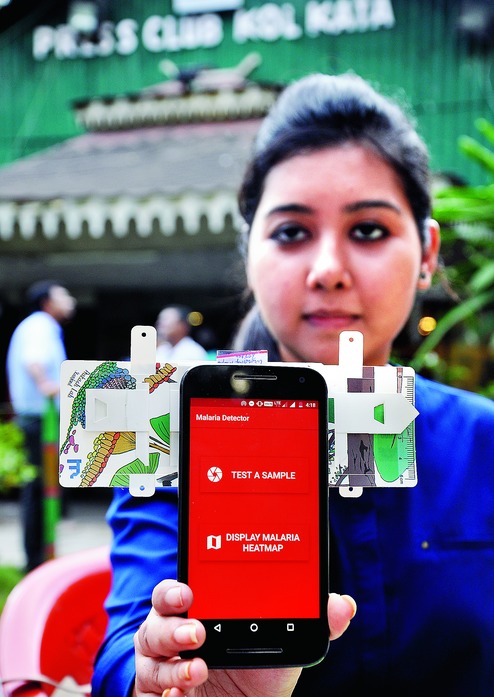
Two aspiring engineers have developed an app-based system to detect malaria in a blood sample in less than a minute.

The detection involves a multi-step process that starts with the collection of a person’s blood sample. The slide containing the blood sample has to be inserted into a foldscope – a small microscope made of folded paper and a microlens.

The foldscope was developed by Manu Prakash, who teaches bioengineering at Stanford University.

Prakash’s lab sent two prototypes to the Calcutta researchers. The foldscope then has to be fitted to a smartphone, whose camera helps magnify the sample. The magnified image is then transported to a server, where using an algorithm, malaria parasites, if any, are detected in less than a minute. The diagnosis is relayed back to the phone user and the findings archived.

Nilanjan Daw and Debapriya Paul, BTech final-year students of computer science and engineering at the Institute of Engineering and Management (IEM), Salt Lake, developed the system with the help of their teacher Nilanjana Dutta Roy and IIEST professor Arindam Biswas.

Picture by Anup Bhattacharya

source: http://www.telegraphindia.com / The Telegraph,Calcutta,India / Home> Calcutta / Thursday – October 19th, 2017

Blind boys in melody mission – MUSIC RESTORES WHAT LOSS OF SIGHT SNATCHED

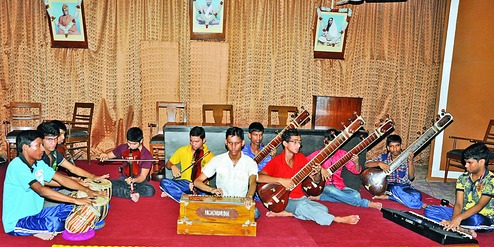
The band rehearses on September 22, a day before going to Delhi to play at a puja concert. Picture by Anup Bhattacharya

Narendrapur:

Asit Sil can feel the calluses on his fingers from hours of playing the sitar but still won’t use a plectrum.

Touch and feel are integral to the music created by this 16-year-old and his friends, part of a band of talented teens from the Ramakrishna Mission Blind Boys’ Academy in Narendrapur.

The band comprises more than 10 members, all of them students with varying degrees of visual impairment. Asit has 90 per cent blindness. Vocalist Dipu Roy, 19, was diagnosed with Nystagmus disease as an infant and lost his eyesight by the time he turned 2.

“Sight is not a must-have for musicians. But it is a different ballgame when you are playing in a group. In a concert, one wrong note can disrupt the entire performance. It takes hours of practice to get the coordination right,” said Bishnu Deb Chakraborty, one of the music teachers at the academy.

The band performs at concerts in the city round the year. From Tagore to SD Burman, instrumental compositions based on ragas to bhajans and folk, the band’s bouquet of music spells variety.

The boys have been invited to perform at pujas in different parts of the country in the past couple of years. Last year, it was Mumbai. This festive season, they performed at a celebration in Delhi.

“They had been invited by a puja near Dwarka. Most of them went to the capital for the first time,” said Biswajit Ghosh, the principal of the academy.

Indranil Kesh, who plays the violin, is from Bardhaman. He had joined the academy in 2011 and has been playing for close to four years. The VG Jog admirer remembers “sweating in panic” the first day he took the stage for a concert at the Rahara Ramakrishna Mission.

“Now I don’t get nervous unless the event is really big,” smiled Indranil, who loves listening to Arijit Singh’s melodies.

If Indranil’s favourite raga is Shivranjani, its Yaman for Asit, who is from a family of farmers in South Dinajpur.

Asit had started taking singing lessons at a very young age. Joining the academy seven years ago changed his passion. “I fell in love with the sitar,” recounted the teenager, who loves listening to Vilayat Khan and Ravi Shankar on YouTube.

On normal days, the boys practise in an auditorium at the academy for an hour after their regular classes. “They put in more hours before an event,” said principal Ghosh.

Sandip Sen, 18, plays the tabla. The Asansol boy’s only memory of music before joining the academy in 2012 is of his mother singing him to sleep. “I had kept my formal initiation into music a secret. When they first heard me in a programme in Calcutta, they could not believe it,” Sandip recalled.

source: http://www.telegraphindia.com / The Telegraph,Calcutta,India / Home> Calcutta / by Debraj Mitra / Tuesday – October 17th, 2017

FAIR appraisal of city science centres – CALCUTTA KEY PARTNER IN PROJECT

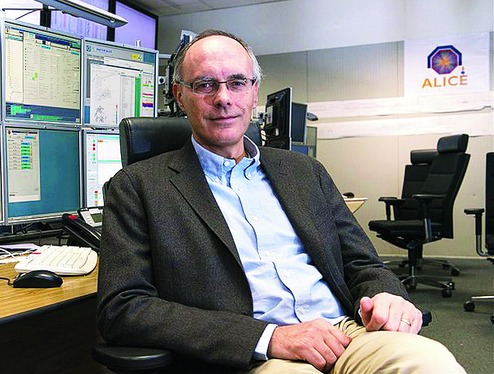
Paolo Giubellino, scientific managing director, FAIR.

Calcutta:

Science institutes in the city got a thumbs up recently from the chief of one of the world’s mega science projects, Facility for Antiproton and Ion Research (FAIR) in Germany.

“Why do students from here go abroad to study when you have such fantastic institutes like the Variable Electron Cyclotron Centre (VECC) and the Bose Institute doing excellent work? They are in the same league as MIT and Oxford, doing cutting edge work in science and are at the frontiers of technology,” said Paolo Giubellino, scientific managing director, FAIR. Giubellino was in the city to update all participating institutes – VECC, Bose Institute, Calcutta University among others – on the status and progress of work at FAIR. FAIR is the newest accelerator facility for research with antiprotons and ions and boasts a large number of contributors from India.

Much like the Large Hadron Collider at CERN, FAIR is being built with international collaboration near Darmstadt in Hesse, Germany, as part of the GSI Helmholtz Centre for Heavy Ion Research. While 70 per cent of the project is funded by Germany, India is the largest contributor after Germany and Russia.

“Unlike CERN, the contribution here is in kind, through building components of the accelerator and conducting experiments. The VECC is shipping us super conducting magnets for the accelerator. There are 25 Indian institutions from India participating at FAIR with the core effort in Calcutta,” said Giubellino. The new facility, which has Bose Institute former director Sibaji Raha as the founding chairman of the Joint Scientific Council of both the GSI and the FAIR, is expected to reveal consolidated findings about unknown states of matter and missing information about the evolution of the universe 13.8 billion years ago. The accelerator is in the process of being built though experiments will start as early as next year.

Stressing the role of the scientists in the city, Giubellino said: “Calcutta is a key partner in our project, the largest science project in the world. Scientists from here and the industry are working hand in hand to produce equipment of the highest standards. There is fierce competition that they have to overcome in building MUON detectors and the CBM equipment and it is based only on meritocracy.”

The Italian scientist, while addressing a group of girls from Calcutta over Skype, was impressed with the huge turnout. “I was in Germany travelling when I was asked to address a group of students from here. I had expected not more than 10 or 15 students but when I opened Skype, I was surprised to see about a thousand waiting,” said the science chief.

Calling all young students to FAIR, he said: “We welcome scientists from institutes like Bose Institute and VECC because we know they will be of international standards. I have been working with scientists from here and am aware of their calibre and do recognise that their students will have the capability to work in an international mega science project as ours.”

source: http://www.telegraphindia.com / The Telegraph,Calcutta,India / Home> Calcutta / by Anasuya Basu / Tuesday – October 17th, 2017