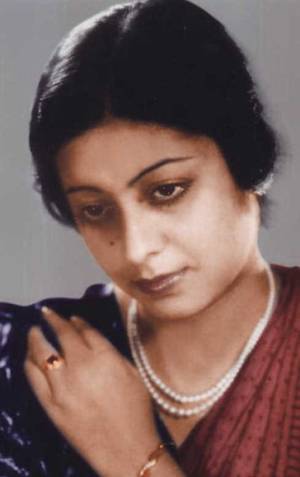
Our fair lady

As the entertainment industry celebrates the birth centenary of Kanan Devi, let’s rewind to the life and times of the first melody queen of Indian cinema.

Kanan Devi, the melody queen and superstar of 1930s and 40s, was a remarkable personality. An epitome of beauty, glamour and grace and the recipient of the prestigious Dadasaheb Phalke Award (1976), Kanan’s life story (1916-1992) transcends that of Eliza Doolittle in “Pygmalion” and “My Fair Lady”. Her memoirs “Sabare Ami Nami” (I pay my respect to everyone) provides a fascinating account of her transformation from an unlettered slum girl into a much sought after social celebrity. The most astounding aspect of her persona was her grit, determination and courage which led her to attain the pinnacle of fame and glory and thus become a legend and an institution in her lifetime.

Kanan began her career as a child artiste Bala in Madan Theatres of Calcutta during the silent era. Her name may not mean anything to the present generation but in her times she was not only a melody queen but also a glamorous superstar of Indian cinema. She was the only artiste of the silent era to make a smooth transition to the talkies.

It was her superb performance in Radha Film Company’s Bengali production “Manmayee Girls School” that made Kanan famous. She was acclaimed by the media as the prettiest and most attractive singing star of the day. So much so, that even the renowned P.C. Barua offered her the role of Paro in his all time classic “Devdas”. Kanan could not accept the offer owing to her contractual obligations with Radha Films but she harboured the regret at not being a part of the film throughout her professional career.

An amateur singer when she joined cinema, Kanan received training in classical music from Allah Rakha, an eminent ustad from Lucknow. This qualified her to master light classical or semi-classical, including the ghazal form of singing. She learnt Rabindra Sangeet from Anadi Dastidar, kirtan from Dhirendra Mitra and Nazrul Geeti from Kazi Nazrul Islam himself. But above all, her real teacher was New Theatres’ R.C. Boral, the father of Indian film music.

Kanan Bala joined the elite New Theatres, Calcutta, in 1936 during its golden era. Debaki Bose gave her a prominent role in his masterpiece “Vidyapati” (1937). She dominated the film with her superb performance as Anuradha, a character created by Nazrul Islam. Her enchanting songs like “More angna mein aaye aali” along with lovely duets with K.C. Dey made her the leading singer-star of New Theatres. She followed up the astounding success of “Vidyapati” as a heroine opposite Barua in his hit “Mukti”. Kanan stunned the viewers with her charming performance as a sophisticated high society emancipated woman. Once again the music scored by Boral and the hit songs by Kanan added to her fame and popularity.

The culmination of Kanan’s career, however, was her appearance as K.L. Saigal’s heroine in the New Theatres’ greatest musical hit “Street Singer” (1938). Directed by Phani Majumdar with music again by Boral, the film was a runaway success all over India. It created a sensation in the film industry. Kanan Bala emerged as the melody queen and reached the zenith of her fame and glory. Kanan was now a celebrity and it was said that she carried honey in her throat. Saigal and Kanan had deep and genuine admiration for each other’s talents. Their enchanting duets, “Lachhmi Moorat daras dikha”, “Sanwariya Prem ki bansi bajaye” and “Sukoon dil ko mayssar gul-o-samar mein nahi”, still continue to haunt music lovers.

Kanan appeared in three other films “Sapera” and “Jawani Ki Reet” in 1939 and “Haar Jeet” in 1940 with stars like Pahadi Sanyal, Prithviraj Kapoor, Nawab and Najmul Hussain. All of them were moderately successful and none was a box-office hit. This temporary set-back in Kanan’s career was more than made up by the great success of “Lagan” where she again teamed up with Saigal and their melodious songs – four by Kanan and five by Saigal – proved to be popular hits.

Soon after this, Saigal left for Bombay and Kanan also left New Theatres. Later, she joined Barua’s M.P. Productions and appeared with him in the famous hit “Jawab” (1942). This film is remembered even today for its captivating numbers “Ae chand chhup na jana” and “Ye dunia toofan mail”. Its music was scored by Kamal Das Gupta, himself a reputed singer. Kanan Bala’s Hindi film career virtually ended with “Jawab” since her subsequent films like “Hospital” (1943), “Chander Shekhar” (1947) and “Faisla” (1947) did not attract audience.

Kanan Bala’s personal life was also quite eventful. She mentions in her memoirs how her first marriage with Ashok Maitra, the son of one of the most eminent educationists of Bengal, broke down due to the society’s reluctance to accept and recognise her as its dignified member. In 1947, she went abroad to educate herself with the goings on in the western world of cinema. She was glad to visit Hollywood and meet legends like Clark Gable, Spencer Tracy, Robert Taylor and others. On her return she resumed her professional career and worked in some films before setting up her own Shrimati Productions. In the meantime she married Haridas Bhattacharya, ADC to the then Bengal Governor in 1949, who also joined films as a director. Together, they produced many Bangali films till she retired from the industry in 1966.

It was quite an uphill task for Kanan Bala to transform herself into Kanan Devi in those days when women liberation was unheard of. She had to struggle and with her strong determination and independent personality, she virtually forced the society to shower their respect and esteem on her when she became a celebrity in her own right. In her old age, she fondly remembered her days at New Theatres, full of joy and laughter. She was deeply impressed with K.L. Saigal and had the greatest regard for him.

Kanan Devi virtually stopped singing after 1947. Her last concert was at the India House in London when she was invited by Shri Krishna Menon, the High Commissioner, to perform on 15th August 1947. She mentioned about it as the greatest moment in her life as a singer. Kanan inspired a whole generation of later day singers, the foremost being Lata Mangeshkar. She lived a full life both as an artiste as well as a woman. A great devotee of Lord Krishna, during her last years she spent most of her time in worshipping her lord and reading Geeta for her self-realisation and inner peace.

source: http://www.thehindu.com / The Hindu / Home> Friday Review / July 01st, 2016

Percussion virtuoso passes away

Kolkata :

A pioneer of Latin music in India and a multi-faceted percussionist, Monojit Datta, passed away in New Delhi on Friday afternoon, a few hours before taking the stage. He was 54.

Also a composer and a lyricist, Datta -popularly known as ‘Kochuda’ -had nurtured the dream of playing Latin music even while performing with rock band Shiva and D For Brother, a band that had experimented with complex harmony and jazz.

“The dream came true in 1996 when he formed The Orient Express, the first Latin band in India. Not only Latin music, he had vast knowledge on Latin culture and politics too. It’s a great loss for the entire music fraternity in the country,” said Chandradip Goswami, the drummer of The Orient Express.

Arkapravo Ghosh, the band’s guitarist, remembered him as a teacher par excellence. “It’s a sad day in the music world,” Ghosh said. lier interview to TOI recalled how `Kochu’ used to pair up with him during practice sessions in the late 60s with `bongos’ made of oil cans. “I was eight years old when I got hold of an old Hawaiian guitar lying in a corner of my house. I turned an empty medicine bottle into a bar that’s needed to play the guitar, and my cousin, Monojit Datta, paired up with me on `bongos’ made of coconut oil tins and butter cans,” Amyt had reminisced.

Musician Neil Mukherjee, According to Ghosh, shortly before leaving for the sound check at the Piano Man Jazz Club, where the band was supposed to perform on Friday evening, Datta went to the washroom at an acquain tance’s place where he was staying. “He fell inside the washroom around 4.30pm and passed away a little while later,” said Ghosh.
Datta’s cousin and guitarist Amyt Datta had in an ear too, remembered Datta as a mentor. “I had collaborated with him for several shows and recordings. But the best part of my association with him is the way he guided me and showed me how to play quality stuff,” he said. Guitarist Bodhisattwa Ghosh recalled performing with Datta at the `Raga with Latin Beats’. “Japanese sitarist Tadao Ishihama had also performed with us. It’s a sad day for us,” he said.

Datta had played with contemporary Indian music stalwarts like Ranjit Barrot, Louis Banks and Karl Peters.

source: http://www.timesofindia.indiatimes.com / The Times of India / News> City News> Kolkata News / TNN / October 08th, 2017

Kolkata set with world class facilities for U17 World Cup

Kolkata:

The stage is set for the 66,000-capacity Vivekananda Yuva Bharati Krirangan in Salt Lake to host 10 matches of the Fifa Under 17 World Cup in the city. The event kicks off in Kolkata with two matches on Sunday— the first between England and Chile and the second between Iraq and Mexico.

DGP Surajit Kar Purkayastha visited the stadium on Saturday afternoon along with senior officials to take a stock of the security, parking and other arrangements to ensure a hassle-free experience for spectators, including the foreigners who will turn up to witness the matches. Tickets for the matches on Sunday have already been sold out.

“The security inside and outside the stadium is perfectly in place and everything has been done in close coordination with Kolkata Police. There will be directional signs and a good number of police assistance booths for the spectators. All the departments under the state government have worked hand in hand to ensure the best of facilities inside and outside the stadium for the spectators,” Kar Purkayastha said.

Commissioner of Bidhannagar City Police Gyanwant Singh had said a few days back that the police have chalked out a detailed evacuation plan through which the entire stadium full to its capacity can be evacuated in eight minutes in case of any emergency. “We don’t want to take any risk in view of the global situation. So we have prepared for all crisis situations. The emergency evacuation plan we have formulated will ensure there is no stampede.”

Spectators would not be allowed to carry anything apart from their mobile phones while women could additionally carry a purse, but after it is checked.Water bottles, newspapers, bags, helmets or containers of any kind, including aerosol cans and spray, will not be allowed.

A total of 3,000 cops — including 35 officers of SP and ASP rank and 60 lower ranked officers — would be on duty. No goods vehicles will be allowed to ply from 7 am to 11.30 pm in the roads, lanes and areas under Kolkata airport, Baguihati, Lake Town, New Town, Rajarhat and the entire Bidhannagar area.

The doors of the stadium would be opened two hours prior to the start of the day’s first match and all spectators will be frisked. Tickets would also be scanned. There will be 110 door frame metal detectors as checking points, with 260 closed circuit TVs deployed at all nook and corner of the stadium to keep vigil.

There will be adequate parking arrangements and everybody is requested to park at the designated parking area. Bidhannagar City Police has provided a link in its website putting the details of the parking & traffic circulation plan along with do’s and don’t’s for facilitating the spectators.

source: http://www.millenniumpost.in / Millennium Post / Home> Kolkata / by Soumitra Nandi / October 07th, 2017

The touch of civility – Jeremy Raisman’s career in India

Peterhoff, in Simla, where Jeremy Raisman stayed in India

Jeremy Raisman is not a name many recognize in India or Britain. But while a few British Jews might take pride in his achievements in the Indian Civil Service, the few Indians who know he presented five wartime budgets as finance member of the viceroy’s council may not remember him with affection.

He comes to mind because the Royal Borough of Kensington and Chelsea library has mounted a display of Indian books to commemorate what the British now call “Partition”. A leading Queen’s Counsel who wonders if India’s judiciary maintains the same high standard as when Soli Sorabjee was attorney-general asks what I think of Partition. So does a benign peer who campaigns against caste discrimination among subcontinental immigrants in Britain. Also a revered academic who has authored erudite tomes on India and Pakistan. I stress the commemoration is of Independence, but Partition is what the avalanche of television talks and discussions calls it. TV imposes its thinking and terminology even on the learned and discerning. It prefers Partition. Why?

A journalist I first encountered during the staged drama of “Mujibnagar” offered a typically English explanation. “‘Partition’ makes us feel guilty,” he said. “We love that!” He finds the endless televised interviews with Hindus and Muslims who had lost all, especially their closest relatives, in the great upheavals of 1947 tiresome. “The one question they never ask is ‘So many of your relatives were killed but did you kill anyone?'” He says Saudi Arabia promised the infant Bangladesh a billion dollars or more to call itself an “Islamic republic”. Mujib refused. Now he fears India is on the brink of betraying the dream of its founding fathers and turning into a rabid Hindusthan.

The books displayed – Nehru’s letters, Gandhi’s thoughts, Mountbatten, Jinnah and even a tattered biography of Maulana Abul Kalam Azad – celebrate the empire’s guilty conscience. It would have been too much to expect The Undark Sky, subtitled “A Story of Four Poor Brothers”, by Jeremy’s nephew, Geoffrey Raisman, among them. India isn’t its main theme. Geoffrey was – I have just discovered he died in January – a distinguished neuroscientist who made it his mission to find a cure for paralysis caused by spinal chord injury. We met many years ago at a formal dinner at Corpus Christi College, Oxford. He was then working on The Undark Sky and later sent me a copy. He told me how his grandparents had fled Lithuania and settled down in a Leeds slum called Leylands. They were tailors with 11 children. Jeremy, born in 1892, was the third and most successful. John came fifth. Harry, Geoffrey’s father, was the sixth.

The family had never seen chocolate biscuits or butter and jam on bread until Jeremy won a scholarship to Oxford. Visiting Blenheim, the Duke of Marlborough’s grand palace that was Churchill’s ancestral home, Harry Raisman echoed another more famous Jew. “The history of England,” he declared, “the history of any country, is nothing more than an account of the bitter, continuous struggle of the common people against their rulers, the kings and queens, the dukes, barons, earls…” It isn’t for that radical explosion that The Undark Sky came to mind at the Kensington library’s exhibition but because of Jeremy Raisman’s Indian career. The boy who had once pointed to an elegant country house in Yorkshire and said “One day I’ll have a house like that” lived in Peterhoff, a Simla mansion burned down in 1981, whose ballroom could take two hundred dancing couples. It’s a house I went to see once for my mother had spent holidays there as a child when her uncle, S.R. Das, lived in it as law member.

J.R.D. Tata visited Peterhoff and beat everyone at ping-pong. Raisman backed Tata’s steel production. He also helped to conserve India’s sterling reserves. They amounted to a handsome £1,300 million or Rs 1,733 crore at the prevailing exchange rate, being mostly money an impoverished Britain, which had “to spend vast sums buying equipment from America… to sustain the war”, owed India. Churchill’s government expected India to pay even more for the war effort than the Indo-British agreement on sharing expenses stipulated. Some in London, including Maynard Keynes, wanted Britain’s debt reduced or cancelled. As India’s effective finance minister, Raisman objected to both. He wanted the agreement adhered to, and told the war cabinet in London on August 6, 1942 that being a belligerent “had already caused a heavy increase in India’s own expenditure”. It could not accept a larger defence liability. But his testimony was kept secret because it might set a precedent. Churchill didn’t want any Indian who succeeded Raisman “to claim the right to attend the war cabinet”.

Perhaps not so surprisingly in that pre-Islamist age when the Jew in question had cast himself in an imperial English mould, Sir Jeremy’s sympathies, personal and political, were with Muslim potentates like the Nizam, and the Nawabs of Bhopal and Chhatari. He didn’t like Gandhi. When he offered not to jail Gandhi in return for tacit cooperation and Gandhi replied he had to stick to his principles, Raisman grunted “Principles! With the bodyguards we provide to protect him, it costs the government of India millions to keep one man in poverty.” The Aga Khan’s palace wasn’t much of a prison!

Gandhi cropped up many years later when Mountbatten told Jeremy at a lunch in London, “In my opinion you were responsible for the death of Gandhi.” Asked why he thought that, Mountbatten replied Nehru had told him so. Raisman explained to Geoffrey, Harry and John, “After independence and the partition of the country, there was a financial crisis. The Reserve Bank of India was holding all the gold and currency reserves. The new Reserve Bank of Pakistan appealed to the British Government to intercede for them. I was asked to go out and advise. I refused, but in the end they insisted, and I agreed to go out, but only on the condition that I would give advice, but I would not enter into any discussion. I would give my opinion and that was that.” He advised that the gold reserves should be shared between India and Pakistan. “It was only fair. Both countries had paid taxes. They were entitled to it. Without reserves, the national banks couldn’t function. It was only common justice.”

According to Mountbatten, Nehru refused. “What!” he exclaimed “Give them the money! They’ll only use it to buy arms to murder our people with.” Hence the appeal to Gandhi. “Gandhi’s influence was tremendous. People worshiped him like a god. Well, Gandhi at once backed my decision. He agreed it was only natural justice, and with that, of course, it was agreed to transfer the gold and currency reserves. They included the sterling balances I had fought so hard for at the war cabinet…”

Jeremy had called on Nehru on the morning of Gandhi’s assassination. Nehru told him, “You know the old man’s being very difficult and causing me a lot of worry because there’s a lot of opposition building up to him.” Raisman went on, “That very afternoon, Gandhi went out as usual, to pray in public… One of his fanatical followers just walked right up to him with a revolver and shot him dead at point blank range.”

Sir Jeremy sat back. John, fumbling with his pipe, remained silent. “Let’s have tea,” said Harry, playing the host. The Jewish refugees from Lithuania had become almost English. Almost but not quite. Unlike the English, they rejected any share of the blame. “Of course I told Mountbatten that I didn’t agree I was responsible” was Sir Jeremy Raisman’s disclaimer. He probably remembered 1947 as the year of Partition more than Independence, but with none of the English sense of guilt for the bloodshed.

source: http://www.telegraphindia.com / The Telegraph,Calcutta,India / Front Page> Opinion> Story / by Sunanda K Datta-Ray / Saturday, October 07th, 2017